
Practice &Assessment
Table of Contents
Blog Content:
Introduction: Why Practice Separates Theory from Reality
You’ve learned every concept. You understand strategies. You know time management. But here’s what separates students who score 80+ from those who score below 60: consistent, deliberate practice.
Practice isn’t about solving random questions hoping something sticks. It’s about targeted, tracked, analyzed practice where every question teaches you something. This module guides you through a structured practice framework that transforms your conceptual knowledge into exam performance.
Section 1: Building Your Practice Roadmap
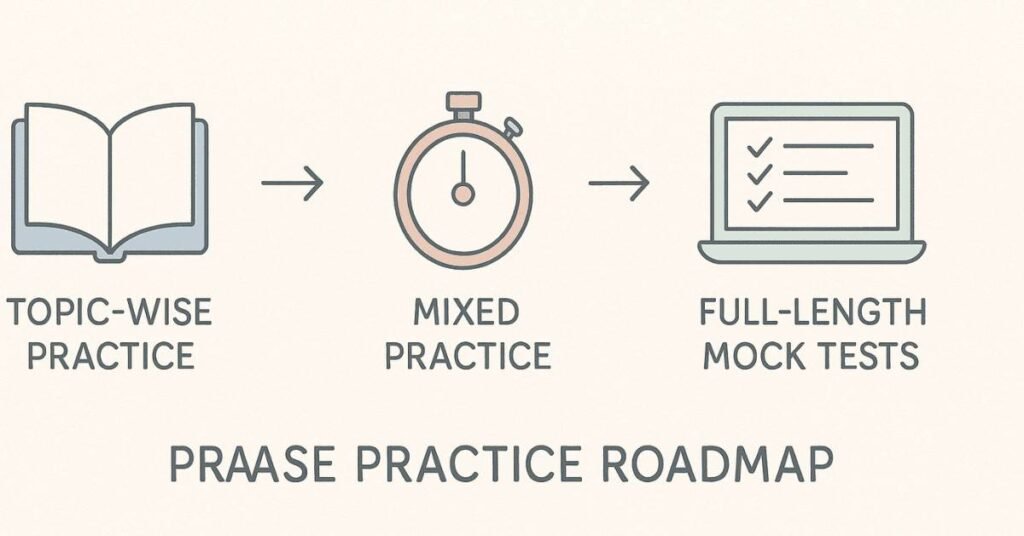
The Three Practice Phases
Phase 1: Topic-Wise Practice (Weeks 1-4)
- Master individual concepts through targeted questions
- Build confidence in weak areas
- Time limit: Relaxed (accuracy over speed)
- Goal: 90%+ accuracy per topic
Phase 2: Mixed Practice (Weeks 5-6)
- Combine multiple topics in one session
- Begin time-conscious solving
- Time limit: Moderate (getting stricter)
- Goal: 70-80% accuracy with time management
Phase 3: Full-Length Mock Tests (Weeks 7-8)
- Complete 90-120 minute simulated exams
- Real exam conditions (no interruptions)
- Time limit: Strict (exam-realistic)
- Goal: 60%+ overall accuracy with all sections
Practice Frequency and Volume
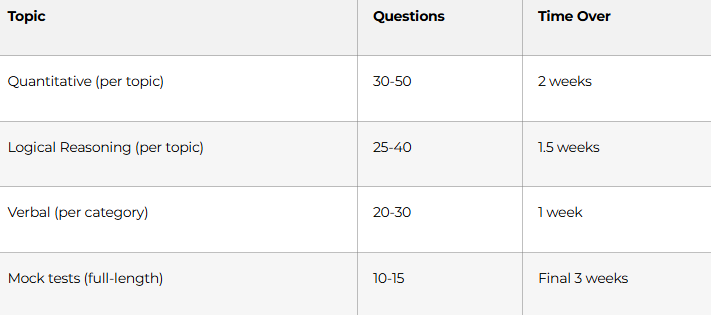
Total Practice Volume: 400-500 questions across 8 weeks
Enhance skill development with structured learning paths →
Section 2: Topic-Wise Practice Structure
Quantitative Aptitude: Question Bank Organization
Module 1 Foundation Topics (Days 1-14):
- Number systems: 40 questions (mix of HCF, LCM, divisibility)
- Percentages: 45 questions (increase, decrease, applications)
- Ratios and proportions: 35 questions
- Simple and Compound Interest: 40 questions
- Profit and Loss: 40 questions
- Time, Speed, Distance: 40 questions
- Work and Time: 35 questions
Practice Approach for Each Topic:
Day 1: Learn concept (45 min) → Attempt 10 easy questions (20 min) → Review answers (10 min)
Day 2: Review concept (10 min) → Attempt 15 medium questions (40 min) → Analyze errors (10 min)
Day 3: Solve 20 mixed difficulty questions (50 min) → Identify weak areas (10 min)
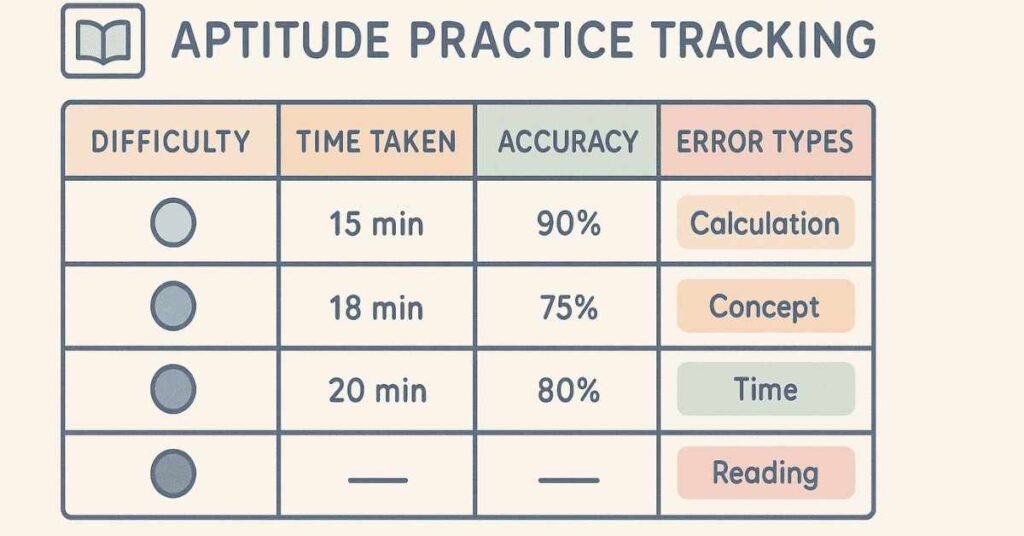
Tracking Sheet Template:
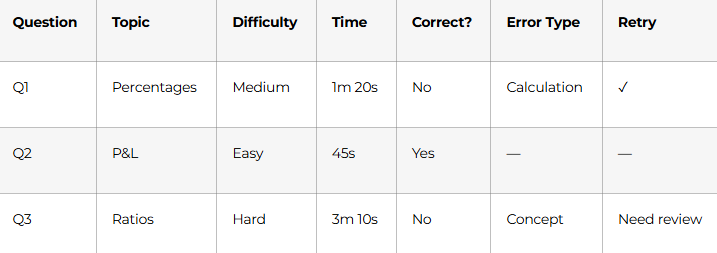
Error Type Classification:
- Calculation: Right method, arithmetic mistake
- Concept: Didn’t understand the principle
- Strategy: Right concept, wrong approach
- Time: Understood but ran out of time
- Reading: Misread the question
Section 3: Logical Reasoning Practice Blueprint
Organized by Difficulty and Speed
Speed-Based Categories:
Lightning Round (30-45 seconds per question):
- Simple series and sequences
- Direct analogies
- Basic coding-decoding
- Easy classification
Questions: 50 in first week
Expected accuracy: 85%+
Time goal: Hit 40% of questions in 20 minutes
Standard Round (1-1.5 minutes per question):
- Complex series with multiple patterns
- Syllogisms requiring logic mapping
- Blood relations with 2-3 family members
- Medium difficulty coding
Questions: 60 across two weeks
Expected accuracy: 70-75%
Time goal: Complete 40 questions in 60 minutes
Challenge Round (2-3 minutes per question):
- Difficult syllogisms with negations
- Complex family tree problems (4+ people)
- Advanced coding patterns
- Classification with non-obvious groupings
Questions: 40 across two weeks
Expected accuracy: 55-65%
Time goal: Attempt at least 20 questions in 60 minutes
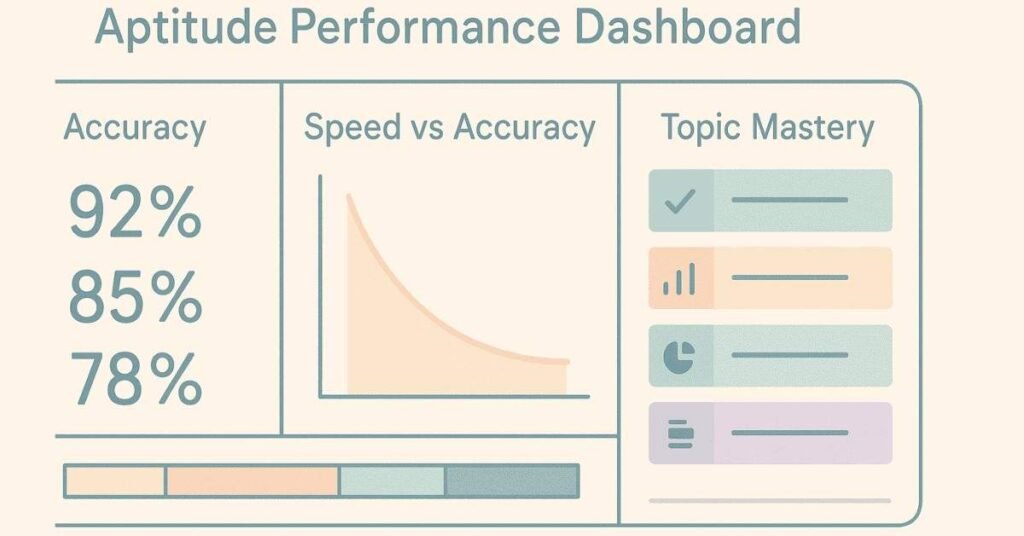
Section 4: Performance Tracking Dashboard
Key Metrics to Monitor
Metric 1: Accuracy by Topic
Track this weekly:
text
Week 1 Accuracy:
Percentages: 82%
P&L: 75%
Ratios: 88%
Compound Interest: 68% ← Weak area, needs focus
Rule: If topic accuracy drops below 70%, dedicate extra practice to that topic before moving forward.
Metric 2: Speed vs. Accuracy Trade-off
Create a simple tracker:
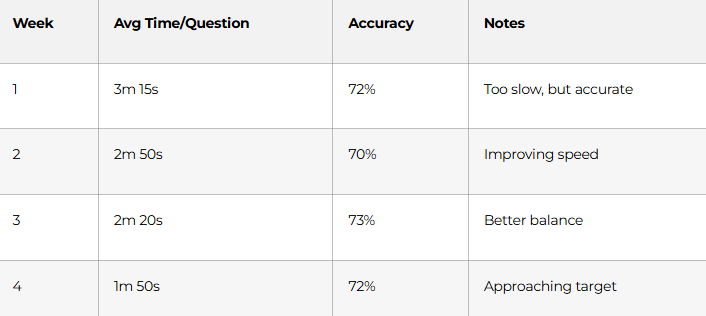
Goal: By week 8, aim for 1m 30s-2m per question with 75%+ accuracy
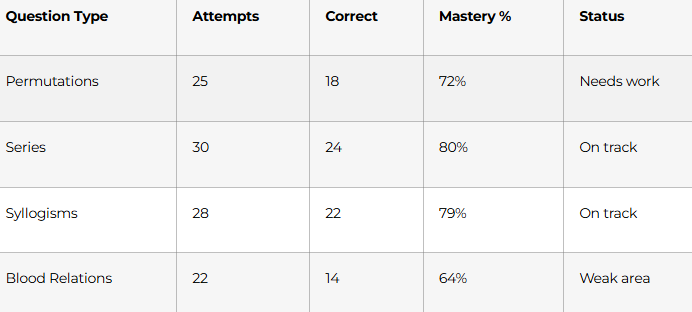
Metric 3: Question Type Mastery
For each question type, track:
- Attempts: How many questions of this type you’ve attempted
- Correct: How many you got right
- Mastery %: (Correct/Attempts) × 100
Example:
Metric 4: Weekly Progress Score
Calculate a composite score combining accuracy and speed:
Progress Score = (Accuracy % × 0.6) + (Speed Improvement × 0.4)
This prevents you from optimizing only for accuracy (slow solving) or only for speed (careless mistakes).
Explore more preparation-focused insights to improve accuracy and speed →
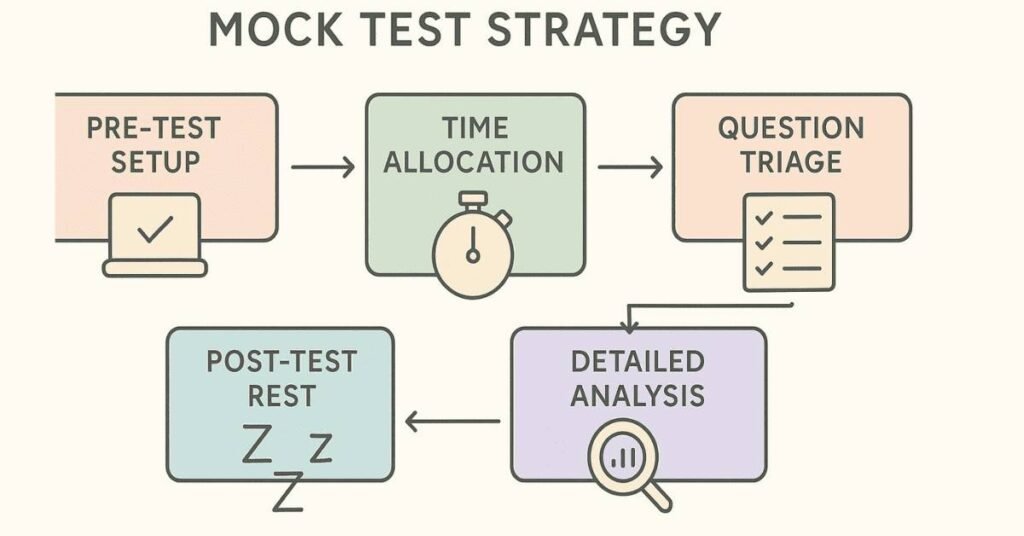
Section 5: Mock Test Strategy and Scheduling
Mock Test Selection Criteria
Choose mock tests that:
- Use actual placement exam format (60-70 questions in 90-120 minutes)
- Include questions from current year (2024-2025)
- Align with your target companies (TCS, Infosys, Wipro patterns differ)
- Provide detailed solutions and video explanations
Recommended Mock Test Sources:
- Platform question banks (IndiaBix, TestBook, SmartKeeda)
- Company-specific previous year papers
- Coaching center compilations
- Online practice portals subscription
Full-Length Mock Test Schedule
Week 7:
- Mock 1 (Baseline): Saturday morning, exam-like conditions
- Analysis: Sunday evening, identify weak sections
- Focused practice: Monday-Friday on identified gaps
Week 8:
- Mock 2 (Mid-prep): Wednesday morning
- Quick analysis: Thursday
- Mock 3 (Final): Saturday morning
- Analysis: Sunday (reflection only, not new learning)
Before Each Mock Test:
- Environment Setup (30 min before)
- Quiet room, no interruptions
- Mobile off, completely
- Water bottle ready
- Pen, scratch paper organized
- Quiet room, no interruptions
- Mental Preparation (10 min)
- Review time allocation strategy
- Remind yourself of tier-wise question prioritization
- Take 3 deep breaths
- Review time allocation strategy
- During Mock
- Follow exam strategy exactly (don’t experiment)
- Track time mentally
- Mark uncertain answers for review
- Follow exam strategy exactly (don’t experiment)
- Immediately After
- REST (30 min minimum)
- Don’t start analysis immediately
- Let your mind decompress
- REST (30 min minimum)
Access complete learning resources designed for exam-ready performance →
Section 6: Analyzing Mock Test Performance
Post-Mock Analysis Framework (1-2 hours, done within 24 hours)
Step 1: Score Breakdown (15 minutes)
text
Total Score: 65/100 (65%)
Quantitative: 18/25 (72%)
– Got right: Basic arithmetic, simple P&L
– Got wrong: Complex series (2), data interpretation (4), probability (1)
Logical Reasoning: 20/25 (80%)
– Got right: Coding, series, analogies
– Got wrong: Complex syllogisms (3), blood relations (2)
Verbal: 12/20 (60%)
– Got right: Direct vocabulary, simple RC
– Got wrong: Context-based vocabulary (4), inference questions (4)
Step 2: Error Categorization (20 minutes)
For each wrong answer, classify:
- Conceptual gap
- Time management (didn’t attempt)
- Careless mistake
- Strategy error
Example Analysis:
Question 43 (Permutations): Got wrong
- Category: Conceptual gap
- Root cause: Misunderstood “identical objects” formula
- Action: Review Module 2, Section 1 (permutations with identical objects)
- Practice: Solve 10 similar problems
Question 62 (Syllogism): Got wrong
- Category: Strategy error
- Root cause: Didn’t draw Venn diagram (relied on intuition)
- Action: Reinforce always drawing diagrams
- Practice: Solve next 5 syllogisms while forced to draw diagrams
Section 7: Focused Remedial Practice
After identifying weak areas, don’t just re-attempt randomly. Follow this structured approach:
For Conceptual Gaps:
- Re-learn (10-15 min): Read the relevant section in this guide
- Understand (5-10 min): Work through an example slowly
- Practice (20-30 min): Solve 8-10 similar problems
- Verify (5 min): Check all solutions carefully
For Careless Mistakes:
- Analyze (5 min): Why did you make the error? (Rushed? Misread?)
- Slow solve (15-20 min): Solve 5 similar questions slowly, deliberately
- Verify (5 min): Recalculate each answer
- Speed practice (15 min): Solve next 5 questions with gradually increasing speed
For Time Management Issues:
- Identify (5 min): Which question types consume disproportionate time?
- Shortcut practice (20 min): Learn and practice shortcuts for those types
- Timed sessions (20 min): Solve those question types under strict time
- Integration (10 min): Attempt mix of types with new time targets
Section 8: Week-by-Week Practice Timeline
Complete 8-Week Practice Schedule
Week 1: Foundation Building
- Days 1-3: Number systems and simplifications (50 questions)
- Days 4-5: Percentages (45 questions)
- Days 6-7: Coding and series in logical reasoning (50 questions)
- Accuracy target: 75%+
- Speed target: Relaxed (focus on concept)
Week 2: Expanding Topics
- Days 1-3: Ratios, P&L, Interest (50 questions mixed)
- Days 4-5: Time-speed-distance (40 questions)
- Days 6-7: Syllogisms and blood relations (50 questions)
- Accuracy target: 72%+
- Speed target: 2.5-3 min per question
Week 3: Advanced Concepts
- Days 1-3: Permutations, combinations, probability (60 questions)
- Days 4-5: Progressions and series (40 questions)
- Days 6-7: Analogies and classification (45 questions)
- Accuracy target: 70%+
- Speed target: 2-2.5 min per question
Week 4: Mixed and Difficult
- Days 1-3: Hard questions from all quantitative topics (50)
- Days 4-5: Complex logical reasoning (60 questions)
- Days 6-7: Data interpretation sets (40 questions)
- Accuracy target: 65-70%
- Speed target: 1.5-2 min per question
Week 5: Sectional Competency
- Days 1-2: Full quantitative section timed (90 min, 25 questions)
- Days 3-4: Full logical reasoning section timed (45 min, 25 questions)
- Days 5-6: Full verbal section timed (30 min, 20 questions)
- Days 7: Review and identify weak questions
- Accuracy target: 60-70% per section
Week 6: Speed Integration
- Days 1-3: Topic-wise speed practice (2 min per question target)
- Days 4-5: Mixed sections under time (1.5-2 min per question)
- Days 6-7: Full-length practice test (Mock 1)
- Accuracy target: 65%+
- Speed target: Complete at least 70% of questions
Week 7: Mock Test Analysis and Refinement
- Day 1: Post-Mock 1 detailed analysis (2-3 hours)
- Days 2-4: Remedial practice on weak areas
- Days 5-6: Full-length practice test (Mock 2)
- Day 7: Quick analysis and mental prep
- Accuracy target: 68%+
Week 8: Final Preparation
- Days 1-3: Targeted practice on persistent weak areas
- Days 4-5: Full-length practice test (Mock 3)
- Days 6-7: Light review of formulas, mental preparation
- Accuracy target: 70%+
- Speed target: Complete 85%+ of questions
Section 9: Video Explanation Integration
Effective Use of Video Solutions
When to Watch:
- After attempting and failing a question
- When you’re stuck on a concept despite re-reading notes
- To learn alternative approaches to problems
When NOT to Watch:
- Before attempting a question (defeats practice purpose)
- As a substitute for deliberate thinking
- Just to “see the answer” without understanding
Video Viewing Strategy:
- Pause and Try (50% of video time): Watch half the solution, pause, try completing it yourself
- Compare Approach (20% of video time): Check if your method matches theirs
- Learn Alternative (20% of video time): See if they use a faster approach
- After attempting and failing a question
Section 10: Building Question Banks and Reference Materials
Creating Your Personal Question Bank
As you practice, maintain a document:
Question Bank Template:
text
DIFFICULT QUESTIONS FOR REVISION
=========================================
Q1: [Question text]
Topic: Permutations
Difficulty: Hard
Your approach: [What you tried]
Correct approach: [What should be done]
Key learning: [What you learned]
Revision date: [When to revisit]
Q2: [Question text]
…
Revisit Schedule:
- Day 1: After getting it wrong
- Day 3: Before attempting new questions
- Day 7: Weekly review
- Day 1: After getting it wrong