
What Does a Management Consultant Do?
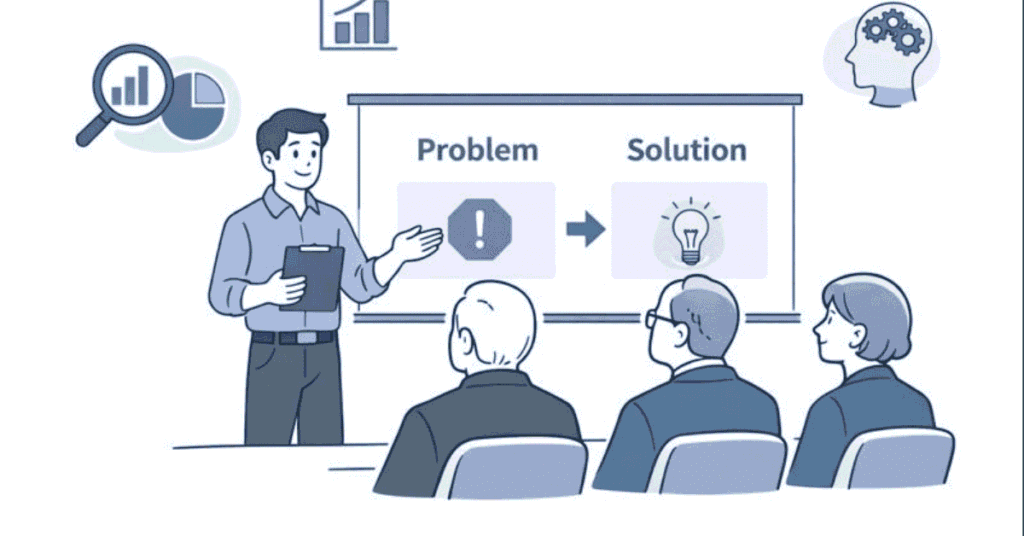
Table of Contents
Management consultants help companies solve business problems they are not able to solve easily on their own. They analyse what is going wrong, find patterns in data, talk to people inside the company, and then suggest practical solutions that can improve profits, reduce costs, or make operations smoother.
In simple words, a management consultant is like a problem-solver for businesses. Instead of working for one company, you get to work with many companies across different industries over time, helping them make better decisions and run more efficiently.
This guide explains the day-to-day work, typical responsibilities, skills used, and what life actually looks like in this role so students and early professionals can decide whether this career fits them.
Core Responsibilities of a Management Consultant
While every project is different, most management consultants spend their time on a few core activities.
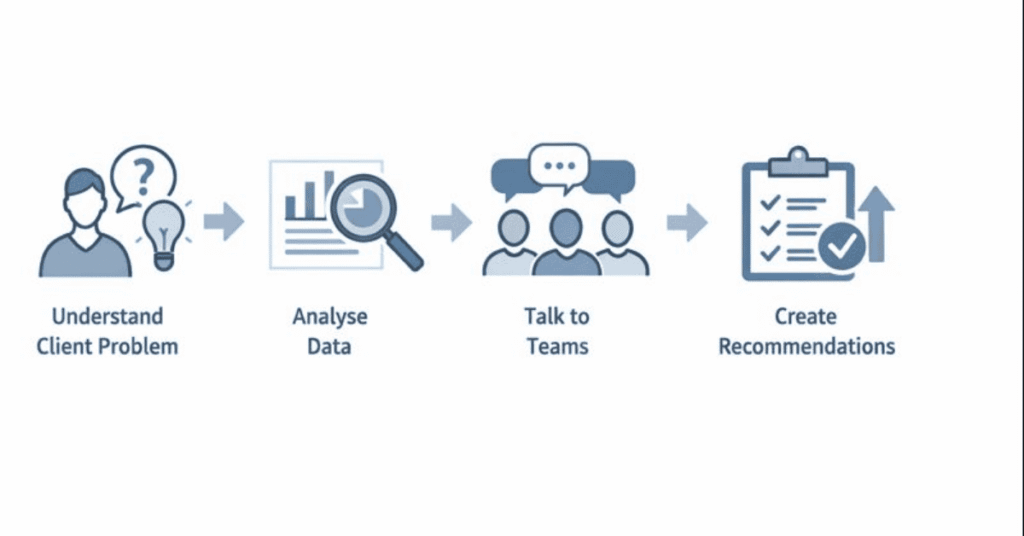
1. Understanding the Client’s Problem
The first step in any project is understanding what the client actually needs help with. Many times, what they say is the problem is only a symptom, not the real issue.
Typical activities include:
- Attending kick-off meetings with client leaders to understand goals and context
- Asking clarifying questions about business performance, history, and constraints
- Reviewing existing documents: reports, financial statements, process maps, org charts
For example, a client may say, “Our profits are falling.” As a consultant, you’ll need to find out if this is because of higher costs, lower sales, poor pricing, or external factors like new competitors.
2. Doing Research and Data Analysis
Once the problem is clear, consultants dig into data and research to find out what is actually happening.
This usually involves:
- Collecting internal data: sales numbers, cost details, operational metrics
- Studying external data: industry reports, competitor information, market trends
- Cleaning data in Excel or similar tools so it can be analysed properly
- Running basic analyses like growth rates, margins, segment-wise performance
You don’t need advanced statistics for most roles, but you do need comfort with numbers and the ability to spot trends. For example, you might discover that 80% of profits come from only 20% of products, or that one region is dragging down overall performance.
3. Talking to People and Understanding Ground Reality
Consulting is not just a “laptop job.” You often speak to people across the client’s organization—from senior managers to frontline staff—to understand how things really work.
You might:
- Interview sales teams to understand customer complaints
- Talk to operations staff to see where processes slow down
- Sit in on meetings or listen to customer calls to observe behaviour
These conversations give you insights that pure numbers cannot. For example, data may show delayed deliveries, but speaking to warehouse staff might reveal that outdated systems or unclear responsibilities are causing the delays.
4. Solving the Problem with Structured Thinking
After gathering data and insights, consultants use structured thinking to solve the problem. This means breaking the big question into smaller logical parts and working through them step-by-step.
For example, if the question is, “How can we increase profits by 20%?”, you might break it into:
- Can we increase revenue? (New customers, better pricing, higher share of wallet)
- Can we reduce costs? (Fixed costs, variable costs, waste, process inefficiencies)
You then explore each area with data and discussions until you find the most impactful and realistic levers.
5. Creating Recommendations and Presentations
Once you have a clear understanding of what is going wrong and what can be improved, you convert your findings into simple, action-oriented recommendations.
This includes:
- Building slides in tools like PowerPoint to tell a clear story
- Summarizing complex analysis into easy-to-understand charts and bullet points
- Prioritizing recommendations based on impact and feasibility
A good recommendation is not just “cut costs” but something like:
“Reduce logistics costs by 12–15% by redesigning the distribution network, renegotiating contracts with two high-cost vendors, and consolidating low-volume routes.”
6. Working with the Client to Implement Changes
In many projects, consultants don’t stop at giving advice. They also help the client put changes into action.
You might:
- Run workshops to explain new processes to client teams
- Help design new dashboards or KPIs to track performance
- Support pilot runs (for example, testing a new process in one city before national rollout)
- Monitor early results and refine the approach
This is where you see the real impact of your work: improved numbers, faster processes, happier customers, or better decision-making inside the client company.
Types of Projects Management Consultants Work On
Management consulting covers many types of problems. Here are some common examples that students can easily understand.
Profit Improvement Projects
Problem: “Our profits are shrinking even though revenue is stable.”
Consultant’s work:
- Analyse revenue and cost breakdown
- Identify loss-making products, segments, or regions
- Recommend actions like price changes, cost cuts, process improvements
Operations and Process Improvement
Problem: “Our turnaround time is too slow; customers are unhappy.”
Consultant’s work:
- Map the end-to-end process
- Identify bottlenecks and unnecessary steps
- Suggest ways to streamline workflows, use technology, or reduce handovers
Market Entry or Expansion
Problem: “We want to enter a new city or country but don’t know how.”
Consultant’s work:
- Study market size, competition, customer behaviour
- Evaluate different entry options (build, partner, acquire)
- Recommend go-to-market strategy, pricing, channels, and timelines
Organization and Change Management
Problem: “Our structure is confusing; roles overlap and decisions are slow.”
Consultant’s work:
- Analyse current org structure, reporting lines, and decision rights
- Propose a new structure with clearer roles and responsibilities
- Help manage communication and change so employees adapt smoothly
These examples show how varied consulting work can be, even within “management consulting” alone.
Skills Used Daily by Management Consultants
To understand what the job really feels like, it helps to see what skills you use almost every day.
Analytical Skills (Working with Numbers and Logic)
- Breaking big questions into smaller pieces
- Doing quick math, estimates, and “back-of-the-envelope” calculations
- Checking whether results make sense logically
For example, if you calculate that a small city has a potential market size larger than the entire country, you know something is off and needs re-checking.
Communication Skills (Speaking and Writing Clearly)
- Explaining complex ideas simply to non-technical audiences
- Writing clear emails, summaries, and slide headlines
- Presenting confidently in meetings, even as a junior
Consultants learn to “speak in headlines,” meaning they share the main message first and then explain supporting details.
Teamwork and Collaboration
Consultants almost never work alone. You will:
- Coordinate daily with your project team
- Share updates, ask for help, and give feedback
- Adjust your work when priorities change
Good team players are valued highly because consulting is intensive and teams rely heavily on each other to meet deadlines.
Time Management and Prioritization
There is always more work that could be done. The challenge is deciding:
- What is most critical for the client right now
- What can be good enough vs what needs perfect accuracy
- How to manage multiple tasks and meetings in the same day
Being organised, using to-do lists, and planning ahead become survival skills.

Day-in-the-Life: Example Scenarios
To make it more real, here are two sample days for a junior management consultant.
Example: Operations Improvement Project (Client-Site)
- 9:30 am: Daily team huddle at client office; decide who will interview warehouse staff, who will work on inventory data
- 10:00 am – 1:00 pm: You sit with warehouse supervisors, ask how they track stock, observe how goods move in and out
- 1:00 pm – 2:00 pm: Lunch with your team; you discuss interesting observations
- 2:00 pm – 5:30 pm: Back to your laptop—cleaning and analysing yesterday’s data to see where delays are happening most
- 5:30 pm – 7:30 pm: You build slides showing bottlenecks and potential 10–15% time savings from process changes
- 7:30 pm: Quick alignment with your manager on what to share with the client tomorrow
Example: Strategy/Market Entry Project (Office/Hybrid)
- 10:00 am: Internal call to refine the market sizing model you created
- 11:00 am – 1:00 pm: Secondary research: reading industry reports, competitor websites, and analyst articles
- 1:00 pm – 2:00 pm: Lunch and short break
- 2:00 pm – 4:00 pm: You estimate potential customers in different segments and build a simple Excel model
- 4:00 pm – 5:30 pm: You convert your analysis into charts and prepare a short “storyline” slide
- 5:30 pm – 7:00 pm: Feedback session with your manager; adjust assumptions and tighten your message
Not every day is this packed, and intensity varies by project phase, but this gives a realistic flavour of the work.
What Makes Someone a Good Fit for Management Consulting?
You do not need to be a topper or a genius to succeed in consulting. However, certain traits make the journey smoother:
- You enjoy solving problems and asking “why” repeatedly
- You are comfortable with numbers and data, even if you’re not from a hardcore maths background
- You like working in teams and don’t mind discussing ideas openly
- You are okay with some level of pressure and deadlines
- You are curious about how businesses work in the real world
If these describe you, consulting can be a strong match and a powerful launchpad for your career.
How This Role Evolves Over Time
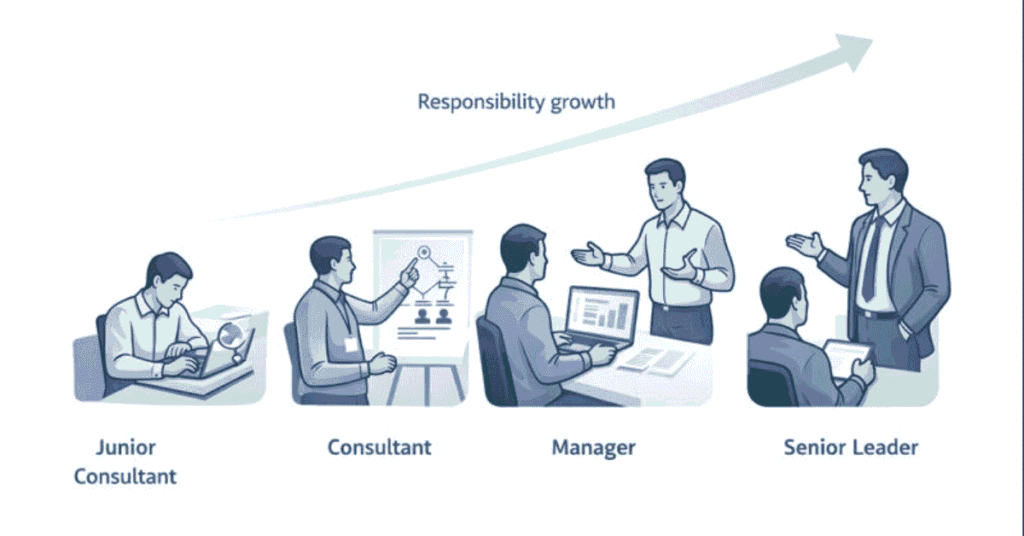
As a fresher, most of your time will go into research, data work, and creating slides. Over time:
- You start owning full parts of the problem
- You speak more in client meetings
- You guide junior team members
- You eventually manage full projects and client relationships
So while you may start by supporting others, you gradually become the person driving the solution.