
Strategy Consulting vs Management Consulting: Which Path Suits You?

Table of Contents
Many students and young professionals hear both terms—strategy consulting and management consulting—but aren’t fully sure what actually differs between them. On paper, both are “consulting jobs,” but in reality the work, pace, project style, and even the type of people who enjoy each path can be quite different.
This guide breaks down the differences in work type, clients, skills, lifestyle, salary, and long-term opportunities in simple language. By the end, you’ll have a much clearer idea of which path fits your strengths and career goals.
Simple Definitions
What is Strategy Consulting?
Strategy consulting focuses on the big picture questions of a business.
These are high-level decisions that affect the future direction of the company.
Examples of questions strategy consultants work on:
- Should the company enter a new country or market segment?
- Should we launch a new product or shut down an existing line?
- Should we acquire a competitor or partner with them?
- How can we grow faster than the market over the next 5 years?
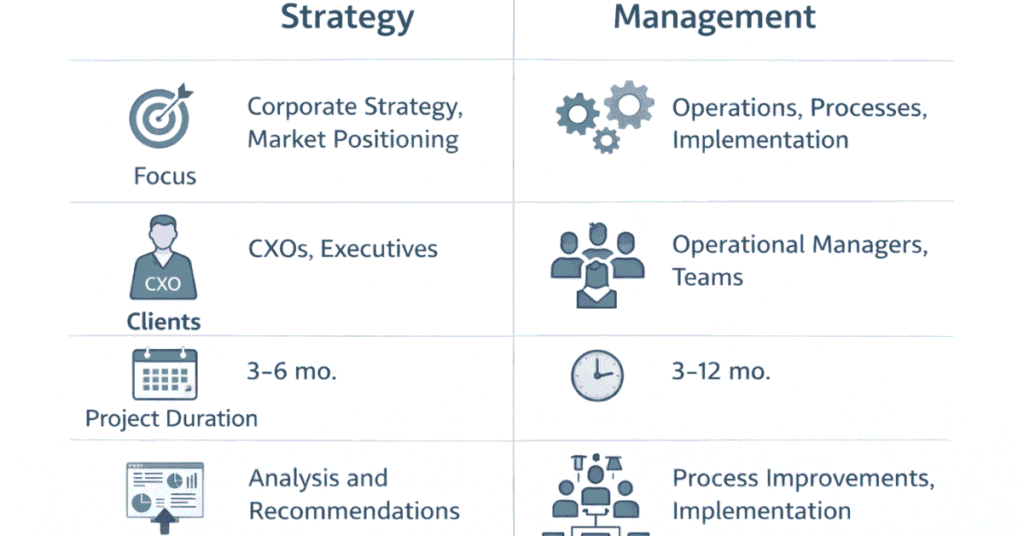
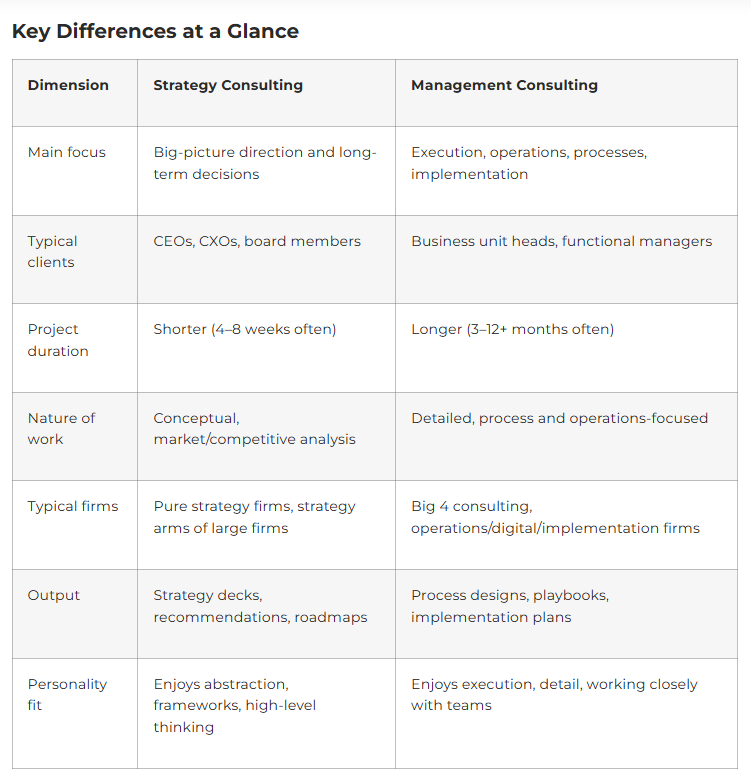
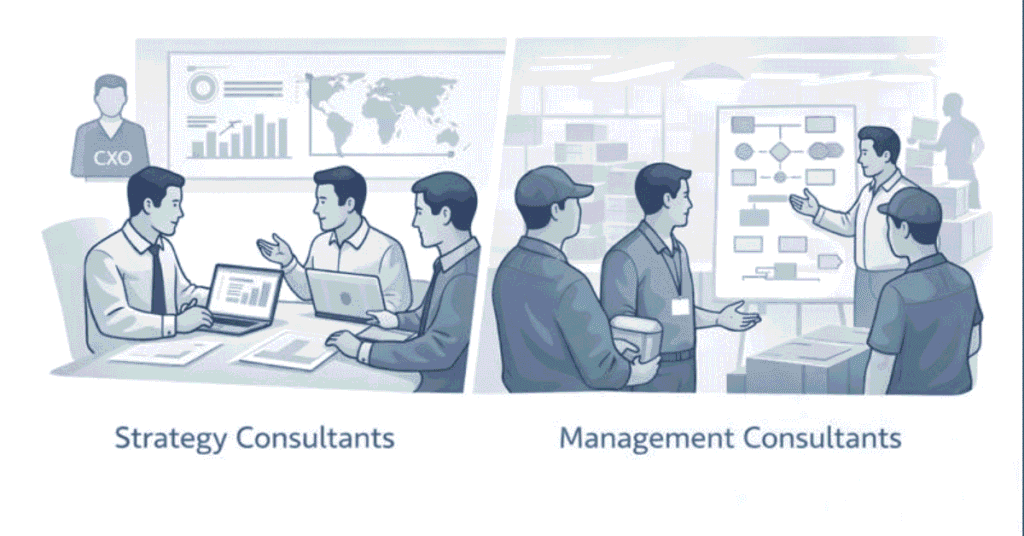
You usually work closely with CXOs (CEO, CFO, CMO, etc.) and board-level leaders. The work is more conceptual and revolves around market analysis, competitive positioning, and long-term strategy.
What is Management Consulting?
Management consulting focuses on how to run the business better in day-to-day operations.
These projects are about making the strategy real.
Examples of questions management consultants work on:
- How can we reduce operating costs by 10–20%?
- How can we improve on-time delivery from 85% to 98%?
- How do we reorganize teams so decisions are faster and roles are clear?
- How can we implement a new system or process across all branches?
You work more with mid-level and senior managers across operations, HR, finance, IT, and other functions. The work is more hands-on and focused on execution and efficiency.
You can think of it like this:
- Strategy consulting = deciding where to go.
- Management consulting = figuring out how to get there.
Types of Problems: Concrete Examples
Strategy Consulting: Sample Projects
- Market Entry Strategy
A consumer electronics company wants to enter the Indian market.
Strategy consultants might:- Estimate market size and growth potential.
- Analyse competitors and their positioning.
- Identify target customer segments.
- Recommend pricing, channels (online/offline), and entry mode (own stores, distributors, partnerships).
- Corporate Growth Strategy
A large conglomerate wants to double revenue in 5 years.
Strategy consultants might:- Identify promising business areas to expand into.
- Evaluate whether to grow organically or through acquisitions.
- Prioritize markets and products with the highest potential.
In these projects, you spend a lot of time with market data, industry reports, financial models, and high-level scenarios.
Management Consulting: Sample Projects
- Cost Reduction / Efficiency Improvement
A manufacturing company’s costs are rising and margins are shrinking.
Management consultants might:- Map the end-to-end production process.
- Identify waste, delays, or duplicated efforts.
- Redesign workflows, roles, and performance metrics.
- Sales and Service Process Improvement
A bank wants faster loan approvals and better customer experience.
Management consultants might:- Observe current loan approval steps across branches.
- Simplify forms, remove unnecessary approvals, or digitize parts of the process.
- Train staff on new workflows and monitor early results.
Here, you spend more time on the ground with client teams, understanding real operations and making practical changes.
Who You Work With
Strategy Consulting
You are more likely to:
- Present directly to the CEO and top leadership.
- Work on “board-level” topics and confidential strategic moves.
- Deal with fewer but more senior stakeholders.
Because of this, your communication needs to be:
- Very concise.
- Very structured.
- Backed by strong logic and data.
Management Consulting
You typically:
- Work with a broader range of people—managers, supervisors, frontline staff.
- Spend time in factories, branches, warehouses, call centres, or client offices.
- Coordinate with multiple teams to make changes actually happen.
Here, your success depends on:
- Relating well to people at different levels.
- Explaining recommendations in doable, practical terms.
- Getting buy-in so people are willing to change how they work.
Project Duration and Work Style
Strategy Projects
- Shorter duration (often 4–8 weeks, sometimes a bit longer).
- Very intense analysis and frequent leadership check-ins.
- A lot of focus on “answering the big question” clearly and fast.
This style suits people who:
- Like working in sprints.
- Enjoy thinking from 30,000-feet view.
- Don’t mind working under high intellectual pressure, especially before big presentations.
Management Projects
- Longer engagements (often 3–12 months or more).
- Work moves through phases: Diagnose → Design → Pilot → Implement.
- Rhythm can be intense during design/launch phases, more stable during implementation.
This style suits people who:
- Enjoy seeing real-world change and measurable results.
- Prefer building relationships with client teams over time.
- Like improving systems, not just designing them on paper.
Skills Emphasized in Each Path
Strategy Consulting: Skill Focus
- High-level problem solving: Breaking ambiguous questions into structured parts.
- Market and competitive analysis: Understanding industry dynamics, competitor moves, and macro trends.
- Financial modelling: Building and interpreting models to evaluate scenarios, investments, or acquisitions.
- Storytelling: Turning complex analysis into a simple, powerful narrative for senior leaders.
Management Consulting: Skill Focus
- Process thinking: Understanding how work flows in real organizations.
- Operational detail: Working with real constraints—people, systems, timelines.
- Change management: Helping people adopt new ways of working.
- Stakeholder management: Coordinating with many teams, handling resistance, and aligning interests.
In both paths, you still need:
- Strong communication.
- Comfort with data and Excel.
- Teamwork and resilience.
But the flavour of your skills and where you use them most changes.
Lifestyle and Work Intensity
Strategy Consulting Lifestyle
- Often more travel (depending on firm and region).
- High-pressure, shorter projects with sharp deadlines.
- You may be “on” constantly for key presentations and decisions.
People who enjoy this often:
- Like intensity and variety.
- Are energized by tough intellectual challenges.
- Don’t mind sacrificing some stability for high-impact work.
Management Consulting Lifestyle
- Travel depends on project type; operations-heavy roles can involve frequent client-site work.
- Hours can be long during roll-outs, but some projects have more predictable patterns.
- You spend a lot of time with client teams, which can be rewarding but also politically complex.
People who enjoy this often:
- Like building long-term relationships.
- Feel satisfied seeing changes actually working in reality.
- Prefer combining analysis with on-ground action.
Salaries and Growth (High-Level View)
While exact numbers vary by firm and city, the broad pattern is:
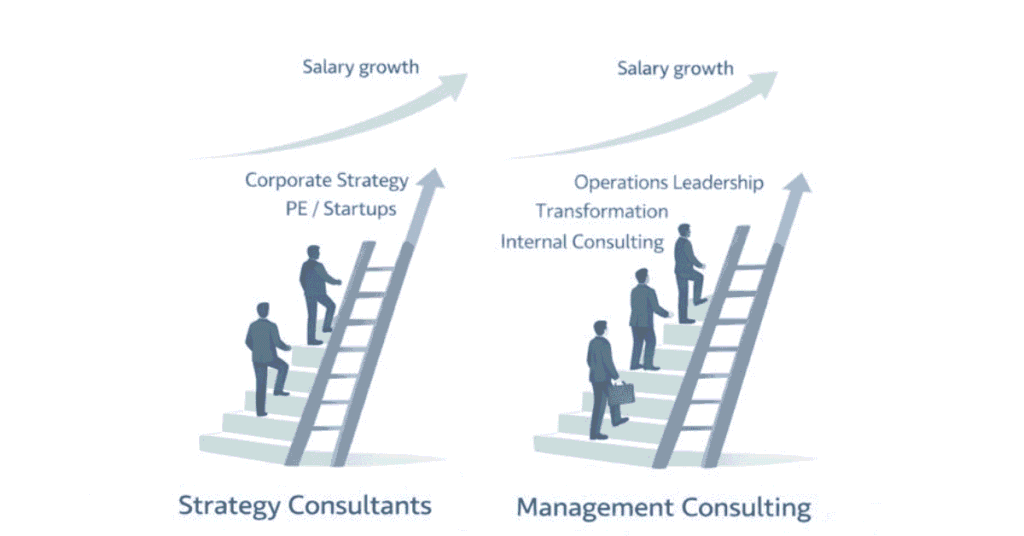
- Strategy roles at top global firms often pay more at entry and mid-level than many management consulting roles.
- However, Big 4 and strong implementation firms can offer competitive packages and steady growth.
- In both paths, pay increases significantly as you move from Analyst → Consultant → Manager → Partner level.
If salary is a major deciding factor, the bigger difference usually comes from:
- The firm tier (global strategy firm vs mid-tier vs boutique), not just “strategy vs management” label.
- The practice area (digital/analytics/financial advisory vs general operations).
For most students, it’s smarter to ask, “Which firm + role combination fits me?” instead of only “Which type pays more?”
Exit Opportunities: Where Can Each Path Take You?
After Strategy Consulting
Common exits:
- Corporate strategy roles in large companies.
- Product management or leadership roles in tech/startups.
- Private equity, venture capital, or investing (for some profiles).
- Entrepreneurship or co-founding startups.
Your skill set is seen as very strong for high-level decision-making and “thinking like an owner.”
After Management Consulting
Common exits:
- Operations/Transformation roles in corporates (Head of Operations, Business Excellence, etc.).
- Program management or delivery leadership roles in tech and services.
- Internal consulting roles in big companies.
- Operational or growth leadership in startups and scale-ups.
Your skill set is valued for getting things done, improving systems, and running complex initiatives.
Both paths open excellent doors. The difference is mainly in where you want to add value: through direction-setting or through execution and transformation.
How to Decide Which Path is Right for You
Ask yourself a few practical questions:
- What kind of problems excite me more?
- “Where should this company go in the next 3–5 years?” → Strategy
- “How can this company run better and faster?” → Management
- What do I enjoy more: ideas or implementation?
- Enjoy abstract thinking, frameworks, market scans? → Strategy
- Enjoy fixing processes, working with real systems and people? → Management
- What type of people do I like working with?
- Senior leaders discussing vision and direction? → Strategy
- Cross-functional teams rolling up their sleeves and making changes? → Management
- How do I handle intensity vs stability?
- Okay with extreme sprints and high-pressure timelines? → Strategy may suit you.
- Prefer longer-term work where you go deeper into one client or problem? → Management may fit better.
Remember, many careers are not pure one or the other. Some roles mix both strategy and implementation over time. Also, switching between them—especially early in your career—is possible if you build strong foundations.
Final Thoughts
Both strategy consulting and management consulting can be powerful launchpads for your career. One isn’t “better” than the other in an absolute sense—they simply suit different personalities, strengths, and preferences.
If you love high-level thinking, big-picture questions, and fast-paced, intellectually intense work, strategy consulting might be your ideal path. If you enjoy making systems work better, collaborating with teams, and seeing tangible change on the ground, management consulting could be a better fit.