
Nursing Career Path – Complete Guide for Indian Freshers
Table of Contents
Introduction: Your Future in White – Why Nursing Calls You
Picture this: You walk into a hospital at 7 AM. The emergency department buzzes with activity. A patient arrives with chest pain. Within seconds, you’re part of a coordinated team—checking vitals, administering medications, communicating with doctors, and most importantly, calming a frightened family. By the end of your shift, that patient is stable, smiling, and thanking you. That’s nursing. Not just a job, but a calling where you make a tangible difference every single day.
If you’re reading this, you’re probably considering nursing as a career. Maybe you’re confused about ANM versus GNM versus BSc Nursing. Perhaps you’re wondering if the salary is worth the effort. Or you’re curious whether nursing offers long-term growth. Here’s the truth: nursing is one of the most stable, rewarding, and growth-oriented careers you can choose in India today.
India’s healthcare sector is experiencing explosive growth. Hospitals are expanding. New medical facilities open every month. The government’s push toward universal healthcare means consistent demand for skilled nurses. Unlike many professions where jobs disappear or salaries stagnate, nursing offers something rare: job security combined with purpose.
This guide walks you through everything—from choosing the right nursing qualification to landing your first job, progressing to senior roles, and even exploring international opportunities where Indian nurses earn 3-5 times more than in India. Whether you’re a 12th-pass student exploring options or someone considering a career change into healthcare, this is your complete roadmap.
Understanding Nursing Qualifications: ANM vs GNM vs BSc Nursing
ANM (Auxiliary Nursing and Midwifery): The Fast-Track Entry
Think of ANM as your quickest entry into the nursing profession. It’s a 2-year diploma program that gets you working faster than other options.
What You’ll Learn:
- Basic patient care and hygiene
- Maternal and child health (pregnancy, childbirth, newborn care)
- Primary healthcare services
- Basic medication administration
- Community health nursing
- Hospital infection control
Eligibility:
Here’s the beautiful part—ANM accepts students from ANY stream after 12th grade. Whether you studied science, commerce, or humanities, you can pursue ANM. Most programs require a minimum of 45-50% marks in 12th grade. Age typically should be between 17-35 years.
Duration: 2 years (includes classroom learning + practical training + internship)
Where ANM Nurses Work:
- Government primary health centers (PHCs)
- Rural healthcare facilities
- Community health programs
- Maternity homes and birthing centers
- Private clinics
- NGOs working in healthcare
- Home healthcare services
Salary Reality:
Let’s talk numbers honestly. Fresh ANM graduates typically start at ₹15,000-25,000 per month (₹1.8-3 LPA annually). This might sound modest, but remember—you’re starting work just 2 years after 12th grade while your friends are still studying for bachelor’s degrees.
With 3-5 years of experience, your salary grows to ₹25,000-35,000 per month (₹3-4.2 LPA). Government positions offer better stability and benefits, though private hospitals sometimes pay slightly more initially.
The Real Advantage:
ANM qualifications allow you to pursue BSc Nursing later through bridge courses. Many smart professionals do exactly this—get ANM, work for 2-3 years while earning, then upgrade to BSc Nursing. This approach lets you earn while learning and gain practical experience early.
Who Should Choose ANM:
- Students wanting quick entry into workforce
- Those needing to earn while continuing education later
- People interested in community health and maternal care
- Candidates unable to afford 4-year degree costs upfront
- Those specifically interested in government primary health center jobs
Why the IT Sector is Booming
India’s IT sector isn’t just thriving—it’s transforming. With a projected 8-10% annual growth rate, the sector continues to be one of the most recession-resistant career fields. But what makes IT so special?
The answer lies in digital transformation. Every business today—whether a startup in Hyderabad or an established company in Bangalore—needs technology to survive. Banks need cybersecurity experts. E-commerce platforms need full-stack developers. Healthcare companies need data scientists. This universal demand means opportunities are everywhere.
Think of IT as the backbone of modern India. From the apps you use daily to the systems powering government services, IT professionals are the architects behind these innovations.
What Exactly is an IT Career?
Here’s where many beginners get confused. “IT career” isn’t just one job—it’s an umbrella covering dozens of specializations. Whether you’re interested in building applications, protecting against cyber threats, analyzing massive datasets, or managing cloud infrastructure, there’s an IT role waiting for you.
An IT professional can be:
- A software developer creating the next mobile app
- A cybersecurity specialist protecting company data
- A data scientist uncovering business insights
- A cloud architect designing scalable systems
- A network engineer managing IT infrastructure
- A DevOps engineer ensuring smooth deployments
- An AI/ML researcher building intelligent systems
Each role is distinct, pays differently, requires different skills, and offers unique career progression paths.
GNM (General Nursing and Midwifery): The Balanced Path
GNM is essentially ANM’s older, more comprehensive sibling. It’s a 3-year diploma that covers everything ANM does, plus significantly more clinical depth.
What Makes GNM Different from ANM:
- More advanced nursing concepts and techniques
- Greater emphasis on hospital-based care
- Deeper understanding of medical conditions
- More extensive practical training in hospital settings
- Better preparation for critical care units
- Stronger foundation for career advancement
Eligibility:
Most GNM programs prefer students with science stream (Physics, Chemistry, Biology) in 12th grade, though some colleges accept other streams. You’ll need minimum 45-50% marks in 12th. Age range typically 17-35 years.
Duration: 3 years (includes theoretical classes + hospital rotations + internship)
Where GNM Nurses Work:
- Private and government hospitals
- ICU and critical care units (with additional ACLS certification)
- Emergency departments
- Surgical departments
- Pediatric wards
- Nursing homes
- Corporate hospitals
- Military and railway hospitals
Salary Reality:
GNM graduates start slightly higher than ANM—expect ₹20,000-30,000 per month initially (₹2.4-3.6 LPA). Within 3-5 years, experienced GNM nurses earn ₹30,000-45,000 per month (₹3.6-5.4 LPA).
Senior GNM nurses with 8-10 years of experience and specializations can reach ₹50,000-70,000 per month (₹6-8.4 LPA), especially in corporate hospitals or specialized units like ICU, operation theater, or cardiology.
Career Progression:
GNM opens doors to:
- ICU and critical care positions (higher pay)
- Operation theater nursing (specialized skill)
- Shift in-charge roles (supervisory position)
- Nursing coordinator positions
- Further studies: Post-Basic BSc Nursing (bridge program)
Who Should Choose GNM:
- Students with science background wanting comprehensive training
- Those targeting hospital nursing roles
- Candidates interested in critical care and specialized nursing
- People willing to invest one extra year for better opportunities
- Those planning to work in corporate hospitals
BSc Nursing (Bachelor of Science in Nursing): The Professional Degree
BSc Nursing is the gold standard in nursing education in India. It’s a full-fledged 4-year bachelor’s degree that positions you for leadership roles from day one.
What Sets BSc Nursing Apart:
- In-depth theoretical knowledge of nursing science
- Advanced clinical training across all hospital departments
- Leadership and management skills
- Research methodology and evidence-based practice
- Community health and public health nursing
- Psychology and patient counseling
- Hospital administration basics
- Teaching and training capabilities
Eligibility:
BSc Nursing requires science stream (Physics, Chemistry, Biology) in 12th grade with minimum 50% marks. In many states, NEET qualification is now mandatory for admission to government nursing colleges. Age typically 17-35 years.
Duration: 4 years (comprehensive theoretical and clinical training + 6-month internship)
Where BSc Nursing Graduates Work:
- All settings where ANM/GNM work, PLUS:
- Nursing management and administration
- Clinical research coordination
- Teaching and education (nursing colleges)
- Public health programs
- NGO leadership positions
- Healthcare consulting
- Corporate wellness programs
- International healthcare positions
Salary Reality:
BSc Nursing graduates command better starting salaries—typically ₹25,000-40,000 per month initially (₹3-4.8 LPA). This reflects the degree-level qualification and broader skill set.
Within 3-5 years, BSc Nurses earn ₹35,000-60,000 per month (₹4.2-7.2 LPA). With specializations and 5-8 years experience, salaries reach ₹50,000-80,000 per month (₹6-9.6 LPA).
Senior BSc Nursing professionals in supervisory or managerial roles (8-15 years experience) earn ₹60,000-1,00,000+ per month (₹7.2-12+ LPA). Nursing superintendents, directors, and heads of nursing departments often cross ₹15 LPA in premier hospitals.
Career Advancement:
BSc Nursing uniquely positions you for:
- MSc Nursing (specialization in medical-surgical, pediatric, psychiatric, community health nursing)
- Nursing administration and leadership roles
- Clinical instructor positions in nursing colleges
- Nurse practitioner roles (with additional certification)
- International migration (USA, UK, Canada, Australia, Gulf countries)
- PhD in Nursing (research and academic leadership)
- Healthcare administration (MBA Healthcare Management)
International Opportunities:
This is where BSc Nursing truly shines. Countries like USA, UK, Canada, Australia, and Gulf nations actively recruit Indian BSc Nursing graduates. With proper licensing exams (NCLEX for USA, NMC registration for UK), you can earn ₹25-50 LPA equivalent abroad—literally 3-5 times Indian salaries.
Who Should Choose BSc Nursing:
- Students with strong science background and academic interest
- Those targeting leadership and management roles
- Candidates planning international nursing careers
- People interested in teaching or research
- Those seeking maximum career flexibility and growth
- Candidates willing to invest 4 years for long-term returns
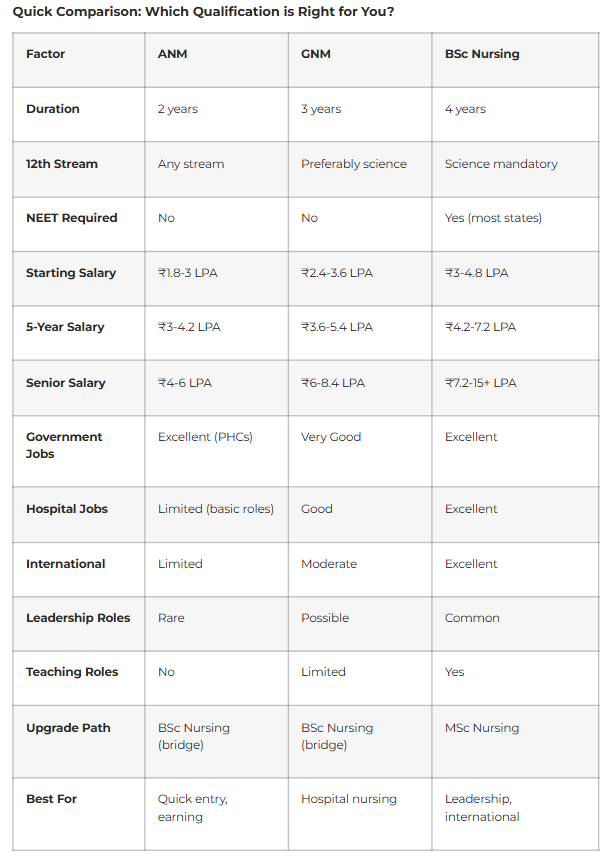
Essential Nursing Certifications That Boost Your Career
BLS (Basic Life Support): The Non-Negotiable Certification
If you remember just ONE certification from this entire guide, remember BLS. It’s becoming mandatory for almost all nursing positions in reputable hospitals.
What is BLS?
BLS teaches you life-saving techniques for cardiac arrest, respiratory failure, and airway obstruction emergencies. You learn high-quality cardiopulmonary resuscitation (CPR), automated external defibrillator (AED) usage, team dynamics during emergencies, and relief of choking.
Why Every Nurse Needs It:
Imagine a patient suddenly collapses. Heart stops. Every second counts. A BLS-certified nurse can immediately begin CPR, use the AED, and coordinate the emergency response team. This isn’t theoretical—these situations happen regularly in hospitals. BLS certification tells employers you’re prepared to save lives when it matters most.
Duration & Cost:
BLS certification typically takes 1-2 days of intensive training. Costs range from ₹2,000-5,000 depending on the training center. The American Heart Association (AHA) offers the most recognized BLS certification globally.
Salary Impact:
BLS certification can increase your starting salary by ₹10,000-20,000 annually. More importantly, many hospitals won’t even interview candidates without BLS certification for ICU, emergency, or critical care positions.
Validity & Renewal:
BLS certificates are valid for 2 years. You’ll need to renew with a refresher course to stay current with updated protocols.
ACLS (Advanced Cardiac Life Support): The ICU Game-Changer
If you’re targeting critical care, ICU, cardiac care units, or emergency departments, ACLS is your golden ticket.
What is ACLS?
ACLS builds on BLS with advanced techniques for managing complex cardiovascular emergencies. You learn cardiac arrest management, advanced airway techniques, pharmacology in resuscitation, ECG interpretation, and acute coronary syndrome management.
Who Needs ACLS:
- ICU nurses (nearly mandatory)
- Critical Care Unit (CCU) nurses
- Emergency department nurses
- Operation theater nurses
- High Dependency Unit (HDU) nurses
- Cardiac care nurses
- Nurses working in tertiary care hospitals
Duration & Cost:
ACLS is a 2-day intensive course. Expect to invest ₹5,000-10,000. Like BLS, AHA-accredited ACLS certification carries the most weight.
Salary Impact:
ACLS certification can boost your salary by ₹20,000-40,000 annually. Critical care nurses with ACLS certification earn significantly more than general ward nurses. An ICU nurse with ACLS can expect ₹3.3-4.3 LPA compared to ₹2.5-2.9 LPA for general nurses.
Career Doors It Opens:
ACLS certification positions you for:
- ICU positions (higher pay scale)
- Critical care specialization
- Emergency department roles
- Leadership positions in nursing
- International opportunities (many countries require ACLS)
Validity: 2 years, requires renewal with refresher course
Other Valuable Nursing Certifications
PALS (Pediatric Advanced Life Support):
If you love working with children, PALS certification is essential for pediatric ICU, neonatal ICU, and pediatric emergency departments. Similar to ACLS but focused on infants and children.
Phlebotomy Certification:
Specialized training in blood collection techniques. Useful for nurses working in diagnostic labs, blood banks, or wanting to offer additional services.
Wound Care Certification:
Specialized training in wound assessment, dressing techniques, and healing promotion. Valuable for surgical units, burn units, and diabetic care.
Infection Control Certification:
Especially relevant post-pandemic. Hospitals actively seek infection control nurses to maintain safety standards.
Oncology Nursing Certification:
Specialized training for working with cancer patients. Oncology nurses are in high demand and command premium salaries (₹4-6 LPA with experience).
Critical Care Nursing Certification:
Beyond ACLS, this comprehensive certification covers all aspects of critical care nursing. Positions you for senior ICU roles.
Nursing Career Progression: From Fresher to Nursing Director
One of the most attractive aspects of nursing is the clear career ladder. Unlike some professions where growth feels random, nursing offers structured progression if you know how to navigate it.
Year 0-2: Staff Nurse (Entry Level)
Your Role:
You’re on the front lines of patient care. You’ll work under supervision initially, learning hospital protocols, medication administration, patient documentation, and coordinating with doctors and senior nurses.
Typical Responsibilities:
- Patient vital signs monitoring and recording
- Medication administration as per doctor’s orders
- Patient hygiene and comfort care
- Basic wound care and dressing changes
- Assisting doctors during procedure
- Maintaining patient records and documentation
- Communicating with patients and families
Salary Range: ₹2-3.5 LPA (₹15,000-30,000 per month)
What You Should Focus On:
- Building strong clinical skills
- Learning from senior nurses
- Getting BLS certification immediately
- Developing communication skills
- Understanding hospital systems and protocols
- Building relationships with doctors and colleagues
- Showing reliability and positive attitude
Reality Check:
Your first year will be challenging. Long hours, physically demanding work, emotional situations, and steep learning curve. Many new nurses feel overwhelmed initially. This is completely normal. The key is persistence. After 6-12 months, things click into place and you’ll feel confident.
Year 2-5: Senior Staff Nurse / Specialized Nurse
Your Evolution:
You’re now experienced and confident. Hospitals trust you with more complex patients. You might specialize in a particular unit (ICU, operation theater, emergency, pediatrics) or take on additional responsibilities like mentoring new nurses.
Typical Roles:
- ICU Nurse: Managing critically ill patients with advanced monitoring
- Operation Theater Nurse: Assisting in surgeries, managing sterile environments
- Emergency Nurse: Fast-paced environment, handling trauma and acute cases
- Pediatric Nurse: Specialized care for children
- Oncology Nurse: Cancer patient care
- Dialysis Nurse: Specialized kidney care procedures
Salary Range: ₹3-5.5 LPA (₹25,000-45,000 per month)
What You Should Focus On:
- Getting ACLS or specialty certification
- Specializing in one clinical area
- Taking leadership in your unit
- Mentoring junior nurses
- Participating in quality improvement projects
- Building reputation for excellence
- Considering BSc Nursing if you did ANM/GNM (bridge course)
Career Decision Point:
This is when you decide: Do you want to stay in direct patient care and specialize further? Or do you want to move toward supervisory/management roles? Both paths are valid and rewarding—choose based on your personality and interests.
Year 5-8: Nursing Coordinator / Shift In-Charge
Your Role:
You’re now in a leadership position. You’re not just caring for patients; you’re coordinating care across multiple patients and managing junior nurses during your shift.
Typical Responsibilities:
- Supervising 3-8 staff nurses during your shift
- Patient assignment and workload distribution
- Handling escalations and complex situations
- Quality assurance and protocol compliance
- Staff performance monitoring
- Coordination between departments
- Incident reporting and management
- Training and mentoring new nurses
Salary Range: ₹5-8 LPA (₹40,000-65,000 per month)
What You Should Focus On:
- Developing leadership and management skills
- Communication across all levels (nurses, doctors, administrators)
- Problem-solving and decision-making under pressure
- Staff motivation and team building
- Understanding hospital operations
- Considering MSc Nursing or healthcare management certification
- Building professional network
The Shift:
At this stage, your work becomes less hands-on patient care and more about ensuring your team delivers excellent care. Some nurses love this transition; others miss direct patient interaction. Understand what fulfills you.
Year 8-12: Nursing Supervisor / Nursing Officer
Your Role:
You oversee entire departments or units. You’re responsible for nursing operations, staff performance, quality metrics, and strategic planning for your area.
Typical Responsibilities:
- Managing 15-30 nurses across multiple shifts
- Recruitment and staff selection
- Performance reviews and development plans
- Budget management for nursing supplies
- Policy implementation and compliance
- Quality improvement initiatives
- Liaison between nursing staff and hospital administration
- Crisis management and conflict resolution
Salary Range: ₹7-12 LPA (₹60,000-1,00,000 per month)
What You Should Focus On:
- Strategic thinking and planning
- Financial management and budgeting
- Healthcare regulations and compliance
- Change management
- Advanced certifications (MSc Nursing, Healthcare Administration)
- Professional publications or presentations
- Networking with hospital leadership
Year 12+: Nursing Manager / Nursing Superintendent / Director of Nursing
Your Role:
You’re at the pinnacle of nursing leadership. You shape nursing policy, represent nursing at executive meetings, and influence hospital strategy.
Typical Responsibilities:
- Hospital-wide nursing operations
- Strategic planning for nursing services
- Annual budgets for nursing departments
- Nursing staff recruitment and retention strategies
- Quality and patient safety initiatives
- Collaboration with medical directors and hospital CEO
- Community health initiatives
- Regulatory compliance and accreditation
- Nursing education and research
Salary Range: ₹10-20+ LPA (₹80,000-1,60,000+ per month
What Makes You Stand Out:
- Master’s degree (MSc Nursing or Healthcare Administration)
- Track record of improving patient outcomes
- Financial acumen and operational excellence
- Leadership and vision
Professional recognition and contributions to nursing field
Landing Your First Nursing Job: Step-by-Step Strategy
Step 1: Polish Your Nursing Resume (30 Minutes)
Your resume needs to immediately tell the recruiter: “I’m clinically competent, caring, and reliable.”
Resume Structure for Nurses:
text
[YOUR NAME]
City, State | Phone: +91-XXXXX-XXXXX | Email: yourname@email.com
PROFESSIONAL SUMMARY
Compassionate [ANM/GNM/BSc] Nursing graduate with [X months/years] of clinical training experience across [specialties]. Skilled in patient care, medication administration, and emergency response. BLS certified and committed to delivering patient-centered care with empathy and clinical excellence.
CERTIFICATIONS
- BLS (Basic Life Support) – American Heart Association – Valid until [Date]
- ACLS (Advanced Cardiac Life Support) – [If you have it]
- [Any other relevant certifications]
CLINICAL EXPERIENCE
Nursing Intern | [Hospital Name] | [City] | [Dates]
- Provided direct patient care for 6-10 patients daily across medical-surgical units
- Administered medications, monitored vital signs, and documented patient conditions with 100% accuracy
- Assisted in 15+ emergency situations, providing BLS and coordinating with medical teams
- Maintained infection control protocols, achieving zero hospital-acquired infections in assigned patients
- Communicated effectively with patients and families, receiving positive feedback from 95% of patients
[If you have more experience, add more roles here]
EDUCATION
[Degree Name] in Nursing | [Institution] | [City] | [Year]
- [Relevant coursework or specialization]
- [Any academic honors or achievements]
SKILLS
Clinical Skills: Patient assessment, Medication administration, Wound care, Vital signs monitoring, IV therapy, Catheterization, Patient documentation
Soft Skills: Empathy, Communication, Team collaboration, Time management, Stress management, Problem-solving
Languages: English (Fluent), Hindi (Native), [Any other languages]
Common Resume Mistakes Nurses Make:
❌ Don’t: Write “Responsible for patient care” (too vague)
✓ Do: Write “Provided direct care for 8-10 patients daily, maintaining 100% medication accuracy”
❌ Don’t: List duties like a job description
✓ Do: Highlight achievements with numbers
❌ Don’t: Submit same resume everywhere
✓ Do: Customize for each hospital/position
Step 2: Where to Find Nursing Jobs
Online Job Portals:
- Naukri.com – Search “Staff Nurse” + your city
- Indeed.com – Good for hospital positions
- LinkedIn – Corporate hospitals post here
- Rozgar.com – Various healthcare positions
- Government job websites – For government hospital positions
Direct Hospital Applications:
This is often more effective than job portals. Identify 10-15 hospitals in your city, visit their websites, find HR contact, and apply directly.
Walk-In Interviews:
Many hospitals conduct walk-in interviews for nursing positions. Check hospital notice boards and social media pages.
Nursing Placement Agencies:
Agencies specialize in placing nurses. They can fast-track your applications.
Professional Networks:
Join nursing groups on Facebook, LinkedIn. Many jobs are shared in these communities before public posting.
Your Nursing College:
Stay connected with your college placement cell. Hospitals often reach out to nursing colleges directly.
Step 3: Nail the Nursing Interview
Nursing interviews typically include clinical questions, scenario-based questions, and soft skill assessment.
Common Nursing Interview Questions:
Q: “Tell me about yourself.”
Weak Answer: “I did GNM nursing and now I want a job.”
Strong Answer: “I’m a GNM graduate with 6 months of internship experience at [Hospital], where I worked across medical-surgical and ICU units. I’m passionate about patient care and have developed strong skills in medication administration, patient assessment, and emergency response. I’m BLS certified and particularly interested in critical care nursing. I’m drawn to [Hospital Name] because of your reputation for patient-centered care and professional development opportunities for nursing staff.”
Q: “How do you handle a difficult or angry patient?”
Strategy: Show empathy first, then professional competence.
Good Answer: “I try to understand what’s causing their frustration. Often patients are scared, in pain, or feeling helpless. I listen actively without interrupting, acknowledge their concerns, and explain what we’re doing to help them. I maintain calm and professional demeanor. If the situation escalates beyond my ability to manage, I involve my supervisor or the attending physician. Patient safety and dignity are always my priority.”
Q: “Describe a time you made a mistake. How did you handle it?”
Strategy: Show accountability and learning.
Good Answer: “During my internship, I once documented a vital sign incorrectly in a patient’s chart. I realized the error within 30 minutes and immediately reported it to my supervisor and corrected the record. We double-checked the patient’s actual vitals to ensure no treatment decisions were affected. I learned the importance of double-checking documentation before submission. Since then, I’ve implemented a personal verification routine that’s helped me maintain 100% accuracy.”
Q: “How do you prioritize when you have multiple patients needing attention?”
Good Answer: “I use the ABCs framework—Airway, Breathing, Circulation—to assess urgency. Life-threatening situations get immediate attention. Then I consider pain levels, scheduled medications, and routine care. I communicate with my team if I need support. For example, if I have a patient experiencing respiratory distress and another requesting pain medication, I’d immediately address the respiratory issue while asking a colleague to check on the patient needing pain relief. Patient safety always guides my prioritization.”
Q: “Why did you choose nursing?”
Strategy: Be genuine, show passion.
Avoid: “For job security” or “My parents wanted me to”
Better: “I’ve always been drawn to caring professions. During my grandmother’s illness, I saw how nurses not only provided medical care but also brought comfort and dignity during a difficult time. That experience made me realize I wanted to make that same impact. Nursing allows me to combine clinical skills with genuine human connection, and I find deep satisfaction in helping people during their most vulnerable moments.”
Step 4: Salary Negotiation for New Nurses
Many new nurses accept the first offer without negotiation. Don’t make this mistake.
Research First:
- Check Glassdoor for salary ranges at that hospital
- Ask seniors from your college what they’re earning
- Know the typical range for your qualification in your city
Negotiation Approach:
When they make an offer:
“Thank you for the offer. I’m excited about joining [Hospital]. Based on my research and the fact that I’m BLS certified with 6 months of internship experience, I was expecting ₹[X amount]. Would there be flexibility on the salary component?”
What to Negotiate:
- Base salary (usually 10-15% room for negotiation)
- Shift allowances (night shift, weekend differential)
- Professional development support (course reimbursement)
- Leave entitlements
What’s Usually Non-Negotiable:
- Insurance and benefits (standardized)
- Probation period
- Joining date
If They Can’t Increase Salary:
“I understand. Would it be possible to revisit salary after my 6-month performance review? Additionally, I’d appreciate if the hospital could support my ACLS certification in the coming year.”
International Nursing Opportunities: Earning 3-5x More
One of nursing’s biggest advantages? International demand. Countries worldwide actively recruit Indian nurses. With proper preparation, you can work abroad earning significantly more than in India.
Why International Opportunities Exist
Developed countries face severe nursing shortages. Aging populations, more healthcare needs, and fewer people entering nursing create massive demand. Indian nurses are highly regarded globally for their training, work ethic, and English proficiency.
Top Destinations for Indian Nurses
United States:
- Salary: $60,000-90,000 annually (₹50-75 LPA equivalent)
- Requirements: NCLEX-RN exam, CGFNS certification, English proficiency (IELTS/TOEFL), visa sponsorship
- Process Duration: 2-3 years typically
- Pros: Highest salaries, excellent career growth, permanent residence pathway
- Cons: Expensive process (₹5-8 lakhs investment), competitive, long timelines
United Kingdom:
- Salary: £25,000-35,000 annually (₹25-35 LPA equivalent)
- Requirements: NMC (Nursing and Midwifery Council) registration, IELTS (minimum 7.0), visa sponsorship
- Process Duration: 1-2 years
- Pros: NHS employs thousands of international nurses, good work-life balance, pathway to permanent residence
- Cons: High cost of living in cities, challenging NMC exam
Canada:
- Salary: CAD 60,000-80,000 (₹38-50 LPA equivalent)
- Process Duration: 1.5-2 years
- Requirements: NCLEX-RN (same as USA), IELTS, provincial nursing registration
- Pros: Excellent quality of life, permanent residence pathway, multicultural society
- Cons: Cold climate (if that matters to you), competitive in certain provinces
Australia:
- Salary: AUD 65,000-90,000 (₹40-55 LPA equivalent)
- Requirements: AHPRA registration, IELTS, relevant clinical experience
- Process Duration: 1-2 years
- Pros: High salaries, excellent lifestyle, permanent residence opportunities
- Cons: Expensive initial setup, distance from India
Gulf Countries (UAE, Saudi Arabia, Qatar, Kuwait):
- Salary: AED 8,000-15,000 per month (₹18-30 LPA equivalent, tax-free)
- Requirements: Nursing license, Gulf-specific licensing exam, experience (1-2 years preferred)
- Process Duration: 6-12 months
- Pros: Tax-free income, close to India, easier process than Western countries, savings potential
- Cons: Work culture differences, limited permanent residence options, family visa restrictions
Step-by-Step: Working Abroad as a Nurse
Step 1: Gain Experience in India (1-2 years)
Most countries prefer nurses with at least 1-2 years of post-qualification experience. Use this time to:
- Build clinical skills
- Get BLS and ACLS certifications
- Specialize in a high-demand area (ICU, emergency, operation theater)
- Save money for the international process
Step 2: English Language Proficiency
Take IELTS exam. Target minimum 7.0 overall (many countries require 7.0 in each band for nursing registration). Preparation time: 2-3 months.
Step 3: Licensing Exam Preparation
- For USA/Canada: NCLEX-RN exam (pass rate 40-60% for first-time takers, requires dedicated study)
- For UK: NMC CBT (Computer Based Test) + OSCE (Objective Structured Clinical Examination)
- For Australia: AHPRA requirements (sometimes requires bridging courses)
- For Gulf: Country-specific licensing exams (generally easier)
Preparation time: 4-6 months of serious study
Step 4: Application and Visa Process
Once you clear licensing, apply for positions through:
- Healthcare recruitment agencies specializing in international placement
- Direct hospital applications (some hospitals sponsor visas)
- Government programs (some countries have specific recruitment programs)
Timeline: 6-12 months from application to relocation
Step 5: Relocation and Settlement
Budget for:
- Visa fees: ₹50,000-2 lakhs depending on country
- Travel: ₹50,000-1 lakh
- Initial accommodation: ₹1-3 lakhs for first 2-3 months
- Licensing fees and exam costs: ₹1-3 lakhs
- Total investment: ₹3-8 lakhs typically
Return on Investment:
If you’re earning ₹3-4 LPA in India and move to a position earning ₹25-30 LPA abroad, you recover your investment in the first year itself. Over 5-10 years abroad, you can save ₹50 lakhs to ₹1 crore+ while gaining invaluable international experience.
Is International Nursing Worth It?
Consider Going Abroad If:
- You want significantly higher earnings
- You’re interested in experiencing different cultures
- You want access to advanced healthcare technology and training
- You’re planning to settle abroad permanently
- You’re early in your career (easier to relocate without family commitments)
Consider Staying in India If:
- Family commitments make relocation difficult
- You’re established in a senior position with good salary
- You prefer familiarity of home culture
- Investment required feels too high
- You’re building private practice or healthcare business
The Middle Path:
Many nurses work abroad for 5-10 years, save substantially, gain advanced skills, then return to India for senior leadership positions or entrepreneurship. This strategy combines high earnings with eventual return home.
Common Mistakes Nursing Students Make (And How to Avoid Them)
Mistake 1: Choosing Qualification Based on Friends, Not Career Goals
Your friend did ANM, so you do ANM. Your cousin did BSc Nursing, so you do BSc Nursing. This is backwards.
Instead: Evaluate based on YOUR goals:
- Need to earn quickly? ANM or GNM
- Want leadership roles? BSc Nursing
- Planning international career? BSc Nursing
- Limited budget? ANM, then upgrade later
- Have time and resources? BSc Nursing
Mistake 2: Skipping BLS Certification
Many new graduates delay getting BLS certified, thinking they’ll do it later. Then they lose job opportunities or have to accept lower salaries.
Instead: Get BLS certified immediately after your qualification, before even starting your job search. It costs ₹2,000-5,000 and takes 1-2 days. This tiny investment prevents months of job search frustration.
Mistake 3: Not Networking with Seniors and Professionals
Nursing students often stay within their peer group and miss valuable connections with working professionals who can guide careers and share job opportunities.
Instead:
- Connect with your college seniors who are working
- Join nursing professional groups on LinkedIn and Facebook
- Attend nursing conferences and workshops
- Build relationships with instructors and clinical supervisors
Mistake 4: Job-Hopping Too Frequently
Some nurses switch jobs every 6-12 months chasing slightly higher salaries. This damages your reputation and limits growth.
Instead: Stay in your first job for at least 18-24 months. This shows commitment, allows you to build deep skills, and makes you attractive for senior positions. Change jobs strategically—for significant salary increases (20%+), better specialization, or clear career advancement.
Mistake 5: Ignoring Soft Skills Development
Students focus intensely on clinical skills but neglect communication, empathy, teamwork, and stress management.
Instead: Actively develop soft skills:
- Practice patient communication during internship
- Seek feedback on your interpersonal skills
- Learn conflict resolution
- Develop emotional intelligence
- Practice stress management techniques
Remember: Hospitals fire nurses for poor soft skills, not clinical incompetence. Clinical skills can be taught; attitude and communication are harder to fix.
Mistake 6: Not Asking Questions During Training
Fear of appearing ignorant prevents students from asking questions during clinical training. This creates knowledge gaps that show up later.
Instead: Ask questions constantly. “Why are we using this medication?” “What are the signs I should watch for?” “How do I handle [situation]?” Good supervisors respect students who ask thoughtful questions.
Mistake 7: Neglecting Self-Care
Nursing is physically and emotionally demanding. Many nurses burn out because they don’t prioritize their own health and well-being.
Instead:
- Maintain regular exercise routine
- Ensure adequate sleep (7-8 hours)
- Eat properly during shifts
- Take your days off seriously (rest and recharge)
- Seek support when feeling overwhelmed
- Set boundaries (don’t work excessive overtime continuously)
Frequently Asked Questions: Real Answers for Nursing Students
Q: Is nursing only for females?
Absolutely not. Male nurses are in high demand, especially for ICU, emergency departments, and operation theaters. Many hospitals actively recruit male nurses. The perception that nursing is “only for females” is outdated. Male nurses often advance quickly due to lower competition and high demand.
Q: Is the ANM qualification enough, or should I do BSc Nursing?
Depends on your goals and situation:
- ANM is enough if: You need to start earning quickly, you’re interested in community health or primary care, you plan to work in government PHCs, or you’ll upgrade to BSc Nursing later through bridge course.
- Go for BSc Nursing if: You want leadership roles, you’re planning international career, you have time and resources for 4-year degree, or you want maximum career flexibility.
Many successful nurses started with ANM, worked while earning, then completed BSc Nursing through bridge programs. This is a smart, financially manageable path.
Q: What’s the actual work-life balance like for nurses?
Nursing involves shift work (morning, evening, night rotations). This can be challenging initially. However:
- You typically work 8-12 hour shifts with designated days off
- Many nurses prefer shift work (allows daytime errands, avoiding traffic)
- Government positions often have better work-life balance than private hospitals
- As you advance to supervisory roles, schedules become more predictable
- Some specializations (outpatient clinics, school nursing) offer regular 9-5 hours
Balance improves significantly as you gain experience and move into leadership positions.
Q: Can I study further while working as a nurse?
Yes! Many nurses pursue further education while working:
- Part-time or distance MSc Nursing programs
- Weekend MBA programs
- Online certifications
- Bridge courses (ANM to BSc Nursing)
Hospitals often support continuing education. Some even offer tuition reimbursement or study leave. The key is planning and time management.
Q: Is government nursing job better than private hospitals?
Both have advantages:
Government Jobs:
- Better job security
- Fixed working hours (usually)
- Pension and benefits
- Less pressure
- Stable salary progression
Private Hospitals:
- Often higher starting salaries
- Faster career progression
- Exposure to advanced technology
- Better infrastructure
- Performance-based bonuses
Many nurses start in private hospitals (fast skill development), then move to government positions (stability) after 3-5 years. Some do the reverse. Choose based on your current priorities.
Q: How long until I can earn ₹50,000+ per month?
Timeline varies based on your path:
- ANM/GNM: 8-12 years with specializations
- BSc Nursing: 5-8 years with specializations or supervisory roles
- International nursing: 2-3 years (if you relocate)
Key accelerators: Specializations (ICU, operation theater), certifications (ACLS, critical care), leadership roles, or moving to corporate hospitals.
Q: What if I’m not good with blood and medical procedures?
Nursing isn’t just about direct patient care. Options if you’re uncomfortable with clinical aspects:
- Nursing administration and management
- Nursing education (teaching in colleges)
- Public health nursing (less clinical, more community work)
- Healthcare IT (nursing informatics)
- Medical writing and communication
- Quality assurance roles
That said, most nurses find they adjust to clinical work within 3-6 months of regular exposure.
Your Action Plan: Getting Your First Nursing Job in 90 Days
Month 1: Foundation (Days 1-30)
Week 1:
- ☐ Update your resume using the template in this guide
- ☐ Take a professional photo for your resume and LinkedIn
- ☐ Register on Naukri, Indeed, LinkedIn
- ☐ Create a list of 15-20 target hospitals in your city
Week 2:
- ☐ Complete BLS certification (if not already done)
- ☐ Get 3-4 professional references lined up (inform them)
- ☐ Prepare your 2-minute self-introduction
- ☐ Research each target hospital (services, values, recent news)
Week 3:
- ☐ Apply to 10 positions (customize resume for each)
- ☐ Visit 3-5 hospitals in person with resume
- ☐ Connect with 10 nursing professionals on LinkedIn
- ☐ Join 3-5 nursing professional groups online
Week 4:
- ☐ Apply to 10 more positions
- ☐ Follow up on Week 3 applications (if no response)
- ☐ Practice interview answers (record yourself)
- ☐ Prepare questions to ask interviewers
End of Month 1 Target: 20-25 applications submitted, 5-10 direct hospital visits, actively networking
Month 2: Applications & Interviews (Days 31-60)
Week 5:
- ☐ Apply to 10 positions
- ☐ Attend any scheduled interviews (likely starting now)
- ☐ Send thank-you emails after interviews
- ☐ Research any upcoming hospitals/opportunities
Week 6:
- ☐ Apply to 10 more positions
- ☐ Continue interviews
- ☐ Seek feedback if you’re getting rejections
- ☐ Adjust approach based on feedback
Week 7:
- ☐ Apply to 5-10 positions
- ☐ Follow up on pending applications
- ☐ Network with nurses you’ve met (coffee meetings)
- ☐ Refine interview answers based on experience
Week 8:
- ☐ Continue applications (5-10)
- ☐ Second-round interviews likely happening
- ☐ Negotiate any offers you receive
- ☐ Document all feedback and learning
End of Month 2 Target: 45-60 total applications, 5-12 interviews completed, 2-4 strong prospects
Month 3: Closing & Starting (Days 61-90)
Week 9:
- ☐ Continue applications if needed (5-10)
- ☐ Finalize job offers
- ☐ Complete joining formalities
- ☐ Prepare for first day (uniforms, documents)
Week 10:
- ☐ Start your first job!
- ☐ Complete orientation and training
- ☐ Learn names of colleagues
- ☐ Ask lots of questions
Week 11:
- ☐ Focus on learning hospital systems
- ☐ Build relationships with team
- ☐ Deliver consistently on assigned tasks
- ☐ Seek feedback from supervisor
Week 12:
- ☐ Reflect on first month performance
- ☐ Identify areas for improvement
- ☐ Plan next certifications or skills to develop
- ☐ Celebrate your new nursing career!
End of Month 3: You’re officially a working nurse, earning, learning, and making a difference!
Closing: Your Nursing Journey Begins Now
You’ve reached the end of this guide, but you’re standing at the beginning of something far more important—your nursing career. Right now, thousands of hospitals across India need nurses. Patients need your care. Healthcare teams need your contribution.
Nursing isn’t just a job. It’s a profession where you’ll witness human resilience, hold hands during scary moments, celebrate recoveries, and know that you made a tangible difference. Yes, there will be long shifts. Yes, the work is demanding. But few careers offer this unique combination: stable employment, clear growth, decent income, and genuine purpose.
Whether you choose ANM, GNM, or BSc Nursing, whether you work in a small clinic or a large hospital, whether you stay in India or work internationally—the core remains the same: you’re choosing to care for others during their most vulnerable moments. That’s noble. That’s powerful. That’s nursing.
Now stop reading. Take the first step. Update that resume. Apply for that certification. Send that first application.
Your nursing career doesn’t start someday. It starts today.
Good luck, future nurse. The healthcare world needs you. 🏥💙