
MBA vs Direct Entry for Consulting: Choosing Your Path
Table of Contents
One of the biggest questions aspiring consultants face: Should I enter consulting straight after undergrad, or should I get work experience, do an MBA, and then join? Both paths work—top consulting firms actively recruit from undergraduate campuses and MBA programs—but they lead to different starting points, career trajectories, and long-term outcomes.
The decision isn’t just about which gets you in faster. It’s about timing, finances, career goals, and personal circumstances. An MBA costs ₹20-60 lakhs (India) or $100,000-200,000 (US) and takes 2 years. Direct entry means earning immediately but starting at a lower level. The “right” choice depends entirely on your background, goals, and how you value time versus credentials.
This comprehensive guide compares both paths across every dimension that matters: entry points, salaries, career progression, total lifetime earnings, skill development, exit opportunities, costs, and ROI. By the end, you’ll have a clear framework for deciding which path fits you best.
Understanding the Two Paths
Direct Entry (Undergraduate Route)
Who: Fresh graduates or those with 0-2 years of work experience
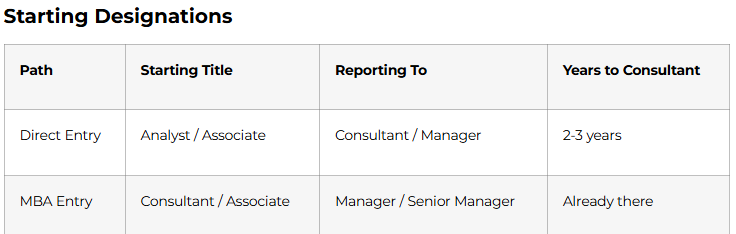
Entry level: Analyst / Associate Consultant
Timeline: Start working at age 22-23
Typical backgrounds: B.Tech from IITs/NITs, B.Com from top colleges, BBA/Economics from premier universities
Recruitment: Campus placements at select collegescollegesearch+1
MBA Entry (Post-MBA Route)
Who: Professionals with 3-6 years of work experience who complete an MBA
Entry level: Consultant / Associate (2-3 levels above direct entry analysts)
Timeline: Start consulting at age 27-29
Typical backgrounds: MBA from IIMs, ISB, XLRI, top international B-schools
Recruitment: MBA campus placements, some experienced hire recruitingmanagementconsulted+2
Key difference: MBA entry skips analyst years entirely, starting at a higher level with better pay and more responsibility from day one.
Entry Level Comparison
Starting Salaries (India – 2025)
Direct Entry – Analyst Packages:
- MBB firms: ₹20-28 LPA total (base + bonus)casebasix+1
- Big 4 consulting: ₹10-16 LPAcollegesearch+1
- Tier 2 firms: ₹14-20 LPAcollegesearch
MBA Entry – Consultant Packages:
- MBB firms (top MBA): ₹30-42 LPA totaljaroeducation+1
- Big 4 consulting (IIM/ISB): ₹18-28 LPAjaroeducation+1
- Tier 2 firms: ₹22-32 LPAjaroeducation
Salary gap: MBA entry starts 40-60% higher in absolute terms.collegesearch+1
Starting Responsibilities
Direct Entry Analyst:
- Conducting research and gathering data
- Building Excel models and financial analyses
- Creating PowerPoint slides
- Supporting senior team members
- Limited client exposure initiallycasebasix+1
MBA Entry Consultant:
- Leading full workstreams on projects
- Regular client presentations
- Managing 1-2 analysts
- Contributing to strategic recommendations
- More autonomy and visibilitycasebasix+1
Work quality: MBA hires are expected to hit the ground running with minimal hand-holding. Direct entry hires get more training and ramp-up tim
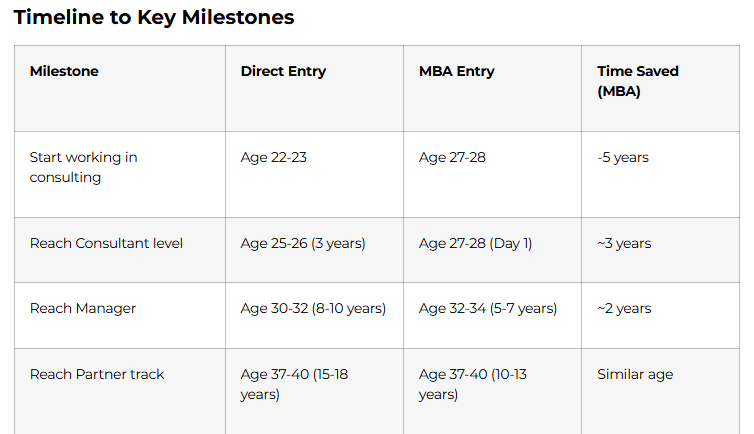
Key insight: Both paths converge around the same age at senior levels (Manager onward). MBA accelerates the journey but starts 5 years later.cphrservices+1
Promotion Speed
Direct Entry:
- Analyst → Consultant: 2-3 years
- Consultant → Senior Consultant: 2-3 years
- Senior Consultant → Manager: 2-4 years
- Total to Manager: 7-10 years from startcphrservices+1
MBA Entry:
- Consultant → Senior Consultant: 2-3 years
- Senior Consultant → Manager: 2-3 years
- Total to Manager: 4-6 years from post-MBA startcphrservices+1
Promotion criteria: Similar standards at equivalent levels. MBA entry doesn’
Financial Analysis: Lifetime Earnings
Let’s compare total earnings over a 15-year horizon for both paths.
Assumptions:
- Direct Entry: Starts at age 23
- MBA Entry: Starts at age 28 (2 years MBA after 3 years work)
- Firm: Top-tier (MBB-level compensation)
- Performance: Strong but not exceptional
- Staying in consulting full 15 years (though most exit earlier

Skills & Experience Development
What You Learn: Direct Entry
Strengths:
- Deep consulting fundamentals: More time doing core analyst work builds strong Excel, PowerPoint, research skillsupgrad
- Learning by doing: Gradual progression allows mastery at each level
- Firm culture immersion: Understanding how consulting really works from bottom-up
- Broader project exposure: More total projects over 15 years
- Resilience: Surviving analyst grind builds mental toughnesscasebasix
Gaps:
- Less formal business education (accounting, finance, strategy frameworks)
- Narrower network initially (mostly consulting peers)
- May lack industry experience before consulting
What You Learn: MBA Entry
Strengths:
- Formal business education: Structured learning in strategy, finance, marketing, operationsgisma
- Industry experience: 3-5 years in corporate/startup before consulting gives contextcasebasix
- Broader network: MBA classmates across industries, functions, geographies
- Career optionality: MBA brand valuable beyond consulting
- Faster responsibility: Earlier exposure to client-facing, strategic workcasebasix
Gaps:
- Less time developing technical consulting skills (fewer total project years)
- Steeper learning curve (expected to perform without analyst apprenticeship)
- Less firm loyalty sometimes (seen as “MBA hire” vs “grown from within”)
Skill verdict: Direct entry builds deeper consulting craft. MBA builds broader business perspective and network.upgrad+2
Exit Opportunities Comparison
Direct Entry Exit Options
After 3-5 years (age 27-28, Consultant level):
- Corporate strategy analyst/manager roles: ₹18-30 LPA
- Startup operations/analytics roles: ₹15-25 LPA + equity
- MBA programs (using consulting as pre-MBA springboard)
- Boutique consulting or independent consultingcphrservices
After 7-10 years (age 30-33, Manager level):
- Senior corporate strategy roles: ₹35-60 LPA
- Business unit leadership: ₹40-70 LPA
- VP roles in startups: ₹30-50 LPA + significant equity
- Private equity/VC (some firms): ₹50-80 LPAcphrservices+1
Ceiling without MBA: Can reach senior corporate roles but C-suite/CEO track harder without graduate degree in many traditional companies.
MBA Entry Exit Options
After 3-5 years post-MBA (age 31-33, Senior Consultant/Manager):
- Senior corporate strategy/operations roles: ₹45-70 LPA
- Director-level positions: ₹50-90 LPA
- Product leadership (tech): ₹60-100 LPA
- PE/VC Associate/VP: ₹60-120 LPAcphrservices+1
After 7-10 years post-MBA (age 35-38, Manager/Senior Manager):
- VP/SVP corporate roles: ₹80 LPA – 1.5 Cr
- GM/Business Unit head: ₹1-2 Cr
- C-suite track positions: ₹1.5-3+ Cr
- Founding/co-founding startups with better investor accesscphrservices
MBA advantage: Higher exit compensation at equivalent years of experience. Better access to C-suite track roles. Stronger alumni network opens doors.cphrservices+1
Cost-Benefit Analysis
MBA Costs (All-In)
India (IIM/ISB 2-year MBA):
- Tuition + living: ₹25-35 lakhs
- Opportunity cost (2 years not earning): ₹20-30 lakhs
- Total cost: ₹45-65 lakhsgisma
International (Top US/EU schools):
- Tuition + living: $120,000-200,000 (₹1-1.65 Cr)
- Opportunity cost: ₹20-30 lakhs
- Total cost: ₹1.2-2 Crores
MBA ROI Scenarios
Scenario 1: Stay in consulting full career
- ROI: Negative to neutral financially vs direct entry
- Reason: Higher starting pay doesn’t compensate for cost + lost years
- Exception: If MBA from M7 school enables MBB entry that wouldn’t have happened otherwise
Scenario 2: Exit consulting after 5-7 years
- ROI: Positive if MBA brand enables 30-40% higher compensation in corporate roles
- Payback period: 7-10 years typically
- Best case: CEO/C-suite trajectory where MBA is near-mandatory
Scenario 3: Use consulting to pivot industries
- ROI: Strong if you’re switching from low-pay to high-pay industry (e.g., education → consulting → tech)
- MBA acts as career reset buttongisma
Scenario 4: Entrepreneurship
- ROI: MBA network, brand, and learning valuable for fundraising and talent recruitment
- Consulting + MBA = strong founder profile
Financial verdict: MBA makes financial sense if:
- You need it to break into consulting (non-target undergrad background)
- You’re using it to switch careers/industries
- You plan to exit consulting to roles where MBA brand matters (PE, tech, C-suite)
- You value network and optionality beyond pure earnings
Decision Framework: Which Path Is Right for You?
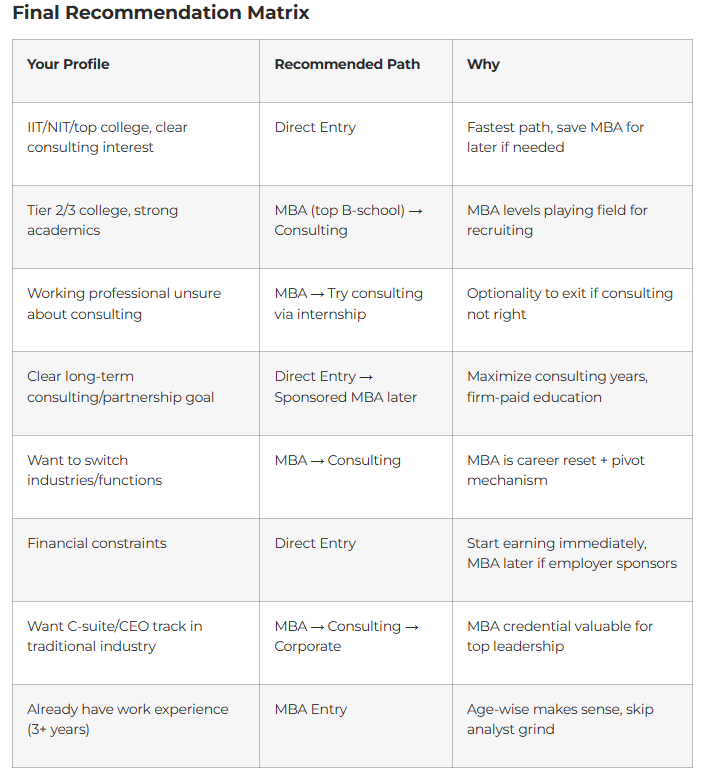
Choose Direct Entry If:
✅ You’re at a target school (IIT, top NIT, premier business college) with campus recruiting access
✅ You want consulting ASAP and don’t want to wait 5 years
✅ You’re confident in your long-term consulting interest (MBA can come later if needed)
✅ Financial pressure to start earning (family obligations, loans)
✅ You value hands-on learning over formal classroom education
✅ You’re okay with grinding as analyst for 2-3 years
✅ You want maximum lifetime earnings within consultingupgrad+2
Choose MBA Entry If:
✅ You’re not at a target undergrad school and need MBA to access top firmsgisma
✅ You want industry experience first to understand business before advising
✅ You’re switching careers (engineering → business, ops → strategy) and need reset
✅ You value formal business education and want foundational frameworks
✅ You want broader career optionality (consulting is one option, not the only)
✅ You’re targeting C-suite long-term where MBA is near-mandatory
✅ You want a strong alumni network for life
✅ You can afford it (savings, family support, or loans with manageable burden)
Hybrid Path: Direct Entry → MBA Later
The “best of both worlds” approach many consultants take:
Timeline:
- Join consulting directly after undergrad (age 22-23)
- Work 3-5 years as Analyst → Consultant
- Firm sponsors your MBA (many top firms do this)
- Return post-MBA at Manager level (or exit to better opportunities)
Advantages:
- Consulting pays for MBA or gives education loan
- Guaranteed job post-MBA at higher level
- MBA benefits from having consulting experience (better class participation, internships, career clarity)
- Still accumulates consulting years + gets MBA credentialcasebasix+1
Disadvantages:
- Obligation to return to firm for 2-3 years post-MBA
- Total time in school is longer (4y undergrad + 2y MBA)
- Career progression pauses during MBA
Who this works for: People who want consulting long-term but also value MBA network and education. Common at MBB and Big 4
Firm Preferences: Do They Favor One Path?
MBB Firms (McKinsey, BCG, Bain)
Both paths valued equally at their respective levels:
- Undergrads from IITs/top schools hired as analysts
- MBAs from IIMs/M7 schools hired as consultants
- No preference in promotions once you’re in—performance matters mostmanagementconsulted+1
Slight MBA lean for: Strategy-heavy projects, client-facing roles early on
Big 4 (Deloitte, EY, PwC, KPMG)
Slight direct entry lean due to:
- Larger analyst hiring classes (100s vs 10s)
- More implementation/operations work suits analyst development
- Cost-efficiency (analysts are cheaper than MBA hires)
- Many senior leaders rose from analyst rankscollegesearch+1
But: Still recruit heavily from top MBA programs for strategy arms and senior roles
Boutique Firms
More flexible: Often care more about skills and cultural fit than pedigree. Some boutiques rarely hire fresh MBAs, preferring experienced consultants or direct entry + train approach.
Geographic Considerations
India Context
Direct entry more common because:
- Strong campus recruitment infrastructure at IITs, NITs, IIMs
- Consulting well-established as undergrad career path
- MBA less mandatory for career success than in UScollegesearch
MBA valuable for: Breaking in from non-target schools, career switching, international aspirations
US/International Context
MBA more traditional route because:
- Top consulting firms recruit mostly from M7 MBA programs
- Undergrad direct entry exists but smaller scale
- MBA seen as essential for C-suite in many US corporationsmanagementconsulted
Direct entry growing: More undergrad recruiting in recent years, especially for analytics/digital roles
Real Examples: Alumni Trajectories
Direct Entry Success Story
Priya, IIT Delhi B.Tech → BCG Analyst:
- Age 23: Joined BCG as Analyst (₹22L)
- Age 26: Promoted to Consultant (₹40L)
- Age 29: Senior Consultant (₹62L)
- Age 32: Exited to Head of Strategy at Flipkart (₹95L + stock)
- Age 35: VP Strategy at Google India (₹1.5 Cr+)
Key factors: Strong technical background, hustled as analyst, built tech industry expertise, no MBA needed for tech leadership roles.casebasix+1
MBA Entry Success Story
Rahul, Engineering (Tier 2) → 4 years IT services → IIM A MBA → Bain Consultant:
- Age 27: Joined Bain post-MBA (₹35L)
- Age 30: Senior Consultant (₹60L)
- Age 33: Manager (₹90L)
- Age 36: Exited to VP Corporate Development at Reliance (₹1.8 Cr)
- Age 39: CFO of mid-size company (₹2.5 Cr)
Key factors: MBA helped break into top consulting from non-target undergrad. MBA brand + consulting experience opened CFO path.gisma+2
Observation: Both reached impressive outcomes but via different paths suited to their starting points.
Conclusion: There's No Wrong Choice, Only Wrong Fit
The MBA vs direct entry debate isn’t about one being objectively better—it’s about which fits your circumstances, goals, and preferences. Direct entry maximizes consulting exposure and lifetime earnings within consulting. MBA entry maximizes optionality, network, and exit opportunities.
Many successful consultants took the direct route. Many others took the MBA route. Both can lead to partnership, both can lead to CEO-ship, both can lead to entrepreneurship.
The real key: Excel at whichever path you choose. Top performers succeed regardless of entry point. Mediocre performers struggle on both paths.
Choose based on where you are now, where you want to go, and what you value most—then commit fully to that path