
Top 10 Skills Needed for Management Consulting Success
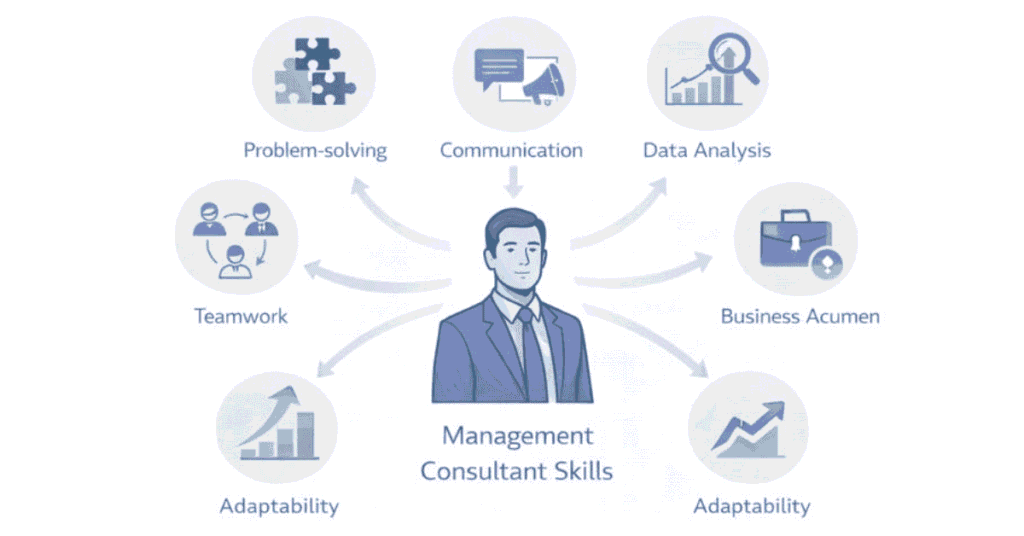
Table of Contents
Consulting isn’t about having all the answers—it’s about having the right skills to find those answers quickly. Whether you’re solving a profitability problem for a retail chain, designing a market entry strategy for a tech company, or helping a manufacturer reduce costs, you’ll rely on a core set of abilities that separate great consultants from average ones.
The good news? Nearly all these skills are learnable. You don’t need to be born with them. With focused effort, the right resources, and deliberate practice, anyone can build a strong consulting skill set—even if you’re starting from a non-business background.
This guide breaks down the 10 most critical skills for consulting success in 2025, explains why each matters, and gives you practical, actionable steps to develop them. We’ll cover both timeless core skills and emerging capabilities that will define the next generation of consulting work.
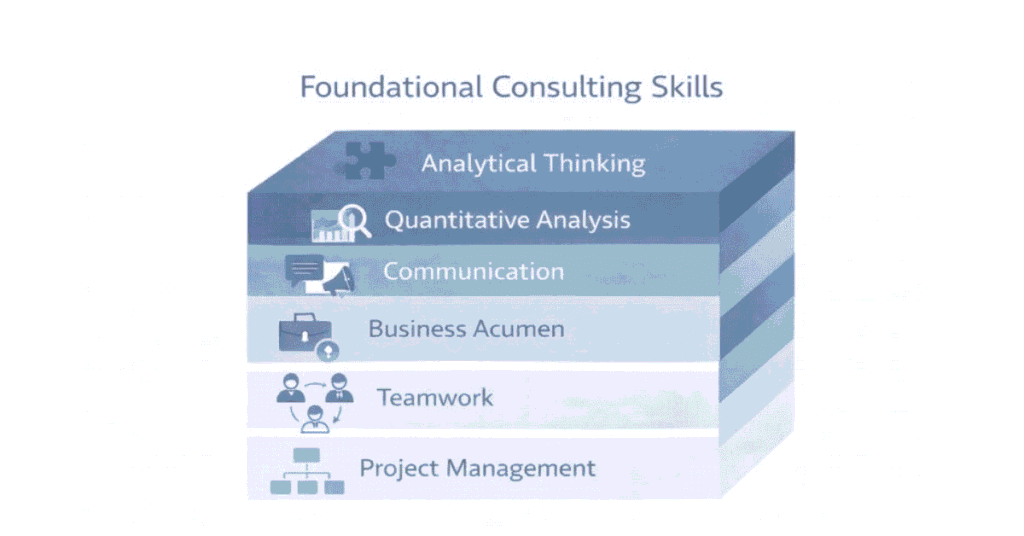
Core Skill 1: Analytical and Structured Problem-Solving
What it means:
The ability to take complex, messy business problems and break them into smaller, logical pieces that can be analyzed systematically.
Why it matters:
This is the foundation of all consulting work. Clients hire consultants because they’re stuck—they don’t know why profits are falling, which market to enter, or how to fix operations. Your job is to structure the chaos.upgrad+1
In practice:
- Breaking “profits are declining” into Revenue (price × volume) and Costs (fixed + variable)
- Decomposing “should we enter this market?” into Market attractiveness, Competition, Company capabilities, Entry strategy
- Using frameworks like MECE (Mutually Exclusive, Collectively Exhaustive) to ensure nothing is missed
How to develop it:
- Practice case interviews (even if not applying yet): Solve 50+ business cases to internalize structured thinkingcareerinconsulting+1
- Use frameworks in daily life: Apply problem-solving structures to personal decisions (choosing a career, budgeting, planning trips)
- Study business situations: Read case studies (Harvard Business Review, business news) and mentally structure problems before reading solutions
- Take online courses:
- “Introduction to Strategic Thinking” (Coursera)
- “Business Problem Solving” (LinkedIn Learning)
Resources:
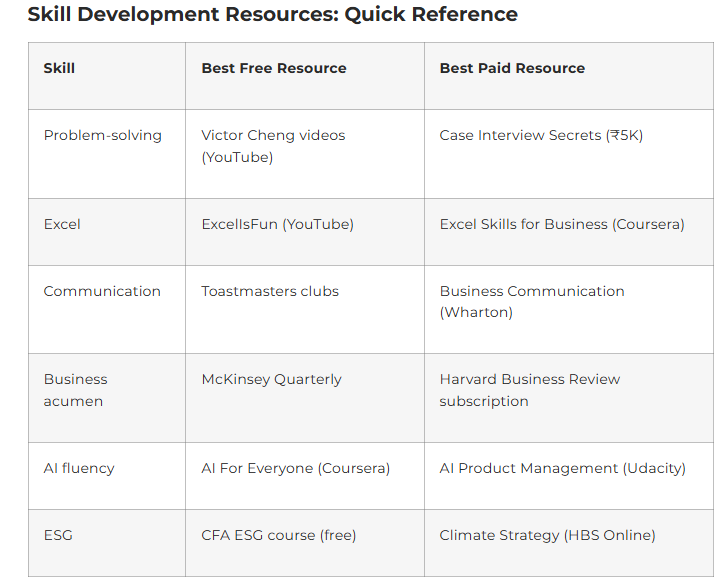
- Victor Cheng’s “Case Interview Secrets” (frameworks guide)
- “The McKinsey Way” by Ethan Rasiel (problem-solving methodology)
Core Skill 2: Quantitative and Data Analysis
What it means:
Comfort working with numbers, data, spreadsheets, and basic statistics to extract insights and support recommendations.
Why it matters:
Consulting decisions must be data-driven, not opinion-based. You’ll constantly analyze sales data, cost structures, market sizes, financial models, and operational metrics.upgrad+1
In practice:
- Building Excel models to project 5-year revenue under different scenarios
- Calculating ROI for a potential investment
- Analyzing customer data to identify high-value segments
- Creating charts that make complex data understandable at a glance
How to develop it:
- Master Excel/Google Sheets:
- Formulas: VLOOKUP, INDEX-MATCH, SUMIF, pivot tables
- Functions: What-if analysis, scenario modeling, data validation
- Practice with real business datasets (Kaggle has many)
- Learn basic statistics:
- Averages, medians, percentiles
- Growth rates and compound growth
- Correlation vs causation
- Sample sizes and confidence
- Practice mental math daily: 10 minutes of percentage calculations, multiplication, estimationigotanoffer+1
- Take courses:
- “Excel Skills for Business” (Coursera – Macquarie University)
- “Data Analysis and Visualization” (Udemy)
- “Business Statistics” (Khan Academy – free)
Resources:
- “Excel for Professionals” YouTube channels (ExcelIsFun, Leila Gharani)
- Practice datasets: data.gov.in, Kaggle
Core Skill 3: Communication and Presentation
What it means:
The ability to explain complex ideas simply, structure compelling presentations, and communicate confidently with diverse audiences—from frontline staff to CEOs.
Why it matters:
Brilliant analysis means nothing if you can’t communicate it. Consultants spend 30-40% of their time crafting presentations and 20-30% in meetings explaining recommendations.gisma+2
In practice:
- Building PowerPoint/Google Slides decks with clear storylines
- Writing executive summaries that busy leaders can scan in 2 minutes
- Presenting recommendations confidently to senior stakeholders
- Facilitating workshops with 20-30 client team members
- Explaining technical concepts to non-technical audiences
How to develop it:
- Learn presentation structure:
- Pyramid Principle: Start with the answer, then support with evidence
- SCQA: Situation → Complication → Question → Answer
- Each slide = one main message (headline tells the story)
- Practice slide design:
- Use charts/visuals instead of text-heavy slides
- Follow the “5-second rule”: Can someone understand your slide in 5 seconds?
- Learn PowerPoint/Google Slides shortcuts and templates
- Improve verbal communication:
- Join Toastmasters or public speaking clubs
- Record yourself presenting and watch for filler words (“um,” “like,” “you know”)
- Practice “executive presence”: confident, clear, concise
- Take courses:
- “Business Communication” (Coursera – Wharton)
- “Presentation Skills” (LinkedIn Learning)
- “Storytelling with Data” by Cole Nussbaumer Knaflic
Resources:
- “The Pyramid Principle” by Barbara Minto
- “Made to Stick” by Chip and Dan Heath
- McKinsey/BCG sample presentations (search online)
Core Skill 4: Business Acumen and Industry Knowledge
What it means:
Understanding how businesses make money, how different industries operate, and what drives success or failure in various markets.
Why it matters:
You can’t advise companies if you don’t understand basic business models, competitive dynamics, and industry economics. Strong business intuition helps you spot problems faster and recommend realistic solutions.upgrad+1
In practice:
- Knowing that retail operates on thin margins (2-5%) while software can have 80%+ margins
- Understanding how banks make money (interest spreads, fees)
- Recognizing that seasonal businesses (ice cream, winter clothing) need different working capital strategies
- Identifying when a cost problem is due to scale vs inefficiency
How to develop it:
- Read business news daily (15-20 min):
- Economic Times, Business Standard, Mint
- Focus on: company strategies, industry trends, financial results
- Ask: “Why did they make this decision? What are the trade-offs?”
- Study annual reports: Read 10-15 annual reports from companies across industries (Reliance, TCS, HDFC Bank, Asian Paints, etc.)
- Understand revenue models, cost structures, growth strategies
- Follow industry-specific content:
- McKinsey Quarterly (free articles)
- Harvard Business Review
- Industry reports from IBEF, Bain, BCG
- Take courses:
- “Introduction to Business Strategy” (Coursera – UVA Darden)
- “Understanding Business Financials” (Khan Academy)
Pro tip: Pick 3-4 industries you’re interested in (tech, BFSI, retail, healthcare) and go deep—this builds specialized knowledge that’s valuable in interviews and on projects.
Core Skill 5: Interpersonal and Teamwork Skills
What it means:
Working effectively with diverse teams, building relationships, managing stakeholders, and navigating organizational dynamics gracefully.
Why it matters:
Consulting is intensely collaborative. You’ll work in small teams with people from different backgrounds, interact with client teams who may be skeptical or resistant, and juggle multiple stakeholders with competing interests.upgrad+1
In practice:
- Coordinating daily with 3-5 team members under tight deadlines
- Managing a client manager who’s defensive about current processes
- Building trust with frontline employees during interviews
- Giving feedback to junior team members tactfully
- Resolving conflicts when team members disagree on approach
How to develop it:
- Join team projects: Participate in group assignments, hackathons, business competitions, NGO work
- Practice active listening: Focus completely when others speak, ask clarifying questions, paraphrase to confirm understanding
- Develop emotional intelligence:
- Recognize others’ emotions and motivations
- Manage your own reactions under stress
- Show empathy and adapt communication style to different people
- Learn conflict resolution: When disagreements arise, focus on interests (what people need) not positions (what they’re demanding)
- Seek feedback regularly: Ask peers and mentors how you come across in team settings
Resources:
- “Crucial Conversations” by Kerry Patterson
- “Never Split the Difference” by Chris Voss
- “Emotional Intelligence 2.0” by Travis Bradberry
Core Skill 6: Project Management and Time Management
What it means:
Planning work effectively, managing deadlines, prioritizing tasks, and delivering consistent quality despite competing demands.
Why it matters:
Consulting moves fast. You’ll often juggle 3-4 workstreams simultaneously, each with tight deadlines. Poor time management leads to missed deadlines, late nights, and burnout.casebasix+1
In practice:
- Breaking a 3-month project into weekly milestones
- Estimating how long each analysis will take (and adding buffer)
- Prioritizing: “This analysis is critical for tomorrow’s client meeting; that one can wait”
- Delegating tasks to team members based on skills and capacity
- Tracking progress and flagging risks early
How to develop it:
- Use project management tools: Trello, Asana, Monday.com, or even simple to-do lists
- Practice the Eisenhower Matrix:
- Urgent + Important: Do now
- Important, not urgent: Schedule
- Urgent, not important: Delegate
- Neither: Eliminate
- Time-block your day: Assign specific hours to specific tasks
- Learn to estimate time: Track how long tasks actually take vs your estimates; improve accuracy over time
- Take courses/certifications:
- Google Project Management Certificate (Coursera)
- PMP basics (even without full certification)
- “Getting Things Done” methodology
Core Skill 7: Adaptability and Learning Agility
What it means:
Quickly learning new industries, tools, concepts, and adapting to changing project needs without losing productivity or confidence.
Why it matters:
Consulting throws you into unfamiliar situations constantly. One month it’s pharmaceuticals, next month it’s logistics. You must learn fast, stay calm amid ambiguity, and perform even when 70% of the context is new.gisma+1
In practice:
- Reading 100+ pages of industry material over a weekend to understand a new client’s business
- Learning a new analysis tool mid-project because the client uses it
- Pivoting project approach when initial findings invalidate your hypothesis
- Handling last-minute changes to deliverables without panic
How to develop it:
- Deliberately expose yourself to new topics: Every month, pick an unfamiliar industry or concept and spend 5 hours learning it
- Embrace discomfort: When you feel lost, that’s where learning happens—lean into it
- Build learning frameworks: Develop personal processes for quickly absorbing new information (e.g., “First I’ll read an overview, then deep-dive on key topics, then find 3 experts to follow”)
- Reflect on learning: After projects or courses, write down what you learned and how you learned it
Resources:
- “Mindset” by Carol Dweck (growth mindset)
- “Ultralearning” by Scott Young (rapid skill acquisition)
Future-Ready Skill 8: AI and Technology Fluency
What it means:
Understanding how AI, automation, cloud, and digital technologies work, and how they can solve business problems—without necessarily being a programmer.
Why it matters:
By 2025, AI and digital transformation dominate consulting agendas. Clients want help adopting GenAI, automating processes, building data platforms, and digitizing operations. Consultants who combine business thinking with tech fluency are in highest demand.hbr+2
In practice:
- Advising a retail client on using AI for demand forecasting
- Helping a bank implement cloud-based systems for better scalability
- Analyzing where automation can cut operational costs by 20%
- Understanding APIs, data lakes, machine learning models at a conceptual level
- Using AI tools (ChatGPT, Claude, Copilot) to accelerate research and analysis
How to develop it:
- Learn AI/ML fundamentals (conceptual, not coding-heavy):
- “AI For Everyone” (Coursera – Andrew Ng)
- “Introduction to Generative AI” (Google Cloud)
- Understand digital transformation basics:
- Cloud computing (AWS, Azure, GCP basics)
- APIs and system integration
- Data analytics platforms (Power BI, Tableau)
- Use AI tools daily:
- ChatGPT for research, brainstorming, writing
- Copilot for data analysis
- Perplexity for fact-checking
- Optional: Learn light coding:
- Python basics (great for data analysis)
- SQL (for database queries)
- Excel VBA/Macros
Resources:
- “The AI-First Company” by Ash Fontana
- McKinsey reports on AI in businessmckinsey
- Newsletters: The Rundown AI, AI Supremacy
Future-Ready Skill 9: ESG and Sustainability Knowledge
What it means:
Understanding environmental, social, and governance (ESG) issues, carbon accounting, sustainability regulations, and how companies integrate these into strategy.
Why it matters:
ESG consulting is exploding. Companies face regulatory pressure, investor demands, and customer expectations to measure and reduce environmental impact, improve social practices, and strengthen governance. Consultants with ESG expertise command premium rates.cse-net+1
In practice:
- Helping a manufacturing client measure and reduce carbon emissions (Scope 1, 2, 3)
- Advising on ESG reporting frameworks (GRI, SASB, TCFD)
- Designing sustainable supply chain strategies
- Assessing climate risks for financial institutions
- Supporting companies in setting science-based targets (SBTi)
How to develop it:
- Learn ESG fundamentals:
- “ESG and Responsible Investment” (CFA Institute – free)
- “Climate Change and Business Strategy” (Harvard Business School Online)
- Understand reporting frameworks:
- GRI (Global Reporting Initiative)
- SASB (Sustainability Accounting Standards Board)
- TCFD (Task Force on Climate-related Financial Disclosures)
- Follow sustainability trends:
- Read: Carbon Brief, GreenBiz, Sustainability Magazine
- Watch: UN Climate Change updates, CDP reports
- Get certified (optional but valuable):
- Certified ESG Analyst (CESGA)
- LEED Green Associate
- Carbon Literacy certificationdazzle-platform+1
Pro tip: Even if you don’t specialize in ESG, basic literacy is becoming expected of all consultants—clients increasingly ask, “How does this decision impact our sustainability goals?”
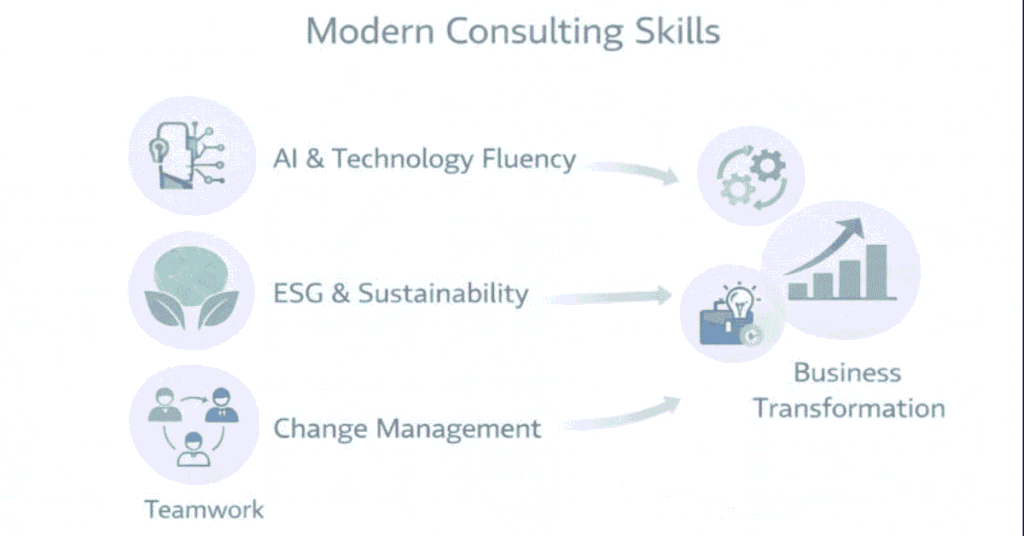
Future-Ready Skill 10: Change Management and Implementation
What it means:
The ability to help organizations actually implement recommendations, manage resistance, train employees, and ensure changes stick after consultants leave.
Why it matters:
Modern consulting isn’t just about making recommendations—it’s about ensuring impact. Clients increasingly expect consultants to support execution, and those who can bridge strategy and implementation are highly valued.consultingheads
In practice:
- Running training workshops for 100+ employees on new processes
- Designing change communication plans to reduce resistance
- Creating implementation roadmaps with clear milestones and owners
- Identifying and addressing organizational barriers to change
- Monitoring KPIs post-implementation to ensure success
How to develop it:
- Learn change management frameworks:
- ADKAR model (Awareness, Desire, Knowledge, Ability, Reinforcement)
- Kotter’s 8-Step Change Model
- Prosci Change Management methodology
- Study organizational behavior: Understand why people resist change and how to address it
- Practice influencing without authority: Lead projects where you don’t have direct control—learn to persuade, motivate, align
- Get certified:
- Prosci Change Management Certification
- Certified Change Management Professional (CCMP)
Resources:
- “Switch: How to Change Things When Change Is Hard” by Chip and Dan Heath
- “Leading Change” by John Kotter
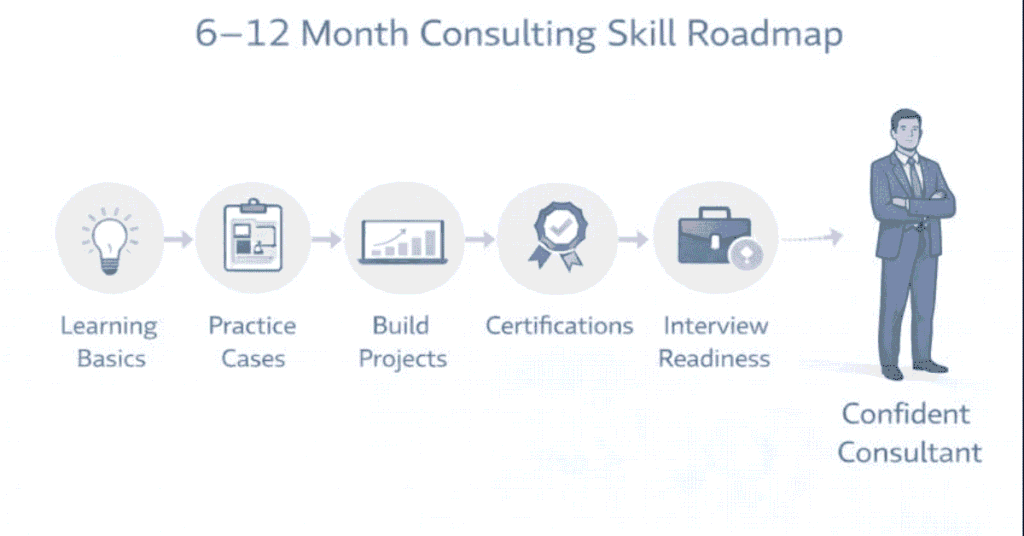
How to Build These Skills: Practical Roadmap
If You’re a Student (6-12 Months to Build Foundation)
Months 1-3: Core foundations
- Excel + business basics (2 hours/week)
- Case interview practice (3-4 cases/week)
- Read business news daily (20 min)
Months 4-6: Deepen and practice
- Join consulting club or case competitions
- Take on leadership role in campus activity
- Start learning one future skill (AI or ESG basics)
Months 7-12: Polish and specialize
- 50+ case practices with peers
- Build 2-3 mini-projects showing consulting skills (analyze a company, solve a business problem)
- Network with consultants, seek internships
If You’re a Working Professional (Lateral Entry)
Focus on transferable skills:
- Your domain expertise + consulting skills = powerful combination
- Take 1-2 online certifications (PMP, Six Sigma, or ESG)
- Do case practice intensively for 8 weeks before applying
- Leverage your industry knowledge in interviews
Final Thoughts: Skills > Pedigree
Here’s the truth: You don’t need an IIT/IIM background to succeed in consulting. Skills matter more than brand names, especially as firms diversify hiring.
The consultants who rise fastest are those who:
- Master structured thinking and communication early
- Stay curious and learn continuously
- Build specialized expertise (industry or function)
- Adapt to future trends (AI, ESG, digital)
Start with 2-3 core skills, get good at them, then layer on future skills over time. With 6-12 months of focused effort, you can build a consulting-ready skill set that opens doors at top firms.