
JAM Performance Evaluation Checklist
Table of Contents

Blog Content:
The Gap Between Feeling Good and Performing Well
After a JAM session, you might think: “That went pretty well!”
But did it really? Or are you using unclear standards?
Most students evaluate themselves vaguely. “It was okay,” “I did better than last time,” “I think the evaluator liked it.”
Vague self-assessment leads to vague improvement.
What you need is a concrete evaluation framework—objective standards against which to measure your performance.
This is exactly what professional speakers and athletes use. They don’t rely on gut feeling. They measure against specific criteria.
The JAM Evaluation Dimensions
Professional JAM evaluation uses 5-6 key dimensions. Let’s explore each:

Dimension 1: Fluency (Weight: 30-35%)
Definition: How smoothly and continuously you speak without hesitation, pauses, or filler words.
What Evaluators Listen For:
- Minimal hesitation (“um,” “uh,” “like,” “you know”)
- Smooth word flow without stuttering
- Continuous speech without long pauses
- Natural pacing (not rushed, not dragging)
Fluency Evaluation Rubric:
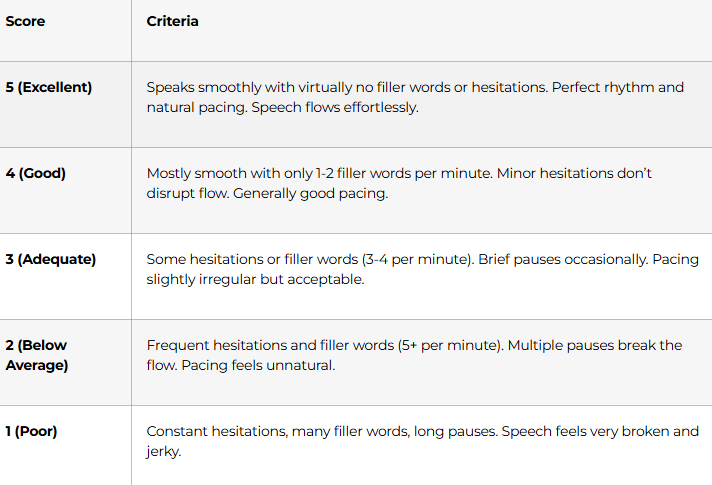
Self-Check Questions:
- Can you count fewer than 2 filler words per minute?
- Does your speech sound natural, conversational?
- Are there uncomfortable silences?
- Do you maintain steady pace throughout?
Improvement Focus (if scoring 3 or below):
- Slow down to speak more consciously
- Replace fillers with transitional phrases
- Build content faster so your mind catches up
- Practice breathing techniques
Dimension 2: Coherence (Weight: 25-30%)
Definition: How logically organized and easy to follow your speech is.
What Evaluators Listen For:
- Clear structure (beginning, middle, end)
- Logical progression of ideas
- Ideas building on each other
- Clear connections between points
- Speech feels complete, not random
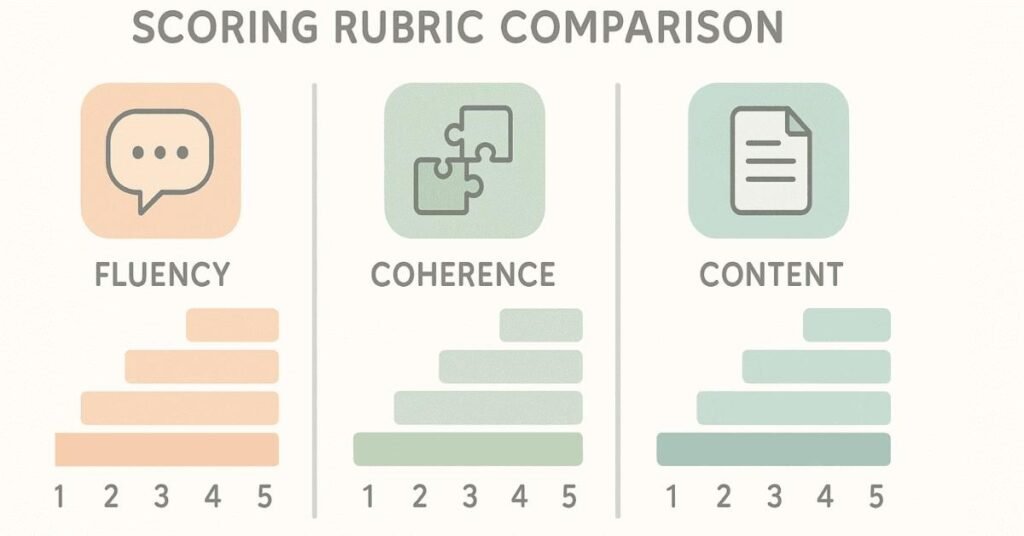
Coherence Evaluation Rubric:

Self-Check Questions:
- Can you identify your opening, 2-3 main points, and closing?
- Does each idea connect to the previous one?
- Is there a clear progression from beginning to end?
- Would someone understand your main message?
Improvement Focus (if scoring 3 or below):
- Use STAR or three-point framework
- Practice transitional phrases
- Map out your speech structure before speaking
- Have someone listen and tell you if they followed it
🔍 Explore structured learning resources designed to strengthen clarity, accuracy, and delivery →
Dimension 3: Content Quality (Weight: 20-25%)
Definition: The accuracy, relevance, depth, and specificity of your information.
What Evaluators Listen For:
- Accurate information (nothing factually wrong)
- Specific examples (not vague generalities)
- Relevant information (connected to topic)
- Depth of understanding (not superficial)
- Appropriate vocabulary (shows knowledge)
Content Quality Evaluation Rubric:

Day 1-2: Focus on Pacing
- Practice with metronome
- Record and time yourself
- Identify your natural pace
Day 3-4: Focus on Voice Modulation
- Vocal scale exercises
- Practice pitch variation
- Work on volume projection
Day 5-6: Focus on Pronunciation
- Tongue twisters daily
- Mirror practice
- Record and correct unclear sounds
Day 7: Focus on Breathing
- Diaphragmatic breathing exercises
- Strategic pause practice
- Full JAM simulation with all techniques
Repeat this cycle for 3-4 weeks and you’ll see dramatic improvement.
Self-Check Questions:
- Did I provide 2-3 specific examples or statistics?
- Is everything I said factually accurate?
- Does my content go beyond surface-level?
- Did I use appropriate, sophisticated vocabulary?
- Would an expert find my content credible?
Improvement Focus (if scoring 3 or below):
- Build your content repository (read daily)
- Include specific examples: “research shows,” “for instance,” “statistically”
- Avoid vague statements
- Use precise vocabulary

📘 Discover more preparation-focused content created to support consistent performance improvement →
Dimension 4: Confidence & Composure (Weight: 10-15%)
Definition: How assured and composed you appear while speaking.
What Evaluators Observe:
- Eye contact with evaluator
- Calm body language
- Steady voice (not shaking)
- No obvious nervousness signals
- Maintains composure if interrupted
Confidence Evaluation Rubric:

Self-Check Questions:
- Did I maintain eye contact 70%+ of the time?
- Did my body feel and look relaxed?
- Did my voice remain steady throughout?
- Did I show any nervousness signals (fidgeting, trembling)?
- How did I respond to interruptions? Calmly?
Improvement Focus (if scoring 3 or below):
- Practice power posing before speaking
- Do breathing exercises beforehand
- Practice in front of audiences to normalize the experience
- Remember: Nervousness is normal; showing it is optional
Dimension 5: Rule Adherence (Pass/Fail)
Definition: Whether you followed JAM rules: No deviation, repetition, or hesitation.
Rule Adherence Checklist:
No Deviation (stayed on topic):
- Every sentence related to the given topic
- No random tangents
- Personal examples connected back to topic
- No veering into unrelated areas
No Repetition (no redundant information):
- Each point was unique
- Didn’t repeat the same idea multiple times
- Used synonyms instead of repeating words
- Content continuously moved forward
No Hesitation (minimal pauses and fillers):
- Fewer than 2 filler words per minute (“um,” “uh,” “like”)
- No long pauses mid-speech
- Continuous flow throughout 60 seconds
- No stuttering or voice breaking
Self-Check:
If all three boxes are checked, Rule Adherence = PASS
If any box has issues, Rule Adherence = NEEDS WORK
Companies often eliminate candidates who violate rules, regardless of other strengths. Ensure rule adherence is consistently excellent.
Dimension 6: Time Management (Pass/Fail)
Definition: Whether you used your 60 seconds effectively.
Time Management Evaluation:

Self-Check:
- Did you fill the entire 60 seconds?
- Did you have to rush at the end?
- Did you stop significantly early?
- Was your content throughout the speech high-quality?
Goal: Speak for 55-60 seconds consistently with good content throughout.
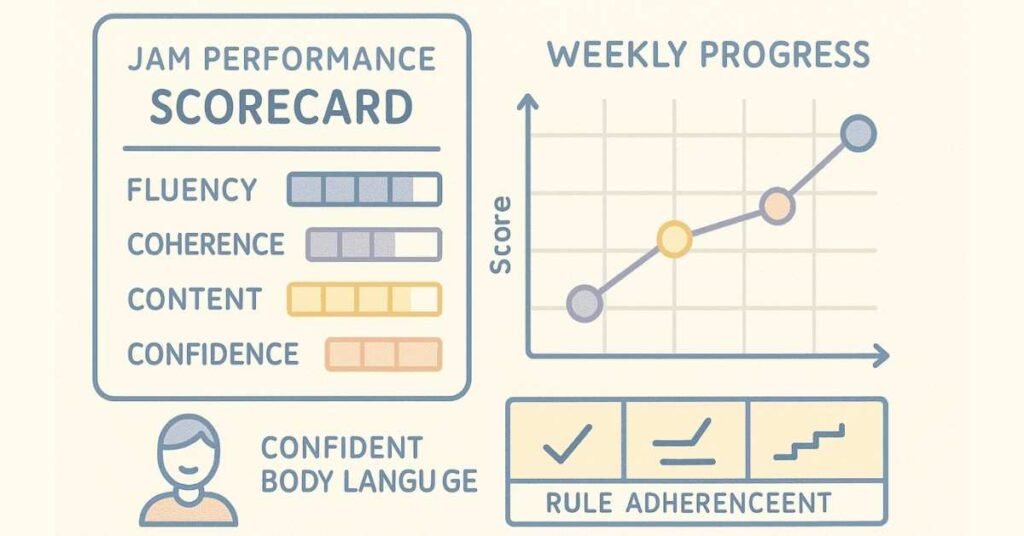
Your Personal JAM Evaluation Form
Use this after every practice session or mock interview:
JAM Evaluation Form
Date: __________ Topic: __________
Fluency Score: 1 / 2 / 3 / 4 / 5
Specific notes: ________________________
Coherence Score: 1 / 2 / 3 / 4 / 5
Structure was: Opening → _____ → _____ → Closing
Content Quality Score: 1 / 2 / 3 / 4 / 5
Specific examples used: ________________
Accuracy: ____________________________
Confidence Score: 1 / 2 / 3 / 4 / 5
Body language: _________ Eye contact:
Rule Adherence: ☐ PASS ☐ NEEDS WORK
Deviation issues:
Repetition issues:
Hesitation issues:
Time Management: seconds
Content quality throughout: ☐ Consistent ☐ Declined toward end
One Thing I Did Well:
One Thing to Improve:
Target Score for Next Practice:
Fluency: ____ Coherence: ____ Content: ____ Confidence: ____
📂 Access complete learning materials that enhance reasoning, confidence, and measurable growth →
Tracking Your Progress Across Dimensions
Create a simple tracking sheet:

Seeing this progression is incredibly motivating and shows objective improvement.
When You're Ready for Real JAM
You’re ready to face actual campus placement JAM when:
- Fluency consistently scores 4/5 or higher
- Coherence consistently scores 4/5 or higher
- Content Quality consistently scores 4/5 or higher
- Confidence consistently scores 4/5 or higher
- Rules: Always PASS
- Time Management: Consistently 55-60 seconds
- You feel genuinely confident (not just pretending)
- Mock evaluators give you positive feedback consistently
If any dimension is below 4/5, continue targeted practice on that area.
Understanding Evaluator Perspective
Different evaluators might weight dimensions differently:
Technical Evaluator (45% Fluency, 25% Coherence, 20% Content, 10% Confidence)
- Focuses heavily on smooth delivery
- Values clarity and no hesitation
- Wants ideas logically organized
- Content quality secondary
Strategy: For technical evaluators, obsess over fluency and rule adherence.
Content-Focused Evaluator (20% Fluency, 20% Coherence, 40% Content, 20% Confidence)
- Prioritizes what you know
- Wants sophisticated understanding
- Values specific examples
- Delivery matters less than substance
Strategy: For content-focused evaluators, invest heavily in knowledge building.
Leadership Evaluator (15% Fluency, 15% Coherence, 20% Content, 50% Confidence)
- Observes how you handle pressure
- Assesses leadership potential
- Wants to see composure
- Delivery confidence matters most
Strategy: For leadership evaluators, focus on confidence and poise.
Most evaluators use a balanced approach, so excel in all dimensions.
Continue your learning journey with more structured guidance and improvement-focused insights →
Key Takeaways for Evaluation
- Fluency (30-35%): Smooth speech with minimal hesitation and filler words
- Coherence (25-30%): Logically organized with clear flow
- Content Quality (20-25%): Accurate, specific, relevant information
- Confidence (10-15%): Composed body language and steady voice
- Rule Adherence: No deviation, repetition, or hesitation (automatic elimination if violated)
- Time Management: Use full 60 seconds consistently
- Use evaluation form after every practice to track progress
- Set specific numerical targets for each dimension
- Understand that improvement is measurable through consistent assessment
You’re ready for real JAM when all dimensions score 4/5+ with consistent rule adherence