
HR CAREER PROGRESSION AND ADVANCEMENT STRATEGIES
Table of Contents
You’re three years into your HR career as an HR Generalist. You enjoy the work and perform well, but lately you’ve been wondering: Where is this heading? What’s my next step? Should I specialize in talent acquisition or compensation, or continue as a generalist? How long until I can become an HR Manager? What does it really take to reach HR Director or CHRO someday? How do I intentionally build my career rather than just letting it happen?
These questions are critical because HR career progression isn’t automatic or linear. Unlike professions with clear hierarchies (medicine has defined progression from resident to attending physician), HR offers multiple pathways with different timelines, trade-offs, and requirements. Strategic career planning—understanding the landscape, making intentional choices, and building required capabilities—dramatically accelerates your progression and increases your probability of reaching senior roles.
This comprehensive guide provides your complete HR career progression roadmap including typical career stages and timelines from entry to executive, the generalist versus specialist career decision and when to choose each path, strategic skills and experiences to build at each stage, common career pivots and lateral moves, accelerating advancement and avoiding plateaus, and realistic paths to reaching CHRO or equivalent senior leadership.
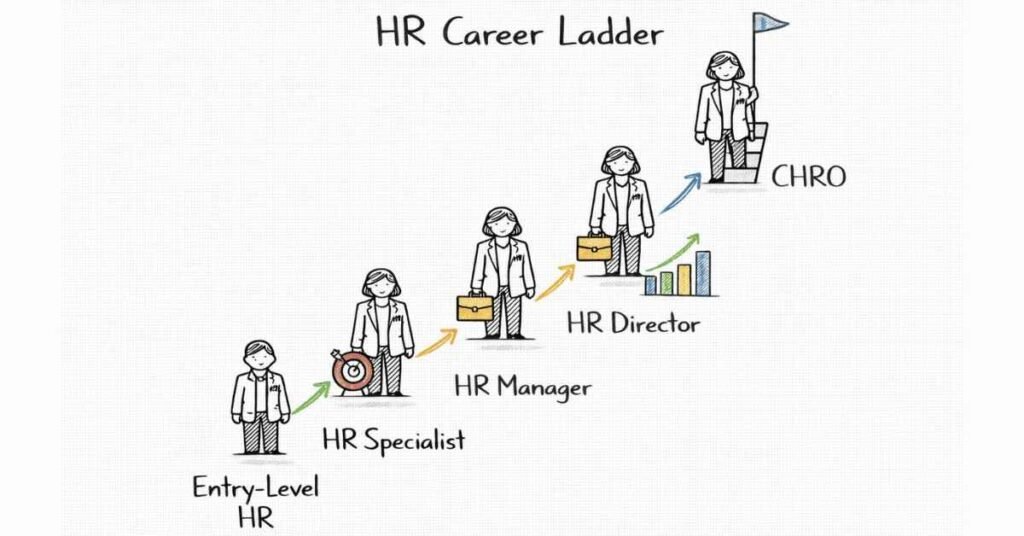
Understanding HR Career Architecture
HR offers diverse career paths—not a single ladder but a climbing wall with multiple routes to the top:
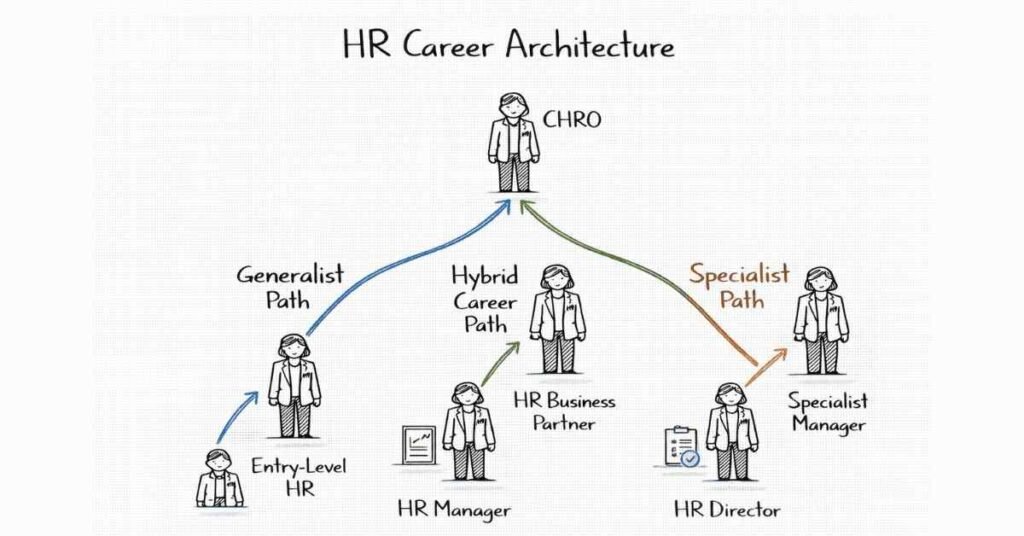
The Traditional Vertical Path (33% of HR Professionals)
This path involves progressive promotions within the HR function, steadily increasing responsibility and scope:
Entry-Level → Mid-Level → Senior → Leadership
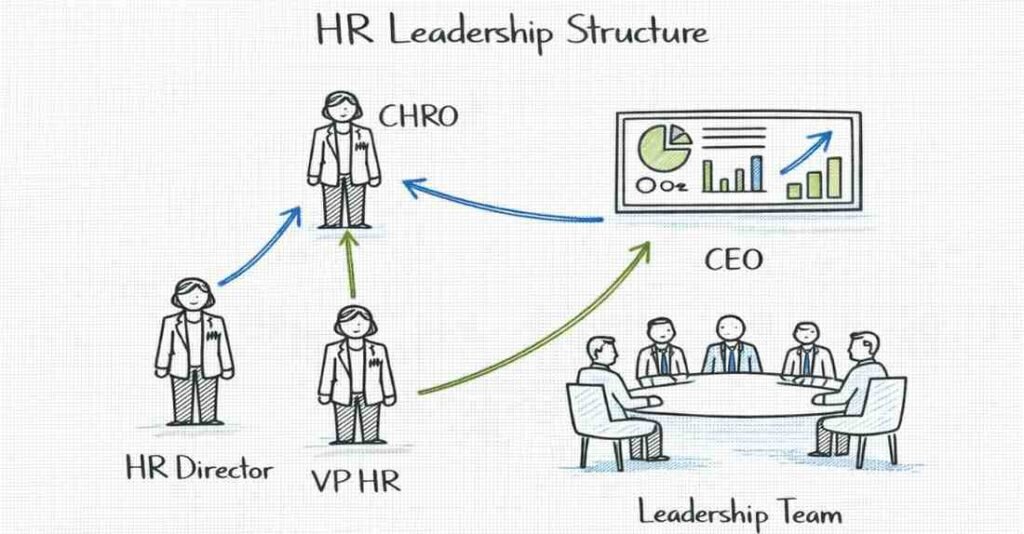
Example progression: HR Coordinator → HR Generalist → Senior HR Generalist → HR Manager → Senior HR Manager → HR Director → VP of HR → CHRO.aus+1
Timeline: Approximately 15-25 years from entry to CHRO, though exceptional performers can accelerate this.
Who Succeeds Here: Professionals who consistently deliver strong performance, develop broad HR capabilities, build strong relationships, and position themselves for promotions as they become available.
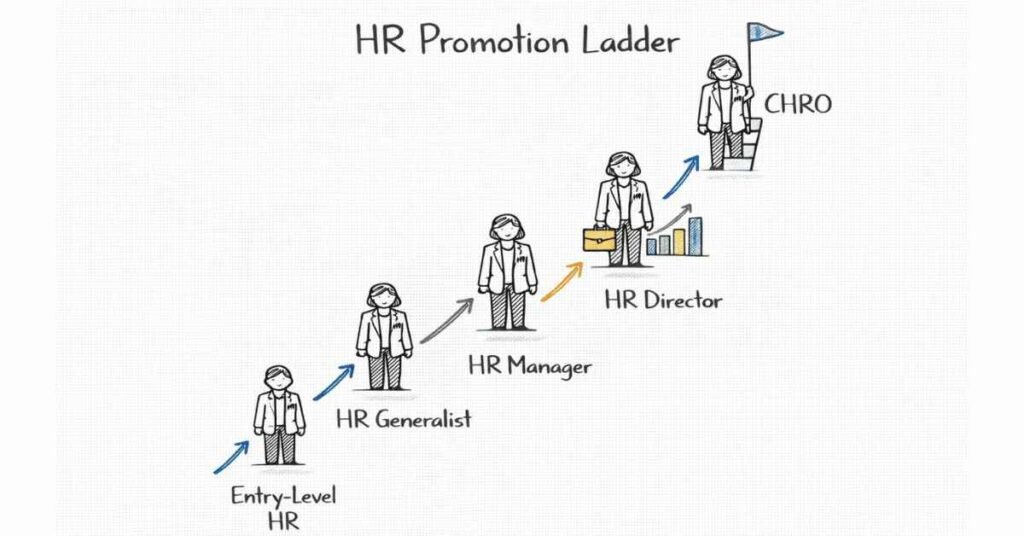
The Specialist Path (Percentage Varies)
This path involves deep expertise in specific HR domains:
Entry-Level Specialist → Senior Specialist → Team Lead → Manager → Director → Executive
Example: Recruitment Coordinator → Recruiter → Senior Recruiter → Talent Acquisition Manager → Director of Talent Acquisition → VP of Talent.
Alternative Domains: Compensation & Benefits, Learning & Development, HRIS, People Analytics, Employee Relations, DEI.
Who Succeeds Here: Detail-oriented professionals who love depth, want to be recognized experts, and build differentiated value through specialized knowledge.
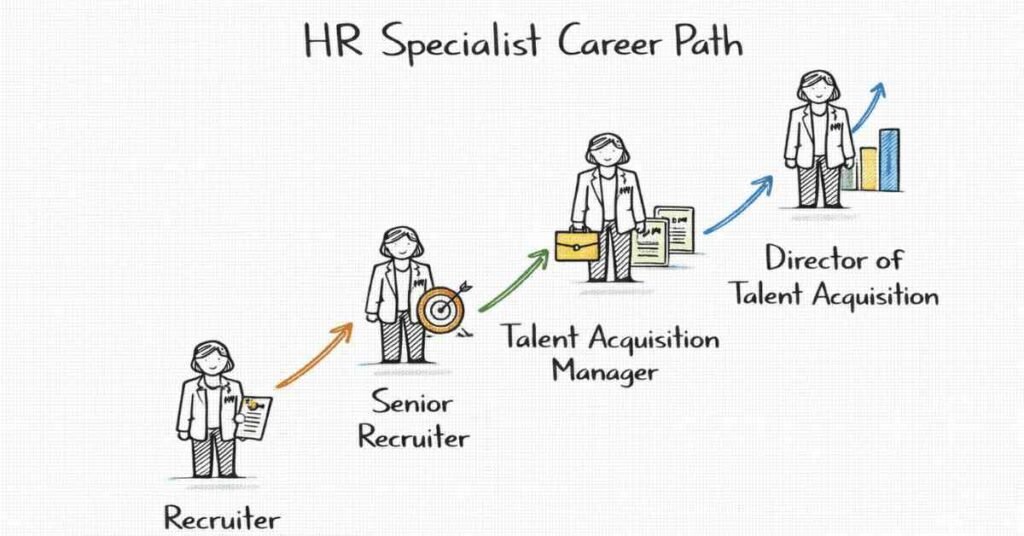
The Non-Linear Path (Growing Percentage)
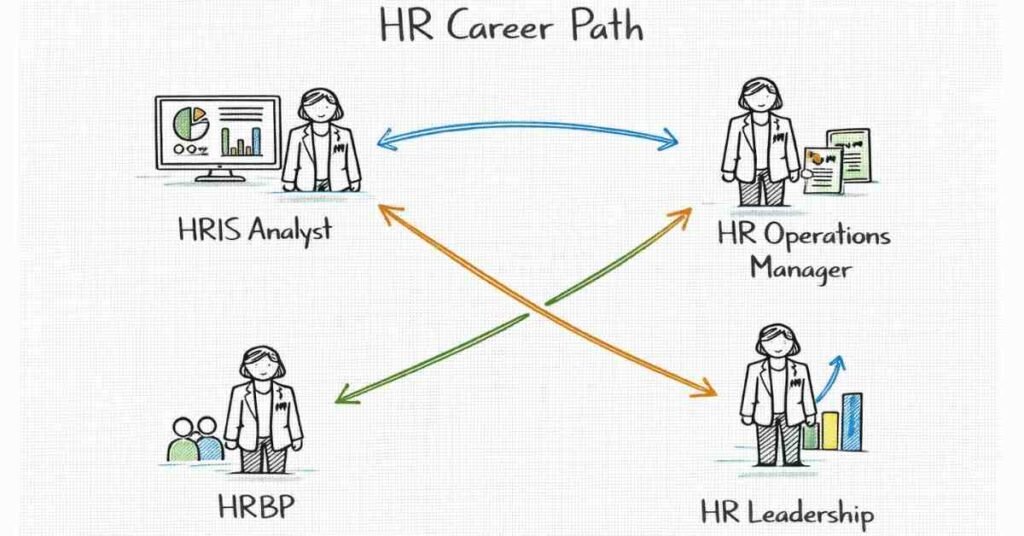
Modern HR careers increasingly involve lateral moves, function switches, and unconventional progressions:
Examples:
- HRIS Analyst → HR Operations Manager → Shared Services Manager → CHRO
- Talent Acquisition Specialist → HRBP → HR Manager → Director of People Operations
- HR Generalist → Compensation Analyst → Senior Compensation Manager → Director of Total Rewards
Who Succeeds Here: Professionals who strategically build diverse experiences, are comfortable with ambiguity, and leverage unique skill combinations to create differentiated value.
The Four Career Stages in HR
Understanding typical stages helps you assess where you are and plan what’s next:
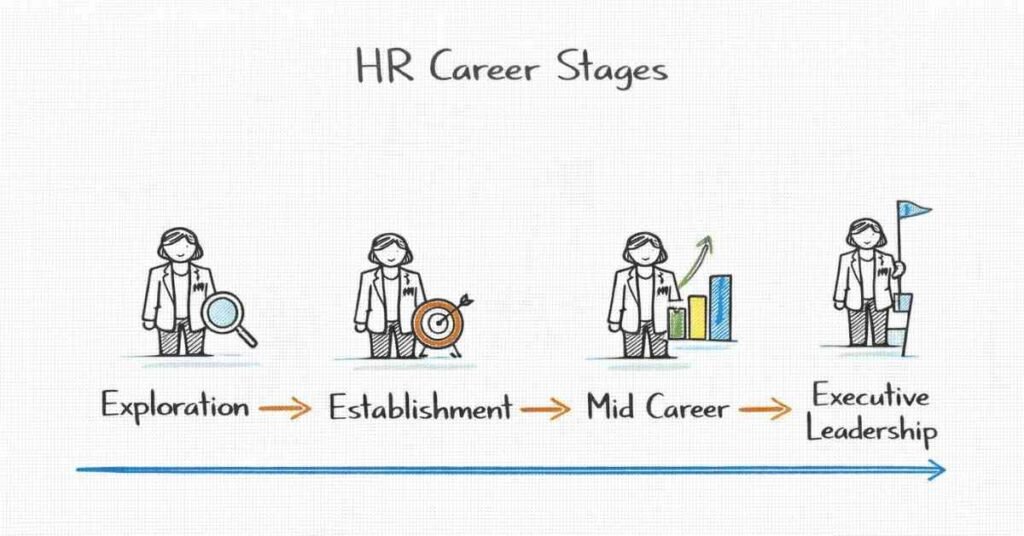
Stage 1: Exploration (0-3 Years)
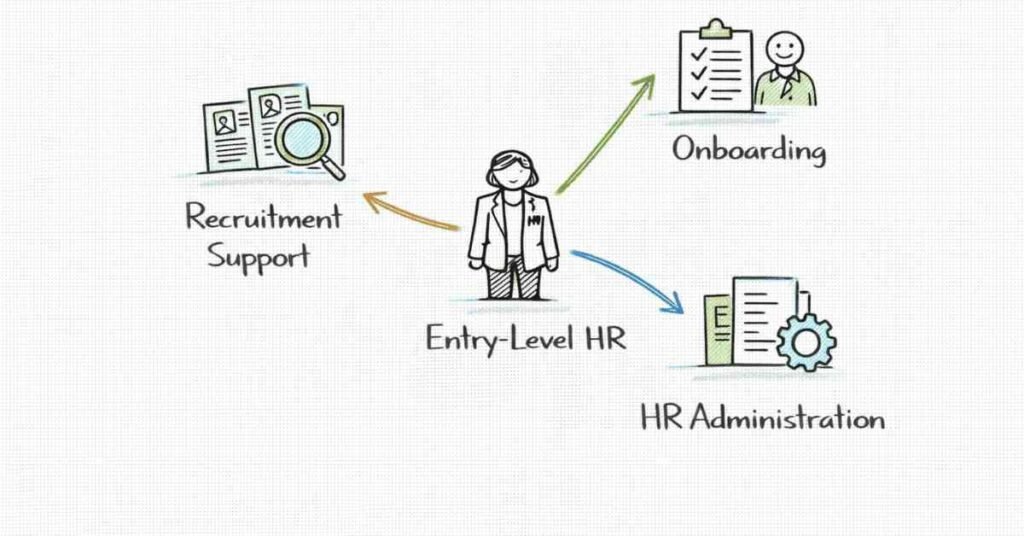
Roles: HR Assistant, HR Coordinator, HR Trainee, Recruitment Coordinator, Junior HR Executive.
Typical Salary: ₹2-5 lakhs annually.
What You’re Doing: Learning HR fundamentals, handling operational tasks, supporting senior HR professionals, gaining exposure to multiple HR functions, building foundational skills, and discovering what aspects of HR energize you.
- Master HR basics across recruitment, onboarding, employee relations, and compliance
- Demonstrate reliability, attention to detail, and professionalism
- Build relationships with colleagues and stakeholders
- Identify areas of HR that interest you most
- Seek diverse experiences to understand the full HR landscape
Common Pitfalls:
- Job-hopping too frequently (stay minimum 18-24 months to learn)
- Specializing too early before understanding broader HR
- Focusing only on tasks without understanding business context
- Neglecting soft skills development (communication, relationship building)
Success Metrics:
- Completing assigned work accurately and on time
- Taking initiative beyond core responsibilities
- Receiving positive feedback from managers and stakeholders
Earning first promotion or expanded responsibilities
Stage 2: Establishment (3-7 Years)
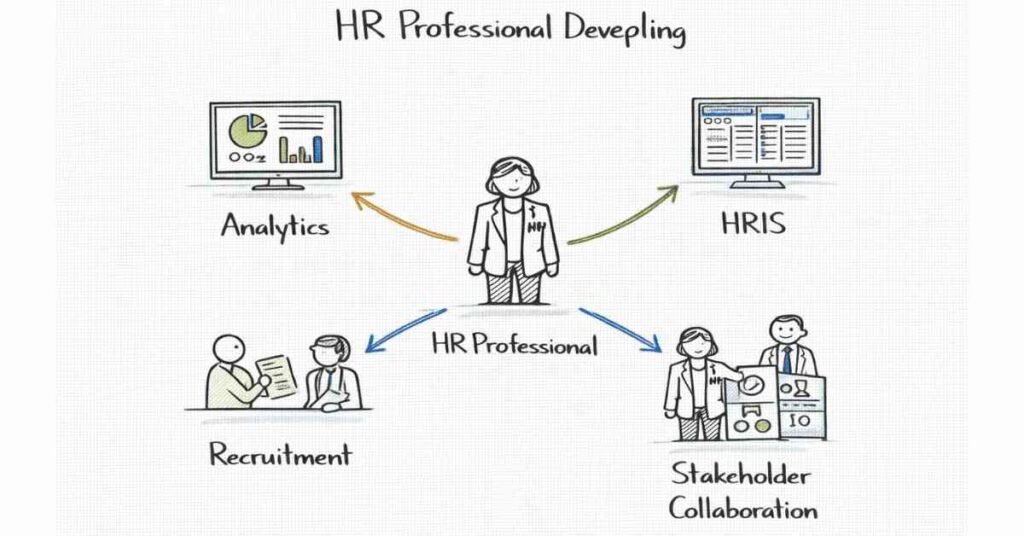
Roles: HR Generalist, HR Specialist (Recruiter, Compensation Analyst, L&D Specialist, HRIS Analyst), HR Executive, HRBP (early).
Typical Salary: ₹5-10 lakhs annually.
What You’re Doing: Developing expertise in chosen areas, managing processes independently, building deeper business understanding, starting to influence decisions rather than just executing, and choosing between generalist breadth or specialist depth.
Key Objectives:
- Build recognized competence in 1-2 HR areas
- Develop business acumen by understanding how HR impacts business results
- Take ownership of complete processes or projects
- Start influencing stakeholders and making recommendations
- Demonstrate measurable impact (metrics, results, improvements)
- Decide on generalist vs. specialist trajectory
Critical Decision Point: Generalist vs. Specialist
This stage requires choosing your path (though it’s not permanent—many switch later):
Choose Generalist If:
- You enjoy variety and wearing multiple hats
- You want to understand how all HR pieces fit together
- You aspire to HR leadership (most CHROs come from generalist backgrounds)
- You prefer broader impact across multiple areas
- You’re considering international moves (generalists transfer more easily)
Choose Specialist If:
- You’re passionate about specific HR domain
- You love deep expertise and becoming recognized expert
- You’re detail-oriented and enjoy mastery
- You want to command premium compensation through specialized knowledge
- You enjoy staying within specific domain
Success Metrics:
- Owning processes or programs independently
- Receiving recognition as go-to person for specific areas
- Demonstrating measurable business impact
- Building strong stakeholder relationships
Earning promotion to senior roles
Stage 3: Mid-Career Strategic Roles (7-15 Years)
Roles: HR Business Partner, Senior HR Generalist, HR Manager, Senior Specialist (Senior TA Manager, C&B Manager, Senior HRIS Manager), Lead roles.
Typical Salary: ₹10-25 lakhs annually.
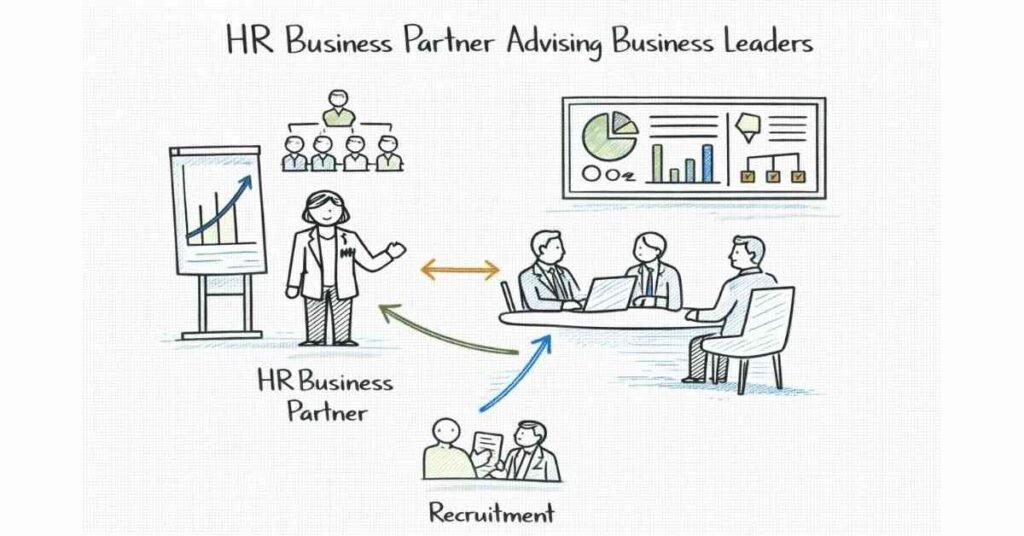
What You’re Doing: Partnering with business leaders strategically, leading HR initiatives and programs, potentially managing people/teams, influencing organizational direction, solving complex people challenges, and building reputation as HR expert.
Key Objectives:
- Transition from execution to strategy and influence
- Partner with senior business leaders on people matters
- Lead significant initiatives (culture change, talent strategy, HR transformation)
- Develop people leadership skills if managing teams
- Build external visibility (speaking, writing, networking)
- Earn advanced certifications (SHRM-SCP, SPHR, specialized credentials)
- Demonstrate business impact through metrics and results
Critical Success Factors:
- Strategic thinking—connecting HR to business outcomes
- Executive presence and communication
- Influencing without authority
- Change management capabilities
- Data-driven decision making
- Business acumen and commercial awareness
Common Pitfalls:
- Remaining too operational instead of becoming strategic
- Failing to develop business acumen
- Poor stakeholder management
- Neglecting continuous learning
- Not building external visibility and network
Success Metrics:
- Business leaders actively seeking your counsel
- Leading major initiatives successfully
- Promotions to director-track roles
- Recognition within and outside organization
Strong engagement and culture metrics in your area
Stage 4: Leadership and Executive Roles (15+ Years)
Roles: HR Director, VP of HR, Head of HR, CHRO, Chief People Officer.
Typical Salary: ₹25-70+ lakhs annually (CHRO average ₹55 lakhs, top performers ₹3.5 crores).
What You’re Doing: Setting HR vision and strategy for organization, partnering with CEO and board, leading HR teams, driving organizational culture and transformation, representing HR at highest executive levels, and aligning people strategy with business strategy.
Key Objectives:
- Develop and execute comprehensive people strategy
- Build high-performing HR organizations
- Drive business results through people initiatives
- Influence organizational strategy and direction
- Manage C-suite relationships effectively
- Create employer brand and culture
- Demonstrate clear ROI of HR investments
Requirements to Reach This Level:
- 10-20 years progressive HR experience
- Proven track record of strategic HR leadership
- Strong business acumen and commercial awareness
- Executive presence and gravitas
- Change management and transformation experience
- Demonstrated ability to drive business results
- Often MBA or master’s degree
- Extensive network and industry reputation
Success Metrics:
- Employee engagement and culture metrics
- Talent acquisition and retention success
- Organizational capability building
- Business results linked to people initiatives
- Board and CEO confidence
- Industry recognition and reputation
Generalist vs. Specialist: The Strategic Choice
This is one of the most consequential career decisions you’ll make:
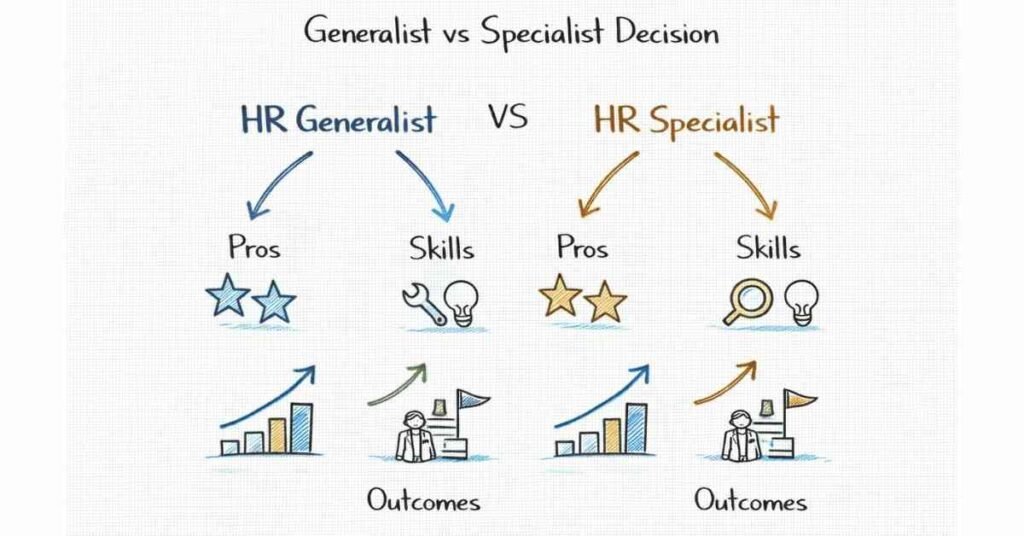
The HR Generalist Path
Definition: Broad knowledge across all HR functions—recruitment, employee relations, compensation, L&D, compliance, performance management.
Strengths:
- Flexibility: Can work across HR functions and adapt to organizational needs[shrm]
- Broader Perspective: Understands how HR pieces interconnect
- Leadership Pipeline: Most CHROs come from generalist backgrounds because they understand full HR landscape
- Geographic Mobility: Easier to relocate internationally
- Organizational Agility: Can move across industries more easily
Challenges:
- Depth Trade-off: May lack deep expertise that specialists possess
- Competitive Differentiation: Harder to stand out—many generalists exist
- Specialization Premium: Often earn less than specialists in high-demand areas
- Jack of All Trades Risk: May be seen as not expert in anything specific
Best For:
- Those who enjoy variety and diverse challenges
- Aspiring HR leaders targeting director/CHRO roles
- Professionals in smaller organizations wearing multiple hats
- Those who like strategic thinking connecting multiple domains
Career Trajectory Example:
HR Coordinator (2 years) → HR Generalist (3 years) → Senior HR Generalist (3 years) → HR Manager (4 years) → Senior HR Manager (4 years) → HR Director (5 years) → VP HR/CHRO
The HR Specialist Path
Definition: Deep expertise in specific HR domain—Talent Acquisition, Compensation & Benefits, Learning & Development, HRIS, People Analytics, Employee Relations, or DEI.
Strengths:
- Expert Status: Recognized authority in domain
- Differentiation: Clear unique value proposition
- Compensation Premium: Specialists in high-demand areas (analytics, HRIS, compensation) often earn more
- Depth of Impact: Deeper influence in specialized area
- Thought Leadership: Easier to build external reputation in specific domain
Challenges:
- Narrower Scope: Limited to specific function
- Leadership Ceiling: Harder to reach CHRO without broader experience
- Market Dependence: Career tied to demand for specific specialization
- Relocation Complexity: Compliance and regulatory specialists face challenges relocating internationally
- Obsolescence Risk: If specialization declines in importance, career impacts are significant
Best For:
- Detail-oriented professionals who love deep expertise
- Those passionate about specific HR domain
- Professionals wanting to command premium through specialized knowledge
- Those who prefer depth over breadth
Career Trajectory Example (Talent Acquisition):
Recruitment Coordinator (2 years) → Recruiter (3 years) → Senior Recruiter (3 years) → Talent Acquisition Manager (4 years) → Senior TA Manager (4 years) → Director of Talent Acquisition (5 years) → VP of Talent
Hybrid Approach: The Best of Both Worlds
Many successful HR careers involve starting as generalist, specializing mid-career, then returning to generalist leadership:
Example Path:
HR Generalist (3 years, builds foundation) → HRIS Specialist (4 years, develops deep technical expertise) → HR Operations Manager (3 years, applies specialized knowledge broadly) → HR Director (5 years, leads with technical depth and strategic breadth) → CHRO
Why This Works:
- Early generalist experience provides HR foundation
- Specialization builds differentiated expertise
- Return to generalist roles leverages specialized knowledge strategically
Creates unique value combination[
Specializations Within Talent Acquisition
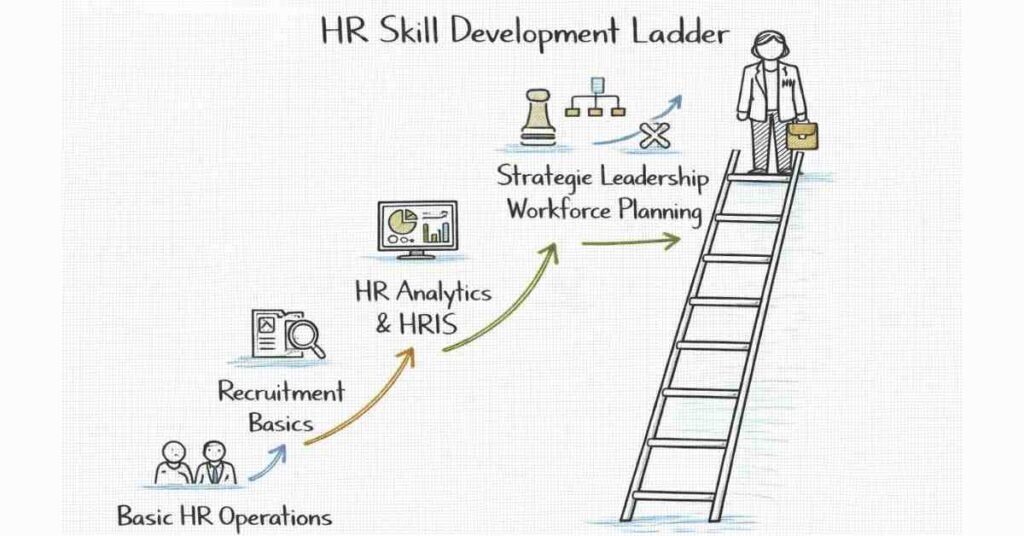
Entry-Level (0-3 Years): Build Fundamentals
Technical Skills:
- MS Office proficiency (especially Excel)
- HRIS basics
- HR process knowledge (recruitment, onboarding, basic employee relations)
- Basic labor law and compliance awareness
- Documentation and administration
Soft Skills:
- Professional communication (written and verbal)
- Attention to detail and accuracy
- Time management and organization
- Teamwork and collaboration
- Receptiveness to feedback
Business Skills:
- Understanding your organization’s business model
- Customer/stakeholder service orientation
Basic project support
Mid-Level (3-7 Years): Build Expertise and Influence
Technical Skills:
- Advanced Excel and data analysis
- Specific HR domain expertise (recruitment, compensation, L&D, etc.)
- HR metrics and reporting
- Project management
- Advanced HRIS capabilities
Soft Skills:
- Stakeholder management and influencing
- Problem-solving and analytical thinking
- Facilitation and training delivery
- Conflict resolution
- Emotional intelligence
Business Skills:
- Business acumen and understanding business drivers
- Financial literacy (reading P&L, understanding budgets)
- Strategic thinking connecting HR to business outcomes
- Change management fundamentals
Credentials:
- Earn SHRM-CP or PHR certification
Specialized certificates in chosen areas
Senior Level (7-15 Years): Build Strategic Leadership
Technical Skills:
- HR strategy development
- Advanced analytics and people metrics
- Organizational design
- Talent management frameworks
- Total rewards strategy
- Technology platform expertise
Soft Skills:
- Executive presence and communication
- Advanced influencing and negotiation
- Leading without authority
- Coaching and developing others
- Managing complexity and ambiguity
Business Skills:
- Advanced business acumen (finance, operations, strategy)
- Strategic planning and execution
- Change leadership and transformation management
- Commercial awareness and P&L understanding
- Industry and competitive knowledge
Credentials:
- SHRM-SCP or SPHR
- Specialized advanced certifications
Potentially pursue MBA (if don’t already have)
Executive Level (15+ Years): Build Organizational Leadership
Technical Skills:
- Enterprise HR strategy
- Board relations and governance
- Merger and acquisition people integration
- Workforce planning at scale
- HR technology strategy
Soft Skills:
- C-suite partnership and influence
- Political savvy and organizational dynamics
- Inspirational leadership
- Crisis management
- Building and leading high-performing teams
Business Skills:
- CEO-level business acumen
- Corporate strategy influence
- Financial management of significant budgets
- External stakeholder management (investors, media, regulators)
Industry thought leadership
Common Career Pivots and Lateral Moves
Strategic lateral moves accelerate careers more than waiting for vertical promotions:
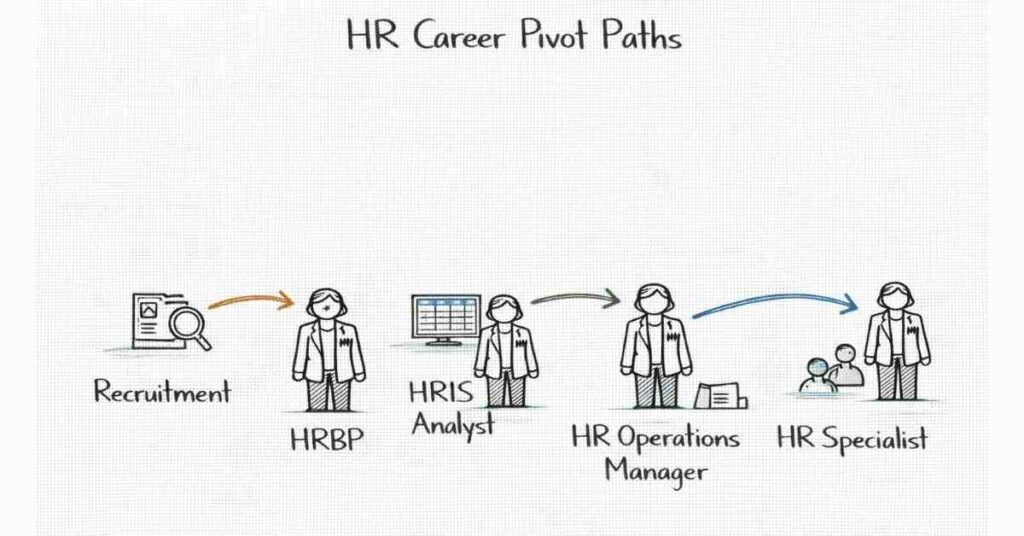
Function-to-Function Pivots
Recruitment → HRBP: Recruiting builds stakeholder relationships and business understanding—excellent foundation for HRBP work.
HR Generalist → Specialist: Broadening into depth allows commanding premium compensation.
Specialist → Generalist: After building deep expertise, returning to generalist roles with specialized knowledge creates unique value.
HRIS → HR Operations → Leadership: Technology expertise combined with operational knowledge positions for senior roles.
Industry-to-Industry Pivots
When to Consider: Mid-career (7-12 years) when you have transferable HR expertise but want different industry exposure.
Easier Transitions: Generalist roles transfer more easily than specialists (who may need to learn new compliance frameworks).
Strategic Industries: Moving to high-growth industries (tech, e-commerce) or prestigious sectors (consulting, finance) can accelerate careers.
Geography-to-Geography Pivots
Domestic Moves: Metro to metro (Hyderabad to Bangalore) for better opportunities.
International Moves: MNC experience facilitates international transfers. Generalists transfer more easily than specialists.
Company Size Pivots
Large to Startup: Trade structure for influence and equity upside. Your responsibility expands dramatically.
Startup to Large: Trade chaos for structure, resources, and scale. You gain brand value.
Corporate to Consulting: Leverages corporate experience to advisory work. Builds diverse exposure.
Strategies to Accelerate Career Advancement
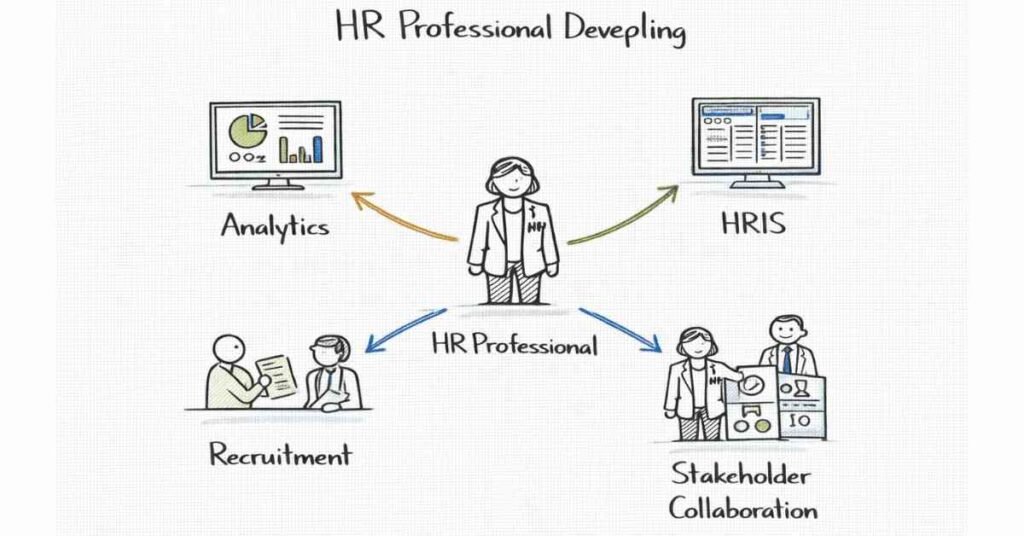
1. Drive Measurable Business Impact
Why It Matters: HR professionals who demonstrate clear business results advance faster than those who simply complete activities.
How to Do It:
- Quantify everything (reduced turnover from X% to Y%, hired Z candidates in A days, saved ₹B through compensation optimization)
- Connect HR initiatives to business metrics (revenue, profitability, productivity, customer satisfaction)
- Present impact regularly to leadership
- Build cases showing HR’s ROI
2. Build Strategic Relationships
Why It Matters: Advancement often depends on who knows your capabilities and advocates for you.
How to Do It:
- Develop trusted relationships with business leaders, not just HR colleagues
- Build network outside your organization (industry associations, conferences, LinkedIn)
- Find mentors and sponsors—mentors advise, sponsors advocate for your advancement
Maintain relationships with former colleagues (they often lead to opportunities)
3. Pursue Stretch Assignments
Why It Matters: Promotions go to those who’ve already demonstrated capability at next level.
How to Do It:
- Volunteer for challenging projects beyond current role
- Take on interim leadership roles
- Lead cross-functional initiatives
Request expanded scope before formal promotion
4. Develop Business Acumen Continuously
Why It Matters: What separates senior HR leaders from mid-level is business understanding.
How to Do It:
- Attend business meetings, not just HR meetings
- Learn finance basics (P&L, balance sheets, budgets)
- Understand your industry deeply (trends, competitors, challenges)
- Read business publications (HBR, McKinsey Quarterly, industry journals)
Take business courses or executive education programs
5. Build External Visibility
Why It Matters: Internal reputation is important, but external recognition creates leverage.
How to Do It:
- Speak at HR conferences and events
- Write articles or blog posts on HR topics
- Participate actively in HR professional associations
- Build LinkedIn thought leadership
- Speak at HR conferences and events
6. Make Strategic Career Moves
Why It Matters: Sometimes advancement requires changing organizations.
When to Move:
- Limited growth opportunities in current organization
- Offered significantly expanded role elsewhere
- Need exposure to different industry or company size
- Current role plateaued with no promotion path
- Limited growth opportunities in current organization
7. Invest in Continuous Learning
Plateaus happen—here’s how to break through:
Recognize Plateau Signals
- Same responsibilities for 3+ years without growth
- Passed over for promotions multiple times
- Declining learning and engagement
Breaking Through Plateaus
Assess Why:
- Limited organizational opportunities?
- Skills gaps preventing advancement?
- Relationship challenges limiting advocacy?
- Not demonstrating readiness for next level?
Take Action:
- Have candid conversation with manager about advancement path
- Request specific feedback on what’s preventing promotion
- Build missing skills or experiences
- Seek lateral moves expanding capabilities
- Consider external opportunities if internal paths blocked
- Limited organizational opportunities?
Realistic Path to CHRO
What does it really take to reach the top HR role?
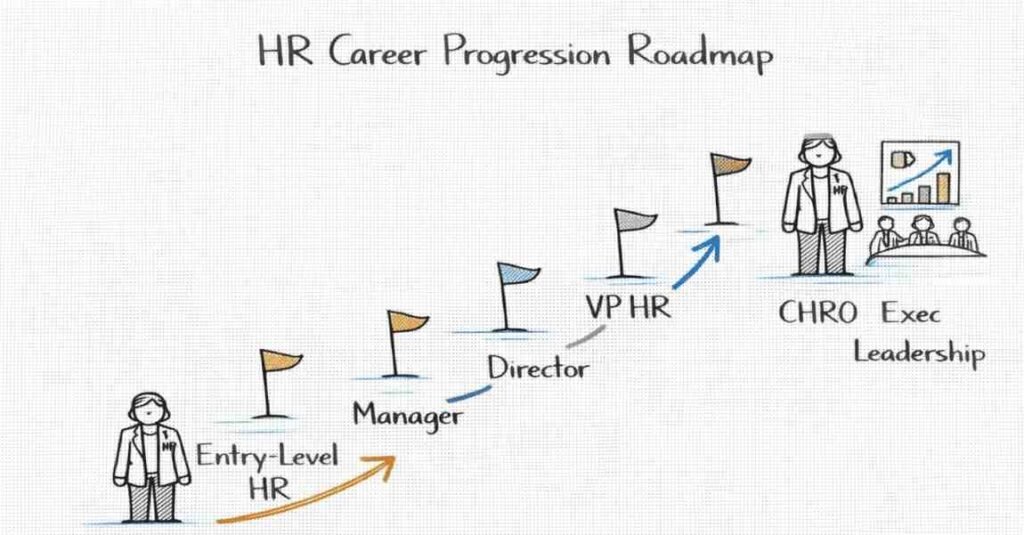
Typical CHRO Profile
Experience: 15-25 years progressive HR experience
Education: Bachelor’s minimum, but MBA or master’s degree preferred by most organizations
Background: Usually comes from generalist or HRBP backgrounds with broad HR exposure
Key Capabilities:
- Strategic business partnership with CEO
- P&L and financial management
- Change leadership and transformation
- Building and leading HR organizations
- Board-level communication
Industry expertise and reputation
Building CHRO-Track Career
Years 0-7: Build Foundation
- Gain broad HR exposure across multiple functions
- Develop business acumen
- Build strong performance track record
- Earn foundational certifications
Years 7-12: Establish Strategic Capability
- Move into HRBP or HR Manager roles
- Lead significant initiatives
- Develop executive relationships
- Earn advanced credentials
- Build external visibility
Years 12-18: Demonstrate Leadership
- Take on director or senior leadership roles
- Lead HR functions or teams
- Drive organizational transformation
- Expand industry network
- Consider targeted moves to fill experience gaps
Years 18+: Position for CHRO
- VP or Head of HR roles
- Demonstrated success leading large HR organizations
- Proven business impact
- CEO and board readiness
- CHRO opportunities emerge
- Gain broad HR exposure across multiple functions
Alternative Realities
Not Everyone Becomes CHRO: That’s perfectly fine. Senior HR roles (Director, VP, Head of Function) offer excellent compensation, influence, and fulfillment without C-suite pressures.
Multiple Paths Exist: Some reach CHRO in 15 years through rapid acceleration. Others take 25+ years. Some never pursue it, finding satisfaction in specialist expertise or mid-level leadership.
HR career progression requires intentionality—understanding your options, making strategic choices, building required capabilities, and creating opportunities rather than waiting for them. Whether you choose the generalist path toward broad leadership or specialist path toward deep expertise, success comes from consistent performance, continuous learning, strong relationships, and demonstrated business impact.
The climb from HR Assistant to CHRO takes 15-25 years for those who reach the summit. But every step of that journey—from generalist to manager to director—offers opportunities for meaningful impact, rewarding compensation, and professional fulfillment. The key is approaching your career strategically, making intentional choices aligned with your goals and values, and persistently developing the capabilities required for each next step.
Your HR career is yours to shape. Build it deliberately, one strategic choice at a time.