
GETTING STARTED: YOUR FIRST HOSPITALITY JOB
Table of Contents
Landing Your First Hospitality Job: A Complete Roadmap for Freshers
The Reality of Your First Hospitality Job
Getting your first hospitality job is simultaneously simpler and more challenging than other industries. Simpler because hotels constantly hire entry-level staff due to high turnover. Challenging because you’re competing with numerous candidates, often with some hospitality experience. Your strategy must involve proactive networking, strong presentation, and demonstrating genuine interest in hospitality.
The good news? Hospitality industries hire freshers regularly, provide on-the-job training, and promote based on performance. A strong first role sets you on the path to rapid advancement.
Where to Find Hospitality Job Openings
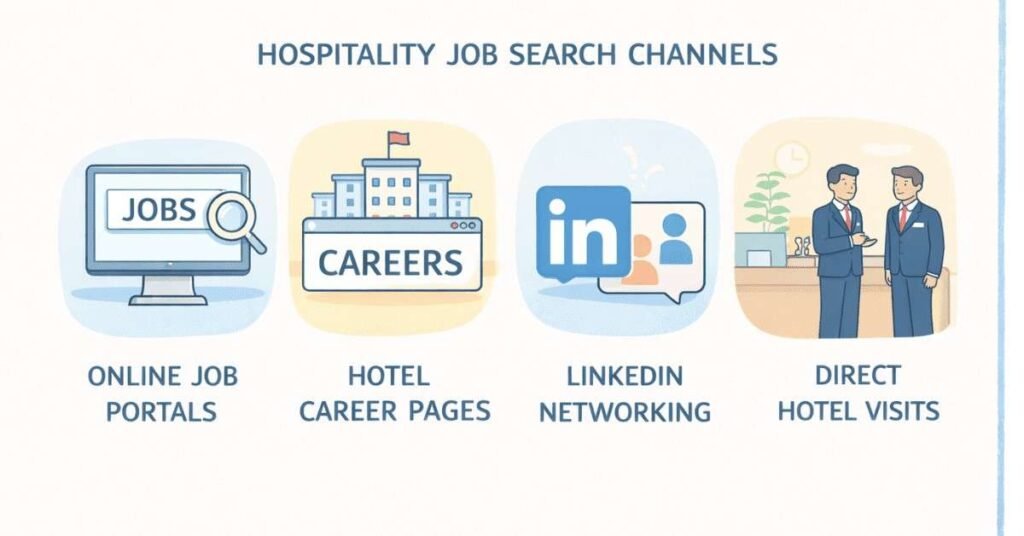
Online Job Portals
- Indeed (indeed.com) – Largest job portal with numerous hospitality listings
- Naukri.com – India’s largest job site, active hospitality postings
- LinkedIn – Search “hospitality jobs near me,” follow hotel recruiters
- Glassdoor – Reviews and salary insights alongside job postings
- Monster.com – Hospitality-focused positions
- Hotel-specific portals – Many hotel chains have careers pages
Pro Tip: Set job alerts for your target locations and roles. Check daily; good positions fill quickly.
Hotel & Restaurant Websites
Visit careers pages of:
- Major Chains: Taj Hotels, ITC Hotels, Oberoi, Marriott, Hilton, Hyatt
- Local Properties: 5-star hotels in your city
- Restaurant Chains: QSR restaurants, fine dining establishments
- Event Venues: Banquet halls, event management companies
Networking & Direct Approach
- Hotel Visits: Visit hotels in person, ask HR about openings
- Alumni Networks: Connect with graduates from your institute
- LinkedIn Networking: Connect with hotel professionals, express interest
- Referrals: Ask friends/family working in hospitality for introductions
- Hospitality Events: Attend industry events, meet recruiters
Recruitment Agencies
- Hospitality-Specific Agencies: Agencies specializing in hotel/restaurant placement
- General Staffing: Temporary staffing agencies often place hospitality staff
- Executive Search: For management positions (less relevant for entry-level)
Crafting Your Hospitality Resume
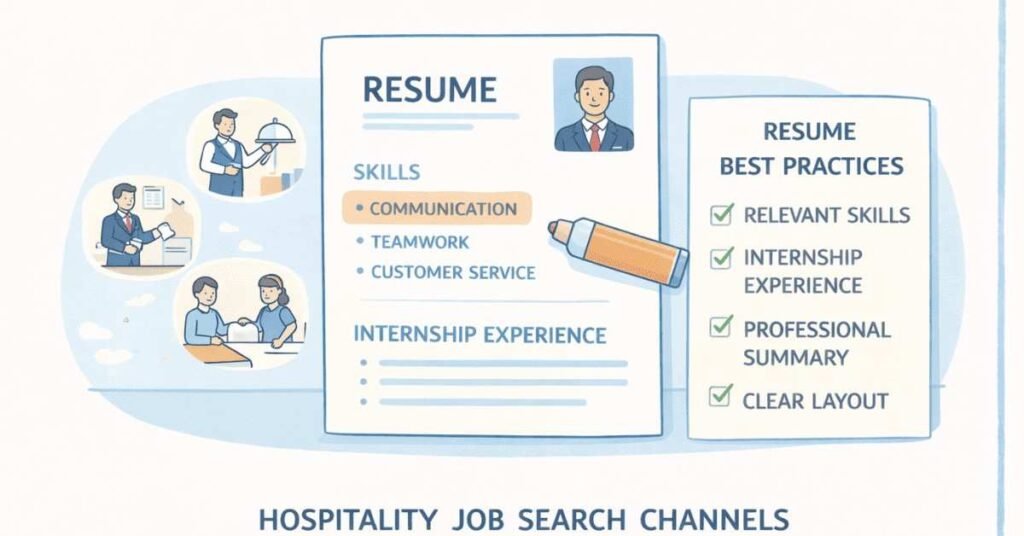
Your resume is your first impression. Hotels receive hundreds of applications; yours must stand out.
Resume Structure
- Header (Most Important)
- Name (large, clear)
- Phone number (ensure it’s always available)
- Email (professional: firstname.lastname@email.com, not partygirl@…)
- City/Location (saves recruitment concerns about relocation)
- LinkedIn profile (if complete)
Example:
text
PRIYA SHARMA
Phone: 98765-43210 | Email: priya.sharma@email.com
Hyderabad, Telangana | LinkedIn: linkedin.com/in/priyasharma
- Professional Objective/Summary (Customize for Each Application)
Generic: “To work in a dynamic hospitality organization.”
Strong: “Seeking entry-level Front Office Executive position at luxury hotel where excellent communication skills and enthusiasm for guest service can contribute to exceptional guest experiences.”
Be specific about role, hotel type, and what you offer.
- Education
- Degree/Diploma (if relevant)
- Institute name, completion year
- Relevant coursework (Hotel Operations, Guest Relations, etc.)
- Academic achievements if notable (top 10% of class)
- Relevant certifications (FSSAI, PMS training, etc.)
- Internship/Experience
Even if minimal, detail any hospitality exposure:
- Hotel internships (dates, department, what you did)
- Restaurant/café work (even part-time)
- Event experience (weddings, conferences)
- Customer service roles
- Leadership in college (club president, event coordinator)
For each, include:
- Organization name
- Duration (Month Year to Month Year)
- 2-3 bullet points of specific achievements/responsibilities
Example:
text
Internship: Front Office, Hyderabad Hilton | June-August 2024
– Supported front desk team with check-ins, check-outs, and guest inquiries
– Achieved 95% guest satisfaction score during internship period
– Assisted with 150+ guest interactions, learning PMS systems
- Skills Section
Hospitality-relevant skills:
- Communication (in multiple languages if applicable)
- Customer Service
- POS/PMS Systems (if trained)
- Food Service (if applicable)
- Event Coordination
- Time Management
- Problem-Solving
- Teamwork
List only skills you actually have.
- Certifications
- FSSAI Food Safety
- Hotel PMS Training
- Language proficiency
- Customer Service Certification
- References
- Teachers/professors who can speak to your reliability
- Internship supervisors
- Avoid family members
Resume Format Tips
- Length: One page maximum for freshers
- Font: Professional (Arial, Calibri, Times New Roman), 11-12pt
- Spacing: Clean, not cramped
- Bullet points: Use for clarity and readability
- Numbers: Include metrics (95% satisfaction, 150+ guests served)
- Customization: Tailor each application to job description
- Proofreading: Zero spelling/grammar mistakes (non-negotiable)
- File naming: “Priya_Sharma_FrontOfficeCV.pdf” (not “resume.pdf”)
What NOT to Include
- Photo (unless specifically requested)
- Personal details (age, marital status, religion)
- Salary expectations
- Negative information about previous employers
- Irrelevant information (high school achievements if college graduate)
- Reasons for leaving jobs (save for interview)
Cover Letter Strategy
Most entry-level applications don’t require cover letters, but submitting one sets you apart.
Strong Cover Letter Example:
text
Dear Ms. Patel,
I am writing to express my strong interest in the Front Desk Executive position at
The Oberoi Hyderabad, as posted on your careers website.
During my 2-month internship at Marriott Hyderabad this summer, I was privileged to
work on the front desk team. I handled guest check-ins, processed reservations, and
resolved guest inquiries. What impressed me most was how excellent service created
lasting relationships—guests returned specifically requesting our team.
I am drawn to The Oberoi for its reputation for service excellence. My strong
communication skills, attention to detail, and genuine enthusiasm for creating
memorable guest experiences align perfectly with your expectations. I am committed
to supporting your team in delivering the exceptional service your guests deserve.
I would welcome the opportunity to discuss how I can contribute to your team’s success.
Sincerely,
Priya Sharma
Key elements:
- Specific hotel name (not generic)
- Reference to specific experience
- Why that hotel appeals to you
- Your value proposition
- Professional, warm tone
Interview Preparation
Interviews are where you shine. Hotels invest heavily in hiring because turnover costs them significantly.
Before the Interview
- Research the Property
- Hotel website: history, properties, brands
- Guest reviews (TripAdvisor, Google): real guest experiences
- Recent news: new openings, awards, events
- Competitor hotels: understand market positioning
- Management team: know who leads the hotel
- Understand the Role
- Job description: know all responsibilities
- Department context: how does this department fit in hotel?
- Typical day: visualize what your day would look like
- Challenges: what problems would this role solve?
- Success metrics: how is success measured?
- Prepare Responses to Common Questions
“Tell me about yourself”
Structure: Background → Hospitality Interest → Why this role
“I completed my diploma in Hotel Management this year. During my internship, I developed a genuine passion for guest service—creating positive experiences for diverse guests was incredibly fulfilling. This Front Office role excites me because it’s the first guest touchpoint, where I can truly impact their entire stay.”
“Why do you want to work in hospitality?”
Authentic answer (not money-focused):
“I genuinely enjoy interacting with people, solving problems, and creating positive experiences. Hospitality combines these passions. I’m excited by the fast-paced environment and the opportunity to make guests’ stays memorable.”
“Why our hotel specifically?”
Research-backed answer:
“I’ve researched your property and am impressed by your 4.8-star TripAdvisor rating. Your guests consistently mention staff warmth and efficiency. I’m drawn to joining a team committed to service excellence, and I’d like to contribute to that reputation.”
“What are your weaknesses?”
Strategic answer (shows self-awareness):
“I sometimes get caught up in details, which helps with accuracy but can slow me down. I’m actively working on prioritizing to balance thoroughness with efficiency. I’ve found that creating checklists helps me stay organized while moving quickly.”
“Where do you see yourself in 5 years?”
Growth-oriented answer:
“In 5 years, I see myself as a Shift Manager, leading a team, solving operational challenges, and ensuring consistent guest satisfaction. I’m committed to continuous learning and development to reach that level.”
During the Interview
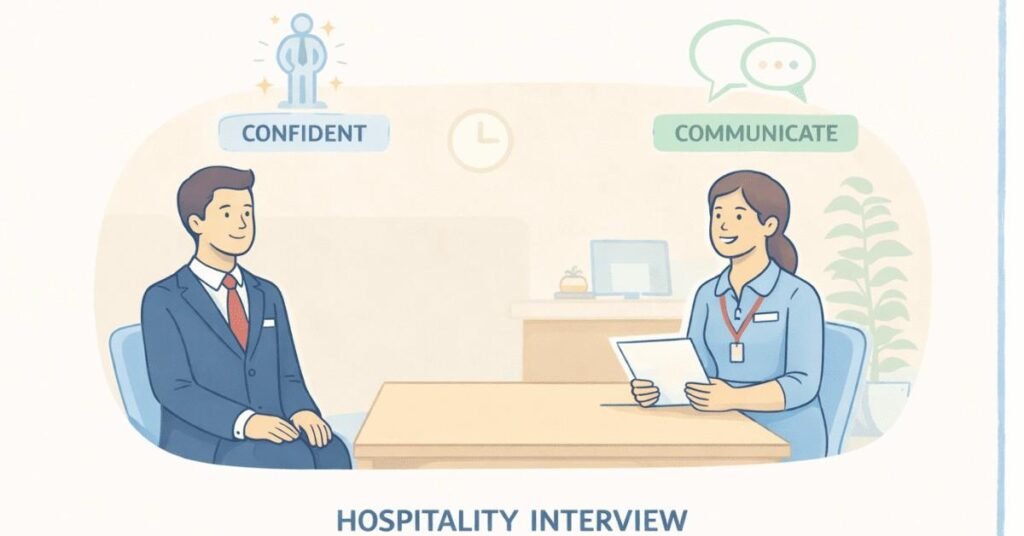
Body Language:
- Arrive 10 minutes early (never late)
- Firm handshake, eye contact
- Sit upright, maintain good posture
- Smile genuinely
- Nod occasionally to show engagement
- Avoid fidgeting, phone checking
Communication:
- Speak clearly, appropriate volume
- Pace: not too fast (nervous), not too slow (disengaged)
- Avoid filler words (“um,” “like,” “you know”)
- Listen completely before responding
- Ask thoughtful questions (shows interest)
Dress:
- Business casual minimum (shirt/trousers or salwar kameez)
- Well-groomed, clean
- Professional shoes
- Minimal jewelry, no strong cologne/perfume
- Hair neatly arranged
Questions to Ask (Shows Genuine Interest)
- “What does a typical day look like in this role?”
- “What qualities make successful people in this department?”
- “What’s your favorite thing about working here?”
- “How do you support staff development?”
- “What’s the next step in the hiring process?”
Red Flags to Watch
- Interviewer is dismissive or rude
- Unclear job description or expectations
- No mention of training (beware)
- Excessive turnover mentioned casually
- No questions about your background
If you notice red flags, you can decline even if offered.
Entry-Level Role Options
Best Entry-Level Roles for Freshers
Guest-Facing Roles:
- Front Desk Executive
- Guest Services Representative
- Concierge
- Bell Desk/Bellhop
- Housekeeping Staff (to learn hotel operations)
Operational Roles:
- Kitchen Trainee (if culinary background)
- Food & Beverage Service
- Event Coordination Assistant
- Maintenance Support
Supporting Roles:
- HR/Recruitment Support
- Administration
- Sales Support
- Marketing Coordinator
Why Front Desk is Popular for Freshers:
- Central to hotel operations (learn entire system)
- High guest interaction (develop people skills)
- Fast career progression (to manager positions)
- Entry salary reasonable
- Clear advancement path
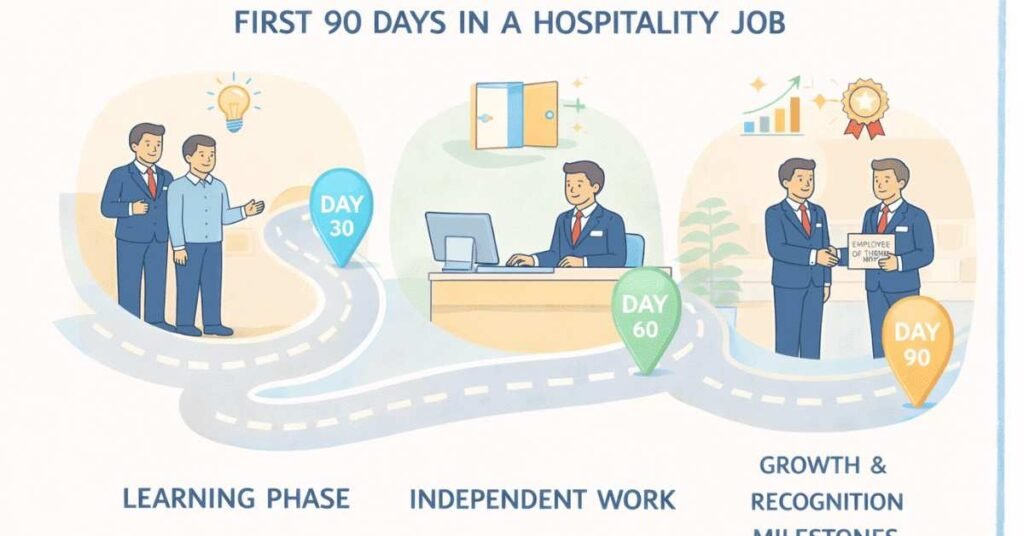
Your First 90 Days: Setting Yourself Up for Success
Your first three months are critical. You’re proving yourself and building reputation.
Days 1-7: Acute Learning Phase
- Listen more than talk
- Learn systems, procedures, hotel layout
- Understand your team
- Ask clarifying questions
- Write things down
- Don’t try to change things yet
Weeks 2-4: Active Learning Phase
- Begin independent work with supervision
- Make small mistakes (normal), learn from them
- Build relationships with colleagues
- Understand departmental challenges
- Contribute ideas but implement carefully
Month 2-3: Productive Phase
- Work independently with decreasing supervision
- Anticipate problems before they arise
- Begin mentoring newer staff
- Show initiative on projects
- Receive feedback, continuously improve
90-Day Review: What Managers Assess
- Reliability (punctuality, attendance)
- Competence (ability to perform role)
- Attitude (positivity, willingness to learn)
- Teamwork (collaboration with colleagues)
- Initiative (going beyond minimum)
- Customer service (guest satisfaction)
Strong 90-day performance positions you for:
- Salary increase
- Promotion to senior/supervisory roles
- Better shifts/schedules
- Training for specializations
Networking: Your Long-Term Career Asset
Even in your first role, build relationships:
- Colleagues: You’ll work together for years
- Senior Staff: Learn from their experience, seek mentorship
- Management: Understand their perspective, show ambition
- Peers: Industry friends provide opportunities and support
- LinkedIn: Connect with hotel professionals, join hospitality groups
Hospitality is relationship-driven. Your network creates opportunities throughout your career.
Common Entry-Level Mistakes to Avoid
- Arriving late: Punctuality is non-negotiable in hospitality
- Complaining about tasks: Every role has unglamorous aspects
- Attitude problems: Negativity spreads; stay positive
- Not asking for help: Ask questions before making mistakes
- Talking negatively about hotel: Loyalty matters early on
- Excessive social media at work: Professionalism critical
- Not adapting to culture: Each hotel has different vibe; adapt
- Expecting rapid promotion: Earn your stripes first
- Not developing skills: Use free time to learn
- Abandoning job when hard: Resilience and persistence matter
Your First Year: Strategic Thinking
Even in your first role, think strategically:
- Skill Development: What competencies does your target next role require? Develop them now.
- Relationships: Build relationships with people in your target roles.
- Documentation: Track your achievements; reference them later.
- Flexibility: Show willingness to work different shifts, cover absences.
- Initiative: Volunteer for projects slightly beyond your role.
- Feedback: Regularly seek feedback; act on it.
By year-end, you should be:
- Fully competent in your role
- Recognized as reliable and engaged
- Ready for promotion or advancement
- Clear on your career path forward