
GD Assessment Checklist
Blog Content:
Here’s what most students don’t realize: Recruiters use a specific rubric to evaluate your GD.
Knowing this rubric gives you a huge advantage. You can assess yourself the same way recruiters assess you. And when you know the exact criteria, you can focus your practice on what actually matters.
In this final section, we’re giving you the exact assessment framework recruiters use.
Understanding the Evaluation Framework
Most companies evaluate GD on 5-6 key dimensions. Some use numerical scores (like 1-10), others use categorical ratings (like Excellent, Good, Average, Poor). But the underlying criteria are almost always the same.
Let me break down each dimension and give you a detailed checklist.
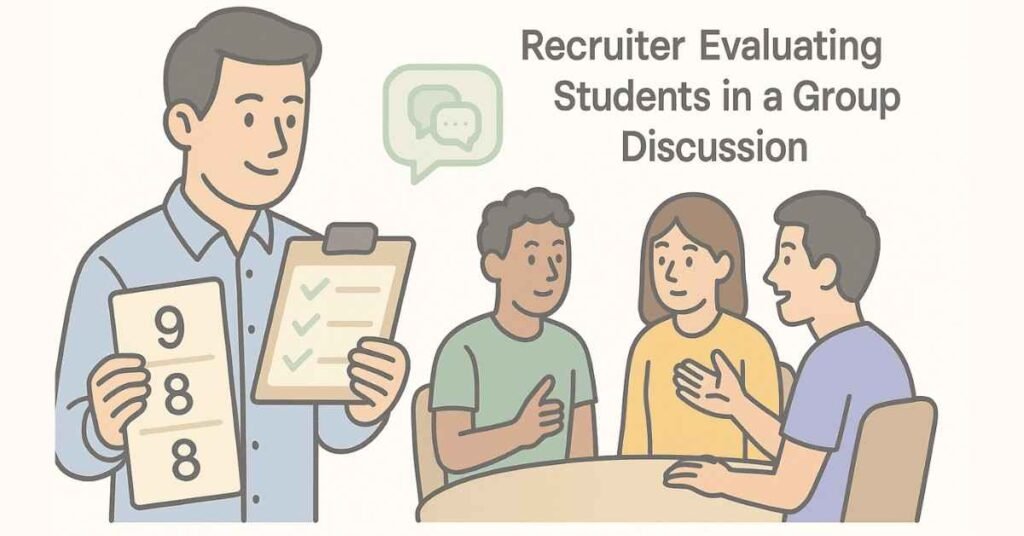
Table of Contents
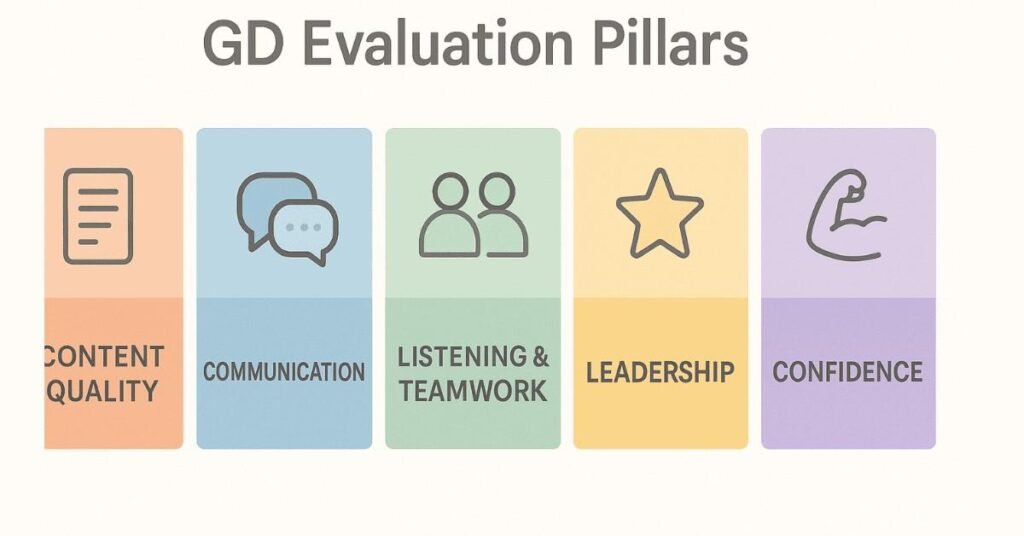
DIMENSION 1: CONTENT QUALITY AND KNOWLEDGE
What recruiters are looking for:
- Do you know what you’re talking about?
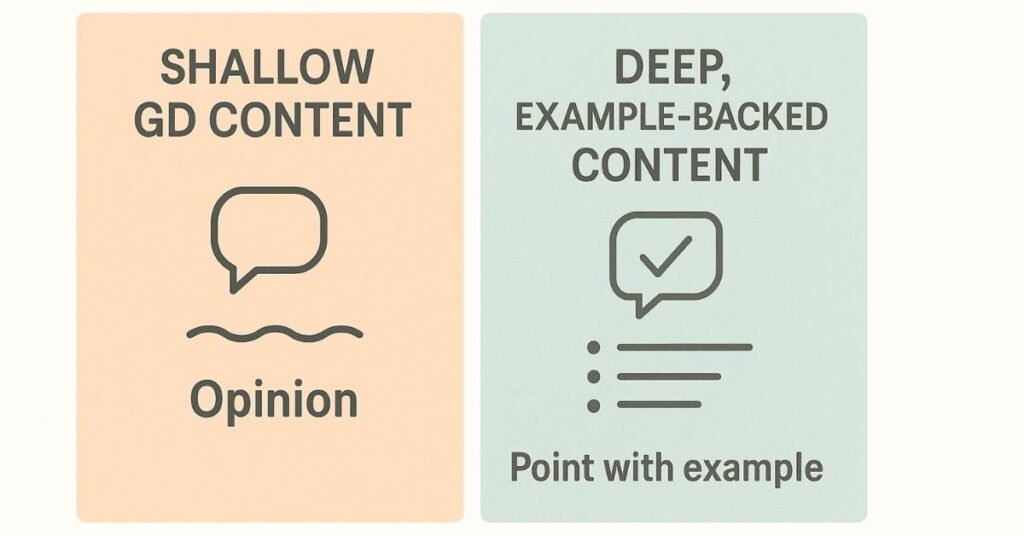
- Are your points backed by facts or examples?
- Do you understand the nuance of the topic?
- Can you think beyond surface-level answers?
Excellent (9-10/10):
☐ All points are backed by recent data or examples
☐ You reference specific companies, studies, or statistics
☐ You acknowledge complexity and present multiple perspectives
☐ Your reasoning is logical and easy to follow
☐ You can explain your position clearly to anyone
Good (7-8/10):
☐ Most points have supporting examples
☐ You show understanding of the topic
☐ You mention 1-2 different perspectives
☐ Reasoning is mostly logical, one or two weak points
☐ Generally clear but occasionally rambles
Average (5-6/10):
☐ Some points lack supporting evidence
☐ Basic understanding but limited depth
☐ Mostly one-sided perspective
☐ Reasoning has some logical gaps
☐ Clarity is okay but could be better
Below Average (3-4/10):
☐ Few or no supporting examples
☐ Surface-level understanding only
☐ No acknowledgment of different perspectives
☐ Reasoning is unclear or flawed
☐ Hard to follow your points
Poor (1-2/10):
☐ No supporting evidence at all
☐ Incorrect or irrelevant information
☐ No understanding of the topic
☐ Points are confusing or contradictory
☐ Seems unprepared
Your assessment: Honestly rate yourself. Be harsh. If you gave examples and facts, rate yourself 7+. If you rambled without evidence, you’re in the 3-5 range.
🔍 Explore structured learning resources designed to strengthen foundational clarity →
DIMENSION 2: COMMUNICATION SKILLS
What recruiters are looking for:
- Can you articulate your thoughts clearly?
- Is your voice confident and audible?
- Do you speak too fast, too slow, or just right?
- Can you explain complex ideas simply?
- Do you use filler words (um, uh, like)?
Excellent (9-10/10):
☐ Speech is clear, confident, and at appropriate pace
☐ No filler words (um, uh, like)
☐ Complex ideas explained in simple language
☐ Good pronunciation and grammar
☐ Varies tone and pace to maintain interest
Good (7-8/10):
☐ Speech is mostly clear and audible
☐ Occasional filler words (1-2 per minute)
☐ Generally explains ideas well
☐ Minor grammar or pronunciation issues
☐ Consistent pace and tone
Average (5-6/10):
☐ Speech is sometimes unclear or hard to hear
☐ Regular filler words (3-4 per minute)
☐ Explanations could be simpler
☐ Some grammar or pronunciation errors
☐ Pace is sometimes too fast or too slow
Below Average (3-4/10):
☐ Speech is often unclear or quiet
☐ Frequent filler words (5+ per minute)
☐ Complex ideas explained in confusing way
☐ Significant grammar or pronunciation errors
☐ Inconsistent or rushed pace
Poor (1-2/10):
☐ Speech is very unclear or inaudible
☐ Speaks in mostly filler words
☐ Cannot explain ideas simply
☐ Major grammar and pronunciation errors
☐ Pace is all over the place
Your assessment: Record yourself speaking for 2 minutes and listen. Count your “um”s. Note your pace. Are you clear?
DIMENSION 3: LISTENING AND TEAMWORK
What recruiters are looking for:
- Do you actually listen to others or just wait for your turn?
- Do you acknowledge and build on others’ ideas?
- Can you disagree respectfully?
- Do you help quieter people contribute?
- Do you work toward group consensus?
Excellent (9-10/10):
☐ Actively listens and shows understanding (nods, acknowledges)
☐ Frequently builds on others’ ideas
☐ Respectfully handles disagreements
☐ Encourages quiet participants to speak
☐ Seeks consensus and finds common ground
Good (7-8/10):
☐ Listens to most people
☐ Occasionally builds on ideas
☐ Mostly respectful during disagreements
☐ Sometimes encourages others to participate
☐ Generally works toward group solutions
Average (5-6/10):
☐ Listens but often planning next point
☐ Rarely builds on others’ ideas
☐ Respectful but not always engaged
☐ Doesn’t encourage participation
☐ More focused on own ideas than group solutions
Below Average (3-4/10):
☐ Doesn’t seem to listen carefully
☐ Never builds on others’ ideas
☐ Disrespectful during disagreements
☐ Ignores quieter participants
☐ Combative or self-focused
Poor (1-2/10):
☐ Clearly not listening
☐ Dismisses others’ points
☐ Aggressive during disagreements
☐ Actively silences others
☐ Completely self-centered
Your assessment: After a mock, ask friends: “Did I seem like I was listening? Did I help you feel heard?” Their answers will tell you your real score.
📘 Discover more preparation content to support better interaction and performance →
DIMENSION 4: LEADERSHIP AND INITIATIVE
What recruiters are looking for:
- Did you take initiative to speak first?
- Did you structure the discussion or keep it on track?
- Did you guide without dominating?
- Did you help summarize or reach conclusions?
- Did you show confidence?
Excellent (9-10/10):
☐ Took initiative early (spoke in first 2 minutes)
☐ Structured discussion clearly
☐ Guided conversation without dominating
☐ Helped group reach conclusions
☐ Confidence shown through calm, clear communication
Good (7-8/10):
☐ Spoke relatively early
☐ Helped structure some parts
☐ Balanced speaking and listening
☐ Contributed to reaching conclusions
☐ Generally confident
Average (5-6/10):
☐ Spoke but not early
☐ Minimal structuring
☐ Mostly spoke without guiding
☐ Limited contribution to conclusions
☐ Somewhat confident, sometimes hesitant
Below Average (3-4/10):
☐ Spoke late or reluctantly
☐ Didn’t structure anything
☐ Spoke too much or too little
☐ Didn’t help reach conclusions
☐ Lacked confidence
Poor (1-2/10):
☐ Didn’t speak or only once
☐ Confused the discussion
☐ Dominated rudely
☐ Worked against group consensus
☐ Very low confidence
Your assessment: In your next mock, consciously try to be an early speaker and discussion guide. Ask yourself: “Did I structure this well?”
DIMENSION 5: CONFIDENCE AND COMPOSURE
What recruiters are looking for:
- Do you seem nervous or composed?
- Can you handle pressure?
- When you make mistakes, do you recover?
- Is your body language confident?
- Do you stay calm during disagreements?
Excellent (9-10/10):
☐ Calm and composed throughout
☐ Handles pressure well
☐ Recovers smoothly from mistakes
☐ Body language is open and confident (sits upright, makes eye contact)
☐ Stays calm even during heated disagreements
Good (7-8/10):
☐ Mostly composed, minimal nervousness
☐ Generally handles pressure
☐ Recovers from most mistakes
☐ Body language is mostly confident
☐ Usually calm during disagreements
Average (5-6/10):
☐ Some nervousness visible (fidgeting, hesitation)
☐ Okay under pressure
☐ Sometimes struggles to recover
☐ Body language is mixed (some confidence, some withdrawal)
☐ Gets a bit defensive during disagreements
Below Average (3-4/10):
☐ Visibly nervous throughout
☐ Struggles under pressure
☐ Doesn’t recover from mistakes well
☐ Body language shows lack of confidence (slouching, avoiding eye contact)
☐ Gets emotional or defensive during disagreements
Poor (1-2/10):
☐ Very nervous, shaking or sweating
☐ Falls apart under pressure
☐ Can’t recover from any mistake
☐ Body language shows fear or arrogance
☐ Becomes emotional or aggressive
Your assessment: Watch your recorded mock. How do you look? Are you slouching? Do you avoid eye contact? These matter.
OVERALL GD ASSESSMENT SCORECARD
Use this to calculate your total score:
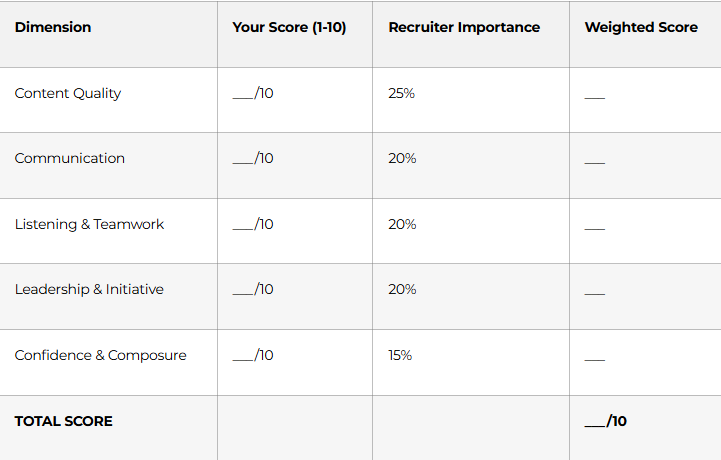
Calculation:
(Content × 0.25) + (Communication × 0.20) + (Listening × 0.20) + (Leadership × 0.20) + (Confidence × 0.15) = Total
What the total score means:
- 8.5-10: Excellent. You’ll likely get through this round.
- 7-8.4: Good. You have a solid chance.
- 6-6.9: Average. You might get through or might not. Depends on competition.
- 5-5.9: Below average. You need improvement before real GD.
- Below 5: Poor. More practice needed.
📂 Access complete learning materials to enhance reasoning, communication, and confidence →
Weekly Improvement Plan Using This Checklist
Week 1:
- Focus on Content Quality. Score yourself. Identify gaps. Research more.
- Target improvement: Increase from 6 to 8
Week 2:
- Focus on Communication. Record yourself. Count filler words. Practice clarity.
- Target improvement: Increase from 5 to 8
Week 3:
- Focus on Leadership. Practice opening statements and summarizing.
- Target improvement: Increase from 5 to 7
Week 4:
- Focus on Listening. Record your mocks. Count how many times you acknowledged others.
- Target improvement: Increase from 6 to 8
Week 5 (Pre-Placement Week):
- Full assessment across all dimensions. Target total score of 7.5+
Do 2-3 final mocks. Aim to score 7.5+ on each.
The Final Truth About GD Assessment
Recruiters spend about 10-15 minutes assessing each candidate in a GD. They’re not being harsh or unfair. They’re looking for specific signals that tell them: “Can this person communicate? Can they work in a team? Do they have knowledge? Can they lead?”
When you use this same rubric to assess yourself, you see exactly what they see. And when you see it, you can fix it.
Remember: A GD is not a test you pass or fail. It’s a signal recruiters use to understand who you are professionally. Show them someone who can:
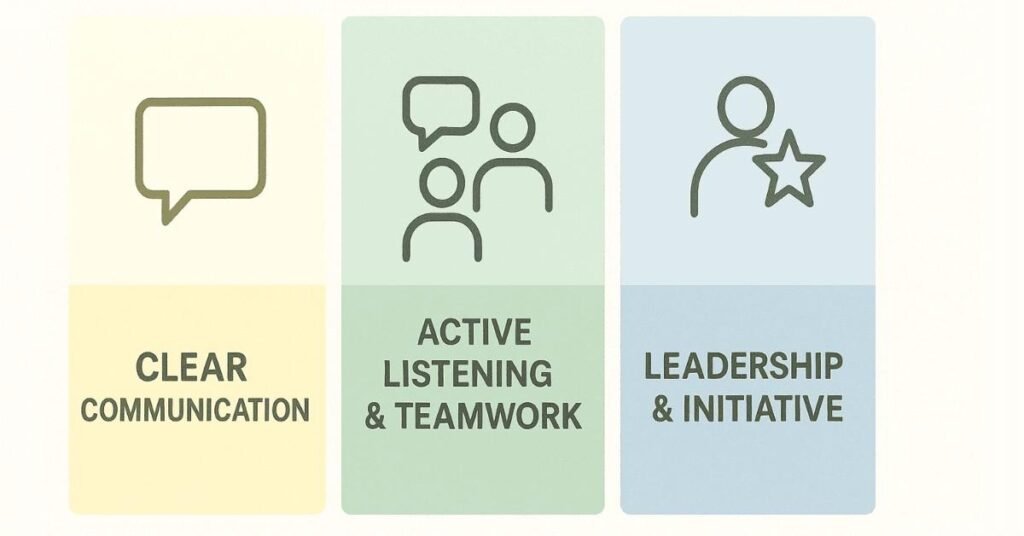
- Communicate clearly
- Listen actively
- Think deeply
- Lead respectfully
- Stay composed
And they’ll want to hire you.
- Communicate clearly