
Environmental Jobs Salary in India: Role-Wise Pay & Growth

Table of Contents
Introduction
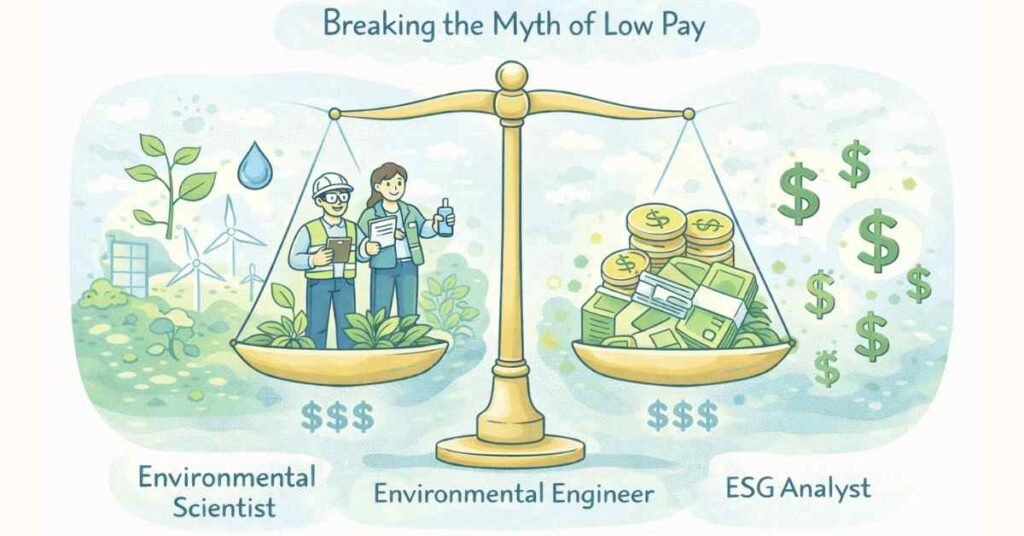
Environmental and sustainability careers are often seen as “impact-driven but low-paying.” In reality, many roles now offer competitive salaries, especially when linked to engineering, ESG, or climate strategy, with clear growth over time. This guide breaks down typical salary ranges in India by role and experience level, so students and freshers can plan with realistic expectations.
Note: Ranges below are indicative and can vary widely by city, company size, sector, skills, and academic background.
Entry-Level Salaries (0–2 Years Experience)
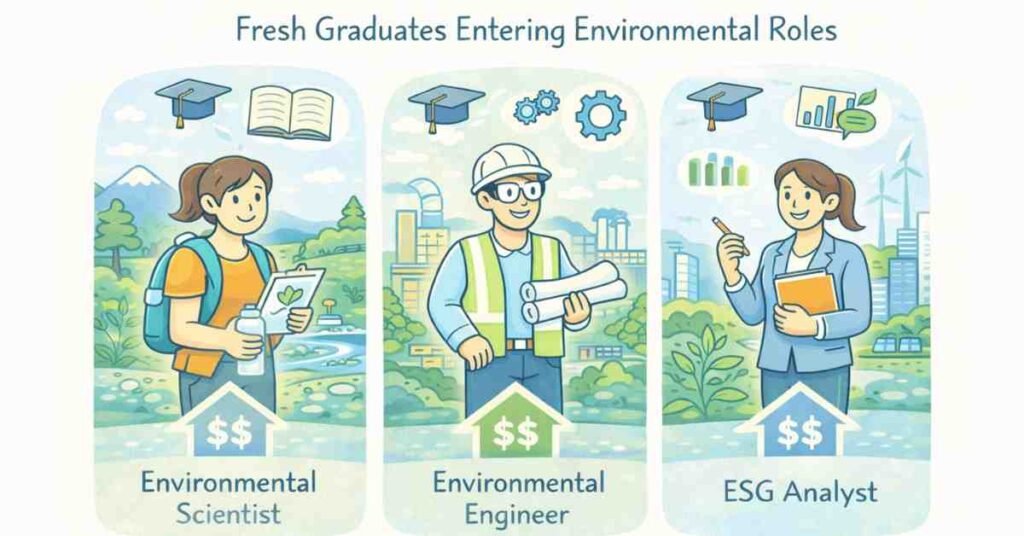
At the start of your career, most environmental roles pay modest but decent salaries compared to other science-based careers in India.
Typical Entry-Level Roles and Ranges
- Environmental Technician / Field Assistant
- Work: sample collection, basic monitoring, assisting in field and lab tasks.
- Typical pay: around ₹3–5 LPA in many Indian cities.
- Work: sample collection, basic monitoring, assisting in field and lab tasks.
- Junior Environmental Scientist / Analyst
- Work: data collection, lab tests, basic analysis, helping with reports.
- Typical pay: roughly ₹3.5–6 LPA depending on organization type.
- Work: data collection, lab tests, basic analysis, helping with reports.
- Junior Environmental Engineer
- Work: support design and operation of treatment plants, pollution control systems, project sites.
- Typical pay: often ₹4–8 LPA, with engineering and infrastructure firms paying on the higher side.
- Work: support design and operation of treatment plants, pollution control systems, project sites.
- EHS (Environment, Health & Safety) Officer – Fresher
- Work: safety rounds, basic compliance checks, assisting senior EHS staff.
- Typical pay: around ₹4–7 LPA, varying by sector (oil & gas and heavy industry usually pay more).
- Work: safety rounds, basic compliance checks, assisting senior EHS staff.
- NGO / Conservation Assistant
- Work: field surveys, community engagement, project support in conservation or environmental education.
- Typical pay: usually ₹2.5–5 LPA, depending on NGO size and funding.
- Work: field surveys, community engagement, project support in conservation or environmental education.
- Junior Sustainability / ESG Analyst (in larger firms)
- Work: data gathering, support in report preparation, basic ESG research.
- Typical pay: often in the ₹6–10 LPA range in bigger companies and consulting environments.
- Work: data gathering, support in report preparation, basic ESG research.
These numbers may feel lower compared to some IT or core finance fresher roles, but environmental careers often catch up as you gain specialization and experience.
Mid-Level Salaries (3–7 Years Experience)
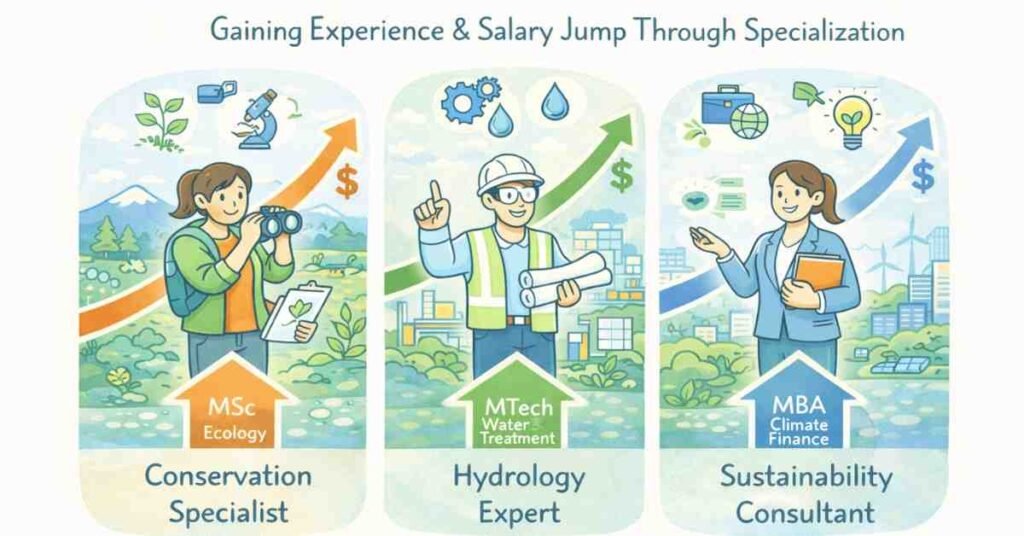
With 3–7 years of experience, a relevant master’s degree, or specialized skills, salary growth becomes significant, especially in engineering, consulting, ESG, and climate-related roles.
Typical Mid-Level Roles and Ranges
- Environmental Scientist (Mid-Level)
- Work: project ownership, advanced analysis, supervision of field and lab teams.
- Typical pay: roughly ₹6–12 LPA depending on sector and location.
- Work: project ownership, advanced analysis, supervision of field and lab teams.
- Environmental Engineer (Mid-Level)
- Work: independent design of treatment systems, lead role in pollution control projects.
- Typical pay: around ₹8–15 LPA, sometimes more in large infrastructure or industrial firms.
- Work: independent design of treatment systems, lead role in pollution control projects.
- Sustainability Analyst / Specialist
- Work: sustainability strategy support, detailed data analysis, report ownership.
- Typical pay: approximately ₹8–18 LPA depending on company size and responsibilities.
- Work: sustainability strategy support, detailed data analysis, report ownership.
- ESG Analyst (3–5 Years)
- Work: deep analysis of company ESG performance, client interaction, complex projects.
- Typical pay: often in the ₹10–20 LPA range, especially in investment, banking, or consulting firms.
- Work: deep analysis of company ESG performance, client interaction, complex projects.
- Climate Consultant / Climate Change Analyst
- Work: GHG inventories, net-zero roadmaps, climate risk assessments.
- Typical pay: about ₹12–22 LPA in consulting and larger corporates.
- Work: GHG inventories, net-zero roadmaps, climate risk assessments.
- EHS Manager / Senior Officer
- Work: managing safety and environment systems, training, audits, regulatory interactions.
- Typical pay: around ₹10–18 LPA, with higher salaries in high-risk or large-scale sectors.
- Work: managing safety and environment systems, training, audits, regulatory interactions.
Mid-level salaries often show strong jumps when professionals switch employers after building demonstrable project experience and niche skills.
Senior-Level Salaries (8+ Years Experience)
Senior environmental and sustainability professionals can earn salaries comparable to other leadership roles, especially if they combine technical depth with management or ESG/strategy skills.
Typical Senior Roles and Ranges
- Senior Environmental Consultant / Practice Lead
- Work: lead major projects, manage teams, handle key clients, contribute to business development.
- Typical pay: roughly ₹18–30 LPA, sometimes higher in reputed consulting firms.
- Sustainability Manager / Head of Sustainability
- Work: drive company-wide sustainability programs, targets, and reporting.
- Typical pay: often ₹20–35 LPA in mid to large corporations.
- Head of ESG / ESG Lead
- Work: oversee ESG frameworks, investor expectations, ESG risk integration.
- Typical pay: commonly ₹30–50 LPA, with potential to go higher in large listed companies and financial institutions.
- Chief Sustainability Officer (CSO) / Director – Sustainability
- Work: strategic leadership, board-level engagement, global sustainability direction.
- Typical pay: can reach ₹40–70 LPA or more in major organizations, depending on sector and scope.
- Senior EHS / Environment Head – Plant or Group Level
- Work: oversee safety and environment function across one or multiple plants.
- Typical pay: usually in the ₹20–40 LPA range, with higher salaries in capital-heavy industries.
At this stage, compensation often includes bonuses, stock options, or performance-linked components, especially in large corporates and multinational organizations.

Salary by Sector: Who Pays More?
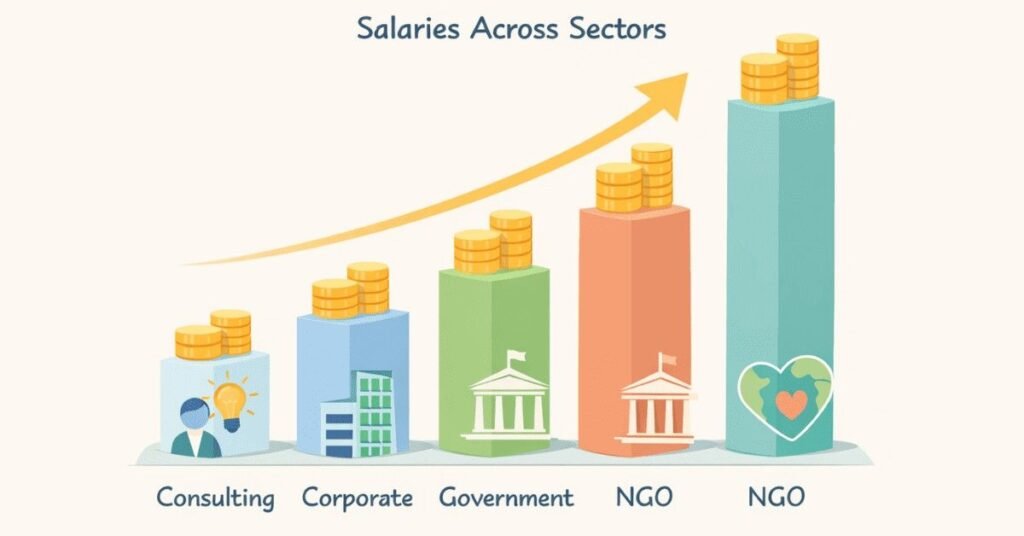
Your sector significantly influences your compensation, even if your job title is similar.
Higher Paying Sectors
- Consulting (especially Big 4 and global firms)
- ESG, climate, and sustainability consulting roles tend to pay better because they directly support high-value client work.
- Corporate (MNCs, large Indian companies)
- Corporate sustainability, EHS leadership, and ESG roles pay well, particularly in sectors like energy, FMCG, IT services, and manufacturing.
- Financial Services (Banks, Asset Managers, Rating Agencies)
- ESG analysts and climate risk professionals working closely with investments often command higher salaries.
Moderate Sectors
- Government Roles
- Pay is usually moderate but stable, with strong benefits, pensions, and job security.
- Research Institutes and Academia
- Salaries vary but can be modest compared to corporate roles, though they offer academic freedom and clear promotion structures.
Lower Paying Sectors
- NGOs and Grassroots Organizations
- Early-career salaries can be modest (₹2.5–6 LPA) but roles often offer rich field experience, international project exposure, and deep purpose.

Salary by City: Metro vs Non-Metro
Location also affects salary levels because cost of living and corporate presence vary.
- Tier 1 Cities (Mumbai, Delhi NCR, Bengaluru, Hyderabad, Pune, Chennai):
- Environmental and sustainability salaries can be 15–25% higher compared to smaller cities, especially in corporate and consulting roles.
- Environmental and sustainability salaries can be 15–25% higher compared to smaller cities, especially in corporate and consulting roles.
- Tier 2/3 Cities and Industrial Towns:
- Pay is lower on average, but cost of living can be much lower as well.
- EHS, environmental officer, and plant roles are common near industrial clusters.
- Pay is lower on average, but cost of living can be much lower as well.
Many professionals begin in metros to build experience and later shift to non-metro locations for better work–life balance and lower living costs.
International Salary Snapshot
For those open to working abroad, environmental and climate skills can translate into significantly higher earnings.
- United States:
- Environmental scientists have a median annual wage around $80,060 (≈₹66 LPA).
- Environmental scientists have a median annual wage around $80,060 (≈₹66 LPA).
- Europe (varies by country):
- Environmental and sustainability roles often range from mid to high five-figure EUR or GBP salaries annually, generally higher than Indian levels when converted.
- Environmental and sustainability roles often range from mid to high five-figure EUR or GBP salaries annually, generally higher than Indian levels when converted.
- Middle East:
- EHS, environmental, and sustainability professionals may receive tax-free packages with additional allowances, often 30–50% higher than similar roles in India for experienced professionals.
- EHS, environmental, and sustainability professionals may receive tax-free packages with additional allowances, often 30–50% higher than similar roles in India for experienced professionals.
Accessing these opportunities usually requires 5–10 years of solid experience, strong English skills, and familiarity with international standards and frameworks.
Key Factors That Influence Environmental Salaries
1. Education Level
- Bachelor’s degree → good for entry-level roles.
- Master’s degree (MSc/MTech) → enables faster progression into mid-level and senior technical roles.
- MBA in Sustainability/ESG → opens management and strategy positions with high growth potential.
2. Specializations and Skills
- Engineering plus environment (e.g., Environmental/Civil/Chemical) → stronger pay in technical roles.
- ESG, climate, and carbon accounting skills → high demand in consulting and finance.
- GIS, remote sensing, data analysis → valuable in mapping, planning, and research roles.
3. Certifications
Relevant certifications can increase both employability and salary prospects:
- Environmental management and auditing (e.g., ISO 14001-related programs).
- ESG and sustainability reporting credentials.
- Carbon accounting and climate risk programs.
These can make candidates stand out, especially in mid-career transitions.
4. Sector and Employer Brand
- Well-known companies, MNCs, and reputed consultancies usually offer higher pay, structured increments, and better benefits.
5. Experience and Performance
- Consistent high performance, successful projects, and demonstrated impact (for example, cost savings from energy efficiency or successful compliance) can support faster promotions and salary jumps.
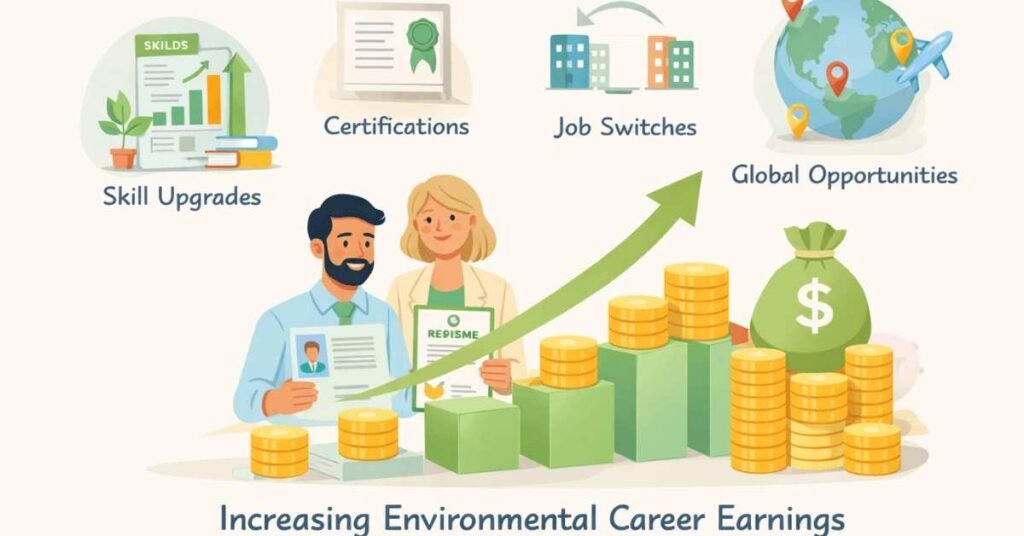
How to Increase Your Earning Potential in Environmental Careers
- Build a Strong Technical Foundation
- Gain depth in at least one area: pollution control, climate, ESG, GIS, or EHS.
- Don’t remain “too general” for too long; specialization often leads to higher pay.
- Gain depth in at least one area: pollution control, climate, ESG, GIS, or EHS.
- Add High-Value Skills
- Learn data tools (advanced Excel, basic BI, maybe some coding for analysis).
- Understand internationally used frameworks (ESG, GHG Protocol, ISO standards).
- Learn data tools (advanced Excel, basic BI, maybe some coding for analysis).
- Choose Sector and Role Strategically
- If pay is a major priority, target consulting, corporate, or finance-linked sustainability roles once you have some experience.
- If pay is a major priority, target consulting, corporate, or finance-linked sustainability roles once you have some experience.
- Use Job Changes Wisely
- Many professionals see their biggest salary jumps when they move companies after 2–4 years and again mid-career, backed by solid achievements.
- Many professionals see their biggest salary jumps when they move companies after 2–4 years and again mid-career, backed by solid achievements.
- Negotiate with Data
- Research typical salaries for your role, experience, and city.
- Highlight concrete results—like emission reductions, cost savings, successful audits, or projects completed.
- Research typical salaries for your role, experience, and city.
- Consider International Work or Remote Roles
- After building expertise, explore remote consulting or global opportunities that may pay in foreign currency.
Final Thoughts: Balancing Passion and Pay
The Story Arc Method
Environmental and sustainability careers offer a rare combination:
- You work on problems that genuinely matter to society and the planet.
- You can still build a financially stable and even high-paying career if you choose your path, skills, and sectors wisely
For students and freshers, the key is to accept that starting salaries may be moderate, but growth can be strong if you:
- Keep learning,
- Build real project experience, and
- Move into high-impact, in-demand niches like engineering, ESG, and climate over time.