
Consulting Career Path: From Analyst to Partner (Complete Roadmap)
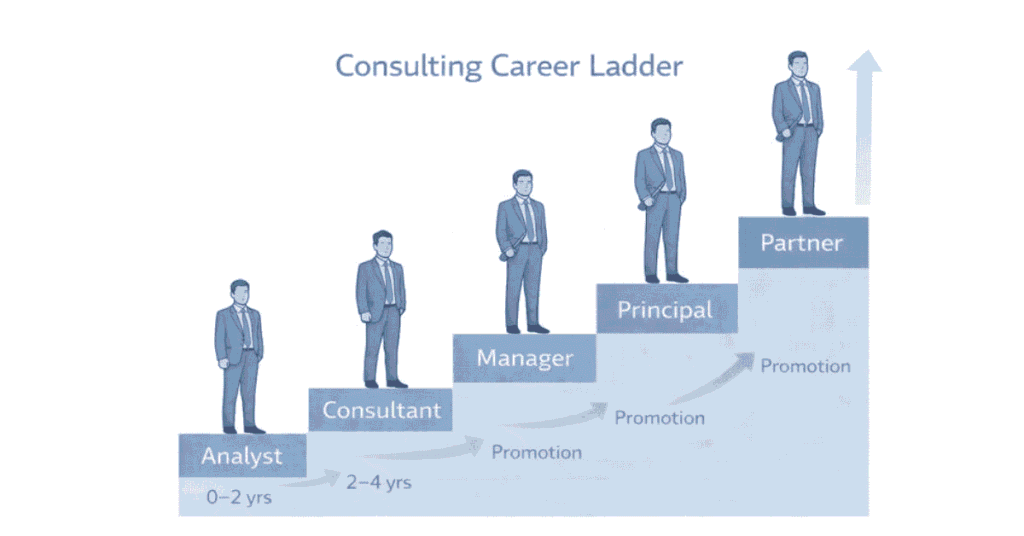
Table of Contents
Consulting offers one of the clearest and most structured career paths in business. Unlike many corporate roles where progression can feel murky and political, consulting firms have explicit hierarchies, defined promotion timelines, and transparent performance expectations. You know exactly where you stand, what’s required to advance, and when you can expect to move up—if you perform well.
But here’s the catch: it’s an “up or out” system at most top firms. If you don’t get promoted within expected timelines, you’re typically counseled to leave. This creates intense pressure but also rapid development—those who succeed advance faster than almost any other career path, reaching senior leadership positions in their early 30s that would take decades elsewhere.
This guide walks you through every stage of the consulting career ladder—from fresh graduate analyst to equity partner—explaining responsibilities, timelines, compensation, skills needed, and what success looks like at each level. Whether you’re considering consulting or already in it, you’ll understand exactly what lies ahead
The Consulting Career Ladder: Overview
Key points:
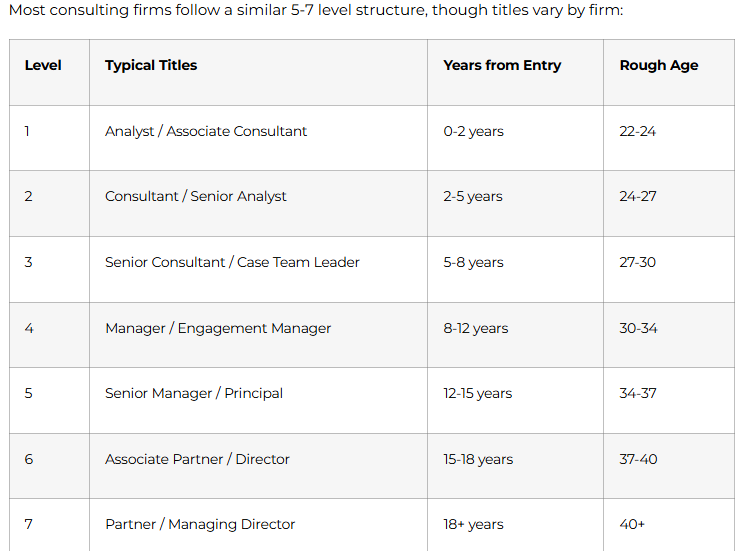
- MBA entry typically starts at Level 2-3 (Consultant/Senior Consultant), saving 2-3 years
- Lateral hires with industry experience may enter at higher levels based on expertise
- Timelines compress at top performers, stretch for average performers
- Not everyone reaches partner—only 10-20% of entry analysts make it that far
Level 1: Analyst / Associate Consultant (0-2 Years)
The Role
This is where most undergrad hires start. You’re the “doer” on project teams—conducting research, analyzing data, building financial models, and creating presentation slides. Think of yourself as the engine that powers project delivery.
Day-to-day responsibilities:
- Gathering and analyzing data (market reports, financial statements, customer data)
- Building Excel models and conducting quantitative analysis
- Creating PowerPoint slides that communicate findings clearly
- Conducting interviews with client employees or customers
- Supporting senior team members in client meetings
- Fact-checking and ensuring accuracy of deliverablesjaroeducation+1
What you’re NOT doing yet:
- Leading client conversations
- Making strategic recommendations independently
- Managing other team members
- Driving project direction
Skills You Build
- Technical proficiency: Excel mastery, data manipulation, financial modeling
- Attention to detail: Ensuring zero errors in analysis and slides
- Structured thinking: Learning to break problems into logical components
- Work ethic: Managing long hours and tight deadlines professionally
- Professional communication: Writing clear emails, presenting progress updatesupgrad
Compensation
- Salary range: ₹8-28 LPA depending on firm tier (MBB highest, Big 4 mid, others lower)casebasix+2
- Bonuses: 15-25% of base for strong performers
- Perks: Laptop, phone, travel allowances when on client sites
Success Metrics
You’re evaluated on:
- Quality of work: Accuracy, thoroughness, presentation quality
- Speed and efficiency: Delivering on time without constant supervision
- Learning agility: Picking up new concepts and tools quickly
- Team contribution: Being helpful, responsive, and positive
- Coachability: Taking feedback well and implementing it
Typical Timeline
Promotion to Consultant: 2-3 years for strong performers
Earlier promotion (18-24 months): Possible for exceptional analysts, especially from top schools
Slower progression (3+ years): If performance is inconsistent or role complexity is high
Career Survival Tips
- Master the basics obsessively: Excel, PowerPoint, structured thinking—these are your foundation
- Ask for feedback frequently: Don’t wait for formal reviews; seek coaching weekly
- Deliver early when possible: Under-promise, over-deliver creates strong reputation
- Build relationships: With seniors, peers, and even clients (when appropriate)
Document learnings: Keep notes on frameworks, industry knowledge, mistakes to avoidc
Level 2: Consultant (2-5 Years)
The Role
Your first real step up. You transition from pure execution to owning workstreams—specific parts of the project where you’re responsible for the approach, analysis, and recommendations.
Day-to-day responsibilities:
- Leading workstreams: Owning major parts of projects (e.g., all customer analysis or competitive benchmarking)
- Developing hypotheses: Proposing what you think is causing the problem and how to test it
- Client interaction: Presenting your analysis in meetings, answering client questions
- Guiding analysts: Providing direction and reviewing their work
- Shaping recommendations: Contributing meaningfully to final recommendations, not just executingjaroeducation+1
What’s new:
- You have more autonomy—managers give you problems to solve, not step-by-step instructions
- You’re expected to think strategically, not just analytically
- Client exposure increases significantly
Skills You Build
- Strategic thinking: Moving from “what does the data say?” to “what should we do about it?”
- Stakeholder management: Reading client personalities, building trust
- Synthesis: Pulling together disparate analyses into coherent stories
- Mentorship: Teaching analysts while learning from managers
- Business development awareness: Understanding how projects are soldcphrservices
Compensation
- Salary range: ₹15-50 LPA depending on firm tier and geographyjaroeducation
- MBB: ₹35-50 LPA total comp
- Big 4: ₹18-28 LPA
- Bonuses: 20-30% for strong performers
Success Metrics
- Quality of insights: Are your recommendations thoughtful and defensible?
- Client feedback: Do clients specifically mention you positively?
- Independence: How much supervision do you need?
- Team leadership: Do analysts want to work with you?
- Business acumen: Are you thinking about client economics and practicality?casebasix
Typical Timeline
Promotion to Senior Consultant: 2-3 years (total 4-6 years from entry)
Direct MBA entry: This is often where post-MBA hires start, sometimes titled “Associate” or “Senior Consultant”
Career Survival Tips
- Develop a point of view: Don’t just present data—have a hypothesis about what it means
- Think like a manager: Anticipate what your manager will ask and prepare answers proactively
- Build client relationships: Remember names, ask good questions, show genuine interest in their business
Start specializing: Begin developing depth in an industry or functional area
Level 3: Senior Consultant / Case Team Leader (5-8 Years)
The Role
You’re now the senior “doer” on teams—running day-to-day project operations while managers handle client relationships and business development at a higher level.
Day-to-day responsibilities:
- Managing multiple workstreams: Coordinating 2-3 parallel analyses
- Quality control: Reviewing all team output before it goes to clients
- Client presentations: Delivering substantial portions of presentations
- Team leadership: Directly managing 2-4 consultants/analysts
- Problem diagnosis: Identifying when the project is off track and proposing solutions
- Contributing to proposals: Helping win new workcphrservices+1
What’s new:
- You’re accountable for overall project delivery, not just your workstream
- You manage the team’s daily rhythm—meetings, work allocation, quality checks
- Clients start viewing you as their primary day-to-day contact
Skills You Build
- Project leadership: Running complex projects with multiple moving parts
- People management: Coaching, motivating, giving tough feedback
- Advanced problem-solving: Handling ambiguous, multi-faceted business problems
- Commercial awareness: Understanding project economics (budgets, scope, staffing)
- Resilience: Managing stress of accountability without partner-level authoritycphrservices
Compensation
- Salary range: ₹25-75 LPA depending on firmjaroeducation
- MBB: ₹55-75 LPA
- Big 4: ₹25-38 LPA
- Bonuses: 25-35% of base
Success Metrics
- Project delivery: Are projects completed on time, on budget, with happy clients?
- Team development: Are your team members growing and getting promoted?
- Client impact: Are recommendations being implemented? Measurable results?
- Thought leadership: Are you building a reputation in a specific area?
- Business development: Are you helping win new projects?casebasix
Typical Timeline
Promotion to Manager: 2-4 years (total 7-10 years from entry)
Critical juncture: Many consultants exit here to industry roles—you’re experienced enough to command senior corporate positions but haven’t committed to the partner trackcphrservices
Career Decision Point
This is when you decide:
- Stay on partner track: Commit to 10+ more years, accept increasing travel/hours
- Exit to industry: Move to corporate strategy, operations, or leadership roles with better work-life balance
- Pivot to specialized consulting: Join boutique firms or start independent practice
About 40-50% of consultants exit around this level, often by choice.
Level 4: Manager / Engagement Manager (8-12 Years)
The Role
The first major leadership role. You own entire projects—P&L responsibility, client relationships, team performance, and delivery excellence.
Day-to-day responsibilities:
- Running full projects: Complete accountability for 2-4 month engagements
- Client relationship management: Primary point of contact, managing expectations
- Team composition: Deciding who’s on your team and how work is divided
- Quality and risk management: Ensuring ethical standards, avoiding project risks
- Proposal development: Leading pitch teams to win new work
- Firm building: Recruiting, training, mentoring
What’s new:
- You’re fully accountable—success and failure are yours
- Significant client relationship ownership
- Business development becomes part of your job (20-30% of time)
- Your reputation in the firm matters greatly
Skills You Build
- Full P&L management: Running projects profitably
- Difficult conversations: Handling underperformers, scope changes, client pushback
- Strategic client management: Deepening relationships, identifying new opportunities
- Selling: Developing compelling proposals, presenting to decision-makers
- Leadership at scale: Managing multiple teams simultaneousl
Compensation
- Salary range: ₹35-120+ LPA depending on firm and performance ₹1.2 Cr
- Big 4: ₹35-55 LPA
- Bonuses: 30-40% of base, increasingly tied to business development
Success Metrics
- Revenue responsibility: Are you hitting project profitability targets?
- Client satisfaction: Net Promoter Scores, repeat business
- Team health: Are your teams happy and productive?
- Business development: How much new work are you bringing in?
- Firm reputation: Are you known for excellence in a domain?casebasix
Typical Timeline
Promotion to Senior Manager/Principal: 3-5 years (total 11-15 years from entry)
Alternative: Lateral move to Director at another firm or senior industry role
Career Survival Tips
- Build your personal brand: Publish thought leadership, speak at conferences
- Cultivate client champions: Develop 3-5 strong client relationships who trust you
- Master the commercial side: Understand pricing, contracts, risk management
Develop future leaders: Your team’s success reflects on you
Level 5-7: Senior Manager → Principal → Partner (12-20+ Years)
Senior Manager / Principal (12-15 Years)
The role:
- Managing multiple simultaneous projects
- Heavy business development focus (40-50% of time)
- Grooming for partnership—proving you can bring in business
- Deep client relationships with C-suite executives
Compensation: ₹50 LPA – ₹2 Cr depending on firmjaroeducation+1
Key challenge: Proving you can originate business, not just deliver existing work
Associate Partner / Director (15-18 Years)
The role:
- Pre-partner testing ground
- Building a “book of business”—portfolio of clients you own
- Firm strategy and leadership contributions
- Evaluating partnership fit (cultural, financial, strategic)
Compensation: ₹80 LPA – ₹2.5+ Cr
Critical evaluation: Firms assess if you’ll be a successful partner before making the investment
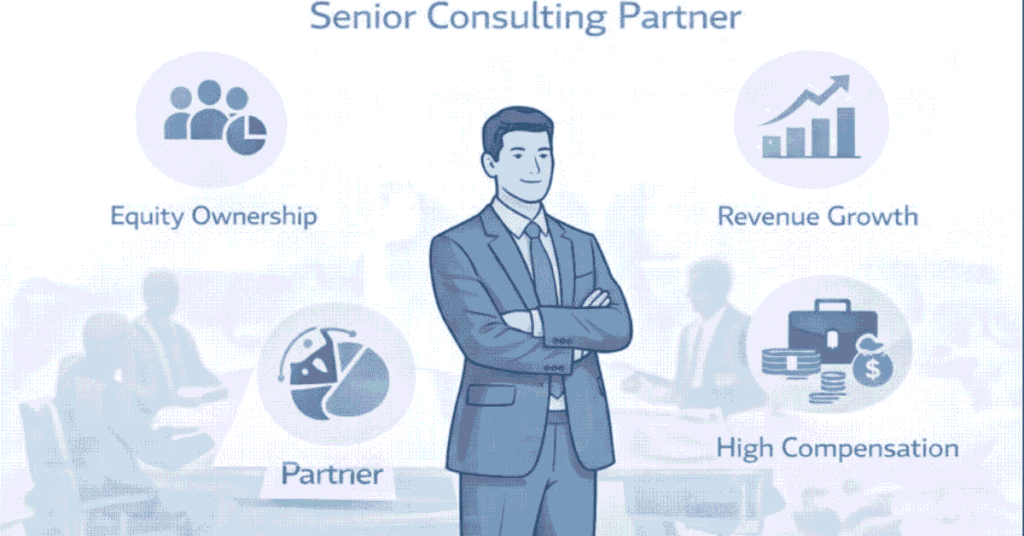
Partner / Managing Director (18+ Years)
The role:
- Equity ownership: You’re now a firm owner, not just an employee
- Business origination: 60-70% of time winning new work
- Client relationships: Portfolio of major clients generating millions in revenue
- Firm building: Shaping strategy, recruiting, building next generation
- Thought leadership: Publishing, speaking, representing the firm externally
Compensation: ₹2-5+ Crore annually (top partners can exceed ₹10 Cr)
- Base salary + profit share + bonuses
- Highly variable based on business brought in
Success metrics:
- Revenue generated
- Client portfolio quality
- Firm reputation and brand building
- Next generation development
The Partnership Decision
What it takes:
- 10-15+ years of proven excellence
- Strong business development track record
- Deep expertise recognized externally
- Cultural fit and firm commitment
- Willingness to buy in (financial investment in some firms)
- Personal sacrifice (travel, hours, family impact)cphrservices+1
Reality check:
- Only 10-20% of entry analysts reach partner
- Many choose to exit before—by choice, for work-life balance
- Partnership is demanding but extremely lucrative
Up or Out: The Promotion System
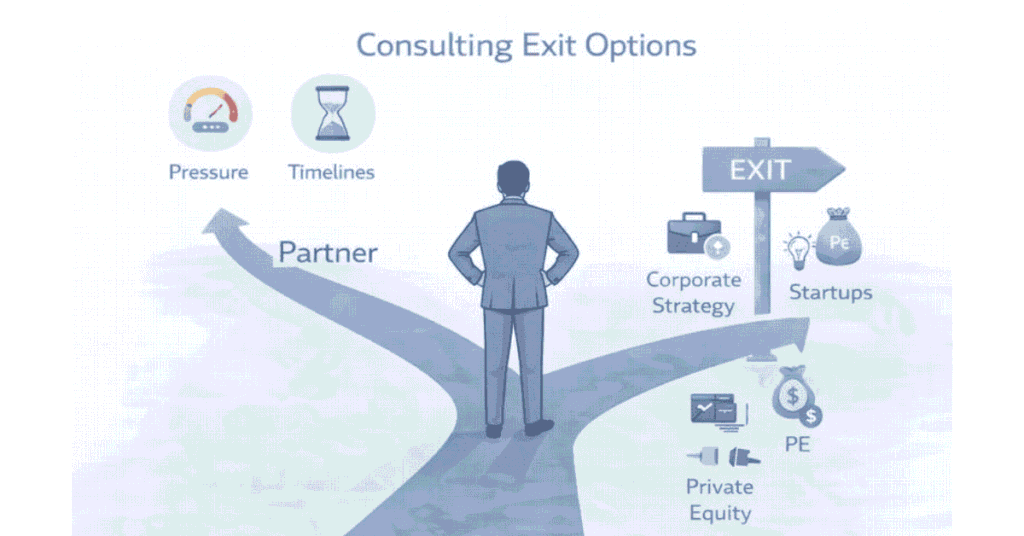
Most top firms operate on “up or out” principles:
How it works:
- Performance reviews every 6-12 months
- Explicit promotion timelines (e.g., “Consultant to Senior Consultant in 2-3 years”)
- If you don’t get promoted within expected window + 1 year grace period, you’re counseled to leave
- Exception: Some firms have “career consultant” tracks for specialistscasebasix
Why firms do this:
- Maintains quality bar
- Creates room for new talent
- Prevents stagnation
- Ensures only high performers reach senior levels
What this means for you:
- Constant pressure to perform
- Clear feedback on where you stand
- Faster development than corporate roles
- Exit is not failure—most leave to great opportunities
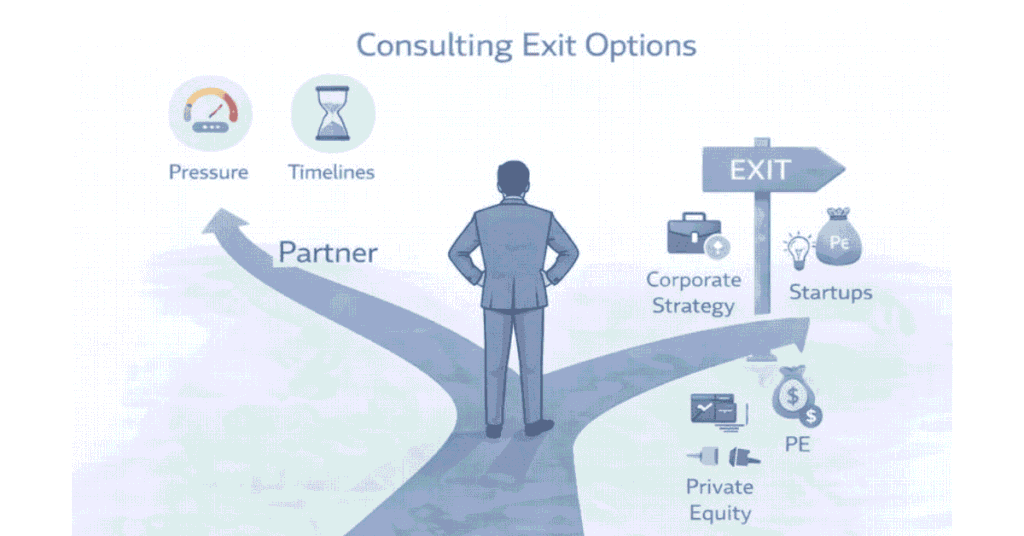
Exit Opportunities at Each Level
Analyst/Consultant (2-5 Years Out)
- Corporate strategy roles: Associate/Manager level
- Startups: Operations, strategy, analytics roles
- MBA programs: Using consulting as pre-MBAexperience
Senior Consultant/Manager (5-10 Years Out)
- Senior corporate roles: Head of Strategy, VP Operations, Business Unit Leader
- Private equity/VC: Associate or Senior Associate
- Entrepreneurship: Starting own ventures
- Industry leadership: General management roles
Senior Manager/Principal (10+ Years Out)
- C-suite positions: Chief Strategy Officer, COO, CEO track
- PE/VC Partner: Investment leadership roles
- Board positions: Serving on company boards
- Independent consulting: High-value boutique practicecphrservices
Key insight: Ex-consultants are heavily recruited because consulting builds versatile, proven leaders.
Final Thoughts: Is the Climb Worth It?
The case FOR climbing the ladder:
- Fastest path to business leadership in your 30s
- Exceptional learning and skill development
- High compensation at every level
- Incredible network and credibility
- Exit options improve with each promotioncasebasix+1
The case for strategic exits:
- Work-life balance improves dramatically in corporate roles
- Less travel, more predictable schedules
- Can earn comparable or better comp in industry senior roles
- More control over your life and location
- Partnership is elite but requires total commitmentcphrservices
Most common path: 3-7 years in consulting → exit to industry senior role → use consulting skills to climb corporate ladder faster than internal candidates
The consulting career path is clear, structured, and rewarding—but it’s not for everyone forever. Understanding the ladder helps you decide how high you want to climb before pivoting to your next adventure.