
Annotated Sample JAM Responses
Table of Contents

Sample Response #1: "The Role of Technology in Education"
[Opening – Hook with statistic, mid-range pitch, clear pronunciation]
“Within the next decade, over 80% of classrooms globally will integrate AI-powered learning tools.”
[Strategic pause for breath – 1 second]
[Main Body Point 1 – Slightly faster pace, conversational tone]
“Technology has fundamentally transformed how students learn and teachers instruct. Digital platforms like Google Classroom and Microsoft Teams enable collaborative learning regardless of physical location.”
[Transition phrase – buying thinking time]
“Building on this infrastructure…”
[Main Body Point 2 – Variable pace, emphasize key words with volume]
“…personalized learning has become reality. Adaptive learning systems analyze individual student performance and customize content delivery. For instance, platforms like Khan Academy adjust difficulty based on student progress, ensuring optimal challenge levels.”
[Strategic pause for breath]
[Main Body Point 3 – Lower pitch for authority]
“However, we must acknowledge the digital divide. Students without reliable internet access face significant disadvantages. Therefore, education technology must prioritize accessibility and equity alongside innovation.”
[Transition to closing – slower pace]
“Ultimately…”
[Closing – Confident tone, mid-low pitch]
“…technology in education isn’t about replacing teachers—it’s about empowering them with tools that enhance learning outcomes while preparing students for a digital future.”
Time: 58 seconds | Word count: ~122 words
⭐Enhance Your Learning Journey — Explore Structured Skill-Building Programs

TECHNIQUE BREAKDOWN:
✅ Structure: STAR method applied
- Situation: Technology’s growing role (statistic hook)
- Task: Understanding the transformation
- Action: Examples of digital platforms, personalized learning, addressing challenges
- Result: Future-forward conclusion
✅ Voice Modulation:
- Pitch variation: Higher on statistics, lower on challenges, mid-range for solutions
- Volume emphasis on “fundamentally transformed” and “digital divide”
- Tone shift from optimistic to cautionary to balanced
✅ Content Quality:
- Specific examples: Google Classroom, Microsoft Teams, Khan Academy
- Statistics: 80% projection
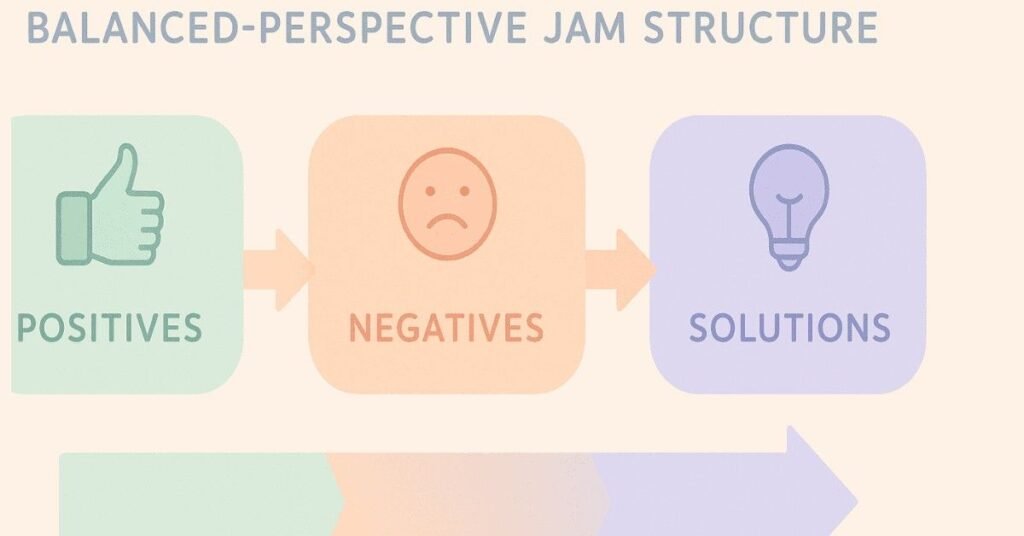
- Balanced perspective: Benefits + challenges + solutions
✅ Pacing:
- Opening: Slower (8 seconds for impact)
- Body: Variable (35 seconds with strategic pauses)
- Closing: Moderate (15 seconds for memorable finish)
✅ Transitions:
- “Building on this infrastructure…” (connects points)
- “However…” (introduces contrasting perspective)
- “Ultimately…” (signals conclusion)
✅ Rule Adherence:
- No deviation: Every sentence relates to technology in education
- No repetition: Each point adds new information
- No hesitation: Strategic pauses only, zero filler words
Sample Response #2: "Why People Procrastinate"
[Opening – Relatable question, friendly tone]
“Have you ever delayed an important task until the last possible moment, despite knowing the consequences?”
[Brief pause – allows question to resonate]
[Personal connection establishing credibility]
“Most of us have. Procrastination isn’t about laziness—it’s a complex psychological response to anxiety and overwhelm.”
[Main explanation – moderate pace]
“When faced with challenging tasks, our brain perceives them as threats. This triggers avoidance behavior as a short-term emotional regulation strategy. We choose immediate relief over long-term benefits.”
[Transition with specific example]
“Consider a familiar scenario…”
[Example – slightly faster, storytelling tone]
“A student knows they must start their project weeks in advance. Yet they clean their room, check social media, reorganize notes—anything except starting. Why? The project feels overwhelming. Breaking it into smaller steps reduces that anxiety.”
[Solution-focused segment – confident, authoritative tone]
“Overcoming procrastination requires understanding its roots. Implementation intentions help: Instead of ‘I’ll study today,’ say ‘I’ll study Chapter 3 at 4 PM in the library.’ Specificity eliminates decision fatigue that triggers delay.”
[Closing – reflective, slower pace]
“Procrastination is human. The difference between chronic procrastinators and productive people isn’t motivation—it’s systems that make starting easier than avoiding.”
Time: 60 seconds | Word count: ~128 words
TECHNIQUE BREAKDOWN:
✅ Structure: Problem-Solution Framework
- Problem identification: Relatable question opening
- Cause analysis: Psychological explanation
- Real-world example: Student scenario
- Solution: Specific strategies
- Reflection: Reframe the issue
✅ Engagement Techniques:
- Opening question creates immediate connection
- Personal pronoun “we” creates inclusivity
- Specific scenario makes abstract concept concrete
- Actionable advice (implementation intentions)
✅ Content Depth:
- Goes beyond surface-level “people are lazy” explanation
- Introduces concept of “implementation intentions”
- References brain’s threat response psychology
- Practical, immediately applicable solution
✅ Vocabulary Sophistication:
- “Emotional regulation strategy”
- “Implementation intentions”
- “Decision fatigue”
- Shows knowledge without sounding pretentious
✅ Natural Flow:
- Conversational tone throughout
- Smooth transitions between segments
- No robotic delivery despite structure
✅Upskill with Industry-Ready Courses Designed for Real-World Growth
Sample Response #3: "The Impact of Social Media"
[Opening – Contrarian perspective to grab attention]
“Social media isn’t inherently good or bad—it’s a mirror reflecting how we choose to use it.”
[Establishing scope]
“With over four billion users globally, social media has fundamentally reshaped human connection, information dissemination, and societal discourse.”
[Positive impacts – optimistic tone, moderate pace]
“On the positive side, social media democratizes voice. Movements like MeToo and climate activism gained momentum through digital platforms. Small businesses reach global audiences. Families separated by distance maintain meaningful connections.”
[Transition to challenges – tone shifts to serious]
“However, these benefits coexist with significant challenges…”
[Negative impacts – concerned but measured tone]
“Mental health research indicates excessive social media use correlates with increased anxiety and depression, particularly among teenagers. Echo chambers amplify misinformation. Constant comparison culture erodes self-esteem.”
[Balanced solution – authoritative, confident]
“The solution isn’t abandonment—it’s intentional usage. Setting boundaries, curating meaningful content, and prioritizing real-world relationships alongside digital ones creates healthy balance.”
[Closing – forward-looking, thoughtful]
“As social media continues evolving, our challenge remains constant: harnessing its connective power while protecting our mental well-being and critical thinking.”
Time: 59 seconds | Word count: ~125 words
TECHNIQUE BREAKDOWN:
✅ Structure: Balanced Perspective Framework
- Opening thesis: Nuanced position
- Context setting: Global scale
- Positive aspects: Multiple examples
- Negative aspects: Research-backed concerns
- Solution: Practical approach
- Future outlook: Ongoing responsibility
✅ Sophistication:
- Avoids simplistic “social media bad” narrative
- Acknowledges complexity
- References specific movements (MeToo, climate activism)
- Cites research implication
✅ Balanced Tone:
- Neither overly optimistic nor pessimistic
- Professional and measured
- Shows critical thinking ability
✅ Specific Examples:
- MeToo movement
- Small business applications
- Mental health research
- Makes abstract concrete and credible
BONUS SECTION 2: Quick Reference Guide for Students
Create this as a downloadable one-page resource:
JAM SUCCESS CHEAT SHEET
Print this and review 5 minutes before your JAM round
THE 3 GOLDEN RULES (Never Violate These)
- No Deviation – Stay on topic throughout
- No Repetition – Each point must be unique
- No Hesitation – Minimize “um,” “uh,” “like”
60-SECOND STRUCTURE (Follow This Every Time)
0-10 seconds: OPENING
Choose one hook:
- Surprising statistic
- Thought-provoking question
- Personal connection
- Contrarian statement
10-45 seconds: BODY (3 points)
- Point 1 + brief example (10-12 seconds)
- Point 2 + brief example (10-12 seconds)
- Point 3 + brief example (10-12 seconds)
Use transitions: “Additionally…” “However…” “For instance…”
45-60 seconds: CLOSING
Choose one approach:
- Summary of main message
- Future outlook
- Call to action
Personal reflection
PACING FORMULA
- 120-150 words per minute = 2-2.5 words per second
- Count: “The quick brown” in 1.5 seconds = perfect pace
- Strategic pauses after sentences only (not between words)
VOICE MODULATION QUICK TIPS
Pitch: Vary high (questions/excitement) and low (authority/seriousness)
Volume: Slightly louder for emphasis, normal for explanation
Tone: Match content (serious for problems, optimistic for solutions)
EMERGENCY RECOVERY PHRASES (When Mind Goes Blank)
- “Another important aspect is…”
- “Building on that point…”
- “Consider another perspective…”
- “To expand on this further…”
“This connects to the broader issue of…”
BODY LANGUAGE CHECKLIST
- Feet firmly planted (grounding)
- Hands at sides or on table (natural)
- 70-80% eye contact with evaluator
- Shoulders relaxed (not hunched)
Open posture (no crossed arms)
PRE-JAM 2-MINUTE ROUTINE
- Deep breathing: 4-7-8 technique (4 in, 7 hold, 8 out)
- Power pose: Hands on hips, chest open (90 seconds)youtube
- Vocal warm-up: “Red lorry yellow lorry” (3 times)
Mental affirmation: “I am prepared and confident”
IF INTERRUPTED OR CHALLENGED
Pause 2-3 seconds (breathe, don’t panic)
Acknowledge clearly: “Understood. New topic: [repeat topic]”
Restart with structure: Use STAR or three-point framework
Maintain confidence: Treat it as fresh start, not failure
COMMON MISTAKES TO AVOID
❌ Speaking too fast (rush feeling)
❌ Using excessive fillers (“um,” “uh,” “like”)
❌ Going off-topic with personal stories
❌ Repeating the same point multiple ways
❌ Apologizing for mistakes mid-speech
❌ Ending with questions instead of statements
❌ No eye contact with evaluator
❌ Showing visible nervousness
EVALUATION CRITERIA (What They’re Scoring)
- Fluency (30-35%): Smooth speech, minimal hesitation
- Coherence (25-30%): Logical organization, clear flow
- Content (20-25%): Accurate information, specific examples
- Confidence (10-15%): Body language, composure, eye contact
- Rule Adherence: Must pass – no deviation/repetition/hesitation
YOUR 5-SECOND TOPIC ANALYSIS
When you receive a topic, immediately ask:
- What is this? (Definition)
- Why does it matter? (Significance)
- What are 2-3 angles? (Perspectives)
Example: Topic “Teamwork”
- What: Collaborative effort toward common goal
- Why: Essential for organizational success
Angles: Benefits, challenges, how to improve
CONFIDENCE REMINDER
✓ The evaluator wants you to succeed
✓ One mistake doesn’t disqualify you
✓ Speaking confidently beats perfect content
✓ You know more than you think you do
✓ This is a learnable skill, not a talent
BONUS SECTION 3: Frequently Asked Questions
Q1: What if I get a topic I know absolutely nothing about?
A: Use the rapid-thinking frameworks. Even without specific knowledge, you can:
- Define what the topic means fundamentally
- Connect it to universal experiences
- Use logical reasoning: causes → effects → implications
- Speak genuinely: “While I’m not an expert, what I understand is…”
- Apply comparison frameworks: relate it to something familiar
Evaluators assess your ability to think and communicate, not encyclopedic knowledge.
Q2: How do I avoid repetition when I only have 2-3 points about a topic?
A: Use these expansion techniques:
- Add examples: General point → specific instance
- Add perspectives: Individual impact → organizational impact → societal impact
- Add dimensions: What it is → why it matters → how to improve
- Use synonyms: Instead of repeating “important,” say “crucial,” “essential,” “significant”
- Expand depth: Don’t just list points; explain each with evidence
Q3: Should I prepare scripted answers for common topics?
A: No. Memorized scripts sound robotic and fail if the topic varies slightly. Instead:
- Build a mental framework (STAR, Problem-Solution)
- Create an example repository (50+ stories, statistics, observations)
- Practice rapid content generation with frameworks
- This allows authentic, flexible responses regardless of specific topic
Q4: Is it okay to use personal examples, or should I stick to general facts?
A: Use both. The strongest speeches blend:
- Personal examples (builds authenticity and relatability)
- Universal facts/research (builds credibility)
- Real-world applications (demonstrates relevance)
Formula: “Research shows [statistic]. I personally experienced this when [example]. This demonstrates why [conclusion].”
Q5: What if I finish everything I planned to say at 40 seconds?
A: Never stop early. Use these expansion strategies:
- Add a new angle: “Consider another perspective…”
- Elaborate on your strongest point: “To expand on that further…”
- Discuss future implications: “Moving forward, this means…”
- Add a comparative example: “Similarly, we see this in…”
- Slow your pace deliberately and add thoughtful pauses
Q6: How many topics should I practice before I’m ready?
A: Minimum 50-75 topics across diverse categories over 8-12 weeks. Quality matters more than quantity:
- Record every session
- Get feedback on 20% of recordings
- Track measurable improvement
- Practice with mock interruptions
- Achieve consistent 4/5 scores across all evaluation dimensions
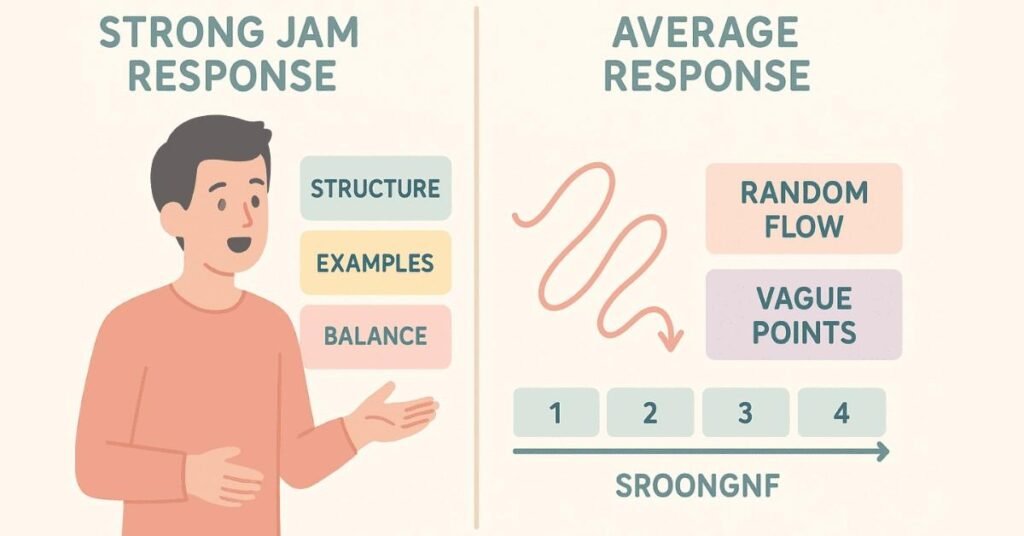
Q7: What’s the biggest difference between average and excellent JAM performance?
A: Structure and examples. Average speakers:
- Speak randomly without clear organization
- Use vague, general statements
- Show visible nervousness
Excellent speakers:
- Follow clear frameworks (STAR, three-point)
- Provide specific examples and data
- Project confidence through preparation
The difference isn’t talent—it’s systematic practice with feedback.
Q8: Can I use humor during JAM?
A: Yes, if it’s:
- Natural (not forced)
- Appropriate (professional context)
- Brief (doesn’t consume too much time)
- Relevant (connects to topic)
Example: “Procrastination—my most reliable skill since childhood.” Then immediately transition to serious analysis. Humor can engage evaluators but shouldn’t dominate your speech.
Q9: What if I completely freeze and can’t think of anything?
A: Use the “What I Know” Emergency Protocol:
- Start with the definition: “X refers to…”
- State why it matters: “This is important because…”
- Give any example: “We see this when…”
- Offer your opinion: “In my view…”
- Close with future outlook: “As we move forward…”
This buys you 60 seconds while your brain processes. Speaking imperfectly beats silence.
Q10: How important is pronunciation? Will one mispronunciation disqualify me?
A: One mispronunciation won’t disqualify you. However:
- Frequent unclear pronunciation signals communication weakness
- Continue speaking after a mispronunciation (don’t apologize)
- Practice difficult words in advance: environment, development, specifically, particularly
- Focus on clarity over perfection
Evaluators assess overall communication effectiveness, not isolated errors.

✨Stay Updated — Access Expert-Written Blogs Across Soft Skills & Career Growth
FINAL SUCCESS FRAMEWORK
Your 90-Day JAM Mastery Path:
Weeks 1-2: Foundation
- Understand rules and frameworks
- Practice 20-25 topics
- Record and identify weaknesses
Weeks3-6: Skill Development
- Focus on specific dimensions (fluency, modulation, content)
- Practice 30-40 topics
- Add interruption practice
Weeks 7-10: Advanced Practice
- Mock interviews with evaluators
- Practice 30-40 harder topics
- Refine weakest dimensions
Weeks 11-12: Confidence Building
- Full simulation practices
- Final refinements
- Mental preparation
Remember:
- JAM is a learnable skill, not innate talent
- Structure + Examples + Confidence = Success formula
- Consistent practice (30 min daily) transforms ability
- Feedback accelerates improvement exponentially
- You’re more prepared than you think