
Blockchain Industry in India : Careers, Growth & Opportunities
Table of Contents
Introduction: The New Digital Gold Rush
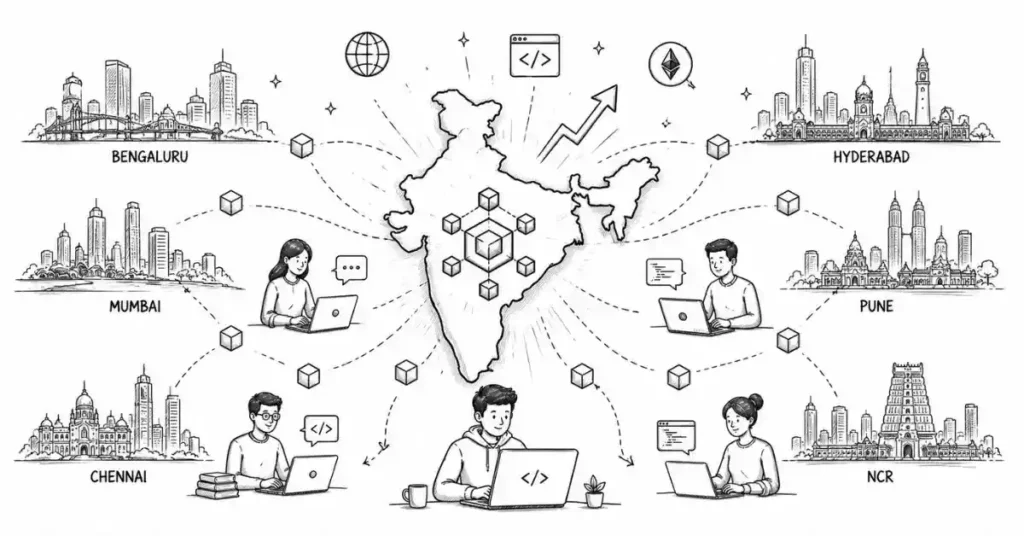
Remember when your parents told you that software engineering was the career of the future? Well, they were right but now there’s something even bigger happening. Blockchain technology is creating a revolution similar to what the internet did in the 1990s, and India is right at the center of this transformation. If you’re wondering whether blockchain is just hype or a real career opportunity, consider this: India is set to become the world’s largest Web3 developer hub by 2028, and companies are desperately searching for skilled professionals.
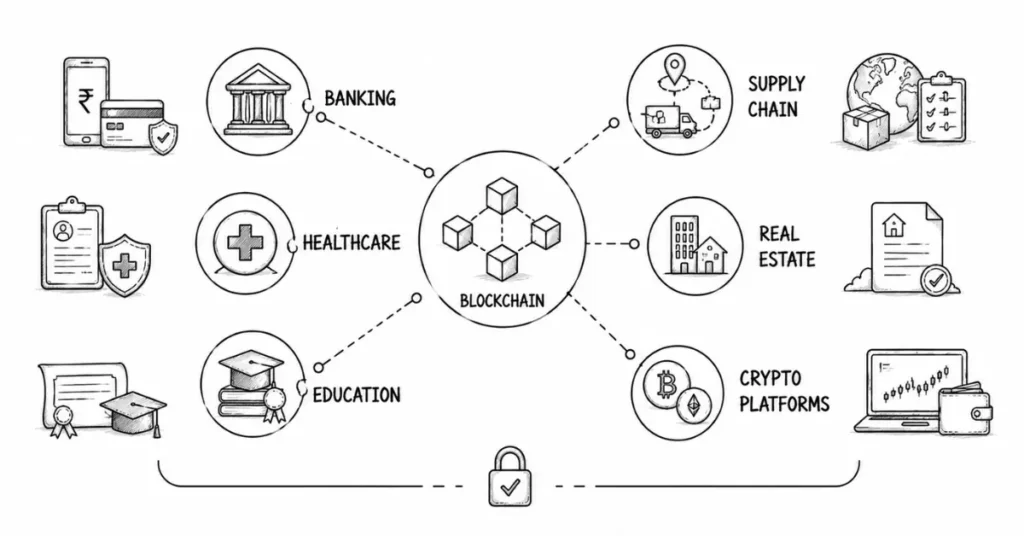
This isn’t just about cryptocurrency and Bitcoin. Blockchain technology is transforming how banks transfer money, how hospitals manage patient records, how companies track products through supply chains, and even how artists sell their work. For Indian students and professionals, this means thousands of high-paying jobs are being created every month, many offering salaries that rival or exceed traditional software engineering roles.
In this guide, we’ll break down the entire blockchain industry landscape in simple terms. You’ll understand what sectors are hiring, which companies are leading the way, what skills are actually needed, and most importantly how you can position yourself to grab these opportunities. Whether you’re a final-year engineering student, a software developer looking to upskill, or even someone from a non-technical background curious about blockchain, this guide will show you exactly where you fit in this booming industry.
The Current State of Blockchain in India
Market Size and Growth Trajectory
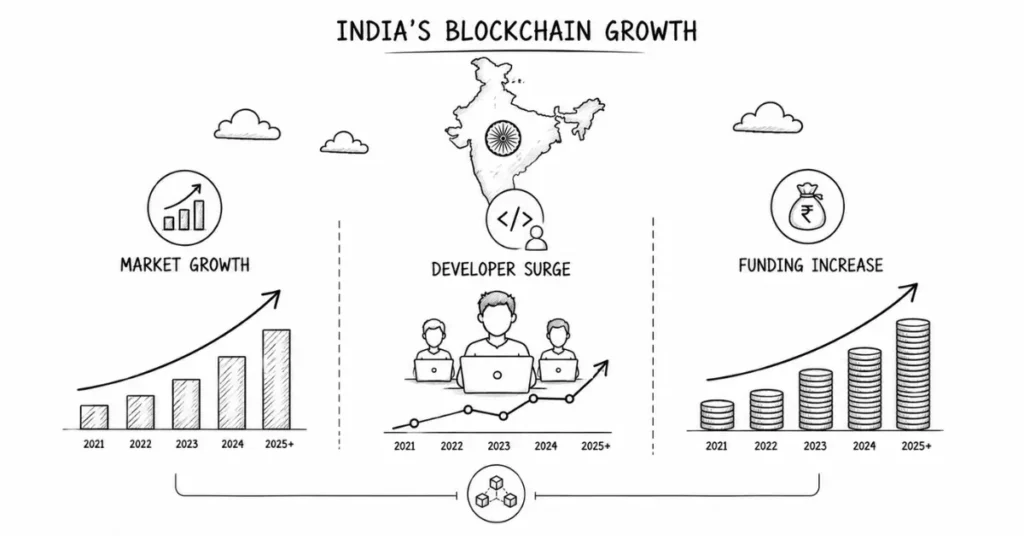
India’s blockchain market is exploding. The country added 4.7 million developers to GitHub in 2024, accounting for 17% of all new Web3 developers worldwide. To put this in perspective, India is adding more blockchain developers than any other nation, including the United States and China. This isn’t happening by accident—it’s the result of several factors coming together at the right time.
First, India’s strong foundation in IT services and software development provides a ready talent pool. Engineers who previously worked on traditional web applications are transitioning to blockchain, leveraging their existing programming knowledge while learning new concepts like smart contracts and decentralized systems. Second, the cost advantage Indian developers offer makes them highly attractive to global blockchain companies. A blockchain developer in Bangalore can earn ₹10-15 lakhs annually while delivering work quality comparable to developers earning $100,000+ in Silicon Valley.
Third, investor confidence in India’s Web3 ecosystem has surged dramatically. Web3 funding in India increased by 109% compared to the previous year, bringing significant capital into the ecosystem. This money isn’t just sitting in bank accounts—it’s actively being deployed to build products, hire teams, and expand operations. For job seekers, this funding boom translates directly into hiring opportunities
Government Stance and Regulatory Environment
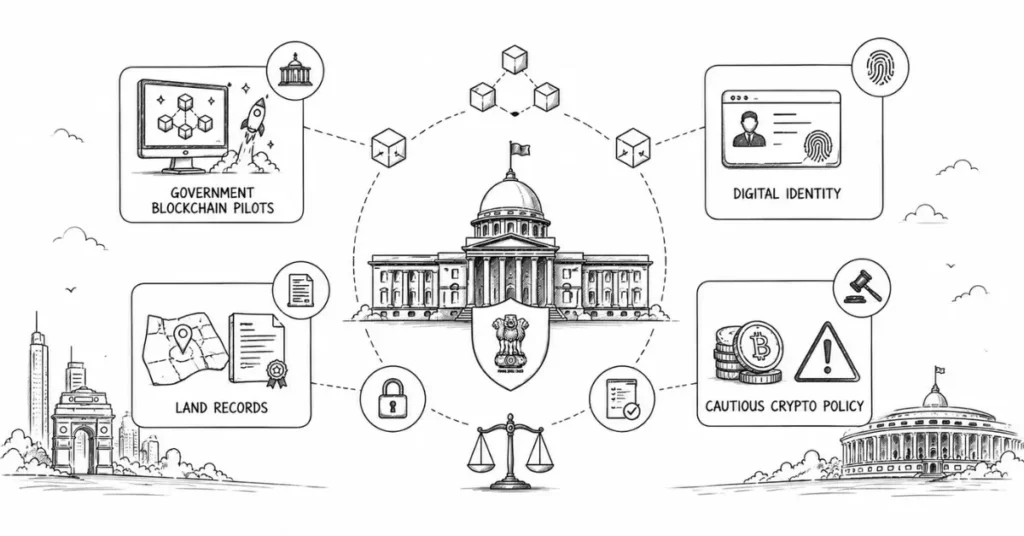
The Indian government’s approach to blockchain has evolved significantly. While cryptocurrency regulations remain under discussion, the government has embraced blockchain technology for various applications. Several state governments are piloting blockchain projects for land records, supply chain tracking, and digital identity management. The Indian Institute of Technology system, including IIT Kanpur, now offers blockchain and Ethereum development programs, signaling official recognition of blockchain as a legitimate career path.
This pragmatic approach—embracing blockchain technology while carefully regulating cryptocurrency—creates a stable environment for blockchain careers. Even if certain cryptocurrency applications face restrictions, the underlying blockchain technology continues finding applications in banking, healthcare, logistics, and government services. For professionals, this means career opportunities exist regardless of cryptocurrency market fluctuations.
India's Global Position in Blockchain
India now ranks as the second-largest crypto developer base globally, trailing only the United States. This ranking reflects not just quantity but quality—Indian developers are contributing to major blockchain protocols, launching successful startups, and working with top international companies. Cities like Bangalore, Pune, Hyderabad, Mumbai, and Delhi have emerged as blockchain hubs with active developer communities, regular meetups, and growing startup ecosystems.
The “Made in India” blockchain narrative is strengthening. Indian companies like Polygon (formerly Matic Network) have achieved global recognition, with Polygon becoming one of Ethereum’s most successful scaling solutions. WazirX, CoinDCX, and ZebPay have established themselves as leading cryptocurrency platforms serving millions of Indian users. These homegrown success stories inspire the next generation of blockchain professionals and prove that world-class blockchain innovation can happen in India.
Key Industry Sectors Embracing Blockchain
Financial Services and Banking
Banks and financial institutions are the biggest adopters of blockchain technology in India. ICICI Bank, HDFC Bank, and Axis Bank have all launched blockchain pilots for various use cases. These projects focus on cross-border payments, trade finance, and settlement systems—areas where blockchain can reduce costs and processing time from days to minutes.
For professionals, banking blockchain projects offer stable career opportunities with established institutions. Banks typically hire blockchain developers with ₹8-15 lakhs salary packages, along with the job security and benefits that come with traditional banking careers. The work involves building private or permissioned blockchains (different from public blockchains like Ethereum), requiring understanding of enterprise blockchain platforms like Hyperledger Fabric and R3 Corda.
Reserve Bank of India (RBI) is also exploring a Central Bank Digital Currency (CBDC), India’s potential digital rupee. This initiative will require hundreds of blockchain professionals for development, testing, security, and maintenance. Working on government-backed blockchain projects provides career stability while contributing to national digital infrastructure.
Supply Chain and Logistics
India’s massive supply chain industry faces challenges with transparency, counterfeit products, and inefficient tracking. Blockchain offers solutions by creating immutable records of product movement from manufacturer to consumer. Companies like Mahindra, Tata Group, and various pharmaceutical firms are implementing blockchain for supply chain transparency.
Supply chain blockchain roles typically involve:
- Integration specialists who connect blockchain systems with existing ERP and logistics software (₹7-12 lakhs)
- Business analysts who identify blockchain use cases and measure ROI (₹6-10 lakhs)
- Blockchain developers who build and maintain supply chain tracking systems (₹8-14 lakhs)
This sector particularly values professionals who understand both blockchain technology and domain-specific knowledge about logistics, warehousing, and distribution. If you have a background in supply chain management and learn blockchain fundamentals, you become extremely valuable to companies implementing these solutions.
Healthcare and Pharmaceuticals
Healthcare blockchain applications focus on patient data management, drug traceability, and clinical trial integrity. Apollo Hospitals and other major healthcare providers are exploring blockchain for medical records that patients can control and share securely across hospitals. The pharmaceutical industry uses blockchain to combat counterfeit drugs—a major problem in India—by tracking medicine from factory to pharmacy.
Healthcare blockchain roles require understanding both HIPAA-like privacy regulations and blockchain technology. Professionals with medical informatics background who upskill in blockchain find excellent opportunities. Typical roles include:
- Healthcare blockchain consultants advising hospitals on implementation (₹10-18 lakhs)
- Privacy-focused blockchain developers building secure patient record systems (₹9-15 lakhs)
- Regulatory specialists ensuring blockchain solutions meet healthcare compliance (₹8-14 lakhs)
Real Estate and Land Records
Several Indian state governments are digitizing land records using blockchain to prevent fraud and disputes. Karnataka, Telangana, and Andhra Pradesh have initiated blockchain land registry pilots. Private real estate companies are exploring blockchain for property tokenization—allowing fractional ownership of expensive properties through blockchain tokens.
Real estate blockchain careers suit professionals with legal, property management, or civil engineering backgrounds. Understanding property law combined with blockchain knowledge creates a rare and valuable skillset. These roles typically pay ₹7-15 lakhs depending on experience and whether you work for government or private sector.
Education and Credential Verification
Universities and educational institutions use blockchain to issue tamper-proof digital certificates and degrees. This prevents fake degree fraud—a significant issue in India—and allows instant verification of credentials by employers. Companies like Collegechain and universities including IIT Bombay and MIT (internationally) are issuing blockchain-based credentials.
Educational blockchain roles include:
- EdTech blockchain developers building credential platforms (₹6-12 lakhs)
- Implementation specialists helping universities adopt blockchain systems (₹7-13 lakhs)
- Verification system analysts designing employer verification processes (₹6-10 lakhs)
This sector offers particularly good opportunities for professionals already in education technology who want to specialize in blockchain applications.
Cryptocurrency and DeFi Platforms
While regulatory clarity is evolving, Indian cryptocurrency exchanges like WazirX, CoinDCX, CoinSwitch, and ZebPay continue operating and actively hiring. These companies need diverse talent:
Technical roles: Smart contract developers, blockchain backend engineers, security specialists, DevOps engineers (₹8-20 lakhs)
Business roles: Trading analysts, market makers, business development managers, partnership leads (₹7-15 lakhs)
Compliance roles: Legal counsel, compliance officers, AML/KYC specialists, regulatory affairs managers (₹8-18 lakhs)
Customer-facing roles: Customer support specialists, community managers, content creators, marketing managers (₹5-12 lakhs)
Working at crypto exchanges provides direct exposure to how cryptocurrency markets function, trading dynamics, and regulatory challenges. Even if you eventually move to other blockchain sectors, experience at a crypto exchange provides valuable real-world perspective that pure development roles may not offer.
Types of Organizations Hiring Blockchain Talent
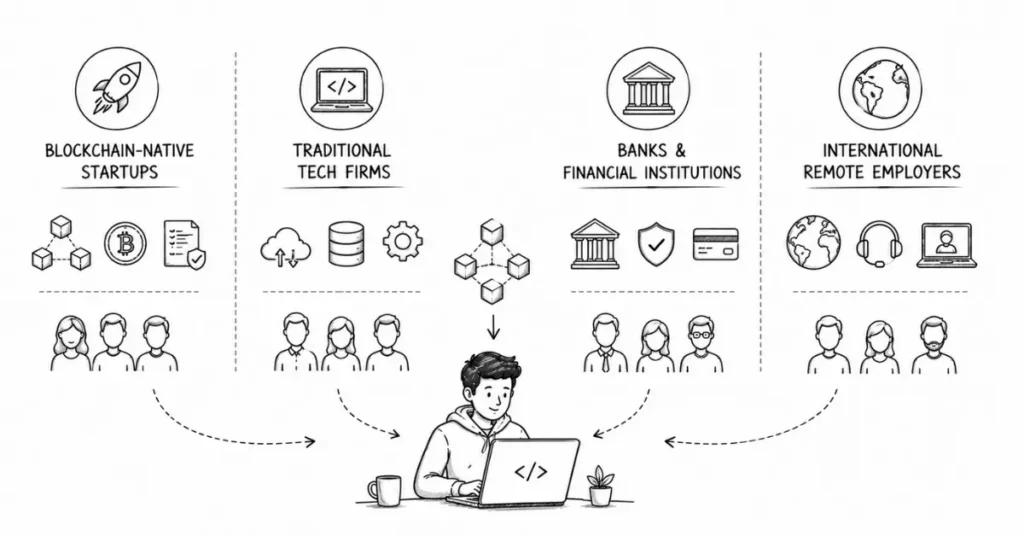
Blockchain-Native Startups
These companies are built entirely around blockchain technology—they wouldn’t exist without it. Examples include Polygon, WazirX, CoinDCX, and various DeFi protocols and NFT platforms.
Advantages:
- Fastest skill growth due to deep blockchain focus
- Potential equity compensation that could be highly valuable
- Direct impact on product success
- Cutting-edge technology and rapid learning
Considerations:
- Higher risk typical of startup environments
- Longer working hours during product launches
- Salary might be slightly lower than established companies but compensated with equity
- Fast-paced environment requiring adaptability
Typical salary ranges: ₹6-18 lakhs depending on role and company funding stage
Traditional Tech Companies Adding Blockchain
Companies like TCS, Infosys, Wipro, Tech Mahindra, and Accenture have established blockchain practices serving enterprise clients. They build blockchain solutions for banks, manufacturers, and government agencies.
Advantages:
- Job stability and established company benefits
- Work on diverse blockchain projects across industries
- Strong training programs and mentorship
- Better work-life balance than startups
Considerations:
- May work on private/permissioned blockchains more than public blockchains
- Potentially slower technology adoption
- Career growth may follow traditional consulting career paths
Typical salary ranges: ₹6-20 lakhs depending on experience and specific role
Banks and Financial Institutions
Major banks like ICICI, HDFC, Axis, and State Bank of India are building blockchain teams for internal innovation labs.
Advantages:
- Excellent job security
- Comprehensive benefits (health insurance, retirement plans)
- Prestige of working for established financial institutions
- Good work-life balance
Considerations:
- May face bureaucracy and slower decision-making
- Technology choices might be conservative
- Less exposure to public blockchain and cryptocurrency applications
Typical salary ranges: ₹8-18 lakhs depending on experience
International Remote Opportunities
Global blockchain companies increasingly hire Indian developers for remote positions, offering salaries in USD. Companies like Coinbase, Tether, FalconX, and various international DeFi protocols actively recruit from India.
Advantages:
- Significantly higher compensation ($40,000-100,000+ annually)
- Exposure to international best practices
- Work with global teams and cutting-edge technology
- USD earnings provide currency advantage
Considerations:
- May require working odd hours to match international time zones
- Need strong English communication skills
- Requires proven portfolio and experience (harder for beginners)
- Tax complexity with foreign income
Typical salary ranges: $40,000-120,000 depending on role and experience (₹33-98 lakhs)
Salary Landscape Across the Industry
Entry-Level Compensation (0-2 Years)
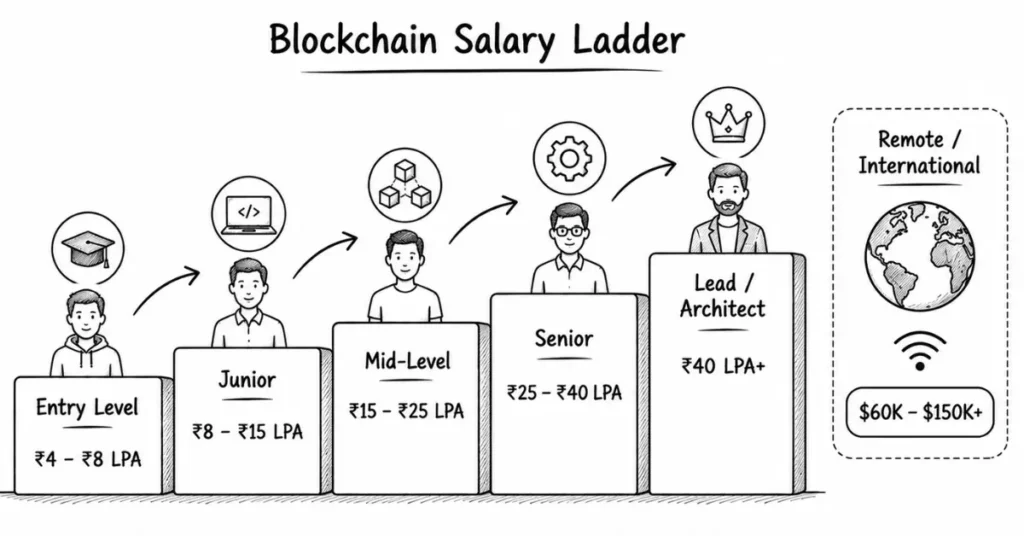
Fresh graduates entering blockchain careers can expect starting salaries between ₹5-7.1 lakhs annually in Indian companies. This represents a 15-25% premium over equivalent traditional software development roles. Entry-level positions include junior blockchain developer, blockchain analyst, community manager, and technical support specialist.
Internships, while lower paying (₹3-5 lakhs annually), provide crucial experience and often convert to full-time roles. Many companies prefer hiring interns they’ve already trained rather than external candidates, making internships valuable stepping stones.
Location significantly impacts entry-level salaries:
- Bangalore: ₹6.27 lakhs average
- Pune: ₹8.29 lakhs average
- Delhi NCR: ₹6.74 lakhs average
- Mumbai: ₹6.46 lakhs average
- Hyderabad: ₹4.14 lakhs average
However, remote work is increasingly common in blockchain, potentially reducing location-based disparities. A developer in a tier-2 city can earn Bangalore-level salaries by working remotely for a Bangalore-based company.
Mid-Career Growth (3-5 Years)
With 3-5 years of blockchain experience, professionals typically earn ₹10-16.5 lakhs in Indian companies. At this level, specialization becomes valuable. Smart contract developers with proven Solidity expertise command ₹11-15 lakhs. DeFi specialists and security auditors earn ₹12-18 lakhs due to specialized knowledge.
Mid-career professionals also access freelance opportunities. Complex smart contract development projects pay ₹1.5-3 lakhs per engagement, allowing skilled developers to earn significantly more than salaried positions by handling multiple projects.
International remote positions at this experience level pay $60,000-80,000 annually (₹50-65 lakhs), representing a substantial jump over domestic opportunities. However, these positions typically require strong portfolios, excellent communication skills, and experience working with distributed teams.
Senior-Level Earning Potential (5+ Years)
Senior blockchain professionals with 5+ years of experience earn ₹16.5-25 lakhs in Indian companies. Specialized roles command even higher compensation:
- Blockchain architects: ₹25-35 lakhs
- Senior security auditors: ₹20-30 lakhs plus project fees
- Blockchain consultants: ₹18-30 lakhs
- DeFi protocol leads: ₹22-35 lakhs
The absolute top tier consists of senior professionals working remotely for international Web3 companies, earning $80,000-150,000+ annually (₹65 lakhs-1.2 crores+). These positions require exceptional technical skills, proven track records of successful project delivery, and often leadership responsibilities.
Some senior professionals transition to contract work, charging ₹3-8 lakhs per project for complex smart contract development or security audits. With 3-4 major projects annually plus smaller engagements, total compensation can exceed traditional employment.
Non-Technical Role Compensation
Non-technical blockchain roles offer competitive compensation:
- Community managers: ₹6-15 lakhs plus potential token allocations
- Content creators/marketers: ₹5-12 lakhs
- Legal/compliance specialists: ₹8-18 lakhs
- Business development managers: ₹10-20 lakhs
- Product managers: ₹12-25 lakhs depending on experience
Token compensation adds interesting dynamics to non-technical roles. Community managers and early employees at blockchain startups often receive token allocations that can become extremely valuable if the project succeeds. However, tokens also carry risk—if the project fails, tokens become worthless.
Skills the Industry Actually Demands
Technical Skills in High Demand
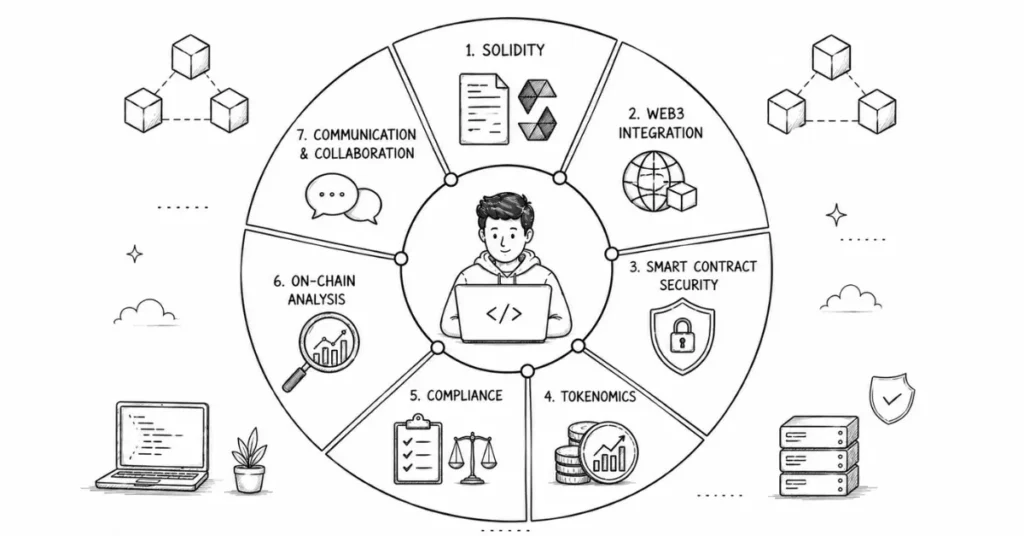
Solidity Programming: The most in-demand blockchain skill, Solidity developers are needed by virtually every Ethereum-based project. Companies struggle to find quality Solidity developers, creating significant salary premiums for this skill.
Smart Contract Security: Understanding common vulnerabilities (reentrancy attacks, integer overflow, access control issues) and security best practices is critical. Developers with security expertise earn 20-30% more than those without it.
Web3 Integration: Frontend developers who can integrate Web3 wallets, read blockchain data, and create smooth user experiences connecting traditional web to blockchain are highly valued.
Multiple Blockchain Platforms: While Ethereum dominates, knowledge of Solana, Polkadot, Avalanche, or Polygon creates additional opportunities. Developers comfortable across multiple chains command premium compensation.
Testing and DevOps: Blockchain DevOps engineers who can set up nodes, manage deployments, and create CI/CD pipelines for smart contracts are rare and valuable, earning ₹10-18 lakhs.
Business and Analytical Skills
Tokenomics Understanding: Knowing how token economies work, how to design incentive structures, and economic modeling distinguishes average professionals from excellent ones. This skill is valuable across product management, consulting, and analyst roles.
Regulatory and Compliance Knowledge: As regulations evolve, professionals who understand legal frameworks, AML/KYC requirements, and compliance procedures become invaluable, especially in cryptocurrency exchanges and DeFi projects.
On-Chain Analysis: Ability to analyze blockchain data, understand network metrics, evaluate protocol health, and identify trends creates opportunities in research, trading, and investment firms.
Community Management: Building and nurturing engaged communities on Discord, Telegram, and Twitter is essential for blockchain projects. Strong communication skills combined with blockchain knowledge create valuable community management careers.
Soft Skills That Matter
Continuous Learning: Blockchain evolves rapidly. Professionals who allocate time weekly to learning new protocols, tools, and best practices stay relevant while others become obsolete.
Security Mindset: Unlike traditional development where bugs cause inconvenience, blockchain bugs can cost millions. Every decision requires considering security implications.
Remote Communication: With distributed teams common in blockchain, clear written and verbal communication becomes essential. Being able to articulate complex ideas clearly in English opens international opportunities.
Community Participation: Blockchain is inherently collaborative and open-source. Professionals who contribute to GitHub projects, answer questions in forums, and share knowledge build reputations that lead to opportunities.
Industry Challenges and Realities
Volatility and Market Cycles
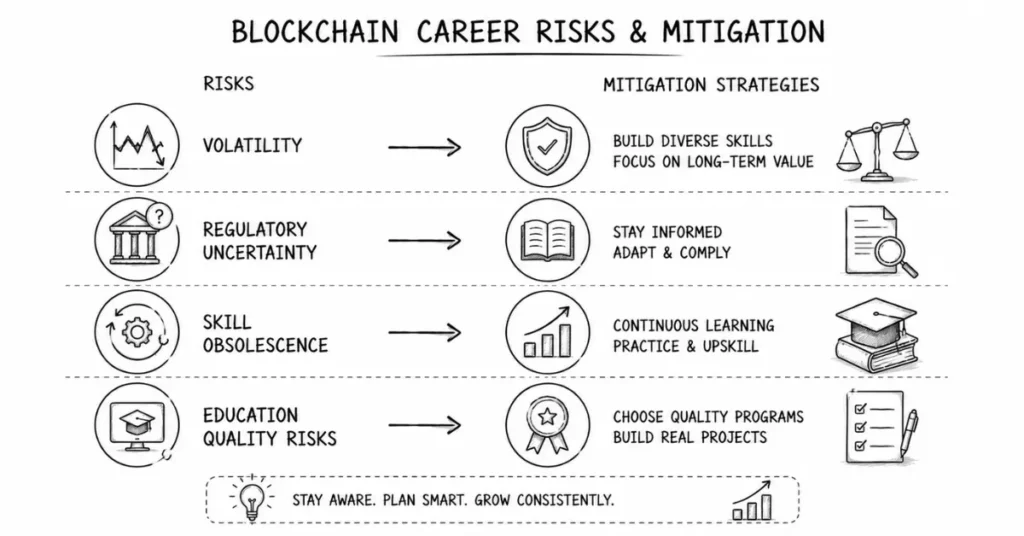
Blockchain industry health correlates with cryptocurrency market performance. During bull markets, companies hire aggressively and salaries increase. During bear markets, hiring slows and some companies downsize. This volatility means blockchain careers can be less stable than traditional tech roles.
Mitigation strategy: Focus on building versatile skills applicable beyond just cryptocurrency. Enterprise blockchain, supply chain applications, and government projects continue regardless of crypto market conditions. Maintain emergency savings to weather potential downturns.
Regulatory Uncertainty
India’s evolving cryptocurrency regulations create uncertainty for companies and professionals. While blockchain technology itself faces minimal regulatory concerns, cryptocurrency-specific roles may face greater uncertainty.
Mitigation strategy: Understand the distinction between blockchain technology (widely accepted) and cryptocurrency applications (under regulatory evolution). Build skills in blockchain fundamentals that transfer across use cases. Stay informed about regulatory developments through official sources.
Skill Obsolescence Risk
Blockchain technology evolves rapidly. Skills relevant today might become less valuable as new protocols and approaches emerge. Layer 2 solutions, zero-knowledge proofs, and other innovations constantly shift the technical landscape.
Mitigation strategy: Dedicate 4-5 hours weekly to continuous learning. Follow key developers on Twitter, read technical documentation, and experiment with emerging technologies. Focus on understanding fundamental concepts that transcend specific implementations.
Quality vs. Quantity in Education
The blockchain education market contains both excellent resources and low-quality courses making unrealistic promises. Many “blockchain certification” programs provide certificates without meaningful knowledge.
Mitigation strategy: Prioritize learning resources with practical projects over theoretical courses. Verify instructor credibility through GitHub profiles and professional background. Focus on building a portfolio that demonstrates capability rather than collecting certificates.
Why 2026 Is the Perfect Time to Enter Blockchain
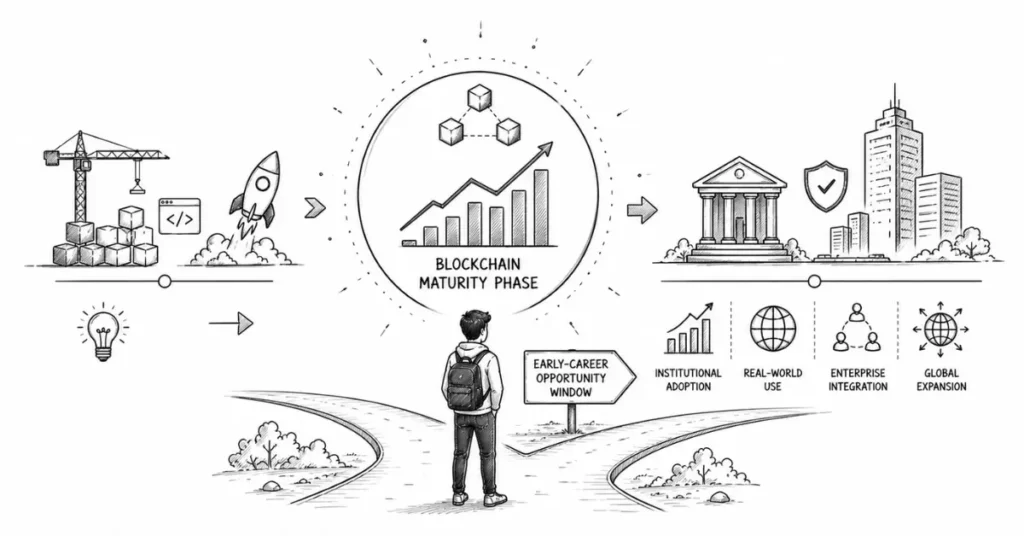
Industry Maturation Phase
Blockchain is entering its maturation phase—past the pure hype cycle but before becoming fully mainstream. This represents an ideal entry point. Early adopters have established the industry, but it’s not so late that opportunities are scarce. Professionals entering now can still build careers as the industry scales over the next decade.
Compare this to cloud computing careers around 2012-2014. AWS launched in 2006, but by 2012-2014, cloud computing was proven yet still growing rapidly. Professionals who entered cloud careers during this maturation phase built extremely successful careers. Blockchain in 2026 occupies a similar position.
Increased Institutional Adoption
Banks, corporations, and governments are moving from blockchain pilots to production deployments. This shift creates stable, long-term career opportunities beyond startup volatility. Enterprise blockchain adoption means demand for professionals will grow steadily rather than boom-and-bust cycles.
Educational Resources Now Available
In blockchain’s early days (2016-2018), learning resources were scarce and often low quality. Now, excellent courses, bootcamps, and documentation exist. New professionals can learn effectively without struggling through poor materials that early adopters faced.
Indian Developer Advantage
India’s emergence as the global Web3 hub provides home-field advantage to Indian professionals. Companies establishing Indian operations create local opportunities. International companies actively recruit from India. Educational institutions are launching blockchain programs. The entire ecosystem is aligning to support Indian blockchain careers.
Your Next Steps: Practical Action Plan
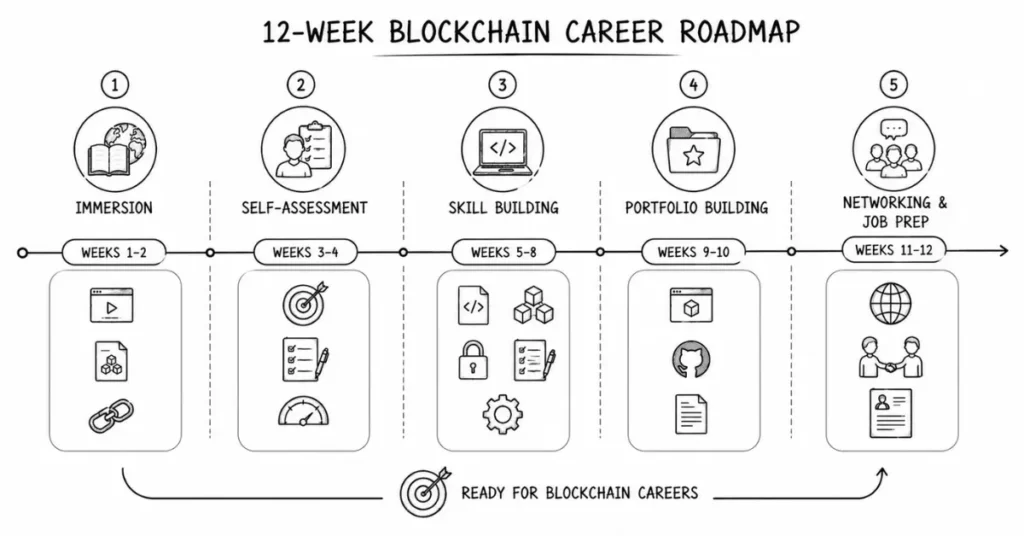
Week 1-2: Industry Immersion
- Read blockchain industry news daily through sources like CoinDesk India, Inc42 blockchain coverage
- Follow 10-15 blockchain professionals on Twitter/LinkedIn to understand industry conversations
- Join 2-3 blockchain Discord communities to observe how professionals interact
- Watch YouTube videos explaining blockchain use cases in simple terms
Week 3-4: Self-Assessment and Path Selection
- Complete a blockchain fundamentals course to understand if the technology genuinely interests you
- Assess your strengths: Are you more technical or business-oriented? Do you prefer coding or communication?
- Research specific roles that match your interests and strengths
- Set a clear goal: “I want to become a smart contract developer” or “I want to work in blockchain marketing”
Week 5-8: Intensive Skill Building
- Enroll in a focused learning program (bootcamp or structured online course)
- Dedicate 15-20 hours weekly to learning
- Build 2-3 practice projects demonstrating your understanding
- Start a GitHub profile and document your learning journey
Week 9-12: Portfolio and Network Building
- Create a professional LinkedIn profile highlighting blockchain focus
- Write 2-3 blog posts explaining blockchain concepts in simple terms
- Contribute to an open-source blockchain project
- Attend at least one blockchain meetup or conference in your city
- Apply to 10-15 relevant positions or internships
Conclusion: Your Blockchain Career Starts Now
The blockchain industry landscape in India offers unprecedented opportunities for professionals willing to invest time in learning this transformative technology. With India positioned to become the world’s largest Web3 developer hub by 2028, early movers will capture the most valuable positions as the industry scales.
The key is starting today rather than waiting for the “perfect moment.” Blockchain technology isn’t going anywhere—it’s becoming increasingly embedded in finance, supply chain, healthcare, and government systems. Whether you pursue technical development roles, business and strategy positions, or creative community management careers, opportunities exist across the spectrum.
Remember that everyone currently working in blockchain was once exactly where you are now—curious but uncertain, interested but unsure how to begin. The difference between those who succeed and those who remain spectators is simply taking that first step. Choose a learning resource today, set up your first crypto wallet, or join a blockchain community. These small actions compound into career-changing momentum.
The blockchain industry landscape is vast, growing, and ready for talented professionals like you. Your career in this transformative technology starts with a single decision: to begin.