
Civil Engineering Education Guide: Degrees, Courses & Certifications
Table of Contents
Introduction
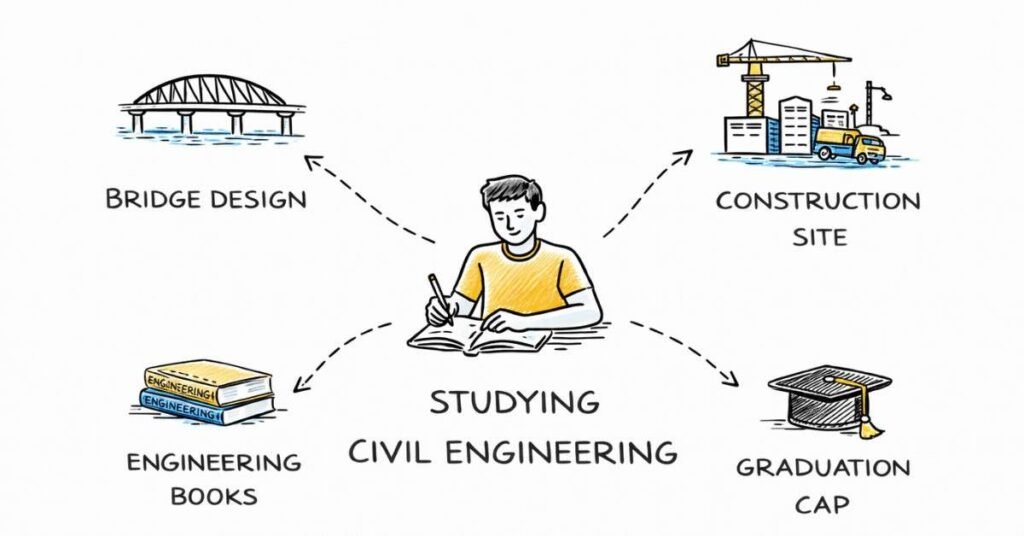
Choosing to become a civil engineer is one thing. Actually becoming one requires navigating a complex educational pathway that most students find confusing. Should you do BTech or Diploma? What subjects will you study? Is MTech necessary? What about certifications?
Let me break down the entire educational journey in simple, practical terms—the kind of guidance I wish someone had given me when I was starting out.
The Foundation: Class 10 to 12 Preparation
Your civil engineering journey actually starts in Class 11 and 12, even if you don’t realize it then.
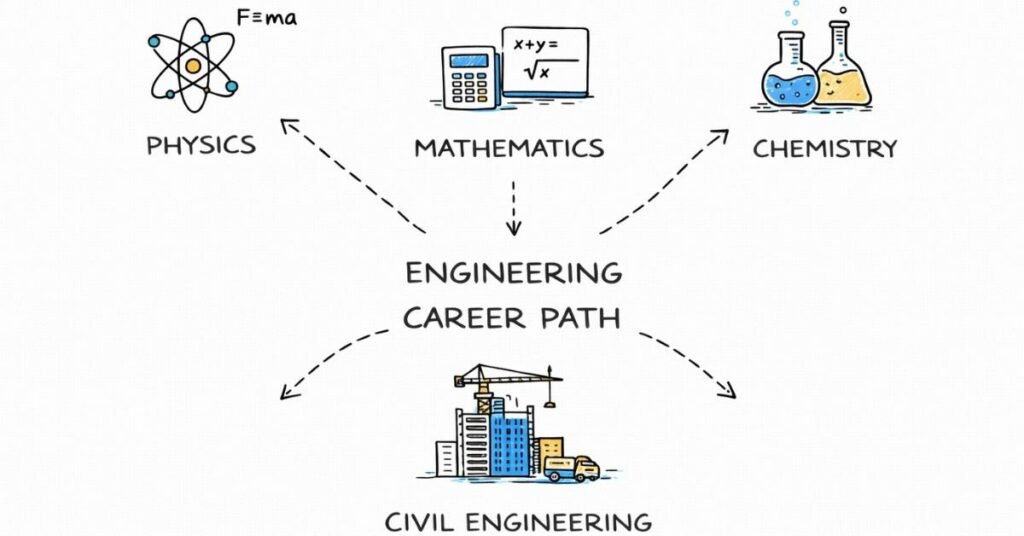
You need to take the Science stream with Physics, Chemistry, and Mathematics as core subjects. There’s no way around this. Civil engineering is heavily math-based, and the physics concepts you learn about forces, motion, and energy directly apply to structural engineering.
Here’s what matters: don’t just study for marks. Actually understand the concepts, especially in:
- Physics: Mechanics (forces, motion, friction), properties of matter, fluid dynamics
- Mathematics: Calculus, trigonometry, coordinate geometry, vectors
- Chemistry: Properties of materials, chemical reactions (important for concrete technology later)
Many students cram and forget everything after boards. Bad idea. These fundamentals will come back in your engineering subjects, and if you don’t understand them properly now, you’ll struggle later.
Your 12th board marks matter for college admissions, though entrance exams carry more weight. Most decent engineering colleges want at least 60-75% in boards for eligibility.
Getting Into Engineering College: Entrance Exams
In India, you can’t just walk into an engineering college. You need to crack entrance exams.
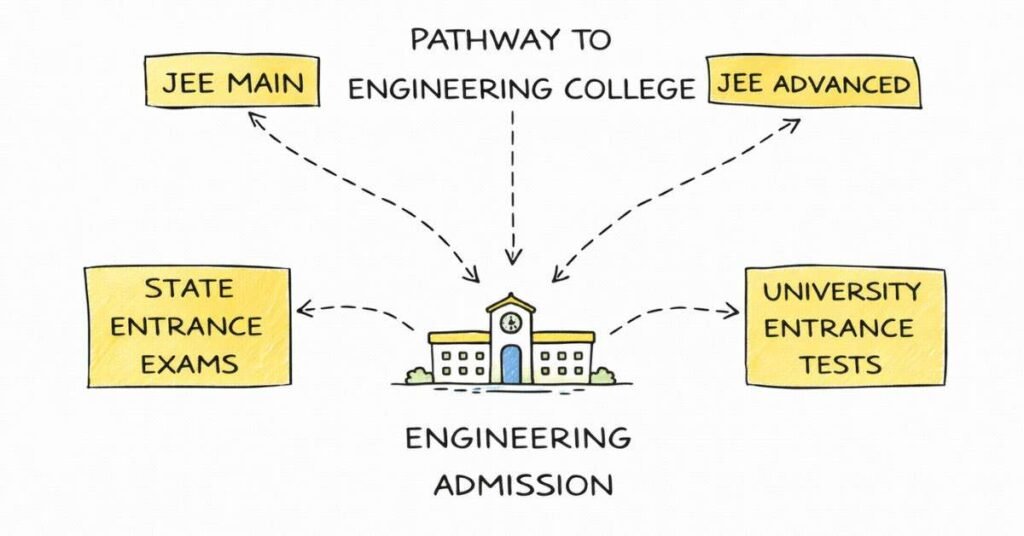
JEE Main is the big one. It’s conducted by the National Testing Agency for admission to NITs, IIITs, and many state engineering colleges. It tests your physics, chemistry, and mathematics knowledge. The competition is intense—lakhs of students appear, but only a fraction get into good colleges.
JEE Advanced is the next level, required for IITs. You can attempt JEE Advanced only if you clear JEE Main with a good rank. IITs are the top engineering institutes in India, and getting in is extremely competitive.
State-level entrance exams like KCET (Karnataka), WBJEE (West Bengal), MHT CET (Maharashtra), and others are for admissions to state government colleges. These are usually easier than JEE but still require preparation.
University-level exams: Many private universities conduct their own entrance tests—VITEEE (VIT), SRMJEEE (SRM), BITSAT (BITS), and others.
Important eligibility: You must be in your 3rd year of undergraduate study or higher to appear for entrance exams like GATE (for postgraduate studies). For BTech admission, you typically need to have passed 12th with at least 50-60% (varies by category and institution).
My advice? Start preparing for JEE in Class 11 itself. Don’t wait until 12th. The syllabus is vast, and last-minute cramming doesn’t work.
The BTech Journey: Four Years That Shape Your Career
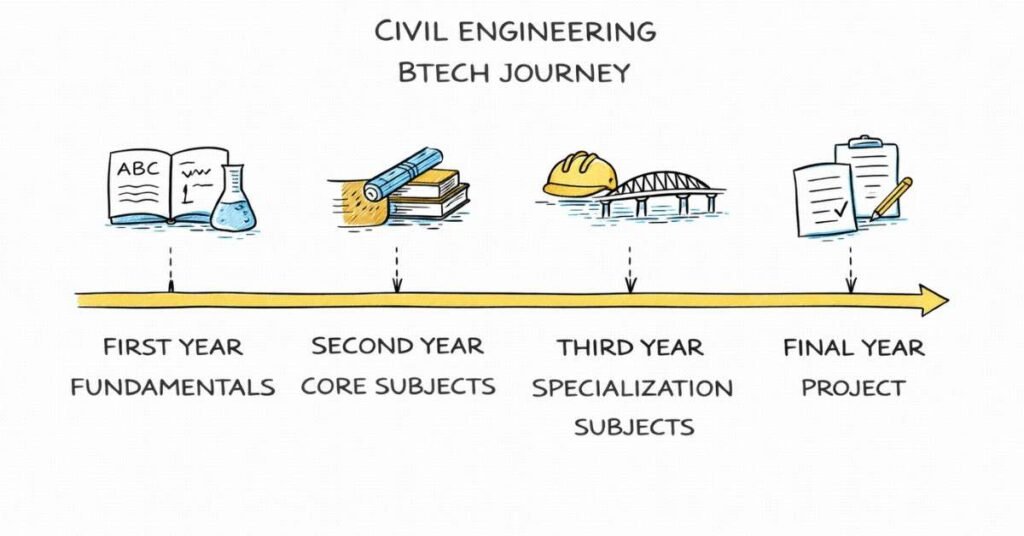
Once you get into college, you’re in for a four-year BTech (Bachelor of Technology) or BE (Bachelor of Engineering) program in Civil Engineering. Both are essentially the same—BTech is more common in newer universities, BE in traditional ones.set.jainuniversity+1
Let me walk you through what you’ll actually study, year by year.
First Year: Building the Foundation
First year is mostly common for all engineering branches. You’ll study:
- Engineering Mathematics-I & II: Calculus, differential equations, linear algebra (yes, a lot of math)
- Engineering Physics: Thermodynamics, electromagnetism, quantum mechanics basics
- Engineering Chemistry: Material science, electrochemistry, polymers
- Engineering Mechanics: Forces, moments, equilibrium (this is where civil engineering really starts)
- Engineering Drawing: Technical drawing, projections, AutoCAD basics
- Programming: Usually C or Python
Honestly? First year can feel disconnected from actual civil engineering. You’re learning foundation concepts that will make sense later. Just power through it.
Second Year: Getting Into Core Subjects
This is when it starts getting interesting. You’ll study:
- Strength of Materials: How materials behave under different types of loads—this is crucial for structural design
- Fluid Mechanics: How water and other fluids flow—important for water resources engineering
- Surveying: Land measurement techniques, using instruments like theodolite and total station
- Building Materials and Construction: Types of construction materials, their properties, construction techniques
- Structural Analysis-I: Analyzing forces in beams, trusses, and frames
- Concrete Technology: Composition of concrete, mix design, testing
- Engineering Geology: Understanding soil and rock formations.
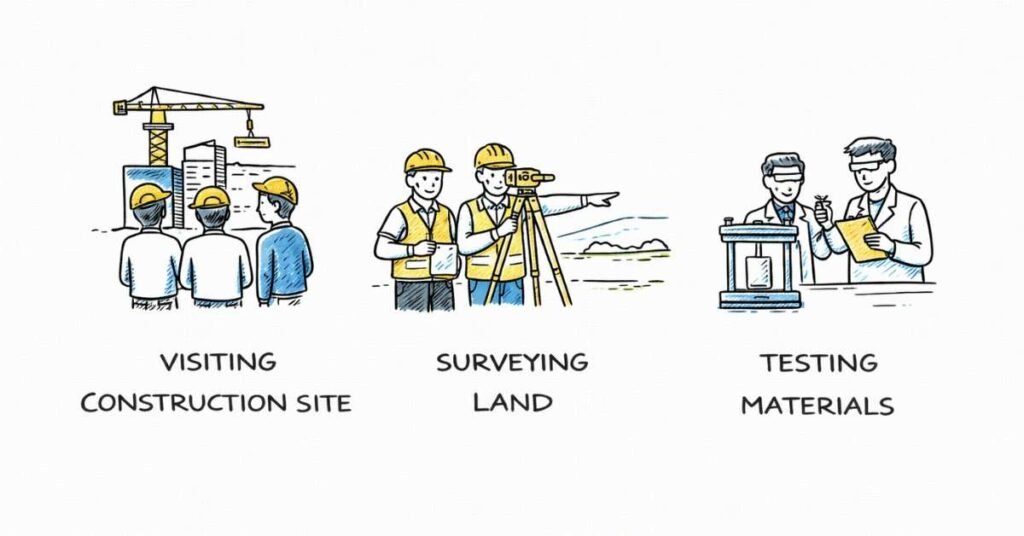
Second year is when you’ll have your first real exposure to construction sites during field visits and surveying practicals. This practical work is where theory starts making sense.
Third Year: Deep Dive Into Specializations
Third year is intense. You’ll study:
- Structural Analysis-II: Advanced analysis methods, indeterminate structures
- Design of Concrete Structures: Designing beams, slabs, columns, footings
- Geotechnical Engineering: Soil mechanics, foundation engineering, earth retaining structures
- Transportation Engineering: Highway planning, geometric design, traffic engineering
- Environmental Engineering: Water supply, waste water treatment, solid waste management
- Water Resources Engineering: Hydrology, irrigation engineering, hydraulic structures
- Estimation and Costing: How to estimate material quantities and project costs.
You’ll also have extensive lab work—soil testing, concrete testing, surveying practicals, CAD lab sessions, and environmental engineering lab.
Fourth Year: Specialization and Projects
Final year gives you some flexibility:
- Design of Steel Structures: Designing steel beams, columns, connections
- Advanced Structural Design: Prestressed concrete, earthquake-resistant design
- Project Management: Construction planning, scheduling, project control
- Electives: Choose from options like Bridge Engineering, Tall Buildings, Advanced Geotechnical Engineering, Urban Planning, GIS and Remote Sensing.
The highlight of fourth year is your final year project. This is where you work on a real-world problem, either independently or in groups. It could be a design project (designing a bridge or building), a research project (studying material properties), or a field-based project (surveying and planning).
You’ll also do industrial training—typically 6-8 weeks at a construction company or consultancy where you get hands-on experience. This internship is crucial. It’s your first real exposure to how civil engineering actually works outside textbooks.
The Reality of Practical Training
Here’s something most students underestimate: practical training is as important as classroom learning in civil engineering.
Throughout your four years, you’ll have:
Lab Sessions: Almost every semester has lab work. You’ll test concrete cubes for strength, perform soil tests to determine properties, use surveying instruments, learn CAD software, conduct water quality tests.
Field Visits: Regular visits to construction sites, factories, dams, or treatment plants. These aren’t just for fun—they show you how classroom theory applies in real situations.
Internships: Most colleges mandate summer internships after third year. You’ll work at construction companies, design consultancies, or government departments. This is your chance to learn from experienced engineers and understand daily work.
Workshops: Practical workshops on new technologies like BIM, advanced surveying equipment, or construction software.
Students who take practical training seriously have a massive advantage when job hunting. Companies prefer candidates who’ve actually been on construction sites and understand ground realities.
Beyond BTech: Higher Education Options
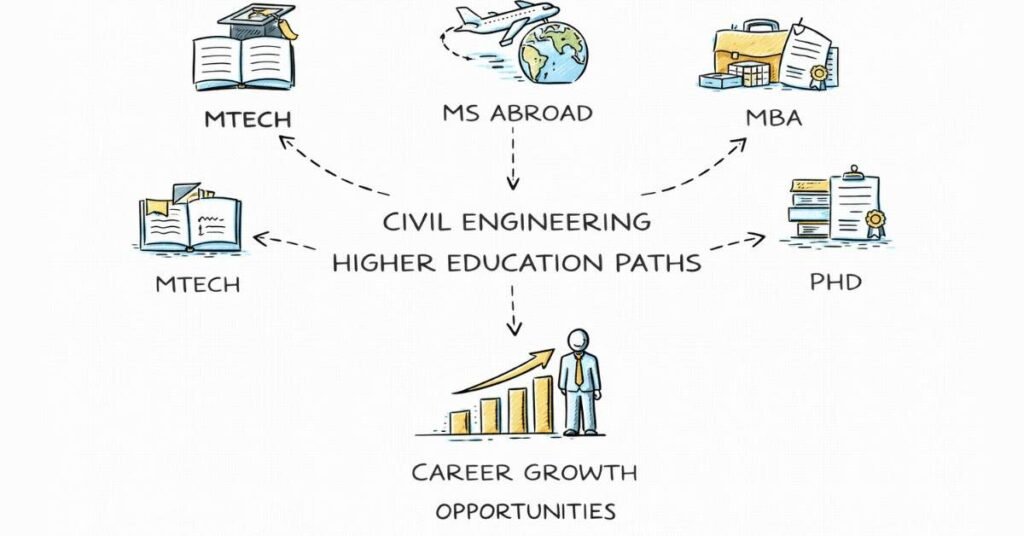
After completing BTech, you have several paths.
MTech (Master of Technology)
MTech is a two-year postgraduate program where you specialize deeply in one area of civil engineering. Common specializations include:
- Structural Engineering: Advanced structural analysis, earthquake engineering, tall buildings
- Geotechnical Engineering: Advanced soil mechanics, ground improvement, foundation engineering
- Transportation Engineering: Traffic management, pavement design, transportation planning
- Water Resources Engineering: Advanced hydrology, groundwater engineering, coastal engineering
- Environmental Engineering: Advanced waste treatment, air pollution control, environmental impact assessment
- Construction Engineering and Management: Advanced project management, construction technology.
Why do MTech?
- Deeper specialization in your area of interest
- Higher starting salaries (typically ₹1-2 LPA more than BTech)
- Better prospects in design consultancies and research organizations
- Opens doors to teaching positions in engineering colleges
- Required if you want to pursue PhD later.
How to get in?
You need to crack GATE (Graduate Aptitude Test in Engineering). GATE is conducted annually for admission to MTech programs in IITs, NITs, and other government-funded colleges. It tests your BTech fundamentals across all core civil engineering subjects.
Eligibility for GATE: You can appear in your final year of BTech or after completing it. Most good colleges require GATE scores for admission. A good GATE score also makes you eligible for scholarships and assistantships.
MS Abroad
If you’re considering international exposure, you can pursue MS (Master of Science) in Civil Engineering from universities in the US, UK, Canada, Germany, or Australia. This route is expensive but offers:
- Exposure to advanced technologies and research
- International work opportunities
- Higher earning potential if you work abroad
- Different teaching methodologies and diverse peer groups
For MS abroad, you’ll need GRE scores, TOEFL/IELTS scores, strong academic record, statement of purpose, and letters of recommendation.
MBA for Civil Engineers
Many civil engineers pursue MBA to move into management roles, especially construction management, project management, or infrastructure consulting. An MBA from a good B-school can open doors to leadership positions in construction firms, real estate companies, or infrastructure consulting.
PhD and Research
If you’re passionate about research, you can pursue PhD in Civil Engineering. This is typically a 4-5 year program involving original research in a specialized area. PhD graduates work in research organizations, teach in universities, or join R&D departments of large companies.
Professional Certifications That Matter
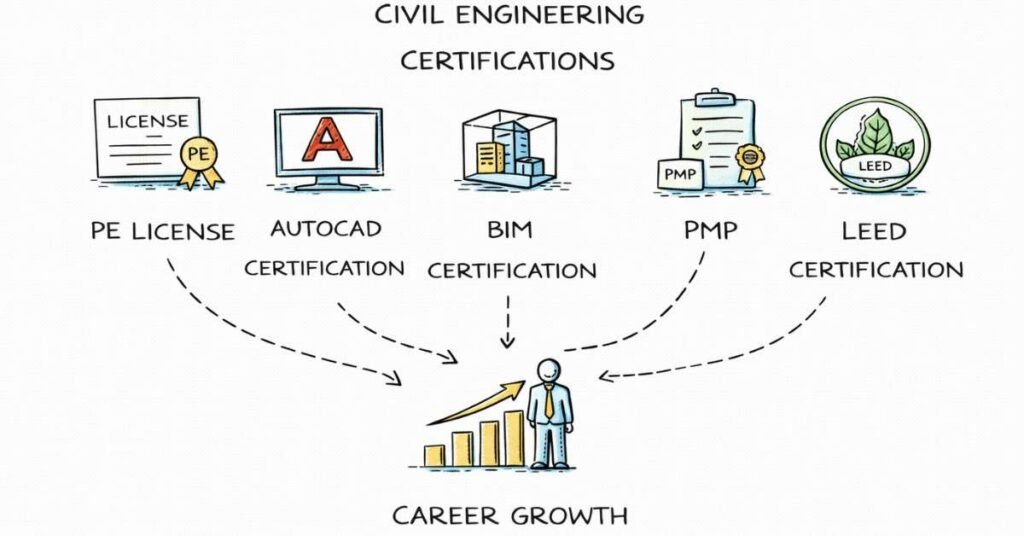
Beyond degrees, certain certifications can significantly boost your career prospects.
Professional Engineer (PE) Certification
In India, the Institution of Engineers India (IEI) offers PE certification. To qualify:
- You need a BE/BTech degree recognized by statutory authorities
- Minimum 5 years of relevant work experience
- Membership in IEI or similar recognized professional society
- Continuous professional development activities.
PE certification adds credibility, especially if you’re planning to start your own consultancy or work on international projects.
AutoCAD Certification
Autodesk offers official AutoCAD certification that validates your proficiency in using the software. Since AutoCAD is industry-standard for technical drawing, this certification is valued by employers.
Revit/BIM Certification
As Building Information Modeling becomes standard practice, Revit certification is becoming increasingly valuable. BIM specialists earn significantly more than traditional CAD operators.
Project Management Professional (PMP)
Offered by PMI (Project Management Institute), PMP is globally recognized and highly valued for civil engineers moving into project management roles. It requires work experience and passing a rigorous exam.
LEED Accreditation
LEED (Leadership in Energy and Environmental Design) certification shows expertise in green building practices. As sustainable construction grows, LEED professionals are in demand.
Other Valuable Certifications:
- STAAD Pro proficiency
- Primavera P6 (project scheduling software)
- HAZOP (safety engineering)
- NEBOSH (construction safety)
Choosing the Right College: What Really Matters
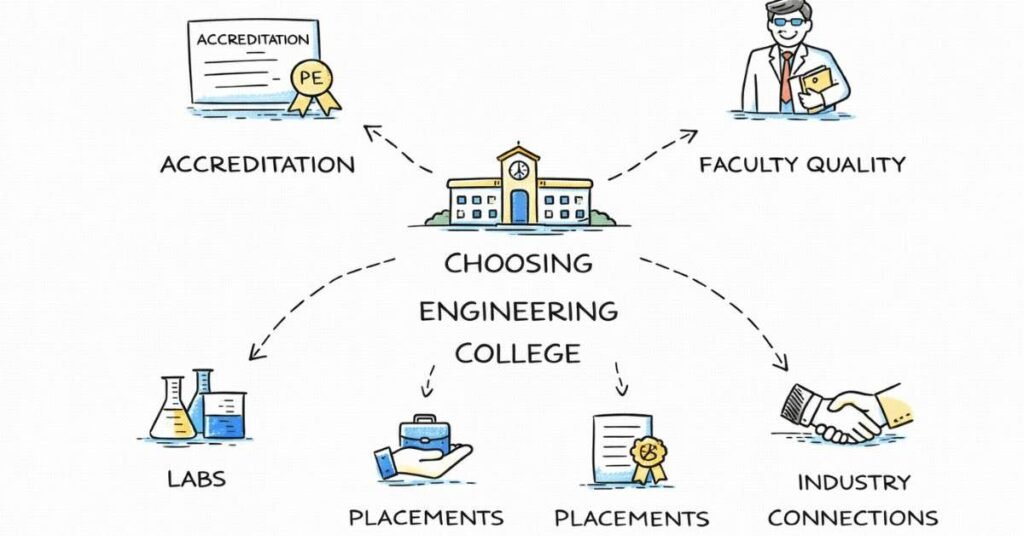
Not all engineering colleges are equal. Here’s what to consider:
Accreditation: Make sure the college is AICTE-approved and the program is accredited by NBA (National Board of Accreditation).
Faculty Quality: Experienced faculty with industry exposure make a huge difference. Research faculty profiles.
Infrastructure: Check lab facilities, software availability, workshop equipment. Civil engineering requires good practical facilities.
Industry Connections: Colleges with good industry tie-ups offer better internship and placement opportunities.
Alumni Network: Strong alumni working in construction firms and consultancies help with placements and career guidance.
Placement Record: Check where graduates actually get placed and at what salaries. Don’t just believe marketing materials—talk to current students.
The Diploma Route: An Alternative Path
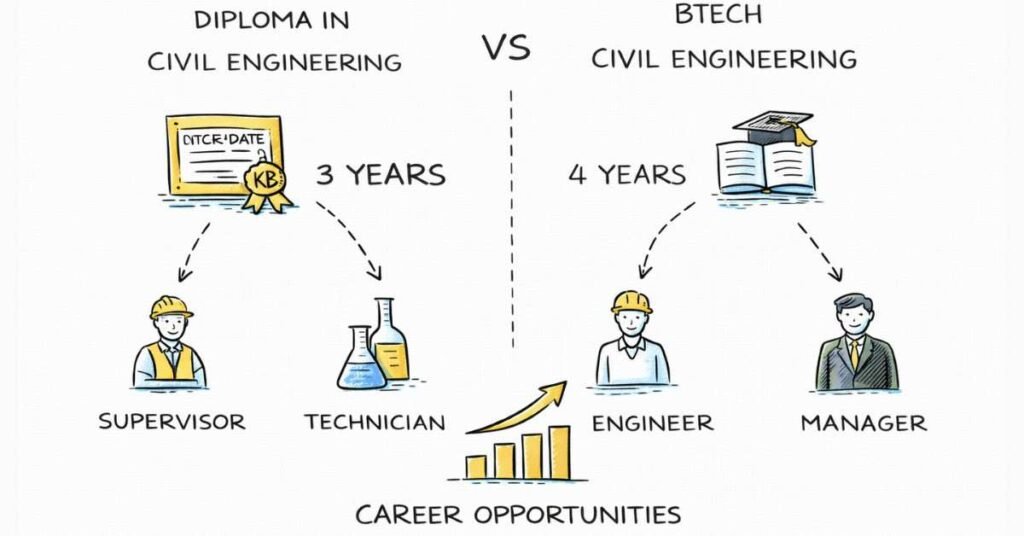
If you don’t want to or can’t do BTech immediately, there’s another option: Diploma in Civil Engineering.
Diploma is a three-year program after 10th standard. It covers similar subjects as BTech but with more practical, hands-on focus and less theoretical depth.
Advantages:
- Shorter duration (3 years vs 4 years for BTech)
- More affordable
- Heavy practical focus
- Can get jobs as junior engineers or supervisors
- Can do BTech later through lateral entry (directly into second year)
Disadvantages:
- Limited career growth compared to BTech
- Lower starting salaries
- Fewer opportunities in design roles
- Advancement to senior positions takes longer
Many students do diploma, work for a few years, and then pursue BTech through lateral entry. This gives them practical experience plus a degree.
Self-Learning and Skill Development
Here’s a reality check: your BTech degree gets you the interview, but your actual skills get you the job.
While in college, invest time in:
Software Skills: Learn AutoCAD thoroughly, get familiar with Revit, explore STAAD Pro. YouTube has excellent free tutorials. Practice by redrawing buildings you see around campus.
Communication Skills: Join clubs, participate in technical paper presentations, improve your English. You’ll need to explain technical concepts to non-technical people.
Site Exposure: Use every vacation to visit construction sites. Ask questions, observe processes, talk to site engineers. This practical knowledge is invaluable.
Reading Industry Publications: Follow civil engineering magazines, blogs, YouTube channels. Stay updated on new technologies and trends.
Networking: Connect with seniors, alumni, and professionals on LinkedIn. Join professional organizations like IEI. Networking opens doors to opportunities.
Financial Aspects: Cost of Civil Engineering Education
Let’s talk money because education costs real rupees.
BTech Fees vary widely:
- Government colleges (IITs, NITs, state colleges): ₹50,000 to ₹2 lakhs per year
- Private colleges (tier-2 and 3): ₹1-3 lakhs per year
- Top private universities (BITS, VIT, Manipal): ₹3-5 lakhs per year
MTech Fees:
- Government colleges with GATE score: Often subsidized or with fellowship (you might actually earn while studying)
- Private colleges: ₹1.5-4 lakhs per year.
Additional Costs:
- Books and study materials: ₹10-20,000 per year
- Laptop (essential): ₹40-60,000
- Software (student versions often free or discounted)
- Accommodation and living (if not at home): ₹50,000-1.5 lakhs per year
- Internship travel and expenses
- Coaching for entrance exams (if needed): ₹50,000-2 lakhs
Scholarships and Financial Aid:
- Government scholarships for SC/ST/OBC candidates
- Merit-based scholarships from colleges
- Education loans from banks
- Corporate scholarships
- State government scholarships
Don’t let finances alone determine your college choice, but do plan realistically. An education loan for a good college often pays for itself through better placements.
The Non-Academic Learning That Matters
Your degree certificate says you’re a civil engineer, but your real education includes:
Time Management: Balancing classes, labs, assignments, projects, and extracurriculars teaches you to manage multiple responsibilities—crucial for project management later.
Teamwork: Group projects, lab partnerships, and hostel life teach you to work with different personalities—essential since construction is team-based.
Problem-Solving Under Pressure: Late-night assignment submissions, last-minute project changes—these stressful situations prepare you for construction site realities.
Handling Failure: Not every exam goes well, not every project succeeds. Learning to bounce back from setbacks builds resilience.
Leadership: Leading a project team, managing group dynamics, coordinating tasks—these experiences develop leadership skills that matter in senior roles.
Common Mistakes to Avoid
Based on what I’ve seen, here are mistakes students make:
Ignoring practicals: Treating lab sessions and field visits as time-pass. Big mistake. Practical knowledge is what employers value.
Not doing quality internships: Taking internships just for the certificate without actually learning. Waste of opportunity.
Neglecting communication skills: Focusing only on technical subjects while ignoring English, presentation skills, and communication. Technical expertise means nothing if you can’t explain it.
Following the crowd: Choosing specializations because friends are doing it, not based on your interests. You’ll spend decades in this field—choose what you actually enjoy.
Not building a portfolio: Not documenting your projects, internship work, and achievements. When job hunting, you’ll need evidence of your skills.
Your Educational Journey is a Marathon
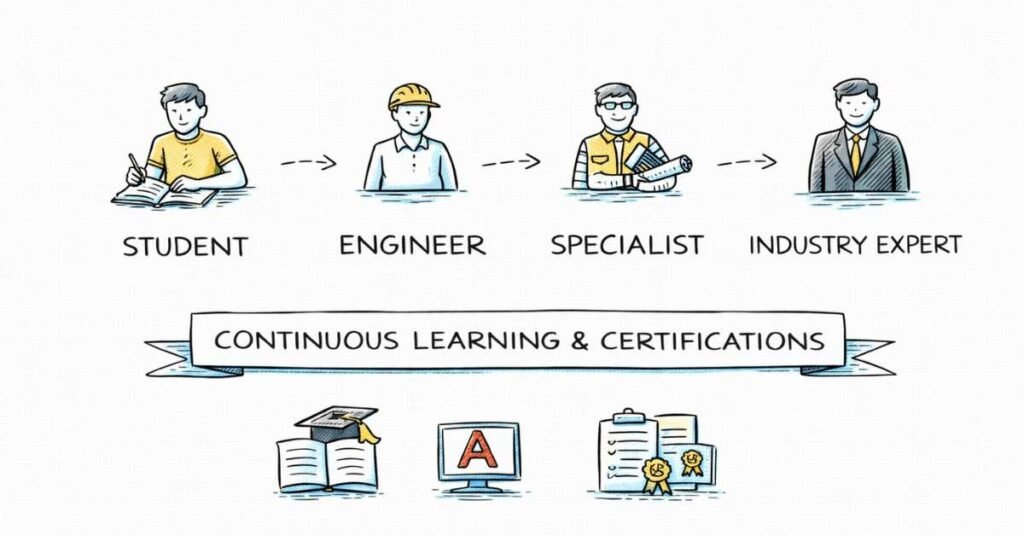
Civil engineering education isn’t just four years of BTech. It’s a continuous journey of learning—from 12th boards to entrance exams, through four years of college, possibly to higher studies, and then lifelong learning on the job.
The curriculum gives you the foundation, but your practical training, internships, self-learning, and real-world experience build your actual expertise.
The construction industry is evolving rapidly with new technologies, materials, and methods. The engineers who thrive are those who keep learning throughout their careers.
Your degree opens the door. What you do after that determines how far you go. Choose your educational path wisely, learn diligently, practice consistently, and stay curious. That’s the recipe for a successful civil engineering career.