
SEO SPECIALIST CAREER GUIDE
Table of Contents
What Does an SEO Specialist Actually Do?
Imagine someone searches “best coding bootcamps in Hyderabad” on Google. If your company’s website appears at the top, that’s the work of an SEO specialist. SEO (Search Engine Optimization) specialists are digital detectives who figure out what people are searching for online and then optimize websites to appear at the top of those search results.
This isn’t just about stuffing keywords into content anymore. Modern SEO requires understanding how search engines work, what makes websites technically sound, and how to build authority through quality backlinks. In 2026, with AI tools like ChatGPT and Google’s Search Generative Experience changing how people find information, SEO specialists must also optimize content for AI-powered searches.
The best part? You don’t need a computer science degree to start. Many successful SEO professionals come from writing, journalism, marketing, or even completely unrelated backgrounds. What matters is curiosity, analytical thinking, and willingness to learn continuously.
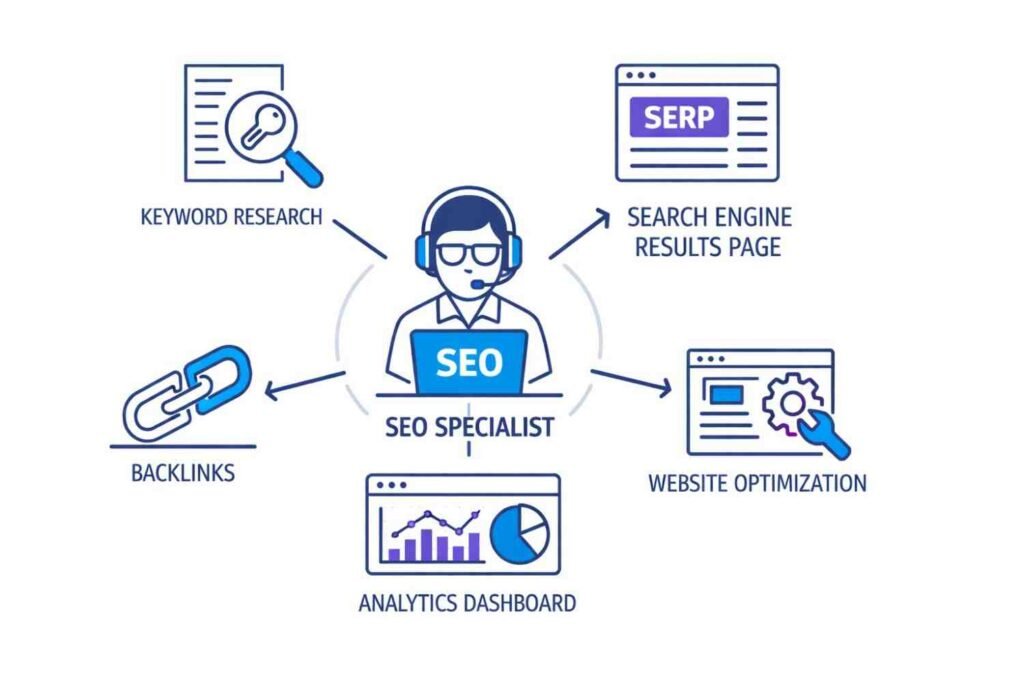
Day in the Life: What SEO Specialists Actually Do Daily
Let’s break down what a typical workday looks like for an SEO specialist in India:
Morning (9:00 AM – 12:00 PM)
- Check website rankings for target keywords using Google Search Console
- Review overnight traffic data in Google Analytics to spot any sudden drops or spikes
- Respond to urgent website issues flagged by monitoring tools
- Conduct competitor analysis to see what’s working for similar businesses
- Research new keyword opportunities using tools like SEMrush or Ahrefs
- Update website content with optimized keywords and improved meta descriptions
Afternoon (12:00 PM – 3:00 PM)
- Collaborate with content writers to brief them on SEO requirements for upcoming blog posts
- Audit website pages for technical issues like broken links, slow loading speeds, or mobile optimization problems
- Build relationships with other websites for backlink opportunities
- Analyze which pages are performing well and which need improvement
- Create monthly performance reports showing traffic growth and ranking improvements
Late Afternoon (3:00 PM – 6:00 PM)
- Work on technical SEO tasks like improving site structure or fixing crawl errors
- Test website speed and implement optimizations
- Stay updated by reading SEO blogs and industry news from sources like Search Engine Journal
- Brainstorm content ideas based on trending search queries
- Coordinate with web developers to implement technical changes
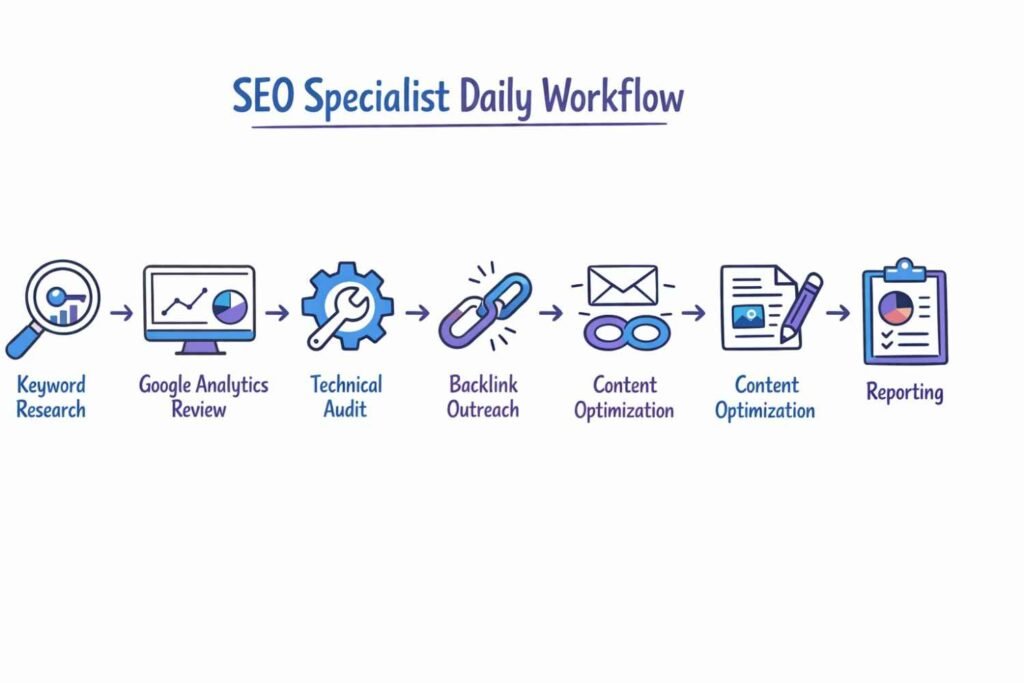
No two days are exactly the same. One day you might focus heavily on keyword research and content optimization, while another day could involve fixing technical issues or analyzing why traffic dropped.
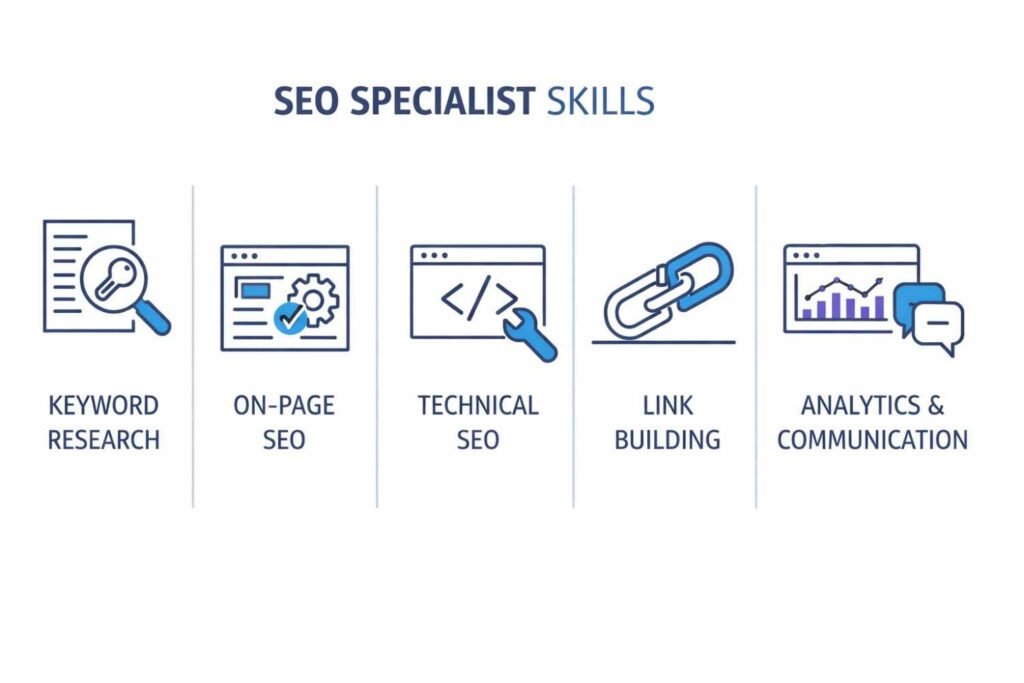
Essential Skills Every SEO Specialist Needs
Technical Skills
Keyword Research Mastery: Understanding what your target audience searches for is fundamental. You’ll use tools like Google Keyword Planner, SEMrush, Ahrefs, or Ubersuggest to find high-volume, low-competition keywords.
On-Page SEO: Optimizing individual web pages by improving title tags, meta descriptions, header tags, URL structures, internal linking, and content quality.
Technical SEO: Understanding website architecture, site speed optimization, mobile responsiveness, XML sitemaps, robots.txt files, and structured data markup. This requires basic knowledge of HTML, CSS, and JavaScript.
Off-Page SEO: Building high-quality backlinks through guest posting, digital PR, broken link building, and relationship building with other website owners.
Analytics and Reporting: Using Google Analytics 4, Google Search Console, and other analytics tools to track performance and make data-driven decisions.
Content Strategy: Working with content teams to develop SEO-friendly content that answers user intent while naturally incorporating target keywords.
Soft Skills
- Analytical thinking: SEO involves constant testing, measuring, and adjusting strategies based on data
- Patience: SEO results take 3-6 months to materialize—quick wins are rare
- Communication: Explaining technical concepts to non-technical stakeholders and content creators
- Adaptability: Google updates its algorithm 500-600 times yearly; you must stay current
- Problem-solving: Diagnosing why rankings dropped or traffic declined requires detective work
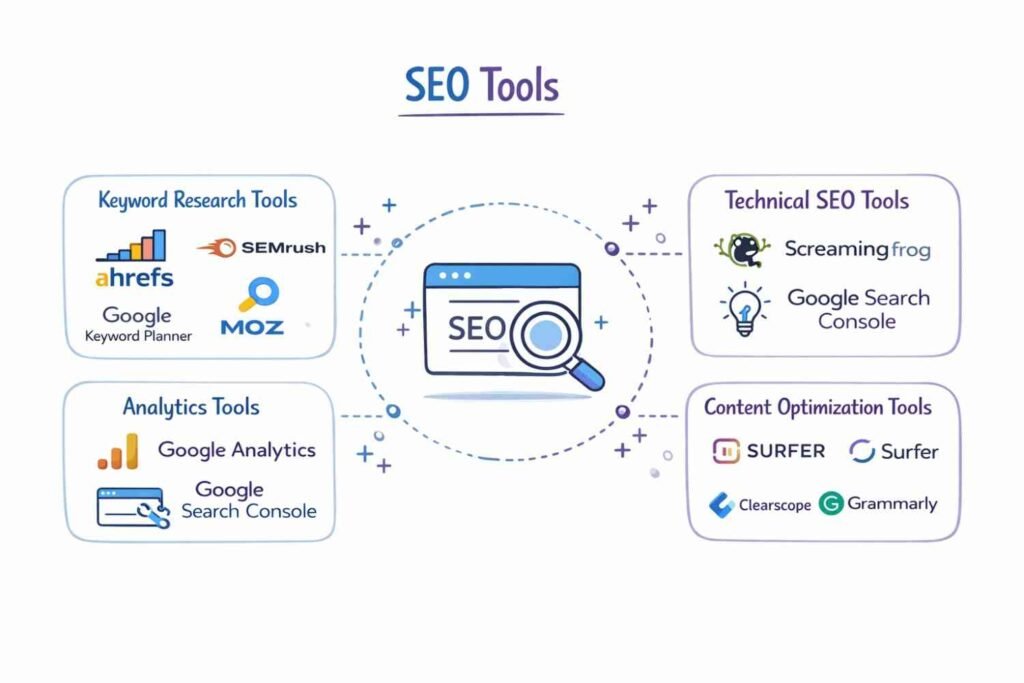
SEO Tools You'll Use Daily in 2026
Keyword Research and Competitive Analysis
SEMrush: Comprehensive all-in-one tool offering keyword research, competitor analysis, site audits, backlink tracking, and rank tracking. It’s particularly strong for tracking full campaigns across search engines and provides AI-powered content recommendations. Cost: Starting at ₹10,000/month.
Ahrefs: Industry-leading backlink analysis tool with the deepest link index and excellent organic traffic estimates. Perfect for understanding competitor strategies and finding link-building opportunities. Cost: Starting at ₹8,000/month.
Ubersuggest: Budget-friendly option ideal for Indian beginners and small businesses with affordable pricing and decent India-specific keyword data. Cost: Starting at ₹2,500/month.
Technical SEO Tools
Google Search Console: Free tool from Google showing how your website appears in search results, indexing issues, and which queries bring traffic.
Screaming Frog: Desktop application that crawls websites to identify technical issues like broken links, duplicate content, and missing meta tags. Free version available for up to 500 URLs.
GTMetrix/PageSpeed Insights: Analyze website loading speed and get actionable recommendations for improvement.
Content Optimization
Surfer SEO: AI-powered tool that analyzes top-ranking pages and provides specific recommendations for optimizing your content.
Clearscope: Content optimization platform helping you create comprehensive content that covers all relevant subtopics.
Jasper SEO Mode: AI writing assistant with built-in SEO optimization features for creating keyword-rich content faster.
Most professionals start with free tools like Google Search Console and Google Analytics, then gradually invest in paid tools as they gain experience.
SEO Specialist Salary in India: What Can You Earn?
SEO specialist salaries vary significantly based on your experience, location, and company type. Here’s a realistic breakdown for 2026:
Experience-Based Salary Ranges
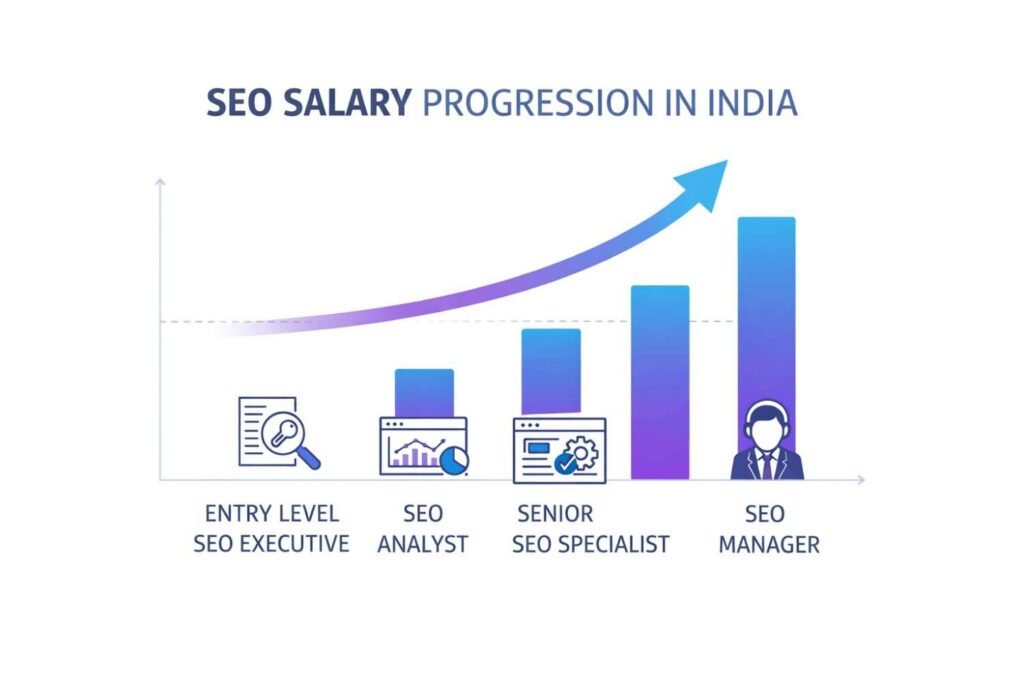
- Entry-Level (0-2 years): ₹2.5-4.5 lakhs per year
- Mid-Level (2-5 years): ₹5-8 lakhs per year
- Senior-Level (5-8 years): ₹9-15 lakhs per year
- Lead/Manager (8+ years): ₹15-25+ lakhs per year
City-Wise Salary Comparison
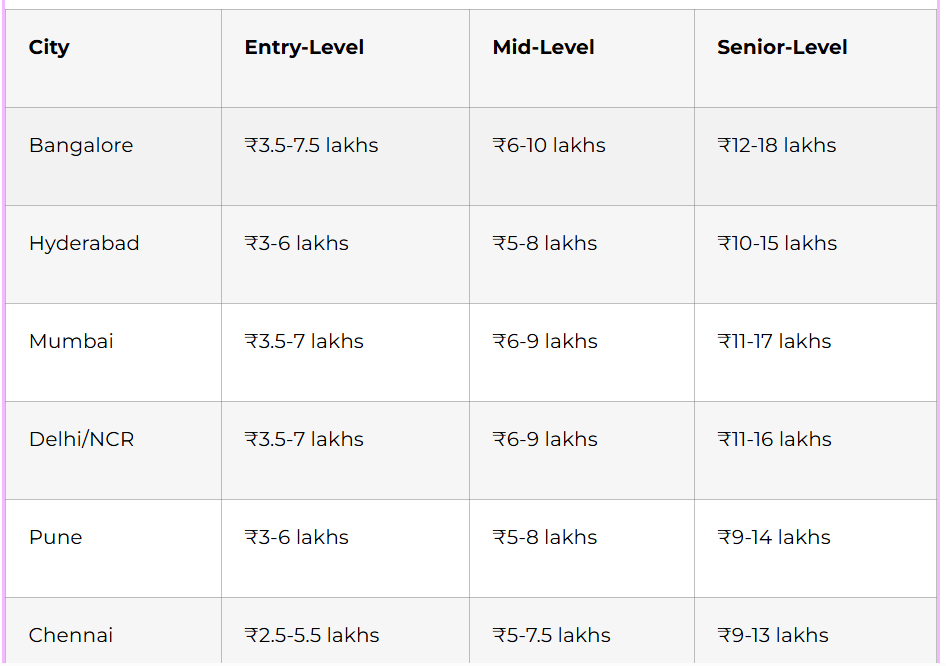
Bangalore consistently offers the highest SEO salaries due to its concentration of tech companies and startups. However, with remote work becoming standard, location matters less than it used to—many Tier 2 city residents now earn Bangalore-level salaries working remotely.
Freelance SEO Income
Experienced freelance SEO specialists often earn more than salaried employees:
- Junior freelancers: ₹20,000-40,000 per client per month
- Mid-level freelancers: ₹40,000-80,000 per client per month
- Senior consultants: ₹1,00,000-3,00,000 per client per month
Managing 3-5 clients simultaneously can generate ₹2-10 lakhs monthly income for established freelancers.
How to Become an SEO Specialist: Step-by-Step Roadmap
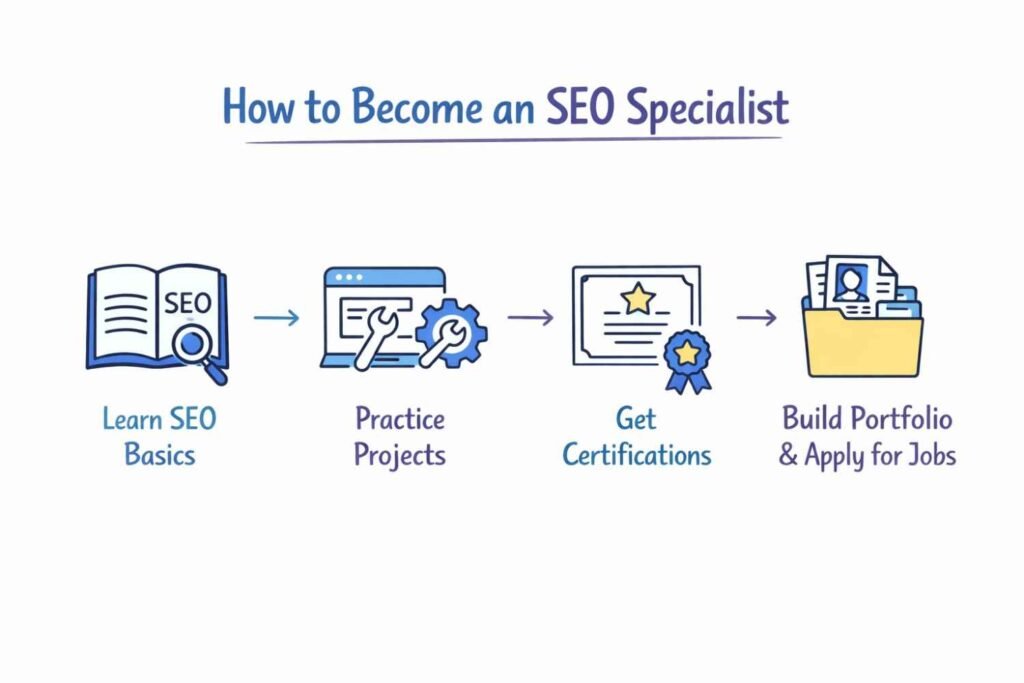
Month 1-2: Learn SEO Fundamentals
Start with free resources to understand core concepts:
- Complete Google’s SEO Starter Guide (free, available on Google Search Central)
- Take the SEMrush Academy SEO Fundamentals Course (free certification)
- Watch Ahrefs’ YouTube video series on SEO basics
- Read blogs daily from Moz, Search Engine Journal, and Backlinko
- Understand how search engines work: crawling, indexing, ranking
Focus on grasping these concepts: keyword intent, on-page optimization, link building, technical SEO basics, and analytics fundamentals.
Month 2-3: Get Hands-On Practice
Theory alone won’t land you a job. Create proof of your skills:
- Start a personal blog on WordPress or Blogger about a topic you’re passionate about
- Optimize your blog for target keywords and document your process
- Create case studies showing before/after improvements (even for your own blog)
- Offer free SEO audits to 2-3 local businesses or friends’ websites
- Join SEO communities on LinkedIn, Reddit (r/SEO), and Facebook groups
Track everything—screenshots of ranking improvements, traffic growth, and lessons learned become portfolio pieces.
Month 3-4: Earn SEO Certifications
Certifications validate your knowledge to employers:
- Google Analytics Individual Qualification (GAIQ) – Essential for proving you can analyze website data
- SEMrush SEO Toolkit Course – Covers keyword research, on-page, link building
- Ahrefs Academy SEO Training Course – Free and highly practical
- HubSpot SEO Certification – Good for understanding content-focused SEO
- Yoast SEO Academy (paid but affordable at ₹8,000) – Comprehensive WordPress SEO training
Aim for at least 3-4 certifications before applying for jobs.
Month 4-6: Build Your SEO Portfolio
Employers want to see results, not just certificates. Create portfolio pieces:
- Case Study 1: Optimize your own website and document ranking improvements over 3 months
- Case Study 2: Conduct a detailed SEO audit for a real business (even if unpaid)
- Case Study 3: Create a keyword research report for a specific industry
- Writing Samples: Publish 3-5 SEO-optimized blog posts showing your content skills
- Technical Audit: Document fixing technical SEO issues on a website
Create a simple portfolio website or PDF showcasing these projects with specific metrics (rankings improved from position 45 to 8, traffic increased by 150%, etc.).
Month 6+: Apply for SEO Jobs
Now you’re ready to enter the job market:
Resume Tips:
- Highlight certifications in a prominent section
- Quantify achievements (“Improved website traffic by 85% in 4 months”)
- Include a link to your portfolio
- List SEO tools you’re proficient with
- Showcase relevant soft skills (analytical thinking, communication, project management)
Job Search Strategy:
- Apply for roles like “SEO Executive,” “Junior SEO Specialist,” or “SEO Intern”
- Use job portals: Naukri.com, LinkedIn, Indeed, Internshala, AngelList (for startups)
- Connect with SEO professionals on LinkedIn and engage with their content
- Join local digital marketing meetups and networking events
- Consider 3-6 month internships to gain experience
Salary Negotiation:
For first jobs, focus on learning opportunities over salary. Expect ₹2.5-4 lakhs for entry roles, but look for companies with strong mentorship and growth potential.
Career Growth Path for SEO Specialists
Year 0-2: SEO Executive
Focus on execution—implementing strategies created by seniors. You’ll handle on-page optimization, content optimization, basic link outreach, and reporting. Your goal is mastering fundamentals and understanding what works.
Year 2-4: Senior SEO Executive/Specialist
Take ownership of specific SEO channels or website sections. You’ll develop strategies independently, manage smaller client accounts, and train junior team members. Expected salary: ₹5-8 lakhs.
Year 4-6: SEO Team Lead
Manage a team of 2-4 SEO executives. You’ll oversee multiple client accounts or large website sections, present strategies to clients, and be responsible for achieving team targets. Expected salary: ₹8-12 lakhs.
Year 6-8: SEO Manager
Develop comprehensive SEO strategies for organizations, manage budgets, hire and train team members, collaborate with content, development, and marketing teams. Expected salary: ₹12-18 lakhs.
Year 8+: Head of SEO/SEO Director
Lead the entire organic search strategy, shape company-wide digital marketing direction, manage large teams, and report to C-level executives. Expected salary: ₹18-30+ lakhs.
Many experienced SEO specialists also transition into freelancing or consulting after 5-7 years, often earning more than salaried positions while enjoying flexibility.
SEO Specializations: Finding Your Niche
As you gain experience, consider specializing in high-demand areas:
Technical SEO Specialist
Focus exclusively on website architecture, page speed, mobile optimization, JavaScript SEO, and structured data. Requires deeper technical knowledge but commands premium salaries (₹8-20 lakhs).
Local SEO Specialist
Help businesses rank in local search results and Google Maps. Perfect for working with restaurants, clinics, salons, and service businesses. Growing demand in Tier 2 and Tier 3 cities.
E-commerce SEO Specialist
Optimize online stores with thousands of product pages. Requires understanding of product schema, category optimization, and conversion rate optimization alongside SEO.
Content SEO Specialist
Bridge between SEO and content marketing. Focus on content strategy, topic clusters, keyword mapping, and working closely with writing teams.
Enterprise SEO Specialist
Work with large websites (100,000+ pages) requiring complex technical solutions, multiple stakeholder management, and strategic planning.
Specializing typically increases your value by 20-40% compared to generalist SEO roles.
Common Challenges SEO Specialists Face (And How to Overcome Them)
Challenge 1: Results Take Time
SEO improvements take 3-6 months to show significant results. This frustrates clients and management expecting quick wins.
Solution: Set realistic expectations upfront. Focus on quick wins (like fixing technical errors) while working on long-term strategies. Report progress metrics beyond just rankings—traffic quality, engagement, conversions.
Challenge 2: Constant Algorithm Changes
Google updates its algorithm frequently, sometimes making established strategies obsolete overnight.
Solution: Follow SEO news sources religiously. Join professional communities where changes are discussed quickly. Focus on fundamental principles (quality content, good user experience, relevant backlinks) that survive algorithm changes.
Challenge 3: Limited Development Resources
You identify technical issues but can’t implement fixes without developer help, creating bottlenecks.
Solution: Learn basic HTML/CSS/JavaScript to handle minor fixes yourself. Build strong relationships with development teams. Create detailed documentation making it easy for developers to implement changes. Prioritize critical issues.
Challenge 4: Proving ROI
Unlike paid ads with clear attribution, SEO’s impact is harder to quantify, making budget approvals difficult.
Solution: Set up proper tracking in Google Analytics. Create dashboards showing organic traffic’s contribution to leads and revenue. Calculate SEO’s cost-per-acquisition compared to other channels. Document ranking improvements and their business impact.
Challenge 5: Content Team Conflicts
Writers resist keyword optimization, seeing it as compromising content quality.
Solution: Frame SEO as enhancing content, not restricting creativity. Educate content teams on user intent. Show how SEO helps content reach more people. Collaborate on content briefs that balance SEO needs with quality writing.
Top SEO Mistakes to Avoid as a Beginner
- Keyword stuffing: Repeating keywords unnaturally hurts rankings instead of helping
- Ignoring mobile optimization: Over 70% of Indian internet users access via mobile
- Buying backlinks: Google penalizes websites with purchased or spammy links
- Neglecting technical SEO: Even great content won’t rank if your site has technical issues
- Copying competitor content: Duplicate content gets penalized; create original content
- Focusing only on rankings: Rankings matter, but traffic quality and conversions matter more
- Ignoring user experience: Slow, confusing websites won’t rank well regardless of optimization
- Not tracking results: If you can’t measure it, you can’t improve it
FAQs: SEO Specialist Career Questions
Q: Can I learn SEO without a technical background?
Absolutely. While basic technical understanding helps, many successful SEO specialists started with zero technical knowledge. Focus on understanding concepts first, then gradually learn technical aspects.
Q: How long does it take to become job-ready in SEO?
With focused learning, 3-6 months is realistic for landing entry-level positions. Mastery takes years of continuous practice.
Q: Is SEO a good long-term career choice?
Yes. As long as search engines exist, businesses will need SEO specialists. The field evolves, so continuous learning is essential, but demand remains strong.
Q: Should I specialize in one area or learn all aspects of SEO?
Start as a generalist, understanding all SEO aspects. After 2-3 years, consider specializing based on what you enjoy most and market demand.
Q: Do I need to know coding for SEO?
Basic HTML, CSS, and JavaScript understanding helps but isn’t mandatory for entry-level roles. As you grow, technical knowledge becomes increasingly valuable.
Your Next Steps: Launch Your SEO Career
SEO offers one of the most stable, high-paying, and intellectually stimulating careers in digital marketing. Unlike trends that come and go, search engine optimization has remained foundational to digital marketing for over two decades—and will continue thriving as long as people use search engines to find information.
Start your journey today by completing one free SEO course, reading three SEO blogs, and optimizing one web page. Small, consistent actions compound into expertise. The SEO specialists earning ₹15-25 lakhs today started exactly where you are now—at zero, wondering if they could really build a career in this field. They did, and so can you.
Remember: SEO rewards patience, curiosity, and persistence. Results don’t happen overnight, but when they do, watching your website climb to the top of Google search results is incredibly satisfying—both professionally and financially.