
Healthcare Administrator – Run the Hospital Behind the Scenes

Table of Contents
Introduction: The Unsung Leaders Making Hospitals Actually Work
Picture this: A hospital has 500 beds, 2,000+ employees, 1,000+ patients daily, and processes millions of rupees in transactions monthly. Doctors save lives. Nurses provide care. But who ensures the hospital runs smoothly? Who manages staff, budgets, operations, patient flow, and strategic decisions?
That’s the healthcare administrator.
Here’s what most people don’t realize: Hospitals aren’t run by doctors. They’re run by administrators. While doctors focus on medicine, administrators focus on operations—making sure the right resources exist for doctors to do their jobs
This is why healthcare administrators are increasingly valuable and increasingly well-paid.
What makes healthcare administration special:
You’re Not Limited to Patient Care. If you don’t enjoy clinical work but want healthcare careers, administration is perfect. You work in offices managing operations, not bedside caring.
The Salary is Surprisingly Good. Entry-level administrators earn ₹3-4 LPA. Experienced administrators earn ₹15-25 LPA. Senior hospital directors earn ₹40-50+ LPA. This rivals many clinical roles.
Career Flexibility. You can work in hospitals, clinics, diagnostic centers, insurance companies, healthcare consulting, pharmaceutical companies, or start your own healthcare business.
Clear Leadership Path. Unlike some healthcare roles, administration offers clear progression from coordinator → supervisor → manager → director → C-suite.
Job Security. Hospitals will always exist. Management is always needed. Your job won’t disappear.
Real Impact on Healthcare. As an administrator, your decisions affect thousands of patients. Your efficiency improvements save lives. Your cost management enables better care.
If you love business, problem-solving, healthcare, and leadership—healthcare administration might be your perfect career.
What Do Healthcare Administrators Actually Do? Beyond Paperwork
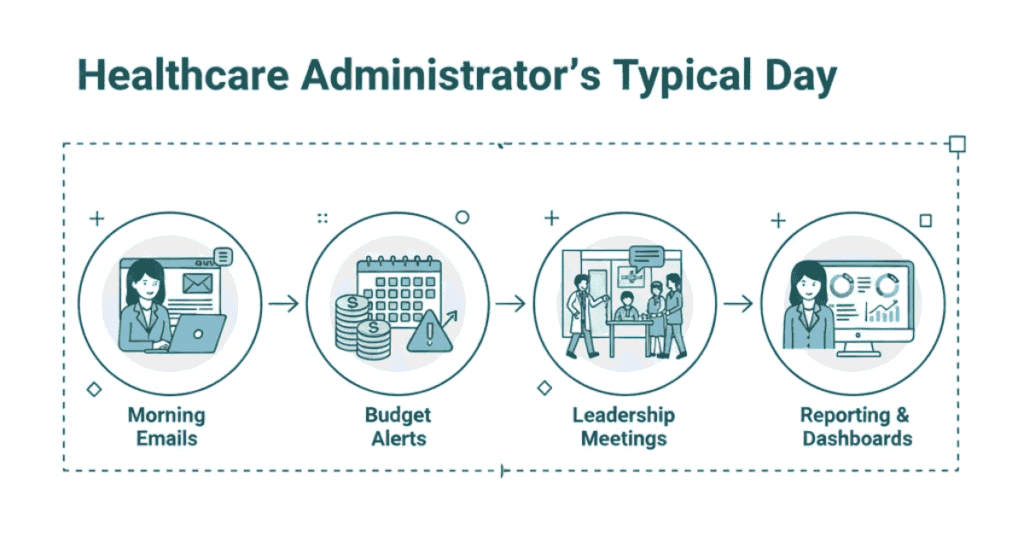
The Typical Day of a Healthcare Administrator
Early Morning (8 AM – 10 AM):
Your email has 50+ messages. Patient complaints. Staff issues. Vendor problems. Budget questions. You begin by prioritizing:
- Patient complaint: A patient’s surgery was delayed 4 hours. They’re angry. You investigate: Was it scheduling error? Emergency took OR? Equipment failure? You identify the root cause and implement prevention measures.
- Staff shortage: Night shift called in sick. You’re short 3 nurses. You activate contingency staffing plan: Contact per-diem nurses, adjust patient assignments, inform doctors. Crisis averted.
- Budget alert: Pharmaceutical costs are 15% over budget mid-quarter. You analyze: Have purchase prices increased? Are doctors over-prescribing? Are patients using more expensive alternatives? You work with procurement and doctors to optimize.
This is operational excellence. Every decision ripples through the hospital.upgrad
Mid-Morning (10 AM – 12 PM):
Strategic meetings.
You meet with:
- Medical director: Discussing new cardiac surgery program. It requires ₹5 crore investment. Will patient volume justify it? What’s the ROI timeline?
- Finance director: Quarterly review. Hospital is 8% under revenue targets. Why? Occupancy rates down? Insurance denials up? You analyze and create recovery plan.
- HR manager: Nursing staff turnover is 22%. Industry standard is 15%. You discuss: Are salaries competitive? Is management supportive? Are shifts unreasonable? You design retention program.
These aren’t just meetings—they’re strategic decisions affecting hospital success.upgrad
Afternoon (12 PM – 3 PM):
Operational focus.
You tour hospital:
- ED: Wait times are 45 minutes. Patient satisfaction is down. You meet with ED director. Root cause? Triage process too slow. Solution? Add triage nurse and redesign triage area. Budget approved. Implementation begins.
- Billing department: Claims denial rate is 12%. Hospital loses ₹50 lakhs monthly. You implement coder training, process improvements, and quality audits. Target: 5% denial rate within 3 months.
- ICU: Bed occupancy is 95% but patient outcomes worse than last year. Something’s wrong. You review data. Problem: Patient census increasing but staffing unchanged. Staff is overworked, burnout increasing, quality declining. You advocate for additional staff—excellent care at lower volume beats mediocre care at high volume.
Evening (3 PM – 5 PM):
Strategic planning & reporting.
You prepare presentations for hospital board:
- Monthly operational metrics (occupancy, patient satisfaction, staff metrics, financial performance)
- Quality metrics (infection rates, readmission rates, adverse events)
- Strategic initiatives (new services, facility expansions, technology upgrades)
- Financial reports (revenue, expenses, profit/loss)
This is what hospital leadership sees. Your data drives board decisions.
The Reality: Healthcare administration is business + healthcare + people management combined. You’re simultaneously problem-solving emergencies, managing thousands of people, overseeing massive budgets, and making strategic decisions affecting patient care.
Why You Don't Need Medical Background: The Hidden Advantage
Here’s a secret: Many excellent healthcare administrators have NO medical background.upgrad
In fact, sometimes NOT having medical background is an advantage. Here’s why:
No Clinical Bias: Doctors trained in medicine see everything through clinical lens: “How does this affect patient care?” Healthcare administrators trained in business see: “How does this affect hospital sustainability and overall care quality?”
Both perspectives are needed. Too much clinical focus means financial disaster. Too much business focus means poor care. Good administrators balance both.upgrad
You Learn Healthcare ON THE JOB: You don’t need to understand cardiology to manage a cardiac unit. You need to:
- Understand the market for cardiac services
- Ensure adequate staffing and equipment
- Monitor quality metrics
- Manage budget
- Recruit and retain talent
You learn cardiac specifics from your cardiac unit director. Your job is enabling them to do their job optimally.
Business Skills are Universal: The business skills you need—financial management, project management, HR, strategic planning, data analysis—apply to ANY organization, healthcare or not.upes
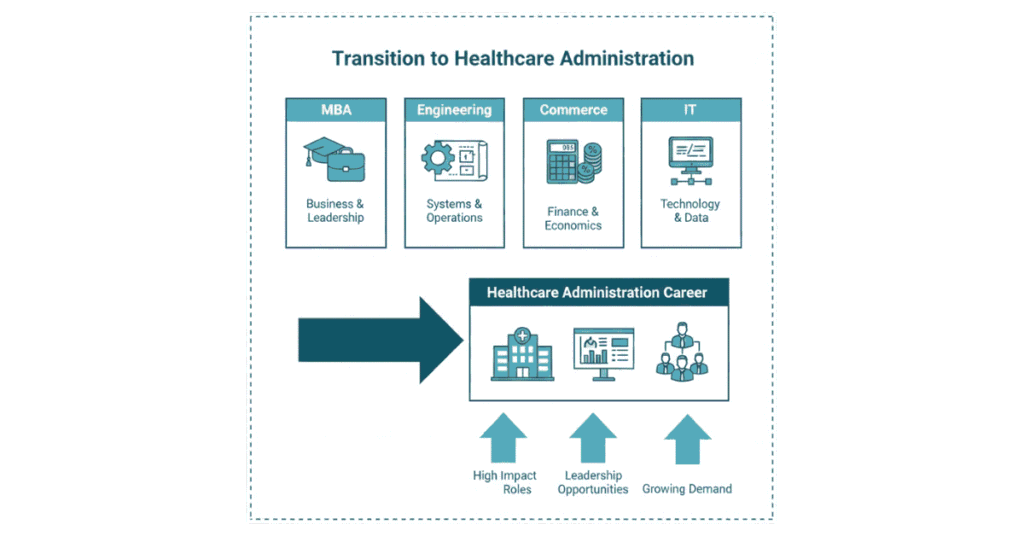
Non-Medical Backgrounds That Work Well:
- Commerce/Accounting: You understand finance, accounting, business fundamentals
- Engineering: You understand systems thinking, process improvement, optimization
- IT: You understand technology, data systems, digital transformation
- MBA holders: You’ve studied business management concepts
- Even arts/humanities: If you have business or analytical background
None of these require medical knowledge. You gain healthcare knowledge through exposure and learning.
Educational Pathways: How to Become a Healthcare Administrator
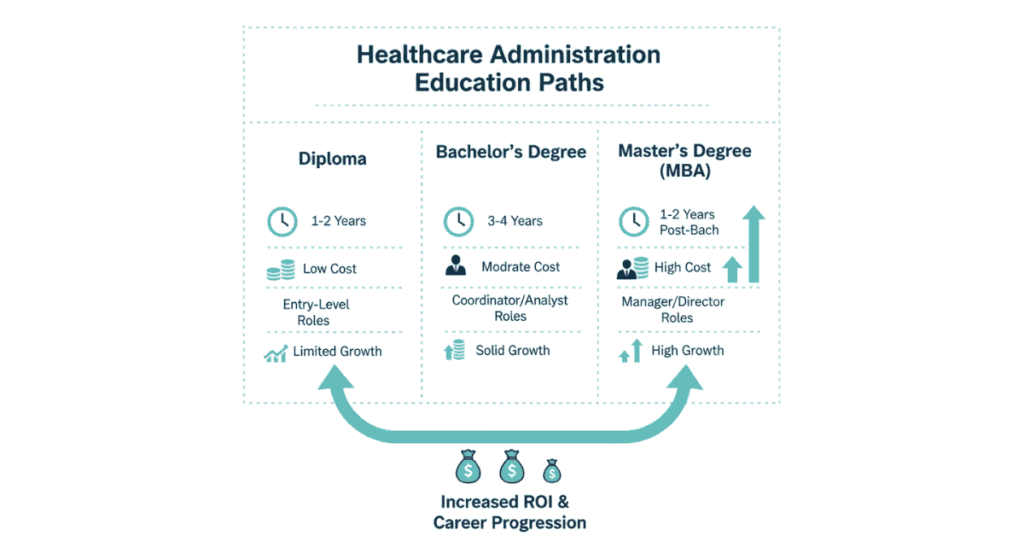
Multiple paths lead to healthcare administration. Choose based on your timeline and goals.
Pathway 1: Diploma in Hospital Management (1-2 Years)
What It Is: Short-term focused training on hospital operations, basics of healthcare management, financial fundamentals.
Duration: 1-2 years
Cost: ₹1-3 lakhs
What You’ll Learn:
- Hospital organizational structure
- Patient flow and operations
- Financial basics and budgeting
- HR and staff management
- Quality and accreditation basics
- Healthcare regulations
Job Market After: Can start as hospital coordinator or junior administrator
Starting Salary: ₹2.5-3.5 LPA
Best For: Quick entry, working professionals, those wanting to test career fit
Limitations: Without bachelor’s degree, advancement to senior roles is slower
Pathway 2: Bachelor’s in Hospital/Healthcare Management (3-4 Years)
What It Is: Full bachelor’s degree combining healthcare systems knowledge with business management.
Duration: 3-4 years
Cost: ₹2-5 lakhs (government), ₹6-15 lakhs (private)
What You’ll Learn:
- Healthcare systems and organization
- Healthcare economics and finance
- Strategic management
- Human resources in healthcare
- Quality improvement and operations
- Healthcare law and ethics
- Business fundamentals
- Healthcare IT
Job Market After: Immediate entry into coordinator or administrator roles
Starting Salary: ₹3.5-5 LPA
Best For: Recent graduates wanting comprehensive education, career planning from start
Advantages:
- Bachelor’s degree credential (valuable)
- Comprehensive healthcare knowledge
- Better starting position than diploma
- Clear path to MBA if wanted
Pathway 3: MBA in Healthcare Management (2 Years)
What It Is: Full master’s degree combining healthcare with business management. Often requires work experience (1-2 years) before admission.
Duration: 2 years full-time, 2-3 years part-time
Cost: ₹6-15 lakhs (Indian colleges), ₹25-40 lakhs (international)
Prerequisites: Bachelor’s degree + often 1-2 years work experience
What You’ll Learn:
- Strategic healthcare management
- Healthcare finance and economics
- Quality improvement (Six Sigma, Lean)
- Healthcare marketing and operations
- Hospital administration
- Healthcare policy and regulations
- Leadership and organizational behavior
- Healthcare IT and digital transformation
Job Market After: Mid to senior-level administrator positions
Starting Salary After MBA: ₹8-12 LPA
Best For: Career advancement, those seeking senior positions, experienced professionals
Advantages:
- Master’s degree credential
- Significant salary jump
- Fast-track to leadership
- Better positioned for director roles
- International opportunities
Pathway 4: Bachelor’s + MBA (5-6 Years Total)
Timeline:
- Bachelor’s in healthcare/business: 3-4 years
- Work experience: 1-2 years
- MBA: 2 years
Total time: 5-6 years
Total cost: ₹12-30 lakhs
Salary progression:
- After bachelor’s: ₹3.5-5 LPA
- After 1-2 years work: ₹5-7 LPA
- After MBA: ₹10-15 LPA
This pathway offers: Comprehensive foundation + practical experience + advanced expertise = strongest position for senior roles
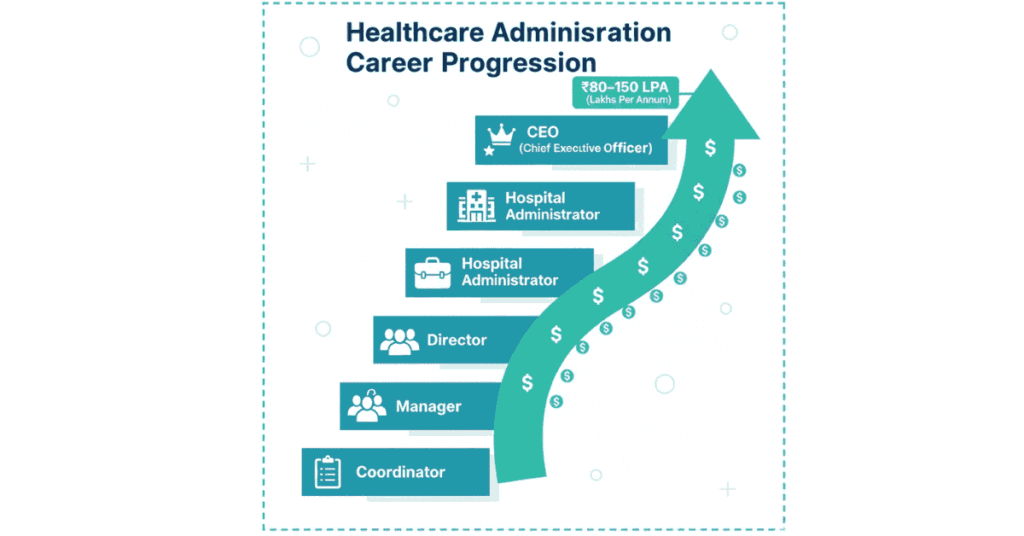
Healthcare Administrator Salary & Career Progression: Realistic Numbers
Entry-Level (0-1 Year): Hospital Coordinator/Administrative Assistant
Typical Responsibilities:
- Coordinating patient appointments and admissions
- Data entry and record management
- Patient complaint handling
- Supporting departments with administrative tasks
- Scheduling and logistics coordination
Salary: ₹2.5-3.5 LPA (₹20,000-29,000/month)
Location Variation:
- Metro cities (Mumbai, Delhi, Bangalore): ₹3-3.5 LPA
- Tier-2 cities: ₹2.7-3 LPA
- Small cities: ₹2.3-2.7 LPA
What to Focus On:
- Learn hospital operations thoroughly
- Understand patient flow
- Build relationships across departments
- Show initiative and problem-solving
- Consider pursuing management education (diploma or bachelor’s)
Timeline: 1-2 years typically
Junior Administrator (1-3 Years): Patient Services Coordinator, Department Administrator
Salary: ₹3.5-5 LPA (₹29,000-42,000/month)
Responsibilities:
- Managing specific department operations
- Staff scheduling and coordination
- Budget tracking for department
- Patient satisfaction management
- Process improvement initiatives
- Handling escalated complaints
With Bachelor’s Degree: Positioned at higher end (₹4.5-5 LPA)
What to Focus On:
- Develop operational expertise in your department
- Learn financial basics
- Show leadership capability
- Consider MBA if career advancement desired
- Build cross-functional understanding
Mid-Level (3-7 Years): Department Administrator, Operations Manager
Salary: ₹6-10 LPA (₹50,000-83,000/month)
Responsibilities:
- Managing entire department or multiple functions
- Budget ownership (₹50-500 lakhs depending on department)
- Staff management (supervising 5-20 people)
- Quality metrics oversight
- Revenue/cost management
- Strategic planning for department
With MBA: ₹8-12 LPA range
Critical Career Decision:
Stay in operations path or move toward strategic management
Senior Level (7-12 Years): Hospital Administrator, Operations Director
Salary: ₹12-20 LPA (₹1,00,000-1,67,000/month)
Responsibilities:
- Hospital-wide operations oversight
- Multiple department management
- Strategic planning and implementation
- Large budget management (₹10-100 crores)
- Staff management (100+ people)
- Board interactions
- Healthcare strategy influence
With MBA/Advanced Education: ₹15-25 LPA
Requirements:
- Proven track record of operational excellence
- Leadership skills
- Strategic thinking
- Often: MBA or advanced degree
- 7+ years experience
Executive Level (12+ Years): Hospital Director, Chief Executive Officer
Salary: ₹20-50+ LPA (₹1,67,000-4,16,000+/month)
Responsibilities:
- Hospital CEO or equivalent
- Overall strategic direction
- Board reporting
- Large multi-department budgets
- Organizational vision and implementation
- Healthcare innovation leadership
Who Reaches Here:
- Top 5-10% of administrators
- MBA typically required
- Exceptional track record
- Strategic and visionary thinking
- Often move between organizations
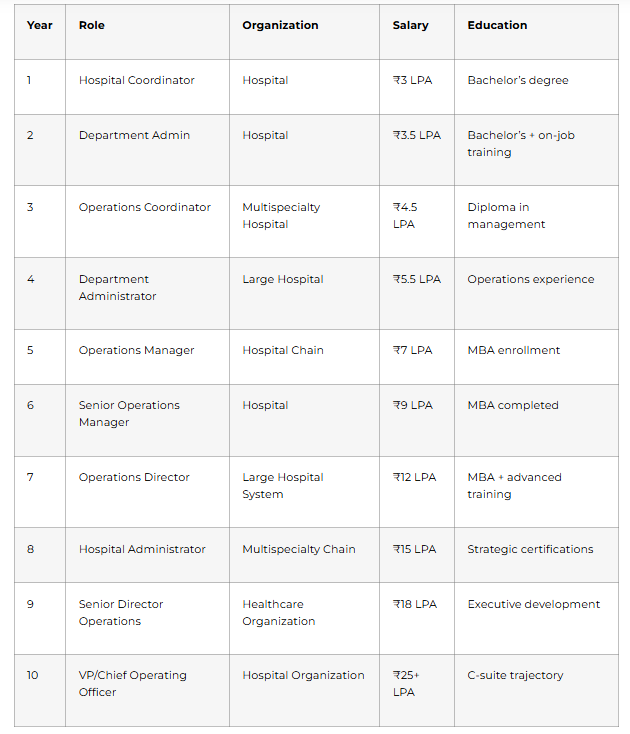
Real Numbers: 10-Year Healthcare Administrator Career Progression
Essential Skills for Healthcare Administrators
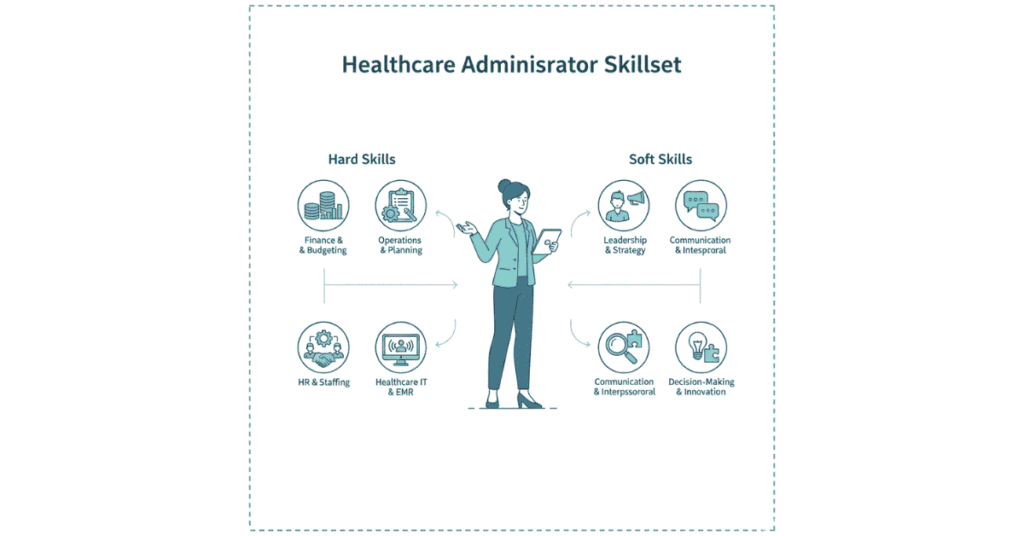
Success in healthcare administration requires specific skill combinations.
Hard Skills (Technical)
Financial Management:
- Budgeting and financial planning
- Cost analysis and optimization
- Revenue cycle management
- Financial reporting and analysis
Operational Management:
- Process optimization and workflow design
- Supply chain and inventory management
- Scheduling and resource allocation
- Quality assurance and metrics tracking
Strategic Planning:
- Developing hospital strategy
- Market analysis
- Competitive positioning
- Long-term planning
Healthcare IT:
- Understanding hospital systems (EHR, HIS)
- Data analysis and reporting
- Healthcare technology trends
- IT project management
HR & Staff Management:
- Recruiting and hiring
- Staff development and training
- Performance management
- Conflict resolution
Soft Skills (Behavioral)
Leadership:
- Inspiring and motivating teams
- Decision-making under pressure
- Vision communication
- Change management
Communication:
- Clear explanations to diverse audiences
- Presentation skills
- Listening and understanding
- Conflict resolution
Problem-Solving:
- Analytical thinking
- Creative solution generation
- Systematic troubleshooting
- Data-driven decision making
Adaptability:
- Comfort with change
- Continuous learning mindset
- Flexibility in challenging situations
- Innovation appreciation
Emotional Intelligence:
- Understanding people’s perspectives
- Empathy for patients and staff
- Political awareness
- Relationship building
Landing Your First Healthcare Administration Job: Complete Strategy
Now let’s get you hired.
Healthcare Administrator Resume Template
text
[YOUR NAME]
City, State | Phone: +91-XXXXX-XXXXX | Email: yourname@email.com | LinkedIn: linkedin.com/in/yourprofile
PROFESSIONAL SUMMARY
Operations-focused healthcare professional with [X years] of experience in hospital administration and patient services. Proven ability to optimize operations, manage budgets, and lead cross-functional teams. Committed to improving hospital efficiency while maintaining highest quality patient care standards. [Bachelor’s/MBA] qualified with strong healthcare systems knowledge.
PROFESSIONAL EXPERIENCE
Hospital Coordinator | [Hospital Name] | [City] | [Dates]
- Coordinated patient admissions and discharge processes, reducing average admission time from 45 minutes to 20 minutes
- Managed patient complaint resolution, achieving 92% satisfaction on complaint follow-ups
- Assisted in scheduling 2,000+ monthly appointments with 98% accuracy and minimal conflicts
- Collaborated with departments to streamline patient flow, reducing ED waiting times by 25%
- Supported budgeting for three departments, tracking monthly expenses and variance analysis
- Implemented appointment reminder system, reducing no-shows from 8% to 3%
[If you have additional experience]:
Department Administrator | [Hospital/Organization Name] | [City] | [Dates]
- [Specific operational achievements with metrics]
- [Budget management example with actual numbers]
- [Process improvement with measurable outcomes]
EDUCATION
[Bachelor’s/Master’s Degree] in [Healthcare/Hospital/Business Management] | [University Name] | [Year]
- [Relevant coursework or GPA if strong]
[If applicable]:
MBA in Healthcare Management | [University Name] | [Year]
- Specialization: [e.g., Hospital Operations, Healthcare Finance]
CERTIFICATIONS & SKILLS
Certifications:
- [Relevant healthcare management certifications]
- Microsoft Office (Advanced)
- Healthcare data analysis
Technical Skills:
- Hospital Information Systems (HIS) – [specific systems if applicable]
- Financial management and budgeting
- Project management
- Data analysis and reporting
- Strategic planning
- Supply chain management
Soft Skills:
- Leadership and team management
- Patient-focused operations
- Process improvement
- Strategic thinking
- Cross-functional collaboration
LANGUAGES
English: Fluent | Hindi: [Proficiency] | [Other languages]
ACHIEVEMENTS
- Successfully implemented [specific process improvement] saving [amount/time]
- Led team of [number] people with [positive outcome]
- Managed budget of ₹[amount] with [percentage] variance
- Improved patient satisfaction from [X%] to [Y%]
Where to Find Healthcare Administrator Jobs
Online Job Portals:
- Naukri.com – Search “Hospital Administrator” or “Healthcare Administrator”
- Indeed.com – Large hospital and healthcare organization positions
- LinkedIn Jobs – Professional administrator positions
- Glassdoor – Research hospital culture and salary
Hospital Websites Directly:
- Large hospital chains post on their careers pages
- Often faster than job portals
Healthcare Organizations:
- Apollo Hospitals
- Fortis Healthcare
- Max Healthcare
- Manipal Hospitals
- Medanta
- Government hospital systems
Healthcare Consulting Firms:
- Deloitte Healthcare
- Accenture Healthcare
- Ernst & Young Healthcare
- Consulting firms need healthcare management expertise
Recruitment Agencies:
- Healthcare staffing agencies
- Management consulting recruiters
- Healthcare-specific recruiters
Interview Preparation: Healthcare Administration
Common Questions:
Q: “Tell me about a time you improved hospital operations.”
Good Answer: “In my hospital coordinator role, I noticed ED patients waited 45 minutes on average before triage. I analyzed the process and found triage was only one nurse handling 20+ patients. I proposed adding another nurse during peak hours. Management was hesitant due to cost. I presented data: one additional nurse cost ₹3 lakhs monthly, but reduced wait times to 20 minutes and patient satisfaction improved 20%, generating ₹5+ lakhs in additional revenue. They approved. Win-win.”
Q: “How do you handle budget constraints?”
Good Answer: “Budget constraints require creative problem-solving, not cutting corners on quality. When our pharmacy budget was 15% over target mid-year, I analyzed usage patterns. We found certain expensive antibiotics were overused. I worked with medical staff to review protocols, identify opportunities for generics, and negotiate better vendor pricing. We recovered 80% of overages without impacting care quality.”
Q: “What’s your experience with data analysis?”
Good Answer: “I regularly use hospital data for operational decisions. I analyze metrics like patient volume trends, staff efficiency, cost per procedure, readmission rates, and patient satisfaction. I create dashboards showing key metrics that help identify problems early. For example, when occupancy dropped 8%, I analyzed admission data, found delays in ED discharge process, fixed that, and occupancy recovered within 3 weeks.”
Salary Negotiation
Research First:
- Check Glassdoor for hospital salary ranges
- Ask peers what coordinators earn at similar hospitals
- Typical range for entry-level: ₹3-4 LPA
Negotiation Script:
“Thank you for the offer. I’m excited about joining [Hospital]. Based on my education and market research for hospital coordinators in [City], I was expecting ₹[X]. Would there be flexibility?”
What’s Negotiable:
- Base salary (10-15% room for entry-level)
- Performance bonuses
- Professional development support (MBA reimbursement)
- Health insurance and benefits
Common Mistakes Healthcare Administrators Make
Mistake 1: Staying in Entry-Level Positions Too Long
Some coordinators work 5+ years at same level earning ₹4-5 LPA. Meanwhile peers who pursued education/advancement earn ₹10+.
Instead: Within 1-2 years, pursue education (diploma, bachelor’s, or MBA) and make strategic moves to advance.
Mistake 2: Getting Stuck in One Hospital
Some administrators stay in one hospital forever. This limits salary growth and learning.
Instead: Move strategically. Every 3-4 years, change to larger hospital or bigger role. Each move is career advancement.
Mistake 3: Ignoring Financial Skills
Administrators who don’t understand financial management limit themselves. Finance skills are critical for senior roles.
Instead: Actively learn financial analysis, budgeting, cost optimization. Take courses if needed.
Mistake 4: Not Getting MBA Despite Ambition
Some aspiring administrators think “I’ll reach senior roles without MBA.” Unlikely. Most director-level administrators have MBA.
Instead: Pursue MBA while working (part-time, online, or executive programs). Worth the investment.
Mistake 5: Poor Communication Skills
Some administrators are excellent operationally but terrible at communication. This kills advancement.
Instead: Actively develop presentation, writing, and interpersonal communication. Take courses. Practice.
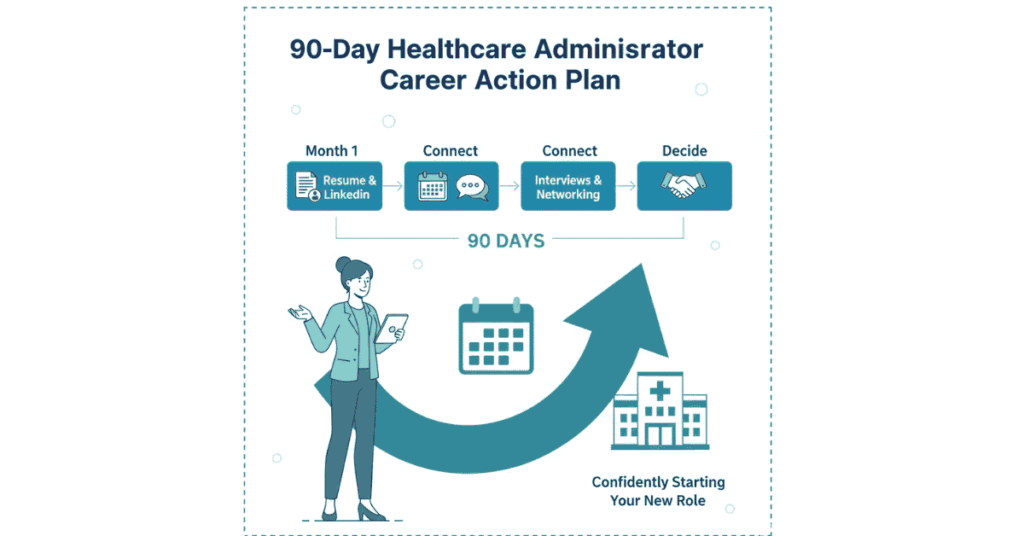
Your 90-Day Action Plan: From Coordinator to Administrator Career
Month 1: Foundation & Applications (Days 1-30)
Week 1:
- ☐ Complete your bachelor’s degree or get hospital coordinator role
- ☐ Create professional resume
- ☐ Create LinkedIn profile (mark “Open to Healthcare Administration Opportunities”)
- ☐ Research healthcare administration programs
Week 2:
- ☐ Identify 20 target hospitals/healthcare organizations
- ☐ Connect with healthcare administrators on LinkedIn (30+ connections)
- ☐ Join healthcare management groups/communities
- ☐ Research entry-level coordinator positions
Week 3:
- ☐ Enroll in diploma/bachelor’s program (if not already done)
- ☐ Apply to 10-15 hospital coordinator positions
- ☐ Prepare interview answers
- ☐ Research organization cultures
Week 4:
- ☐ Send direct applications to hospital HR departments
- ☐ Apply to 10 more positions
- ☐ Follow up on previous applications
- ☐ Continue program enrollment if chosen
End of Month 1: 25-30 applications, education plan in place
Month 2: Interviews & Offers (Days 31-60)
Week 5:
- ☐ Interviews starting (likely by now)
- ☐ Continue applications (10 more)
- ☐ Practice case studies
- ☐ Learn about hospital operations
Week 6:
- ☐ Attend interviews (2-5 expected)
- ☐ Send thank-you emails after interviews
- ☐ Get feedback if rejected
- ☐ Continue education program enrollment
Week 7:
- ☐ More interviews happening
- ☐ Apply to final positions (5-10)
- ☐ Prepare for negotiation
- ☐ Research organizations interviewing you
Week 8:
- ☐ Receive job offers (likely by now)
- ☐ Negotiate if applicable
- ☐ Accept offer
- ☐ Complete education program enrollment
End of Month 2: 40-50+ applications, 3-6 interviews, offers received
Month 3: Starting Your Career (Days 61-90)
Week 9:
- ☐ Complete joining formalities
- ☐ Get employee credentials
- ☐ Complete orientation
- ☐ Meet your team and department heads
Week 10:
- ☐ Start your first day as healthcare administrator!
- ☐ Learn hospital systems and processes
- ☐ Shadow experienced administrators☐ Ask questions and observe
Week 11:
- ☐ Start independent projects
- ☐ Build relationships across hospital
- ☐ Get feedback on performance
- ☐ Plan education timeline
Week 12:
- ☐ Complete first month of employment
- ☐ Reflect on learning and progress
- ☐ Plan next steps (MBA? Specialization?)
- ☐ Celebrate your healthcare administration career launch!
End of Month 3: First healthcare administration job secured, earning, learning hospital operations!
Closing: Your Healthcare Administration Career
You’ve now understood healthcare administration as a complete career—running hospitals from behind the scenes.
Here’s what’s possible:
- Quick entry: Hospital coordinator roles available with bachelor’s degree
- Decent starting income: ₹3-4 LPA starting
- Explosive growth: ₹25+ LPA within 10 years with MBA and strategic moves
- Multiple specializations: Hospital operations, finance, quality, HR, strategy
- No patient pressure: Office-based work if you prefer
- Real organizational impact: Your decisions affect thousands of patients
- Genuine leadership path: Clear progression from coordinator to CEO
- Job security: Healthcare organizations always need administrators
Healthcare administration isn’t glamorous. You won’t be on the front lines. But you’ll be the person making hospitals actually work—enabling doctors to heal, nurses to care, and patients to recover.
Your healthcare administration career doesn’t start someday. It starts when you take that first coordinator role.
Good luck, future healthcare administrator. Healthcare needs your operational excellence and strategic vision. 🏥💼✨