
Sustainable Farming Careers in India: Green Jobs & Future Scope
Table of Contents
Introduction
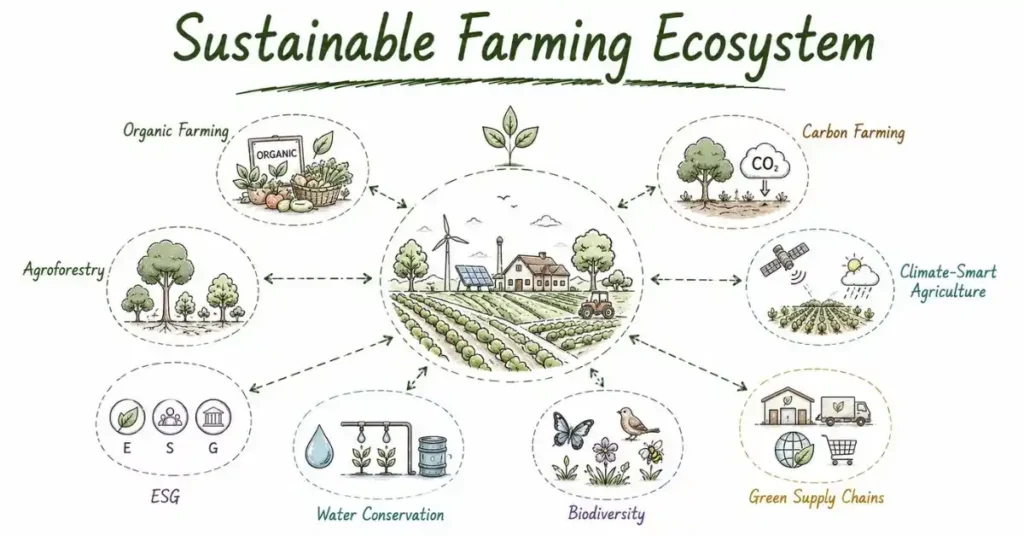
In 2023, a farmer in Wardha district of Maharashtra received a payment not for selling crops, but for the carbon his soil had sequestered over three years of regenerative farming practices. A company in London bought those carbon credits to offset its emissions. The transaction was verified by an Indian agronomist trained in carbon accounting, facilitated by a sustainability startup based in Bengaluru, and monitored through satellite imagery analysed by a remote sensing specialist in Hyderabad.
Four careers. One sustainable farming transaction.
Sustainable farming as a career is widely misunderstood. Most students think it means working for an NGO in a village for ₹15,000 a month. That version exists but it is only a fraction of the picture. The sustainable agriculture sector in India today spans corporate sustainability departments, carbon markets, organic certification bodies, climate finance institutions, agroforestry enterprises, and government climate programmes and it is growing faster than most students realise.
This guide tells you what sustainable farming careers actually look like in India, which employers are hiring, what they pay, and how you can position yourself for this sector regardless of your current background.
Why Sustainable Farming Careers Are Growing in India Right Now
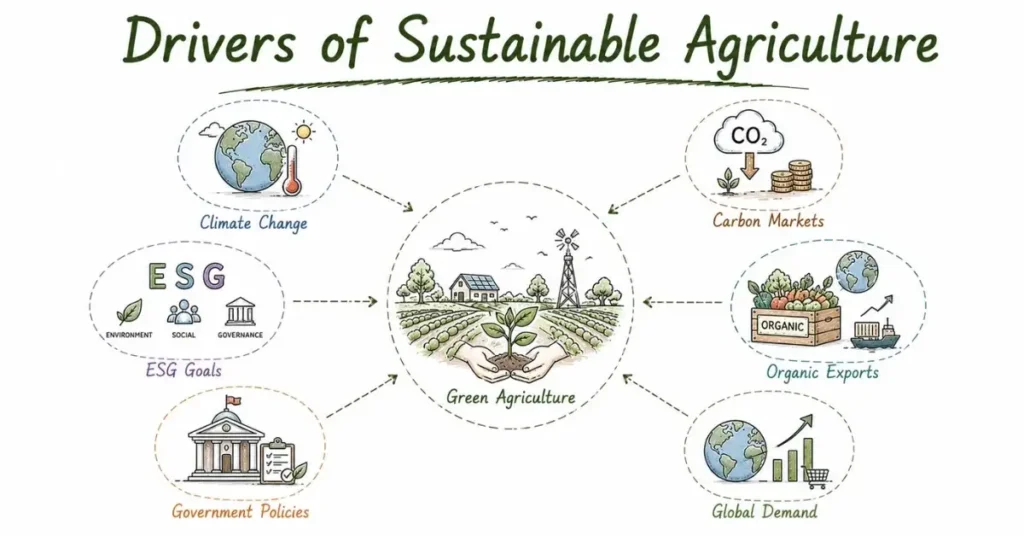
Three forces are converging to create genuine career demand in this space.
Climate pressure on Indian agriculture: India loses an estimated ₹50,000 crore annually to climate-related agricultural losses droughts, unseasonal rainfall, pest pressure linked to temperature shifts. Farmers, governments, and agribusinesses are all investing in climate adaptation, and that investment needs people who understand both agriculture and environmental science.
ESG mandates on corporations: Large Indian companies ITC, Tata, Mahindra, Reliance have committed to sustainability targets under SEBI’s Business Responsibility and Sustainability Reporting (BRSR) framework. Many of their supply chains run through agriculture. Meeting these targets requires sustainability professionals who understand farm-level environmental impact.
Global market requirements: Indian agricultural exports rice, spices, cotton, coffee, tea, horticulture produce increasingly face sustainability certification requirements from European and American buyers. The EU’s Carbon Border Adjustment Mechanism and deforestation regulations are already reshaping what Indian agri-exporters need to document and prove. Someone has to do that work.
Sustainable Farming Career Tracks: The Full Breakdown
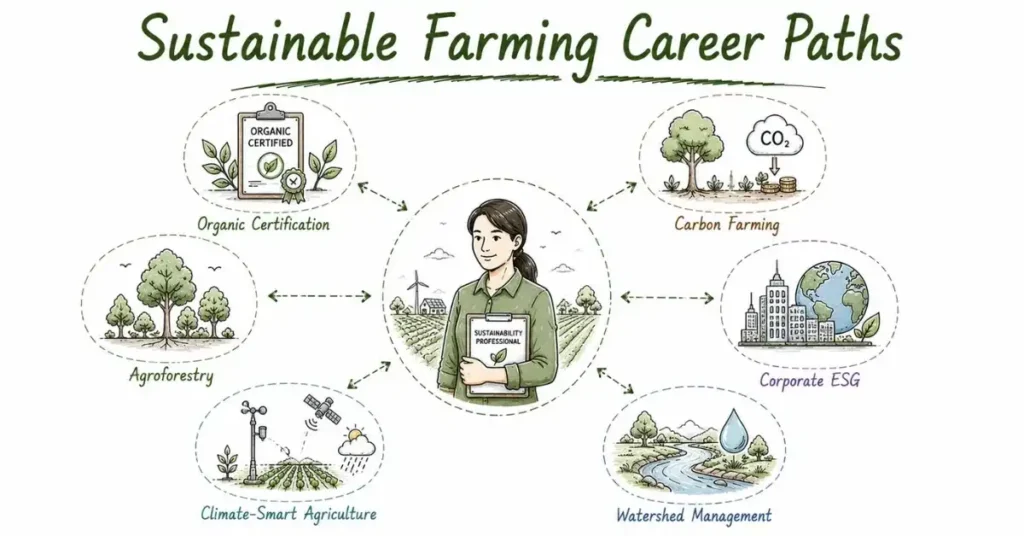
1. Organic Farming and Certification
What it is: Organic farming careers span farm-level advisory, certification auditing, and supply chain traceability. India is the world’s largest producer of certified organic farmers by number over 44 lakh certified organic farmers as of 2023 but organic certification infrastructure and advisory capacity is chronically understaffed.
What you do day to day: Conduct farm inspections to verify compliance with organic certification standards (NPOP for Indian market, NOP for US export, EU Organic for European export), review farm records and input purchase logs, interview farmers about their practices, write inspection reports, flag non-compliances, and issue or recommend renewal of certificates.
Who fits: B.Sc. Agriculture graduates with knowledge of soil health, crop nutrition, and pest management. Patience for documentation and process compliance is important certification auditing is detail-intensive work.
Key skills: NPOP standards knowledge, EU Organic and NOP standards for export-focused roles, farm record keeping systems, soil and input testing interpretation, inspection report writing.
Sample roles: Organic Certification Auditor, Organic Farming Advisor, Internal Control System (ICS) Manager, Organic Supply Chain Coordinator, Organic Input Quality Controller.
Employers: Control Union India (Hyderabad), ECOCERT India, OneCert Asia (Jaipur), IMO Control India, SGS India (agri certification division), APEDA (for government organic promotion roles), Organic India, Sresta Natural Bioproducts (24 Mantra Organic).
Salary range: ₹3 – ₹5.5 LPA (junior auditor / field advisor) | ₹7 – ₹14 LPA (lead auditor / certification manager)
2. Carbon Farming and Climate Finance
What it is: Carbon farming means implementing agricultural practices cover cropping, reduced tillage, agroforestry, improved grazing management that sequester carbon in soil and vegetation. Carbon credits generated by these practices are sold to companies or governments offsetting their emissions. This entire system needs professionals who can measure, verify, and facilitate carbon transactions at the farm level.
What you do day to day: Baseline soil carbon assessments on enrolled farms, monitor practice implementation through farm visits and remote sensing, calculate carbon sequestration using approved methodologies (Verra VCS, Gold Standard, or India’s emerging domestic carbon market framework), prepare project documentation for carbon registry submission, coordinate with farmers on practice adoption.
Why it matters for India right now: India launched its Carbon Credit Trading Scheme (CCTS) in 2023 under the Energy Conservation Amendment Act. Agricultural soil carbon is one of the eligible offset categories. This is a genuinely nascent market people building expertise in it now will be positioned well when it scales.
Who fits: B.Sc. Agriculture or Environmental Science graduates with interest in climate science and finance. Analytical skills for carbon accounting calculations are important.
Key skills: Carbon accounting methodologies (VCS, CDM for agriculture), soil carbon measurement protocols, GIS basics for land use mapping, carbon registry platforms (Verra, Gold Standard), climate finance basics.
Sample roles: Carbon Project Developer, Soil Carbon Analyst, Climate-Smart Agriculture Specialist, Carbon Credits Coordinator, Agricultural Carbon Market Analyst.
Employers: Earthtree, Boomitra (carbon farming startup with India operations), South Pole (carbon project developer), EKI Energy Services (Indore), 3Bee India, Tata Trusts (climate-smart agriculture programmes), NABARD’s climate finance division.
Salary range: ₹4 – ₹7 LPA (junior carbon analyst / field officer) | ₹10 – ₹18 LPA (senior project developer / carbon market specialist)
3. Agroforestry and Forest-Based Livelihoods
What it is: Agroforestry integrates trees into farming systems combining crops, livestock, and trees on the same land to improve productivity, biodiversity, carbon storage, and farmer income. India has a National Agroforestry Policy and multiple state-level programmes funding agroforestry expansion. Private companies with large land holdings or supply chain dependencies also run agroforestry programmes for sustainability and raw material security.
What you do day to day: Design agroforestry systems suited to local soil, climate, and crop conditions, source and supply quality planting material to farmers, provide establishment and management advisory, monitor tree growth and canopy coverage, calculate ecosystem service benefits, coordinate with government extension systems.
Who fits: B.Sc. Agriculture / Horticulture / Forestry graduates; Environmental Science graduates with field comfort.
Key skills: Tree species identification and silviculture basics, farm system design, nursery management, GIS for land use mapping, carbon sequestration estimation for tree-based systems.
Sample roles: Agroforestry Specialist, Social Forestry Officer, Farm Forestry Coordinator, Green Value Chain Manager, Landscape Restoration Specialist.
Employers: ITC’s Social and Farm Forestry division (one of India’s largest corporate agroforestry programmes, planting millions of trees annually across Andhra Pradesh, Telangana, and Karnataka), Tata Coffee (shade-grown coffee agroforestry), Rainforest Alliance (certification and advisory), ICRAF (World Agroforestry Centre, India office), state forest departments.
Salary range: ₹3.5 – ₹6 LPA (field specialist) | ₹8 – ₹15 LPA (programme manager / agroforestry consultant)
4. Corporate Sustainability Agriculture Supply Chains
What it is: Large companies with agricultural supply chains food companies, textile companies, commodity traders are under increasing pressure to demonstrate sustainable sourcing. They need professionals who can assess farm-level sustainability risks, build responsible sourcing programmes, engage with farmer communities, and report sustainability metrics to investors and regulators.
What you do day to day: Assess sustainability risks in a company’s cotton or rice supply chain, develop a supplier code of conduct for farm-level environmental and social standards, conduct farmer training programmes on Good Agricultural Practices (GAP), collect and verify sustainability data from supply chain partners, prepare BRSR sustainability disclosures, engage with sustainability certification bodies.
Who fits: B.Sc. Agriculture graduates with good analytical and communication skills; MBA graduates with sustainability or CSR interest; Environmental Science graduates who want private sector roles.
Key skills: Supply chain sustainability frameworks (Rainforest Alliance, UTZ, FSC, RSPO for relevant commodities), ESG reporting standards (GRI, BRSR, TCFD), stakeholder engagement, sustainability data collection and analysis.
Sample roles: Sustainability Manager Agri Supply Chain, Responsible Sourcing Specialist, ESG Analyst (Agriculture), CSR Manager Farmer Programmes, Sustainable Agriculture Programme Officer.
Employers: ITC Limited (sustainability division), Mahindra Agri, Olam International India, Cargill India, Mondelez India (cocoa and dairy supply chains), Godrej Agrovet, HUL (tea and palm oil sourcing sustainability).
Salary range: ₹6 – ₹10 LPA (analyst / junior manager) | ₹12 – ₹22 LPA (senior manager / sustainability head)
5. Climate-Smart Agriculture Advisory
What it is: Climate-smart agriculture (CSA) means farming practices that increase productivity, build resilience to climate variability, and reduce greenhouse gas emissions simultaneously. Professionals in this space work with governments, international development organisations, and research institutions to design, implement, and evaluate CSA programmes across Indian farming systems.
What you do day to day: Assess climate vulnerability of farming communities in a specific district, design a CSA intervention package drought-tolerant varieties, water harvesting, improved soil management suited to local conditions, train farmer groups and Krishi Vigyan Kendra staff on new practices, monitor adoption rates and yield outcomes, prepare reports for programme funders.
Who fits: B.Sc. Agriculture or M.Sc. Agronomy / Environmental Science graduates; people with development sector field experience who want to combine technical agriculture knowledge with climate science.
Key skills: Climate risk assessment basics, participatory rural appraisal (PRA) methods, M&E (Monitoring and Evaluation) frameworks, agricultural extension methods, report writing for institutional donors.
Sample roles: Climate-Smart Agriculture Specialist, Agricultural Extension Officer (CSA), Climate Resilience Programme Manager, Rural Livelihoods and Agriculture Advisor.
Employers: CGIAR research centres (ICRISAT, CIMMYT, IRRI all with India offices), GIZ India (German development agency with active agricultural programmes), UNDP India, World Food Programme India, Bill & Melinda Gates Foundation agricultural programmes (through partner organisations), state agricultural departments under national adaptation programmes.
Salary range: ₹4 – ₹8 LPA (field officer / programme associate) | ₹10 – ₹20 LPA (specialist / programme manager at international organisations)
6. Watershed Management and Water Conservation
What it is: Watershed management careers involve planning and implementing programmes that restore degraded land, recharge groundwater, prevent soil erosion, and improve water availability for farming communities. This is one of the most established sustainable agriculture career tracks in India, with decades of government and NGO investment.
What you do day to day: Survey a micro-watershed in a semi-arid district, map land use and drainage, design a treatment plan including check dams, farm bunds, and vegetative barriers, supervise construction through community labour or contractors, monitor water table recovery and crop yield changes, prepare impact documentation for NABARD or government programme reporting.
Who fits: B.Sc. Agriculture / Natural Resource Management / Environmental Science graduates; B.Tech Agricultural Engineering or Civil Engineering graduates with environmental interest.
Key skills: Watershed survey and planning, civil structure basics for water harvesting, GIS mapping, community mobilisation, NABARD watershed programme guidelines.
Sample roles: Watershed Development Officer, Natural Resource Management Specialist, Groundwater Recharge Programme Officer, Community Resource Person Trainer.
Employers: WOTR (Watershed Organisation Trust, Pune India’s most respected watershed NGO), PRADAN, BAIF Development Research Foundation, Aga Khan Rural Support Programme (AKRSP) India, state watershed missions under PMKSY.
Salary range: ₹3 – ₹5.5 LPA (field officer at NGO) | ₹7 – ₹14 LPA (programme manager / technical specialist)
Skills That Cut Across All Sustainable Farming Tracks
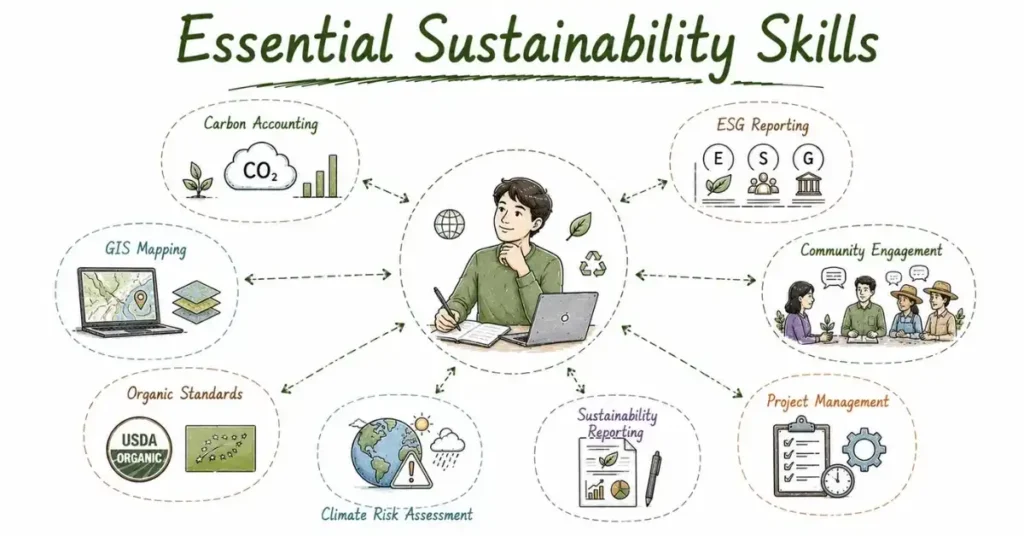
Scientific credibility: Sustainable farming careers live and die on the quality of evidence. Whether you are writing an organic inspection report or a carbon project document, your work will be scrutinised by auditors, investors, and regulators. The discipline to collect accurate data, document it properly, and present it without exaggeration is the single most career-defining skill in this sector.
Stakeholder communication at multiple levels: You will spend time talking to a subsistence farmer about soil health, to a corporate sustainability director about supply chain risks, and to an international donor about programme outcomes sometimes in the same week. The ability to adjust your language and frame without changing the substance is critical.
Knowledge of sustainability standards and frameworks: Organic certification standards (NPOP, EU Organic, NOP), carbon market methodologies (Verra VCS), ESG reporting frameworks (GRI, BRSR), and agricultural sustainability certifications (Rainforest Alliance, UTZ) are the professional language of this sector. Familiarity with even two or three of them immediately signals credibility to employers.
Regional language and community engagement: Sustainable farming work is inherently community-facing. Your ability to build trust with farmer communities which in most cases requires speaking their language directly determines the effectiveness of any programme you work on.
Education and Certifications for Sustainable Farming Careers
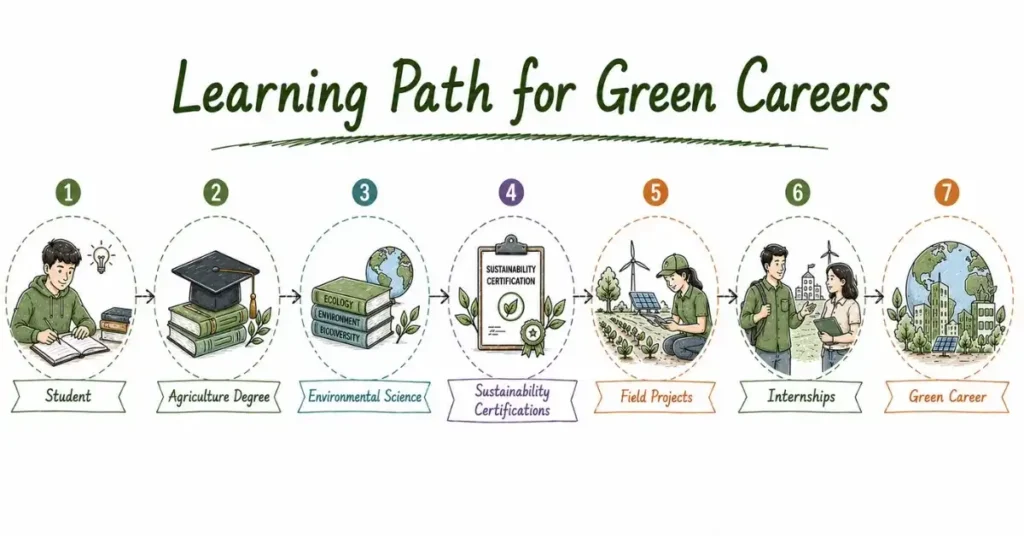
Degrees With Direct Relevance
M.Sc. Natural Resource Management / Agroforestry (IARI, IGFRI, SAUs): The most focused postgraduate path for watershed, agroforestry, and climate-smart agriculture careers. IARI and the Indian Grassland and Fodder Research Institute (IGFRI) offer strong programmes.
M.Sc. Environmental Science (multiple universities): Good foundation for corporate sustainability and climate finance roles. Pair with an agriculture internship to add domain credibility.
MBA in Sustainable Business / CSR: Emerging programmes at institutions like TERI School of Advanced Studies (New Delhi) and Symbiosis School of Economics that specifically address ESG and sustainability careers. Relevant for corporate sustainability track.
Certifications Worth Getting
Lead Auditor Certification Organic (IOIA or equivalent): The International Organic Inspectors Association offers inspector training that is recognised globally. Directly applicable for organic certification auditor roles.
GRI Sustainability Reporting Standards (Online, Free): The Global Reporting Initiative offers free online learning on sustainability reporting standards. Relevant for corporate ESG roles. Completing it signals baseline reporting competence.
CGIAR Climate-Smart Agriculture Online Courses (Free): CGIAR and its research centres offer free online courses on climate-smart agriculture through their CGIAR Learning platform. Credible, research-backed, and directly applicable.
Carbon Project Development Training (Verra / Gold Standard): Both major carbon registries offer online training resources. Paid workshops are available through South Pole and EKI Energy Services in India for those serious about the carbon markets track.
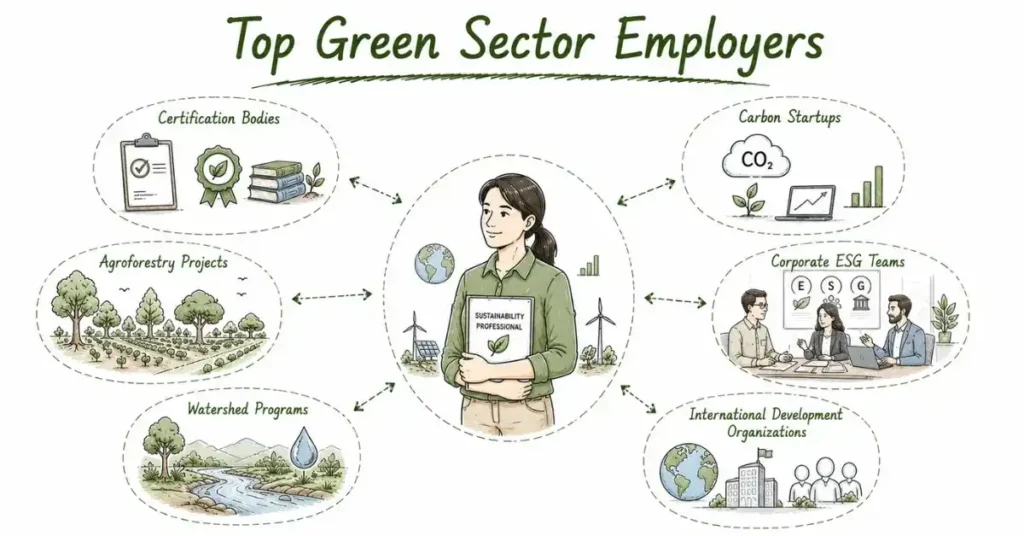
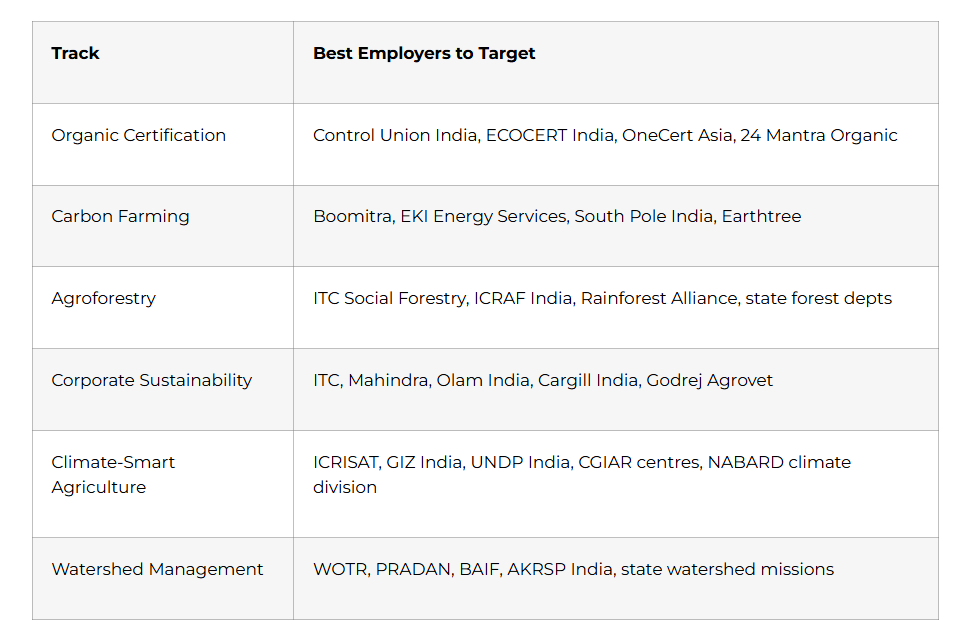
Top Employers by Track Quick Reference
Honest Salary Reality Check for Sustainable Farming Careers
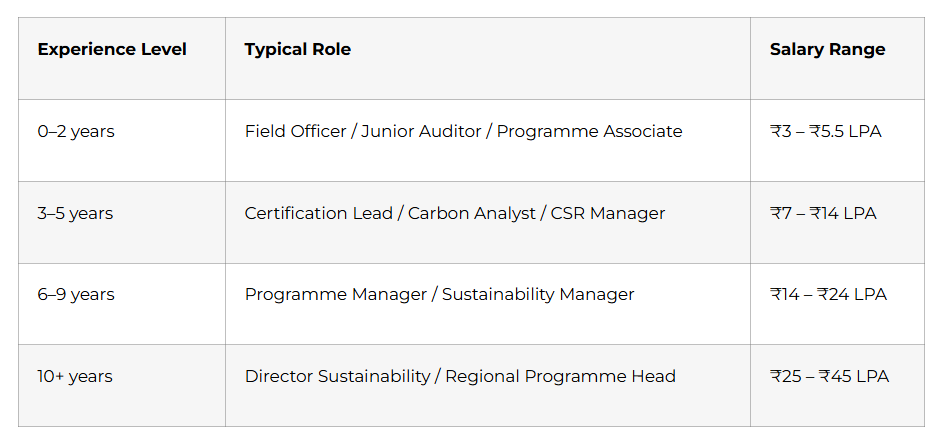
Sustainable farming careers pay less at entry level than technology or agribusiness tracks. This is the honest truth. A junior organic auditor earns ₹3 – ₹4.5 LPA. A climate programme field officer earns ₹3.5 – ₹5 LPA. NGO-side roles at the junior level are rarely above ₹4.5 LPA even at respected organisations.
The picture changes meaningfully at mid and senior levels. Corporate sustainability managers at ITC or Mahindra earn ₹12 – ₹22 LPA. Carbon project developers at funded startups earn ₹10 – ₹18 LPA. Senior programme managers at international organisations like GIZ, UNDP, and CGIAR earn ₹15 – ₹28 LPA with additional benefits.
The career entry requires patience and genuine commitment to the sector. People who enter sustainable farming careers for the salary will leave within two years. People who enter because they want to work on climate and agriculture will find that the mid-career compensation is competitive and the work quality is exceptional.
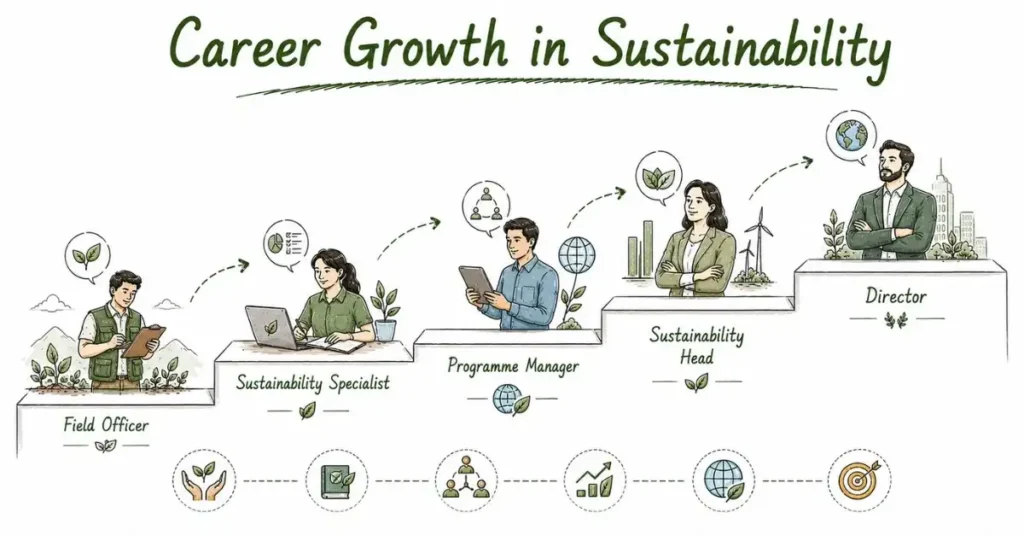
Salary Growth Path in Sustainable Farming
How to Get Your First Sustainable Farming Job in India
Start with your KVK or ATMA: If you are a fresh B.Sc. Agriculture graduate, your district’s Krishi Vigyan Kendra or Agricultural Technology Management Agency runs on-the-ground sustainable farming programmes. Volunteering or interning here for 2–3 months gives you field documentation experience that immediately strengthens any application to WOTR, NABARD, or a certification body.
Get one standards certification: Pick one sustainability standard most relevant to your target track NPOP for organic, GRI for corporate sustainability, VCS basics for carbon and complete whatever free or low-cost training is available. This signals credibility that pure degree qualifications do not.
Target organisations with structured field programmes: WOTR, PRADAN, BAIF, and GIZ India all run structured associate or fellowship programmes that are competitive but provide genuine mentorship, training, and career development. These are far better starting points than small, under-resourced NGOs.
Build a visible knowledge base: Sustainable farming is a sector where thought leadership matters early. Writing one well-researched article per month about organic farming, carbon markets, or agroforestry published on LinkedIn or a personal blog builds your professional profile faster than in most other career tracks. Recruiters in this sector read and value public knowledge contributions.