
Agricultural Engineering Career Guide: Scope, Jobs & Salary in India
Table of Contents
Introduction
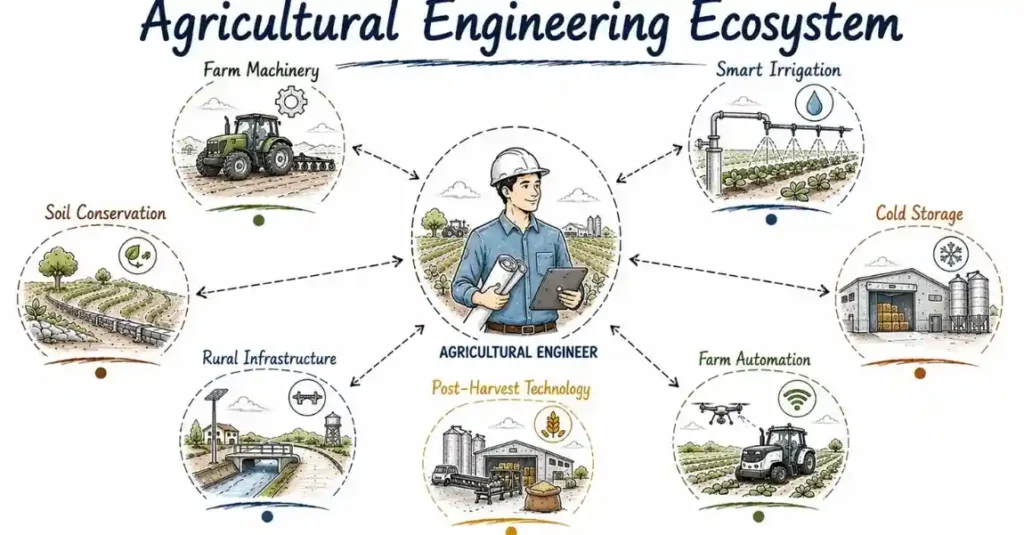
Somewhere in Punjab right now, a combine harvester is cutting wheat at a rate that would have taken 200 farm labourers a full day to match. In Rajasthan, a micro-sprinkler system is watering 50 acres of mustard using a fraction of the water a flood-irrigated field would consume. In a cold storage facility outside Pune, a controlled atmosphere system is keeping onions fresh for six months instead of six weeks.
None of this happened by accident. Every piece of that infrastructure was designed, built, installed, and maintained by an agricultural engineer.
Agricultural engineering is one of the oldest technical disciplines in India and one of the most underestimated. Most engineering students think of it as a lesser branch, less glamorous than computer science or electronics. That perception is outdated and expensive to hold. As Indian agriculture modernises at speed, the demand for engineers who understand both farming systems and engineering principles has never been higher.
This guide tells you exactly what agricultural engineering careers look like in India today what roles exist, which companies hire, what salaries look like, and how to build a career in this field regardless of whether you have a dedicated agricultural engineering degree or not.
What Agricultural Engineers Actually Do
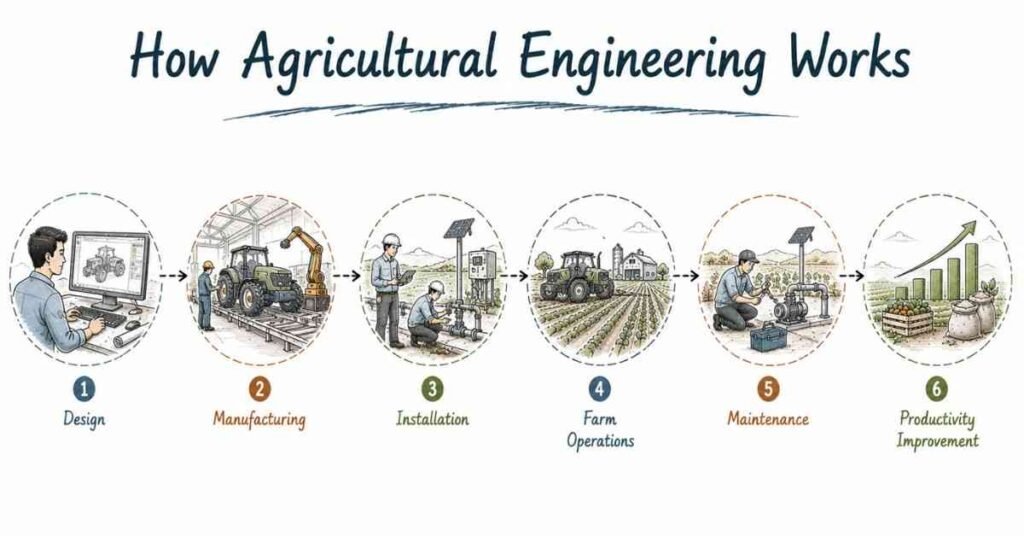
Agricultural engineering applies engineering science to solving problems in farming, food production, and rural infrastructure. It spans five major application areas:
Farm machinery and equipment: Designing, manufacturing, testing, and maintaining tractors, harvesters, tillers, seed drills, and sprayers that make farm operations faster, cheaper, and less physically demanding.
Irrigation and water management: Designing drip irrigation systems, sprinkler networks, canal structures, and water harvesting systems that deliver water precisely where crops need it while conserving a resource India can no longer afford to waste.
Post-harvest technology: Designing and operating storage facilities, cold chains, grain dryers, threshers, and processing equipment that reduce the 15–20% of Indian crop production that is currently lost between harvest and market.
Soil and water conservation: Building bunds, check dams, contour trenches, and watershed structures that prevent soil erosion, recharge groundwater, and protect farmland from degradation.
Rural infrastructure: Designing rural roads, farm buildings, irrigation canals, and drainage systems that form the physical backbone of agricultural operations.
What makes agricultural engineering distinctive is that engineers in this field must understand not just the engineering but also the agronomic context what crops are being grown, what soil conditions exist, what the farmer can afford and maintain. That dual knowledge is what makes a good agricultural engineer genuinely difficult to replace.
The State of Agricultural Engineering in India
India has 141 million hectares of net sown area the second largest in the world. Yet farm mechanisation in India is still well below global averages. According to government data, India’s farm power availability is around 2.02 kW per hectare compared to 4–5 kW per hectare in developed agricultural economies. This gap represents both a challenge and a career opportunity.
The government is actively pushing mechanisation through the Sub-Mission on Agricultural Mechanisation (SMAM), which subsidises farm equipment purchase and custom hiring centres across rural districts. Private investment in irrigation infrastructure has increased significantly under the Pradhan Mantri Krishi Sinchayee Yojana (PMKSY). Cold chain infrastructure is being built at scale under PM Kisan SAMPADA.
All of this creates sustained, long-term demand for agricultural engineers who can design systems, supervise installation, and support ongoing operations across India’s diverse farming geographies.
Agricultural Engineering Career Roles: The Full Breakdown
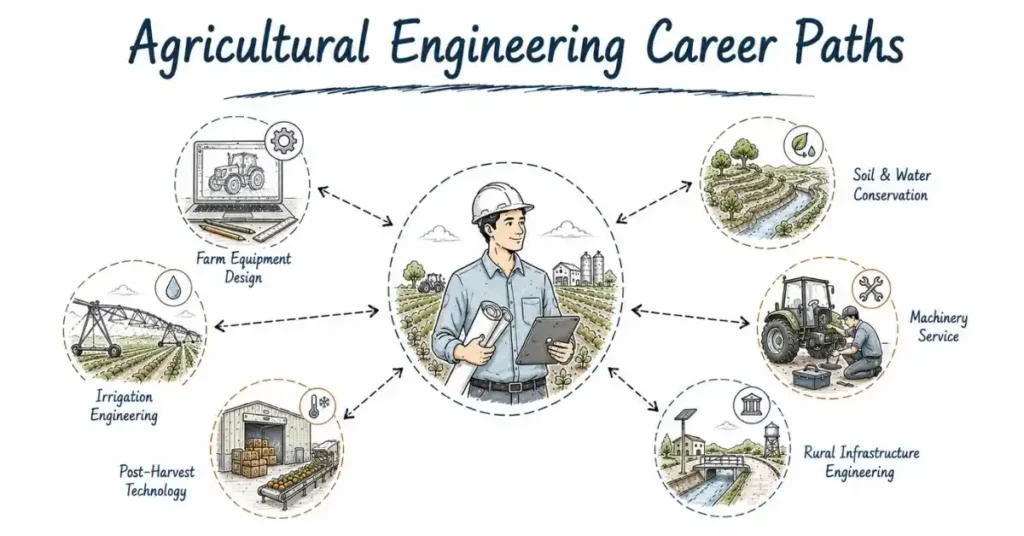
1. Farm Equipment Design Engineer
What you do: You work in the R&D or product development team of a farm machinery manufacturer. You design new equipment or improve existing designs to make them more efficient, durable, affordable, and suited to Indian farming conditions. Indian farms are mostly small and fragmented, which means equipment designed for large Western farms often needs significant adaptation.
Day in the life: Review field feedback reports on a tractor attachment failing in black cotton soil conditions, redesign the mounting bracket in CAD software, coordinate with manufacturing team on material specifications, join a field trial in a Maharashtra farm to test the revised design, document results for the engineering review.
Who fits: B.Tech Agricultural Engineering or Mechanical Engineering graduates with CAD skills and genuine interest in mechanical systems. Hands-on problem-solving orientation is essential.
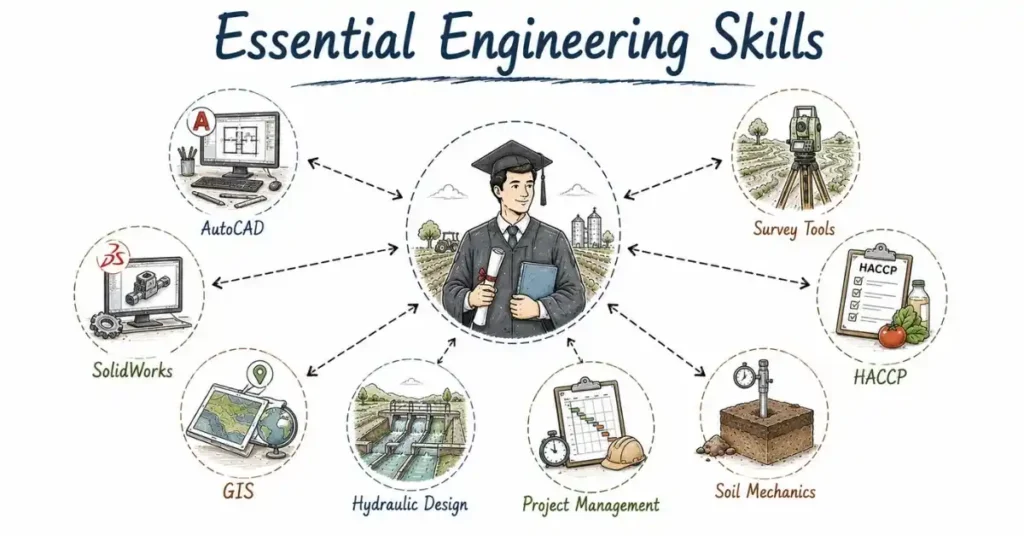
Key tools: AutoCAD, SolidWorks, CATIA, ANSYS (for stress analysis), basic metallurgy and materials knowledge.
Employers: Mahindra & Mahindra Farm Equipment Division (Mumbai/Nagpur), TAFE Tractors and Farm Equipment (Chennai), John Deere India (Pune), AGCO India, VST Tillers Tractors (Bengaluru), Fieldking (Hisar), Lemken India.
Salary range: ₹4 – ₹7 LPA (junior design engineer) | ₹9 – ₹16 LPA (senior engineer / team lead)
2. Irrigation Systems Engineer
What you do: You design, plan, and supervise the installation of irrigation infrastructure drip systems, sprinkler networks, pressurised main lines, pumping stations, and fertigation units. You work on projects ranging from a single 5-acre farmer’s drip installation to a government-funded canal modernisation covering thousands of hectares.
Day in the life: Survey a 30-acre grape farm in Sangli, measure field topography and soil permeability, design a drip irrigation layout using hydraulic calculation software, prepare a bill of materials and cost estimate, present the design to the farmer and a bank loan officer, coordinate with an installation team for commissioning.
Who fits: B.Tech Agricultural Engineering or Civil Engineering graduates with interest in hydraulics and water management. Field survey comfort is important this role involves significant outdoor work.
Key tools: WaterGEMS, EPANET, AutoCAD Civil 3D, basic hydraulic calculation skills, field surveying instruments.
Employers: Jain Irrigation Systems (Jalgaon world’s second-largest drip irrigation company), Netafim India (Pune), EPC Industrie, Finolex Plasson Industries, state irrigation departments, National Water Development Agency (NWDA).
Salary range: ₹3.5 – ₹6 LPA (site engineer) | ₹8 – ₹14 LPA (project or design manager)
3. Post-Harvest Technology Specialist
What you do: You focus on reducing food losses after the crop leaves the field. This means designing and operating storage facilities, cold rooms, grain dryers, sorting and grading lines, and packaging systems. You also work on food safety and quality standards at the point where raw produce becomes market-ready product.
Day in the life: Inspect a newly commissioned potato cold storage facility in Agra for temperature uniformity issues, identify airflow design problems causing warm spots, coordinate with refrigeration engineers on corrective measures, develop a standard operating procedure for loading and unloading to minimise temperature fluctuations, train warehouse staff on protocols.
Who fits: B.Tech Agricultural Engineering or Food Technology graduates; Mechanical Engineering graduates with refrigeration and HVAC knowledge.
Key tools: Cold chain monitoring software, refrigeration system fundamentals, HACCP food safety methodology, post-harvest physiology knowledge (understanding how different crops respire and decay).
Employers: NCCD (National Centre for Cold-Chain Development), Snowman Logistics, Coldex Logistics, Mother Dairy, SAFEXPRESS (cold chain division), APEDA (for export-linked post-harvest projects), state horticulture departments.
Salary range: ₹4 – ₹7 LPA (site specialist) | ₹9 – ₹16 LPA (facility manager / post-harvest consultant)
4. Soil and Water Conservation Engineer
What you do: You plan and implement structures and practices that protect agricultural land from erosion, manage watershed drainage, and improve water availability for farming in water-stressed regions. Much of this work is implemented through government watershed development projects, though private sector players are increasingly active.
Day in the life: Conduct a watershed survey in a semi-arid district in Telangana, map drainage lines and erosion-prone slopes, design a network of check dams and contour bunds, prepare detailed project reports for NABARD funding, supervise construction through a contractor, monitor post-construction water table changes through installed piezometers.
Who fits: B.Tech Agricultural Engineering or Civil Engineering graduates with interest in environmental and water resource management; candidates with state agricultural university backgrounds who understand local soil types.
Employers: WOTR (Watershed Organisation Trust), NABARD-funded state watershed missions, state agriculture and horticulture departments, ICRISAT (International Crops Research Institute for the Semi-Arid Tropics, based in Hyderabad), ADB and World Bank-funded rural infrastructure projects.
Salary range: ₹3.5 – ₹6 LPA (field engineer / junior project officer) | ₹8 – ₹14 LPA (project manager / watershed specialist)
5. Agricultural Machinery Technician and Service Engineer
What you do: You provide technical support, maintenance, and repair services for farm equipment tractors, harvesters, irrigation pumps, and implements through manufacturer dealer networks or custom hiring centres. This is a critical and consistently in-demand role because farm machinery in India operates in harsh conditions and requires frequent servicing.
Day in the life: Respond to a dealer service call for a tractor with hydraulic failure in a Vidarbha district, diagnose the fault using OBD tools, replace the failed component, test and certify the machine, update service records, conduct a preventive maintenance training session for dealer service staff.
Who fits: Diploma or B.Tech Mechanical or Agricultural Engineering graduates; ITI graduates with relevant trade certificates can also enter this track at a junior level.
Employers: Mahindra authorised service centres, John Deere dealer networks, TAFE service divisions, Kubota India, and increasingly through custom hiring centre networks set up under government SMAM schemes.
Salary range: ₹2.5 – ₹4.5 LPA (junior service technician) | ₹6 – ₹10 LPA (senior service engineer / regional service manager)
6. Rural Infrastructure and Farm Buildings Engineer
What you do: You design and supervise construction of farm-related civil infrastructure irrigation canals, rural roads, farm storage buildings, greenhouse structures, animal housing, and water harvesting systems. Much of this work is executed through government programmes in rural districts.
Who fits: B.Tech Civil Engineering or Agricultural Engineering graduates with construction project management skills.
Employers: State Public Works Departments (PWDs), NABARD-financed rural infrastructure projects, PMGSY (rural roads programme), private greenhouse manufacturers like Ecotech Industries and Green House India.
Salary range: ₹3 – ₹6 LPA (junior site engineer) | ₹8 – ₹14 LPA (project manager)
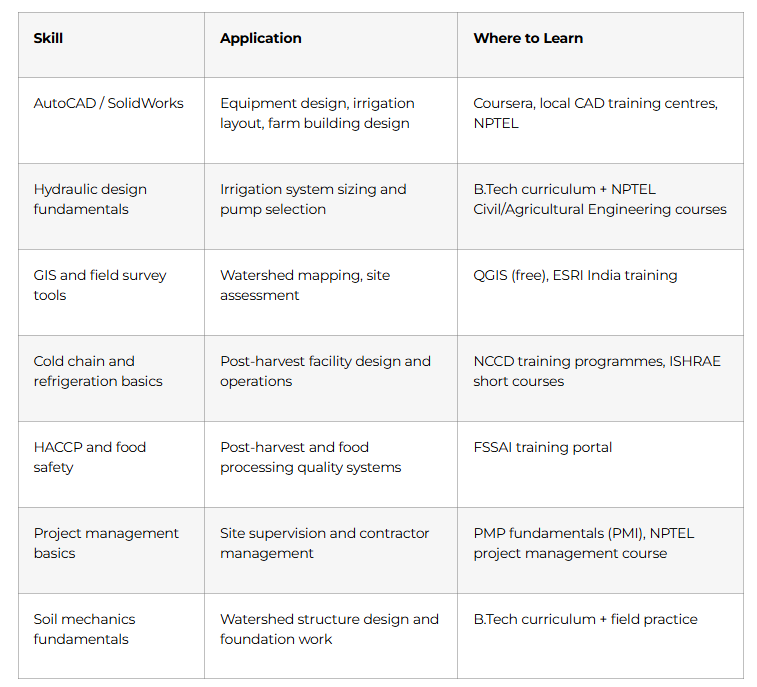
Technical Skills That Agricultural Engineering Employers Look For
Education Pathways Into Agricultural Engineering
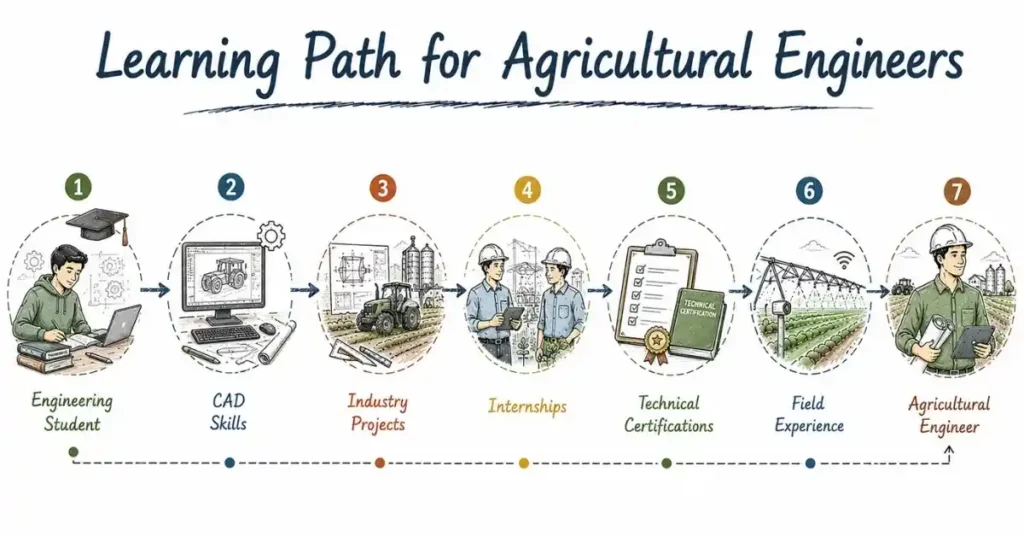
If You Have a B.Tech in Agricultural Engineering
You have the most direct path into this sector. Your degree from any ICAR-recognised agricultural university or state agricultural university is the baseline qualification. Focus on:
- Building CAD proficiency through AutoCAD or SolidWorks most colleges teach the theory without ensuring students can actually design independently. Practice on real project sketches.
- Doing your final-year project with an industry partner Jain Irrigation, Mahindra, or a state watershed project rather than a purely academic topic. The industry contact and practical experience dramatically accelerates your first job search.
- Writing the ICAR JRF exam if you want to pursue M.Tech it funds your postgraduate degree while giving you research credentials that R&D divisions at Mahindra and TAFE actively seek.
If You Have a B.Tech in Mechanical Engineering
Your core mechanical skills machine design, thermodynamics, manufacturing processes, CAD are directly applicable to farm equipment design and post-harvest technology roles. What you need to add:
- Basic agronomy knowledge understand the major crops, their growth stages, and the farming operations each requires. This gives you the context to design equipment that actually works in the field.
- Exposure to agricultural machinery through internships at Mahindra, John Deere, or TAFE even a one-month internship on a production line is worth more than any certification.
- Familiarity with SMAM government schemes and agricultural equipment standards set by BIS (Bureau of Indian Standards).
If You Have a B.Tech in Civil Engineering
Your hydraulics, soil mechanics, and construction management skills translate directly to irrigation engineering and watershed development roles. Target:
- Jain Irrigation, Netafim India, and state irrigation departments for irrigation engineering roles
- NABARD-funded watershed projects and WOTR for soil and water conservation work
- Greenhouse and rural infrastructure companies for farm buildings engineering
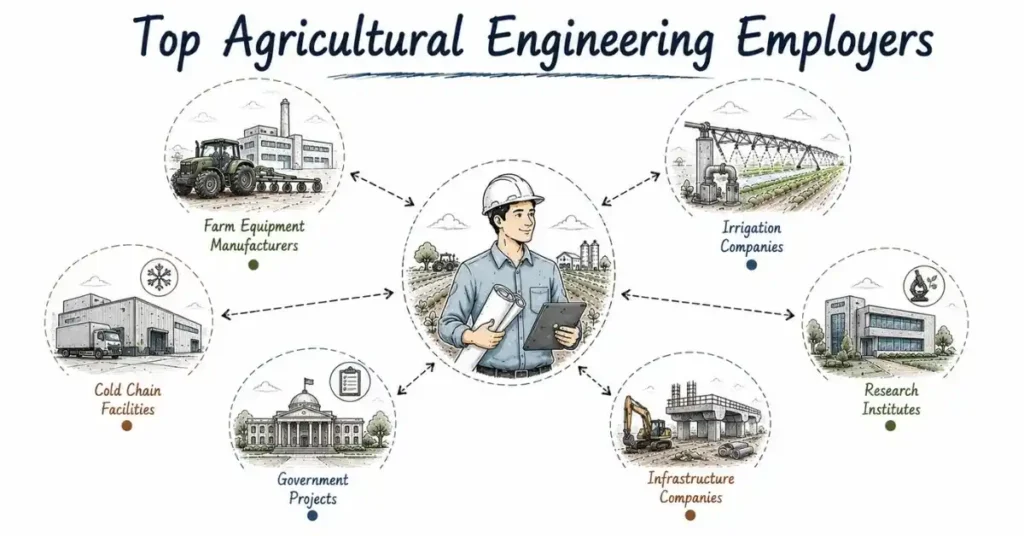
Top Recruiters: Where to Apply and When
Mahindra & Mahindra Farm Equipment Division runs one of India’s largest engineering graduate hiring programmes in the agricultural machinery space. They recruit from NITs, agricultural universities, and good regional engineering colleges. Application windows open between December and February each year. Their Nagpur and Chennai plants are primary hiring locations.
John Deere India (Pune) hires B.Tech mechanical and agricultural engineering graduates for product engineering, manufacturing engineering, and quality roles. They maintain active campus connections with NIT Nagpur, COEP Pune, and TNAU Coimbatore.
TAFE (Tractors and Farm Equipment) is India’s second-largest tractor manufacturer. Chennai-based. Strong campus hiring from Tamil Nadu engineering colleges and agricultural universities. Known for structured graduate engineering trainee programmes.
Jain Irrigation Systems is the world’s second-largest drip irrigation company and India’s primary employer of irrigation engineers. Headquartered in Jalgaon, Maharashtra a Tier 2 city context that deters some candidates but rewards those who join with exceptional learning opportunities and faster career growth.
Netafim India (Israeli drip irrigation leader’s India arm) hires irrigation design engineers with a more premium profile typically 1–2 years experience preferred even for junior roles.
ICRISAT Hyderabad is the International Crops Research Institute for the Semi-Arid Tropics a CGIAR research centre based in Patancheru, Hyderabad. It hires research engineers and agricultural engineers for water management and farm mechanisation research. An excellent option for M.Tech graduates or those interested in combining engineering with applied research.
How Agricultural Engineering Salaries Grow Over Time
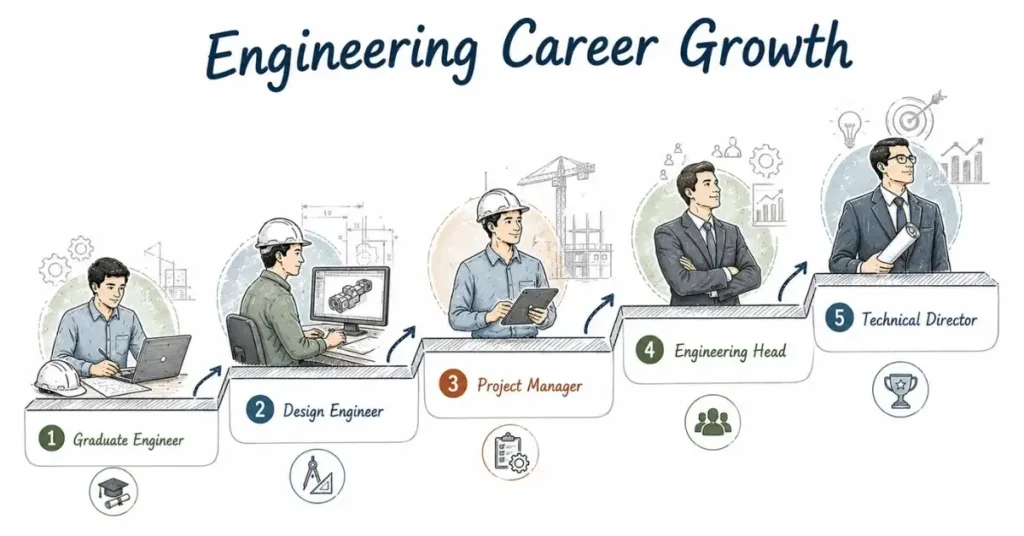
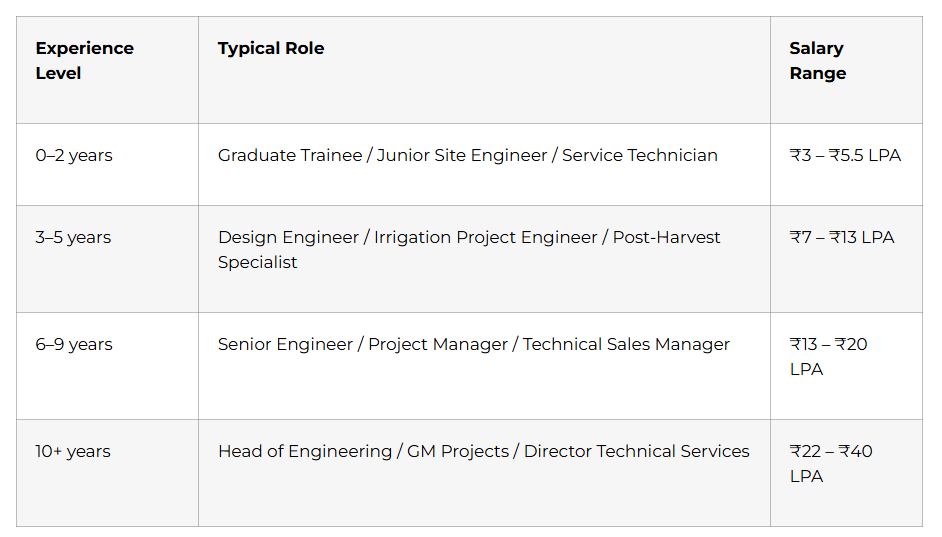
One important note on salaries in this field: agricultural engineering in India pays less at entry level than software or electronics engineering. The gap narrows significantly at mid-level as domain expertise becomes harder to replace. At senior levels particularly in irrigation project management and farm equipment product leadership compensation is competitive with equivalent-level roles in other engineering sectors.
The Overlooked Career Path: Agricultural Engineering Consulting
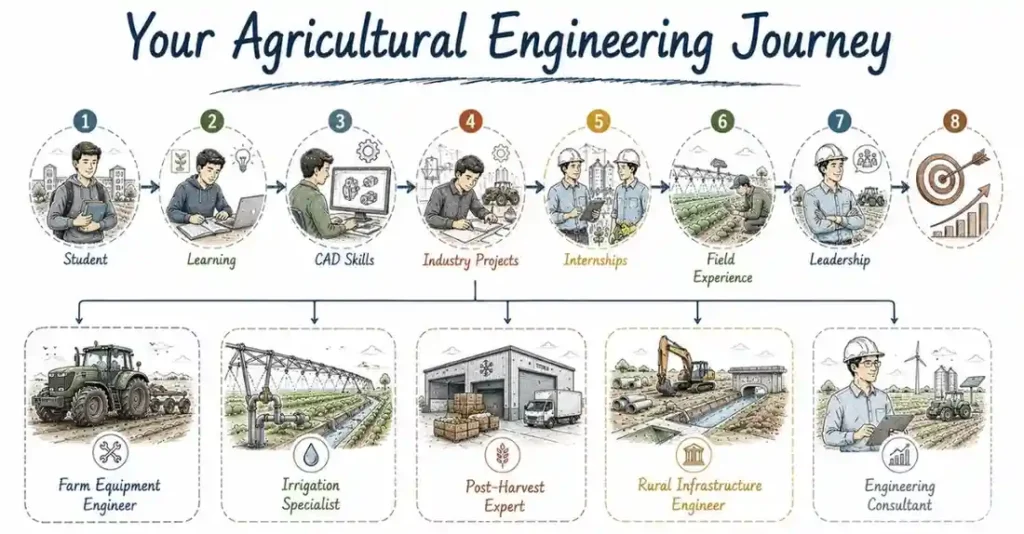
Very few Indian students think about independent consulting as an agricultural engineering career path but it is a real and viable option, particularly after 5–8 years of field experience.
Agricultural engineers with proven expertise in drip irrigation design, cold chain facility planning, or watershed development are in demand as independent consultants for:
- Banks and NBFCs assessing the technical feasibility of agri-infrastructure loan proposals
- State governments requiring detailed project reports for watershed or irrigation schemes
- Export-oriented farmers wanting post-harvest storage systems designed for international food safety standards
- AgriTech startups needing technical advisory for product design in specific farming contexts
Building a consulting practice requires a strong professional network which you build by doing excellent field work in your first 5 years, maintaining relationships with farmers, contractors, and government officers, and building a documented portfolio of completed projects.
One Honest Reality About Agricultural Engineering
The work is field-intensive, geographically dispersed, and often based in non-metro cities. Jalgaon, Nagpur, Coimbatore, Ludhiana, and Anand are significant agricultural engineering employer locations not Bengaluru or Hyderabad.
If your priority is living in a major metro, agricultural engineering in its traditional form may require compromise. However, this is changing. The R&D divisions of Mahindra and John Deere are in Pune and Bengaluru respectively. AgriTech startups working on smart irrigation and precision equipment are based in Pune, Hyderabad, and Bengaluru. The technology-adjacent roles in agricultural engineering IoT-enabled irrigation, precision equipment with embedded sensors are increasingly located in major cities.
The engineers willing to spend their formative years in Tier 2 and Tier 3 cities close to where the actual farming and machinery operations happen consistently build stronger domain expertise and advance faster than those who only work from city offices.