
Space Technology Career Guide: Aerospace & Satellite Jobs in India (2026)
Table of Contents
Introduction:
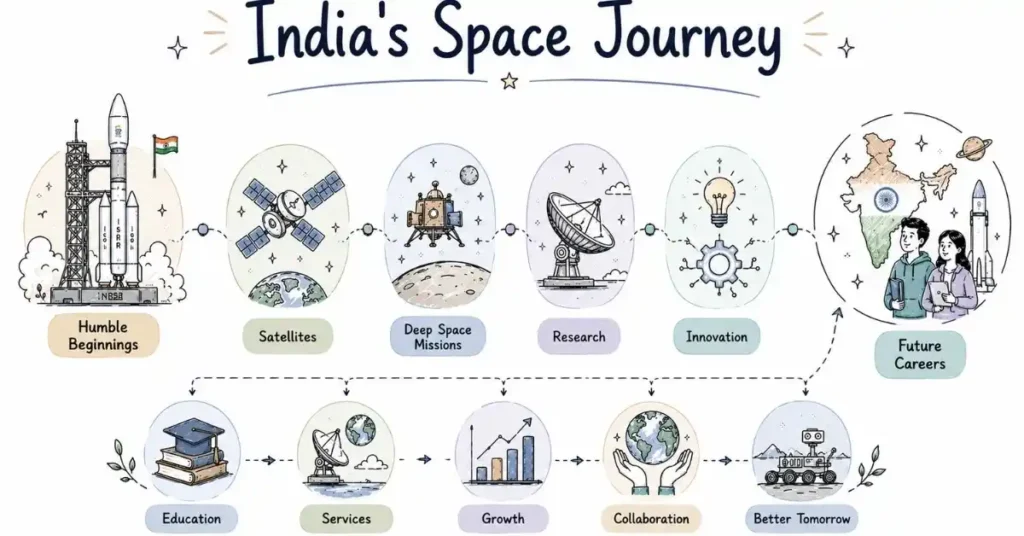
India sent a spacecraft to the Moon’s south pole in 2023 a place no country had ever reached before. Chandrayaan-3 did not just make history. It changed how millions of young Indians thought about their future.
If you were one of them, this guide is for you.
The space sector in India is not what it was ten years ago. It is not just ISRO anymore. As of 2025, India has over 300 active space startups, an $8.4 billion space economy, and a government policy framework that now allows private companies to build rockets, own satellites, and compete for global contracts. The industry is expected to reach $44 billion by 2033. That kind of growth does not happen without people engineers, software developers, data scientists, business managers, and policy experts
This guide maps every major career path in India’s space sector. Whether you are a student choosing a college, a working engineer thinking about a switch, or someone who simply wants to understand what “working in space” actually means everything you need is here.
Why Space Tech Is the Career Sector to Watch Right Now
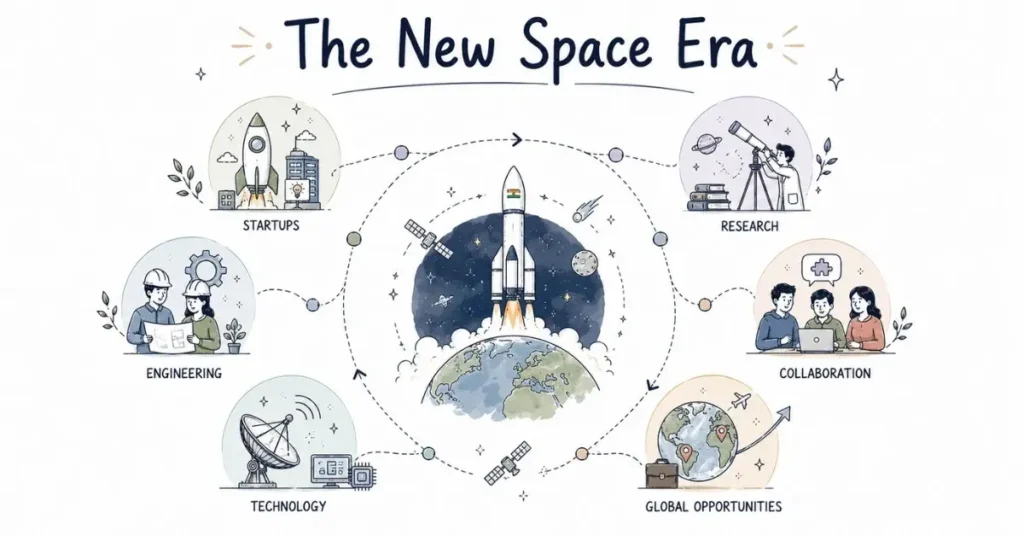
Three things changed India’s space story in the last five years.
- The government opened the door to private companies. The New Space Policy 2023, liberalised FDI norms in 2024, and IN-SPACe’s single-window authorisation framework now let private Indian and international firms build and launch satellites, run their own rocket companies, and offer commercial space services. Before 2020, this was simply not possible.
- Money started following. Private space startups in India raised nearly ₹1,250 crore (roughly $150 million) in FY 2025 alone, taking total funding past $617 million. The government additionally operationalised a ₹1,000 crore IN-SPACe Venture Capital Fund and a ₹500 crore Technology Adoption Fund that covers up to 60% of project costs for startups.reports.weforum+1
- Projects are real, not just announcements. Skyroot Aerospace launched India’s first private rocket Vikram-S. Agnikul Cosmos flew the world’s first rocket with a fully 3D-printed engine. Pixxel’s hyperspectral satellites are already delivering Earth observation data. These are not experiments. They are operational companies with active hiring pipelines.
India’s national space budget also nearly tripled from ₹5,615 crore in 2013–14 to ₹13,416 crore in 2025–26. Every rupee of that spending translates into jobs somewhere in the value chain.
Who Is Hiring in India's Space Sector?
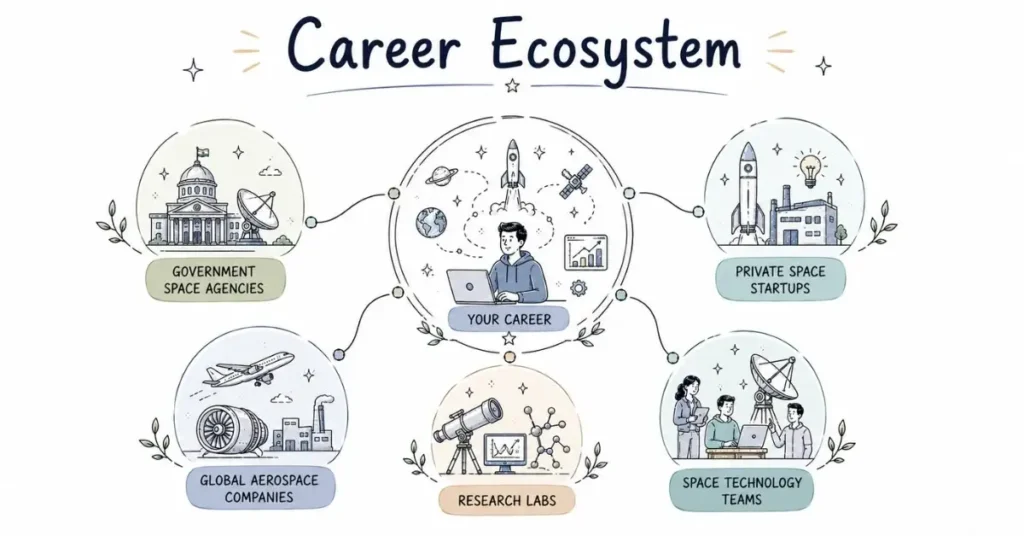
India’s space hiring ecosystem has three distinct layers:
Government / PSU organisations
- ISRO (Indian Space Research Organisation) – the primary national agency, with centres across Bengaluru, Thiruvananthapuram, Ahmedabad, Sriharikota, and Hyderabad
- NSIL (NewSpace India Limited) – ISRO’s commercial arm, focused on satellite manufacturing and launch service exports
- IN-SPACe – the regulatory and promotional body for private space activities
- DRDO (Defence Research and Development Organisation) – defence-aerospace overlap roles
- HAL (Hindustan Aeronautics Limited) – aircraft and spacecraft manufacturing
- BEL (Bharat Electronics Limited) – electronics and avionics for space systems
Private Indian startups (the new engine of hiring)
- Skyroot Aerospace (Hyderabad) – launch vehicles
- Agnikul Cosmos (Chennai) – semi-cryogenic rockets
- Pixxel (Bengaluru) – hyperspectral Earth observation satellites
- Dhruva Space (Hyderabad) – satellite platforms and deployment services
- Bellatrix Aerospace (Bengaluru)- in-space propulsion and orbital transfer
- Digantara (Bengaluru)- space situational awareness
- SatSure (Bengaluru)- satellite data analytics for agriculture and infrastructure
MNCs and global aerospace companies with India operations
- Boeing India (Bengaluru)
- Airbus India
- Tata Advanced Systems Limited (TASL)
- L&T Technology Services (LTTS)
- GE Aviation India
- Rolls-Royce India
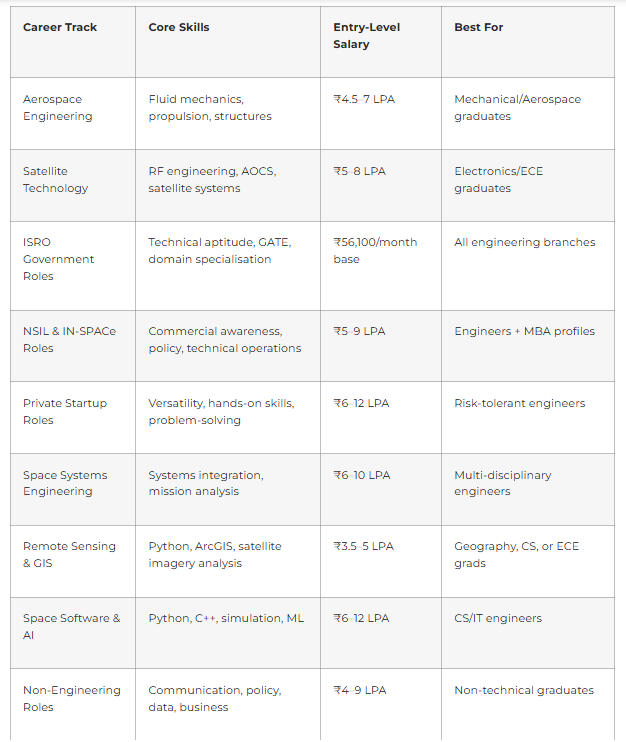
India's Space Career Pathways At a Glance
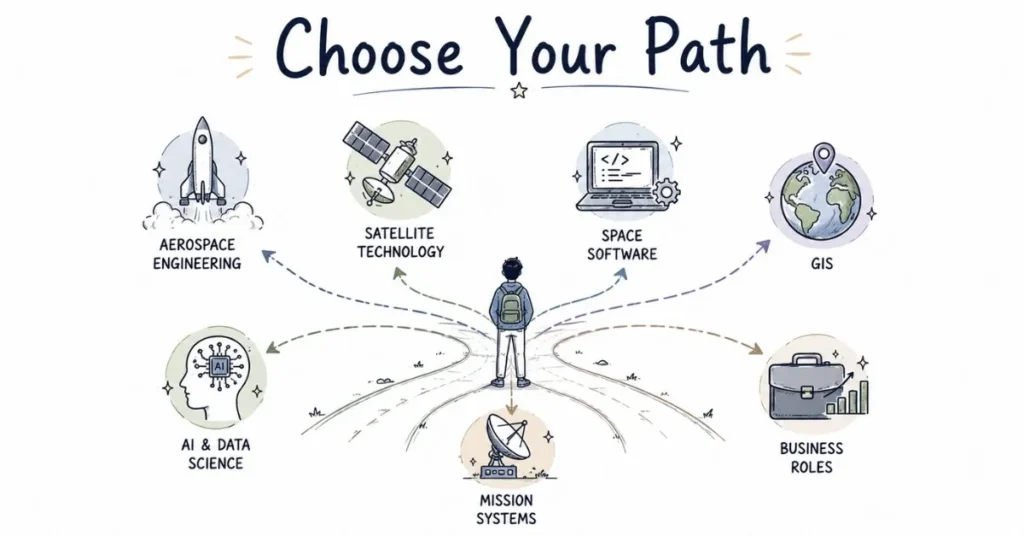
There are nine broad career tracks in India’s space sector. Each one is covered in a dedicated guide below, but here is a quick orientation:
What Qualifications Do You Actually Need?
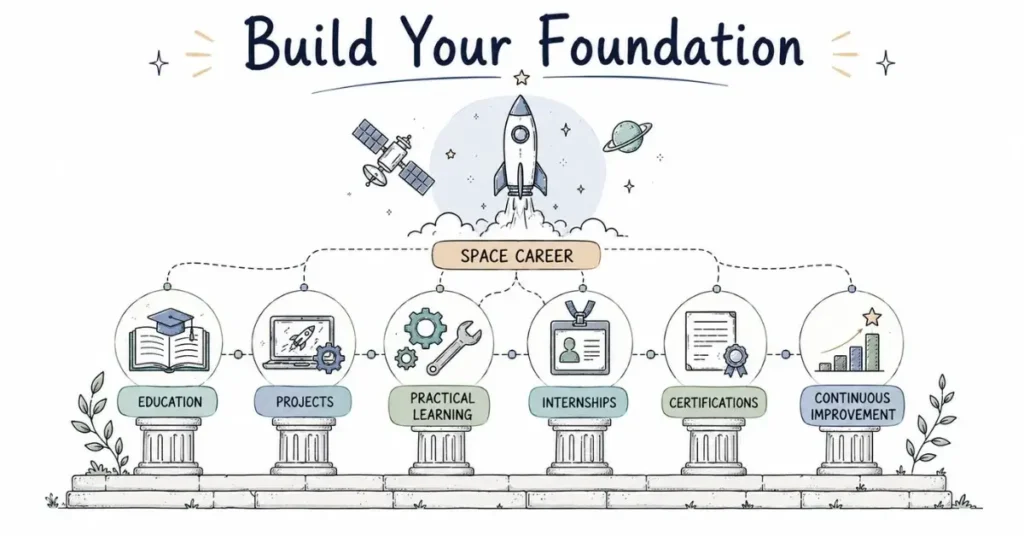
The honest answer: it depends on where you want to work.
For ISRO: The main entry route is through ISRO Centralised Recruitment Board (ICRB). Most roles require a B.E./B.Tech in a relevant engineering branch with a minimum 65% aggregate. GATE scores are not mandatory for ISRO recruitment (unlike IIT admissions) but help at some centres. A few roles also recruit through written exams and interviews conducted by individual ISRO centres.
For private startups: Startups care more about what you have built than what grade you scored. A strong portfolio a CubeSat project, MATLAB simulations, CAD models, a GitHub repository with aerospace-related code often carries more weight than a specific degree. Many startups also recruit from NITs, BITS Pilani, and UPES Dehradun, not just IITs.
For MNCs: Boeing, Airbus, and TASL typically hire through campus placements at IITs, NITs, and IIST, and also through job portals like Naukri and LinkedIn. They generally require B.E./B.Tech in aerospace, mechanical, electronics, or computer science.
The one degree that gives you a direct lane: IIST (Indian Institute of Space Science and Technology, Thiruvananthapuram) is India’s only university dedicated exclusively to space science and technology. Entry is through JEE Advanced. B.Tech fees range from ₹1.45 lakh (first year) to ₹6.3 lakh total. IIST graduates are directly absorbed into ISRO on completing their degree no separate exam required
The Three Career Tracks Simplified
If you are new to the field and feeling overwhelmed by options, think of the entire space sector as three broad tracks:
Track 1 Build Things (Hardware)
Aerospace engineers, propulsion specialists, structures engineers, avionics engineers, mechanical engineers. You design, test, and manufacture the physical components of rockets and satellites.
Track 2 Connect and Control Things (Electronics + Software)
RF engineers, AOCS engineers, firmware developers, mission software engineers, embedded systems engineers. You make sure the hardware communicates, navigates, and operates correctly.
Track 3 Use the Data (Analytics + Applications)
GIS analysts, remote sensing engineers, satellite data scientists, earth observation specialists. You work with what satellites send back turning raw data into actionable insights for agriculture, urban planning, disaster management, and defence.
All three tracks have government and private sector versions, and all three are growing.

Salary Reality Check What You Can Actually Earn
compared to IT. The honest answer: entry-level space jobs pay less than a TCS or Infosys package, but mid-career and senior earnings catch up quickly and the work is more specialised, which means less competition for the top slots.
Fresher to 3 years experience: ₹4.5–8 LPA across most roles
3–7 years experience: ₹10–25 LPA depending on specialisation and company
Senior/lead (7–15 years): ₹25–50+ LPA at MNCs; ISRO senior scientists earn ₹37,400–₹67,000 basic pay per month
ISRO Scientist/Engineer SC (entry level): ₹56,100/month in-hand base, plus allowances
At private startups like Skyroot and Agnikul, early employees with high ownership roles often also receive ESOPs (equity stakes), which can be significantly valuable if the company grows toward an IPO or acquisition.
The 12 Career Guides in This Series
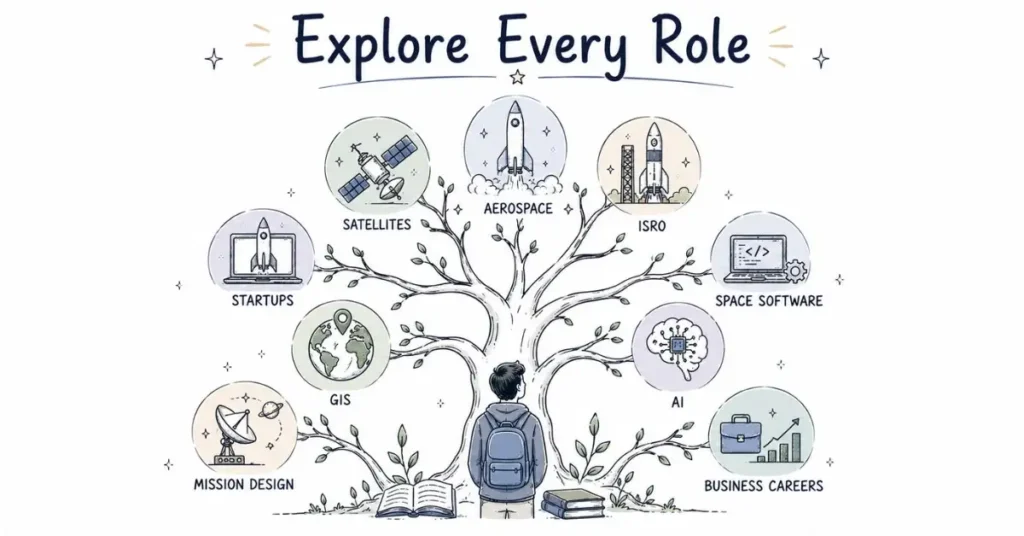
Each guide below goes deep on one specific career track with job roles, salary data, how to break in, and which companies are actively hiring.
Cluster 1: Aerospace Engineering
- Aerospace Engineer Career in India: Roles, Salary & How to Start
- How to Become an Aerospace Engineer in India: Colleges, Exams & Roadmap
Cluster 2: Satellite Technology
- Satellite Engineer Career in India: Job Roles, Skills & Top Recruiters
- Satellite Communication Jobs in India: Scope, Salary & Companies
Cluster 3: Government Space Careers
- ISRO Career Guide: How to Get a Job at ISRO After Engineering
- NSIL & IN-SPACe Careers: Government Space Jobs Beyond ISRO
Cluster 4: Private Startups
Cluster 5: Space Systems
Cluster 6: Remote Sensing & GIS
Cluster 7: Space Software & AI
Cluster 8: Education & Certifications
Cluster 9: Non-Engineering Roles
FAQs About Space Technology Careers in India
Q: Can a student from a non-IIT college get a job in ISRO?
Yes. ISRO recruits nationally through ICRB and conducts its own written tests and interviews. Students from NITs, BITS Pilani, regional engineering colleges, and IIST all get selected. Grades, technical depth, and a genuine understanding of space systems matter more than your college brand.
Q: Is coding necessary for a space career?
For software and data roles, absolutely. For hardware roles like propulsion or structures engineering, coding is not mandatory but knowing Python or MATLAB for simulation and data analysis makes you significantly more competitive. Even ISRO scientists regularly use simulation tools.
Q: What is IN-SPACe and why does it matter for my career?
IN-SPACe (Indian National Space Promotion and Authorisation Centre) is the government body that regulates and promotes private space activities. It is also building its own team of policy, technical, and commercial professionals. For people interested in space policy or regulatory work, IN-SPACe is a direct employer and an important body to understand.
Q: Are space startup jobs stable?
All startup jobs carry some risk that is honest. But India’s top-tier space startups like Skyroot, Agnikul, and Pixxel are well-funded, have launched hardware successfully, and have active government and international contracts. They are not speculative ventures anymore. The risk is lower than a typical early-stage startup, but higher than ISRO.
Q: How soon can I expect a job after completing a space-related degree?
IIST graduates are absorbed directly into ISRO on completing their B.Tech that is effectively a guaranteed placement. For IIT/NIT graduates, campus placements from aerospace and defence companies happen in their final year. For private startups, the hiring cycle is continuous and you can apply at any stage.
One Final Thought Before You Pick a Path
India is at a genuinely rare moment. The country has the institutional credibility of ISRO’s 50+ year track record and the fresh energy of 300+ startups, all operating in the same ecosystem at the same time. Most countries never get both simultaneously.
The careers available in this sector today building rockets, designing satellites, analysing Earth observation data, managing space missions were not accessible to ordinary Indian engineers just five years ago. They are now. The question is whether you will be ready when the opportunity opens for you.
Pick the guide that matches your background and start there.