
NSIL & IN-SPACe Careers : Government Space Jobs Beyond ISRO
Table of Contents
Introduction
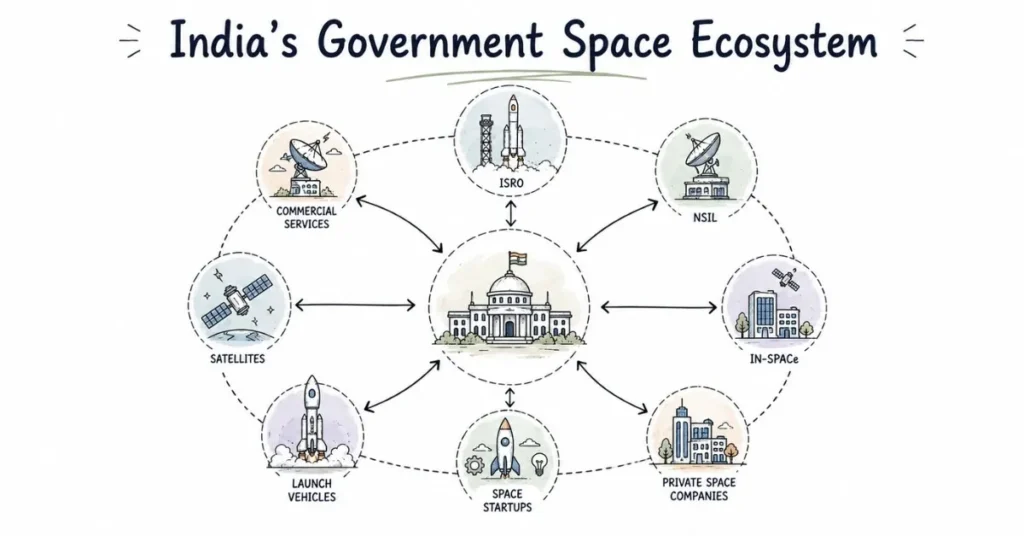
Most people who want a government space job in India think of exactly one option: ISRO. That is understandable. ISRO is the most visible, most celebrated, and most written-about space organisation in the country.
But India’s government space sector is bigger than ISRO alone and two organisations that most students have barely heard of are quietly building teams that will shape how India’s space economy operates for the next two decades.
NSIL (NewSpace India Limited) and IN-SPACe (Indian National Space Promotion and Authorisation Centre) are not household names yet. But if you are interested in the business, commercial, and policy side of space rather than just the engineering these two organisations represent some of the most interesting government career opportunities in India right now.
This guide explains what both organisations do, what kinds of people they hire, and how you can build a career there.
NSIL : India's Commercial Space Arm
What NSIL Does
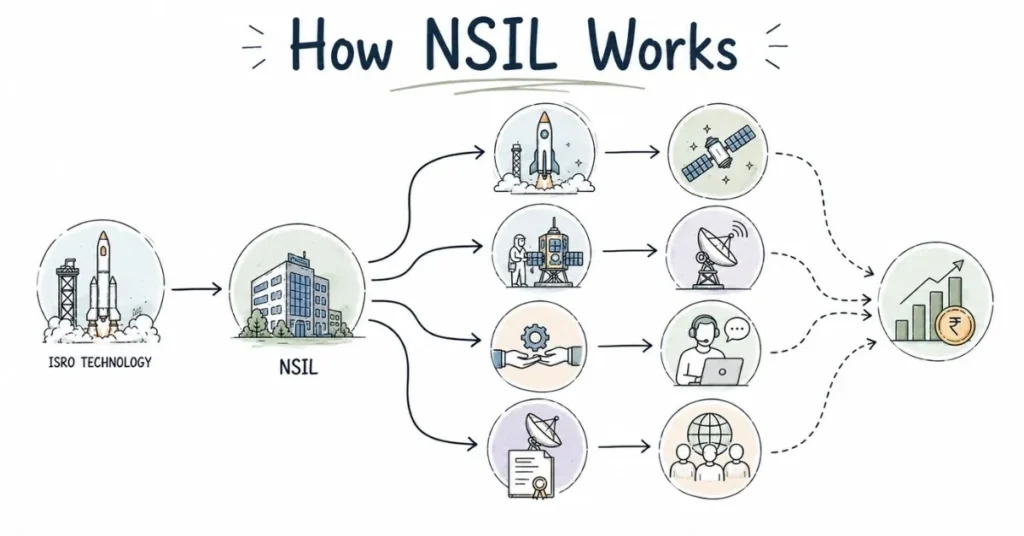
NewSpace India Limited was incorporated in March 2019 as a Central Public Sector Enterprise (CPSE) under the Department of Space. It is, in plain terms, ISRO’s business arm.
While ISRO focuses on research, development, and national missions, NSIL’s job is to commercialise what ISRO builds. Specifically, NSIL:
- Manufactures and sells launch services: NSIL has the rights to commercially operate PSLV and GSLV launch vehicles, selling launch slots to Indian and international customers
- Manufactures and operates communication satellites: NSIL built GSAT-24, India’s first demand-driven communication satellite, fully funded by NSIL itself without a government grant
- Leases transponder capacity: Sells satellite transponder bandwidth to Indian broadcasters, internet service providers, and enterprise clients
- Enables technology transfer: Facilitates transfer of ISRO-developed technologies to Indian private industries
Think of NSIL as the company that takes ISRO’s technology and turns it into revenue-generating products and services for paying customers.
Why NSIL Is Hiring More Aggressively Now
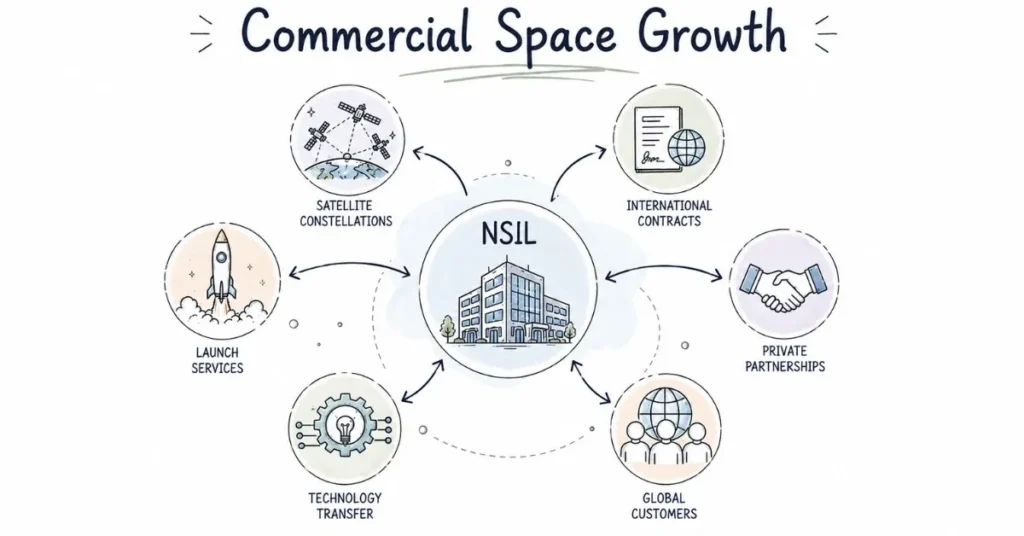
India’s government gave NSIL an expanded mandate under the New Space Policy 2023. NSIL is now authorised to:
- Build and operate its own satellite constellations independently
- Sign international contracts for launch services directly
- Partner with private Indian companies for satellite manufacturing
- Compete for global satellite communication contracts
This expanded commercial role means NSIL needs people who understand both the technical side of space systems and the commercial, contractual, and operational realities of running a business. That is a genuinely rare combination and it is why NSIL’s hiring is growing.
Job Roles at NSIL
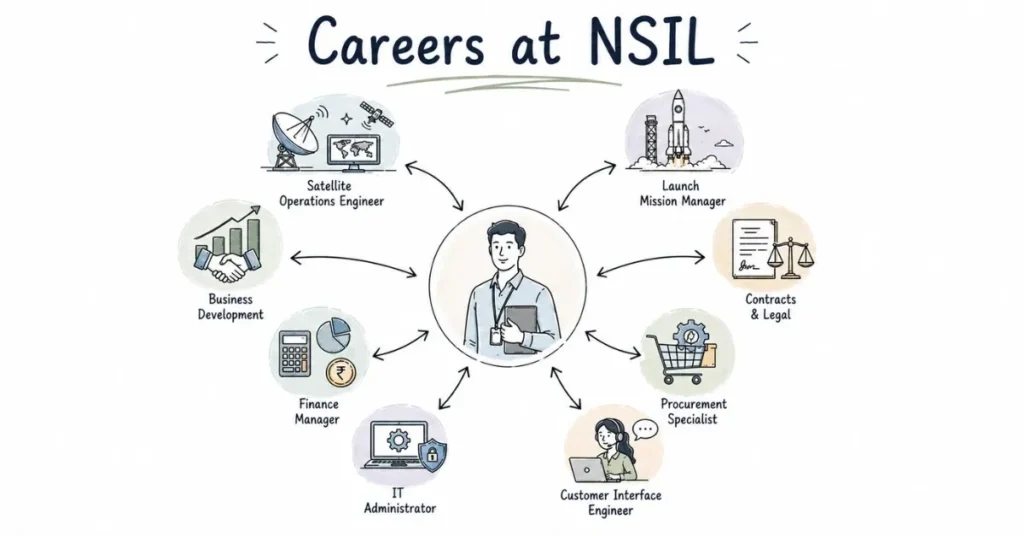
Role | What You Do |
Satellite Operations Engineer | Monitor and control NSIL’s operational satellites; manage in-orbit anomalies |
Launch Mission Manager | Coordinate commercial launch campaigns; interface with customers and ISRO launch teams |
Transponder Sales and Business Development | Identify and contract transponder capacity customers; manage commercial relationships |
Contracts and Legal Officer | Draft, review, and manage commercial contracts for launch and satellite services |
Finance and Accounts Manager | Manage NSIL’s commercial finances, revenue recognition, and project accounting |
Customer Interface Engineer | Technical point of contact for satellite and launch customers; manage customer requirements |
Procurement and Vendor Management | Manage supply chain for satellite components and launch services |
IT and Systems Administrator | Manage NSIL’s internal IT infrastructure and mission support systems |
NSIL’s team is deliberately multi-disciplinary it needs engineers who can talk business and business professionals who understand space. If you are an engineering graduate with an MBA, or a commerce/management graduate genuinely interested in space, NSIL is one of the few government space employers where that profile fits naturally.
How to Apply to NSIL
NSIL recruits through its official website (nsilindia.co.in/career). Unlike ISRO’s large centralised recruitment drives, NSIL’s hiring is more targeted specific roles are advertised when vacancies arise. Recruitment typically involves:
- An online application through the NSIL careers portal
- A written test or shortlisting based on application and qualifications
- A personal interview
NSIL also occasionally deputes ISRO employees into NSIL roles temporarily, creating a hybrid workforce of permanent NSIL hires and ISRO-deputed staff.
Eligibility: Most technical roles require B.E./B.Tech in a relevant branch with minimum 60–65% aggregate. Commercial roles accept MBA, LLB, or CA qualifications depending on the position.
NSIL Salary
NSIL follows a pay structure aligned with Central Public Sector Enterprise (CPSE) norms under the Department of Public Enterprises (DPE) guidelines broadly comparable to other PSUs like BEL, BHEL, or HAL.
- Entry level (E1 grade equivalent): ₹40,000–₹50,000/month basic + DA + allowances; take-home approximately ₹55,000–₹70,000/month
- Mid-level (E3–E4): ₹12–18 LPA total
- Senior level (E6–E7): ₹20–30 LPA total
Benefits include PF, gratuity, medical insurance, and HRA. Salary is slightly lower than ISRO’s 7th Pay Commission-linked scales for comparable experience, but the commercial growth trajectory of NSIL means roles carry broader responsibility sooner.
IN-SPACe : India's Space Regulator and Promoter
What IN-SPACe Does
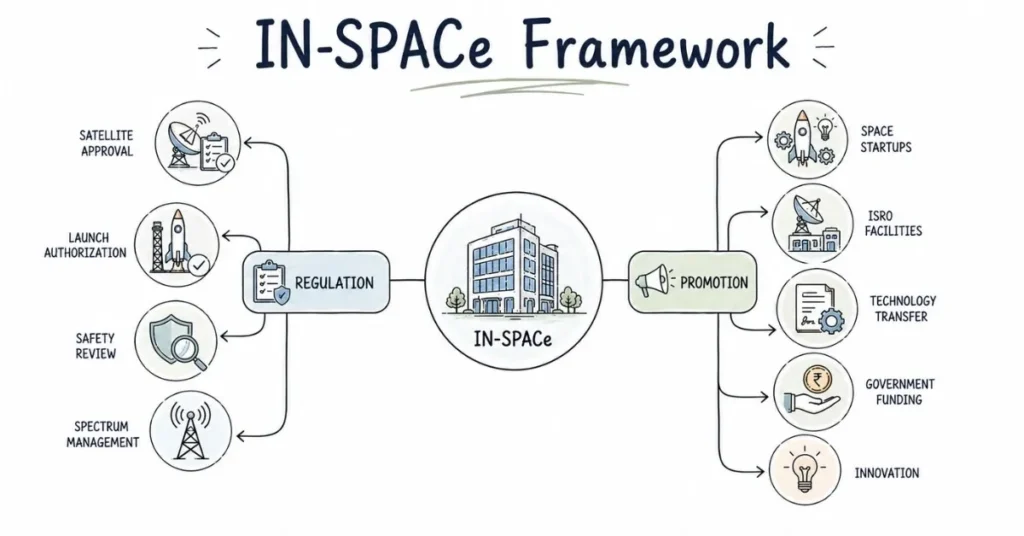
IN-SPACe Indian National Space Promotion and Authorisation Centre was established in June 2020 under the Department of Space. It is India’s equivalent of the FAA’s commercial space division, but with an additional mandate to actively promote private space activity.
IN-SPACe has two distinct functions:
Regulatory function: IN-SPACe is the single-window authorisation body for all non-government (private) space activities in India. Any Indian private company that wants to build a satellite, launch a rocket, operate a ground station, or provide satellite communication services needs IN-SPACe’s authorisation. IN-SPACe evaluates these applications, assesses safety and security implications, and grants or denies permission.
Promotional function: IN-SPACe also actively supports private space startups helping them access ISRO facilities, connecting them with government funding programs (like the ₹1,000 crore VC fund and ₹500 crore Technology Adoption Fund), and facilitating technology transfer from ISRO to private companies.
This dual role regulator and promoter simultaneously makes IN-SPACe one of the most unusual and genuinely interesting government organisations to work for in India today.
Why IN-SPACe Careers Are Underexplored
Most engineering students looking for government space jobs do not think about IN-SPACe because they have not heard of it. This is a missed opportunity.
IN-SPACe sits at the intersection of government policy, private sector growth, and technical oversight. People who work there have visibility into every significant private space project in India because every single one must come through IN-SPACe for authorisation. It is a vantage point that does not exist anywhere else in India’s space ecosystem.
For professionals interested in space policy, regulatory affairs, technology assessment, or startup ecosystem work IN-SPACe is arguably the most interesting employer in the entire sector.
Job Roles at IN-SPACe
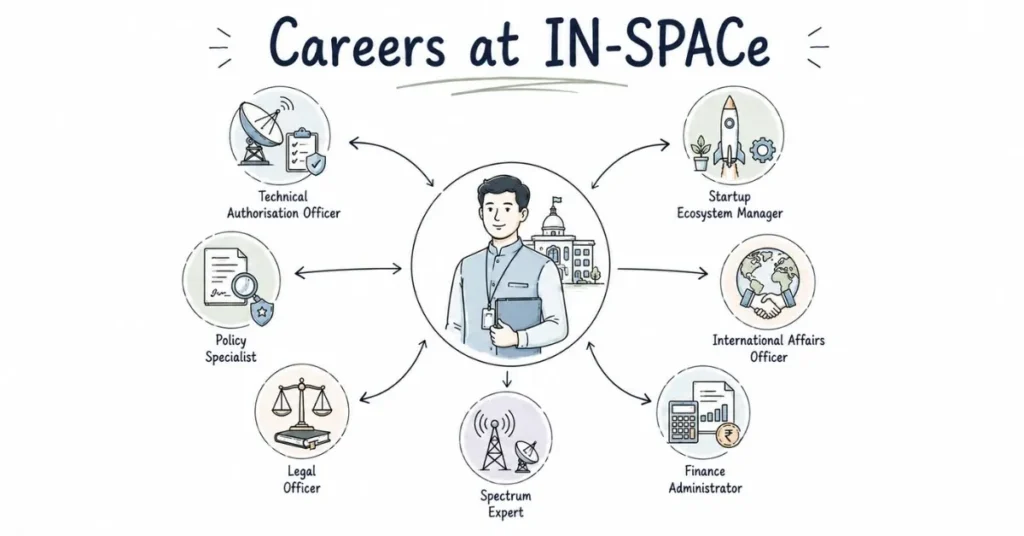
Role | What You Do |
Technical Authorisation Officer | Evaluate technical applications from private space companies; assess safety, spectrum, and orbital parameters |
Policy and Regulatory Affairs Specialist | Develop and update India’s space regulatory framework; interface with ITU and international bodies |
Space Startup Ecosystem Manager | Support private space companies in accessing ISRO facilities, funding, and technical resources |
Legal and Compliance Officer | Draft space activity agreements; ensure applicants comply with international treaty obligations |
Frequency and Spectrum Management Specialist | Coordinate satellite frequency assignments; interface with DoT and TRAI on spectrum matters |
International Affairs Officer | Manage India’s international space agreements and bilateral cooperation programs |
Finance and Administration | Support IN-SPACe’s operational and programme budgets |
How to Apply to IN-SPACe
IN-SPACe recruits through the Department of Space’s recruitment channels and occasionally through direct advertisements on its website (inspace.gov.in). It also absorbs some ISRO staff on deputation. Like NSIL, IN-SPACe’s team is relatively small compared to ISRO which means each hire carries significant responsibility.
Eligibility for technical roles: B.E./B.Tech in aerospace, mechanical, ECE, or computer science with relevant experience.
Eligibility for policy/legal roles: Law degree (LLB/LLM) or postgraduate qualifications in public policy, international relations, or economics.
IN-SPACe also occasionally recruits through UPSC (Union Public Service Commission) mechanisms for senior officer-level positions.
IN-SPACe Salary
As a government body under the Department of Space, IN-SPACe salaries follow Central Government pay scales under the 7th Pay Commission broadly similar to ISRO’s pay structure.
Entry-level roles: ₹56,100/month base pay (Level 10) with standard central government allowances
Senior roles: Up to ₹1.23 lakh/month basic at senior director levels
The non-monetary value of working at IN-SPACe policy influence, visibility across the entire private space ecosystem, and involvement in shaping India’s space regulatory future is genuinely significant for professionals interested in space policy careers.
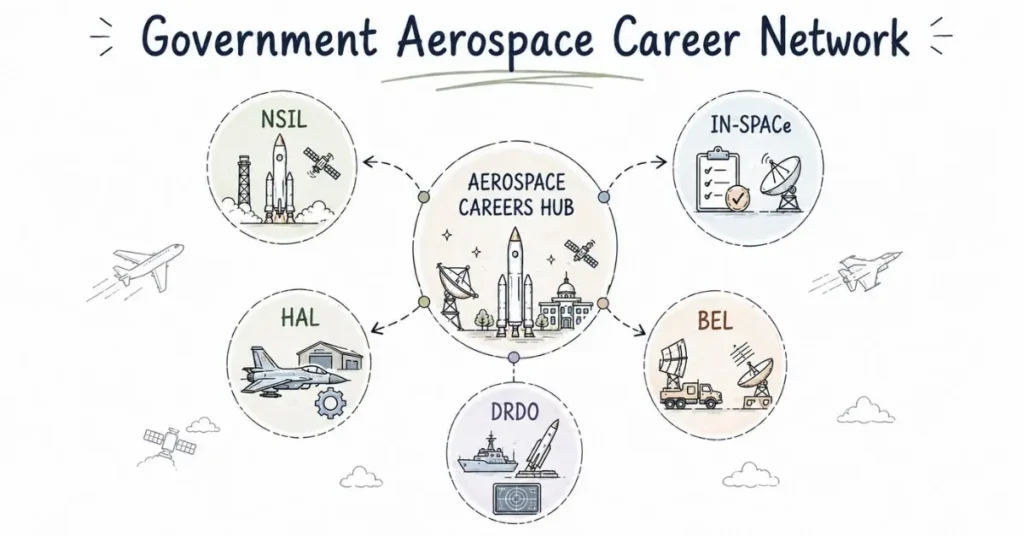
HAL, BEL, and DRDO Other Government Aerospace Employers Worth Knowing
While NSIL and IN-SPACe are the focus of this guide, three other government organisations deserve mention for students exploring government space and aerospace careers:
HAL (Hindustan Aeronautics Limited)
India’s largest aerospace and defence manufacturer. HAL builds aircraft, helicopters, and aerospace components. It also manufactures structural parts for ISRO’s PSLV and GSLV launch vehicles under work-share agreements. HAL recruits Management Trainees (Technical) through its own exam and campus placements at IITs and NITs.
BEL (Bharat Electronics Limited)
Builds electronics systems for space and defence including avionics, radar systems, and satellite ground equipment. BEL recruits Probationary Engineers through a written exam similar in format to ICRB.
DRDO
India’s defence research organisation works on missiles (Agni, BrahMos), combat aircraft (Tejas), and increasingly on hypersonic vehicles and space defence systems. Entry is through DRDO SET (Scientist Entry Test) for Scientist B positions.
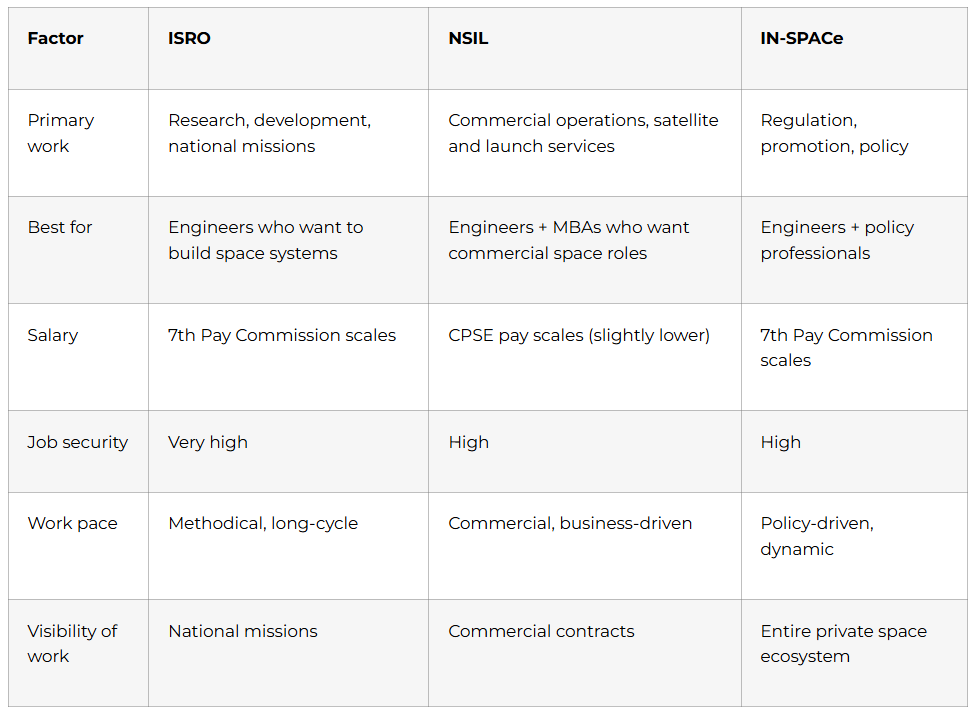
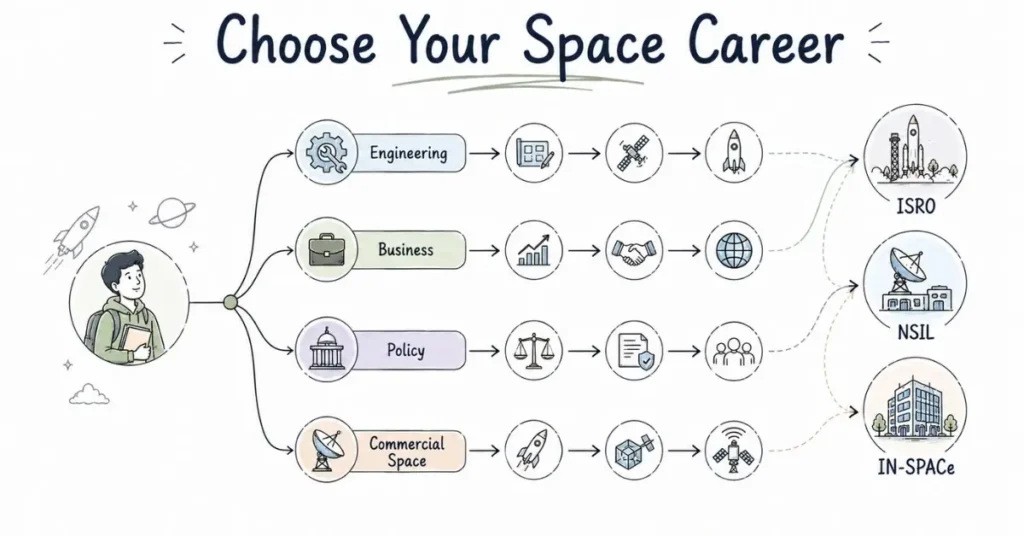
Choosing Between ISRO, NSIL, and IN-SPACe
FAQs : NSIL and IN-SPACe Careers
Q: Does NSIL have a recruitment exam like ISRO’s ICRB?
NSIL’s recruitment process varies by role and batch. Some recruitment cycles include a written test followed by an interview; others shortlist directly from applications. Watch nsilindia.co.in/career for current notifications and process details.
Q: Can a non-engineer work at IN-SPACe or NSIL?
Yes. Both organisations need professionals in legal, policy, finance, business development, and international affairs roles. IN-SPACe in particular recruits policy and legal professionals for its regulatory and international cooperation functions.
Q: Is IN-SPACe a permanent employment organisation or a contract body?
IN-SPACe is a permanent government body under the Department of Space. Its employees are government servants with the security and benefits that come with permanent central government employment.
Q: How large are NSIL and IN-SPACe teams currently?
Both organisations are relatively small compared to ISRO’s 17,000+ workforce. IN-SPACe has a few hundred staff; NSIL is similarly sized. This means individual roles carry significant scope you are not a small cog in a large machine.
Q: Can I join NSIL or IN-SPACe directly from college, or do I need prior experience?
Entry-level roles at both organisations are open to fresh graduates. NSIL’s technical roles are accessible to B.Tech freshers; IN-SPACe tends to prefer some experience for its policy and technical assessment roles, but does recruit at the entry level for specific positions.