
How to Become an Aerospace Engineer in India
Table of Contents
Introduction:
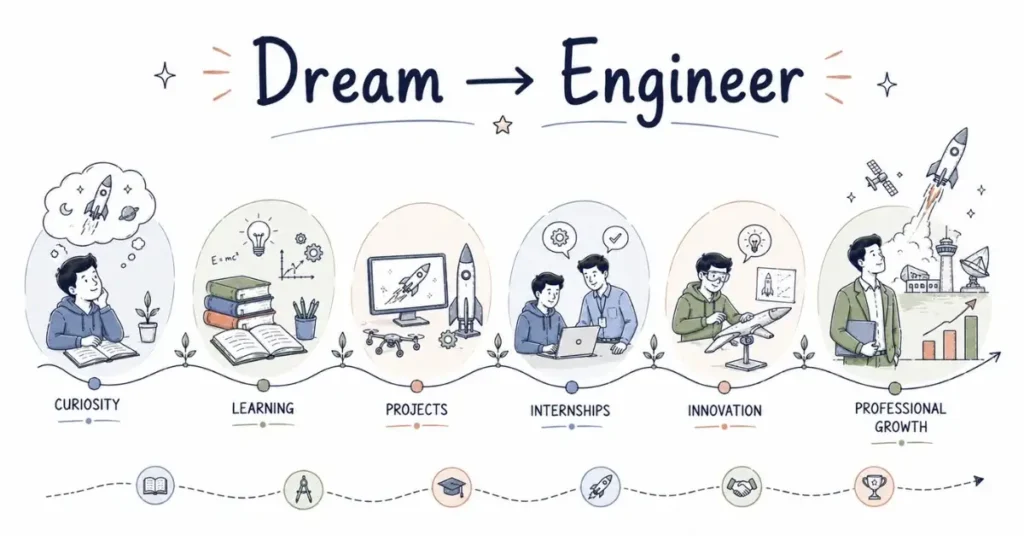
Most students who want to become aerospace engineers in India know the destination. What they struggle with is the map which college to target, which exam to crack, which skills to build along the way, and what the first three years of a career actually look like.
This guide gives you that map. No fluff, no vague advice just a clear, step-by-step path from where you are now to a job in India’s space or aviation sector.

Step 1 : Choose the Right Undergraduate Degree
Your undergraduate degree is the foundation. In India, the most relevant B.E./B.Tech branches for an aerospace career are:
- Aerospace Engineering the most direct path; covers aerodynamics, propulsion, structures, avionics, and orbital mechanics
- Aeronautical Engineering focused on aircraft (atmosphere-bound vehicles); highly relevant for HAL, Boeing India, Airbus
- Mechanical Engineering the most flexible entry point; mechanical engineers are hired across ISRO, HAL, DRDO, and all aerospace companies for structures, propulsion, thermal, and manufacturing roles
- Electronics and Communication Engineering (ECE) directly relevant for avionics, satellite systems, RF engineering, and AOCS (Attitude and Orbit Control Systems)
- Computer Science Engineering (CSE) increasingly hired by ISRO, DRDO, and aerospace companies for simulation, mission software, and AI-based systems
If you are clear that space is your goal, aerospace or mechanical engineering gives you the strongest base. If you want the most options across both space and IT, mechanical or ECE keeps more doors open.
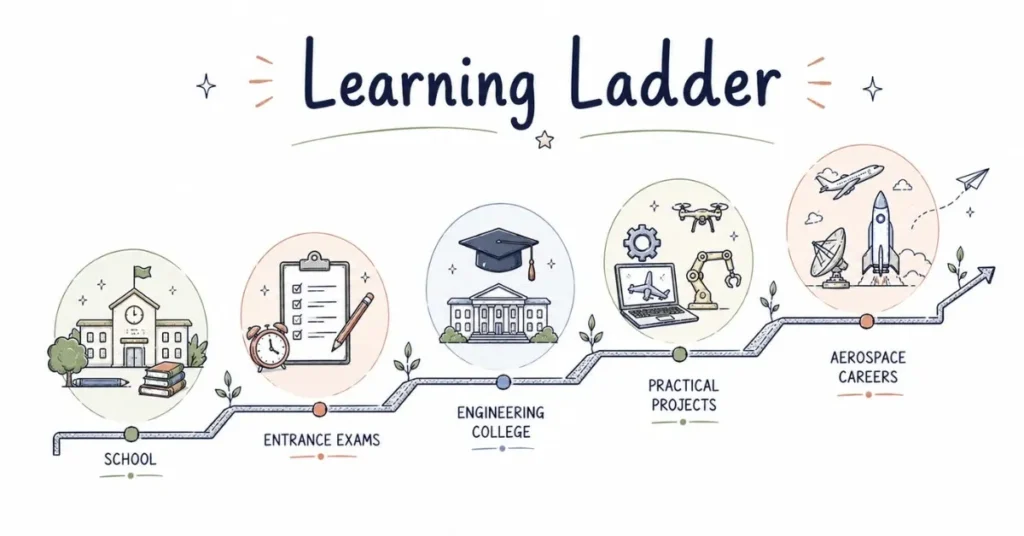
Step 2 Target the Right College
Not all engineering colleges are equal when it comes to aerospace placements and ISRO recruitment. Here are your best options, sorted by selectivity:
Tier 1 : The Direct Pipeline
IIST Indian Institute of Space Science and Technology, Thiruvananthapuram
This is the single most direct route into ISRO. IIST is India’s only university built exclusively for space science and technology. It was established by the Department of Space (Government of India) and its graduates are directly absorbed into ISRO on completing their B.Tech no separate entrance exam, no ICRB written test required.
- Entry: JEE Advanced rank (a separate IIST merit list is drawn from JEE Advanced scores)
- Programs: B.Tech in Aerospace Engineering, Avionics, and Physical Sciences
- Total fees: Approximately ₹6.3 lakh for the full B.Tech program
- Location: Thiruvananthapuram, Kerala the same city as VSSC (Vikram Sarabhai Space Centre), ISRO’s main launch vehicle development centre
If you can crack JEE Advanced and your rank falls in the IIST range (typically above 5,000–8,000 in the common rank list, but varies by year and category), this is the clearest path available to any Indian student who wants to work in space.
Tier 1 : IITs with Aerospace Programs
- IIT Bombay – Aerospace Engineering (B.Tech + M.Tech + Dual Degree)
- IIT Madras – Aerospace Engineering; strong industry connections with DRDO and private sector
- IIT Kharagpur – Aerospace Engineering; large alumni network in HAL and ISRO
- IIT Kanpur – Aerospace Engineering; strong research programs
IIT aerospace graduates are recruited by ISRO, HAL, Boeing India, Airbus India, DRDO, and international aerospace firms. Campus placements are robust.
Tier 2 : Strong Options Beyond IITs
- UPES Dehradun One of the few universities with a dedicated School of Engineering focused on energy and aerospace; good industry partnerships
- MIT Pune (Maharashtra Institute of Technology) One of the oldest aeronautical engineering colleges in India; consistent ISRO and HAL placements
- PEC University of Technology, Chandigarh Aerospace Engineering program; strong government sector placements
- Manipal Institute of Technology Aeronautical Engineering; campus placements with Boeing and HAL
- SRM Institute of Science and Technology, Chennai Aerospace Engineering; active student satellite (SRMSAT) program gives students real project exposure
- Amrita School of Engineering Aerospace Engineering; active research collaborations with ISRO
NITs with Mechanical / Aerospace Engineering
NITs (National Institutes of Technology) do not universally offer aerospace engineering, but their mechanical engineering graduates are among the most consistently recruited by ISRO and HAL. NIT Trichy, NIT Warangal, NIT Surathkal, and NIT Calicut all have strong aerospace-adjacent placement records.

Step 3 : Clear the Right Entrance Exams
For undergraduate admission:
- JEE Main Required for admission to most NITs, IIITs, and centrally funded institutions. Conducted by NTA twice a year.
- JEE Advanced Required for IITs and IIST. Only the top ~2.5 lakh JEE Main scorers are eligible to appear. IIST draws admissions from the JEE Advanced merit list.
- State CETs Maharashtra CET (MHT-CET), Karnataka CET (KCET), AP EAMCET, TS EAMCET for admission to state-level engineering colleges including those with aeronautical programs.
- UPES Engineering Aptitude Test (UPESEAT) For UPES Dehradun admission.
For postgraduate admission (M.Tech):
- GATE (Graduate Aptitude Test in Engineering) Aerospace Engineering paper (code: AE) is available for those who want an M.Tech in aerospace from IITs or IISC. A strong GATE AE score also opens PSU recruitment (HAL, BEL, and some DRDO labs use GATE scores for shortlisting).
- IIST also offers M.Tech programs with direct connection to ISRO research.
For government jobs after graduation:
- ISRO ICRB written exam ISRO conducts centralised recruitment through ICRB. The exam has a technical paper (specific to your engineering branch) and a general aptitude section. Shortlisted candidates appear for an interview. There is no GATE requirement, but strong technical fundamentals are essential.
- HAL Management Trainee (Technical) exam Conducted by HAL periodically. Open to engineering graduates from relevant branches.
- DRDO SET (Scientist Entry Test) Conducted by DRDO for Scientist B positions. Open to engineers and science graduates.
- CEPTAM (Centre for Personnel Talent Management) DRDO’s exam for technical and support staff roles.
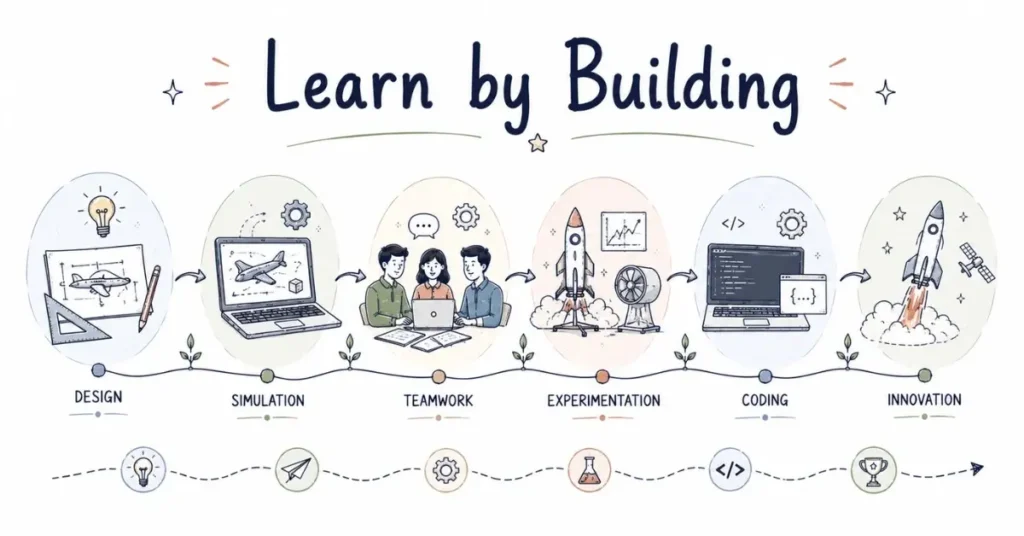
Step 4 : Build Skills During Your Degree (This Is Where Most Students Fall Behind)
A degree gets you eligible. Skills get you hired. These are the things you should be actively doing from your second year onward:
Learn simulation software seriously
Do not just attend the lab practical and move on. Pick one tool and become genuinely good at it:
- MATLAB / Simulink Control systems, trajectory simulation, data analysis. Free student license available.
- ANSYS Structural and thermal analysis. Used across ISRO, HAL, and all MNCs.
- OpenFOAM or FLUENT Computational fluid dynamics. Used for aerodynamics and propulsion work.
- CATIA or SolidWorks 3D CAD. HAL and TASL specifically expect CAD skills.
Participate in aerospace competitions and student programs
- SAE Aerodesign Challenge Design, build, and fly a remote-controlled aircraft. Widely respected by aerospace employers.
- CANSAT Competition Design a small satellite-like payload that fits inside a soda can. Excellent for understanding satellite systems fundamentals.
- Student Rocketry Challenge India Build and launch a small rocket. Gives direct hands-on propulsion and structures experience.
- ISRO’s Young Scientist Programme (YUVIKA) For school students (Classes 9–11), but worth knowing about if you are still at that stage or advising younger siblings.
Work on a final year project that is actually aerospace-relevant
Generic final year projects that have nothing to do with aerospace are a red flag to recruiters. Work on something specific a CubeSat design, a propulsion test rig, a CFD analysis of a nozzle geometry, a MATLAB simulation of a satellite attitude control system. Document it thoroughly. Put it on GitHub and LinkedIn.
Get Python basics right
You do not need to be a software engineer. But knowing Python well enough to write scripts for data processing, run simulations, and visualise results is now expected even in hardware-focused aerospace roles. It takes about 2–3 months of consistent practice to reach a usable level.

Step 5 : Get an Internship That Means Something
Internships in aerospace are competitive, but they are not impossible to get if you start early and apply systematically.
ISRO Internships
ISRO’s various centres (VSSC, ISAC, SAC, NRSC, URSC) offer internships for B.Tech and M.Tech students. Applications are made directly through the respective centre’s website or a centralised ISRO portal. Seats are limited. Apply 3–4 months before your desired internship period and have a specific technical area in mind when you apply not just “I want to work at ISRO.”
India Space Academy (ISA) Training Programs
ISA runs structured winter and summer training programs covering satellite technology, remote sensing, rocket propulsion, and space mission design. These are paid programs but give you structured learning and a certificate that carries weight with aerospace employers.
IISc Advanced Certification in Space Technologies
A 6-month part-time certification offered in collaboration with TalentSprint. Covers space systems, satellite design, remote sensing, and emerging SpaceTech applications. Open to engineering graduates and working professionals.
Private Startup Internships
Skyroot, Agnikul, Pixxel, Dhruva Space, and Digantara all take interns. Apply directly through their careers pages or LinkedIn. These are particularly valuable because startup internships often mean real work you are not making tea and photocopying documents.
Defence PSU Internships
HAL, BEL, and DRDO all have structured internship programs for engineering students. Apply through their official websites.

Step 6 : Understand What ISRO's Hiring Process Actually Looks Like
Since ISRO is the most common target for aerospace engineering students, here is exactly how the process works:
- ICRB notification released Watch ISRO’s official website (isro.gov.in) and set job alerts. Notifications are not released on a fixed schedule.
- Online application Fill the form carefully. Ensure your engineering branch matches the advertised vacancy category.
- Written examination Two papers: a discipline-specific technical paper and a general aptitude paper. Previous year papers are available online. Study them.
- Interview Shortlisted candidates are called for a personal interview. This tests technical depth, problem-solving approach, and awareness of ISRO’s current missions.
- Medical examination A standard medical fitness check.
- Joining Selected candidates join as Scientist/Engineer SC. Posting location is determined by ISRO based on project requirements.
The entire process from notification to joining can take 6–12 months. Apply early and keep other options running in parallel.
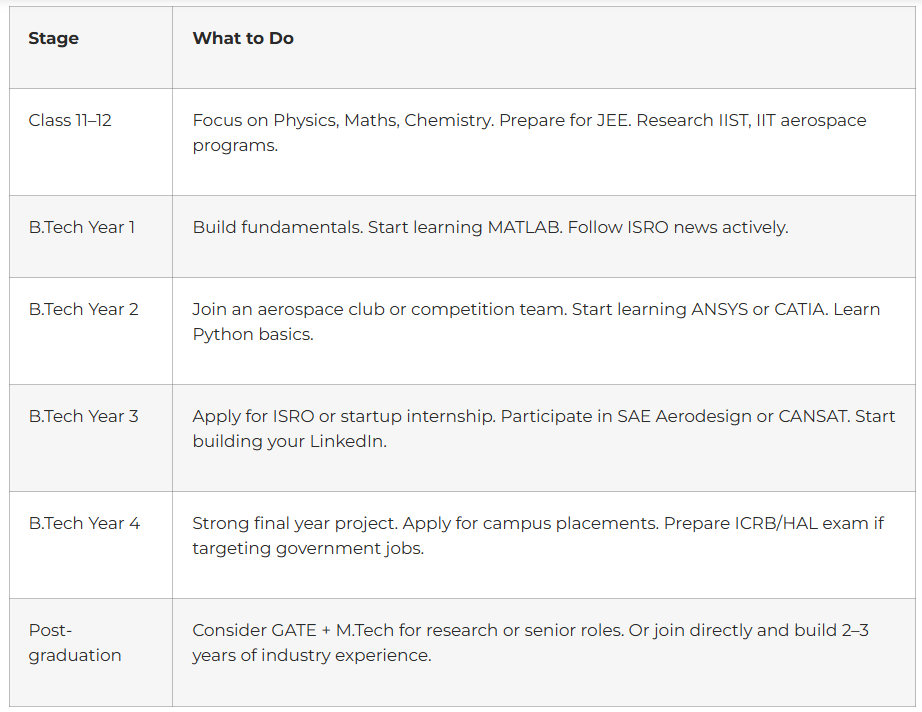
The Full Roadmap : Timeline View

FAQs : How to Become an Aerospace Engineer in India
Q: What is the minimum JEE rank needed for IIST?
The IIST cutoff varies by year and category. For the general category, a JEE Advanced rank roughly between 5,000–9,000 has historically been competitive, but check the official IIST admission website each year for current cutoffs as they change.
Q: Can I study aerospace engineering after a diploma?
Yes. Lateral entry into B.Tech (second year) is available at many colleges for diploma holders. Check individual college lateral entry admission processes.
Q: Is GATE compulsory for ISRO?
No. ISRO conducts its own ICRB written exam. GATE scores are not required for ISRO recruitment. However, a good GATE score helps if you want to pursue M.Tech from IITs or if you are targeting HAL recruitment (which uses GATE scores for initial shortlisting in some cycles).
Q: I am in my third year of mechanical engineering. Is it too late to pivot toward aerospace?
Not at all. Use your remaining time to take aerospace-relevant electives, build a space-focused final year project, learn simulation tools, and apply for aerospace internships. Mechanical engineering is one of the most accepted branches across ISRO, HAL, and aerospace companies.
Q: Which is better IIST or IIT for aerospace?
IIST gives you a guaranteed ISRO absorption after your B.Tech that is its primary advantage. IITs give you more flexibility, stronger brand recognition globally, and placement options across both space and non-space sectors. If your goal is specifically ISRO, IIST is hard to beat. If you want options, IIT is better.