
How to Start a Blockchain Career in India : Complete Guide
Table of Contents
Introduction: Your Career Starts Before Your First Job
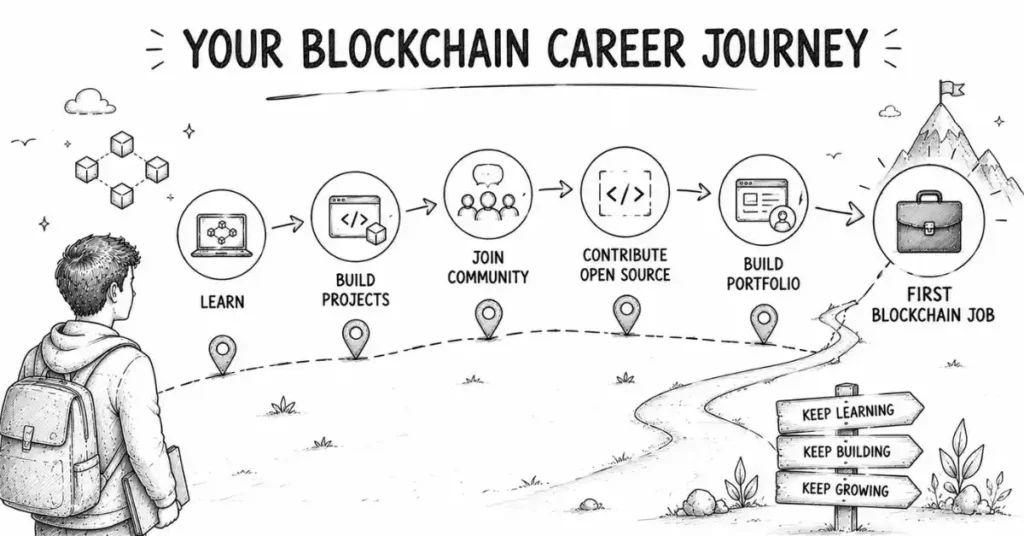
The most common mistake aspiring blockchain professionals make is passive waiting completing a course, uploading a resume, and expecting job offers to follow. Blockchain hiring doesn’t work this way. In a field where credentials matter less than demonstrated capability and community presence, your blockchain career begins before your first formal job through portfolio building, community participation, and open-source contributions.
The good news: India’s blockchain ecosystem is growing rapidly enough that entry points exist at every skill level, educational background, and career stage. Computer science students can pursue technical internships. Commerce and finance graduates can target compliance and analyst roles. Marketing and communication professionals can enter through community management. Lawyers can target legal and regulatory roles. There is no background from which blockchain careers are inaccessible only backgrounds requiring different entry strategies.
This guide gives students, freshers, and career-changers a concrete, actionable roadmap to their first blockchain role: what skills to build first, which internship programs to target, how to build a portfolio that gets noticed, and exactly how to navigate India’s blockchain job market as an entry-level candidate.
Understanding the Entry-Level Blockchain Landscape
What Companies Actually Hire For
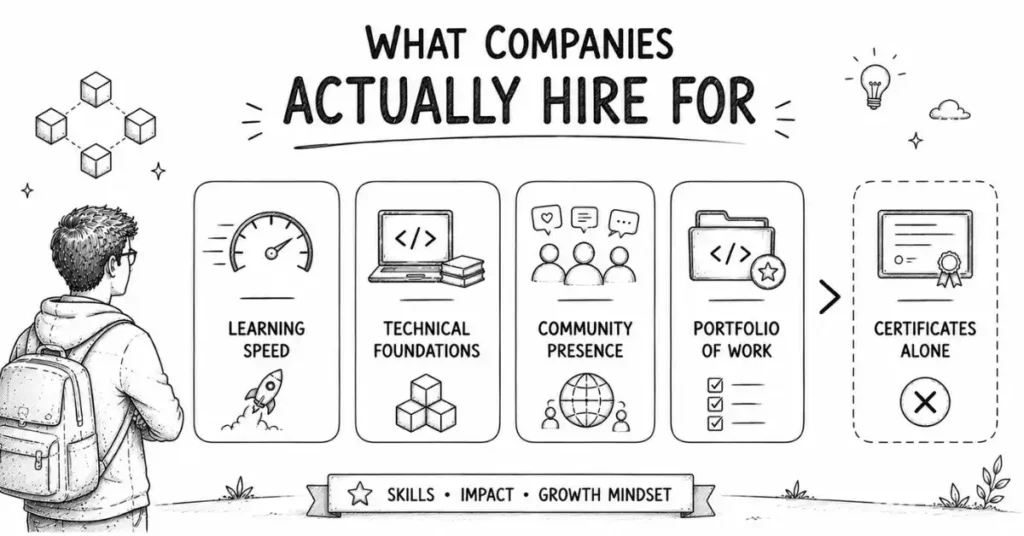
Most blockchain companies don’t expect freshers to arrive blockchain-ready. They hire for:
Potential and learning velocity: Can you learn fast? Do you demonstrate genuine curiosity about blockchain? Have you taught yourself anything beyond course curriculum?
Foundational technical skills (for technical roles): Solid programming fundamentals in at least one language. You can build blockchain-specific skills on the job; broken foundations are harder to fix.
Community presence: Are you active in blockchain Discord communities, GitHub, or online forums? This demonstrates genuine interest beyond course completion.
Portfolio over certificates: A GitHub repository with 3 deployed contracts shows more than 5 blockchain certificates. One good research report on tokenomics demonstrates more than a general blockchain course completion.
Internship Programs: India's Best Entry Points
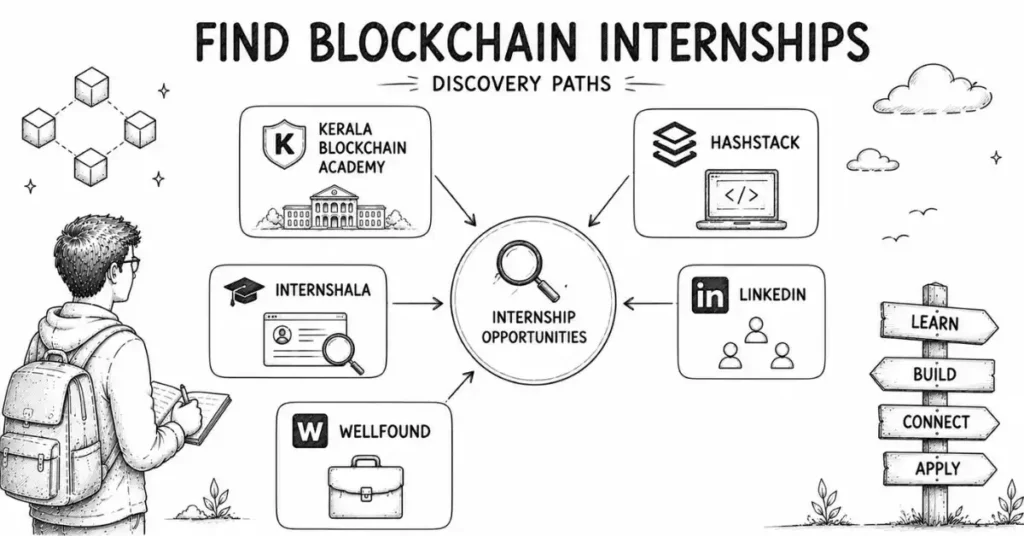
Kerala Blockchain Academy (KBA) Internship
What it is: Government of Kerala’s 3-month blockchain internship program for students with basic web development knowledge.
What you get:
- Comprehensive dApp development training
- Online mentorship from blockchain researchers
- Hands-on project experience
- Certificate from an official Hyperledger partner organization
Eligibility: Basic web development understanding required. Engineering and IT students preferred.
Application: Through KBA’s official website; intake announced periodically.
This is India’s most credible government-backed blockchain internship. The Hyperledger partnership means your experience is recognized by enterprise blockchain employers globally.
Hashstack Blockchain Internship (Bangalore)
What it is: Paid blockchain development internship at a DeFi protocol in Bangalore.
Stipend: ₹3–6 lakhs annualized equivalent
What you need:
- Practical Solidity smart contract experience (mandatory)
- Ability to write secure, scalable contracts for Ethereum and EVM chains
- Knowledge of ERC-20 and ERC-721 standards
- Understanding of DeFi terminology
- At least one live on-chain project
What you build: Secure, scalable, upgradeable smart contracts using EIP-2535 (Diamond standard), end-to-end testing, and technical documentation.
This internship requires demonstrated skills before applying—it’s not for complete beginners. Perfect for engineering students who’ve spent 2–3 months learning Solidity and Hardhat.
Platform-Based Internship Discovery
Internshala: 42+ active blockchain jobs and internships listed in February 2026 alone. Internshala is India’s most active platform for student internships. Search “blockchain” and “smart contract” regularly—new listings appear weekly.
LetsIntern and Unstop: Additional platforms with blockchain internship listings specifically for Indian students.
LinkedIn India: Remote internship listings with global companies accessible from India. Filter by “internship” + “blockchain” + “India” or “Remote.”
Wellfound (AngelList): Startup internships with equity potential. Many early-stage Indian blockchain startups list here.
Entry-Level Job Roles: What's Available for Freshers
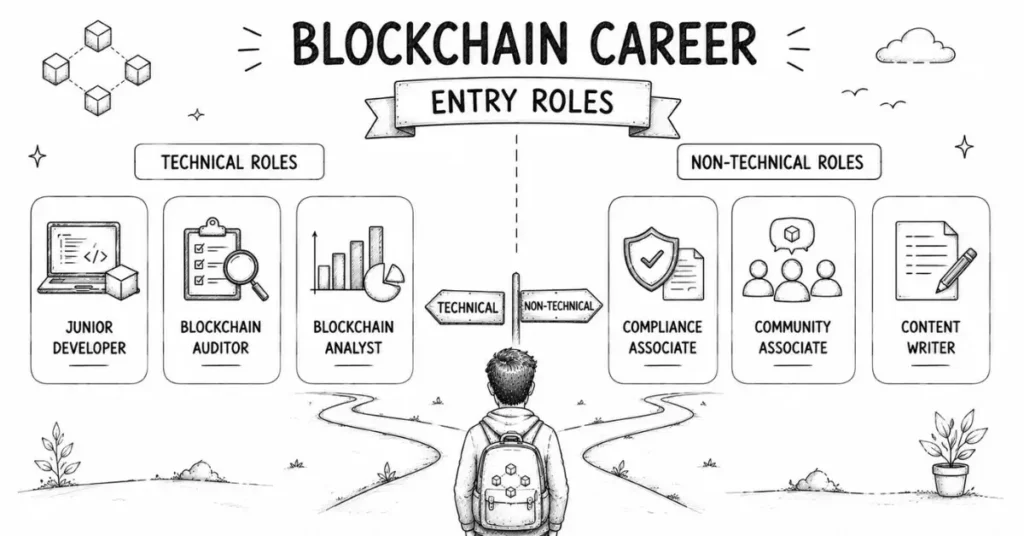
For Technical Background (Engineering, CS, IT)
Junior Blockchain Developer: Most common entry technical role
- Requirements: Solidity basics, one or more deployed contracts, testing framework knowledge
- Starting salary: ₹6–9 lakhs
- Hiring companies: Blockchain startups, Web3 agencies, IT services companies with blockchain practice
Junior Smart Contract Auditor: For security-focused freshers
- Requirements: Strong Solidity knowledge, completed Ethernaut and Damn Vulnerable DeFi, Code4rena participation
- Starting salary: ₹8–12 lakhs
- Competitive entry: Most competitive technical entry point—requires real demonstrated capability
Web3 Frontend Developer: For JavaScript/React background
- Requirements: React proficiency, ethers.js basics, MetaMask integration experience
- Starting salary: ₹5–8 lakhs
- Most accessible technical entry: If you’re already a frontend developer, Web3 transition is fastest
For Non-Technical Background (Commerce, Law, Arts)
Crypto Analyst / Research Associate:
- Background: Finance, economics, or business degree
- Requirements: Understanding of crypto markets, ability to analyze protocols, writing skills
- Starting salary: ₹5–8 lakhs
- Best entry portfolio: 5 published protocol analysis pieces
KYC/AML Analyst:
- Background: Commerce, law, banking
- Requirements: KYC documentation knowledge, PMLA basics, attention to detail
- Starting salary: ₹4–7 lakhs at Indian crypto exchanges
- Growth path: Compliance Specialist → Compliance Officer → Head of Compliance
Web3 Community Associate:
- Background: Marketing, communications, any background
- Requirements: Active Discord presence, writing skills, blockchain enthusiasm
- Starting salary: ₹4–7 lakhs
- Best entry portfolio: Example Discord moderation system, community engagement campaign design
Crypto Content Writer:
- Background: Any, with strong English writing skills
- Requirements: Writing portfolio, basic blockchain knowledge
- Starting salary: ₹4–7 lakhs full-time; ₹1,000–2,500 per article freelance
- Fast entry: Can start writing freelance immediately while job searching
The 90-Day Entry Strategy: A Concrete Plan
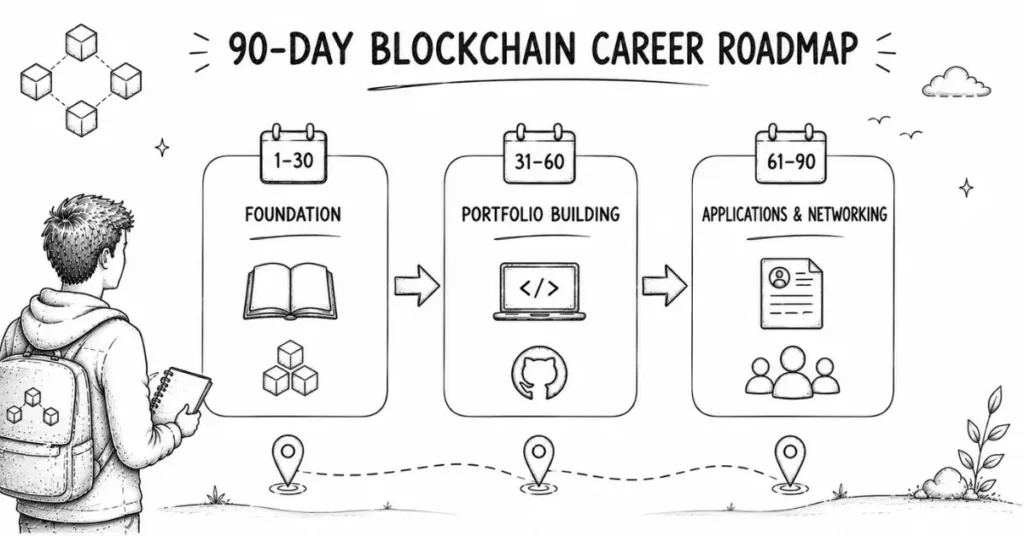
Days 1–30: Build Foundation
Technical Track:
- Install MetaMask, Remix IDE, and connect to Goerli testnet
- Complete CryptoZombies Solidity tutorial (free, 10–15 hours)
- Deploy your first ERC-20 token to testnet
- Set up Hardhat development environment
- Join Ethereum, Buildspace, and LearnWeb3 Discord communities as active learner
Non-Technical Track:
- Create accounts on WazirX, CoinDCX (KYC the process—experience what you’ll work with)
- Read 15 blockchain project whitepapers in your target sector
- Follow 20 blockchain professionals on LinkedIn and Twitter
- Join crypto-focused Discord communities as active participant
- Write your first blockchain explainer article on Medium
Days 31–60: Build Portfolio
Technical Track:
- Build 3 complete smart contract projects: ERC-20 token, NFT contract, simple DeFi protocol
- Write comprehensive test suites for each project (target 90%+ coverage)
- Deploy all projects to testnet with verified Etherscan source code
- Run Slither on every project and document findings
- Write README documentation for each GitHub repository
Non-Technical Track (Research/Analyst):
- Write 5 deep-dive protocol analysis pieces on Medium
- Build a Dune Analytics dashboard tracking metrics for one protocol
- Create a tokenomics comparison spreadsheet for 5 competing projects
- Publish one comprehensive research report on a blockchain sector
Non-Technical Track (Community/Marketing):
- Create mock Discord server demonstrating community management skills
- Write 10 Twitter threads explaining blockchain concepts in simple language
- Develop a complete NFT project launch strategy document
- Document a community growth campaign from scratch
Days 61–90: Apply and Network
Portfolio finalization:
- Clean up GitHub—every repository needs clear README, documentation, and deployment details
- Create LinkedIn profile highlighting blockchain skills with portfolio links
- Write 3–5 LinkedIn posts demonstrating knowledge and getting engagement
Active applications:
- Apply to 3–5 positions per week on Internshala, LinkedIn, Web3.career, and CryptoJobsList
- Email directly to HR teams of Indian blockchain companies with specific, personalized cover notes
- Attend blockchain meetups in your city (ETHIndia events, local Web3 communities in Bangalore, Hyderabad, Mumbai)
Network activation:
- Message 5 blockchain professionals on LinkedIn weekly (not asking for jobs—asking genuine questions about their work)
- Participate actively in blockchain Discord communities where hiring managers are present
- Comment thoughtfully on LinkedIn posts by blockchain company founders and team members
Common Entry-Level Mistakes to Avoid
Mistake 1: Certificate Collection Without Skill Building
Collecting 10 blockchain certificates without building projects or joining communities creates an impressive-looking resume that performs poorly in technical screening. Build first, certify second.
Mistake 2: Applying to Senior Roles Too Early
Job hunting works better with 30 targeted applications than 300 untargeted ones. Apply to roles genuinely matching your current skill level—growth happens after getting in the door, not before.
Mistake 3: Ignoring Community as an Entry Path
Many blockchain companies hire their best community members for formal roles. Being consistently helpful, knowledgeable, and present in a project’s Discord is sometimes the fastest path to a job offer—the community manager or developer lead notices you before a job is even posted.
Mistake 4: Only Targeting Large Companies
WazirX and CoinDCX are competitive for freshers. Early-stage blockchain startups often need help and hire capable freshers who take initiative. The experience you gain at a small startup in one year frequently exceeds what large companies offer in three.
Mistake 5: Skipping English Communication Development
International remote positions—where compensation is 3–5x domestic rates—require strong English communication in writing and speaking. Investing in communication skills early dramatically expands the job market you can access.
Fresher Salary Negotiation: Getting More Than the Default Offer
Most blockchain companies expect freshers to negotiate. The default offer is rarely the best offer. Leverage these elements:
Portfolio specificity: “I’ve deployed 3 mainnet contracts with 100% test coverage—here are the Etherscan links” is stronger negotiation evidence than general experience claims.
Competing offers: Even one competing offer creates leverage. Apply to multiple companies simultaneously for this reason.
International rate awareness: Know that equivalent skills pay 3–5x more internationally. Mentioning this awareness signals you understand your market value without being aggressive about it.
Equity/token discussion: At startups, token allocations can be worth more than salary differences. If base salary flexibility is limited, negotiate token allocation, vesting schedule, and cliff period.