
Blockchain Development Tools : Frameworks & Platforms Guide
Table of Contents
Introduction: Your Toolkit Determines Your Productivity
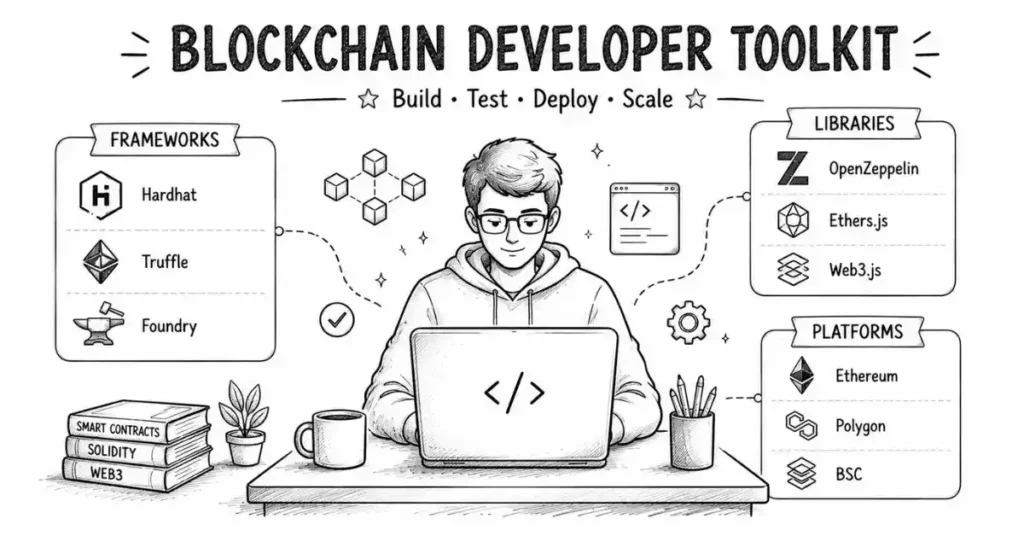
Every professional tradesperson has a toolkit plumbers have their wrenches, surgeons have their instruments, architects have their CAD software. Blockchain developers have theirs: development frameworks, testing environments, deployment tools, libraries, and monitoring platforms that transform raw programming skill into deployed, tested, production-ready applications.
Understanding this toolkit before you start learning blockchain development saves enormous time. Beginning developers who learn the ecosystem of tools alongside programming languages arrive at employability far faster than those learning languages in isolation. And for hiring managers reviewing candidates, familiarity with professional tools signals practical experience that theoretical knowledge alone cannot demonstrate.
In 2026, the blockchain development tooling landscape has consolidated around clear winners in each category. This guide covers every major tool category, explains what each tool does, shows how tools work together in a typical development workflow, and gives you a prioritized list of which tools to learn in what order based on your career focus.
Smart Contract Development Frameworks
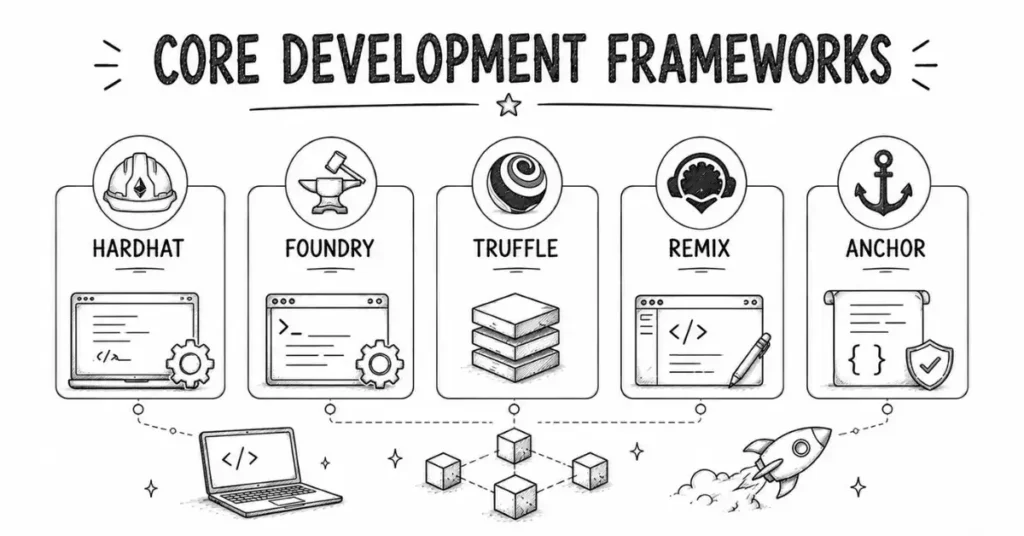
Hardhat: The Industry Standard
Hardhat has become the most widely used Ethereum development environment in 2026, offering comprehensive tooling for development, testing, and deployment.
Core capabilities:
- Local Ethereum network (Hardhat Network) for fast development testing
- JavaScript and TypeScript test execution with Mocha and Chai
- Advanced debugging with Solidity stack traces and console.log
- Network forking—test against real mainnet/testnet state locally
- Extensive plugin ecosystem for additional functionality
- Built-in gas reporting showing function-by-function gas costs
Why Hardhat dominates: Its debugging capabilities are significantly better than alternatives. When a transaction fails, Hardhat shows you the exact Solidity line where it failed with a complete stack trace—invaluable for development efficiency.
Learning path: Hardhat documentation includes comprehensive tutorials. Estimate 1–2 weeks to become productive with basic Hardhat workflows, 4–6 weeks to master advanced features.
Used by: Uniswap, Aave, OpenZeppelin, Compound, and most production DeFi protocols.
Foundry: The Fast Challenger
Foundry is a rapidly growing development framework with distinctive characteristics making it increasingly preferred for security-focused and high-performance teams.
Core capabilities:
- Tests written in Solidity (same language as contracts—no JavaScript/TypeScript required)
- Extremely fast compilation and test execution (significantly faster than Hardhat)
- Built-in fuzzing (property-based testing)
- Advanced gas snapshots and optimization analysis
- Forge (testing), Cast (blockchain interaction), Anvil (local network), Chisel (REPL)
Why Foundry is gaining adoption: Security auditors prefer Foundry because writing tests in Solidity means testing the same language as the contracts—no abstraction layer introducing potential errors. The built-in fuzzing capabilities catch edge cases automatically.
Recommendation: Learn Hardhat first (more widespread, better documentation for beginners), then add Foundry as a complement. Many teams use both—Hardhat for development workflow, Foundry for security testing.
Truffle Suite: The Enterprise Legacy
Truffle was the original Ethereum development framework and remains widely used, particularly in enterprise contexts.
Components:
- Truffle: Smart contract compilation, testing, migration
- Ganache: Local blockchain for development (desktop app version accessible to beginners)
- Drizzle: Frontend library for React dApp development
Status in 2026: ConsenSys (Truffle’s developer) announced wind-down of active development, but Truffle remains in production at many enterprise deployments. Understanding Truffle is still valuable for enterprise consulting roles where existing systems use it, but new projects should typically choose Hardhat or Foundry.
Remix IDE: The Beginner's Best Friend
Remix is a browser-based development environment requiring zero installation:
Capabilities:
- Write, compile, and test Solidity directly in browser
- Deploy to local JavaScript VM, testnets, or mainnet
- Connect with MetaMask for real transaction testing
- Plugin ecosystem for analysis, code quality, and gas optimization
- No setup—works immediately in any browser
Best for: Learning Solidity, quick prototyping, testing individual contract functions, explaining code in educational contexts. Not suitable for large production projects (better to use Hardhat/Foundry for those), but invaluable as a learning tool.
Learning priority: Start here before learning Hardhat. Remix’s accessibility enables your first deployed smart contract within hours of beginning Solidity.
Anchor Framework: Solana's Hardhat Equivalent
For Solana development, the Anchor framework provides Hardhat-equivalent functionality built for Rust/Solana:
- Simplifies Solana program development with higher-level abstractions
- Built-in testing with TypeScript test clients
- IDL (Interface Description Language) generation for frontend integration
- Security features reducing common Solana-specific vulnerabilities
Learning Anchor alongside Rust reduces Solana’s steep learning curve significantly.
Blockchain Interaction Libraries
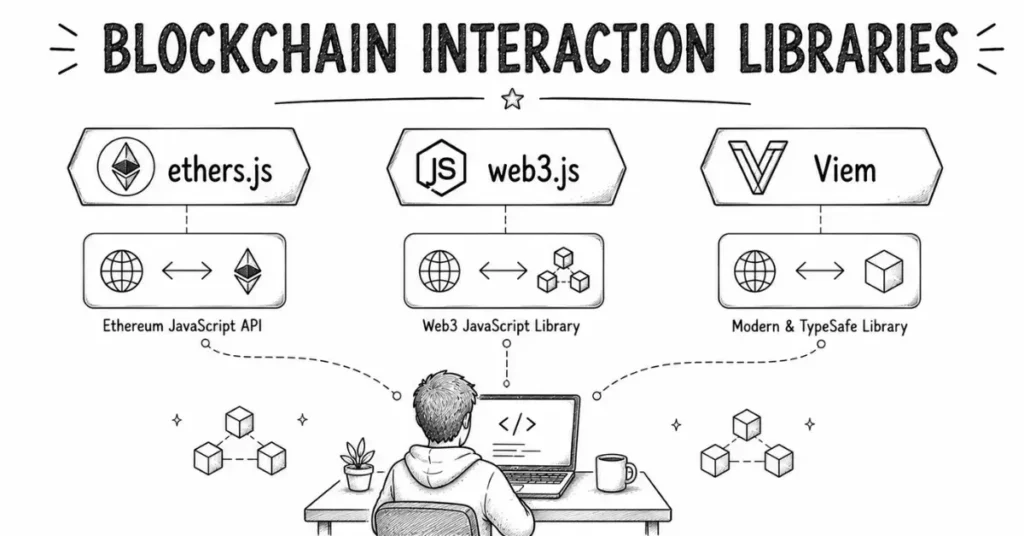
ethers.js: The Modern Standard
ethers.js is the primary JavaScript library for interacting with Ethereum and EVM-compatible blockchains from frontend applications and Node.js backends.
What ethers.js does:
- Connect to Ethereum networks via JSON-RPC providers
- Create and manage wallets and private keys
- Send transactions and call smart contract functions
- Read blockchain state (balances, contract data)
- Listen for blockchain events
- Sign messages and verify signatures
- Encode/decode ABI data
Why ethers.js over web3.js: Cleaner API design, better TypeScript support, smaller bundle size, more actively maintained, and preferred by most modern DeFi protocol frontends.
Learning priority: Essential for any dApp frontend developer. Master after basic Solidity knowledge.
web3.js: The Original Library
web3.js was the first JavaScript blockchain interaction library and still has significant adoption in older projects:
- Battle-tested with years of production use
- Complete feature set for Ethereum interaction
- Still used by many enterprise blockchain applications
Status in 2026: Still relevant for working with existing codebases, but new projects typically choose ethers.js. Understanding both is valuable; prioritize ethers.js for new development.
Viem: The TypeScript-First Alternative
Viem is a newer, TypeScript-first alternative to ethers.js gaining rapid adoption in 2026:
- Full TypeScript support with exceptional type safety
- Better performance through tree-shaking
- Designed from the ground up for TypeScript projects
- Used by Wagmi (React hooks for Web3) under the hood
For TypeScript developers building modern dApps, Viem combined with Wagmi (for React) is increasingly the standard stack.
Testing and Security Tools
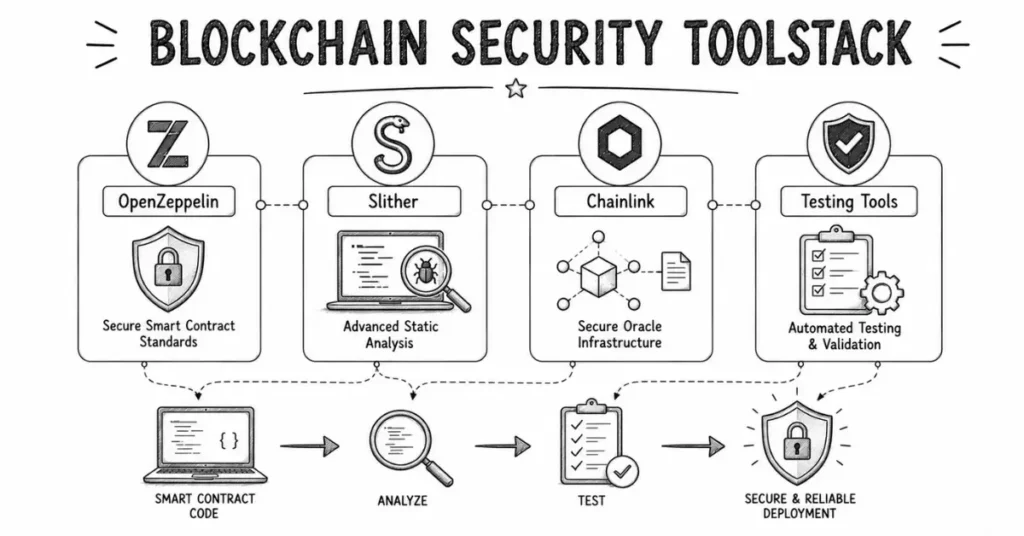
OpenZeppelin Contracts and Test Helpers
OpenZeppelin provides the most widely used library of audited, secure smart contract components:
OpenZeppelin Contracts: Pre-built implementations of standard token contracts (ERC-20, ERC-721, ERC-1155), access control, governance, and security utilities. Using OpenZeppelin components reduces security risk by building on audited foundations.
OpenZeppelin Defender: Security platform for monitoring, automating, and managing smart contract operations.
Learning priority: Essential from day one. Never write a token contract from scratch—use and extend OpenZeppelin’s audited implementations.
Slither: Automated Static Analysis
Slither is Trail of Bits’ open-source static analysis tool that detects known vulnerability patterns automatically:
- Detects reentrancy, access control issues, arithmetic problems
- Identifies code quality issues and best practice violations
- Integrates with CI/CD pipelines for continuous security checking
- Fast—runs in seconds on most contracts
Learning priority: Run Slither on every smart contract you write. It takes minutes to set up and catches issues that could take hours to find manually.
Chainlink: Oracle Integration Standard
Chainlink provides decentralized price feeds, random number generation, and external data access for smart contracts:
- Price feeds used by nearly every DeFi protocol
- VRF (Verifiable Random Function) for provably fair randomness
- Automation (formerly Keepers) for triggering contract functions
- Cross-chain messaging via CCIP
Understanding Chainlink integration is essential for DeFi development—virtually every protocol using price data relies on Chainlink.
Deployment and Infrastructure Tools
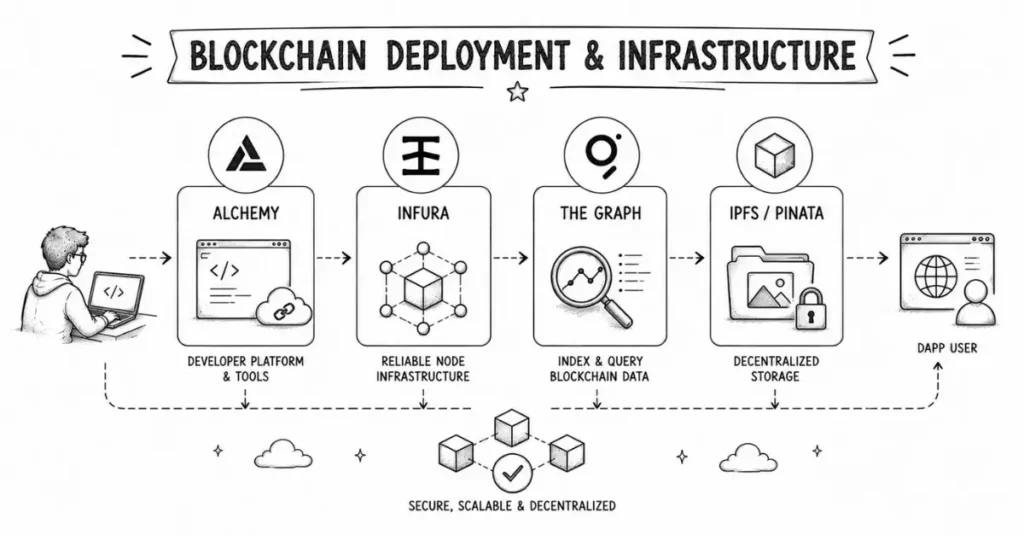
Alchemy and Infura: Node Providers
Smart contracts deploy to blockchain networks through nodes. Alchemy and Infura provide hosted node infrastructure eliminating the need to run your own:
Alchemy: Preferred by most modern DeFi projects for reliability, developer experience, and enhanced APIs. Includes debugging tools, mempool monitoring, and NFT APIs.
Infura: ConsenSys’ node provider with longest track record. Still widely used, particularly in enterprise contexts.
Learning priority: Sign up for Alchemy’s free tier immediately—you’ll use it for every testnet and mainnet deployment.
The Graph: Blockchain Data Indexing
Smart contracts don’t store data in easily queryable formats. The Graph indexes blockchain data and provides GraphQL APIs enabling efficient querying:
- Index smart contract events and build queryable subgraphs
- Query historical blockchain data efficiently
- Used by Uniswap, Aave, and most major DeFi protocols for their frontends
Understanding The Graph is essential for building dApp frontends that display historical data—transaction histories, price charts, user activity.
IPFS and Filecoin: Decentralized Storage
Blockchain transactions are expensive—storing large files on-chain is impractical. IPFS provides decentralized file storage for NFT metadata, images, and documents:
IPFS: Peer-to-peer distributed file storage. NFT metadata and images are typically stored on IPFS with only the IPFS hash stored on-chain.
Pinata: IPFS pinning service making content reliably accessible. Used by most NFT projects to ensure metadata stays available.
Learning for NFT developers: Essential. Every NFT project stores metadata on IPFS.
Development Workflow: How Tools Work Together
A typical professional blockchain development workflow uses these tools in sequence:
- Design phase: Whiteboard contract architecture, write specifications
- Initial development: Remix IDE for quick prototyping and learning
- Production development: VS Code with Hardhat project structure, OpenZeppelin for base contracts
- Testing: Hardhat tests (unit and integration), Foundry for fuzzing and security testing
- Static analysis: Slither automated scanning, manual security review
- Local deployment: Hardhat Network for fast iteration testing
- Testnet deployment: Alchemy/Infura for testnet node access, Hardhat migration scripts
- Verification: Etherscan contract verification for transparency
- Audit: External security audit before mainnet
- Mainnet deployment: Hardhat scripts, multi-sig wallet for deployment
- Monitoring: Tenderly for transaction monitoring, The Graph for data indexing
Understanding this workflow before your first job means you contribute productively from Day 1.
Prioritized Tool Learning Sequence
Week 1–2: Remix IDE (deploy first contract), MetaMask (interact with testnet), Etherscan (read transactions)
Week 3–4: Hardhat (development environment), ethers.js basics (interact from JavaScript)
Month 2: OpenZeppelin contracts (build with audited components), Alchemy (testnet deployment)
Month 3: Hardhat testing (comprehensive test suites), Slither (security scanning)
Month 4: Foundry (fuzzing and advanced testing), The Graph (data indexing basics)
Month 5–6 (specialization): Chainlink (oracle integration), IPFS/Pinata (NFT metadata), Tenderly (monitoring)