
Web3 Developer Career Guide : Build Decentralized Apps
Table of Contents
Introduction: Building the Internet's Next Generation
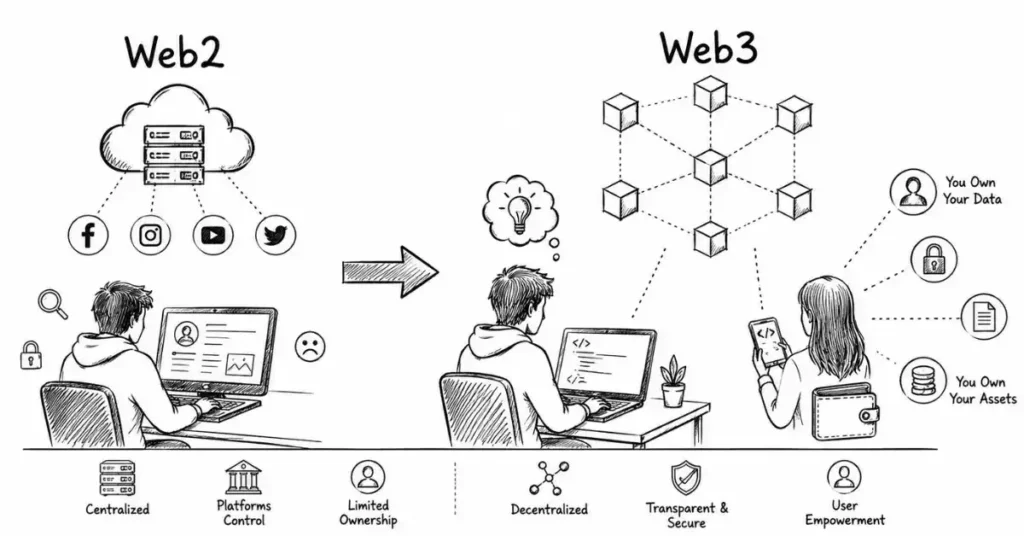
Remember when “web developer” wasn’t a real job title? In the late 1990s, building websites was a novelty. Today, web developers power the entire digital economy. We’re at a similar inflection point with Web3 the decentralized internet built on blockchain technology. Web3 developers build decentralized applications (dApps) that run on blockchain networks instead of centralized servers, giving users control over their data and digital assets.
Web3 development represents the perfect middle ground in blockchain careers. It’s more accessible than core protocol development but offers more opportunities than most other blockchain specializations. If you already know web development (HTML, CSS, JavaScript, React), you’re 60% of the way to becoming a Web3 developer. You simply need to learn how to connect your familiar frontend skills with blockchain backends.
The career prospects are exceptional. Web3 developers in India earn ₹6-12 lakhs starting out, with experienced developers commanding ₹15-20 lakhs. International remote positions pay $50,000-100,000+ annually (₹40-82 lakhs). The best part? The transition from traditional web development takes only 2-4 months of focused learning, making this one of the fastest paths to high-paying blockchain careers.web3+1
In this comprehensive guide, you’ll learn exactly what Web3 developers do, how dApps differ from traditional applications, the essential technologies you need to master, how to build a portfolio that gets noticed, and how to land your first Web3 development role. Whether you’re currently a web developer looking to specialize or a student deciding which development path to pursue, this guide shows you exactly how to become a professional Web3 developer.
Understanding Web3 and Decentralized Applications
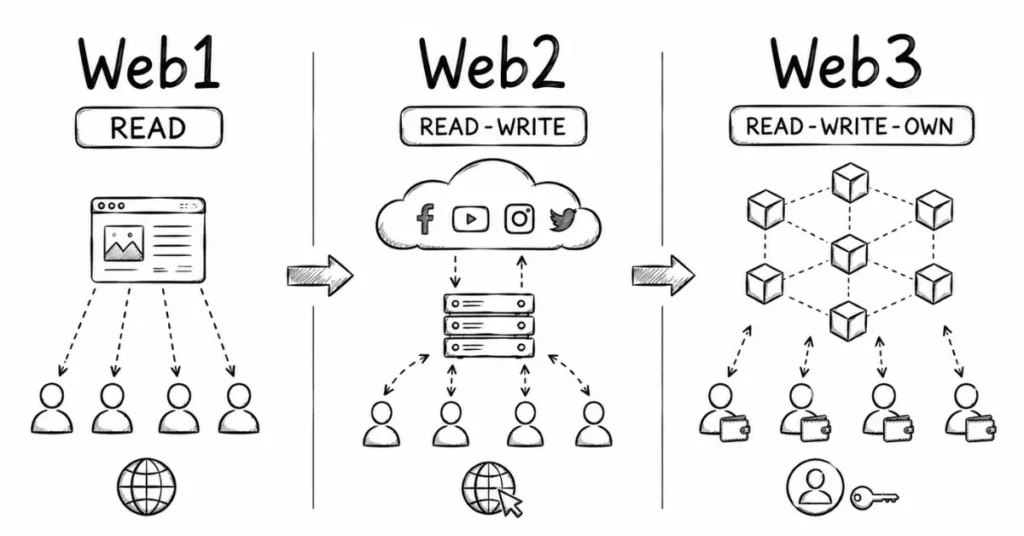
Web1, Web2, and Web3: The Evolution
Web1 (1990s-2004): Read-only internet. Static websites, basic information sharing, no user interaction. Think early Yahoo and personal blogs.
Web2 (2004-Present): Read-write internet. Social media, user-generated content, interactive applications. Users create content but platforms own data and profit from it. Think Facebook, YouTube, Twitter—you create posts but don’t truly own them.
Web3 (Emerging Now): Read-write-own internet. Users control their data, digital assets, and online identity. Applications run on decentralized networks instead of company servers. Think blockchain-based social media where you own your followers and posts, or games where you truly own in-game items you can sell anywhere.
What Makes dApps Different from Traditional Apps
Decentralized Backend:
Traditional apps store data in company-owned databases (AWS, Google Cloud). dApps store critical data on blockchains, making it permanent, transparent, and censorship-resistant.
No Central Authority:
Traditional apps are controlled by companies that can change rules, ban users, or shut down anytime. dApps run on smart contracts—once deployed, nobody (not even creators) can arbitrarily change the rules or deny access.
Wallet-Based Authentication:
Instead of email/password login, dApps use wallet authentication. Users connect MetaMask or other wallets, signing messages to prove identity. No passwords to remember or hack.
Direct Ownership:
In traditional apps, companies own user data and digital assets. In dApps, users truly own their assets (NFTs, tokens, reputation) and can transfer them between applications.
Examples of Popular dApps:
Uniswap: Decentralized cryptocurrency exchange where users trade directly peer-to-peer without a company facilitating trades.
OpenSea: NFT marketplace where users buy, sell, and trade digital assets. While OpenSea provides the interface, actual ownership is on blockchain.
Decentraland: Virtual world where users own land and assets as NFTs, build experiences, and monetize without platform taking control.
Mirror: Decentralized blogging platform where writers own content as NFTs and readers can support creators directly.
Essential Web3 Technologies and Skills
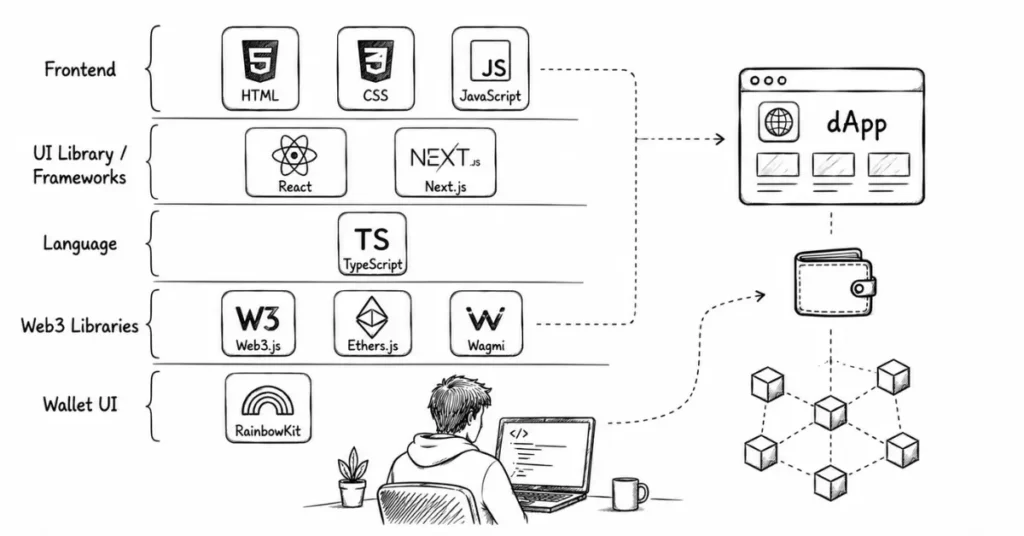
Frontend Technologies (Similar to Web2)
HTML/CSS/JavaScript: Foundation remains identical to traditional web development. If you know these, you’re already halfway there.
React: Most popular framework for Web3 frontends. Alternative frameworks (Vue, Angular, Svelte) work too, but React dominates the ecosystem. Learn React if you haven’t already.
Next.js: React framework providing server-side rendering, routing, and optimization. Many production dApps use Next.js for better performance and SEO.
TypeScript: JavaScript with type safety. Increasingly standard in Web3 development for catching errors before they reach production.
State Management: Redux, Context API, or Zustand for managing application state including wallet connections and blockchain data.
Web3-Specific Libraries
Web3.js: Original library for interacting with Ethereum from JavaScript. Provides methods for:
- Connecting to Ethereum networks
- Reading blockchain data
- Sending transactions
- Interacting with smart contracts
Ethers.js: Modern alternative to Web3.js, cleaner API and better documentation. Most new projects use Ethers.js. Includes:
- Wallet integration
- Contract interaction
- Utility functions for blockchain data
- Provider abstraction across networks
Wagmi: React hooks library built on Ethers.js, simplifying common Web3 tasks:
- Connect/disconnect wallets
- Read contract data
- Send transactions
- Listen to blockchain events
Makes building React dApps significantly easier.
RainbowKit / Web3Modal: Pre-built wallet connection interfaces supporting MetaMask, WalletConnect, Coinbase Wallet, and more. Saves hundreds of hours building wallet connection UI.
Blockchain and Smart Contract Knowledge
Understanding Smart Contracts: You don’t need to write Solidity professionally, but understanding how smart contracts work is essential. You must:
- Read and understand contract ABIs (Application Binary Interfaces)
- Know common token standards (ERC-20, ERC-721)
- Understand gas fees and transaction confirmation
- Debug failed transactions
Reading Blockchain Data: Learn to:
- Query account balances and transaction history
- Read smart contract state
- Listen for contract events in real-time
- Use blockchain explorers (Etherscan) for debugging
Wallet Architecture: Understand how wallets work:
- Private keys and public addresses
- Signing transactions and messages
- Multiple wallet types (browser extensions, mobile, hardware)
- WalletConnect protocol for mobile wallet integration
Backend and Infrastructure
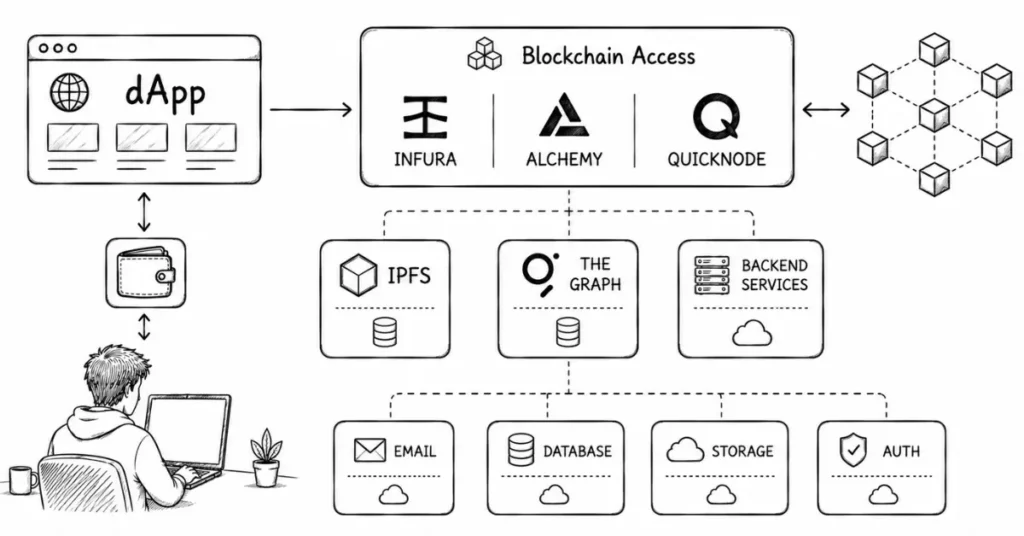
Node Providers: dApps need to connect to blockchain nodes. Running your own is expensive, so most developers use providers:
- Infura: Popular hosted node service
- Alchemy: Enhanced node service with better debugging tools
- QuickNode: Fast, reliable node infrastructure
These services provide free tiers suitable for development and moderate production use.
IPFS (InterPlanetary File System): Decentralized storage for images, metadata, and other files. NFTs store metadata on IPFS to truly decentralize all data.
The Graph: Indexing protocol for querying blockchain data efficiently. Instead of parsing blockchain logs yourself, query pre-indexed data using GraphQL.
Backend Servers (When Needed): Not everything belongs on blockchain. Many dApps use traditional backends for:
- Caching blockchain data for faster UI
- Handling heavy computations off-chain
- Storing non-critical data cheaply
- Implementing features not practical on-chain
Building Your First dApp: Step-by-Step
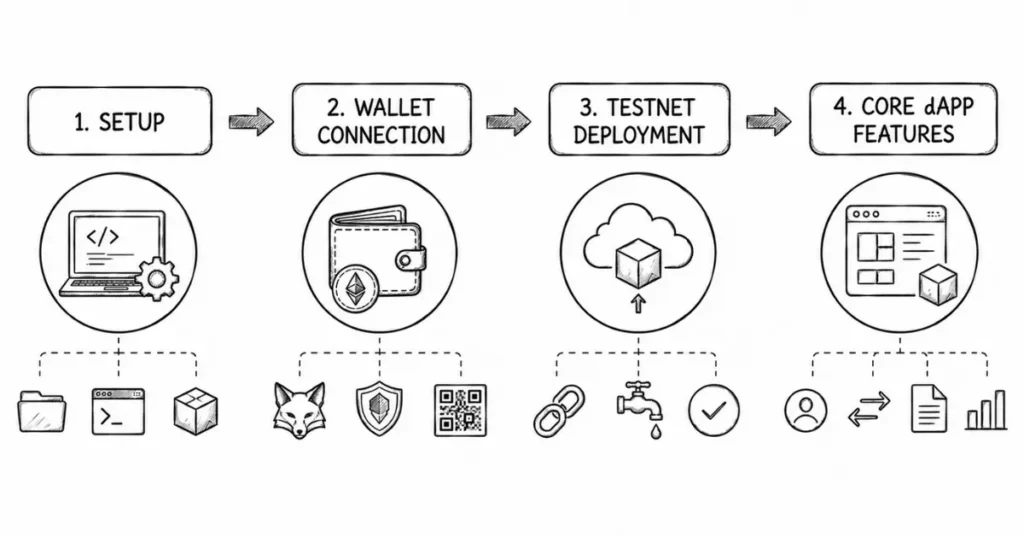
Project Setup
1.Initialize React Application:
bash
npx create-react-app my-dapp
# or with TypeScript
npx create-react-app my-dapp –template typescript
2.Install Web3 Dependencies:
bash
npm install ethers wagmi
# For wallet connection UI
npm install @rainbow-me/rainbowkit
3.Configure Wallet Connection:
Set up RainbowKit with Wagmi to handle wallet connections. This provides professional wallet connection UI supporting multiple wallets.
4.Connect to Test Network:
Configure connection to Goerli or Sepolia testnet for development. Never develop directly on mainnet—transaction costs make iteration expensive.
Core dApp Features
Wallet Connection:
Every dApp needs wallet authentication. Users connect MetaMask or other wallets, which serves as both authentication and payment method.
javascript
// Using Wagmi hooks (simplified example)
import { useAccount, useConnect } from ‘wagmi’
function App() {
const { address, isConnected } = useAccount()
const { connect, connectors } = useConnect()
if (isConnected) {
return <div>Connected: {address}</div>
}
return <button onClick={() => connect({ connector: connectors[0] })}>
Connect Wallet
</button>
}
Reading Contract Data:
Display information from smart contracts:
- Token balances
- NFT ownership
- Protocol statistics
- User-specific data
Writing Transactions:
Enable users to interact with contracts:
- Transfer tokens
- Mint NFTs
- Stake assets
- Vote on proposals
Handling Transaction States:
Provide feedback during transaction lifecycle:
- Waiting for user approval in wallet
- Transaction submitted, awaiting confirmation
- Transaction confirmed successfully
- Transaction failed (show error message)
Event Listeners:
Listen for blockchain events in real-time:
- New transactions affecting user
- Price updates
- NFT transfers
- Governance votes
Example Project: Token Dashboard
Build a dashboard showing ERC-20 token information:
Features:
- Connect wallet with MetaMask/WalletConnect
- Display user’s token balance
- Show total token supply and holder count
- Transfer tokens to another address
- View transaction history
Technical Skills Demonstrated:
- Wallet integration
- Reading contract state
- Sending transactions
- Handling transaction errors
- Real-time updates via events
This project showcases core Web3 development skills to potential employers.
Web3 Developer Portfolio Projects
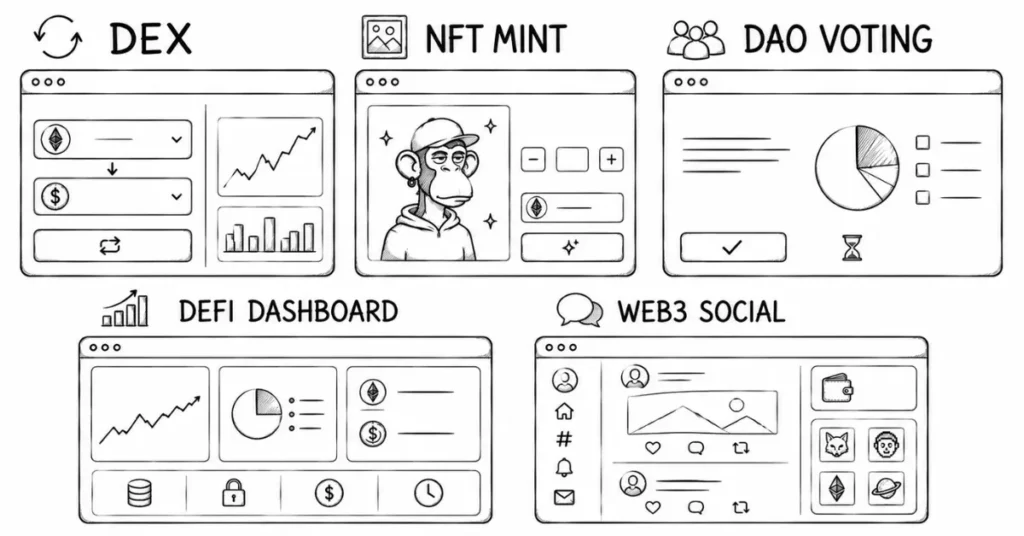
Essential Projects to Build
1.DEX Interface (Decentralized Exchange Frontend)
Build a Uniswap-like interface:
- Connect wallet
- Select tokens to swap
- Display estimated exchange rate and price impact
- Execute swap transaction
- Show transaction confirmation
Why It Matters: Demonstrates ability to work with complex DeFi protocols and handle multi-step transactions.
2.NFT Minting dApp
Create an interface for minting NFTs:
- Display collection information
- Show available/minted quantities
- Implement minting functionality
- Display user’s minted NFTs
- Metadata display from IPFS
Why It Matters: NFTs are hugely popular. Shows understanding of NFT standards and IPFS integration.
3.DAO Governance Interface
Build voting interface for a DAO:
- Display active proposals
- Show voting statistics
- Allow token holders to vote
- Display voting history
- Show proposal outcomes
Why It Matters: DAOs are growing rapidly. Demonstrates ability to build governance tools.
4.DeFi Dashboard
Aggregate DeFi positions across protocols:
- Connect to multiple DeFi protocols
- Display total portfolio value
- Show positions (lending, liquidity pools, staking)
- Calculate total earnings
- Historical performance charts
Why It Matters: Shows ability to integrate multiple protocols and present complex data clearly.
5.Web3 Social Media
Build a decentralized social platform:
- Wallet-based authentication
- Post content stored on-chain or IPFS
- Like, comment, share functionality
- Follow/unfollow users
- Tokenized engagement rewards
Why It Matters: Demonstrates creativity in applying Web3 to familiar use cases. Shows full-stack Web3 development.
Making Your Portfolio Stand Out
Deployed Live Demos: Don’t just show code—deploy working dApps to Vercel/Netlify connected to testnets. Recruiters want to interact with your projects, not just read code.
Polished UI/UX: Many blockchain developers neglect design. Beautiful, intuitive interfaces make you stand out. Use UI libraries like Chakra UI or Material-UI for professional appearance.
Mobile Responsive: Ensure dApps work on mobile using WalletConnect for mobile wallet connections.
Comprehensive README: Each project should have detailed documentation explaining:
- What the dApp does and why you built it
- Technologies used and why you chose them
- Setup and deployment instructions
- Challenges faced and how you solved them
- Future improvements planned
Video Demos: Create 2-3 minute demo videos showing dApps in action. Upload to YouTube and link from GitHub. Videos show functionality quickly and professionally.
Landing Your First Web3 Developer Role
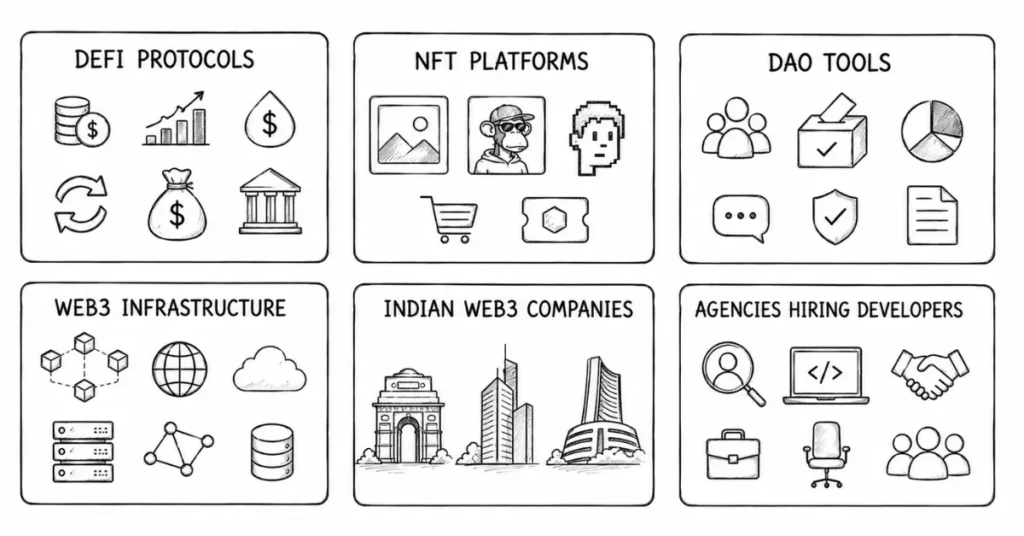
Where Web3 Developers Are Hired
DeFi Protocols: Platforms like Uniswap, Aave, Compound need frontend developers building interfaces for their protocols.
NFT Platforms: Marketplaces like OpenSea, Foundation, and gaming projects need developers building minting and trading interfaces.
DAO Tools: Projects like Snapshot, Aragon, Colony build governance tools needing Web3 developers.
Web3 Infrastructure: Alchemy, Infura, The Graph need developers who understand both Web3 development and infrastructure.
Indian Web3 Companies: Polygon, WazirX, CoinDCX, and various startups actively hire Web3 developers in India.web3+1
Agencies and Studios: Web3 development agencies build dApps for clients—great places to gain diverse experience.
Required Skills for Job Applications
Core Requirements:
- Proficiency in React and modern JavaScript/TypeScript
- Experience with Ethers.js or Web3.js
- Understanding of smart contracts and blockchain basics
- 2-3 portfolio projects demonstrating Web3 integration
- Familiarity with Git/GitHub for version control
Bonus Skills That Help:
- Experience with Web3 design patterns and best practices
- Knowledge of Solidity for better understanding of contracts
- Backend development (Node.js, Python) for full-stack roles
- Experience with The Graph for efficient data querying
- Understanding of Web3 security considerations
Salary Expectations:
Entry-Level (0-2 years Web experience, new to Web3): ₹6-10 lakhs
- Junior Web3 frontend developer
- dApp developer learning on the job
- Internships: ₹3-5 lakhs
Mid-Level (2-4 years Web experience, 1-2 years Web3): ₹10-16 lakhs
- Independently build and deploy dApps
- Mentor junior developers
- Contribute to architecture decisions
Senior (5+ years experience, 3+ years Web3): ₹16-25 lakhs
- Lead frontend development for major protocols
- Make technical decisions for projects
- Represent engineering in cross-functional teams
International Remote: $50,000-100,000+ (₹40-82 lakhs)
- Work with global teams
- Requires strong English communication
- Often includes token compensation
Interview Preparation
Technical Challenges:
- Build a simple dApp connecting to a smart contract (2-3 hours)
- Add wallet connection to an existing React app
- Fix bugs in provided Web3 code
- Optimize gas costs for transactions
System Design:
- “Design a decentralized Twitter”
- “How would you build an NFT marketplace?”
- “Design a DeFi dashboard aggregating multiple protocols”
Focus on trade-offs: what belongs on-chain vs. off-chain, how to handle errors, optimizing for user experience.
Code Review:
Review existing dApp code and identify:
- Security issues (exposing private keys, unsigned transactions)
- UX problems (poor error handling, confusing flows)
- Performance issues (unnecessary blockchain queries)
- Best practice violations
Conceptual Questions:
- “Explain how MetaMask works”
- “What’s the difference between Web3.js and Ethers.js?”
- “How do you handle transaction failures?”
- “What are gas fees and how do they affect UX?”
Career Growth and Specialization
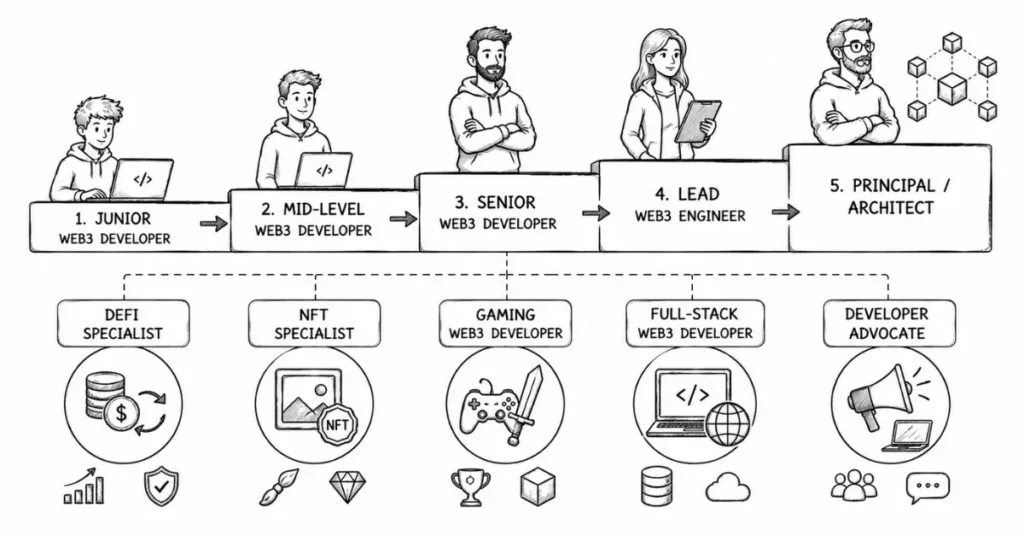
Web3 Developer Career Progression
Junior Web3 Developer → Web3 Developer → Senior Web3 Developer → Staff/Principal Engineer → Engineering Manager or Architect
Each step requires broader responsibilities:
- Junior: Implement features from specifications
- Mid-Level: Design and implement complete features independently
- Senior: Lead major projects, mentor others, influence technical direction
- Staff/Principal: Set technical strategy, cross-team leadership
- Manager/Architect: People management or deep technical specialization
Specialization Options
DeFi Frontend Specialist: Focus specifically on DeFi interfaces. Requires understanding financial concepts, complex state management, and real-time updates. High compensation given DeFi’s complexity and value locked.
NFT Platform Developer: Specialize in NFT minting, marketplaces, and galleries. Combines Web3 skills with creative aspects. Growing rapidly with NFT adoption.
Web3 Gaming: Build interfaces for play-to-earn games and metaverses. Intersection of gaming and Web3 offers exciting creative opportunities.
Full-Stack Web3 Developer: Add backend, smart contract, and infrastructure skills to become fully independent. Can build complete dApps solo, valuable for startups.
Web3 Developer Advocate: Combine development skills with teaching and content creation. Work for protocols/infrastructure companies helping others build on their platforms.
Challenges and How to Overcome Them
Challenge 1: Web3 User Experience Complexity
Web3 introduces friction: users need wallets, must sign transactions, pay gas fees, wait for confirmations. This creates worse UX than Web2 apps.
Solution: Design progressively. Start users with features not requiring transactions. Abstract complexity where possible—handle gas estimation automatically, provide clear transaction status, offer fallbacks when transactions fail.
Challenge 2: Rapidly Changing Ecosystem
Libraries, best practices, and tools evolve constantly. Today’s optimal approach may be deprecated in six months.
Solution: Build strong fundamentals in core concepts. Learn principles behind tools, not just tools themselves. Follow key developers and projects on Twitter. Participate in Web3 developer communities.
Challenge 3: Limited Debugging Tools
Web3 debugging is harder than traditional web development. Transactions fail for unclear reasons, contract events don’t fire, or wallets behave unexpectedly.
Solution: Learn to use Hardhat local development environment for testing. Use Tenderly for debugging failed transactions. Master browser dev tools for finding wallet connection issues. Build debugging skills systematically.
Challenge 4: Security Considerations
Web3 dApps handle users’ money directly. Security bugs can drain user funds, even if the smart contract itself is secure.
Solution: Never store or transmit private keys in frontend code. Validate all user inputs. Show users exactly what transactions do before signing. Follow Web3 security best practices from Day 1.
The Future of Web3 Development
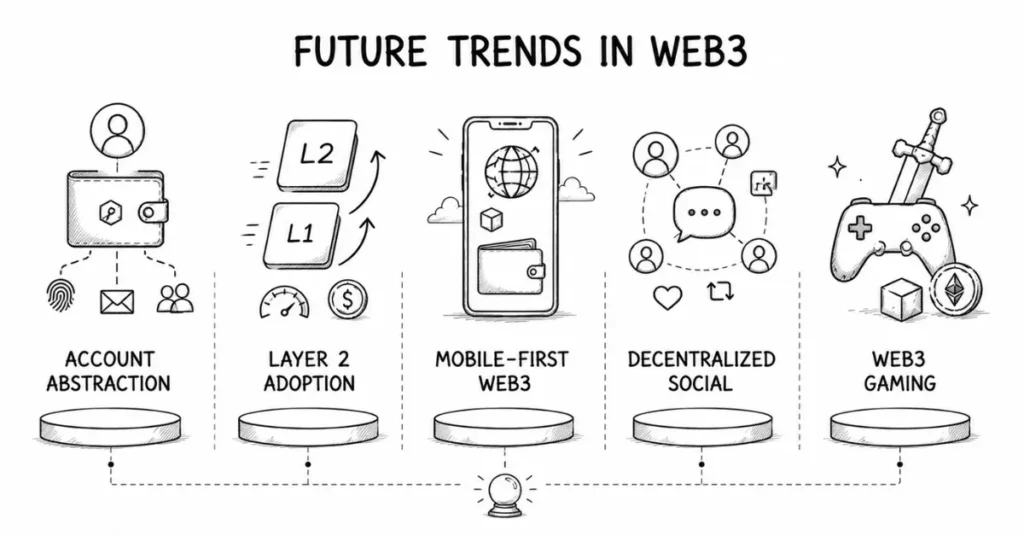
Web3 development is still early—equivalent to web development around 2005-2008. The fundamental technology is proven, but user experience, tooling, and best practices are still evolving. This creates extraordinary opportunities for developers entering now.
Emerging Trends:
Account Abstraction: Making wallets as easy to use as Web2 logins—no seed phrases, built-in 2FA, spending limits. Will dramatically improve UX and expand adoption.
Layer 2 Adoption: Most dApps moving to Layer 2 solutions (Polygon, Arbitrum, Optimism) for lower fees and faster transactions. Web3 developers will need to understand cross-layer interactions.
Mobile-First Web3: Current Web3 is desktop-heavy. Future is mobile-first, requiring developers skilled in mobile Web3 patterns and wallet integration.
Decentralized Social: Web3 social platforms (Lens Protocol, Farcaster) challenging traditional social media. Developers building decentralized social apps will be in high demand.
Web3 Gaming: Play-to-earn and NFT-based gaming continuing to grow, requiring developers combining game development with Web3 skills.
Conclusion: Your Web3 Developer Journey Starts Now
Web3 development offers the perfect blend of accessibility and opportunity. If you already know web development, you’re remarkably close to becoming a Web3 developer just 2-4 months of focused learning separates you from this high-paying, future-focused career path. If you’re new to development entirely, learning Web3 development alongside traditional web skills positions you perfectly for the next decade of internet evolution.
The demand for Web3 developers far exceeds supply. Every DeFi protocol, NFT project, DAO, and Web3 platform needs skilled frontend developers who can bridge the gap between blockchain technology and user-friendly interfaces. With India becoming the world’s largest Web3 developer hub, opportunities will only multiply.
Start your journey today. Connect MetaMask to a dApp and examine how it works. Clone a simple Web3 project and modify it. Take the first lesson of a Web3 development course. These small actions build toward career-transforming skills. The decentralized internet of tomorrow will be built by developers who decided to start learning today let that be you.