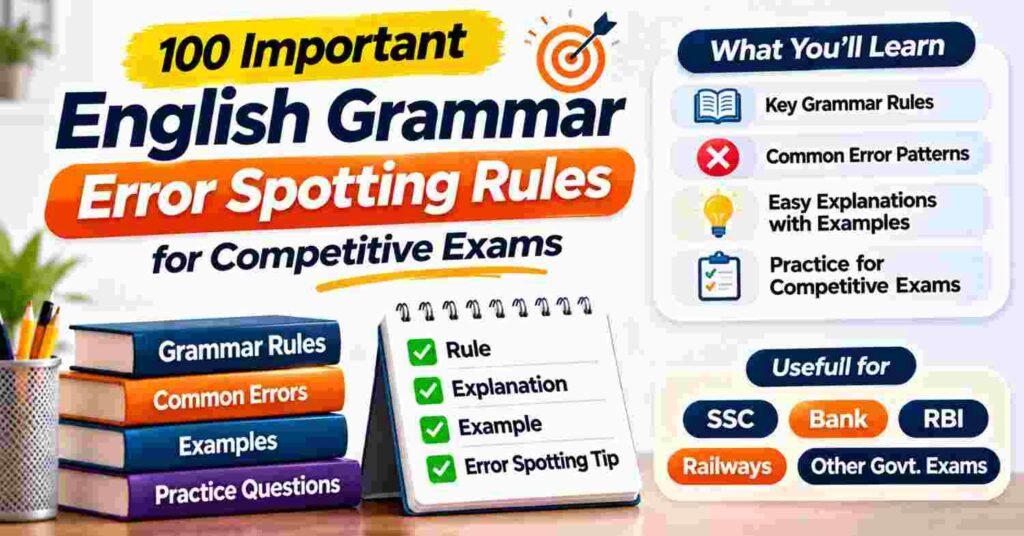
Scoring well in the English section of competitive exams requires more than vocabulary alone. Candidates also need a strong understanding of grammar rules, sentence structure, verb usage, articles, pronouns, prepositions, and common error patterns.
This guide presents 100 important English Grammar Error Spotting Rules designed for competitive-exam preparation, including exams such as SSC CGL, Banking Exams, and UPSC-related English practice. Each rule is explained using a wrong sentence, corrected sentence, and a short explanation, making it easier to understand how common grammatical errors occur.
The rules cover key areas such as Subject–Verb Agreement, Tenses, Articles, Pronouns and Relative Pronouns, Modals and Auxiliary Verbs, Prepositions, Gerunds and Conjunctions, Voice and Narration, Special Nouns, and Adjectives and Comparison.
By practising these rules regularly, learners can improve their ability to identify grammatical errors quickly and build stronger accuracy for sentence correction and error-spotting questions.
These 100 English Grammar Error Spotting Rules provide a practical revision resource for candidates preparing for competitive examinations.
The guide focuses on frequently tested grammar areas such as Subject–Verb Agreement, Tenses, Articles, Pronouns, Modals, Prepositions, Gerunds, Conjunctions, Voice, Narration, Special Nouns, and Comparison Rules. Each topic is supported by incorrect and corrected sentence examples, helping learners understand both the rule and its practical application.
The final revision checklist recommends prioritising high-value topics, practising at least 20 error-spotting questions daily, revising verb-preposition combinations, understanding V1, V2 and V3 forms, and taking weekly mock tests to improve speed and accuracy.
Consistent practice with these rules can help candidates reduce common grammar mistakes and approach English error-spotting questions with better confidence and accuracy.