
Customer Success Job Roles and Responsibilities
Table of Contents
Introduction
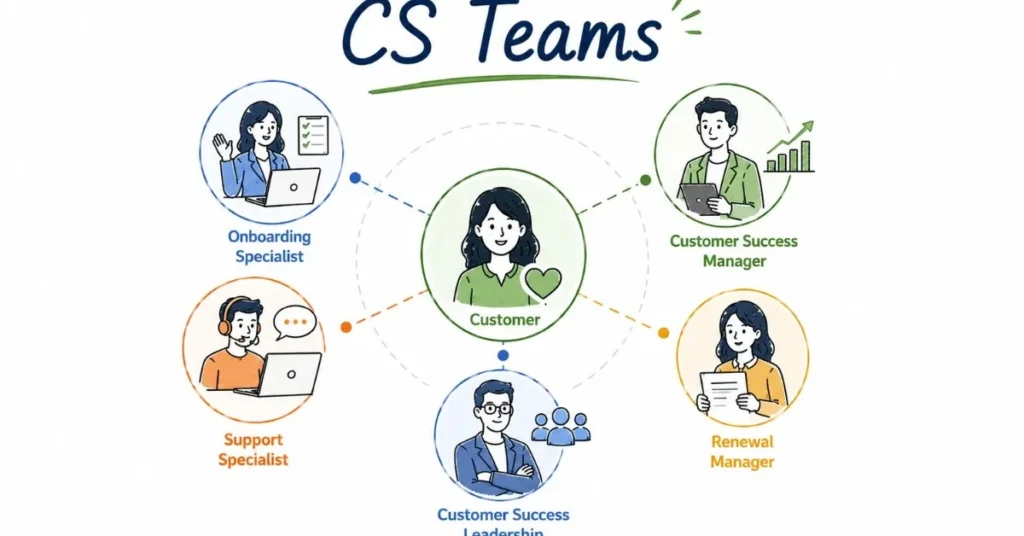
When Neha from Chennai was promoted from Customer Success Associate to Customer Success Manager last year, her father proudly announced to relatives, “My daughter got promoted to Manager!” Everyone congratulated her, but she could see the confusion in their eyes. Manager of what, exactly?
This confusion is common because Customer Success is still relatively new in India, and the role structures aren’t widely understood. Unlike traditional careers where everyone knows what an “Accountant” or “Sales Manager” does, Customer Success roles have varied titles, responsibilities, and expectations.
If you’re exploring Customer Success as a career or trying to figure out your next move within the field, understanding the complete role hierarchy is crucial. This guide breaks down every Customer Success position from entry-level to C-suite, explaining what each role actually does daily, what skills you need, how much you can earn, and how to progress from one level to the next.
By the end, you’ll know exactly where you fit and where you can go in your Customer Success career journey.
Understanding Customer Success Team Structures
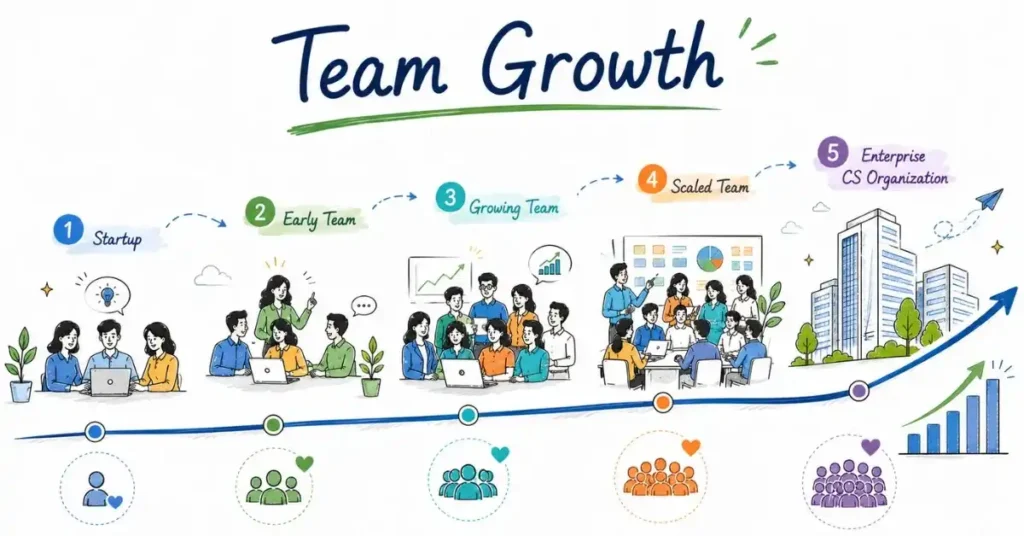
Before diving into specific roles, let’s understand how Customer Success teams are typically organized in Indian companies.
Small Startups (10-50 employees):
At this stage, companies might have 1-2 people handling all customer-facing work support, onboarding, renewals, everything. Titles might be vague: “Customer Success Executive” or “Customer Happiness Manager.” Everyone wears multiple hats.
Growing Startups (50-200 employees):
Companies begin separating functions. You’ll see distinct Customer Success and Customer Support teams. CS might have 3-5 people with one Team Lead. Roles start specializing someone handles onboarding, others manage ongoing accounts.
Mid-Sized Companies (200-500 employees):
CS becomes a full department with 10-20 people, clear hierarchy, and specialized roles. There’s a CS Manager or Director, multiple CSMs handling different account segments (SMB, mid-market, enterprise), dedicated onboarding specialists, maybe a CS Operations person handling data and processes.
Large Companies (500+ employees):
Fully mature CS organizations with 50+ people, multiple teams based on customer segments or product lines, a VP or Chief Customer Officer leading the function, and highly specialized roles like Technical CSMs, CS Analysts, Renewal Managers, and Customer Education Managers.
Your career trajectory depends partly on company size. Small companies offer broad experience; large companies offer specialization and structure.
Entry-Level Roles: Your Starting Point
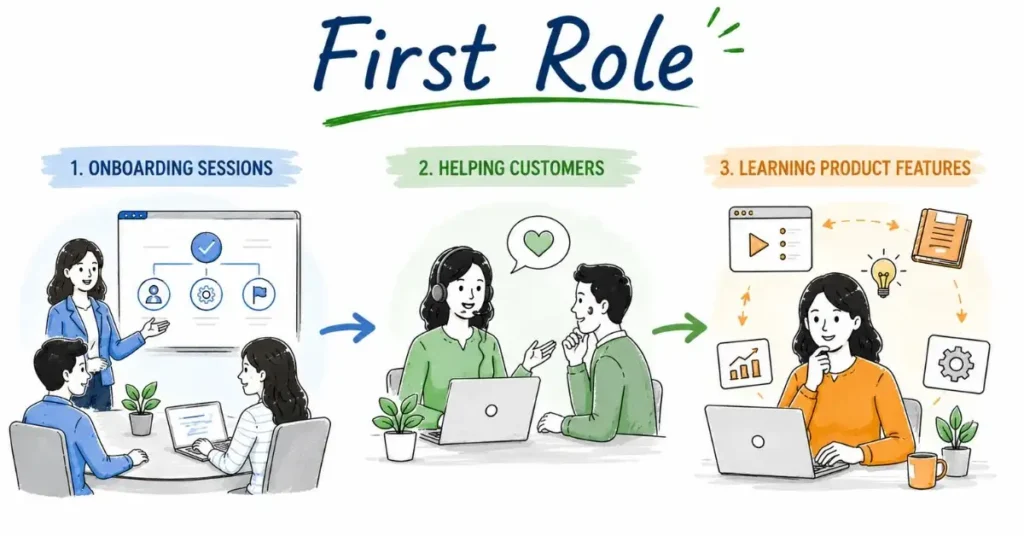
1. Customer Success Associate / Customer Support Specialist
Experience Level: 0-2 years
Typical Salary in India: ₹3-6 lakhs per annum[payscale]
What You’ll Actually Do:
This is where most people start, and honestly, it’s not glamorous. You’re the CS team’s support system, handling tasks that senior CSMs don’t have time for.
Daily Responsibilities:
- Responding to customer emails and basic queries (30-40% of your time)
- Scheduling calls for senior CSMs and sometimes attending to take notes
- Updating CRM records with customer interaction details
- Running basic usage reports and highlighting concerning trends
- Assisting with customer onboarding sending welcome emails, sharing documentation, conducting basic training sessions
- Managing a portfolio of 30-50 small accounts with low complexity
- Handling administrative tasks like updating spreadsheets, maintaining documentation, and coordinating with other teams
Real Example:
Karthik, a Customer Success Associate at a Bangalore SaaS company, spends his mornings responding to customer queries about how to use specific features. In the afternoon, he conducts three 30-minute onboarding calls with new customers, walking them through basic setup. He updates the CRM after each interaction and prepares a weekly report showing which customers haven’t logged in recently. It’s repetitive but teaches him the product inside-out.
Skills You Need:
- Clear written and verbal communication
- Basic CRM familiarity (you’ll learn the specific tool on the job)
- Patience and attention to detail
- Ability to follow processes
- Comfortable learning new software quickly
Career Growth:
Most people spend 12-24 months in this role before moving to full Customer Success Manager positions. The key is demonstrating ownership, exceeding expectations, and constantly learning.
Honest Reality Check:
This role involves significant grunt work. You’ll do data entry, send routine emails, and handle repetitive tasks. But you’re building foundational product knowledge and customer understanding that becomes invaluable later. Don’t skip this stage embrace it as your learning period.
2. Customer Onboarding Specialist
Experience Level: 1-3 years
Typical Salary in India: ₹4-7 lakhs per annum
What You’ll Actually Do:
Some companies separate onboarding into a dedicated role. You’re responsible for the critical first 60-90 days of a customer’s journey the period that determines whether they’ll become long-term customers or churn quickly.
Daily Responsibilities:
- Conducting structured onboarding calls (4-6 per day)
- Creating personalized onboarding plans based on customer goals
- Training customers on product features and best practices
- Monitoring early adoption metrics and intervening when customers struggle
- Creating onboarding documentation, videos, and resources
- Coordinating handoff to account management teams after onboarding completion
- Tracking time-to-value metrics
Real Example:
Priyanka specializes in onboarding for a fintech company. When a new customer signs up, she schedules a kickoff call within 24 hours, understanding their specific use case. She creates a customized 45-day onboarding plan, conducts three training sessions, sends resource materials, and monitors their progress. Once the customer achieves their first “success milestone” (maybe processing their first successful transaction), she hands them over to a Customer Success Manager for ongoing relationship management.
Skills You Need:
- Training and presentation abilities
- Project management (managing multiple onboarding journeys simultaneously)
- Pattern recognition (identifying common obstacles)
- Creating instructional content
- Patience with confused customers
Career Growth:
This role can lead to Customer Success Manager positions, Customer Training Manager roles, or CS Operations if you prefer process optimization over direct customer interaction.
Mid-Level Roles: Where Strategy Begins
3. Customer Success Manager (CSM)
Experience Level: 2-5 years
Typical Salary in India: ₹8-16 lakhs per annum
What You’ll Actually Do:
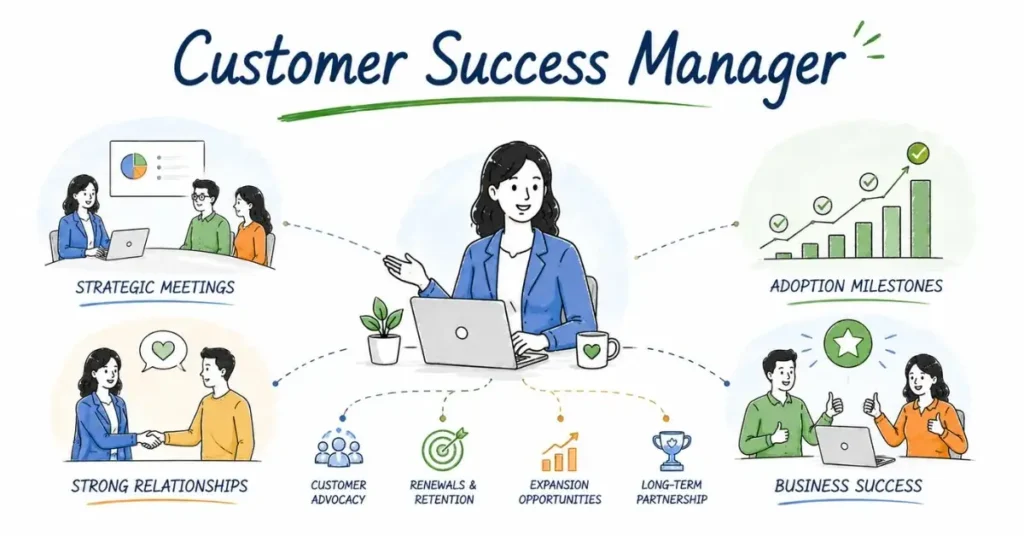
This is the core Customer Success role. You own a portfolio of accounts end-to-end, responsible for their satisfaction, retention, and growth.
Daily Responsibilities:
- Managing 15-30 mid-market accounts (varies by company)
- Conducting regular check-in calls and Quarterly Business Reviews (QBRs)
- Monitoring customer health scores and proactively addressing risks
- Identifying and solving adoption barriers
- Coordinating with Support, Product, and Sales teams on customer issues
- Presenting product updates and roadmap
- Managing contract renewals and negotiating terms
- Identifying upsell and cross-sell opportunities (though not always primarily responsible for closing them)
- Analyzing usage data and creating customer-specific recommendations
- Serving as the voice of the customer internally
Real Example:
Aman manages 22 accounts for an HR software company. His typical week includes five customer calls (mix of regular check-ins, problem-solving sessions, and one QBR), analyzing health scores for all accounts and creating action plans for three “at-risk” customers, attending internal meetings with Product team to discuss customer feature requests, preparing a renewal presentation for his largest account, and handling numerous emails and Slack messages coordinating customer issues.
Negotiation and Communication:
- Strategic thinking beyond day-to-day issues
- Data analysis and presenting insights
- Relationship building at multiple organizational levels
- Comfortable with CRM and CS platforms (Gainsight, Totango, etc.)
- Negotiation for renewals and upgrades
- Time management across multiple accounts
- Business acumen understanding customers’ businesses, not just your product
What Success Looks Like:
Good CSMs maintain 90%+ renewal rates, drive 10-20% account expansion through upsells, maintain high NPS scores (50+), and consistently keep their accounts “green” on health scores. They’re proactive rather than reactive, anticipating problems before customers complain.
Career Growth:
After 3-4 years as CSM, you can move to Senior CSM managing larger accounts, Team Lead managing other CSMs, or specialize into Technical CSM or Strategic CSM roles.
Honest Reality Check:
This role is the heart of Customer Success, but it’s also where pressure intensifies. You’re measured on metrics churn rate, renewal rate, expansion revenue. When customers cancel, it’s personally disappointing and professionally stressful. You’ll spend significant time in internal meetings defending customer requests against company constraints. It’s rewarding but demanding.
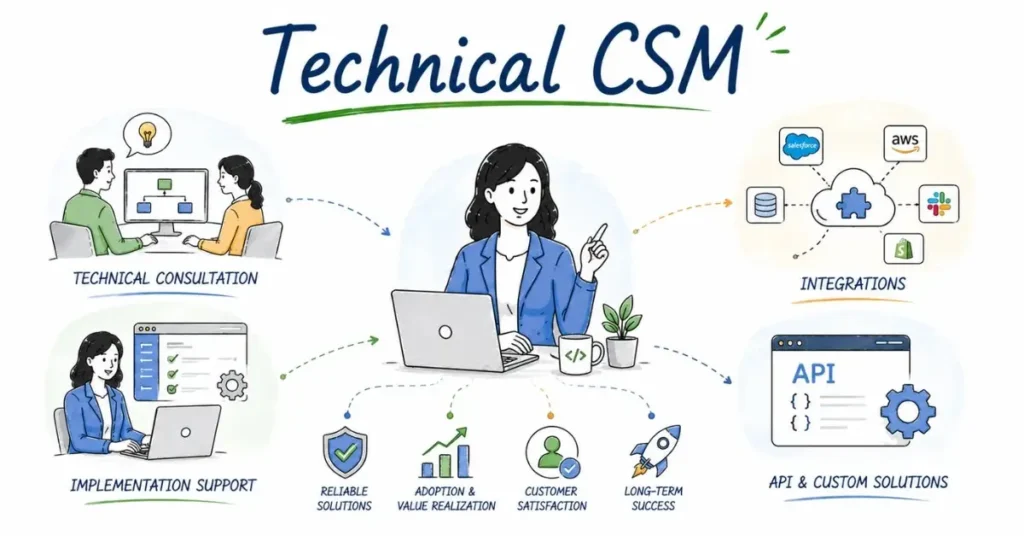
4. Technical Customer Success Manager
Experience Level: 3-6 years (including technical background)
Typical Salary in India: ₹10-18 lakhs per annum
What You’ll Actually Do:
This specialized role exists in companies with complex, technical products developer tools, API platforms, infrastructure software, data solutions. You need both CS skills and technical chops.
Daily Responsibilities:
- Managing technical accounts requiring deep product expertise
- Assisting with API integrations and technical implementations
- Troubleshooting complex technical issues alongside support engineers
- Conducting technical workshops and training
- Reviewing customers’ technical architecture and recommending optimizations
- Translating technical customer feedback for Product and Engineering teams
- Creating technical documentation and best practice guides
- Working with customers’ technical teams (developers, IT admins, data engineers)
Real Example:
Vikram works as a Technical CSM for an API platform company. His customers are software companies integrating his company’s APIs into their products. He helps them design integration architectures, troubleshoot authentication issues, optimize API calls for performance, and stays updated on technical roadmap. He speaks the language of developers and can read code, though he’s not writing it daily.
Skills You Need:
- Understanding of APIs, databases, and software architecture
- Ability to read and understand code (not necessarily write it)
- Technical troubleshooting skills
- Translating technical concepts for non-technical stakeholders
- All standard CSM skills plus technical depth
Career Growth:
Can progress to Senior Technical CSM, Solutions Architect, Technical Account Manager, or Product Management roles given the unique blend of customer insight and technical knowledge.
Senior-Level Roles: Leadership Emerges
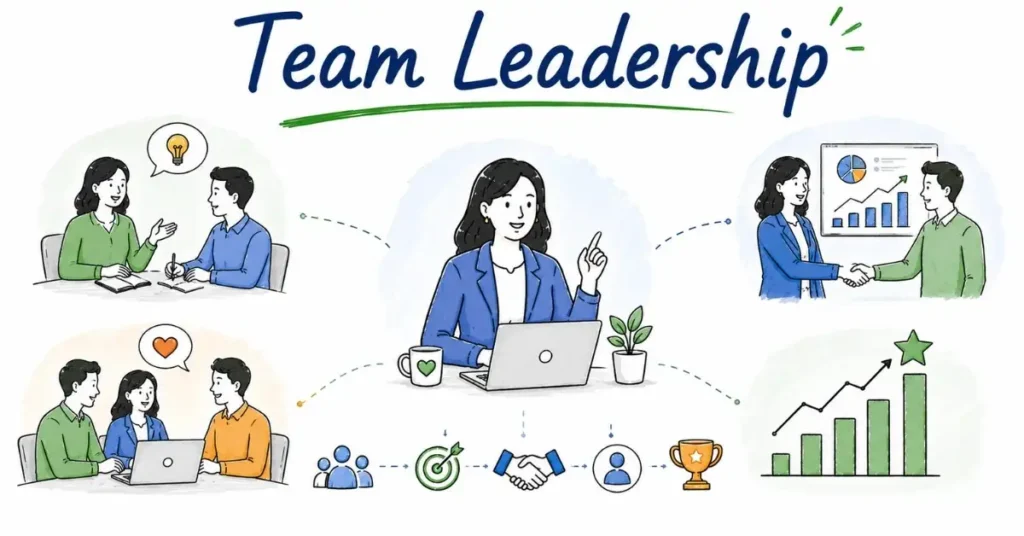
5. Senior Customer Success Manager / CSM Team Lead
Experience Level: 5-8 years
Typical Salary in India: ₹18-30 lakhs per annum
What You’ll Actually Do:
This role comes in two flavors either managing a small number of very large, strategic accounts, or leading a team of CSMs while managing some accounts yourself.
Daily Responsibilities (Strategic Account Path):
- Managing 5-10 enterprise accounts worth ₹20+ lakhs each annually
- Building relationships with C-level executives at customer companies
- Creating strategic account plans for multi-year growth
- Conducting Executive Business Reviews (EBRs) with customer leadership
- Coordinating complex, multi-stakeholder relationships within large organizations
- Leading account teams (involving Solutions Engineers, Support, Sales)
- Negotiating large contract renewals and expansions
Daily Responsibilities (Team Lead Path):
- Managing 3-5 Customer Success Managers
- Conducting weekly one-on-ones and performance reviews
- Creating CS playbooks, processes, and best practices
- Analyzing team metrics and identifying improvement areas
- Handling escalations when CSMs can’t resolve issues
- Training and mentoring junior team members
- Contributing to CS strategy alongside director
Real Example:
Meera leads a team of four CSMs at a Pune-based company. She spends mornings reviewing her team’s accounts, identifying risks, and coaching team members on handling complex situations. Afternoons involve customer escalations (when CSMs need help), internal meetings about CS strategy, and documenting processes. She also manages two large accounts herself to stay connected to customer realities.
Skills You Need:
- Executive presence and communication
- People management and coaching
- Strategic account planning
- Advanced negotiation skills
- Ability to influence without authority (coordinating cross-functional teams)
- Process thinking and documentation
- Strong business acumen
Career Growth:
Typically moves to Director of Customer Success within 2-3 years, or pivots to Director of Sales, Product Management, or Operations roles.
6. Customer Success Operations Manager
Experience Level: 4-7 years
Typical Salary in India: ₹15-25 lakhs per annum
What You’ll Actually Do:
This is the behind-the-scenes role that keeps Customer Success machinery running. You’re not managing customers directly you’re optimizing how the CS team operates.
Daily Responsibilities:
- Managing and optimizing CS tools and platforms (Gainsight, CRM integrations)
- Building dashboards and reports for CS leadership
- Analyzing CS metrics across the organization
- Defining customer segmentation models
- Creating and refining CS playbooks and processes
- Automating routine tasks and workflows
- Forecasting churn and expansion revenue
- Conducting CS performance analyses and identifying trends
Real Example:
Arjun never talks to customers but is crucial to his company’s CS success. He built the automated health scoring model that predicts churn risk, created dashboards that CSMs check daily, designed the onboarding workflow reducing time-to-value by 40%, and runs weekly analyses showing which customer segments have the highest LTV. He’s the data brain behind CS strategy.
Skills You Need:
- Advanced Excel and data analysis
- CRM and CS platform expertise
- Process optimization thinking
- Business intelligence tools (Tableau, Looker)
- Project management
- Systems thinking
Career Growth:
Can move to Director of CS Operations, Revenue Operations, or general Operations leadership roles. This is perfect for people who love Customer Success outcomes but prefer working with data and systems over people.
Leadership Roles: Driving Strategy
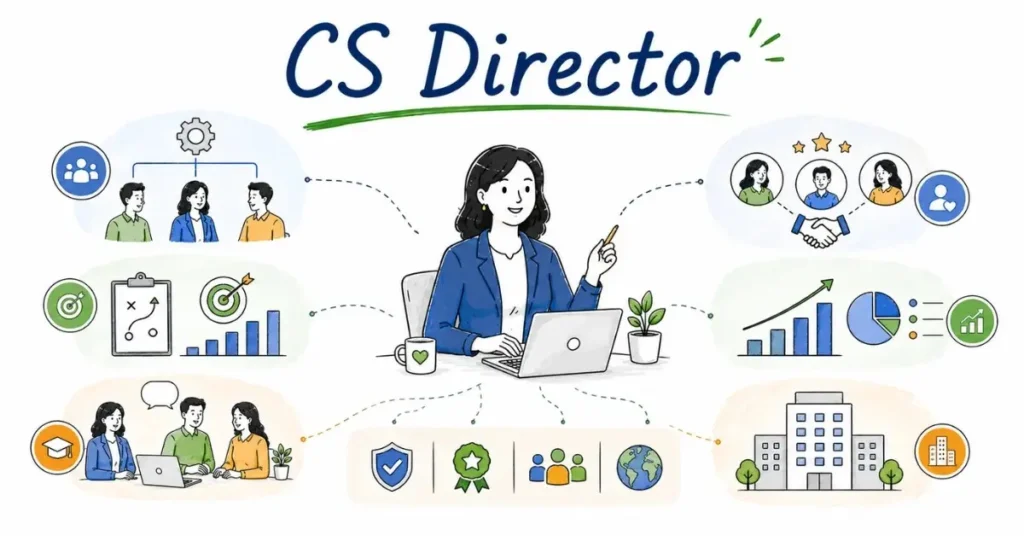
7. Director of Customer Success
Experience Level: 8-12 years
Typical Salary in India: ₹30-50 lakhs per annum
What You’ll Actually Do:
You own Customer Success for a business unit, product line, or geographic region. This is where you transition from doing to leading.
Daily Responsibilities:
- Setting CS strategy and goals (retention targets, expansion goals)
- Managing a team of 10-30 people (CSMs, Team Leads, Specialists)
- Hiring, performance management, and developing talent
- Budget planning and resource allocation
- Collaborating with Sales, Product, Marketing, and Support leadership
- Presenting CS performance to executive leadership
- Defining customer segmentation and coverage models
- Building CS infrastructure (tools, processes, playbooks)
- Representing customer voice in company strategic decisions
Real Example:
Rajesh directs Customer Success for a company’s mid-market segment. He manages 25 people organized into four teams, each led by a Senior CSM. He sets quarterly retention and expansion targets, decides which CS platforms to invest in, defines how accounts are distributed among CSMs, and presents monthly CS performance to the CEO. When a major customer threatens to churn, he personally gets involved. He spends 60% of time on people management and strategy, 30% on cross-functional coordination, and 10% on direct customer interaction.
Skills You Need:
- Proven people leadership
- Strategic thinking and planning
- Financial acumen (managing budgets, calculating ROI)
- Cross-functional influence
- Change management
- Executive communication
- Understanding of customer success economics
Career Growth:
Typically progresses to VP of Customer Success, Chief Customer Officer, or moves laterally to VP of Sales, COO, or General Manager roles.
8. VP of Customer Success / Chief Customer Officer
Leadership Level (8+ years): Head of Influencer Marketing/VP:
Experience Level: 12+ years
Typical Salary in India: ₹50 lakhs – ₹1 crore+ per annum
What You’ll Actually Do:
You’re a senior executive responsible for the entire customer success function across the organization, reporting to the CEO or COO.
Daily Responsibilities:
- Defining company-wide customer success vision and strategy
- Building CS organization from scratch or scaling it significantly
- Managing Directors and senior leadership team
- Owning retention and expansion revenue (often ₹50+ crores)
- Partnering with CEO, CRO, and Board on company strategy
- Representing customer perspective in all major company decisions
- Driving cross-functional initiatives (Product roadmap, Marketing strategy, Sales process)
- Building customer advisory boards and community programs
- Speaking at conferences, building the company’s CS brand
- In some companies, also owning Support, Professional Services, or Customer Education
Real Example:
Anita is the Chief Customer Officer at a major Indian SaaS company. She leads 80 people across Customer Success, Support, and Training functions. She reports directly to the CEO, presenting monthly on customer health, retention rates, and expansion revenue. She influences product roadmap based on customer feedback patterns, partners with the CRO on go-to-market strategy, and personally manages relationships with the company’s top 10 strategic accounts. Her compensation includes significant equity because she’s measured on overall company retention and expansion metrics that directly impact valuation.
Skills You Need:
- Visionary leadership
- P&L ownership and financial management
- Board-level communication
- Organizational design and scaling
- Strategic partnerships
- Influencing company culture
- Deep understanding of SaaS business models
Career Growth:
This is often the pinnacle of CS-specific careers, though some move to CEO, COO, or Board positions. Others transition to consulting, advising startups, or starting their own companies.
Specialized Roles: Niche Paths
- Customer Education Manager / Training Specialist
Creates training content, webinars, certification programs, and educational resources. Perfect for people who love teaching and content creation. Salary: ₹10-20 lakhs depending on experience.
- Renewal Manager / Retention Specialist
Focuses specifically on contract renewals, handling 60-90 days before renewal. Measures success purely on renewal rates. Often has variable compensation tied to renewed revenue. Salary: ₹8-18 lakhs.
- Customer Experience (CX) Analyst
Deep data analysis role building predictive models, analyzing churn patterns, creating segmentation models. More analytical than customer-facing. Salary: ₹12-22 lakhs.
- Implementation/Solutions Consultant
Handles complex technical implementations for enterprise customers, working closely with customer IT teams during initial setup. Bridges gap between Sales and CS. Salary: ₹12-24 lakhs.
Your Career Progression Path
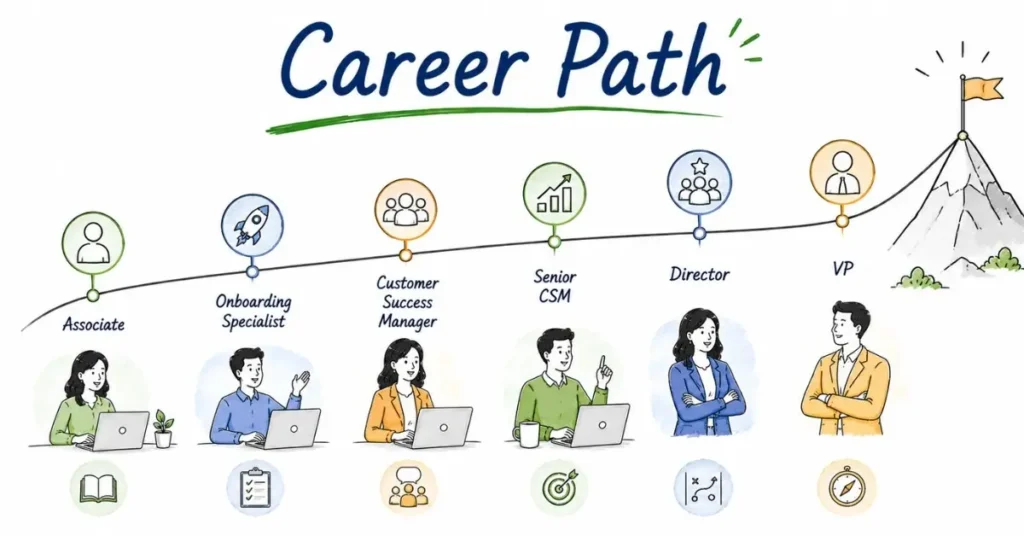
Here’s a realistic timeline of how your Customer Success career might progress:
Years 0-2: Customer Success Associate, learning fundamentals, managing small accounts, building product knowledge
Years 2-5: Customer Success Manager, owning accounts, driving renewals, developing strategic skills
Years 5-8: Senior CSM or Team Lead, managing large accounts or leading small teams
Years 8-12: Director level, owning strategy for a segment or region
Years 12+: VP/CCO level, leading entire function
This timeline can compress or extend based on company growth, your performance, and career moves. Moving companies often accelerates progression more than staying at one place.
Choosing Your Path
As you can see, Customer Success offers diverse paths:
- Generalist Path: Associate → CSM → Senior CSM → Director → VP
- Technical Path: Technical CSM → Senior Technical CSM → Solutions Architect → Product
- Operations Path: CSM → CS Operations → Director CS Ops → VP Operations
- Training Path: CSM → Education Manager → Director of Customer Education
- Analytics Path: CS Analyst → Senior Analyst → Director of CX Analytics
Your choice depends on what energizes you: people, technology, data, process, or education.
Conclusion
Customer Success offers remarkably clear career progression compared to many fields. The roles, responsibilities, and salary ranges are well-defined. The demand is strong. The growth potential is real.
Whether you’re just starting as an Associate or aiming for VP level, understanding the complete landscape helps you make informed decisions about which skills to develop, which roles to target, and how to navigate your career strategically.
The question isn’t whether opportunities exist they absolutely do. The question is: which path will you choose?