
Content Preparation and Knowledge Building
Table of Contents
Blog Content:
The Hidden Advantage of Content-Rich Speakers
Two equally skilled speakers face the same JAM topic: “Artificial Intelligence in Education.”
Speaker A has a surface-level understanding. They know AI exists and it’s used in education somehow. Their speech is generic: “AI can help students learn. Teachers can use it for grading. It’s the future of education.”
Speaker B has spent time building content knowledge. They reference specific examples: “AI tutoring systems like Carnegie Learning personalize learning paths. Machine learning algorithms analyze student performance to identify knowledge gaps. Platforms like Coursera use AI to recommend content. However, concerns exist about algorithmic bias and data privacy…”
Both speeches are grammatically correct and well-delivered. But Speaker B sounds infinitely more credible, confident, and impressive.
Why? Because knowledge gives confidence.
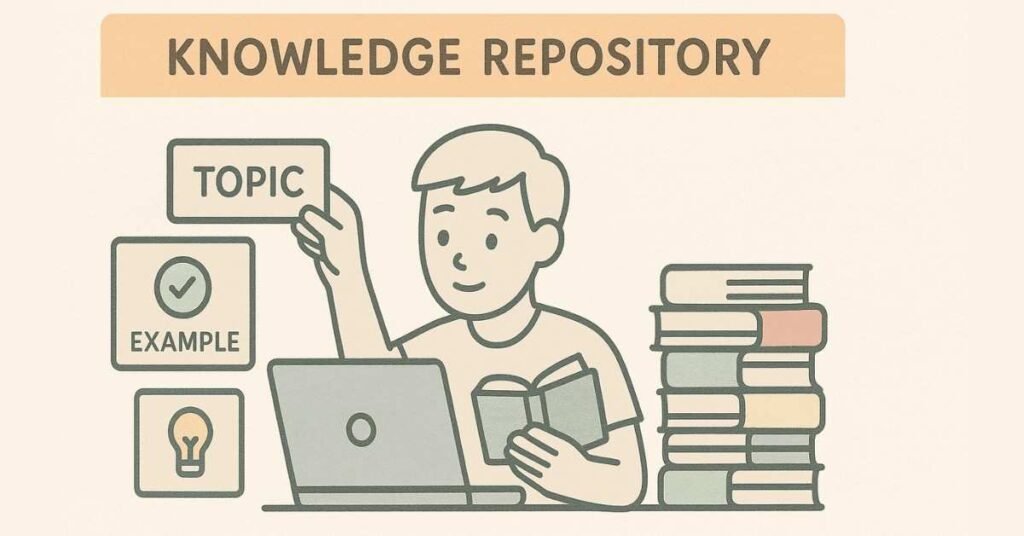
When you have examples, data points, and perspective to draw from, you speak with authority. Your mind works faster because you’re not searching for content—you’re selecting from a rich repository.
The Knowledge Preparation Strategy
Building this repository requires systematic daily effort. You don’t need to be an expert in everything. You just need enough knowledge about many things to speak intelligently for 60 seconds.
The 30-Minute Daily Preparation Routine
Commit to just 30 minutes daily. This is your content-building investment:
Segment 1: Current Affairs (10 minutes)
Read 2-3 news articles from credible sources daily. For each:
- Understand what happened
- Understand why it matters
- Identify one learning or implication
Good sources for India: Hindu, Indian Express, Economic Times, BBC, Reuters
Why this works: Current affairs topics appear frequently in JAM rounds. You’ll have recent examples when needed.
Content Storage Tip: Create a simple document or notes app with headlines and key points. You’re not memorizing—just building familiarity.
Segment 2: Industry/Career Content (10 minutes)
Read about your field or interest area (IT, Finance, Marketing, etc.). Understanding sector trends helps you speak authoritatively.
Good sources: LinkedIn articles, industry blogs, company announcements, startup news
Why this works: Role-specific topics are common in campus placements. Showing sector awareness impresses evaluators.
Example: If interviewing for an HR role, understanding HR tech trends, compensation models, and talent management strategies gives you massive advantage.
Segment 3: Soft Skills & Personal Development (10 minutes)
Read about communication, leadership, psychology, productivity, or well-being. These topics appear frequently in JAM.
Good sources: Medium blogs, Harvard Business Review, Psychology Today, TED transcripts
Why this works: Abstract and personal development topics require thoughtful examples. Reading others’ perspectives trains your thinking.
🔍 Explore structured learning resources designed to strengthen your knowledge foundation →
Building Your Personal JAM Topic Database
Don’t wait until your JAM round to think about potential topics. Proactively build a database of 50-100 topics you might face:
Category 1: Abstract Concepts (15-20 topics)
- Success
- Failure
- Change
- Patience
- Courage
- Happiness
- Leadership
- Creativity
- Trust
- Excellence
Category 2: Current Affairs (15-20 topics)
- Climate change
- Remote work
- AI and jobs
- Economic trends
- Social media regulation
- Education reform
- Space exploration
- Energy transition
- Political developments
- Global health
Category 3: Technology & Science (10-15 topics)
- Artificial Intelligence
- Blockchain
- Cybersecurity
- Renewable energy
- Genetic engineering
- Virtual reality
- Electric vehicles
- Quantum computing
- 5G technology
- Automation
Category 4: Social & Ethical (10-15 topics)
- Work-life balance
- Gender equality
- Environmental conservation
- Mental health awareness
- Online privacy
- Corporate social responsibility
- Sustainable living
- Education accessibility
- Diversity and inclusion
- Digital divide
Category 5: Personal & Lifestyle (10-15 topics)
- Reading
- Exercise
- Procrastination
- Time management
- Hobbies
- Relationships
- Career growth
- Travel
- Healthy eating
- Sleep quality
Database Creation Process:
For each topic in your database:
- Write the topic name
- Note 3-4 key angles you could take
- Write 2-3 relevant examples or statistics you know
- Identify which framework (STAR, Problem-Solution, etc.) works best
Example Database Entry:
Topic: “Importance of Reading”
Angles:
- Cognitive benefits (concentration, vocabulary, memory)
- Emotional intelligence and empathy
- Escape and mental wellness
- Knowledge and career advancement
Examples/Statistics:
- Studies show readers have better critical thinking
- Reading reduces stress more than any other activity
- Successful people consistently read 30+ minutes daily
- Readers develop richer vocabulary crucial for career
Best Framework: Comparison (reading vs. scrolling) or Benefits approach
Now when JAM asks about reading, you don’t start from zero. You have a prepared mental framework with examples ready.

📘 Discover more preparation-focused content to expand your thinking and awareness →
The Strategic Example Repository
Generic speeches lack impact. Specific examples make speeches memorable. Build a personal example library:
Personal Examples (Most Powerful)
- Challenges you’ve overcome
- Learning experiences
- Observations from your life
- People who inspired you
- Projects you’ve worked on
Real-World Examples
- Business success stories (Apple, Amazon, Netflix)
- Social change movements
- Scientific discoveries
- Sports achievements
- Entertainment/media moments
Statistical Examples
- Research findings
- Survey data
- Industry reports
- Academic studies
- Government statistics
Create a Simple Document:
Topic: Time Management
Personal: “When I started using time-blocking, I increased productivity by 40% and reduced stress significantly.”
Real-world: “Elon Musk famously time-blocks his schedule in 5-minute increments to manage multiple companies.”
Statistical: “Studies show that focused work blocks of 90 minutes followed by breaks maximize performance.”
When you have examples ready, your speech transforms from generic to compelling.

📂 Access complete learning materials to develop clarity, confidence, and deeper insight →
The Quick-Learning Method for Unfamiliar Topics
Sometimes you’ll face a topic you’ve never prepared for. Here’s how to quickly generate knowledge-based content:
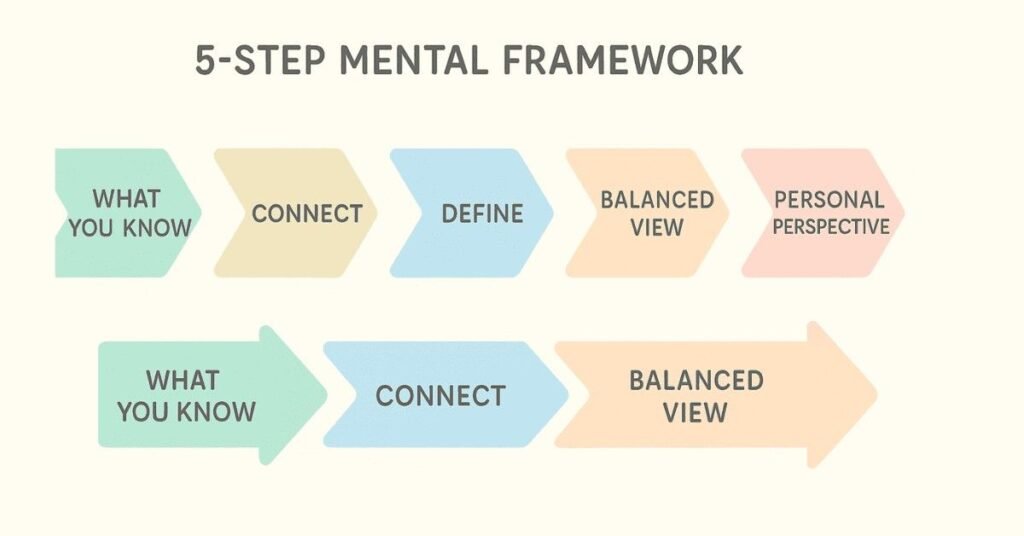
The 30-Second Mental Framework:
- Identify what you DO know about the topic or related topics
- Connect to universal experiences (something most people relate to)
- Use the definition angle (explain what it means fundamentally)
- Offer balanced perspective (pros and cons, multiple views)
- Share genuine observation (even “I haven’t thought deeply about this but…” is honest)
Example: Unexpected topic “Nanotechnology”
You’ve never studied nanotechnology specifically, but you can think:
Opening: “Nanotechnology is the science of manipulating matter at the atomic and molecular level.”
What you might know: Technology that’s incredibly small, used in electronics, medicine, materials
Connection: “Just as the internet revolutionized communication through miniaturization, nanotechnology promises similar breakthroughs in medicine and manufacturing.”
Angles: Medical applications, material science, challenges with implementation
Balanced view: “While nanotechnology offers incredible potential for disease treatment and stronger materials, we must carefully consider environmental and safety implications.”
Genuine perspective: “What’s clear is that nanotechnology, like all emerging technologies, will be transformational—but success depends on responsible development.”
You’ve delivered a credible speech on an unfamiliar topic by leveraging general knowledge and frameworks.

The "Learn 5 Things Weekly" Challenge
Make this your commitment for the next 3 months:
Weekly Goal: Learn 5 new things—one deep fact about 5 different topics
Sunday Night Routine (20 minutes):
- Pick 5 topics you know little about
- Read one article or watch one short video on each
- Write down: what it is, why it matters, one interesting detail
By end of Month 1: You’ll know something about 20+ topics
By end of Month 3: You’ll have knowledge across 60+ diverse topics
This creates a mental library you can draw from instantly. When a JAM topic comes up, you likely have some relevant knowledge or perspective stored.
Building Perspective and Critical Thinking
Knowledge isn’t just facts—it’s perspective. Develop the ability to see multiple angles:
The Perspective Exercise:
For any topic, practice thinking about:
- Individual perspective: How does this affect a person?
- Organizational perspective: How does this affect businesses?
- Societal perspective: How does this affect society?
- Global perspective: How does this affect the world?
- Future perspective: What will this look like in 5-10 years?
Example: Social Media
- Individual: Impacts attention span, mental health, self-esteem
- Organizational: Creates new marketing channels, employment opportunities
- Societal: Changes social dynamics, creates community vs. division
- Global: Enables global connection, spreads misinformation globally
- Future: AI-driven personalization will be more sophisticated; regulation likely
Practicing this regularly trains your brain to generate multiple angles instantly during JAM.
Curated Content Sources for Indian Students
To build knowledge efficiently, follow these sources:
Daily News & Current Affairs (5 minutes daily):
- The Hindu (reliable, comprehensive)
- Indian Express (editorial quality)
- Mint (business and economics)
Tech & Industry (3 times weekly):
- TechCrunch India
- LinkedIn Top Voices
- YourStory
Soft Skills & Psychology (3 times weekly):
- Medium’s top publications
- TED Talks transcripts
- Harvard Business Review
Government & Policy (2 times weekly):
- The Wire
- Scroll.in
- NITI Aayog reports
YouTube Channels (10-15 minutes, 2-3 times weekly):
- Kurzgesagt (science simplified)
- TED-Ed (educational content)
- Crash Course (comprehensive topics)
Podcasts (Listen while commuting):
- The Daily (New York Times)
- Freakonomics (economics and behavior)
- IVM Podcasts (Indian perspectives)
🧭 Continue your learning journey with more structured guidance and growth-focused content →
Key Takeaways for Content Preparation
- Invest 30 minutes daily in building your knowledge repository
- Read current affairs, industry news, and soft skills content across segments
- Build a personal topic database with 50-100 potential JAM topics