
Remote Blockchain Jobs in India : Freelancing Guide
Table of Contents
Introduction: The Geography-Independent Career
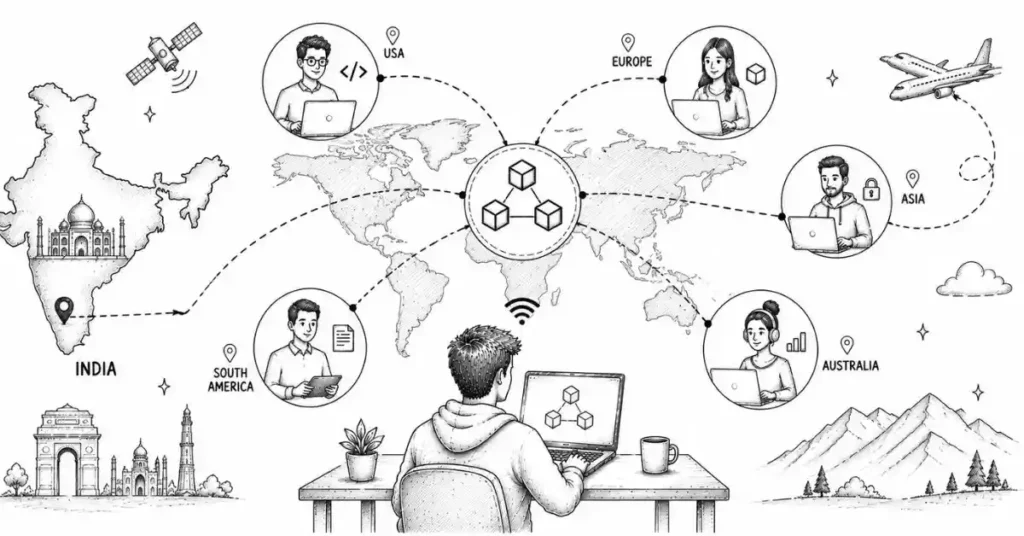
No career category has benefited more from remote work normalization than blockchain. The technology was built by distributed, global teams Ethereum’s core developers are spread across 20+ countries, major DeFi protocols operate without physical offices, and smart contract auditing firms routinely employ professionals across time zones. This distributed-by-design culture means blockchain is the most genuinely remote-friendly technical career field in existence.
For Indian professionals, this creates a historically rare opportunity: earning global compensation rates while living in India’s lower-cost cities. A blockchain developer in Hyderabad accessing a remote position at a London-based protocol earns London-equivalent compensation while benefiting from Hyderabad’s cost of living a genuine wealth-creation arbitrage unavailable in most career fields.
The numbers substantiate this opportunity. LinkedIn lists 1,000+ remote blockchain developer jobs accessible from India. Cutshort.io shows 49+ remote blockchain positions specifically targeting India. Web3.career lists new remote blockchain jobs every single day with global companies actively recruiting Indian talent. For skilled professionals willing to build the English communication and self-management skills remote work requires, blockchain’s remote opportunities represent perhaps the highest available career ROI in Indian tech.
This guide covers finding and securing remote blockchain positions, platforms for crypto freelancing, how to set competitive freelance rates, managing international payments, and building the professional habits that make remote blockchain careers sustainable and lucrative.
Finding Remote Blockchain Jobs: The Best Platforms
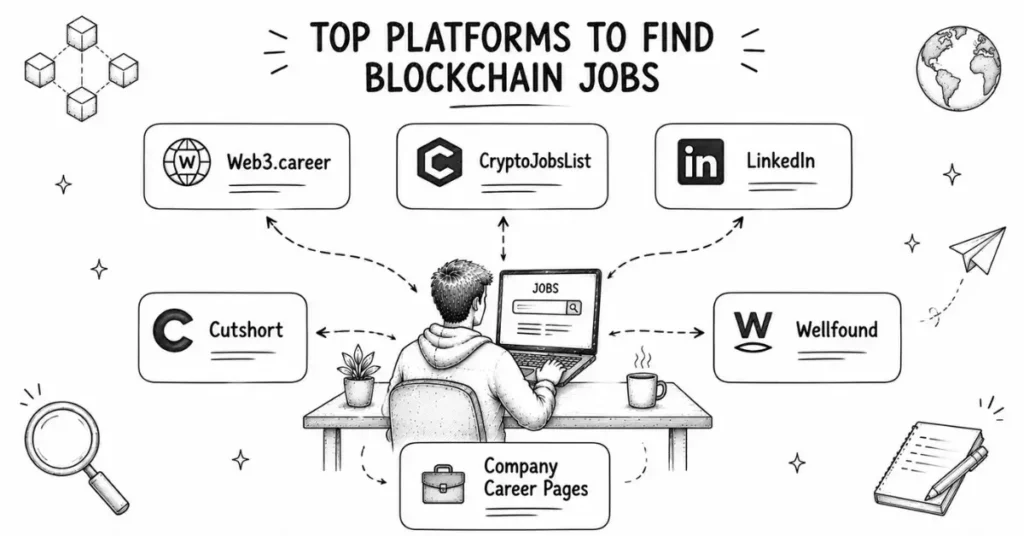
Dedicated Blockchain Job Platforms
Web3.career:
The most comprehensive blockchain-specific job board, updated daily with new positions. Features:
- 7+ new remote blockchain jobs added on February 22, 2026 alone
- Salary filters allowing search specifically for high-compensation positions
- Company filters to avoid scams (verified employers)
- Role filters across technical, non-technical, and specialty positions
- Free to use; no account required to browse
Search strategy: Check Web3.career every Monday morning. Set up email alerts for your specific role keywords. Companies listing here are genuinely looking to hire—less competition than general job boards.
CryptoJobsList:
Strong selection of remote positions with salary transparency. Particularly good for non-technical roles including community management, marketing, content, and compliance. Salary data visible before applying helps target appropriate positions.
CryptoJobsSearch and CryptoCurrencyJobs:
Additional dedicated platforms with different company listings. Covering multiple platforms ensures you see comprehensive opportunities rather than subset.
Wellfound (AngelList Talent):
Best platform for early-stage blockchain startup positions. Startups here often prefer remote hiring and are more flexible with geography. Equity compensation information is transparent, helping evaluate total compensation packages.
General Job Platforms With Strong Blockchain Remote Listings
LinkedIn:
1,000+ remote blockchain developer positions accessible from India. LinkedIn’s advantage is direct hiring manager outreach—you can message the person who posted a job before applying, building a personal connection that helps your application stand out.
LinkedIn search strategy:
- Search: “blockchain developer” + “remote” + “India”
- Filter: Posted in last week (most relevant)
- Filter: Remote job type
- Sort: Most recent
Cutshort.io:
49+ remote blockchain jobs specifically curated for Indian professionals. Cutshort’s algorithm matches profiles to job requirements, reducing application-to-interview time.
Internshala (For Freshers and Students):
42+ blockchain jobs listed including remote internship options. Best for students and freshers building initial experience through remote work before targeting senior positions.
Company Career Pages: Direct Applications
Many top blockchain companies hire directly without posting to job boards:
Companies with active India-remote hiring:
- Tether: Senior backend developer roles; cities listed: Bangalore, Mumbai, Hyderabad, Chennai, Pune, Delhi
- Polygon: Engineering and non-technical roles with India-remote options
- Coinbase: Engineering, compliance, and operations with India presence
- Chainlink Labs: Developer relations and engineering remote positions
- Alchemy: Developer advocacy and engineering
Strategy: Visit the careers page of your 20 target companies every two weeks regardless of active listings. Contact their HR or relevant team leads on LinkedIn expressing interest. Many positions are filled through direct outreach before being posted publicly.
Crypto Freelancing: Building Your Independent Practice

Why Blockchain Freelancing Pays Exceptionally Well
Blockchain freelancing rates reflect both the skill scarcity and the high-stakes nature of the work:
Smart contract development: ₹1.5–8 lakhs per project depending on complexity
Security auditing: ₹1–15 lakhs per audit engagement
Technical writing: ₹1,000–3,000 per article; ₹30,000–1.5 lakhs for whitepapers
Blockchain consulting: ₹25,000–1.5 lakhs per day depending on seniority
Community management: $1,500–5,000/month retainer for ongoing management
Tokenomics design: ₹1–5 lakhs per project engagement
A skilled blockchain freelancer handling 6–10 projects annually can earn ₹20–60 lakhs—comparable to or exceeding senior salaried positions with greater flexibility and variety.
Top Freelancing Platforms for Blockchain Work
Upwork:
The largest professional freelancing platform with substantial blockchain project demand. India-based blockchain freelancers are competitive because:
- Strong English communication skills (India’s advantage)
- Time zone overlap with European clients (IST is business hours for EU morning/evening)
- Significantly lower living costs enabling competitive rates vs. US/UK freelancers
Getting started on Upwork:
- Create detailed profile with blockchain specialization clearly stated
- Include portfolio links (GitHub, deployed contracts, Etherscan verified contracts)
- Apply to 5–10 smaller projects initially to build reviews (reviews are currency on Upwork)
- Set rates 20–30% below market initially to build reputation, then increase as reviews accumulate
Toptal:
Premium freelancing platform serving Fortune 500 clients. Acceptance requires passing a rigorous technical screening—approximately 3% of applicants are accepted. But the reward is access to the highest-paying clients:
- Blockchain developer rates: $60–150/hour
- Smart contract auditor rates: $80–200/hour
If you pass Toptal’s screening, you’re competing in a much smaller, better-compensated pool.
Braintrust:
Web3-native freelancing platform where the platform itself is community-owned. Braintrust takes zero commission from freelancers (funded by client fees), meaning your full negotiated rate reaches you. Growing rapidly with quality blockchain clients.
Gitcoin:
Blockchain-specific bounty and freelancing platform where projects post specific development tasks with cryptocurrency bounties. Excellent for:
- Building portfolio through small paid tasks
- Getting introduced to project teams (leading to larger work)
- Earning cryptocurrency (directly in ETH or tokens)
Working on Gitcoin: Browse active bounties on gitcoin.co. Start with smaller bounties (₹5,000–25,000 equivalent) where competition is lower. Successfully completed bounties demonstrate capability to larger projects.
Freelancer.com and Fiverr:
Lower average rates than Upwork but higher volume and lower competition for specific niches. Blockchain technical writing and explainer content, basic smart contract projects, and token creation services do well on Fiverr.
Setting Your Freelance Rates: A Practical Framework
Many skilled Indian blockchain professionals significantly underprice their services—reducing their income while inadvertently signaling lower quality to clients who associate price with expertise.
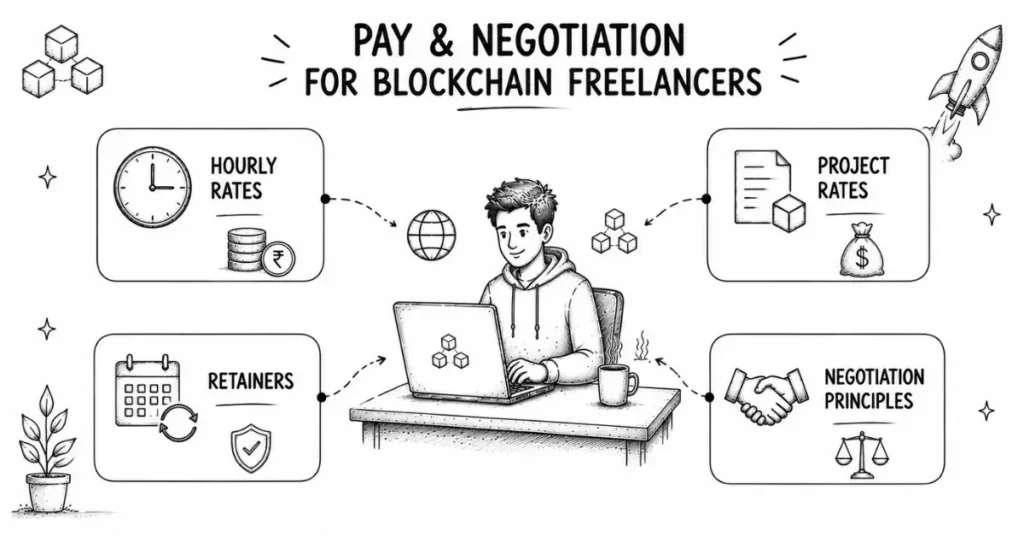
Rate-Setting by Role (2026 Market Rates)
Smart Contract Development:
- Junior (0–2 years): $30–60/hour or ₹1.5–3L per project
- Mid-level (2–4 years): $60–100/hour or ₹3–6L per project
- Senior (4+ years): $100–200/hour or ₹6–15L per project
Smart Contract Security Auditing:
- Per line of code: $0.05–0.50 per line depending on complexity
- Per project: ₹1–15 lakhs depending on contract complexity and criticality
- Retainer (ongoing security review): ₹2–8 lakhs/month
Blockchain Technical Writing:
- Blog posts/tutorials: ₹1,500–5,000 per piece
- Whitepapers: ₹50,000–2 lakhs
- Full documentation projects: ₹1–5 lakhs
- Course content: Revenue share (20–40%) or ₹1–3 lakhs per course
Blockchain Consulting:
- Entry-level independent: ₹15,000–40,000/day
- Experienced consultant: ₹40,000–1.5 lakhs/day
- Retainer-based advisory: ₹1–5 lakhs/month
Rate Negotiation Principles
Never start with hourly rate—start with project value:
“This audit protects potentially millions in user funds” frames your rate against project value rather than your time cost. Clients who understand the value don’t negotiate rates the same way as those thinking of you as a time-rented resource.
Research comparable rates before every negotiation:
Web3.career’s salary data, Upwork marketplace rates, and CryptoJobsList compensation data provide current benchmarks. Knowing the market makes confident rate statements natural.
Build in revision limits:
Clearly define deliverables and revision rounds in every freelance contract. Unlimited revisions on a fixed-price project is unprofitable—define scope carefully.
International Payments: Getting Paid From Global Clients
Receiving international payments as an Indian freelancer involves navigating RBI regulations and choosing the right payment infrastructure.
Legitimate Payment Methods
Bank Wire Transfers (SWIFT):
Most reliable for large project payments (₹50,000+). Your Indian bank receives international wire transfers. Requires providing SWIFT code, IBAN/account details, and bank address. RBI’s LRS (Liberalised Remittance Scheme) governs inbound payments.
Wise (formerly TransferWise):
Most cost-effective for regular international payments. Significantly lower fees than traditional bank wires. Set up a Wise account to receive USD/EUR/GBP, then transfer to Indian bank account. Widely used by Indian freelancers for payments from international clients.
PayPal:
Widely accepted by US and European clients. Can receive funds in USD and withdraw to Indian bank. Note PayPal India has had restrictions—verify current status and use as secondary option.
Payoneer:
Popular for Indian freelancers receiving payments from Upwork, Fiverr, and other platforms. Provides virtual US bank account details, simplifying receipt of American client payments.
Crypto Payments (Stablecoins):
Many blockchain clients prefer paying in USDC or USDT (stablecoins pegged to USD). This is entirely legal in India for services rendered internationally. Receive stablecoins, convert to INR through registered Indian exchanges (WazirX, CoinDCX), withdraw to bank. This process is fast, cheap, and increasingly preferred in the blockchain industry.
Tax Obligations for Indian Freelancers
Indian freelancers earning from international clients are subject to Indian income tax on global income:
- Income from freelancing is taxed as business income or professional fees under Income Tax Act
- GST registration required if annual income exceeds ₹20 lakhs (exports of services qualify as zero-rated under GST with refund option)
- Advance tax payment obligations for freelancers earning above threshold
- Consult a CA familiar with both IT/ITeS taxation and cryptocurrency regulations for optimized compliance
Building a Sustainable Remote/Freelance Career
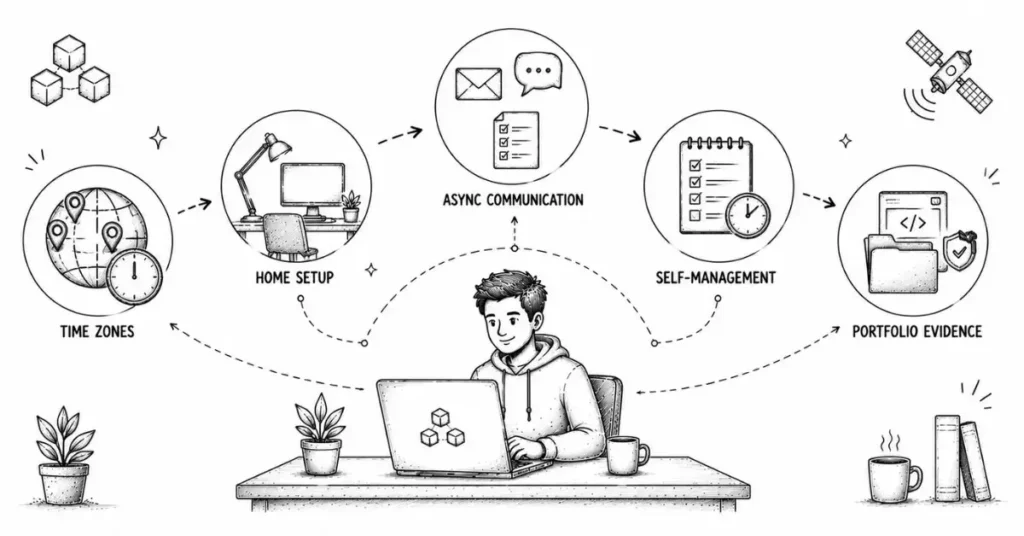
Professional Infrastructure
Time Zone Management:
For remote positions with international companies, overlap hours matter. IST (India Standard Time, UTC+5:30) overlaps with:
- EU companies: 3–4 hours of overlap in EU morning
- US East Coast: Requires early morning India hours (7–9 AM IST for US evening)
- US West Coast: Difficult overlap; requires late night India hours
- Singapore/APAC: Near-perfect overlap
Being explicit about availability hours and consistent within them builds trust with remote employers who cannot physically see you working.
Professional Home Setup:
Remote blockchain work requires:
- Reliable high-speed internet (primary + backup connection)
- Quiet, professional background for video calls
- Adequate hardware (16GB+ RAM for running local blockchain nodes)
- External monitor for multi-window development work
- Quality microphone for calls (disproportionately improves professionalism perception)
Async Communication Excellence:
Remote blockchain teams communicate primarily through written channels. Developing async communication skills—writing status updates clearly, asking questions with context already included, documenting decisions for colleagues in different time zones—is the single most valued soft skill in remote blockchain environments.
Self-Management Discipline:
Remote work’s primary challenge is maintaining productivity without external accountability structures. Blockchain development requires deep focus periods—sustained concentration on complex smart contract logic. Effective remote professionals:
- Protect morning hours for deep work (no meetings, no messages)
- Use time-blocking to structure development, communication, and learning
- Maintain clear separation between work and personal time
- Build physical exercise habits that counteract sedentary remote work
Portfolio for Remote Applications: What Works Internationally
International remote applications require stronger portfolio evidence than domestic applications because employers can’t rely on face-to-face interviews or local references:
GitHub Profile Optimization:
- Profile README showcasing your best work
- Pinned repositories: 3–5 best projects with detailed README files
- Contribution graph showing consistent activity
- All projects with deployment addresses and Etherscan verification links
On-Chain Verifiability:
International employers love that blockchain work is verifiable independently:
- “My deployed contracts: [Etherscan links]” is more compelling than any resume claim
- Bug bounty findings (even small ones) on Immunefi show security capability
- Code4rena participation history with findings demonstrates security knowledge
- Dune Analytics dashboards with thousands of views show analytical capability
English Written Communication:
Maintain a blog, Medium profile, or Substack newsletter demonstrating clear English technical writing. International employers evaluate written communication from your application email, GitHub READMEs, and any published writing they can find.
Managing Remote Career Challenges
Challenge 1: Isolation and Community Connection
Working remotely from India on international blockchain projects can feel isolating—no office colleagues, large time zone gaps from US-based team members.
Solution: Build local blockchain community connections. Attend Bangalore Ethereum meetups, Hyderabad blockchain events, and online Indian Web3 communities. Maintain deliberate social professional connections independent of remote employer.
Challenge 2: Continuous Learning Without Structured Environment
Remote workers lack the passive learning that happens in offices—conversations overheard, whiteboards explained, colleagues mentoring informally.
Solution: Create structured learning routines replacing passive office learning: weekly blockchain newsletter reading, monthly course completion goals, regular participation in blockchain research communities. Pair with a remote learning partner for accountability.
Challenge 3: Payment Delays and Project Gaps
Freelancing and contract remote work involves payment delays and gaps between projects. Income is less predictable than salaried employment.
Solution: Maintain 3–6 months of living expenses as financial buffer. Build pipeline of 2–3 simultaneous smaller projects rather than depending on single large client. Establish payment milestone schedules in all contracts rather than single end-of-project payments.
Challenge 4: Visa and International Compliance for Long-Term Remote
Working for international companies as an Indian-based contractor involves navigating tax treaties, service export regulations, and FEMA (Foreign Exchange Management Act) compliance.
Solution: Engage a CA experienced with IT/ITeS taxation for regular freelancers. Maintain proper invoicing records for all international payments. Report foreign income accurately in ITR (Income Tax Return) filings. Compliance complexity is manageable and should not deter remote work—it simply requires appropriate professional guidance.
Conclusion: Your Global Blockchain Career, Built From India
India’s blockchain professionals are sitting at an extraordinary convergence: world-class technical education, strong English communication capability, competitive work ethic, and time zones convenient for European clients—all combined with India’s rapidly growing local blockchain ecosystem creating domestic opportunities simultaneously.
The remote blockchain career represents the highest-ROI professional opportunity currently available to skilled Indian technology professionals. With 1,000+ remote positions accessible from India, international companies actively recruiting from Bangalore, Hyderabad, Mumbai, and beyond, and freelance rates that can generate ₹20–100+ lakhs annually for skilled practitioners, the financial case is as compelling as the professional opportunity.
The barrier is skill and portfolio—not geography, not background, not education. Build real blockchain skills, deploy real contracts, participate in real communities, write real analyses, and the global blockchain job market opens to you regardless of where in India you’re building your career from.
Your remote blockchain career doesn’t start when you find the perfect opportunity. It starts today—with one deployed testnet contract, one published analysis, one Discord community joined, one GitHub repository created. The professionals earning $100,000+ remotely from Indian cities started exactly where you are now.