
Tokenomics Specialist Career : Crypto Economics Guide
Table of Contents
Introduction: The Economists Designing Tomorrow's Financial Systems
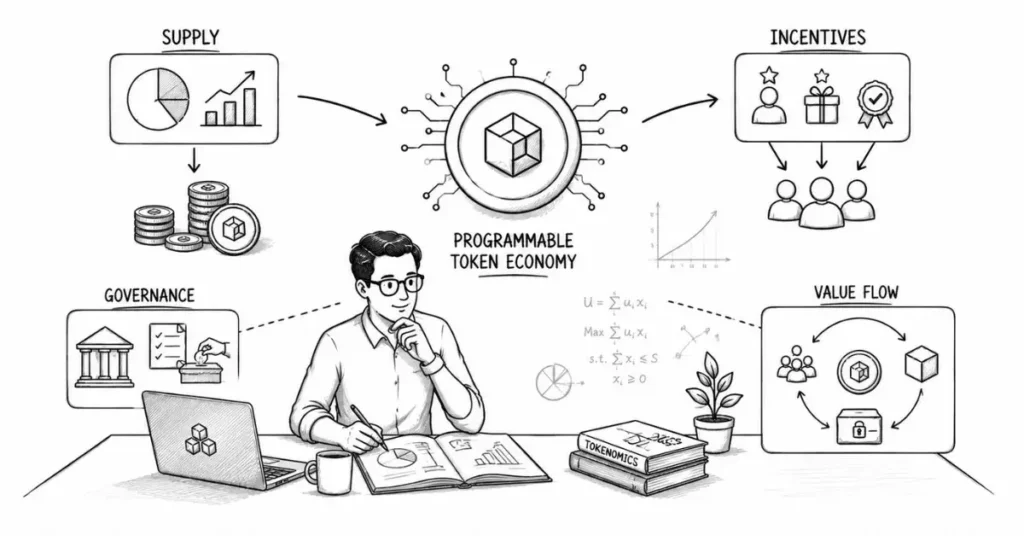
What if you could design the economic rules of an entire financial ecosystem from scratch? Set the rules for how value flows, who gets rewarded, how governance works, and how the system stays sustainable for years. That’s precisely what tokenomics specialists do and it’s one of the most intellectually fascinating careers in the entire blockchain industry.
Tokenomics (a combination of “token” and “economics”) is the study and design of token economic systems. Every cryptocurrency, DeFi protocol, NFT project, DAO, and blockchain game has a token economy rules governing token supply, distribution, incentive structures, governance rights, and value capture mechanisms. When these economics are designed well, protocols attract users, retain liquidity, and create genuine long-term value. When poorly designed, they inevitably collapse often spectacularly.
The financial reward for getting tokenomics right is enormous and so is the compensation for professionals who can do it. Globally, protocol economists and token engineers earn $120,000–$250,000+ annually, with senior positions at funded Web3 companies paying $184,000–$269,000 base salary plus equity. In India, tokenomics specialists earn ₹12–25 lakhs at Indian blockchain companies, with international remote positions accessible to those with strong portfolios.
This career sits at the intersection of economics, game theory, mathematics, behavioral psychology, and blockchain technology. It’s genuinely rare very few professionals have deep expertise in all required disciplines which is precisely why exceptional tokenomics specialists command such high compensation. If you have a background in economics, finance, mathematics, or data science and you’re curious about blockchain, tokenomics represents perhaps the most differentiated and high-value career path you can build.
What Is Tokenomics? A Simple Explanation
Tokens as Economic Instruments
A token in blockchain is a digital asset with programmable rules. Unlike traditional company shares—which represent ownership and dividend rights—tokens can represent almost anything: governance voting power, access to services, staking rewards, protocol fees, or economic incentives for specific behaviors.
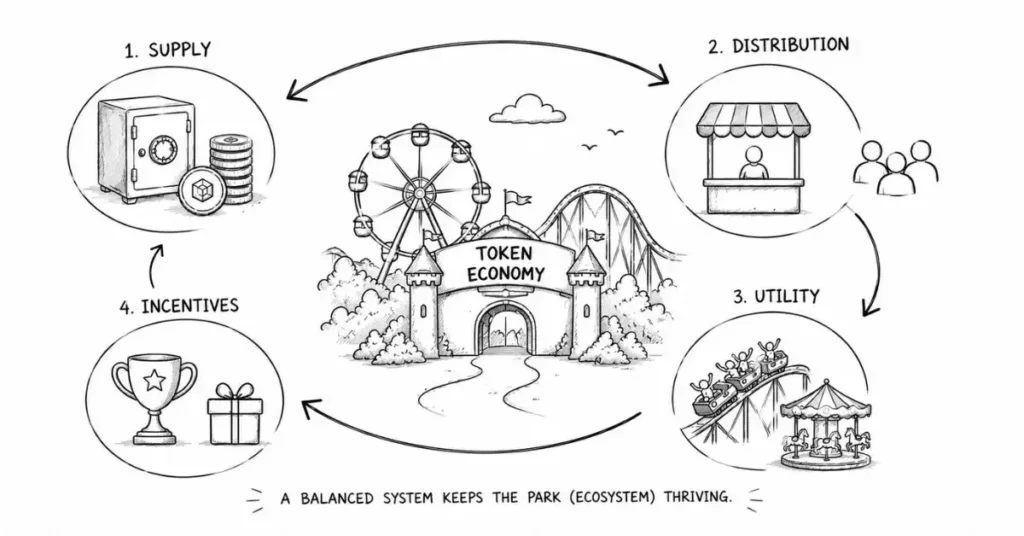
Simple Analogy: Think of a theme park that creates its own “Park Dollars” instead of accepting regular currency. They control how many Park Dollars exist, what you can buy with them, how you earn them (ride points, contests), and what happens to them when spent (burned forever vs. recycled back into circulation). Design these rules well and you create an economy where people are motivated to participate, spend, and promote the park. Design them poorly and you have either inflation (Park Dollars become worthless) or deflation (nobody wants to spend them because they’ll be worth more tomorrow).
Tokenomics specialists design these economic rules for blockchain protocols—except instead of theme park rides, they’re designing systems handling billions of dollars with complex interactions between thousands of rational economic actors.
Core Tokenomics Components
Supply Mechanics:
- Total supply: Maximum tokens that will ever exist
- Circulating supply: Tokens currently available in market
- Emission schedule: How new tokens enter circulation over time
- Inflation/deflation: Whether supply grows or shrinks over time
- Burning mechanisms: How tokens are permanently removed from supply
Distribution:
- Initial allocation between team, investors, treasury, community
- Vesting schedules preventing immediate dumping by insiders
- Fair launch vs. pre-sale distribution
- Airdrop mechanics for community acquisition
- Mining/staking rewards distribution
Utility and Value Accrual:
- What can tokens actually do? (governance, fee discounts, staking, access)
- How does protocol revenue flow to token holders?
- What creates genuine demand beyond speculation?
- How does token capture value as the protocol grows?
Governance:
- Voting weight per token
- Quorum requirements for proposals
- Timelock periods before execution
- Delegation mechanics
- Emergency governance procedures
Incentive Design:
- Liquidity mining rewards attracting initial liquidity
- Staking rewards encouraging long-term holding
- Referral mechanisms growing user base
- Activity rewards incentivizing desired behaviors
- Penalties/slashing discouraging bad behavior
The Science Behind Token Design
Game Theory and Mechanism Design
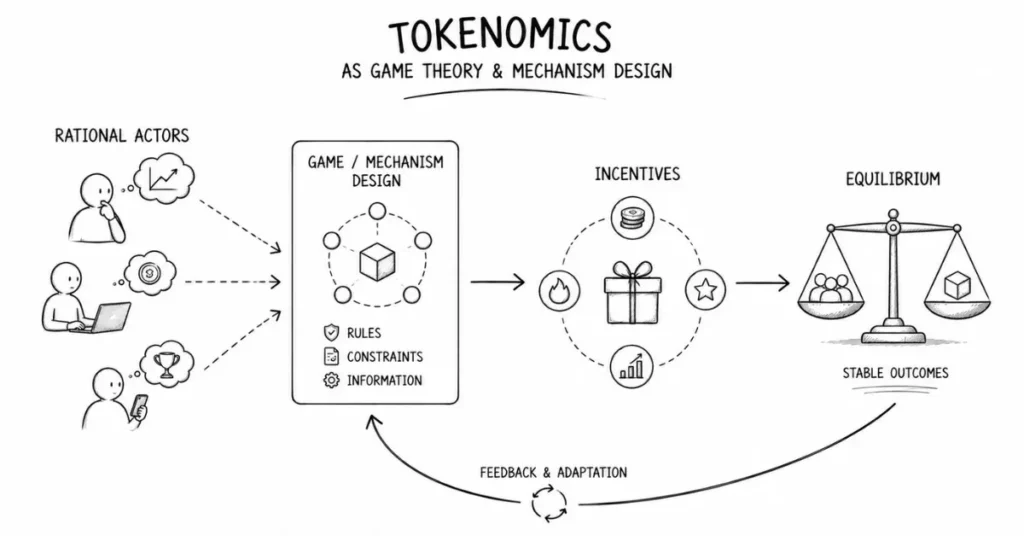
Tokenomics is fundamentally applied game theory. Users are rational economic actors making decisions based on incentives. Design the right incentives and you get the behaviors you want (providing liquidity, voting on governance, reporting bugs). Design the wrong incentives and you get exploitative behavior (wash trading, governance attacks, liquidity extraction).
Nash Equilibrium in Token Systems:
A well-designed token system should reach Nash equilibrium—a state where no individual participant can improve their outcome by unilaterally changing strategy. When all participants doing what’s best for themselves also benefits the protocol collectively, you have good mechanism design.
Examples of Incentive Failures:
- Vampire attacks: DeFi protocols copying another protocol and offering higher token rewards to steal all their liquidity (SushiSwap vs. Uniswap)
- Mercenary liquidity: Liquidity providers who leave immediately when rewards end, destabilizing protocols
- Governance attacks: Accumulating voting tokens to pass self-serving proposals
- Inflationary death spirals: Paying unsustainable yields that attract money in, cause token inflation, reduce yields, cause panic exits, collapse the protocol
Tokenomics specialists design systems that are robust against these failure modes.
Mathematical Modeling Skills
Tokenomics specialists use quantitative models to predict how token economies behave over time:
Bonding Curves: Mathematical functions defining token price based on supply. Used in automated market makers and token launches.
Monte Carlo Simulations: Running thousands of random scenarios to understand how token economies perform under different conditions.
Agent-Based Modeling: Simulating how different types of users (whales, yield farmers, long-term holders, speculators) would interact with a token system.
Supply/Demand Projections: Modeling how token emission schedules interact with demand growth to predict price trajectories under different adoption scenarios.
Game-Theoretic Equilibrium Analysis: Mathematically identifying dominant strategies for different participant types and ensuring they align with protocol goals.
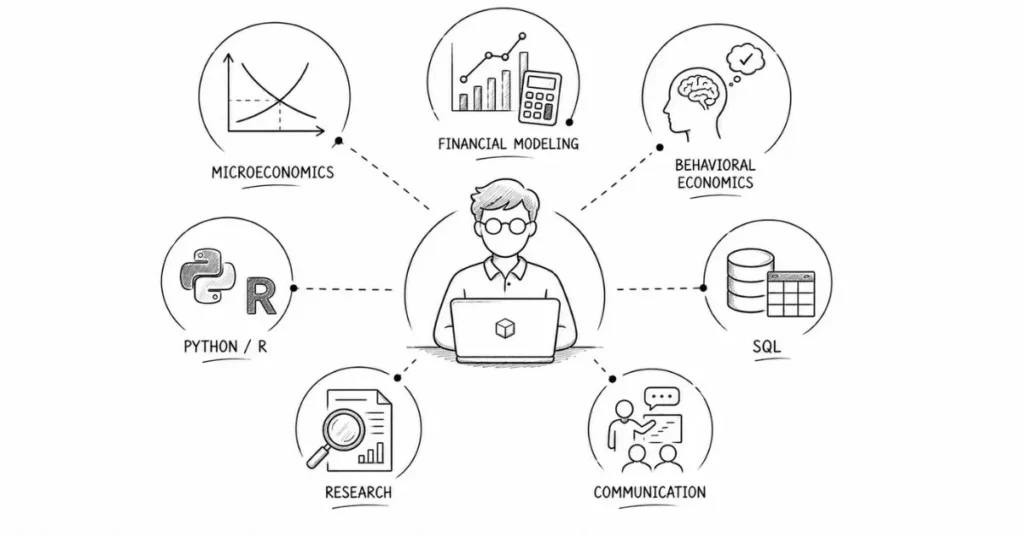
Required Skills for Tokenomics Specialists
Economics and Finance Foundation
Microeconomics: Supply and demand, price elasticity, game theory, market structures. Essential for understanding how token markets behave.
Financial Modeling: Building Excel or Python models projecting protocol financials, token flows, and economic outcomes over time.
Behavioral Economics: Understanding how real humans deviate from perfectly rational behavior—FOMO, loss aversion, herd mentality—and how these biases affect token holder decisions.
Market Design: Academic field studying how to design markets that achieve desired outcomes. Directly applicable to designing token incentive systems.
Corporate Finance Basics: Understanding valuation, discounted cash flows, and capital structure helps design tokens that capture protocol value analogously to how equity captures company value.
Quantitative and Technical Skills
Python or R: For financial modeling, simulation, data analysis, and statistical testing:
- Pandas for data manipulation
- NumPy for numerical computations
- Matplotlib/Plotly for visualizing economic models
- SciPy for statistical analysis
- SimPy for discrete event simulation
SQL: Querying on-chain data from blockchain databases for analysis.
Spreadsheet Modeling (Advanced Excel): Building dynamic token economic models that executives and investors can interact with.
Statistical Analysis: Time series analysis, regression modeling, hypothesis testing for validating assumptions about user behavior.
Basic Blockchain Understanding: Not deep development knowledge, but understanding of how tokens work technically, what smart contracts can and cannot enforce, and what parameters are adjustable post-launch.
Research and Communication
Academic Research: Reading and applying findings from economics, game theory, and mechanism design research papers. Staying current with cutting-edge tokenomics research from top Web3 researchers.
Writing and Documentation: Tokenomics designs must be documented clearly for:
- Technical teams implementing the system
- Community members evaluating governance proposals
- Investors assessing protocol viability
- Public audiences in whitepapers and blog posts
Data Visualization: Presenting complex economic models in charts and diagrams that non-economists can understand. Decisions about billion-dollar protocols often depend on how clearly models are communicated to leadership.
Types of Tokenomics Roles
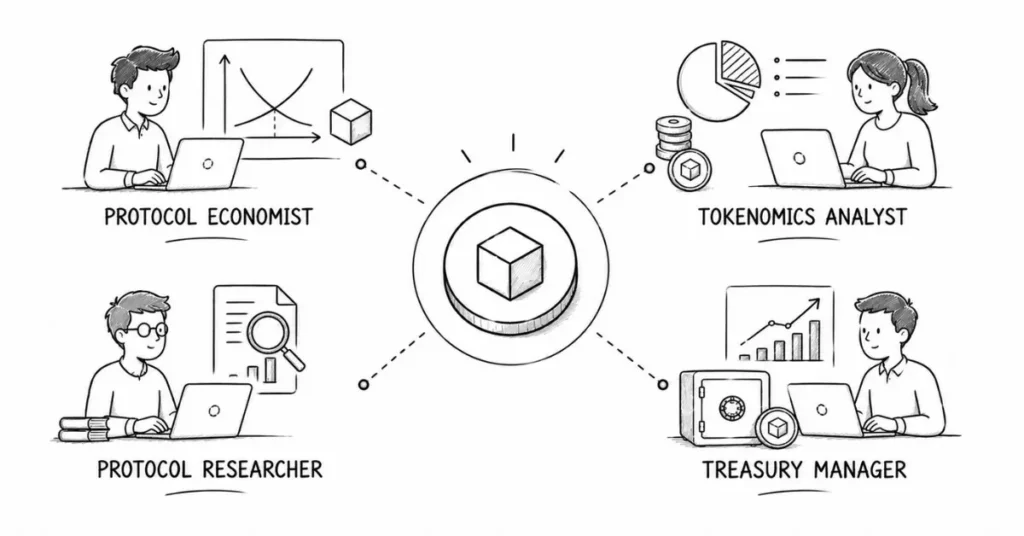
Protocol Economist / Token Engineer
The most senior and highest-paid tokenomics role. Designs complete token economic systems for new protocols or redesigns existing ones.
What They Build:
- Complete tokenomics documentation including supply, distribution, utility, governance
- Financial models projecting protocol economics under various scenarios
- Incentive design for specific protocol mechanics
- Risk analysis identifying economic attack vectors
Salary: $120,000–$250,000+ internationally; ₹15–30 lakhs in Indian market for senior profiles
Example: The token engineer at Uniswap who designed UNI governance token distribution, the economist at Aave who designed AAVE staking and safety module, or the designer at Optimism who built OP token’s retroactive public goods funding
Tokenomics Analyst
Research and analytical role focused on evaluating existing token systems and providing recommendations.
What They Do:
- Analyze tokenomics of existing protocols for investment or partnership purposes
- Build models comparing different tokenomics approaches
- Monitor protocol health metrics and flag economic risks
- Write research reports on token economic systems
Salary: ₹10–18 lakhs in India; $80,000–140,000 internationally
Employers: Crypto VCs (evaluating investments), hedge funds (evaluating trading positions), research firms (Messari, Delphi Digital), protocol treasuries
DeFi/Protocol Researcher
Combines tokenomics with broader protocol research at established blockchain organizations or research firms.
What They Research:
- Economic security of consensus mechanisms
- MEV (Maximal Extractable Value) and its implications for protocol design
- Optimal fee market designs
- Cross-protocol economic interactions and systemic risk
Salary: $90,000–180,000 internationally, with positions accessible remotely from India
Treasury Manager (DAO)
Manages protocol treasury—the collective funds owned by a DAO—using tokenomics and financial expertise.
What They Do:
- Diversify treasury holdings to reduce protocol financial risk
- Invest treasury assets to generate sustainable yield
- Manage token buyback programs
- Execute strategic treasury grants
- Report treasury status to governance community
Salary: ₹12–22 lakhs in India; $80,000–150,000 internationally
Learning Tokenomics: A Structured Path
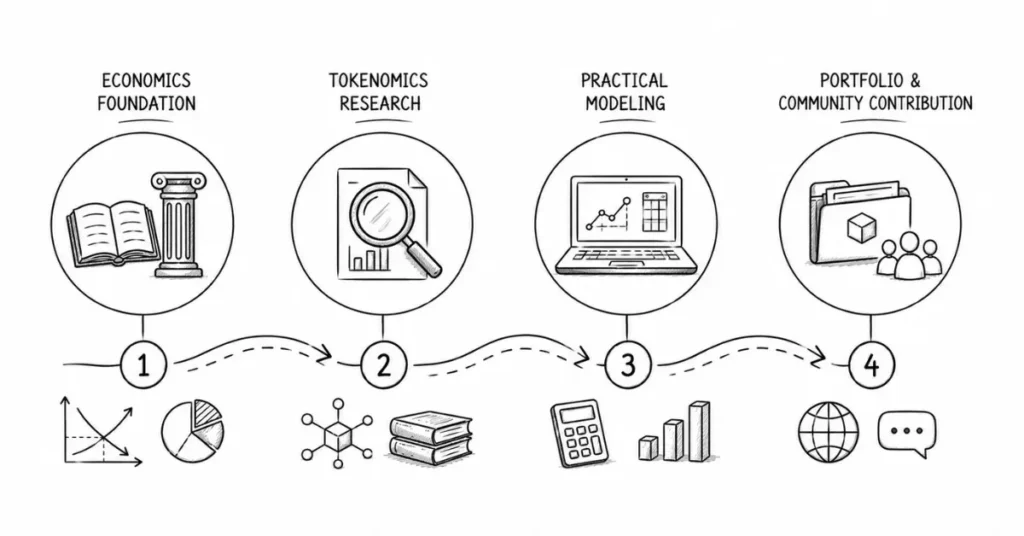
Phase 1: Economics Foundation (4–6 Weeks)
If you have an economics or finance background: Review microeconomics game theory sections and read “Mechanism Design” introductory materials. Immediately applicable to tokenomics.
If you’re from a technical background: Take an introductory economics course on Coursera (Yale’s Financial Markets or similar). Focus on supply/demand, incentives, and market design. Add game theory basics through “Thinking Strategically” by Dixit and Nalebuff.
Resources:
- Khan Academy Microeconomics (free, excellent)
- Coursera Financial Markets by Robert Shiller (free to audit)
- “Thinking Strategically” for game theory (book)
Phase 2: Tokenomics-Specific Knowledge (4–6 Weeks)
- Read Vitalik Buterin’s blog posts on mechanism design and token economics (free, high quality)
- Study whitepapers of major protocols: Uniswap, Aave, Curve Finance, Compound
- Follow tokenomics researchers on Twitter: @tokenbrice, @Cobie, @Delphi_Digital
- Read Delphi Digital and Messari research reports on tokenomics
- Complete Token Engineering Commons courses (community-developed curriculum)
Phase 3: Practical Modeling (4–6 Weeks)
- Build tokenomics model for an imaginary protocol in Python or Excel
- Model supply schedule, distribution, and incentive programs
- Run Monte Carlo simulation to stress-test assumptions
- Analyze a failed token economy postmortem: TerraLUNA collapse, OlympusDAO decline
- Build Dune Analytics dashboard tracking a real protocol’s tokenomics metrics
Phase 4: Portfolio and Community (Ongoing)
- Publish tokenomics analysis pieces on Mirror.xyz or Substack
- Contribute to Token Engineering Commons community discussions
- Present tokenomics designs at local blockchain meetups
- Join protocol Discord servers and participate in governance economic discussions
- Apply for junior tokenomics roles or offer pro bono tokenomics review for early-stage projects
Career Challenges Unique to Tokenomics
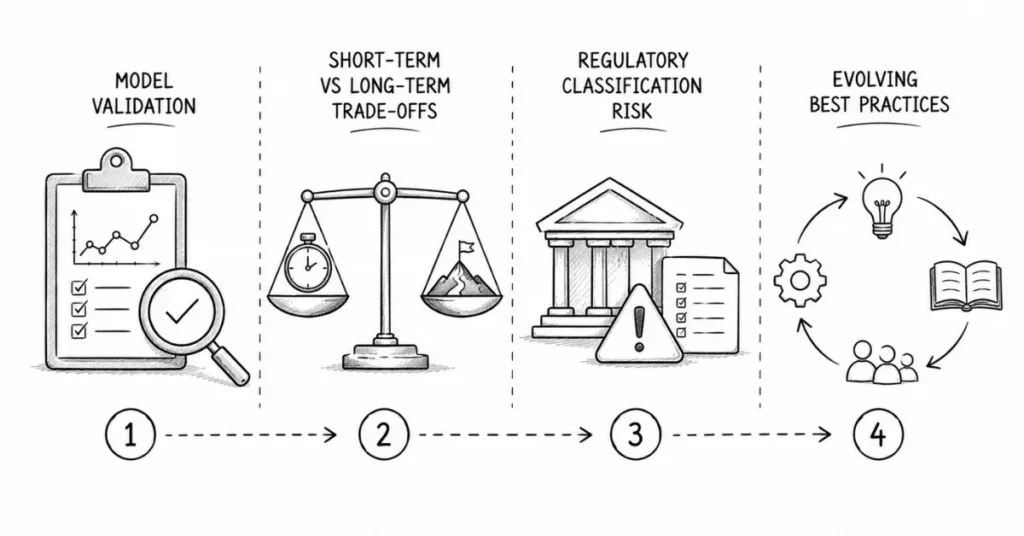
Challenge 1: Validating Models Before Launch
Unlike engineering where code either works or doesn’t, tokenomics models are theoretical until launch. Real user behavior often defies model assumptions. Your model may look perfect and still fail in practice.
Solution: Build adversarial thinking into every model—assume rational actors will exploit any weakness. Use agent-based modeling to simulate different user types. Run conservative scenarios. Design graceful degradation mechanisms that keep protocols functional even if incentive models underperform.
Challenge 2: Short-Term vs. Long-Term Trade-Offs
Communities often push for higher short-term token yields that create long-term unsustainability. Tokenomics specialists who recommend sustainable but lower yields may face community pushback.
Solution: Build clear economic arguments for sustainability. Show historical examples of unsustainable yields collapsing (TerraLUNA, OlympusDAO). Frame long-term sustainability as protecting token holder value. Develop communication skills to make complex economic arguments accessible to non-economist communities.
Challenge 3: Regulatory Classification Risk
Tokenomics designs can inadvertently create tokens that regulators classify as securities. Certain utility features, investment return promises, and governance structures raise regulatory flags.
Solution: Build regulatory review into tokenomics design process. Understand Howey Test for securities classification. Work with legal counsel on token designs, especially for protocols with Indian users subject to SEBI oversight.
Challenge 4: Evolving Best Practices
Tokenomics is a young field—best practices developed in 2021 were upended by 2022 failures. The field is still learning what works long-term.
Solution: Engage with Token Engineering Commons community where practitioners share evolving best practices. Follow research from academic economists entering the space. Treat every tokenomics design as a learning experiment with explicit monitoring and adjustment mechanisms.
Conclusion: Designing the Economics of the Future
Tokenomics specialists are building something genuinely new: economic systems programmable in code, accessible globally, and verifiable by anyone. This is intellectually exciting work with real consequences—well-designed token economies create genuine value and wealth; poorly designed ones destroy both.
With global compensation ranging from $120,000 to $269,000+ for senior specialists and international remote positions accessible from India, tokenomics careers offer exceptional financial rewards for those with the right combination of economic thinking, quantitative skills, and blockchain knowledge.
If economics and mathematics excite you, and you’re drawn to designing systems rather than just analyzing existing ones—tokenomics is your blockchain career calling. Start building your economic reasoning skills today, begin studying how real protocols designed their token economies, and build your first tokenomics model as a portfolio piece. The protocols of tomorrow need economists who understand blockchain today.