
Supply Chain Technology Stack: Essential Software & Tools
Table of Contents
Introduction: Technology as Your Career Multiplier
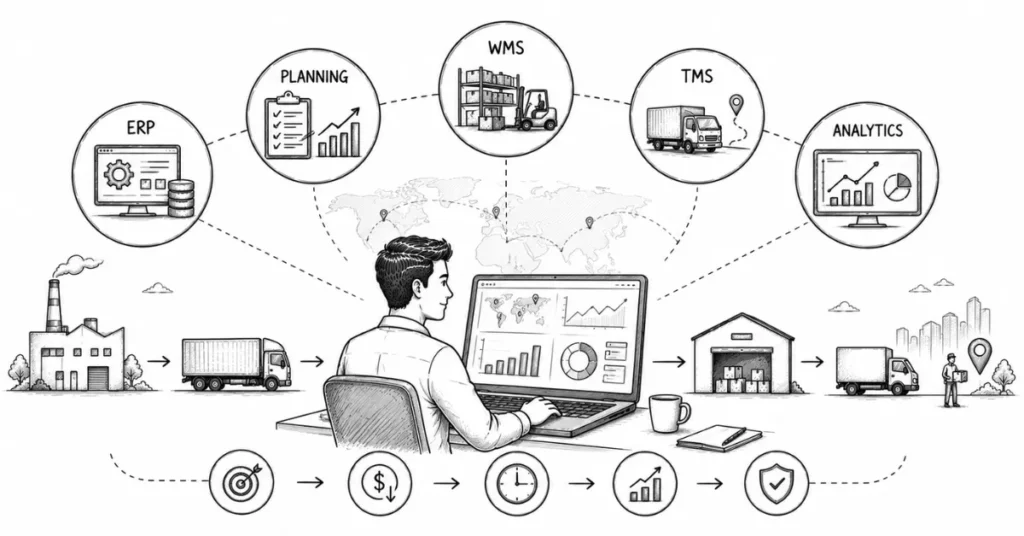
Picture two supply chain managers with similar experience. One manually tracks shipments in Excel, relies on email for vendor communication, and spends hours creating reports. The other uses integrated software that automatically tracks shipments, sends alerts for exceptions, and generates real-time dashboards with a few clicks.
Who do you think delivers better results? Who advances faster in their career?
Technology isn’t optional anymore—it’s the foundation of modern supply chain management. Companies are investing billions in digital transformation, and professionals who understand and leverage supply chain technology are significantly more valuable than those who don’t.
But here’s the challenge: the supply chain technology landscape is vast and confusing. SAP, Oracle, Blue Yonder, Kinaxis, Manhattan Associates—hundreds of software solutions, each claiming to be essential. Which tools actually matter? Which should you learn? How do they fit together?
This guide cuts through the noise, explaining the essential supply chain technologies, how they work together, and most importantly—which ones you should prioritize learning to accelerate your career in 2026.
Understanding the Supply Chain Technology Stack
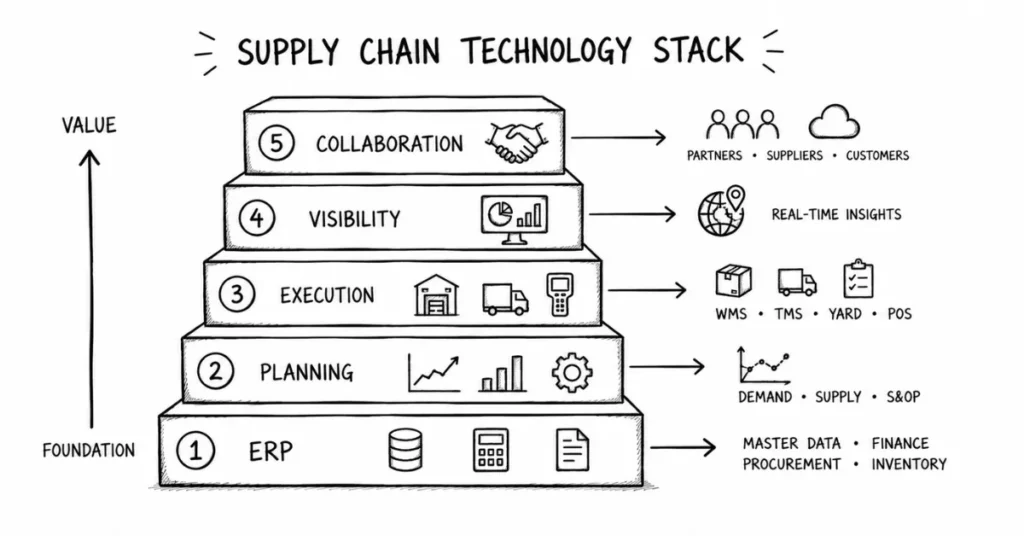
Modern supply chains run on integrated technology ecosystems, not single tools. Think of it as layers:
Foundation Layer: ERP Systems
- Core business system managing all company data
- Examples: SAP, Oracle, Microsoft Dynamics
Planning Layer: Supply Chain Planning Software
- Demand forecasting, supply planning, S&OP
- Examples: SAP IBP, Kinaxis, Blue Yonder
Execution Layer: Operations Software
- Warehouse Management Systems (WMS)
- Transportation Management Systems (TMS)
- Examples: Manhattan Associates, Blue Yonder
Visibility Layer: Analytics and Monitoring
- Business intelligence, dashboards, AI-powered insights
- Examples: Tableau, Power BI, specialized supply chain analytics
Collaboration Layer: Communication and Networks
- Supplier portals, collaboration platforms
- Examples: Infor Nexus, E2open
Understanding how these layers connect helps you see the complete picture rather than getting lost in individual tool details.
CATEGORY 1: ENTERPRISE RESOURCE PLANNING (ERP) SYSTEMS
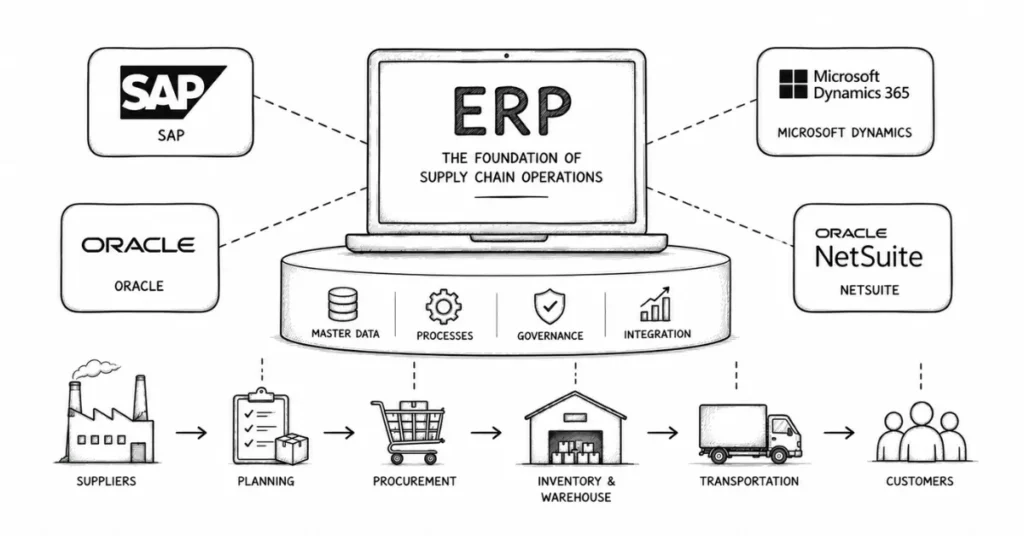
Why ERP Matters
ERP is your supply chain’s nervous system—connecting procurement, inventory, manufacturing, sales, finance, and logistics into one integrated database. Without ERP understanding, you’re operating with incomplete information.
1. SAP (Market Leader in India)
Why SAP Dominates:
SAP is the de facto standard for large Indian corporations and MNCs. If you work in manufacturing, FMCG, pharmaceuticals, or automotive, you’ll encounter SAP.
Key SAP Supply Chain Modules:
SAP MM (Materials Management):
- Procurement processes
- Purchase orders and vendor management
- Inventory management and valuation
- Material master data
SAP SD (Sales & Distribution):
- Sales order processing
- Delivery and shipping
- Billing and invoicing
- Pricing and promotions
SAP PP (Production Planning):
- Production orders
- MRP (Material Requirements Planning)
- Capacity planning
- Shop floor control
SAP WM (Warehouse Management):
- Warehouse operations
- Storage location management
- Goods movements
- Inventory tracking
SAP IBP (Integrated Business Planning):
- Modern cloud-based planning solution
- Demand planning with AI-driven forecasting
- Supply response planning
- Inventory optimization
- S&OP collaboration
SAP S/4HANA (Latest Version):
- Modern, in-memory database technology
- Real-time processing and analytics
- Simplified data model
- Enhanced user experience
- Companies globally are upgrading to S/4HANA
Career Relevance:
- SAP skills add ₹1-2 lakhs to compensation
- Most manager-level roles expect basic SAP navigation
- Deep SAP expertise opens consulting opportunities (₹2,000-5,000/day rates)
- SAP implementation project experience highly valuable
Learning SAP:
- Ideal: On-the-job training during SAP implementation projects
- Training institutes: ₹15,000-50,000 for module courses
- OpenSAP: Free online courses (great starting point)
- SAP Learning Hub: Official paid platform (~$1,500/year)
Reality Check:
You don’t need to be an SAP expert (that’s for SAP consultants), but understanding navigation, transactions, and how modules connect is essential for supply chain roles at medium-large companies.
2. Oracle SCM Cloud
What Makes Oracle Different:
Cloud-native platform with strong AI/ML capabilities, designed for modern, agile supply chains.
Key Features:
- Oracle Supply Chain Planning: Demand forecasting, supply planning
- Oracle Procurement Cloud: Source-to-pay processes
- Oracle Logistics Cloud: Transportation and warehousing
- Oracle IoT Cloud: Real-time asset monitoring
- Integrated analytics: Predictive insights and decision support
Best For:
- Companies seeking cloud-first approach
- Organizations prioritizing AI-driven planning
- Businesses wanting integrated planning and execution
Career Advantage:
Oracle skills are valuable but less common than SAP in India, creating niche opportunity. Growing adoption means increasing demand for Oracle-skilled professionals.
3. Microsoft Dynamics 365 Supply Chain Management
Why It’s Growing:
- More affordable than SAP for mid-sized companies
- Familiar Microsoft interface (easier learning curve)
- Strong integration with Microsoft ecosystem (Office, Power BI, Azure)
- Cloud-based and modern architecture
Key Capabilities:
- Demand forecasting and planning
- Procurement and vendor collaboration
- Manufacturing and production management
- Warehouse and transportation management
- IoT intelligence and asset monitoring
Career Perspective:
Dynamics 365 adoption is accelerating, especially among mid-sized companies. Learning it positions you for growing market segment often overlooked by SAP-focused professionals.
4. NetSuite Supply Chain Management
What It Is:
Oracle’s cloud ERP platform popular with smaller companies and startups.
Strengths:
- Complete business management (finance + operations)
- Quick implementation compared to SAP
- Lower total cost of ownership
- Supply and demand planning
- Inventory optimization
Career Niche:
Valuable for professionals targeting startup/scale-up environments or consulting to small-medium businesses.
CATEGORY 2: SUPPLY CHAIN PLANNING SOFTWARE
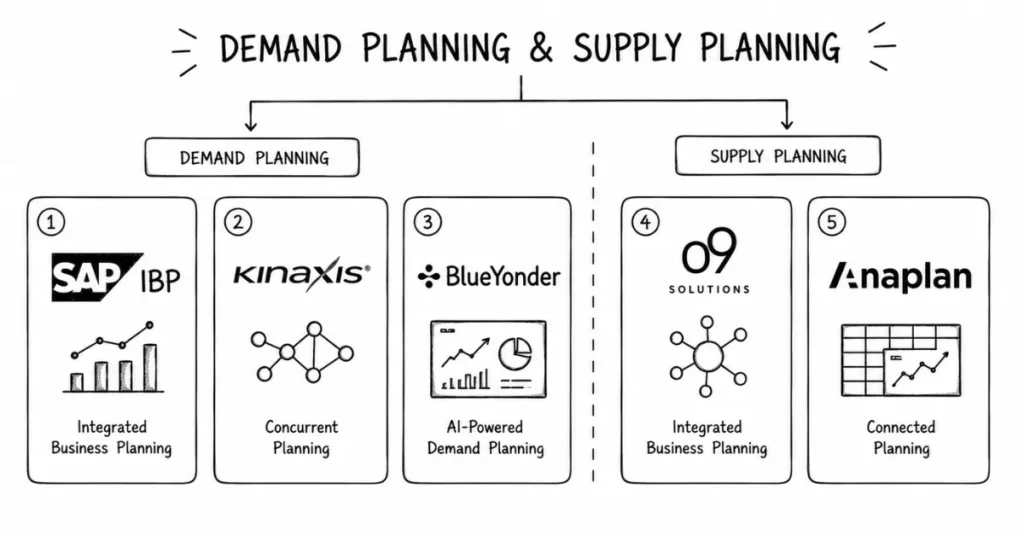
Why Planning Tools Matter
Planning software optimizes what to produce, buy, and move—before execution happens. These tools forecast demand, plan supply, and balance across the network.
1. SAP Integrated Business Planning (IBP)
What Makes IBP Special:
Modern, cloud-based planning platform with AI-powered capabilities.
Core Modules:
- Demand Planning: Statistical forecasting with machine learning
- Supply Response Planning: Optimizing production and procurement
- Inventory Optimization: Balancing service levels and costs
- Sales & Operations Planning (S&OP): Cross-functional consensus planning
Key Capabilities:
- Real-time collaboration across teams
- Scenario modeling and what-if analysis
- AI-driven forecast improvements
- Integration with SAP ERP and external systems
- Mobile access for decision-making
Career Impact:
SAP IBP expertise is in high demand with limited supply. Companies paying premiums for professionals who can implement and optimize IBP
2. Kinaxis RapidResponse
What It Does:
Real-time supply chain planning and control with powerful simulation capabilities.
Unique Strengths:
- Concurrent planning: Changes in one area immediately visible everywhere
- Real-time simulation: Test scenarios before making decisions
- Exception management: Alerts for issues requiring attention
- Collaborative planning: Cross-functional visibility and communication
Best For:
Fast-moving environments requiring agility—technology, consumer electronics, automotive.
User Perspective:
Kinaxis is known for powerful capabilities but steeper learning curve. Professionals skilled in RapidResponse are highly sought after.
3. Blue Yonder (formerly JDA)
AI-Powered Planning:
Leading platform leveraging AI and machine learning for demand forecasting and supply chain optimization.
Key Solutions:
- Demand Planning: AI-driven forecasting
- Inventory Optimization: Service level balancing
- Transportation Optimization: Route and load optimization
- Warehouse Management: Execution optimization
Strength:
Strong AI capabilities improving forecast accuracy and decision quality.
Career Note:
Blue Yonder combines planning and execution, making it valuable end-to-end platform. Experience with Blue Yonder demonstrates advanced supply chain technology understanding.
4. o9 Solutions
The New Challenger:
Modern, AI-powered platform with “digital twin” capabilities—virtual representation of your supply chain.
What’s Different:
- Enterprise-scale planning with consumer-app ease
- Real-time collaboration and scenario planning
- AI/ML built into core platform
- Rapid deployment compared to legacy systems
Career Opportunity:
o9 is growing rapidly, particularly among companies dissatisfied with older systems. Early expertise positions you well as adoption expands.
5. Anaplan
Unique Approach:
“Connected planning” platform linking supply chain, finance, sales, and HR planning in one system.
Strength:
Cross-functional planning integration—connecting supply chain plans with financial impacts, sales targets, and workforce planning.
Best For:
Organizations seeking planning platform that breaks down functional silos
CATEGORY 3: WAREHOUSE MANAGEMENT SYSTEMS (WMS)
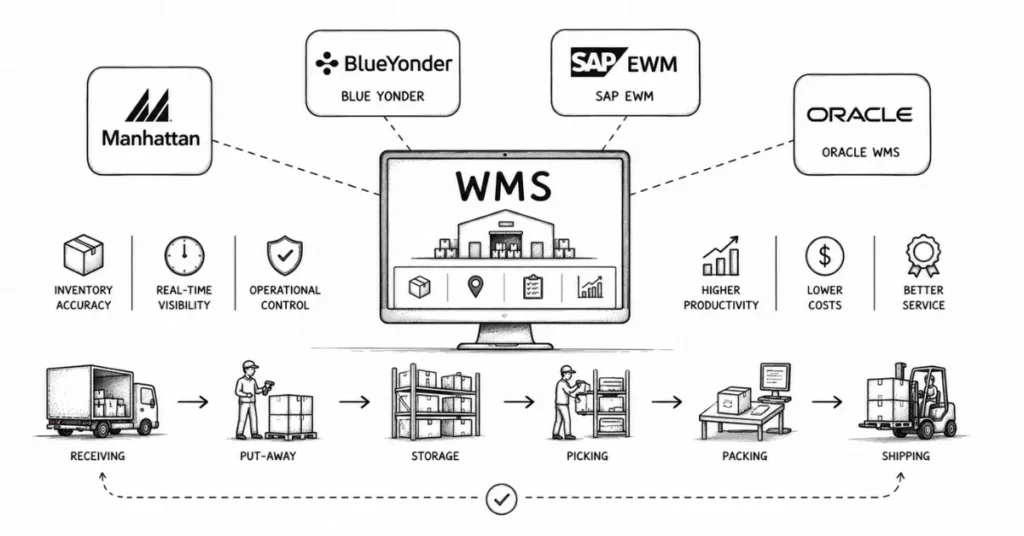
Why WMS Matters
WMS optimizes warehouse operations—receiving, putaway, picking, packing, shipping. Essential for anyone in warehousing, e-commerce fulfillment, or distribution.
1. Manhattan Active Supply Chain
Industry Leader:
Comprehensive platform for warehouse, transportation, and fulfillment.
Key Capabilities:
- Advanced warehouse management
- Labor management and optimization
- Multi-channel fulfillment (omnichannel support)
- Real-time inventory visibility
- Transportation management integration
Why It’s Respected:
Manhattan is gold standard in WMS—powerful, flexible, but complex. Large retailers, 3PLs, and e-commerce companies rely on Manhattan.
Career Value:
Manhattan WMS expertise is highly marketable, particularly for warehouse management, fulfillment operations, and 3PL roles.
2. Blue Yonder WMS
AI-Driven Warehouse Operations:
Advanced WMS with AI capabilities for labor optimization and space utilization.
Strengths:
- Intelligent task assignment
- Real-time inventory tracking
- Labor productivity optimization
- Flexible configuration
3. SAP Extended Warehouse Management (EWM)
SAP’s Advanced WMS:
More sophisticated than basic SAP WM, designed for complex warehouse operations.
Capabilities:
- Advanced slotting and putaway strategies
- Wave management for picking
- Labor management
- Yard management
- Cross-docking support
When It Makes Sense:
Companies already using SAP often choose EWM for integration benefits.
4. Oracle Warehouse Management Cloud
Cloud-Native WMS:
Modern, flexible WMS for various warehouse types.
Advantages:
- Quick deployment
- Mobile-first interface
- Configurable workflows
- Strong inventory accuracy capabilities
Learning WMS Technologies:
Practical Approach:
- WMS expertise comes primarily from hands-on warehouse experience
- Volunteering for WMS implementation projects provides learning opportunity
- Understanding one WMS deeply transfers to learning others
- Focus on WMS concepts (receiving processes, putaway strategies, picking methods) as much as specific software
CATEGORY 4: TRANSPORTATION MANAGEMENT SYSTEMS (TMS)
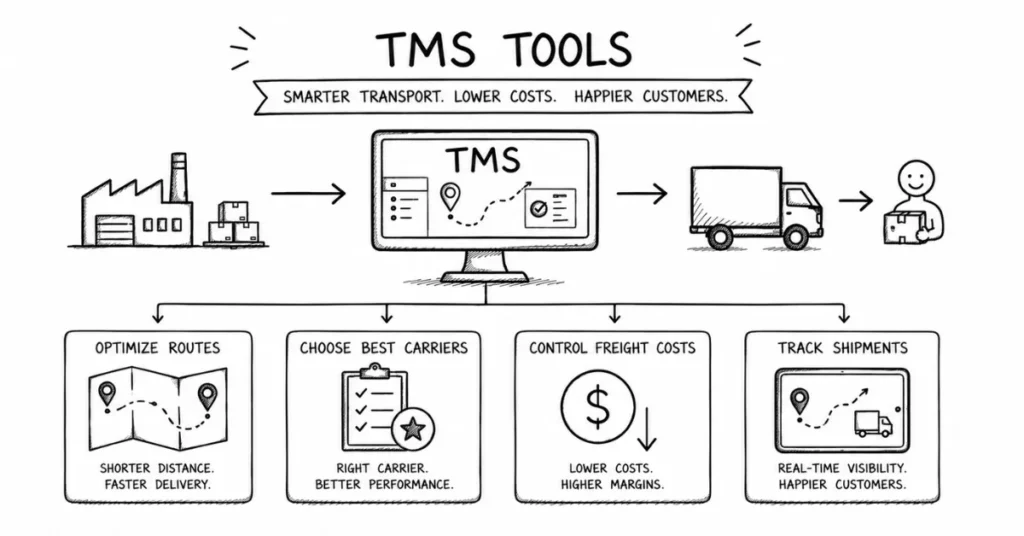
Why TMS Matters
TMS optimizes freight movement—route planning, carrier selection, shipment tracking, freight payment.
1. Blue Yonder Transportation Management
Comprehensive TMS:
- Route optimization algorithms
- Carrier management and rate shopping
- Load planning and consolidation
- Real-time shipment tracking
- Freight audit and payment
Strength:
AI-powered optimization reducing transportation costs while improving service.
2. Manhattan Active Transportation Management
Industry-Leading TMS:
- Execution and planning in one platform
- Multi-modal transportation support
- Carrier collaboration portal
- Real-time visibility
3. Oracle Transportation Management Cloud
Global TMS:
- International shipping support
- Customs and trade compliance
- Multi-modal optimization
- Cloud-based flexibility
4. SAP Transportation Management (TM)
Integrated with SAP ERP:
- Freight order management
- Route optimization
- Carrier collaboration
- Transportation analytics
Best For:
Companies using SAP ERP wanting integrated transportation management.
CATEGORY 5: ANALYTICS AND BUSINESS INTELLIGENCE
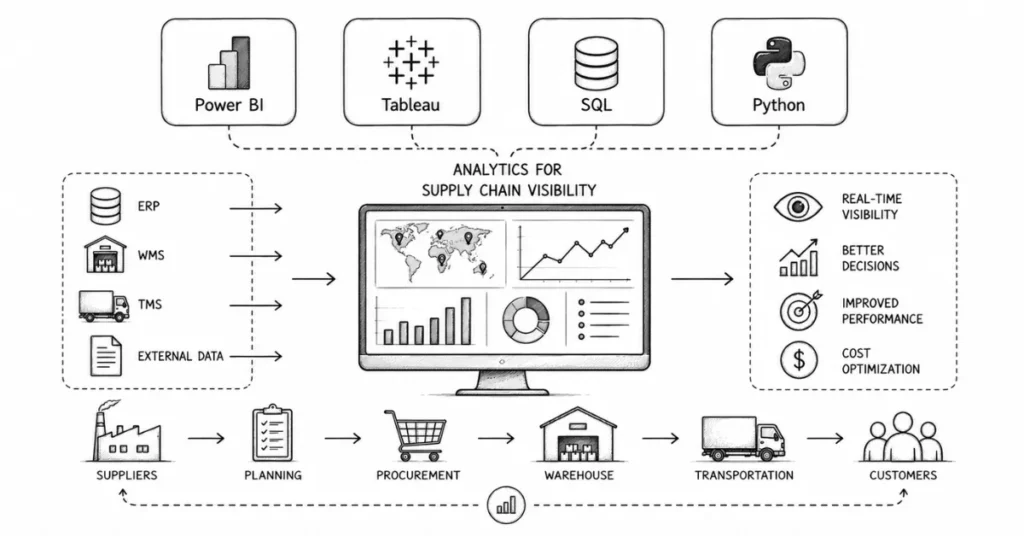
Why Analytics Tools Matter
Supply chains generate massive data. Analytics tools transform data into insights, dashboards, and decisions.[linkedin]
1. Microsoft Power BI
Why It’s Everywhere:
- Integrates seamlessly with Microsoft ecosystem
- More affordable than alternatives
- User-friendly interface
- Growing supply chain use cases
Supply Chain Applications:
- KPI dashboards (on-time delivery, inventory turnover, fill rates)
- Supplier performance scorecards
- Cost analysis and variance reports
- Forecast accuracy tracking
Learning Power BI:
- LinkedIn Learning: Comprehensive courses (₹2,000-3,000/month subscription)
- YouTube: Free tutorials
- Microsoft Learn: Official free training
- Practice: Build dashboards with sample supply chain data
Career Value:
Power BI skills increasingly expected for analyst and manager roles. Ability to create insightful dashboards differentiates you significantly.
2. Tableau
Powerful Visualization:
Industry-leading data visualization platform, slightly more powerful but also more complex than Power BI.
Advantages:
- Superior visualization capabilities
- Handles large datasets well
- Strong community and resources
- Industry standard in analytics-heavy organizations
Learning Tableau:
- Tableau Public: Free version for learning
- Coursera/Udemy: Structured courses
- Practice: Create public visualizations (builds portfolio)
3. SQL (Structured Query Language)
Why SQL Matters:
Extract data directly from databases without waiting for IT support.
Supply Chain Applications:
- Custom data extraction from ERP systems
- Ad-hoc analysis queries
- Data validation and reconciliation
- Building automated reports
Learning SQL:
- Khan Academy: Free beginner courses
- SQLBolt: Interactive free tutorial
- DataCamp/Codecademy: Structured paid courses
- Practice: Use sample databases (many free online)
Career Impact:
SQL proficiency adds ₹50,000-1 lakh to compensation for analyst roles. Enables self-sufficiency in data analysis.
4. Python for Supply Chain Analytics
Why Python:
- Powerful data analysis and automation
- Machine learning capabilities
- Growing adoption in supply chain
- Free and open-source
Supply Chain Applications:
- Advanced forecasting models
- Inventory optimization algorithms
- Supply chain network optimization
- Process automation
- Data cleaning and preparation
Key Libraries:
- Pandas: Data manipulation
- NumPy: Numerical computing
- Matplotlib/Seaborn: Data visualization
- Scikit-learn: Machine learning
Learning Python:
- Python for Everybody (Coursera): Free beginner course
- DataCamp: Supply chain analytics with Python
- Automate the Boring Stuff: Practical automation book
- Practice: Small automation projects at work
Reality Check:
Python is advanced skill not required for most supply chain roles, but increasingly valuable for analytics-focused positions and career differentiation.
CATEGORY 6: COLLABORATION AND VISIBILITY PLATFORMS
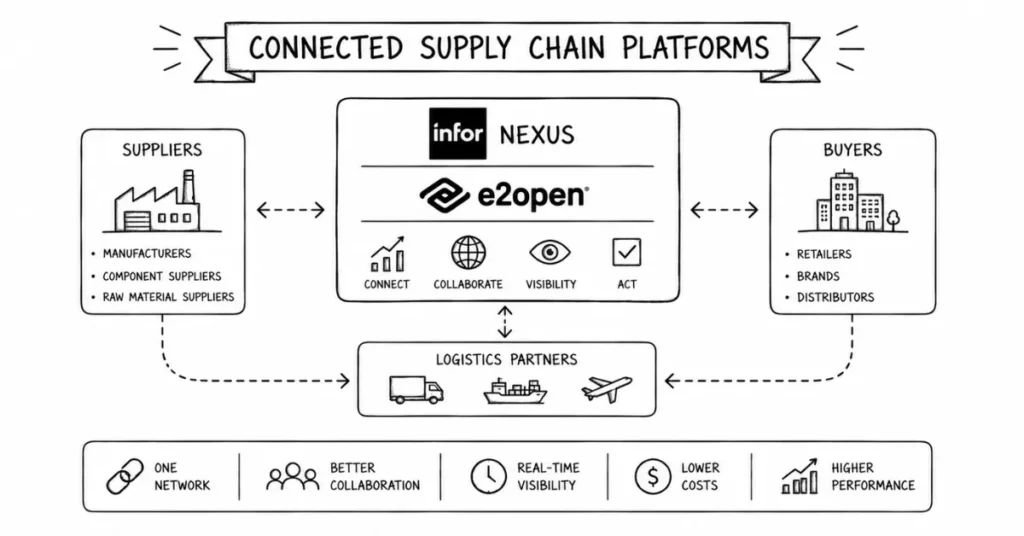
1. Infor Nexus
What It Does:
Multi-enterprise supply chain network connecting brands, suppliers, and logistics providers.
Key Features:
- Real-time visibility across supply chain
- Supplier collaboration and communication
- Financial settlement and payment
- Risk management and tracking
- Sustainability tracking
Best For:
Global supply chains with complex supplier networks requiring transparency and collaboration.
2. E2open
Connected Platform:
Cloud-native platform unifying planning, sourcing, and logistics.
Capabilities:
- Demand sensing and forecasting
- Supply planning and collaboration
- Transportation and logistics management
- Trade and compliance management
Strength:
Massive network (400,000+ partners) enabling collaboration across supply chain ecosystem.
CATEGORY 7: SPECIALIZED TOOLS
1. Freight Tracking and Logistics
Project44, FourKites, FreightPOP:
- Real-time shipment tracking
- Carrier integration and visibility
- Automated alerts and notifications
- Analytics on delivery performance
Value:
Essential for logistics coordinators and transportation managers monitoring numerous shipments daily.
2. Inventory Optimization Tools
Netstock, ToolsGroup:
- Advanced inventory optimization algorithms
- Multi-echelon inventory planning
- Service level optimization
- Safety stock calculations
3. Supplier Relationship Management (SRM)
SAP Ariba, Coupa:
- E-procurement and e-sourcing
- Supplier onboarding and management
- Contract management
- Spend analytics
TECHNOLOGY LEARNING ROADMAP BY CAREER STAGE
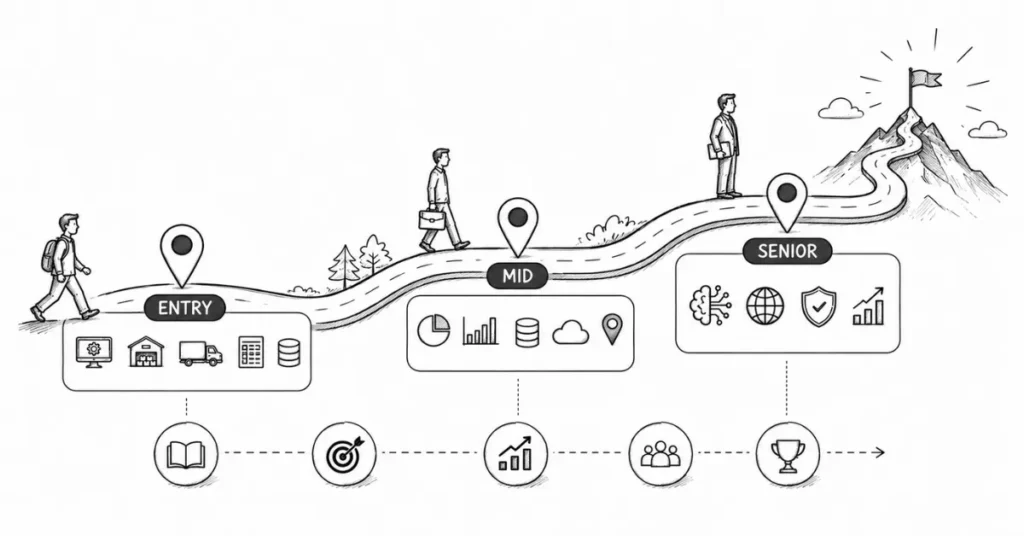
Entry-Level (0-3 Years): Foundation Building
Must Learn:
- Advanced Excel (pivot tables, VLOOKUP, basic formulas)
- Basic ERP navigation (whichever your company uses)
- Power BI or Tableau basics (for data visualization)
Nice to Have:
- Basic SQL for data extraction
- Understanding of WMS/TMS concepts (even without software access)
Time Investment: 3-6 months of consistent learning alongside work.
Mid-Level (3-8 Years): Specialization
Must Learn:
- Deep ERP expertise in your modules (SAP MM/SD/PP, Oracle SCM modules)
- Advanced analytics (Power BI/Tableau mastery)
- Specialized software for your function (demand planning software for planners, TMS for logistics, WMS for warehouse managers)
Nice to Have:
- SQL proficiency for custom analysis
- Basic Python for automation
- Supply chain planning software (IBP, Kinaxis, Blue Yonder)
Time Investment: Continuous learning; 5-10 hours/month dedicated to skill development.
Senior Level (8-15 Years): Strategic Technology Leadership
Must Understand:
- Technology strategy and digital transformation
- AI/ML applications in supply chain (conceptual understanding)
- System integration and architecture basics
- Change management for technology implementations
Focus:
Less about operating software yourself; more about selecting technology, leading implementations, managing technology strategy.
Practical Learning Strategies
1. On-the-Job Learning (Most Effective)
Strategies:
- Volunteer for system implementation projects
- Request access to training environments
- Shadow power users and super users
- Take on report creation responsibilities
- Participate in system testing
Why It’s Best: Real problems, real data, immediate application, and builds reputation at work.
2. Online Courses (Flexible Learning)
Best Platforms:
- LinkedIn Learning: Broad supply chain software courses (₹2,000-3,000/month)
- Udemy: Specific tool courses (₹1,000-3,000 per course)
- Coursera: University courses with certificates (₹3,000-8,000)
- YouTube: Free but less structured
3. Vendor Training (When Available)
SAP, Oracle, Manhattan, Kinaxis all offer official training:
- Often expensive (₹50,000-1.5 lakhs per course)
- High quality and comprehensive
- Official certifications available
- Best pursued if company sponsors
4. Practice Environments
Free Trial Accounts:
Many vendors offer limited-time free trials—SAP, Oracle, Tableau, Power BI. Use these for hands-on practice.
Sample Datasets:
Download supply chain datasets (Kaggle, government data portals) and practice analysis in Excel, Tableau, SQL.
Technology Trends Shaping 2026 and Beyond
1. AI and Machine Learning Integration
Current Reality:
All major supply chain platforms now incorporate AI—SAP IBP, Blue Yonder, Kinaxis, Oracle.
Applications:
- Demand forecasting improving accuracy by 10-20%
- Automated exception management
- Predictive maintenance
- Intelligent route optimization
Your Action:
Understand AI capabilities conceptually even if not coding algorithms. Know what’s possible, when to apply, and how to interpret results.
2. Cloud Migration
Trend:
Companies migrating from on-premise systems (SAP ECC, older versions) to cloud platforms (SAP S/4HANA Cloud, Oracle SCM Cloud).
Impact:
- Cloud skills increasingly valuable
- Understanding SaaS model important
- Integration with other cloud services
- Mobile accessibility becoming standard
3. Real-Time Visibility and IoT
Growing Adoption:
IoT sensors tracking shipments, monitoring warehouse conditions, predicting equipment failures.
Platforms:
- Oracle IoT Cloud
- SAP IoT solutions
- Specialized IoT platforms integrated with supply chain systems
4. Digital Twins
What It Means:
Virtual representation of physical supply chain enabling simulation and optimization.
Platforms Leading:
- o9 Solutions
- Blue Yonder
- Kinaxis
5. Blockchain for Traceability
Emerging:
Still early stage but growing for pharmaceutical, luxury goods, food supply chains requiring complete traceability.
Awareness Level:
Understand concept and use cases; deep expertise not yet widely needed.
Building Your Technology Portfolio
Document Your Skills:
- Create LinkedIn skills section listing supply chain software
- Build portfolio of dashboards/analyses (sanitize confidential data)
- Get vendor certifications when valuable
- Write about technology implementations you’ve participated in
Strategic Learning:
Don’t try learning everything. Focus on:
- Tools used at your company (immediate applicability)
- Market-leading platforms (SAP, Oracle, Power BI)
- Tools aligned with your specialization (TMS for logistics, planning software for demand planners)
Continuous Improvement:
Dedicate 5-10 hours monthly to technology learning. Over a year, that’s 60-120 hours—enough to become proficient in new software.
Final Thoughts: Technology as Career Accelerator
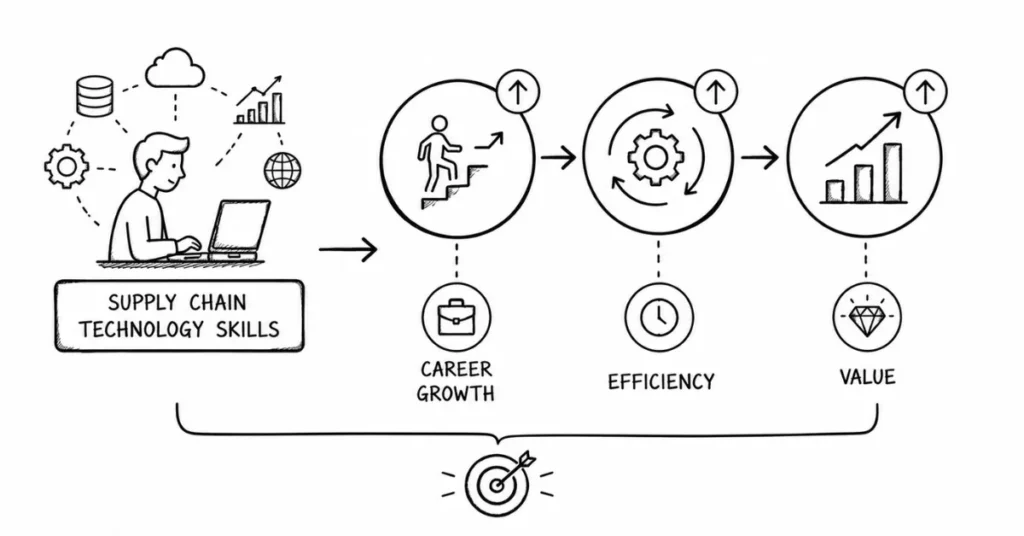
Supply chain technology literacy isn’t optional—it’s fundamental to career success in 2026 and beyond. Companies are investing heavily in digital transformation, and professionals who can leverage these technologies deliver dramatically better results than those who can’t.
But here’s the good news: you don’t need to be a programmer or IT specialist. You need practical proficiency—understanding what technologies can do, how to use them effectively, and how to drive business value with them.
Your Action Plan:
This Month:
- Master Excel to advanced level if you haven’t
- Get comfortable with one ERP system (whichever your company uses)
- Start learning one visualization tool (Power BI or Tableau)
Next 6 Months:
- Deep dive into software relevant to your specialization
- Complete 2-3 online courses
- Build practice projects demonstrating skills
Next Year:
- Become the “go-to” technology person in your team
- Lead or significantly contribute to technology projects
- Consider vendor certifications for career differentiation
Technology skills compound over time. The supply chain professional who invested 100 hours learning SAP IBP, Power BI, and Python automation three years ago is now earning ₹5-10 lakhs more annually than peers who didn’t, simply because they deliver more value with less effort.
Your career is your most important investment. Technology skills are your highest-ROI area for time investment. Start today—your future self will thank you.