
Supply Chain Interview Guide: 50+ Questions & Answers
Table of Contents
Introduction: The Interview That Changed Everything

“Tell me about a time you handled a supply chain disruption.”
This single question determined whether Priya got her dream job at HUL or remained stuck in her current role. She had the experience—managing vendor delays, coordinating urgent airfreight, solving production shortages. But in the interview room, under pressure, she fumbled. She rambled without structure, forgot to quantify the impact, and couldn’t articulate what she learned. The interviewer thanked her politely. The rejection email came two days later.
Three months later, Priya got another opportunity—this time at ITC. But now she was prepared. She had structured frameworks for behavioral questions. She practiced technical questions until answers flowed naturally. She researched the company deeply and prepared intelligent questions. When asked about handling disruptions, she delivered a crisp STAR-format answer with quantified results. She got the offer—with ₹6 lakhs more than her previous attempt.
The truth about supply chain interviews: Your qualifications get you the interview. Your interview performance gets you the job and determines your offer package. Two equally qualified candidates can walk away with offers differing by ₹3-5 lakhs based purely on interview performance.
This comprehensive guide prepares you to ace supply chain interviews at any level—entry-level coordinator to senior director. We’ll cover:
- 50+ actual interview questions with model answers
- Technical questions by function (logistics, procurement, planning, operations)
- Behavioral questions with STAR framework
- Case studies and problem-solving scenarios
- Questions to ask interviewers (showing strategic thinking)
- Salary negotiation strategies
- Red flags to watch for
Whether you’re preparing for your first supply chain role or interviewing for VP positions, this guide ensures you walk into every interview confident, prepared, and ready to secure the best possible offer.
PART 1: INTERVIEW PREPARATION FRAMEWORK
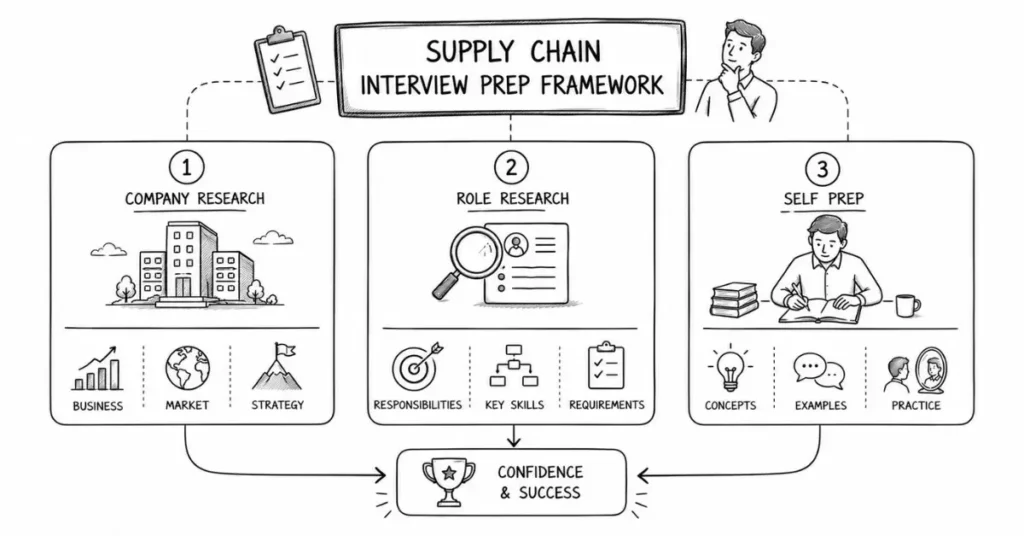
Before the Interview: Research Phase
Company Research (2-3 Hours Minimum):
Understand the Business:
- What products/services do they sell?
- Who are their customers (B2B, B2C, segments)?
- Revenue, size, growth trajectory
- Competitors and market position
- Recent news and developments
Supply Chain Specifics:
- Where do they manufacture? (Locations, capacity)
- Distribution network (warehouses, channels)
- Key supply chain challenges in their industry
- Technology they use (SAP, Oracle, etc.)
- Sustainability initiatives
- Recent supply chain issues or successes (search news)
Interview Context:
- Who’s interviewing you? (Look up on LinkedIn)
- What’s their background and role?
- What would success look like in this role?
- Team structure and reporting relationships
Sources:
- Company website (especially “About,” “Careers,” “Sustainability” sections)
- LinkedIn company page
- News articles (Google News search)
- Glassdoor (interview experiences, company reviews)
- Annual reports (for listed companies)
- Industry reports and analyses
The STAR Framework for Behavioral Questions
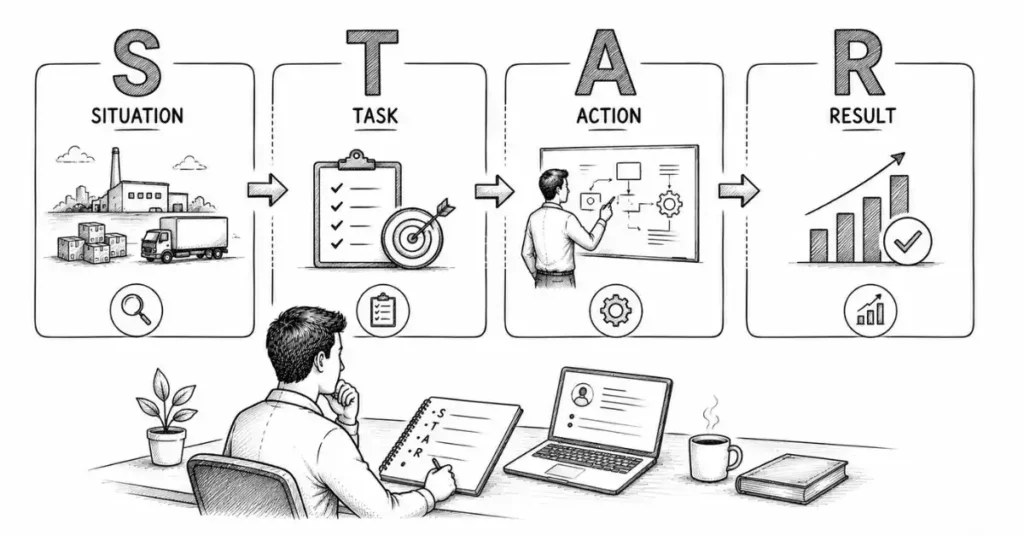
STAR = Situation, Task, Action, Result
Example Question: “Tell me about a time you resolved a supplier quality issue.”
Poor Answer (Rambling, No Structure):
“Yeah, we had this supplier who kept sending bad materials. It was really frustrating because production kept complaining. I called them many times and eventually they fixed it. It took a while but we got there in the end.”
Excellent Answer (STAR Framework):
Situation: “In my role as procurement executive at XYZ Company, our primary raw material supplier began delivering substandard material—reject rates increased from 2% to 15% over two months.”
Task: “My responsibility was to resolve this quickly because it was causing production delays costing ₹8 lakhs weekly and threatening delivery commitments to our top client.”
Action: “I took a three-step approach: First, I analyzed six months of quality data to identify specific defect patterns. Second, I conducted a supplier audit with our quality team, discovering their testing equipment was malfunctioning. Third, I negotiated a 60-day improvement plan with weekly checkpoints, while simultaneously qualifying a backup supplier to reduce risk.”
Result: “Within 45 days, reject rates returned to 3%. We avoided production delays worth ₹24 lakhs, maintained client relationships, and now had a qualified alternate supplier reducing future risk. The supplier also invested ₹15 lakhs in new testing equipment to prevent recurrence.”
Why This Works:
✅ Structured and clear
✅ Quantified impact (₹8 lakhs weekly, reduced to 3%, saved ₹24 lakhs)
✅ Shows analytical thinking (data analysis)
✅ Demonstrates initiative (audit, backup supplier)
✅ Highlights stakeholder management (supplier negotiation, client protection)
✅ Shows foresight (risk mitigation with backup)
Practice STAR for Every Behavioral Question:
Prepare 10-15 stories from your experience covering different competencies (problem-solving, leadership, conflict resolution, innovation, failure/learning). Use STAR structure for each.
PART 2: TECHNICAL INTERVIEW QUESTIONS
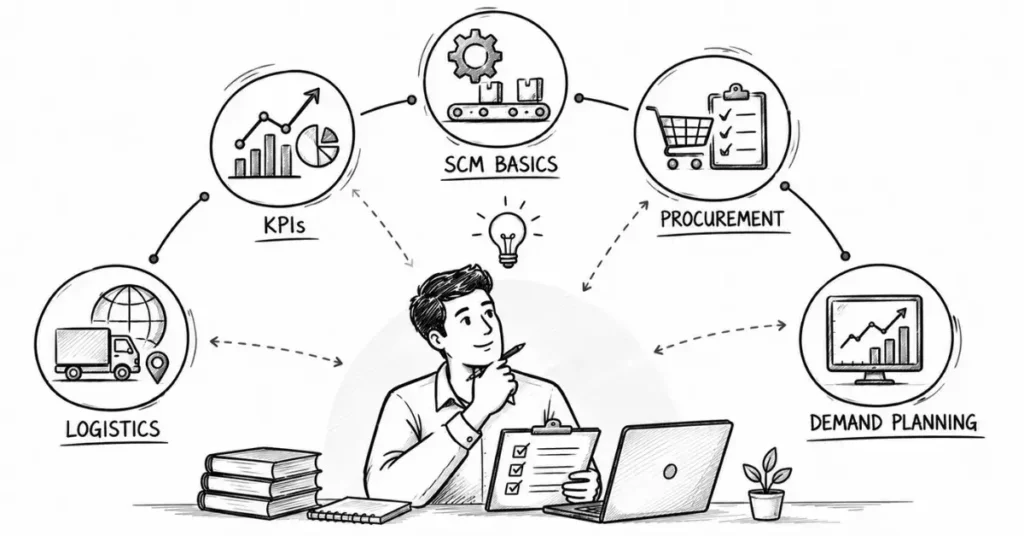
General Supply Chain Knowledge (All Levels)
Q1: What is supply chain management?
Model Answer:
“Supply chain management is the end-to-end coordination of activities involved in sourcing, procurement, production, and logistics to deliver products or services from suppliers to customers. It encompasses planning, executing, and optimizing the flow of materials, information, and finances across the value chain. The goal is creating customer value efficiently while managing costs, service levels, and working capital.”
Why This Works: Comprehensive, touches key elements, shows understanding of value creation.
Q2: What’s the difference between supply chain and logistics?
Model Answer:
“Logistics is a subset of supply chain management focused specifically on the movement and storage of goods—transportation, warehousing, inventory management, and order fulfillment. Supply chain management is broader, encompassing logistics plus strategic planning, procurement, supplier management, demand forecasting, production planning, and overall network optimization. Think of logistics as execution while supply chain includes both planning and execution across the entire value chain.”
Q3: What are key supply chain KPIs you track?
Model Answer (Tailor to Your Role):
“The KPIs depend on the function, but common ones I’ve worked with include:
Service Metrics:
- On-Time In-Full (OTIF) delivery rate—measures reliability
- Order fill rate—percentage of orders completely fulfilled
- Customer order cycle time—end-to-end delivery time
Cost Metrics:
- Cost per unit delivered
- Transportation cost as percentage of sales
- Warehousing cost per unit handled
Efficiency Metrics:
- Inventory turnover—how efficiently inventory converts to sales
- Cash-to-cash cycle time—working capital efficiency
- Perfect order percentage—orders delivered without errors
Planning Metrics:
- Forecast accuracy—typically measured by MAPE or bias
- Supply chain cycle time—speed of response
In my previous role, I focused particularly on OTIF (target 95%) and inventory turnover (target 12x), as these directly impacted both customer satisfaction and working capital.”
Why This Works: Shows breadth of knowledge, categorizes logically, mentions specific targets, connects to business impact.
Q4: Explain the bullwhip effect.
Model Answer:
“The bullwhip effect describes how small demand fluctuations at the customer level amplify as they move upstream through the supply chain, causing increasingly larger swings in orders at manufacturer and supplier levels.
For example, a 5% increase in retail demand might lead a retailer to order 10% more, the distributor 15% more, and the manufacturer 25% more as each player adds safety margins and batch ordering. This creates inefficiency—excess inventory, increased costs, and poor service.
Common causes include:
- Demand signal processing (forecasting errors)
- Order batching (economic order quantities)
- Price fluctuations (promotional buying)
- Shortage gaming (inflating orders during constraints)
Mitigation strategies include:
- Information sharing (POS data visibility)
- Vendor-managed inventory
- Everyday low pricing (reducing promotional spikes)
- Allocation rules during shortages
In my experience at [Company], we reduced bullwhip by implementing collaborative planning with key customers, which improved forecast accuracy by 12% and reduced inventory by 18%.”
Why This Works: Clear explanation, examples, causes, solutions, personal application.
Procurement & Sourcing Questions
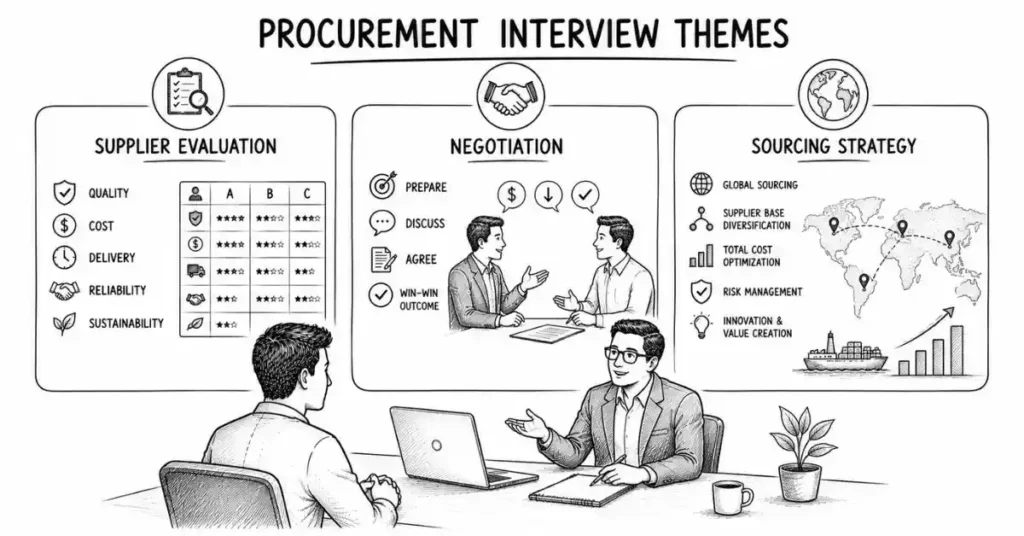
Q5: How do you evaluate and select suppliers?
Model Answer:
“Supplier evaluation involves multiple dimensions beyond just price:
Capability Assessment:
- Quality systems and certifications (ISO, industry-specific)
- Technical capabilities and capacity
- Financial stability (credit reports, financial statements)
- Geographic location and supply chain risk
Performance Criteria:
- Total cost of ownership (not just unit price—includes freight, quality costs, payment terms)
- Quality track record and reject rates
- Delivery reliability and lead times
- Responsiveness and flexibility
Strategic Fit:
- Innovation capabilities
- Sustainability and ESG practices
- Cultural alignment
- Long-term partnership potential
I typically use a weighted scorecard evaluating these factors. For example, in a recent strategic sourcing project, we evaluated 8 potential suppliers across 12 criteria, with quality and reliability weighted 30% each, cost 25%, and sustainability 15%. This systematic approach helped us select a supplier who wasn’t the cheapest but delivered 35% lower total cost over two years due to superior quality and reliability.”
Q6: How do you negotiate with suppliers?
Model Answer:
“Effective negotiation requires preparation and a win-win mindset:
Preparation Phase:
- Understand total spend and leverage
- Benchmark market rates and alternatives
- Identify supplier’s pain points and motivations
- Define BATNA (Best Alternative to Negotiated Agreement)
- Quantify value beyond price (volume commitment, payment terms, growth potential)
Negotiation Approach:
- Lead with relationship building, not adversarial positioning
- Present data-driven arguments (market benchmarks, competitive quotes)
- Bundle items to create negotiating flexibility
- Look for creative value exchanges (longer contracts for better pricing, inventory consignment, collaborative forecasting)
- Focus on total value, not just price reduction
Example:
Recently negotiating with a packaging supplier, rather than just demanding 10% price reduction, I proposed a two-year contract with volume commitment, automated ordering integration reducing their admin costs, and quarterly business reviews. This created ₹15 lakhs annual savings for us while giving them revenue certainty and lower cost-to-serve—a genuine win-win that strengthened the partnership.”
Logistics & Operations Questions
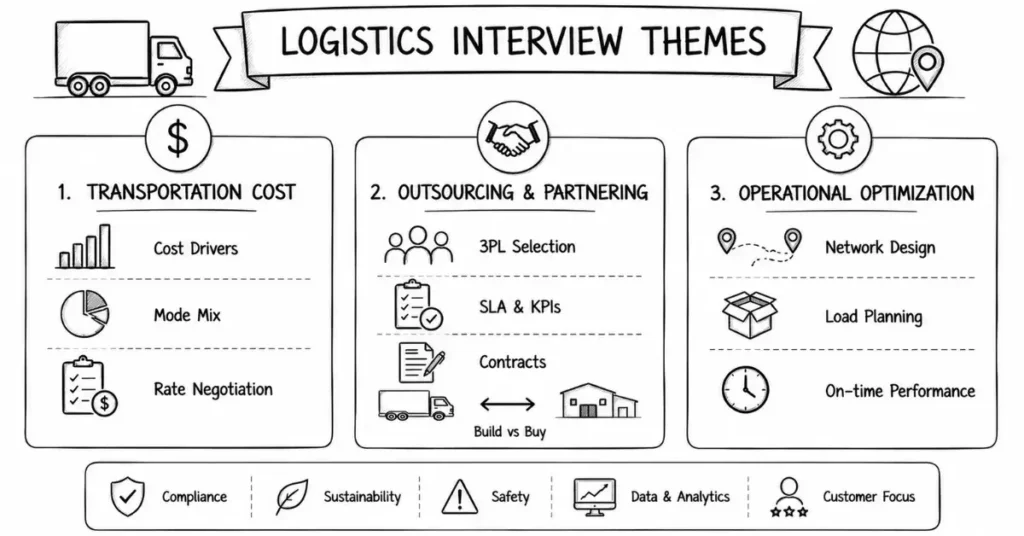
Q7: How do you optimize transportation costs?
Model Answer:
“Transportation optimization involves multiple levers:
Network Design:
- Optimal warehouse/DC locations minimizing total distance
- Consolidation opportunities (combining shipments)
- Direct vs. hub-and-spoke models
Operational Efficiency:
- Route optimization software (TSP algorithms)
- Load optimization (maximizing vehicle utilization, reducing empty miles)
- Mode selection (truck vs. rail vs. air based on urgency-cost tradeoff)
- Backhauling (finding return loads)
Commercial Strategies:
- Carrier negotiation and competitive bidding
- Volume commitments for better rates
- Collaborative transportation with non-competing companies
- 3PL partnerships for volume aggregation
Measurement:
- Cost per ton-kilometer
- Vehicle utilization percentage
- On-time delivery rates
In my previous role, I led a transportation optimization project using route optimization software and renegotiating carrier contracts. We reduced transportation costs by 18% (₹42 lakhs annually) while improving on-time delivery from 89% to 94%.”
Q8: How do you decide between in-house vs. outsourced logistics?
Model Answer:
“The make-vs-buy decision for logistics depends on several factors:
Consider In-House When:
- Core competency (logistics is competitive advantage)
- High control requirements (sensitive products, quality concerns)
- Sufficient scale (fixed costs justifiable)
- Unique requirements (specialized handling, custom processes)
- Cost-effective at your volume
Consider Outsourcing (3PL) When:
- Non-core activity (focus resources on core business)
- Variable demand (3PL provides flexibility)
- Limited scale (benefit from 3PL’s aggregated volume)
- Capital constraints (avoid warehouse/fleet investment)
- Geographic expansion (leverage 3PL’s existing network)
- Expertise gaps (complex import-export, specialized warehousing)
Decision Framework:
- Calculate total cost comparison (5-year horizon)
- Assess service level requirements and capabilities
- Evaluate strategic importance
- Consider flexibility and scalability needs
- Assess risk factors
Example:
At my previous company, we analyzed warehousing for a new product line. Despite in-house being 12% cheaper annually, we chose 3PL because the product had uncertain demand trajectory. This avoided ₹2.5 crore capital investment and provided flexibility to scale up or down. After two years when demand stabilized, we reassessed and transitioned to in-house operations, optimizing costs while managing risk appropriately initially.”
Demand Planning Questions
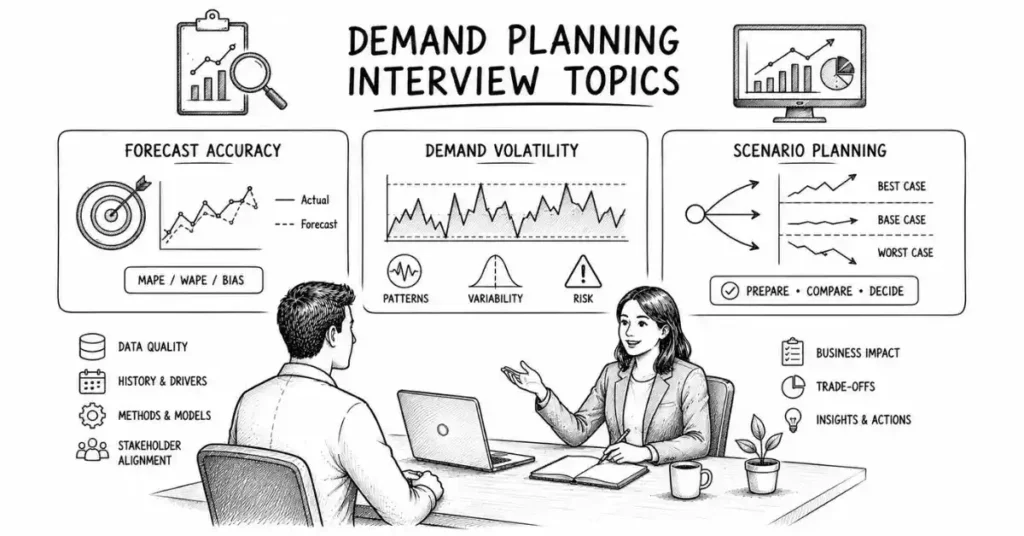
Q9: How do you improve forecast accuracy?
Model Answer:
“Forecast accuracy improvement requires systematic approaches:
Data Quality and Analytics:
- Clean historical data (remove outliers, adjust for one-time events)
- Statistical methods selection (time series, regression, machine learning)
- Segmentation (ABC analysis—different methods for different product categories)
- External data incorporation (economic indicators, weather, trends)
Collaboration:
- Sales input on customer plans and market intelligence
- Marketing input on promotional activities
- Customer collaboration (VMI, sharing POS data)
- S&OP process for consensus forecasting
Continuous Improvement:
- Track forecast accuracy metrics (MAPE, bias, forecast value added)
- Conduct forecast post-mortems (understand miss reasons)
- Adjust models based on learnings
- Benchmark against industry standards
Technology:
- Advanced planning systems (SAP IBP, Blue Yonder)
- Machine learning models for complex patterns
- Automated alerts for anomalies
Example:
In my role as demand planner, I implemented a three-step improvement program: First, segmented products by demand pattern (ABC-XYZ analysis) and applied appropriate models. Second, established weekly consensus meetings with sales integrating market intelligence. Third, introduced machine learning for top 20% products driving 80% revenue. Over six months, we improved MAPE from 32% to 24%, reducing safety stock by ₹1.2 crores while maintaining 96% service level.”
Q10: How do you handle demand volatility?
Model Answer:
“Managing demand volatility requires both supply-side and demand-side strategies:
Supply Chain Flexibility:
- Safety stock buffers (calculated based on demand variability and lead time)
- Flexible production capacity (overtime, alternate suppliers, contract manufacturers)
- Postponement strategies (customize late in the process)
- Fast, reliable suppliers (shorter lead times reduce uncertainty impact)
Demand Management:
- Price mechanisms (dynamic pricing to smooth demand)
- Promotional planning (coordinate with marketing)
- Product portfolio management (balance stable and volatile products)
- Customer collaboration (visibility into their plans)
Planning Approaches:
- Rolling forecasts (update frequently rather than static annual)
- Scenario planning (best/worst/most likely cases)
- Responsive planning cycles (weekly instead of monthly)
Trade-off Management:
Balance inventory investment vs. service levels—quantify cost of stockouts vs. holding costs.
Real Example:
Managing demand for seasonal products with 60-70% forecast error, we implemented a two-tier strategy: manufactured core volumes to high-confidence forecast, then partnered with contract manufacturer for flexible capacity covering demand variability. This increased per-unit cost by 8% but eliminated stockouts (previously costing ₹35 lakhs annually in lost sales) while reducing excess inventory by 40%. Net benefit: ₹22 lakhs annually.”
PART 3: BEHAVIORAL INTERVIEW QUESTIONS
Leadership & Teamwork
Q11: Tell me about a time you led a cross-functional project.
STAR Answer Template:
Situation: “In my role as Supply Chain Manager at [Company], our CEO challenged us to reduce end-to-end order cycle time by 30% to match competitors.”
Task: “I was assigned to lead a cross-functional team including sales, production, quality, logistics, and IT to redesign the order-to-delivery process.”
Action:
- “Formed team with representatives from each function (8 people total)
- Conducted current-state analysis using process mapping—identified cycle time was 15 days vs. competitor 10 days
- Facilitated brainstorming identifying bottlenecks: order processing (2 days), production scheduling (3 days), quality holds (2 days), logistics planning (1 day)
- Developed action plans for each bottleneck with function owners
- Implemented weekly steering committee meetings tracking progress
- Managed resistance from quality team (concerned about rushing) by redesigning inspection process rather than eliminating steps
- Secured ₹8 lakhs budget for IT automation of order processing”
Result:
“Within 4 months, reduced cycle time from 15 to 10.5 days (30% improvement). Customer satisfaction scores increased 12 points. Freed up working capital of ₹65 lakhs due to faster cash conversion. The project became template for other improvement initiatives across the company.”
Q12: Describe a time you had a conflict with a colleague. How did you resolve it?
STAR Answer:
Situation: “As Procurement Manager, I had a conflict with the Production Manager who insisted on single-sourcing a critical component from a supplier I knew was financially unstable.”
Task: “I needed to ensure supply security without damaging my relationship with a key stakeholder who had worked with this supplier for 5 years.”
Action:
- “First, I listened to understand his perspective—he valued the supplier’s technical expertise and responsive service
- Shared my concerns professionally with data—credit report showing declining financials, news about layoffs
- Proposed a compromise: keep them as primary supplier but qualify a backup supplier at 20% volume
- Jointly visited the supplier to discuss financial stability plans and our concerns
- Agreed on monthly financial health checks and contingency plans
- Built relationship through regular collaboration on other sourcing initiatives”
Result:
“Six months later, the primary supplier faced cash flow crisis and couldn’t meet an urgent order. Our backup supplier filled the gap within 48 hours, preventing a production shutdown that would have cost ₹25 lakhs. The Production Manager later thanked me, and our working relationship actually strengthened through transparent collaboration.”
Problem-Solving & Crisis Management
Q13: Tell me about your biggest supply chain failure and what you learned.
STAR Answer (Honesty + Learning):
Situation: “Early in my career as Logistics Coordinator, I was responsible for coordinating shipments to a major customer’s product launch.”
Task: “Ensure on-time delivery of 50,000 units for their nationwide launch event.”
Action (Where I Failed):
“I confirmed shipping dates with our warehouse but didn’t verify with the carrier. I assumed standard 3-day transit. The carrier actually needed 5 days for this volume, which I didn’t realize until 2 days before delivery deadline.”
Result:
“The shipment arrived 2 days late, causing the customer to postpone their launch event. We had to offer ₹8 lakhs compensation. It damaged the relationship and my credibility.”
Learning:
“This taught me three critical lessons I apply daily:
- Verify end-to-end: Never assume—confirm every link in the chain
- Build buffers: For critical deliveries, plan with time buffers for unexpected issues
- Proactive communication: When I realized the mistake, I should have immediately escalated and explored alternatives (air freight, partial shipments) rather than hoping it would work out
Since then, I’ve managed hundreds of critical shipments without similar failures by implementing checklists, cross-verification, and contingency planning. That painful lesson made me a much more thorough and reliable supply chain professional.”
Why Sharing Failure Works:
- Shows self-awareness and humility
- Demonstrates learning and growth
- Proves you take accountability
- Interviewers respect authentic reflection over false perfection
PART 4: CASE STUDY & PROBLEM-SOLVING
Q14: Case Study – Inventory Optimization
Question:
“Our company carries ₹50 crores inventory across 200 products. The CFO wants to reduce inventory by 30% without impacting customer service. How would you approach this?”
Structured Answer:
Understand Current State:
“First, I’d analyze the inventory composition:
- ABC analysis—what percentage of inventory is in top 20% products?
- XYZ analysis—demand pattern (stable vs. volatile)
- Inventory turnover by product category
- Service level performance by product
- Obsolete and slow-moving inventory value
Identify Opportunities:
Based on typical patterns, I’d expect to find:
- Obsolete inventory: 5-10% (₹2.5-5 crores)—dispose or liquidate
- Slow-moving inventory: 15-20% (₹7.5-10 crores)—reduce to minimum stocks
- Safety stock excess: Recalculate based on actual demand variability (often 10-15% reduction possible)
- Pipeline inventory: Can we reduce lead times or order frequencies?
Actions by Category:
A-items (high value, 20% items, 80% value):
- Negotiate consignment stock or VMI with suppliers
- Reduce lead times through closer suppliers or expedited shipping
- Implement more frequent ordering (reduce batch sizes)
B-items:
- Optimize reorder points and safety stock using statistical methods
- Consider min-max inventory policies
C-items (low value, 80% items, 20% value):
- Two-bin systems or simple reorder points
- Focus management attention on A and B items
Risk Mitigation:
- Implement in phases (test on selected products before full rollout)
- Establish weekly service level monitoring to catch issues early
- Keep contingency plans (expedited freight budget, backup suppliers)
Expected Results:
- Obsolete disposal: ₹3 crores (6%)
- Slow-mover reduction: ₹5 crores (10%)
- Safety stock optimization: ₹4 crores (8%)
- Pipeline reduction: ₹3 crores (6%)
- Total: ₹15 crores (30% reduction)
While maintaining service levels through intelligent segmentation and risk management.”
Why This Answer Impresses:
✅ Structured approach (not random ideas)
✅ Data-driven thinking (ABC analysis, metrics)
✅ Realistic estimates (specific percentages)
✅ Risk awareness (phased approach, monitoring)
✅ Cross-functional thinking (supplier negotiations, demand management)
PART 5: QUESTIONS TO ASK INTERVIEWERS
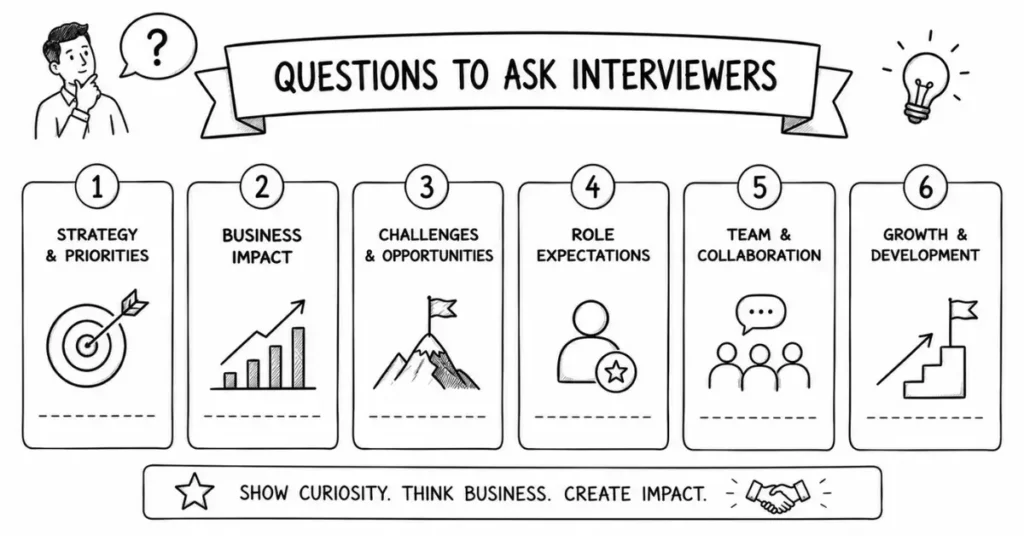
Never say “No, I don’t have any questions.” Shows lack of interest.
Strategic Questions (Show Business Acumen):
- “What are the biggest supply chain challenges the company is facing in the next 12-18 months?”
- “How does supply chain contribute to the company’s competitive advantage?”
- “What does success look like for this role in the first 6 months and first year?”
- “How is supply chain performance measured at the leadership level? What metrics matter most?”
- “Can you describe the supply chain organization structure and how this role fits in?”
Cultural Fit Questions:
- “How would you describe the supply chain team culture?”
- “What’s your favorite thing about working here? What’s most challenging?”
- “How does the company support professional development and learning?”
Role-Specific Questions:
- “What technology stack does the supply chain team use? (ERP, planning systems, analytics tools)”
- “What’s the team size and structure I’d be working with?”
- “What are the growth opportunities from this role?”
Strategic Timing:
- Ask 3-4 questions in first round
- Ask deeper, more strategic questions in later rounds
- Show you’ve researched by referencing company specifics
PART 6: SALARY NEGOTIATION

Before Negotiating:
Know Your Worth:
- Research market rates (Glassdoor, Ambition Box, network)
- Know your current compensation (base + variable + benefits)
- Define your walk-away number (minimum acceptable)
Delay Salary Discussion:
- If asked early: “I’m flexible on compensation and more interested in understanding the role and fit. What’s the budgeted range for this position?”
- Let them make first offer when possible
Negotiation Tactics:
When You Receive an Offer:
1.Thank and Request Time:
“Thank you for the offer. I’m excited about the opportunity. Could I have 2-3 days to review everything carefully?”
2.Evaluate the Full Package:
- Base salary
- Variable/bonus
- Benefits (PF, insurance, leave)
- Joining bonus
- Relocation allowance
- Stock options (if applicable)
3.Negotiate Strategically:
If Offer is Below Expectations:
“I’m very excited about this opportunity and believe I can deliver significant value. Based on my research and my current compensation of ₹X lakhs plus my specialized skills in [SAP/analytics/etc.], I was expecting a package in the range of ₹Y-Z lakhs. Is there flexibility to move closer to that range?”
What to Negotiate (Priority Order):
- Base salary (impacts future raises, most important)
- Joining bonus (one-time, easier for companies)
- Variable/performance bonus percentage
- Title (impacts future mobility)
- Role scope (responsibilities, team size)
Leverage (Use Carefully):
- Competing offers (only if true)
- Current compensation (if moving for less than 20-30%, they may question motivation)
- Unique skills (certifications, technical expertise, domain knowledge)
Example Script:
“I’m very enthusiastic about joining [Company] and contributing to [specific initiative you discussed]. The role aligns perfectly with my goals. However, the offered package of ₹16 lakhs is 10% below my current ₹18 lakhs. Given my [APICS CSCP certification / SAP IBP expertise / 8 years experience in FMCG supply chain], and considering the market rate for this role is ₹18-22 lakhs, would you be able to increase the offer to ₹20 lakhs? Alternatively, a ₹2 lakh joining bonus would help bridge the gap and make this an easy decision.”
Common Mistakes to Avoid:
❌ Accepting first offer immediately (always negotiate, even if good)
❌ Lying about current compensation or other offers (easily verified, damages trust)
❌ Negotiating aggressively or with ultimatums (collaborative tone works better)
❌ Focusing only on salary (total package and role growth matter)
❌ Comparing yourself to others (“My friend with same experience got ₹X”)
❌ Negotiating too long (2-3 rounds maximum, then decide)
PART 7: RED FLAGS TO WATCH FOR
During Interview Process:
🚩 Vague job descriptions (unclear responsibilities)
🚩 Disorganized interview process (multiple reschedules, unprofessional communication)
🚩 Interviewer speaks negatively about company or colleagues
🚩 High turnover in the role (multiple predecessors in short time)
🚩 Unrealistic expectations (“We need someone to fix everything in 3 months”)
🚩 Pressure tactics (“We need decision by tomorrow”)
🚩 Reluctance to discuss challenges or problems
🚩 No clear growth path or development opportunities
🚩 Poor glassdoor reviews with consistent patterns
🚩 Salary significantly below or above market (both suspicious)
Trust your instincts. If something feels wrong, it probably is.
CONCLUSION: Interview Preparation = Career Investment

Interview performance isn’t luck—it’s preparation. The difference between mediocre and excellent interview performance is 15-20 hours of deliberate practice:
Your 2-Week Prep Plan:
Week 1:
- Day 1-2: Company research (3-4 companies if multiple interviews)
- Day 3-4: Prepare STAR stories (10-15 experiences)
- Day 5-7: Practice technical questions (review fundamentals)
Week 2:
- Day 8-9: Mock interviews with friend or mentor
- Day 10-11: Prepare questions to ask, salary research
- Day 12-13: Review and refine answers
- Day 14: Rest, confidence building, logistics planning
Investment: 15-20 hours
Return: ₹3-8 lakhs higher offer + right role fit
ROI: 1,500-4,000% (best investment you’ll make)
Walk into your next supply chain interview not hoping for the best, but knowing you’re prepared to showcase your best.
You’ve got this. Now go get that offer.