
Supply Chain Education: Degrees, MBA Programs & Courses
Table of Contents
Introduction: Choosing Your Educational Path
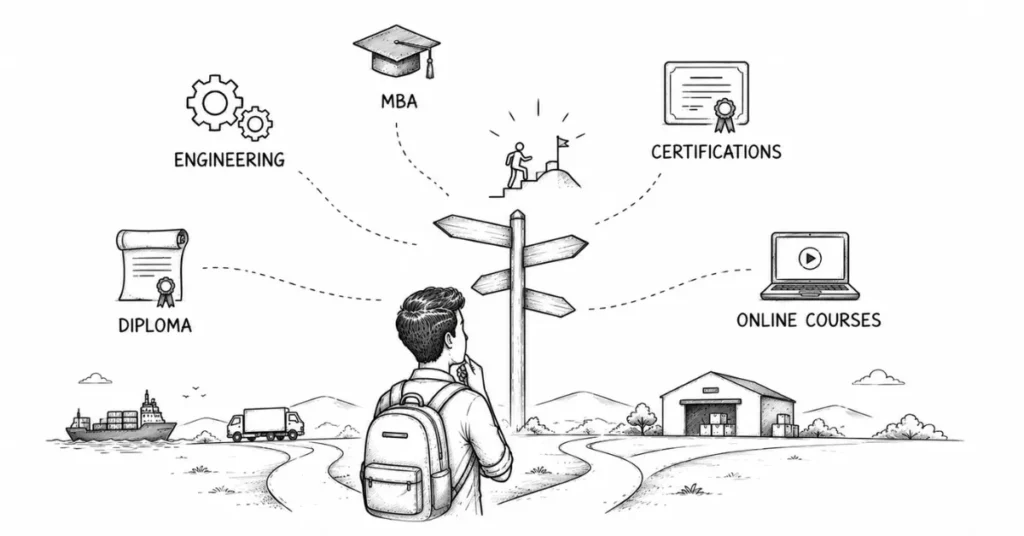
“Do I need an MBA to succeed in supply chain?” “Which undergraduate degree is best?” “Are online courses enough?” These are questions I hear constantly from students and career switchers exploring supply chain management.
Here’s the truth: There’s no single “required” educational path into supply chain careers. I’ve seen successful supply chain professionals with engineering degrees, commerce backgrounds, MBAs from top schools, and self-taught professionals who learned through online courses and experience. What matters is choosing the right educational path for your situation, goals, and resources.
India now has over 400 institutes offering supply chain education, from premier IIMs to online platforms. With so many options, making informed decisions is crucial. This guide breaks down undergraduate programs, MBA specializations, certifications, and online learning—helping you invest your time and money wisely.
Understanding Supply Chain Education Landscape in India
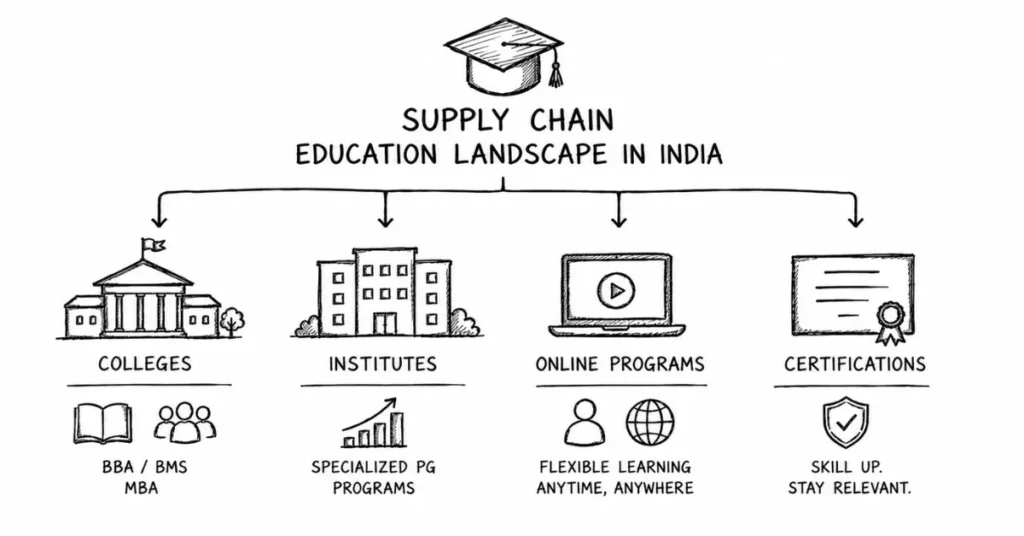
Current Scenario:
- 400+ colleges offer MBA in Supply Chain Management
- 320+ private institutions and 11 government colleges
- Growing number of specialized supply chain programs at engineering colleges
- Expanding online education options from Indian and international universities
- Professional certifications (APICS, Six Sigma) gaining recognition
Market Reality:
India’s supply chain sector growing at 11.12% annually will reach $5.55 billion by 2032. This growth drives demand for educated supply chain professionals, making quality education a sound investment.
PART 1: UNDERGRADUATE EDUCATION
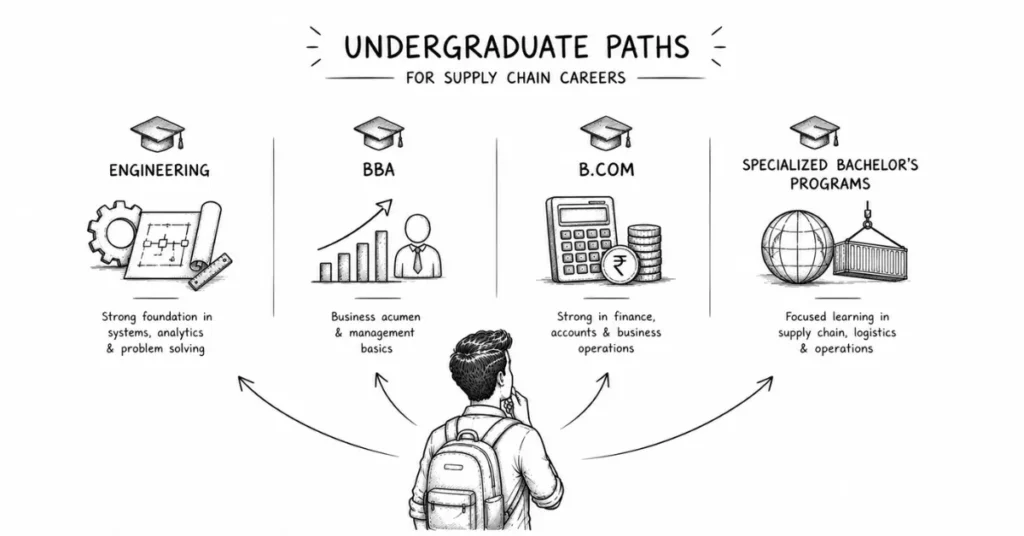
Option 1: Engineering Degrees (B.Tech/BE)
Most Relevant Specializations:
Industrial Engineering & Operations Research:
- Best fit for supply chain careers
- Curriculum naturally aligns: production planning, inventory management, optimization, logistics
- Top colleges: IIT Bombay, IIT Delhi, IIT Kharagpur, NIT Trichy, NITIE Mumbai
Mechanical Engineering:
- Strong foundation for manufacturing supply chain roles
- Relevant subjects: production systems, industrial management
- Easy transition into operations and supply chain
Other Engineering Branches:
- Computer Science: Excellent for supply chain analytics and technology roles
- Chemical/Electrical: Can pivot to supply chain in relevant industries
- Any engineering: Provides analytical foundation valued by employers
Advantages:
✅ Analytical and quantitative skill development
✅ Highly valued by manufacturing companies
✅ Strong problem-solving foundation
✅ Opens doors to both technical and supply chain roles
✅ IIT/NIT engineering degrees carry significant brand value
Limitations:
❌ Supply chain education limited to few elective courses
❌ May need MBA later for management roles
❌ Not all engineering branches align naturally
Option 2: Business Administration (BBA/BBM)
Supply Chain/Operations Specialization:
Several universities offer BBA with operations focus:
- Christ University, Bangalore
- Symbiosis, Pune
- NMIMS, Mumbai
- Amity University, Noida
Typical Curriculum:
- Business fundamentals (finance, marketing, HR)
- Operations management
- Supply chain principles
- Logistics and distribution
- Inventory management
- Project management
- Internships and industry exposure
Advantages:
✅ Directly relevant business education
✅ Earlier exposure to supply chain concepts
✅ Business communication and management skills
✅ Industry internship opportunities
✅ Can enter workforce after graduation or pursue MBA
Limitations:
❌ Less quantitative rigor than engineering
❌ May face competition from engineers for analytics roles
❌ Brand value limited to tier-1 universities
Option 3: Commerce (B.Com)
Relevance to Supply Chain:
Not directly supply chain-focused, but provides strong foundation:
- Business fundamentals and accounting
- Economics and statistics
- Analytical thinking development
Path Forward:
- Pursue supply chain MBA or specialized PG Diploma
- Take online supply chain courses during graduation
- Seek internships in supply chain functions
- Develop Excel and analytical skills independently
Advantages:
✅ Widely available and affordable
✅ Flexible education allowing self-learning
✅ Good foundation for procurement/commercial roles
✅ Can complement with online certifications
Limitations:
❌ No direct supply chain education
❌ Requires additional learning for technical skills
❌ May need MBA for competitive positions
Option 4: Specialized Bachelor's in Supply Chain
Emerging Programs:
Some universities now offer B.Sc. or BBA in Logistics and Supply Chain Management:
- Galgotias University
- MIT World Peace University, Pune
- UPES, Dehradun
Typical Curriculum:
- Core supply chain subjects from year 1
- Logistics and transportation management
- Warehouse operations
- Supply chain technology
- Procurement and sourcing
- Analytics for supply chain
- Industry projects and internships
Advantages:
✅ Focused supply chain education from start
✅ Industry-relevant curriculum
✅ Early career clarity and preparation
✅ Strong internship connections
Limitations:
❌ Limited to few universities
❌ Relatively new programs without long track record
❌ Less flexibility if you change career interests
❌ Brand value still developing
Recommendation:
Unless you’re absolutely certain about supply chain as career path, broader programs (engineering or BBA) provide more flexibility while allowing supply chain specialization.
PART 2: POSTGRADUATE EDUCATION (MBA/PGDM)
MBA in Operations & Supply Chain Management
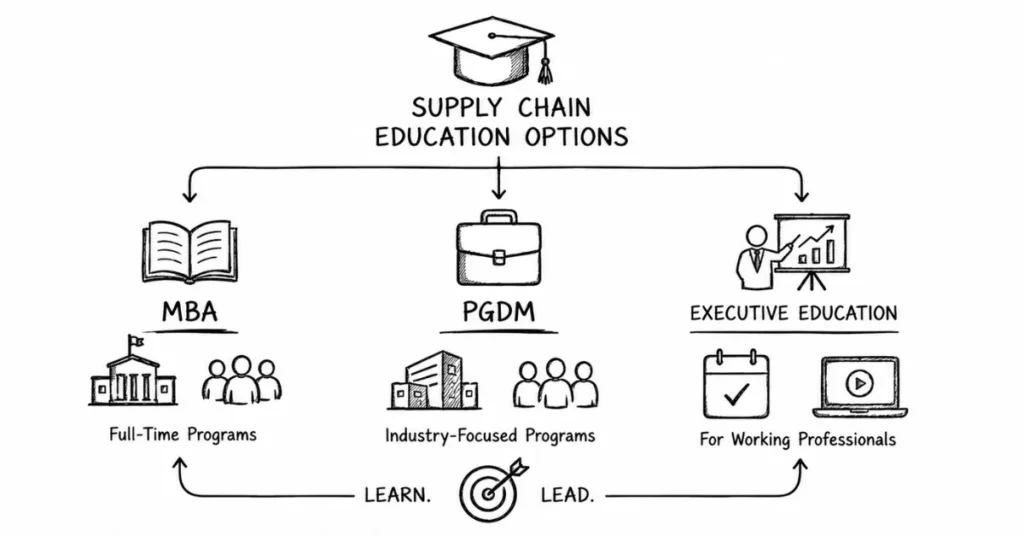
Why MBA for Supply Chain?
- Most management positions require MBA or equivalent
- Provides strategic thinking framework
- Develops leadership and soft skills
- Strong alumni networks and placement opportunities
- Significantly accelerates career growth
Top-Tier Programs (Most Competitive)
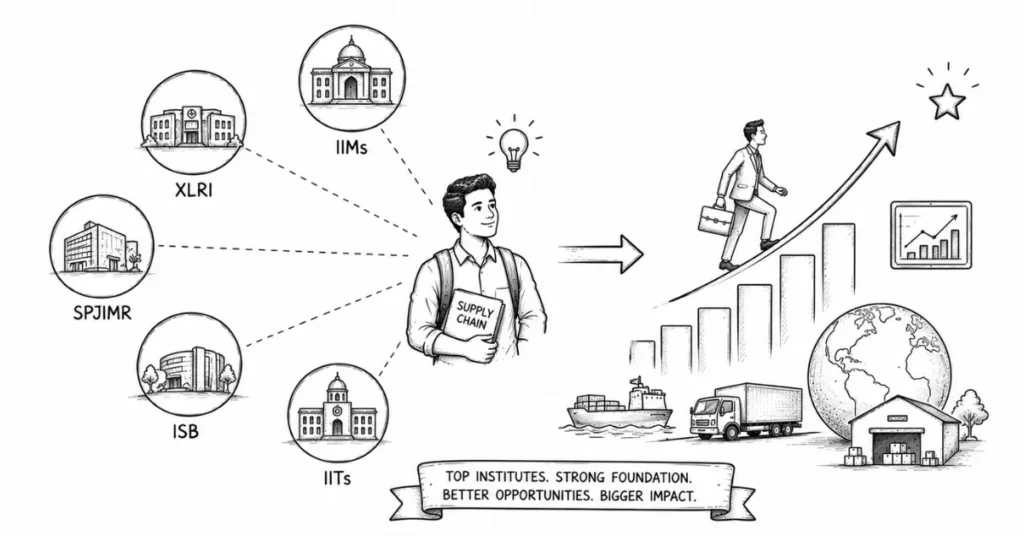
1. IIMs (Indian Institutes of Management)
Leading IIMs for Supply Chain:
- IIM Calcutta: Strong operations program, excellent placements
- IIM Bangalore: Renowned for operations management
- IIM Ahmedabad: Overall prestige, good operations faculty
- IIM Lucknow: Operations specialization strength
- IIM Udaipur: Growing operations focus
Program Details:
- Duration: 2 years (PGP program)
- Fees: ₹23-28 lakhs approximately
- Admission: CAT score (98+ percentile typical for older IIMs)
- Average placement: ₹25-35 lakhs CTC
- Supply chain roles: ₹18-30 lakhs typical
Specialization Structure:
- Common first year covering all business functions
- Operations/Supply Chain electives in second year
- Summer internships in supply chain companies
- Final placements with FMCG, e-commerce, consulting firms
ROI Analysis:
- Investment: ₹25 lakhs + 2 years opportunity cost
- Starting salary: ₹20-30 lakhs
- Break-even: 2-3 years typically
- Long-term career acceleration: Significant
Who Should Target:
- Strong academic record (80%+ throughout)
- CAT preparation commitment (6-12 months)
- 0-3 years work experience (for PGP programs)
- Career seriousness and leadership potential
2. XLRI Jamshedpur
Flagship Program: PGDM (Business Management)
- Duration: 2 years
- Fees: ~₹26 lakhs
- Admission: XAT + GD/PI
- Strength: Excellent operations and supply chain faculty
- Placements: ₹20-32 lakhs for supply chain roles
Why XLRI?
- Among India’s oldest and most respected B-schools
- Strong industry connections particularly in manufacturing
- Excellent operations management department
- Alumni network across supply chain roles
3. S.P. Jain Institute (SPJIMR), Mumbai
PGDM Program with Operations Specialization:
- Duration: 2 years
- Fees: ~₹21 lakhs
- Admission: CAT/XAT + GD/PI
- Unique feature: Strong corporate interaction, living in Mumbai
- Placements: ₹18-28 lakhs for supply chain
4. ISB Hyderabad/Mohali
PGP (Post Graduate Programme):
- Duration: 1 year (intensive)
- Fees: ~₹36 lakhs
- Admission: GMAT (700+ typical) + significant work experience (4-5 years average)
- Target audience: Experienced professionals, not fresh graduates
- Average CTC: ₹30-35 lakhs
Who Should Consider:
Mid-career professionals (5-10 years experience) seeking acceleration to senior roles. Not suitable for fresh graduates or early career.
5. IIT Programs (Supply Chain-Specific)
IIT Bombay – MBA (Operations Management):
- Shailesh J. Mehta School of Management
- Strong analytics and operations focus
- IIT brand value
IIT Delhi – MBA:
- Department of Management Studies
- Technology-oriented supply chain education
IIT Kharagpur – MBA:
- Vinod Gupta School of Management
- Operations and analytics strength
Advantages:
- IIT brand and alumni network
- Strong quantitative and technology focus
- Lower fees than IIMs (~₹8-12 lakhs)
- Excellent for supply chain analytics careers
Tier-2 Quality Institutions
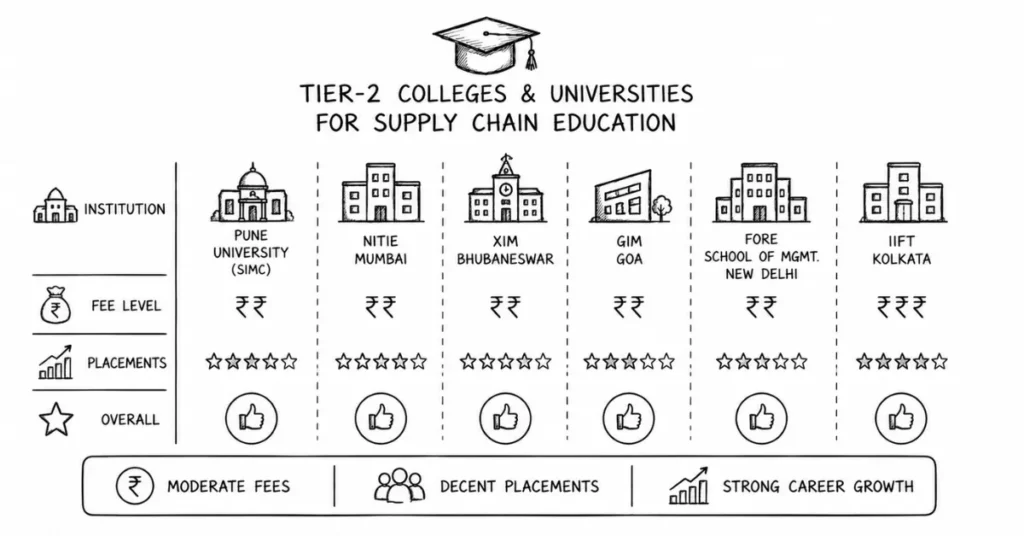
These provide good education and placements at more accessible admission standards and fees:
Private Institutions:
- Chandigarh University: Growing supply chain program
- Amity University (Noida, Mumbai): Multiple locations, decent placements
- NMIMS Mumbai: Strong Mumbai industry connections
- Symbiosis, Pune: Good operations program
- Christ University, Bangalore: Quality education, affordable
- Great Lakes, Chennai: One-year program for experienced professionals
Government Institutions:
- New Delhi Institute of Management (NDIM): Affiliated with IP University
- Delhi Technological University (DTU): Good placements in Delhi-NCR
- JBIMS, Mumbai: Excellent value, very low fees, competitive admission
Program Details (Typical):
- Fees: ₹5-15 lakhs
- Duration: 2 years
- Admission: MAT/CMAT/State exams (80-90 percentile range)
- Placements: ₹6-12 lakhs average for supply chain roles
Specialized Supply Chain MBA/PGDM Programs
Some institutions offer supply chain-specific programs:
NITIE Mumbai (National Institute of Industrial Engineering):
- PGDIE (Post Graduate Diploma in Industrial Engineering): Supply chain focus
- Fees: ~₹14 lakhs
- Duration: 2 years
- Unique: Exclusively focused on operations and supply chain
- Placements: ₹15-25 lakhs, extremely strong in manufacturing/logistics sector
- Who should consider: Those certain about supply chain careers
Galgotias University:
- Specialized MBA in Logistics and Supply Chain
- Industry tie-ups and practical focus
Graphic Era (Deemed University), Dehradun:
- MBA in Supply Chain Management[
PG Diploma Programs (1-Year Options)
For Working Professionals:
Several institutions offer part-time or executive PG Diplomas:
IIMs (Executive Education):
- Various executive programs in operations (3-12 months)
- Fees: ₹2-6 lakhs
- For professionals with 3-5+ years experience
ISB Executive Education:
- Executive programs in supply chain and operations
- Premium pricing but excellent quality
Great Lakes Executive Program:
- One-year PGPM for experienced professionals
- Weekend format
Advantages:
✅ Continue working while studying
✅ Immediate application of learning
✅ Lower opportunity cost
✅ Peer learning from experienced professionals
Limitations:
❌ Intense work-study balance
❌ May not have campus placement support
❌ Less immersive than full-time programs
MBA Decision Framework: Is It Worth It?
MBA Makes Sense If:
✅ You’re targeting management roles (not just technical positions)
✅ You can afford fees (₹5-25 lakhs) without crippling debt
✅ You can gain admission to quality institutions (tier-1 or strong tier-2)
✅ You’re early career (0-5 years) or mid-career wanting acceleration
✅ You want faster progression to senior positions
Skip or Delay MBA If:
❌ You’re doing it “just because everyone else is”
❌ Admission target is tier-3 college with poor placements
❌ You can’t afford it and would take heavy loans for weak programs
❌ You’re already succeeding without it (can always do executive MBA later)
❌ You’re very early career (0-1 year)—get experience first
PART 3: ONLINE EDUCATION & CERTIFICATIONS
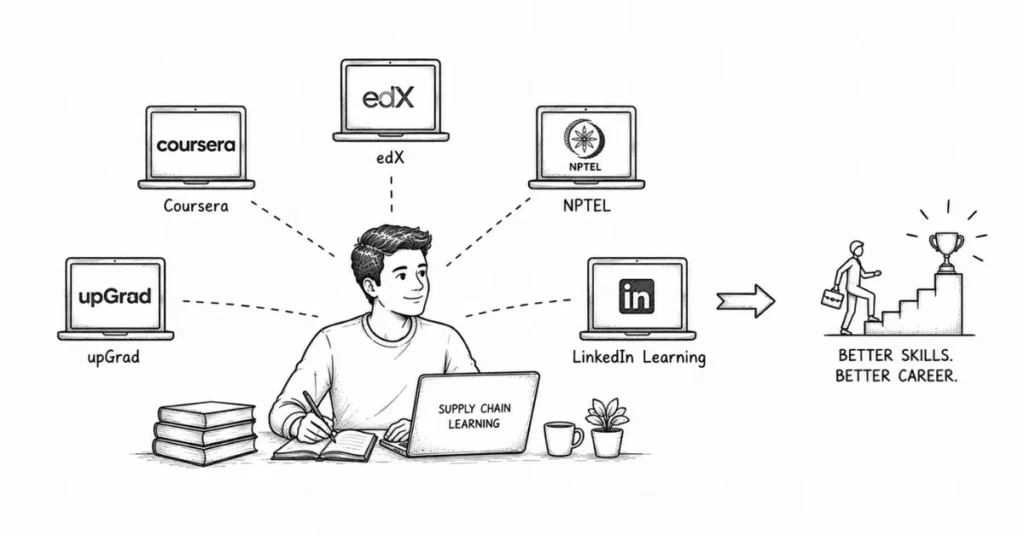
University Online Programs
Coursera (Top University Programs):
Supply Chain Management Specialization (Rutgers University)
- 5 courses covering end-to-end supply chain
- Duration: 6-8 months
- Cost: ~$49/month or ₹18,000-24,000
- Certificate value: Good for knowledge, moderate for Indian job market
Supply Chain Excellence Specialization (Rutgers)
- Advanced topics including analytics
- Duration: 4-6 months
- Cost: Similar pricing
Supply Chain Analytics (MIT via edX)
- MicroMasters program
- Highly quantitative and rigorous
- Duration: 10-12 months
- Cost: ~₹30,000-50,000
- Strong value due to MIT brand
Pros:
✅ Learn from world-class universities
✅ Flexible, self-paced learning
✅ Affordable compared to degrees
✅ Stackable credentials
Cons:
❌ Less recognized than degrees in India
❌ No placement support
❌ Requires self-discipline
❌ Primarily theoretical without practical projects
Indian Online Programs
NPTEL (IIT/IISc Online Courses):
- Free video lectures
- Supply chain and logistics courses available
- Optional paid certification (~₹1,000)
- Excellent value for knowledge building
upGrad Supply Chain Programs:
- Partnership with various universities
- PG Diploma programs (₹1.5-3 lakhs)
- Includes career support and mentorship
- 12-18 month duration
- Growing recognition in Indian market
Simplilearn Supply Chain Courses:
- Various certification prep courses
- APICS exam preparation
- Fees: ₹15,000-50,000
LinkedIn Learning:
- Monthly subscription: ~₹2,000
- Hundreds of supply chain courses
- Bite-sized, practical learning
- Good for specific skill development (Excel, forecasting, Six Sigma)
When Online Learning Works Best:
Ideal Situations:
- Complementing existing degree (e.g., B.Com + online supply chain courses)
- Upskilling while working
- Exploring field before committing to degree
- Learning specific tools (Excel, SAP basics, analytics)
- Budget constraints preventing full degree
Less Suitable:
- As only credential when competing with MBA graduates
- Expecting placements and career services
- Lacking self-discipline for self-paced learning
PART 4: PROFESSIONAL CERTIFICATIONS
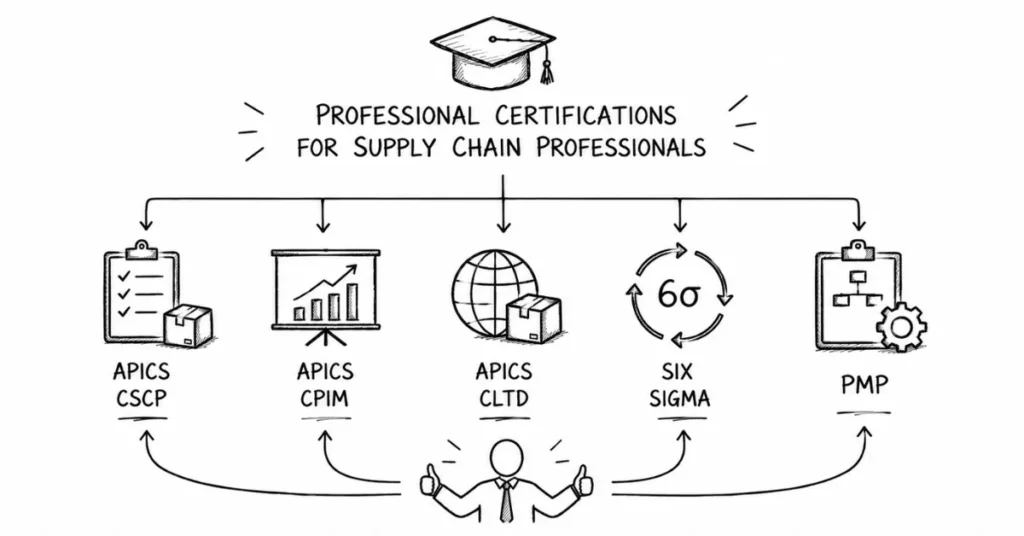
APICS (CSCP, CPIM, CLTD):
- Detailed in previous blog post on certifications
- Suitable for professionals with 3+ years experience
- Cost: ₹1-1.5 lakhs
- ROI: Good for MNC roles, moderate for domestic companies
Six Sigma (Green Belt, Black Belt):
- Process improvement focus
- Cost: ₹15,000-1.5 lakhs
- Valuable for operations and quality roles
Project Management (PMP):
- Useful for project-heavy supply chain roles
- Cost: ₹35,000-75,000
PART 5: EDUCATION RECOMMENDATIONS BY SITUATION
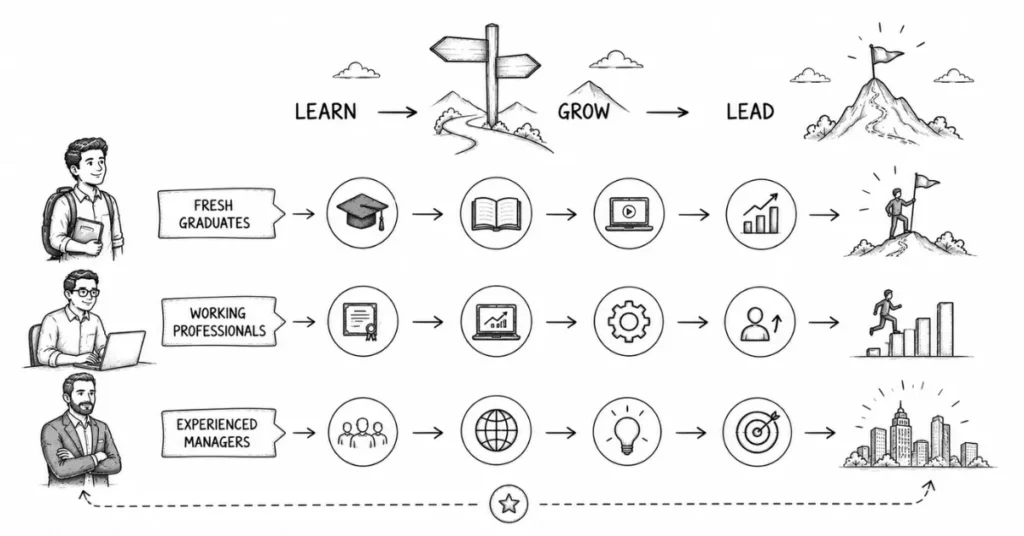
Fresh Graduate (After 12th Standard)
Scenario 1: Strong Academic Record (90%+), Can Crack IIT/NIT:
→ B.Tech Industrial Engineering from IIT/NIT → Work 2-3 years → MBA from IIM (if targeting senior management)
Expected outcome: Top tier supply chain career, compensation ₹20-40 lakhs by year 7-8
Scenario 2: Good Academic Record (75-90%), Can Get into Decent Engineering/BBA:
→ B.Tech (any branch) or BBA with operations focus → Develop supply chain skills through internships and online courses → Work 2-3 years → MBA from tier-1/2 B-school if needed
Expected outcome: Good supply chain career, compensation ₹12-25 lakhs by year 7-8
Scenario 3: Moderate Academic Record, Budget Constraints:
→ B.Com or BBA from local college → Heavy self-learning (online courses, Excel skills, NPTEL) → Entry-level job → Continue learning while working → Consider executive MBA after 5 years
Expected outcome: Solid supply chain career, compensation ₹8-18 lakhs by year 7-8
Working Professional (Career Transition)
Scenario 1: 0-2 Years Experience, Any Background:
→ Full-time MBA from best B-school you can access → Supply chain specialization → Placements
Scenario 2: 3-7 Years Experience, Different Field:
→ Lateral move to supply chain role at current company → Online learning + APICS certification → Build experience
Alternative: Executive MBA if seeking acceleration
Scenario 3: 7+ Years Experience, Want Supply Chain Leadership:
→ Executive MBA from IIM/ISB if you don’t have MBA → APICS CSCP → Focus on strategy and leadership development
Supply Chain Professional (Advancement)
Scenario 1: Early Career, No MBA:
→ Work 3-5 years building experience → Consider MBA if targeting director+ roles or switching to premier companies
Scenario 2: Mid-Career with MBA:
→ APICS certifications for functional depth → Executive education programs for specific skills → Focus on delivery and results
Scenario 3: Senior Professional:
→ Executive leadership programs (IIM, ISB, global schools) → Industry certifications for credibility → Focus on thought leadership
Cost-Benefit Analysis: Making Smart Investment Decisions
Top-Tier MBA (IIM)
- Investment: ₹25 lakhs + 2 years opportunity cost (~₹10-15 lakhs)
- Total cost: ~₹35-40 lakhs
- Expected starting salary: ₹20-30 lakhs
- Break-even: 2-4 years
- Long-term value: Significant career acceleration, alumni network, brand value
- Verdict: Worth it if you gain admission and can afford it
Tier-2 MBA
- Investment: ₹8-15 lakhs + opportunity cost
- Total cost: ~₹15-25 lakhs
- Expected starting salary: ₹8-15 lakhs
- Break-even: 3-5 years
- Verdict: Worth it if quality institution with good placements; questionable if tier-3 with poor placements
Online Degree/Diploma
- Investment: ₹1-3 lakhs
- No opportunity cost (can work simultaneously)
- Career impact: Moderate—adds credentials but less impactful than full-time degree
- Verdict: Good value for working professionals; supplementary rather than primary credential
Professional Certifications (APICS)
- Investment: ₹1-1.5 lakhs
- Time: 3-6 months part-time
- Career impact: 15-20% salary increase potential when changing jobs
- Verdict: Good ROI for mid-career professionals at MNCs; moderate for domestic-focused careers
Online Courses (Coursera/LinkedIn Learning)
- Investment: ₹10,000-50,000
- Time: Flexible
- Career impact: Builds knowledge; moderate credential value
- Verdict: Excellent value for skill-building and exploration; should complement, not replace formal education
Final Thoughts: Education as Investment
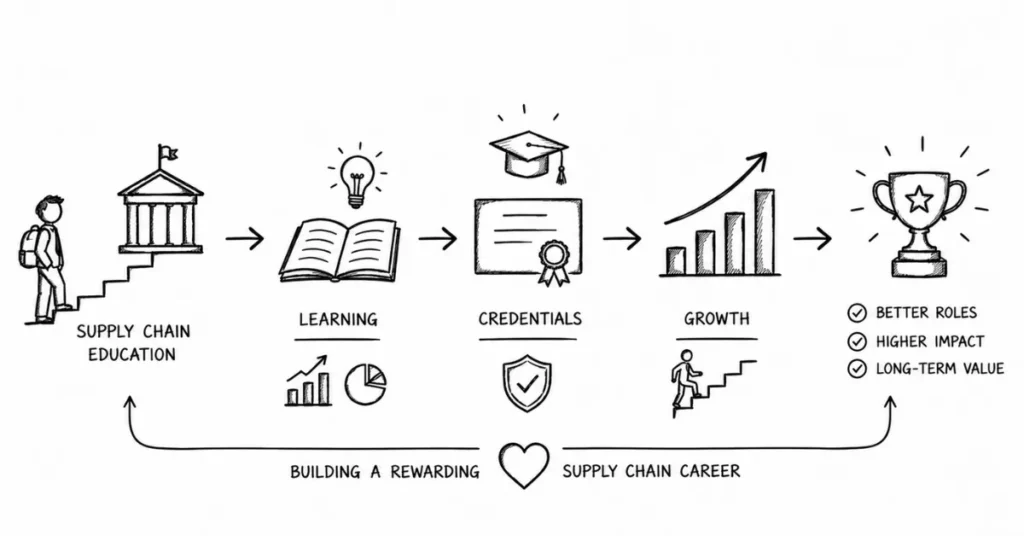
Your education in supply chain management is one of the most important investments you’ll make. The “right” path depends entirely on your circumstances:
Consider:
- Current academic standing and career stage
- Financial resources and budget constraints
- Career ambitions (technical specialist vs. senior management)
- Timeline (immediate need vs. long-term planning)
- Learning style (classroom vs. self-directed)
Principles:
- Quality matters more than quantity of degrees
- Practical skills complement formal education—don’t rely solely on degrees
- Timing matters—right education at right career stage maximizes ROI
- Debt for tier-1 education may be worthwhile; avoid debt for weak programs
- Learning never stops—continuous education throughout career is essential
India’s growing supply chain sector offers excellent opportunities for educated professionals. Invest wisely in education that builds genuine capabilities, opens doors, and accelerates your career—but remember that education alone isn’t enough. Combine quality education with practical skills, strong performance, and strategic career management for optimal results.
Choose your path deliberately, commit fully, and make it count.