
Supply Chain Consulting & Freelancing Career Guide
Table of Contents
Introduction: The ₹15 Lakh Question
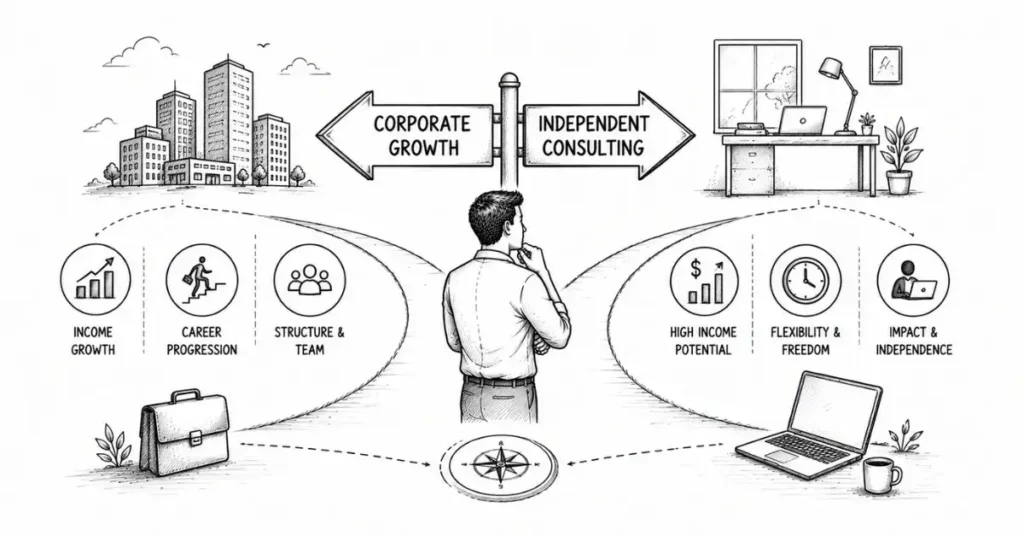
Rajesh spent 12 years climbing the corporate ladder—supply chain analyst to manager to senior manager. His salary grew steadily to ₹18 lakhs. Respectable. Comfortable. But also… capped. His next promotion to director was 3-4 years away, maybe longer. And he saw directors earning ₹25-30 lakhs—good, but not transformational.
Then he met his former colleague Meera at an industry conference. Five years ago, they were peers earning similar salaries. Today, Meera was running her own supply chain consulting practice. Her income last year? ₹35 lakhs. This year she’s on track for ₹45 lakhs. She worked with 6-7 clients, setting her own schedule, choosing interesting projects, and building something she owned.
Rajesh asked the question many supply chain professionals eventually ask: “Should I go independent?”
The supply chain consulting and freelancing market in India is exploding. Companies need expertise but don’t want full-time headcount. Projects are short-term—ERP implementations, network optimization, process improvement, interim management. They’re willing to pay ₹2,000-5,000 per day (₹40,000-1,00,000 per month) for experienced professionals.
But here’s the reality check: Independence isn’t for everyone. It offers freedom, higher earning potential, and entrepreneurial satisfaction. It also brings uncertainty, business development pressure, and feast-or-famine income cycles. Some thrive. Others struggle and return to corporate roles within 18 months.
This guide helps you decide if supply chain consulting or freelancing is right for you, and if so, how to build a successful independent practice. We’ll cover:
- Is independence right for your situation and personality?
- Types of independent supply chain work (consulting vs. freelancing vs. interim management)
- How to get your first clients (the biggest challenge)
- Pricing strategies and financial management
- Platforms and tools for finding work
- Legal and business setup
- Scaling from solo practitioner to small firm
Whether you’re seriously considering independence or just curious about alternatives to corporate careers, this guide provides the realistic roadmap.
PART 1: IS INDEPENDENT WORK RIGHT FOR YOU?
Three Paths to Independence
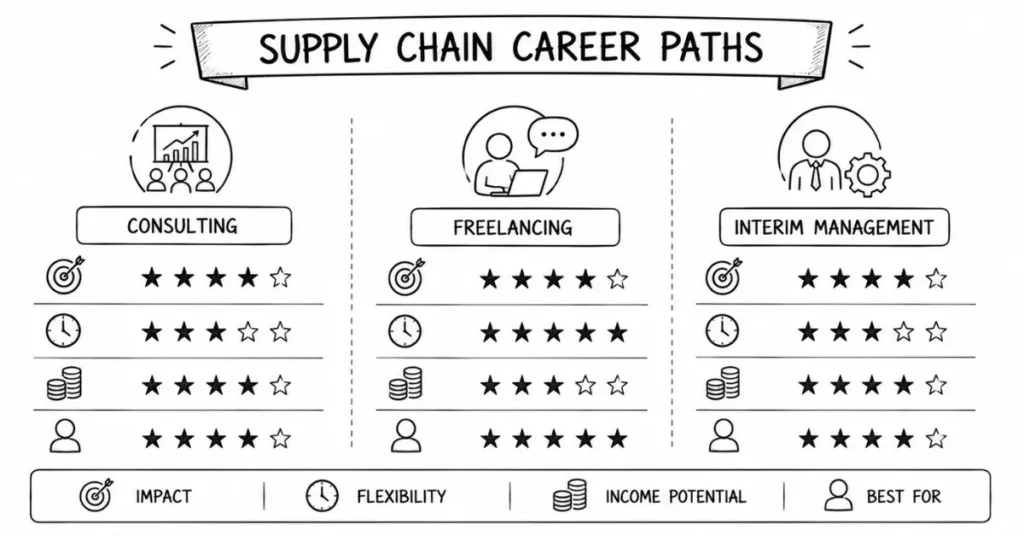
Supply Chain Consulting:
- What it is: Project-based advisory work solving specific business problems
- Typical projects: Network optimization, cost reduction programs, process improvement, strategic sourcing, S&OP implementation
- Duration: 2-6 months per project
- Client relationship: Strategic advisor, working with senior management
- Income model: Project fees (₹3-15 lakhs per project) or daily rates (₹3,000-8,000/day)
- Best for: Strategic thinkers with 10-20 years experience, strong analytical skills, comfortable with ambiguity
Supply Chain Freelancing:
- What it is: Specialized tactical work or short-term execution support
- Typical work: Demand forecasting, data analysis, procurement for specific categories, logistics optimization, SAP support
- Duration: Days to 3 months
- Client relationship: Tactical expert, often embedded in operations
- Income model: Hourly/daily rates (₹1,500-4,000/day) or fixed deliverable pricing
- Best for: Specialists with 5-12 years experience in specific domains (SAP, forecasting, procurement)
Interim Management:
- What it is: Temporary leadership filling permanent roles (maternity cover, sudden departures, restructuring periods)
- Typical roles: Interim supply chain manager, head of procurement, logistics director
- Duration: 3-12 months
- Client relationship: Temporary employee/leader
- Income model: Monthly retainer (₹2-6 lakhs/month for senior roles)
- Best for: Experienced leaders (12-25 years) who can step into senior roles immediately
Self-Assessment: Are You Ready?
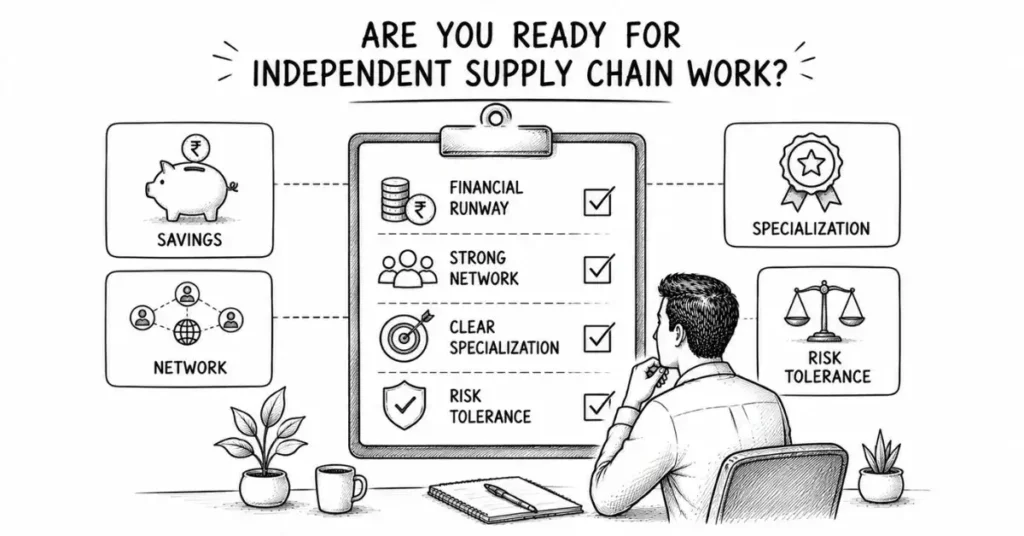
You’re LIKELY Ready for Independence If:
✅ Financial Stability: 12-18 months living expenses saved (₹10-25 lakhs buffer depending on lifestyle)
✅ Experience: Minimum 7-10 years supply chain experience (consulting firms want proven expertise)
✅ Network: 50-100+ industry contacts who know your work
✅ Specialization: Deep expertise in specific domain (not generalist)
✅ Self-motivation: Comfortable working independently without external structure
✅ Business savvy: Basic understanding of marketing, finance, legal basics
✅ Risk tolerance: Can handle income uncertainty and rejection
✅ Communication skills: Excellent written and verbal, comfortable presenting to executives
✅ Family support: Spouse/family understands and supports the transition
You’re NOT Ready If:
❌ Financial pressure: Need consistent income immediately (dependents, loans, no savings)
❌ Limited experience: Less than 7 years or narrow functional exposure
❌ Weak network: Don’t know 25-50 people who could hire you or refer you
❌ Generalist profile: “I can do anything” instead of clear expertise
❌ Need for structure: Thrive only with clear direction and external deadlines
❌ Conflict averse: Uncomfortable with sales, negotiation, difficult conversations
❌ Corporate benefits dependent: Need employer health insurance, PF, stability
❌ Risk averse: Anxiety about uncertain income keeps you awake at night
Honest Reality: If you scored 7+ on “Likely Ready” and 0-2 on “Not Ready,” you’re a candidate. If the opposite, wait and build readiness. This isn’t binary—you can prepare systematically over 12-24 months.
Financial Reality Check
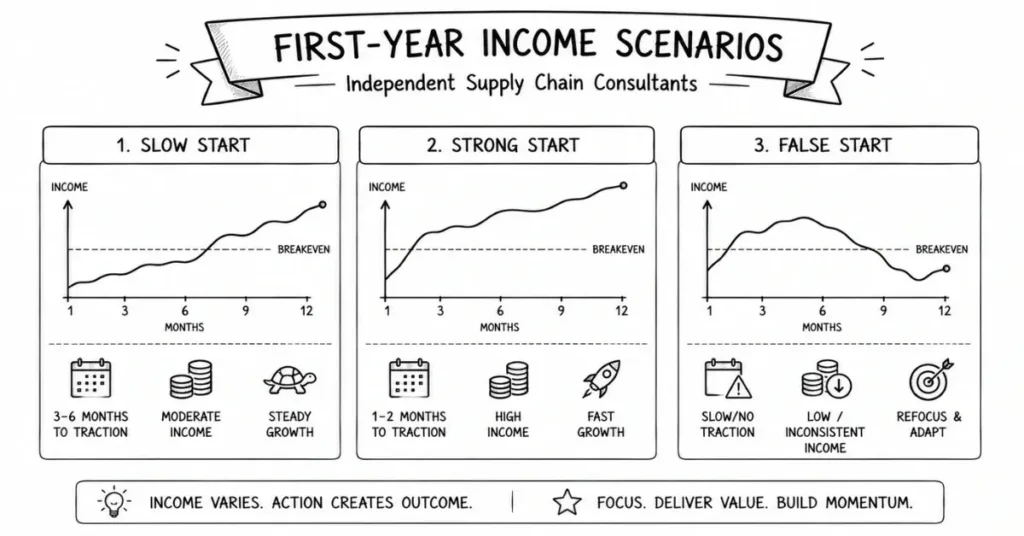
First Year Income Expectations (Realistic):
Scenario 1: Slow Start (Common)
- Months 1-3: ₹0-2 lakhs (setup, networking, first small projects)
- Months 4-8: ₹3-6 lakhs (2-3 projects landing)
- Months 9-12: ₹6-8 lakhs (momentum building)
- Year 1 Total: ₹10-15 lakhs
- Comparison to corporate: Usually 30-50% less than previous salary
Scenario 2: Strong Start (Good network/preparation)
- Months 1-3: ₹3-5 lakhs (first project from network)
- Months 4-8: ₹8-12 lakhs (multiple clients)
- Months 9-12: ₹10-12 lakhs (full pipeline)
- Year 1 Total: ₹20-28 lakhs
- Comparison to corporate: Matches or slightly exceeds previous salary
Scenario 3: False Start (Poor preparation)
- Months 1-6: ₹1-2 lakhs (desperate low-value projects)
- Months 7-12: Returns to corporate job
- Total: Financial and emotional cost
Year 2-3 Trajectory (If Successful):
- Year 2: ₹25-40 lakhs (established client base, referrals flowing)
- Year 3: ₹35-60 lakhs (premium positioning, selective projects)
- Year 4-5: ₹50-80 lakhs (considered building small firm)
Key Variable: Time to first significant project (₹5+ lakhs). Strong network = 1-3 months. Weak network = 6-12 months.
PART 2: GETTING YOUR FIRST CLIENTS
The Biggest Challenge
95% of independent consultants say finding clients is harder than delivering projects. You might be brilliant at supply chain optimization, but if you can’t find clients willing to pay, you starve.
Where First Clients Come From (Real Data):
- Previous employers: 35% (asking former company for project work)
- Professional network: 30% (colleagues, ex-bosses, industry contacts)
- Referrals: 20% (existing clients referring you)
- Direct outreach: 10% (LinkedIn, cold emails)
- Platforms: 5% (Upwork, consulting marketplaces)
Insight: 85% of first clients come from people who already know your work. This is why network strength predicts success more than technical skills.
Strategy 1: The "Soft Launch" (Lowest Risk)

Approach: Start while still employed, test market before full leap.
How:
- Register business: GST registration, professional services
- Notify employer: Ensure no conflict of interest (some companies allow weekend/evening consulting)
- Take 1-2 small projects: Evenings/weekends for 3-6 months
- Test market: Can you find projects? Enjoy the work? Make decent rates?
- Decide: If successful and you enjoy it, transition to full-time. If not, continue corporate job.
Example:
Priya, procurement manager earning ₹16 lakhs, took on weekend sourcing projects for startups (₹40,000-80,000 per project). After 6 months, she had 3 clients generating ₹6 lakhs annually part-time. She went full-time, confident she could replace her income.
Pros: Low risk, test hypothesis before jumping
Cons: Exhausting (working 60-70 hour weeks), potential employer conflict
Strategy 2: The "Anchor Client" Launch
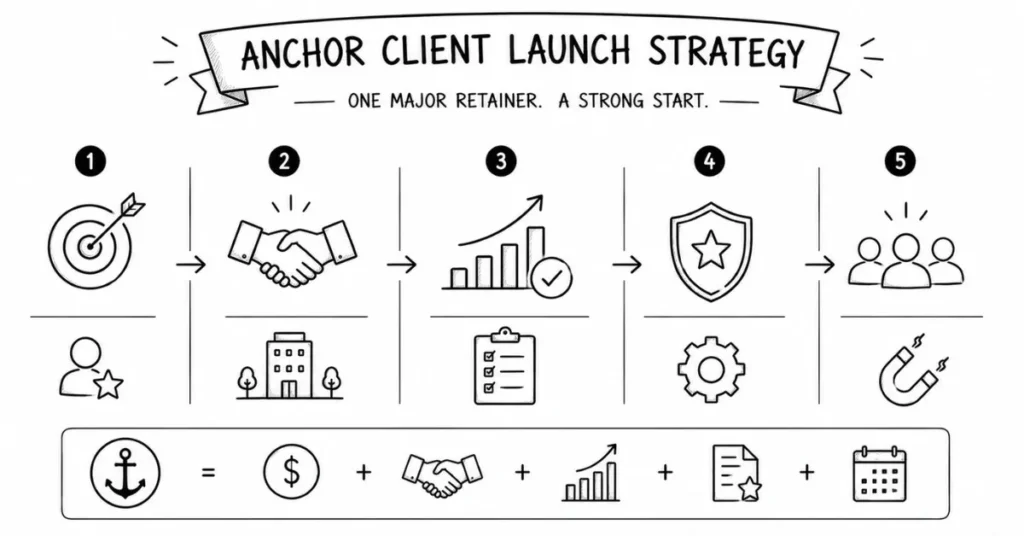
Approach: Secure one substantial client (6-12 month project) before leaving corporate job, providing income runway.
How:
- Identify potential anchor: Previous employer, major client, or connection needing significant help
- Negotiate project: 6-12 months, ₹4-8 lakhs/month retainer
- Give notice: With anchor client secured, leave corporate role
- Execute anchor project: Deliver excellently while building additional client pipeline
- Expand: As anchor project ends, have 2-3 additional clients ready
Example:
Amit, logistics manager, learned his company was implementing new WMS but lacked internal expertise. He proposed a 9-month consulting engagement at ₹5 lakhs/month to lead implementation. Company agreed (cheaper than hiring + recruiting). Amit resigned, delivered the project excellently, and earned referrals to two other companies needing similar expertise.
Pros: Financial security from day one, proven capability demonstration
Cons: Requires identifying and securing anchor opportunity (takes 3-6 months preparation)
Strategy 3: The "Bold Leap" (Highest Risk/Reward)
Approach: Quit, go all-in on building practice from scratch.
Requirements:
- 18-24 months living expenses saved
- Strong network (100+ contacts)
- Clear positioning and target market
- High risk tolerance
- No major financial obligations
How:
- Financial buffer secured: ₹15-30 lakhs saved
- Resign: Professional exit, maintain relationships
- Intense outreach: 40-60 hours/week networking, business development for first 3-6 months
- Land projects: Expect 3-6 month lag before significant revenue
- Build momentum: Each successful project leads to referrals
Reality: Works for risk-tolerant individuals with strong networks. Fails dramatically for underprepared optimists.
Client Acquisition Tactics (Practical)
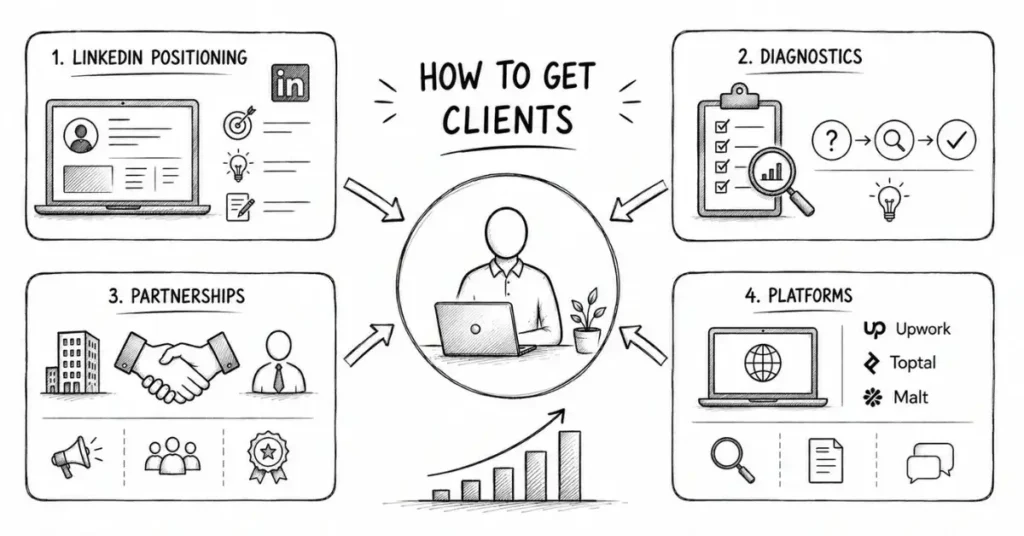
Tactic 1: LinkedIn Professional Positioning
Action Steps:
- Update headline: “Independent Supply Chain Consultant | Network Optimization & Cost Reduction | Ex-[Company]”
- Write 2-3 LinkedIn articles showcasing expertise
- Post weekly insights demonstrating knowledge
- Engage on posts from target client profiles
- Direct message warm connections offering coffee chats (not asking for projects directly initially)
Timeline: Build presence over 3-6 months before expecting results
Tactic 2: The “Free Diagnostic” Lead Generation
Approach: Offer free 2-hour supply chain diagnostic to qualified prospects, converting 30-40% to paid projects.
Process:
- Identify target companies (specific industry/size)
- Reach out offering free supply chain assessment
- Conduct diagnostic (identify 3-5 improvement opportunities)
- Present findings with estimated impact
- Propose paid project to implement top priorities
Example Script:
“Hi [Name], I specialize in helping mid-sized FMCG companies reduce logistics costs 15-20% without impacting service. I’m offering free 2-hour supply chain diagnostics to 3 companies this quarter to showcase the approach. Would [Company] be interested? No obligation—just insight into potential savings.”
Conversion: 30-40% of diagnostics lead to paid projects (₹3-8 lakhs)
Tactic 3: Strategic Partnerships
Partner Types:
- Implementation partners: SAP consultants, IT firms (you handle process, they handle tech)
- Complementary consultants: Strategy consultants (they design, you implement)
- Industry associations: APICS, CII (speak at events, build credibility)
- Recruiters: Placement firms needing interim managers
Value: They refer clients to you (share 10-20% fee or reciprocal referrals)
Tactic 4: Platform Freelancing (Starter Projects)
Platforms:
- Upwork: Global freelancing marketplace (supply chain category growing)
- Toptal: High-end consulting marketplace (rigorous vetting, better clients)
- Catalant (formerly Business Talent Group): Corporate consulting projects
- Expert Networks: GLG, AlphaSights (hourly consultations)
Reality Check:
- Useful for first 3-6 months (building portfolio, testimonials)
- Rates lower than direct clients (platform takes 10-20%)
- Global competition (bidding against lower-cost countries)
- Not sustainable long-term but helpful initially
Strategy: Use platforms for first 5-10 projects, build testimonials, transition to direct clients.
PART 3: PRICING YOUR SERVICES
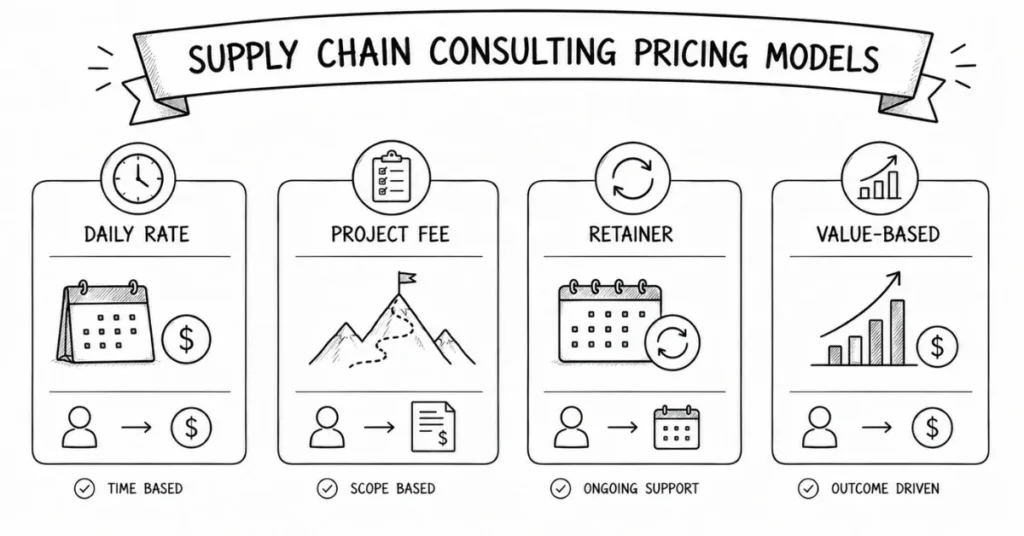
Pricing Models
Daily Rate:
- Range: ₹2,000-8,000/day depending on experience and expertise
- When to use: Well-defined scope, client wants flexibility
- Example: “₹4,000/day, estimated 40 days over 3 months for process mapping and optimization project”
Project-Based Fee:
- Range: ₹3-25 lakhs depending on scope and value
- When to use: Clear deliverables, prefer avoiding hourly tracking
- Example: “₹8 lakhs fixed fee for complete supplier consolidation project including analysis, RFP, negotiation, and implementation”
Monthly Retainer:
- Range: ₹1.5-6 lakhs/month
- When to use: Ongoing advisory, interim management, continuous support
- Example: “₹3 lakhs/month retainer for fractional Head of Supply Chain (20 hours/week)”
Value-Based Pricing:
- Approach: Price based on value delivered (percentage of savings)
- Example: “15% of documented cost savings in first year, estimated ₹12 lakhs fee based on projected ₹80 lakhs savings”
- Risk: Need bulletproof measurement methodology
Pricing Strategy by Experience
7-10 Years Experience (Starting Out):
- Daily rate: ₹2,500-4,000
- Project fee: ₹3-8 lakhs (2-3 month projects)
- Strategy: Build portfolio, collect testimonials, position as value alternative
10-15 Years Experience (Established):
- Daily rate: ₹4,000-6,000
- Project fee: ₹6-15 lakhs
- Strategy: Selective clients, proven methodology, industry specialization
15-25 Years Experience (Premium):
- Daily rate: ₹6,000-10,000+
- Project fee: ₹12-30 lakhs
- Strategy: C-suite advisory, high-stakes transformations, reputation-based
The Pricing Conversation
Client Asks: “What do you charge?”
Weak Response:
“I charge ₹3,500 per day.”
Strong Response:
“My fees depend on project scope and value delivered. To give you an accurate estimate, could you share more about the challenge you’re facing and outcomes you need? Once I understand that, I can provide a tailored proposal outlining approach, timeline, and investment required.”
Why Better:
- Shifts focus to value, not hourly rate
- Allows you to understand budget
- Positions as customized solution
- Avoids premature price anchoring
PART 4: BUSINESS OPERATIONS
Legal & Administrative Setup
Business Structure Options:
Sole Proprietorship:
- Pros: Simplest, lowest cost, minimal compliance
- Cons: Personal liability, less professional appearance
- Setup: GST registration (mandatory above ₹20 lakhs revenue), PAN card, business bank account
- Cost: ₹5,000-10,000
Private Limited Company:
- Pros: Limited liability, professional image, easier to scale, tax benefits
- Cons: Higher compliance (annual filings, audit), setup complexity
- Setup: Company registration, GST, PF (if hiring)
- Cost: ₹15,000-30,000 (using CA or online services)
Recommendation: Start as sole proprietorship for first 12 months, convert to Pvt Ltd if revenue exceeds ₹25-30 lakhs.
Essential Tools & Investments
Technology Stack (₹25,000-50,000 annual):
- Laptop: ₹60,000-1,00,000 (one-time)
- Microsoft Office / Google Workspace: ₹5,000-10,000/year
- Project management: Trello/Asana (free to ₹5,000/year)
- Accounting software: Zoho Books, QuickBooks (₹10,000-20,000/year)
- Video conferencing: Zoom Pro (₹15,000/year)
- Website: ₹15,000-50,000 (one-time) + ₹5,000/year hosting
Professional Services (₹50,000-1,00,000 annual):
- Chartered Accountant: ₹30,000-70,000/year (tax filing, compliance)
- Legal: ₹20,000-40,000 (contract templates, occasional advice)
Marketing (₹20,000-50,000 first year):
- Business cards, branding: ₹10,000-20,000
- LinkedIn Premium: ₹25,000/year (worth it for outreach)
- Conference attendance: ₹10,000-30,000/year
- Total First-Year Investment: ₹1,50,000-3,00,000
Financial Management
Invoicing & Collections:
- Invoice immediately upon milestone completion
- Payment terms: 50% advance + 50% on completion (for new clients)
- Established clients: Net 30 days
- Follow up on overdue invoices weekly (biggest cash flow issue)
Tax Planning:
- Set aside 30-35% of revenue for taxes (Income tax + GST)
- Quarterly advance tax payments
- Maintain detailed expense records
- Work with good CA (worth the investment)
Buffer Management:
- Maintain 6-month operating expense buffer always
- Income highly variable (₹8 lakhs one month, ₹0 next month common)
- Don’t increase lifestyle expenses immediately when revenue spikes
PART 5: SCALING BEYOND SOLO PRACTICE
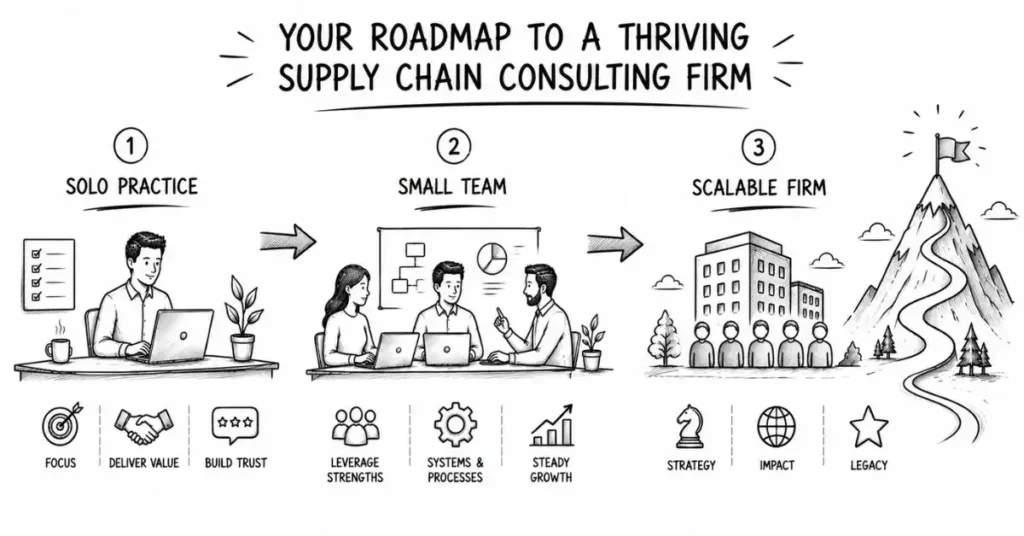
Growth Stages
Stage 1: Solo (Year 1-2): ₹10-30 lakhs revenue
- You do everything (business development, delivery, admin)
- Limited capacity (200-220 billable days/year max)
- Revenue ceiling: Your daily rate × billable days
Stage 2: Solo + Support (Year 2-4): ₹25-50 lakhs revenue
- Hire part-time admin/assistant (₹15,000-25,000/month)
- Outsource accounting, legal
- You focus on high-value activities (client work, business development)
- Capacity increases 20-30%
Stage 3: Small Team (Year 4-6): ₹50 lakhs-1.5 crores revenue
- Hire 1-2 junior consultants/analysts (₹6-10 lakhs annual salary each)
- You lead projects, they execute
- Expand service offerings
- Multiple simultaneous projects possible
Stage 4: Firm (Year 6+): ₹1.5 crores+ revenue
- 5-10 person team
- Specialized service lines
- Partnerships with larger firms
- Subcontracting to other consultants
- You primarily lead business development and client relationships
Reality: Most independent consultants stay at Stage 1-2 (by choice or circumstance). Only 10-15% scale to Stage 3-4.
PART 6: WORK-LIFE REALITY
What Independence Actually Feels Like
The Good:
✅ Freedom: Choose clients, projects, schedule
✅ Income potential: Uncapped by corporate salary bands
✅ Variety: Different industries, problems, clients
✅ Autonomy: Make decisions without layers of approval
✅ Satisfaction: Seeing direct impact of your work
✅ Learning: Rapid exposure to diverse challenges
The Challenging:
❌ Uncertainty: Income variability creates stress
❌ Always on: No clear work/life boundary
❌ Isolation: Working alone can be lonely
❌ Business development: Constantly selling yourself
❌ Benefits: No employer PF, health insurance, paid leave
❌ Validation: No promotions, titles, external recognition structure
Typical Week for Established Consultant:
- Client work: 30-35 hours (3-4 days)
- Business development: 5-10 hours (networking, proposals)
- Admin: 3-5 hours (invoicing, emails, planning)
- Learning: 2-3 hours (staying current)
- Total: 45-55 hours typically
FINAL DECISION FRAMEWORK
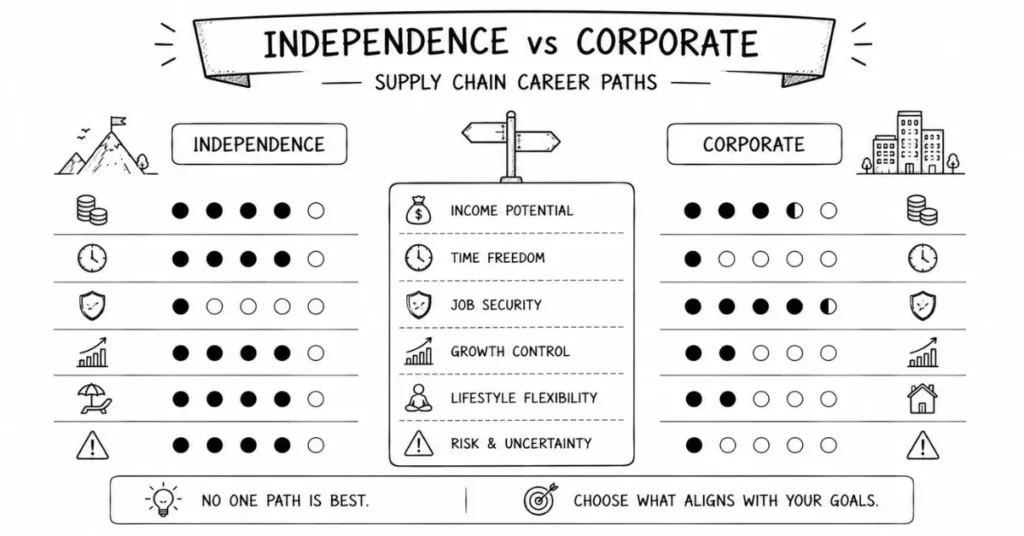
Choose Independence If:
✅ You value autonomy over security
✅ You have 7-10+ years proven expertise in specific domain
✅ You possess strong network (50+ industry contacts)
✅ You have financial buffer (12+ months expenses saved)
✅ You’re comfortable with uncertainty and rejection
✅ You enjoy business development and client relationships
✅ You have family support for the transition
✅ You want income potential beyond corporate ceiling
Stay Corporate If:
✅ You value stability and predictable income
✅ You’re early career (less than 7 years experience)
✅ You have significant financial obligations (loans, dependents)
✅ You dislike sales, networking, self-promotion
✅ You thrive on team collaboration (work alone feels isolating)
✅ You need external structure and direction to perform well
✅ You’re advancing well in corporate career (promotion imminent)
✅ You value corporate benefits (PF, insurance, leave) highly
YOUR 12-MONTH PREPARATION PLAN
If You Decide to Pursue Independence:
Months 1-3: Foundation
- Increase savings rate (target 6-12 months buffer)
- Register business legally
- Build LinkedIn presence
- Identify 3-5 potential anchor clients
Months 4-6: Testing
- Take 1-2 small projects part-time
- Develop service packages and pricing
- Create basic website and marketing materials
- Expand network systematically (10-15 new connections/month)
Months 7-9: Preparation
- Refine positioning based on project feedback
- Build project portfolio and testimonials
- Complete business setup (accounting, legal templates)
- Secure anchor client or build strong pipeline
Months 10-12: Transition
- Give notice professionally
- Transition responsibilities thoroughly
- Launch full-time with confidence
- Execute first major projects excellently
Total Investment: 12 months preparation significantly increases success probability from 40% to 75-80%.
Conclusion: Independence is a Choice, Not a Destination
Supply chain consulting and freelancing offers genuine opportunity—higher income potential, professional freedom, and entrepreneurial satisfaction. But it’s not inherently better than corporate careers. It’s different, with distinct tradeoffs.
Some of the happiest, most successful supply chain professionals I know are corporate VPs earning ₹40-60 lakhs with stability and growth. Others are independent consultants earning ₹30-80 lakhs with freedom and variety. Both paths work.
The question isn’t which is objectively better. It’s which aligns with your values, personality, life stage, and goals.
If after reading this guide you’re energized by independence despite the challenges, start preparing systematically. If you feel relief that corporate path might be better fit, that’s equally valid. Either way, you’re making an informed decision rather than following romanticized notions of “being your own boss.”
Your supply chain expertise is valuable. Whether you deploy it through corporate employment or independent consulting, you’ll build a successful, fulfilling career.
The choice is yours. Choose deliberately.