
State-by-State RERA Registration Requirements Guide
Table of Contents
Introduction
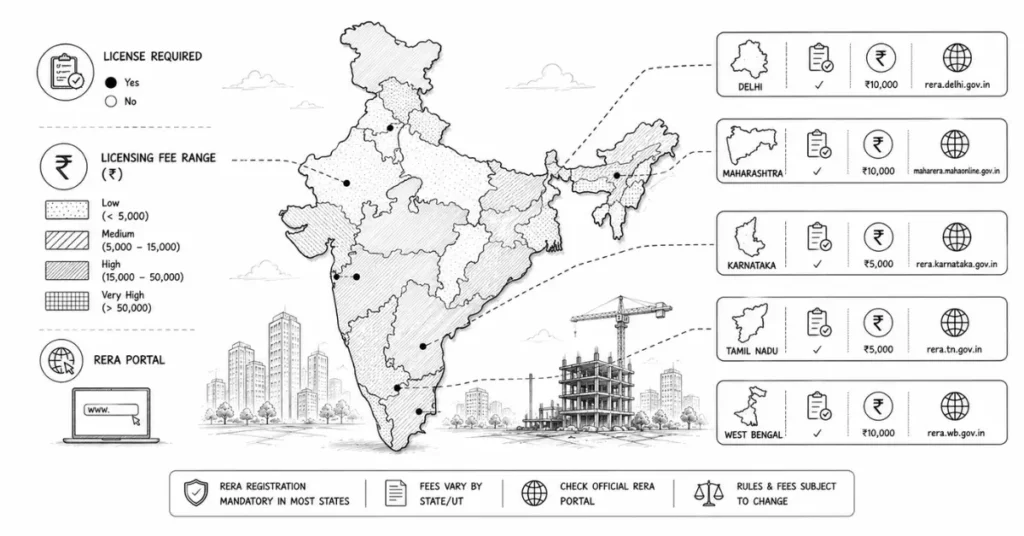
Real estate licensing in India operates under a state-specific framework, with each state implementing the Real Estate (Regulation and Development) Act, 2016 (RERA) according to local regulations, fee structures, and procedural requirements. Unlike countries with uniform national licensing standards, Indian real estate professionals must navigate varying requirements depending on where they intend to practice, creating both complexity and important strategic considerations for aspiring agents.
Understanding state-by-state variations is crucial for several reasons. RERA registration is state-specific—if you plan to operate in multiple states, you must register separately with each state’s RERA authority and follow that state’s compliance and renewal rules. Registration fees vary dramatically, ranging from ₹6,000 in Punjab to ₹2,50,000 in Uttar Pradesh for non-individual entities. Processing timelines, required documents, validity periods, and enforcement standards differ across states, affecting your career planning and business operations.
As of 2026, RERA implementation has reached maturity across most major states, though enforcement strength varies significantly. States like Maharashtra, Karnataka, Uttar Pradesh, and Tamil Nadu demonstrate strong RERA enforcement with well-established systems, while some smaller states continue developing their regulatory frameworks. This variation impacts your practice location decisions, particularly if you’re establishing a new real estate career.
The good news is that RERA has brought unprecedented transparency and professionalism to India’s real estate sector. Mandatory agent registration protects consumers while elevating the profession’s standards. Understanding your target state’s specific requirements enables efficient registration, full compliance, and avoidance of penalties that can reach ₹10,000 per day for operating without proper registration.
This comprehensive guide provides detailed state-by-state comparisons of real estate licensing requirements across India, covering registration fees, required documents, validity periods, renewal processes, key differences in state RERA implementations, strongest enforcement states, and strategic considerations for choosing where to establish your real estate career. Whether you’re starting fresh, relocating between states, or planning multi-state operations, this resource provides the clarity needed to navigate India’s complex state-specific licensing landscape.
Understanding India's State-Based RERA Framework
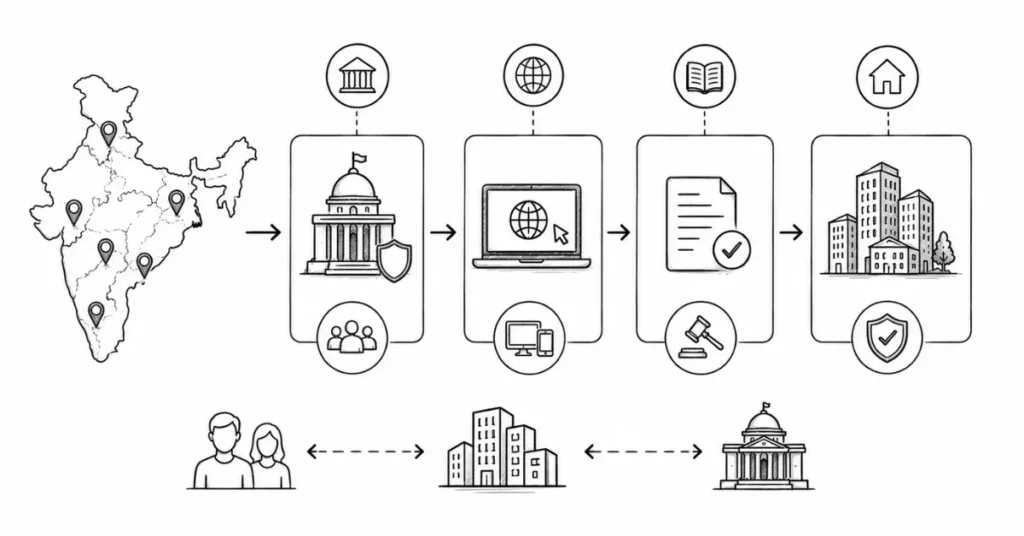
Why State-Specific Registration?
The Real Estate (Regulation and Development) Act, 2016 is central legislation establishing broad regulatory principles, but individual states implement RERA through their own rules, regulations, and administrative structures. This federal structure recognizes that real estate markets, practices, and challenges vary significantly across India’s diverse states, requiring localized regulatory approaches.
Each state has its own RERA authority with independent administrative bodies, separate registration portals and systems, state-specific forms and procedures, distinct fee structures, and unique enforcement mechanisms and penalties. This creates both flexibility allowing states to address local conditions and complexity requiring agents to understand specific requirements in their target markets.
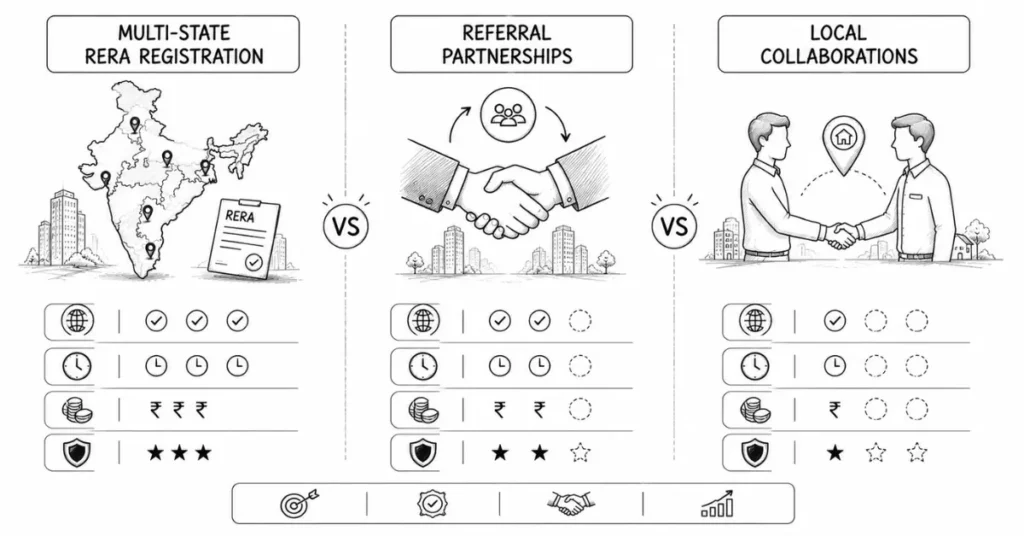
Registration validity is geographically limited. Your Maharashtra RERA registration doesn’t authorize you to operate in Karnataka or Delhi. If you want to facilitate transactions across multiple states, you face three options: register separately with each state’s RERA authority following their individual procedures, partner with local registered agents or brokerages in other states, or act as referral partners connecting clients with licensed agents rather than directly facilitating sales.
Most agents starting out focus on establishing themselves in one state and one primary market before considering expansion. This strategic focus allows you to build deep local market knowledge, develop strong professional networks, establish client referral systems, and understand state-specific regulations thoroughly before adding complexity of multi-state operations.
Common Elements Across All States
Despite state-specific variations, certain requirements remain consistent across India’s RERA framework:
Mandatory registration: Operating as a real estate agent without RERA registration is illegal in all states, with penalties including fines up to ₹10,000 per day and potential imprisonment.
Basic eligibility criteria: Minimum age of 18 years and educational qualifications of at least 10th or 12th grade completion are standard across most states.
Online application process: All states process registrations through online portals, making geographic location less restrictive for application submission.
Five-year validity: Most RERA registrations are valid for five years from issuance, requiring renewal before expiration.
Public registration database: All states maintain publicly accessible databases where consumers can verify agent registration status using registration numbers.
Mandatory display of registration number: Agents must quote their RERA registration numbers in all advertisements, property dealings, and business communications across all states.
State-by-State RERA Registration Fee Comparison
Registration fees represent one of the most significant variations across states, ranging from a few thousand rupees to several lakhs depending on entity type.
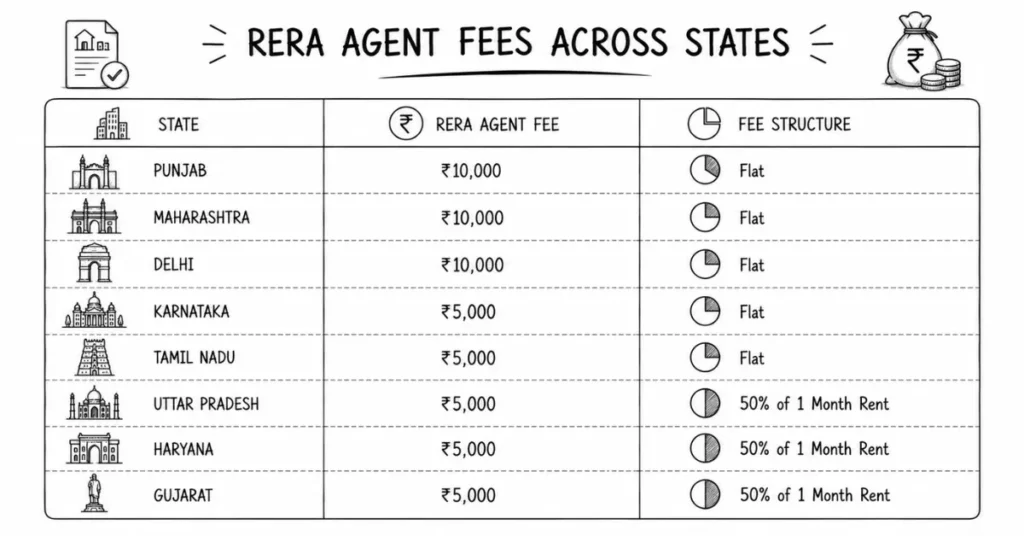
Major State Fee Structures
The following comprehensive comparison shows registration fees for both individual agents and non-individual entities (partnerships, companies) across India’s states and union territories:
Highest Fee States:
- Uttar Pradesh: ₹25,000 (Individual) | ₹2,50,000 (Non-Individual)
- Haryana: ₹25,000 (Individual) | ₹2,50,000 (Non-Individual)
- Uttarakhand: ₹25,000 (Individual) | ₹2,50,000 (Non-Individual)
- West Bengal: ₹25,000 (Individual) | ₹2,50,000 (Non-Individual)
These states impose the highest registration costs, particularly for corporate entities. The ₹2,50,000 fee for companies represents substantial upfront investment, though this covers five years of legal operating authorization.
High Fee States:
- Karnataka: ₹25,000 (Individual) | ₹2,00,000 (Non-Individual)
- Gujarat: ₹25,000 (Individual) | ₹2,00,000 (Non-Individual)
- Tamil Nadu: ₹25,000 (Individual) | ₹50,000 (Non-Individual)
These states charge premium rates for individuals while varying significantly on corporate fees. Notably, Tamil Nadu charges only ₹50,000 for non-individual entities—substantially lower than comparable states.
Moderate Fee States:
- Maharashtra: ₹10,000 (Individual) | ₹1,00,000 (Non-Individual)
- Delhi (NCT): ₹10,000 (Individual) | ₹50,000 (Non-Individual)
- Bihar: ₹10,000 (Individual) | ₹50,000 (Non-Individual)
- Chhattisgarh: ₹10,000 (Individual) | ₹50,000 (Non-Individual)
- Madhya Pradesh: ₹10,000 (Individual/Proprietor) | ₹50,000 (Company)
- Rajasthan: ₹10,000 (Individual/Proprietor) | ₹50,000 (Company)
These large, important real estate markets maintain moderate fee structures balancing accessibility with regulatory resource requirements. The ₹10,000 individual fee makes entry relatively affordable for new agents.
Lowest Fee State:
- Punjab: ₹6,000 (Individual) | ₹25,000 (Non-Individual)
Punjab offers India’s most affordable RERA registration fees, making it particularly accessible for individual agents starting their careers.
Union Territories (Uniform Structure):
Most union territories follow a consistent fee structure:
- ₹10,000 for Individual agents
- ₹50,000 for Non-Individual entities
This includes Andaman and Nicobar Islands, Chandigarh, Dadra and Nagar Haveli, Daman and Diu, Lakshadweep, and Puducherry.
Fee Payment Methods
States accept registration fee payments through multiple channels:
- Online payment: Net banking, debit/credit cards, UPI through state RERA portals
- Demand draft: Drawn on scheduled banks payable to the state RERA authority
- Banker’s cheque: From scheduled banks as specified by authorities
- Offline payment: At designated bank branches or collection centers in some states
Online payment has become the preferred method in most states, enabling immediate application processing without physical document submission for payment verification.
Required Documents: State-by-State Variations
While core documentation requirements remain consistent, states have subtle variations in specific document formats, authentication requirements, and additional submissions.
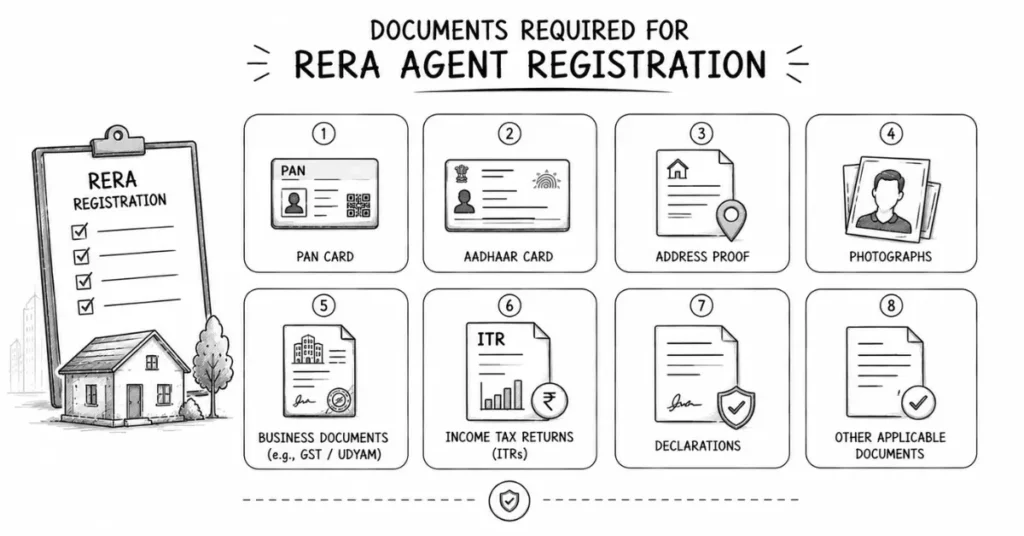
Universal Required Documents
All states require these foundational documents:
Identity proof: Authenticated copy of PAN card (mandatory), Aadhaar card number, Voter ID, Passport, or Driving License
Address proof: Authenticated copy of utility bills (electricity, water, gas), property tax receipts, rental agreement, or Aadhaar card
Educational qualification certificates: 10th or 12th standard mark sheets and passing certificates, degree certificates if applicable
Photographs: Recent passport-size photographs in specified format (usually 2-4 copies), digital photo uploads in JPG/PDF format (typically 50KB-200KB)
Business registration documents (for entities): Partnership deed, Memorandum of Association (MoA), Articles of Association (AoA), Certificate of Incorporation, or other relevant formation documents
Income tax returns: Returns for last 3 financial years preceding application, or declaration of exemption if not required to file in any of those years
Principal place of business proof: Authenticated address proof, branch office details with contact information (telephone, fax, email)
Professional history: Details of all real estate projects and promoters you represented as agent in preceding 5 years
Legal declarations: Details of all civil or criminal cases pending against individual/directors/partners
Business materials: Authenticated copies of letterheads, rubber stamp images, acknowledgment receipts proposed for use
State-Specific Document Variations
Maharashtra emphasizes comprehensive business documentation, requiring detailed information about branch offices, operational structure, and professional history spanning five years.
Delhi (NCT) streamlines documentation with clear digital formats and specifications, emphasizing online submission quality and format compliance.
Gujarat requires additional declarations regarding compliance with professional standards and ethical conduct beyond basic legal clearance declarations.
Uttar Pradesh demands extensive financial documentation including detailed income tax returns, financial statements, and banking relationships demonstrating financial stability.
Tamil Nadu implements highly structured documentation requirements with specific formats, sequencing, and authentication requirements ensuring comprehensive application review.
State RERA Implementations: Key Differences
Beyond fees and documentation, states differ in several substantive regulatory aspects affecting agent operations.
Registration and Renewal Processes
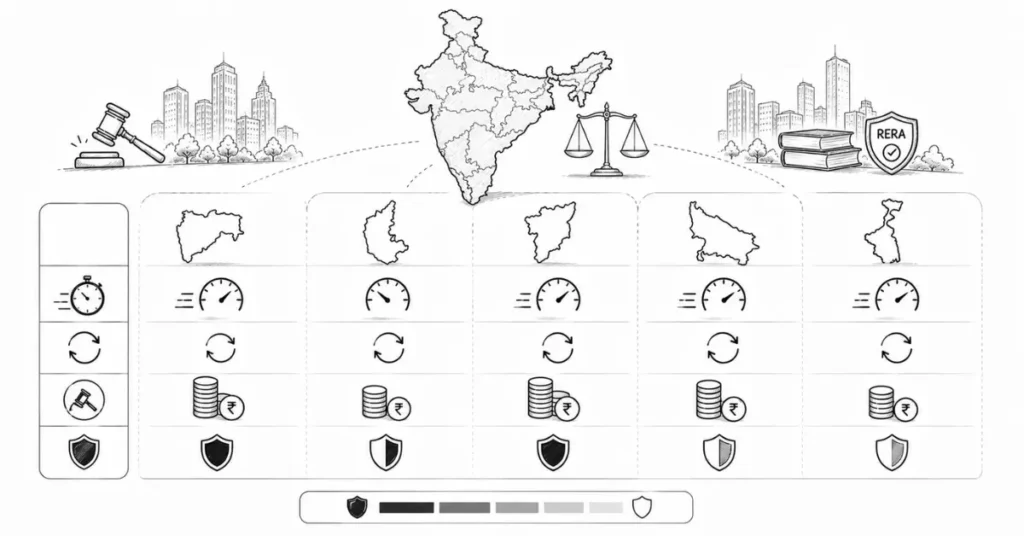
Processing timelines vary significantly across states. Maharashtra typically processes applications within 4-6 months with well-established systems and clear communication. Karnataka completes processing in 3-5 months with efficient digital systems and reduced bureaucratic delays. Uttar Pradesh requires 5-7 months due to high application volumes and extensive documentation verification. Delhi (NCT) processes applications in 4-6 months with streamlined procedures. Tamil Nadu completes processing in 3-4 months with highly efficient and transparent systems.
Validity and renewal: Most states issue five-year registrations requiring renewal 60 days before expiration. However, renewal fee structures vary—some states charge full initial fees, others offer reduced renewal rates. Some states implement graduated renewal fees based on transaction volumes or registration history.
Penalties and Enforcement
States vary dramatically in enforcement rigor.
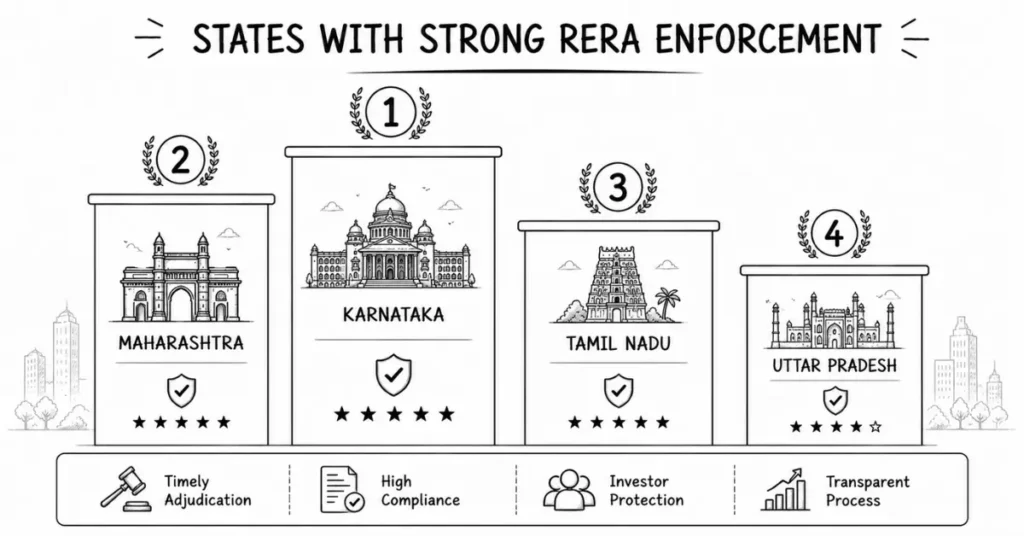
Strong enforcement states (Maharashtra, Karnataka, Uttar Pradesh, Tamil Nadu) actively monitor agent compliance, quickly process consumer complaints, impose substantial penalties for violations, maintain regular audit mechanisms, and demonstrate high conviction rates for serious violations.
Moderate enforcement states have regulatory frameworks in place but enforcement is inconsistent, complaint resolution is slower, penalties are less frequently imposed, and monitoring mechanisms are developing but incomplete.
Weak enforcement states have notified RERA rules but minimal active enforcement, limited complaint processing capacity, rare penalty imposition, and agents operating with limited oversight despite registration requirements.
Interest Penalties and Compensation
States set different interest rates for developer delays affecting buyers, which indirectly impacts agent accountability in representing projects:
Maharashtra: Imposes State Bank of India’s highest marginal cost of lending rate (MCLR) plus 2% on delayed possession compensation, creating strong developer accountability.
Karnataka: Similar structure using MCLR plus 2% ensuring robust buyer protection.
Uttar Pradesh: State Bank of India’s MCLR plus 2%, aligning with major state standards.
Tamil Nadu: Implements comparable interest penalty structures with clear calculation methodologies.
These variations matter for agents because states with stronger buyer protections typically attract more consumer confidence but also create higher accountability standards for all real estate professionals operating in those markets.
States with Strongest RERA Enforcement (2026)
Understanding which states demonstrate the most robust RERA implementation helps agents make strategic location decisions.
Tier 1: Exemplary Implementation
Maharashtra leads RERA enforcement with comprehensive project and agent database, active consumer complaint resolution (typically within 60 days), strict penalties consistently enforced for violations, regular audits of registered agents and projects, and transparent online systems enabling easy compliance verification.
Karnataka demonstrates exemplary enforcement through efficient digital infrastructure, fast-track complaint resolution mechanisms, proactive monitoring of agent activities, regular stakeholder engagement and training programs, and high compliance rates among registered agents.
Tamil Nadu implements highly structured systems ensuring minimal ambiguity, making it one of the most reliable states for RERA-based protection. Clear procedural guidelines, transparent documentation requirements, efficient processing timelines, and strong accountability mechanisms characterize Tamil Nadu’s approach.
Uttar Pradesh shows strong commitment despite high volumes through extensive registered project database, active complaint resolution infrastructure, penalties regularly imposed for non-compliance, growing digital transformation of processes, and improving transparency standards.
Tier 2: Strong Implementation
Rajasthan, Gujarat, Madhya Pradesh, Haryana, and Punjab demonstrate solid RERA enforcement with established regulatory frameworks, functional complaint mechanisms, regular monitoring activities, digital systems in place, and improving transparency and accountability standards.
Tier 3: Developing Implementation
Several states have notified RERA rules and established authorities but continue developing comprehensive enforcement mechanisms, complaint resolution systems, digital infrastructure, and consistent penalty imposition. These states present opportunities for early entrants but require careful attention to regulatory evolution.
Strategic Considerations for Choosing Your State
Market Size and Opportunity
Large metropolitan markets (Maharashtra, Karnataka, Delhi-NCR, Tamil Nadu) offer larger transaction volumes and higher property values translating to larger commission potential, greater competition requiring differentiation, higher living costs affecting net income, more sophisticated buyers with higher expectations, and better professional infrastructure including training, technology, and support services.
Tier-2 city markets (Uttar Pradesh secondary cities, Gujarat, Rajasthan, Madhya Pradesh) provide growing transaction volumes in developing markets, less established competition creating opportunities, lower living costs preserving more earnings, underserved buyers needing quality professional services, and potential for faster market share capture.
Regulatory Environment
Strong enforcement states offer consumer confidence enabling easier relationship building, clear rules reducing compliance ambiguity, level playing field where unregistered competitors face consequences, but higher accountability standards and scrutiny, and potentially slower processes due to thorough oversight.
Developing enforcement states present opportunities for early movers establishing reputations before markets mature, lower immediate compliance pressure, but consumer skepticism requiring extra trust-building, uneven competition from unregistered operators, and potential for regulatory surprises as frameworks evolve.
Registration Cost Considerations
Lower fee states (Punjab ₹6,000, moderate fee states ₹10,000) enable affordable career entry with minimal capital requirements, easier multi-state registration for broader coverage, and lower barrier discouraging competitive entry less than higher fee markets.
Higher fee states (Uttar Pradesh, Haryana, Karnataka ₹25,000+) require significant upfront investment but potentially signal more serious, committed market entrants, may correlate with higher property values and commissions justifying costs, and create higher barriers to entry reducing competition from less serious entrants.
Personal and Professional Factors
Local knowledge and connections: Starting in your home state or region where you possess existing network, market familiarity, language fluency, and cultural understanding often outweighs other considerations.
Real estate market dynamics: Research which states show strongest property market growth, transaction volume trends, price appreciation patterns, and development activity creating opportunities.
Long-term career goals: Consider whether you’re building location-specific expertise or planning eventual multi-state operations requiring strategic first-state selection facilitating later expansion.
Multi-State Operations: Strategies and Compliance
Direct Multi-State Registration
Agents operating in multiple states must register separately with each state’s RERA authority. This approach provides full legal authorization in each state, unrestricted transaction capabilities, direct commission collection, and independent business operations.
However, it requires separate application and fees for each state (potentially ₹50,000-₹1,00,000+ total for 3-4 states), compliance with multiple state regulations and renewal schedules, separate continuing education requirements in some states, and administrative burden tracking different requirements and deadlines.
Partnership and Referral Networks
Many agents legally work across cities by partnering with local registered agents or brokerages and acting as referral partners instead of direct sellers. This model enables geographic expansion without multiple registrations, leverages local partners’ market knowledge and relationships, shares commission revenue typically 25-50% to referring agent, maintains compliance as transactions handled by properly registered local agents, and reduces administrative complexity.
The trade-off involves lower commission retention (50-75% versus 100% for direct transactions), dependence on partner relationship quality and reliability, less direct client control, and potential conflicts over client ownership or transaction disputes.
Corporate Structure Considerations
Larger real estate firms operating multi-state often establish corporate entities registered in each target state. While requiring higher registration fees (₹50,000-₹2,50,000 per state), this approach creates institutional brand presence, enables team hiring in each market, facilitates centralized training and standards, and builds long-term enterprise value beyond individual agent relationships.
Practical Registration Timeline and Process
Typical Registration Journey
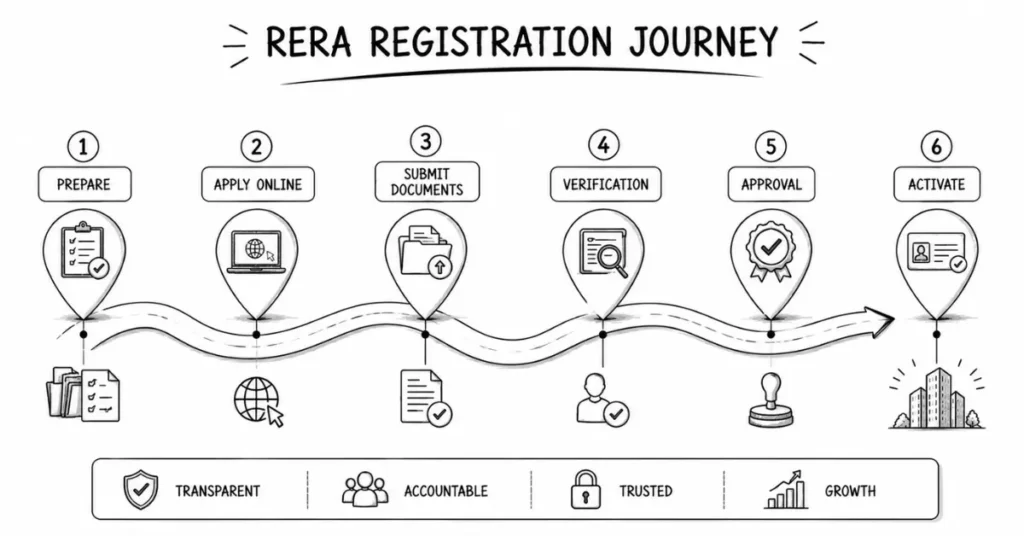
Months 1-2: Preparation Phase
- Research your target state’s specific RERA requirements
- Gather all required documents
- Ensure proper authentication of documents (notarization, apostille where required)
- Complete any mandatory training programs
- Prepare financial resources for registration fees
Month 2: Application Submission
- Create account on state RERA portal
- Complete online application form carefully
- Upload all required documents in proper format
- Pay registration fees through preferred method
- Save acknowledgment receipt and application reference number
Months 3-6: Processing Phase
- Monitor application status regularly through portal
- Respond promptly to any document requests or clarifications
- Attend any required interviews or verification appointments
- Maintain contact information accuracy for authority communications
Month 6-7: Approval and Activation
- Receive registration approval notification
- Download registration certificate from portal
- Note registration number and validity period
- Update business cards, website, and marketing materials
- Begin legal operations as registered agent
Common Application Delays and Solutions
Incomplete documentation: Thorough preparation with checklist verification prevents most delays. Many states provide document checklists on their RERA portals.
Document format issues: Scan documents at specified DPI, compress to required file sizes, use approved formats (typically PDF or JPG), and ensure clear, legible quality.
Payment processing errors: Keep transaction receipts, use government-recommended payment methods, verify correct fee amounts before payment, and immediately contact authority helpdesk for payment issues.
Application volume backlogs: Apply well before you need registration active, follow up regularly on status, consider engaging RERA consultants for complex applications, and maintain patience as most applications eventually process successfully.
Frequently Asked Questions
Can I work in multiple states with one RERA registration? No, RERA registration is state-specific. You must register separately with each state’s RERA authority where you plan to operate, or work through partnerships with locally registered agents.
Which state has the easiest RERA registration process? Tamil Nadu, Karnataka, and Maharashtra generally offer the most streamlined, transparent processes with efficient digital systems and clear guidelines. However, “easiest” also depends on your document preparedness and familiarity with online processes.
Do I need to renew RERA registration every year? No, most state RERA registrations are valid for five years from issuance. Renewal is required before expiration, typically initiated 60 days before your five-year validity expires.
What happens if I operate without RERA registration? Operating without registration is illegal across all states and can result in penalties up to ₹10,000 per day, inability to legally enforce commission agreements, consumer complaints and legal actions, and potential imprisonment in serious cases.
Can I transfer my RERA registration if I relocate to another state? No, RERA registrations are not transferable between states. If you relocate, you must apply for new registration in your destination state following that state’s complete application process and fee payment.
Which states offer reciprocity or simplified registration for agents already registered elsewhere? Currently, no states offer formal reciprocity. Each state requires complete independent registration regardless of registrations held in other states. However, experience documentation from other states can support your new application.
Conclusion
Navigating India’s state-specific RERA registration landscape requires careful research, strategic location selection, thorough preparation, and ongoing compliance commitment. While state variations create complexity, they also enable regulatory approaches tailored to local markets and allow agents to choose operating environments aligned with their circumstances, goals, and preferences.
Successful real estate agents master their chosen state’s requirements thoroughly, maintain meticulous compliance with renewal deadlines and operational rules, build deep local market expertise creating competitive advantages, and strategically expand to additional states only after establishing solid foundations in their primary market.
Your journey begins with selecting your initial target state based on market opportunity, personal connections, regulatory environment, and career goals. Then complete that state’s registration process thoroughly, establishing yourself as a compliant, professional agent building a sustainable, rewarding real estate career within India’s increasingly regulated, transparent property sector.
Take your first step today—visit your target state’s RERA website, download their agent registration guidelines, and begin gathering the documentation needed to launch your properly licensed, legally compliant real estate career.