
The "As Per Company Norms" Trap: How Freshers Can Negotiate Their Starting Salary
Table of Contents
Introduction
You have reached the finish line.
You built a flawless ATS resume (Episode 1). You optimized your LinkedIn and Naukri profiles so recruiters chased you (Episodes 2 & 3). You bypassed the crowds using hidden platforms and cold emails (Episodes 5 & 7). You cracked the technical round with ChatGPT, and you mesmerized the HR manager with your STAR method project stories (Episodes 9 & 11).
The HR Manager closes their notebook, smiles warmly, and says the magic words:
“We are very impressed with your profile, and we would like to extend an offer to join our team.”
Your heart jumps. You did it. But then, the HR manager leans forward and asks the final, most dangerous question of the entire hiring process:
“What are your salary expectations?”
And what do 99% of freshers say in this moment?
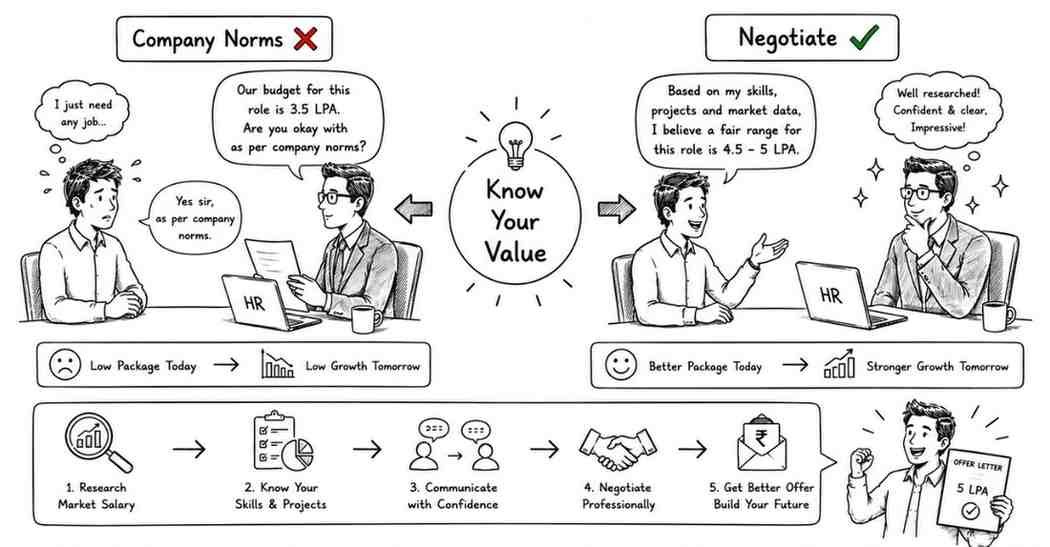
“Whatever the company policy is, sir.” Or, “As per company norms.”
I need you to understand something right now: When you say “As per company norms,” you are voluntarily setting your career back by lakhs of rupees. There is a massive myth in the Indian IT industry that freshers do not have the right to negotiate. We are taught that as a fresher, we should just be grateful to get a job at all, take whatever they offer, and keep our mouths shut.
In this Grand Finale of the Job Ready 2026 series, I am going to destroy that myth. I am going to show you the mathematical disaster of accepting a lowball offer, the psychology of corporate hiring budgets, and the exact, polite, word-for-word scripts you must use to negotiate your worth.
Let’s get you paid.
Chapter 1: The Mathematical Disaster of a Low Starting Salary
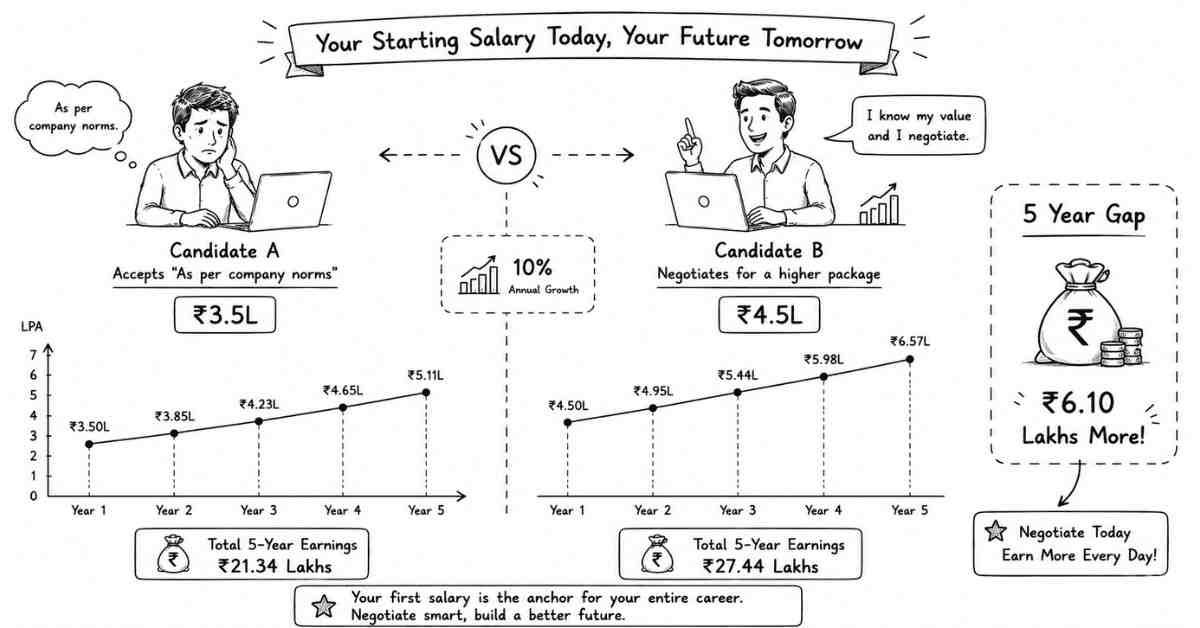
Why does your starting salary matter so much? If you accept ₹3.5 LPA instead of pushing for ₹4.5 LPA, it’s just a 1 Lakh difference, right? You can make it up next year?
Wrong. Corporate appraisals are based on percentages, not fixed numbers.
Let’s look at the math over a 5-year career, assuming a standard 10% annual increment.
Candidate A (Accepts “As per company norms” – ₹3.5 LPA):
- Year 1: ₹3.50L
- Year 2: ₹3.85L
- Year 3: ₹4.23L
- Year 4: ₹4.65L
- Year 5: ₹5.11L
- Total 5-Year Earnings: ₹21.34 Lakhs
Candidate B (Negotiated starting salary – ₹4.5 LPA):
- Year 1: ₹4.50L
- Year 2: ₹4.95L
- Year 3: ₹5.44L
- Year 4: ₹5.98L
- Year 5: ₹6.57L
- Total 5-Year Earnings: ₹27.44 Lakhs
Because Candidate B had the courage to negotiate for 5 minutes during the HR round, they earned ₹6.1 Lakhs more over 5 years. When you change jobs in the future, your new company will ask for your previous payslips and base your new hike on your old salary. Your starting salary acts as the anchor for your entire financial life. You must fight for it.
Chapter 2: The Psychology of Negotiation (Do Freshers Have Leverage?)
“But Ashok, I am a fresher. If I negotiate, won’t the HR get angry and cancel my offer? Won’t they just hire someone else?”
This is the fear that paralyzes every student. Let’s look at the psychology of the HR manager.
By the time an HR manager offers you the job, they have spent thousands of rupees and dozens of hours interviewing candidates. They have rejected 50 people to find you. The Senior Tech Manager has already said, “I want this kid on my team.” If the HR cancels your offer over a polite negotiation, they have to start the entire expensive, exhausting hiring process all over again. They do not want to lose you.
Do you have leverage?
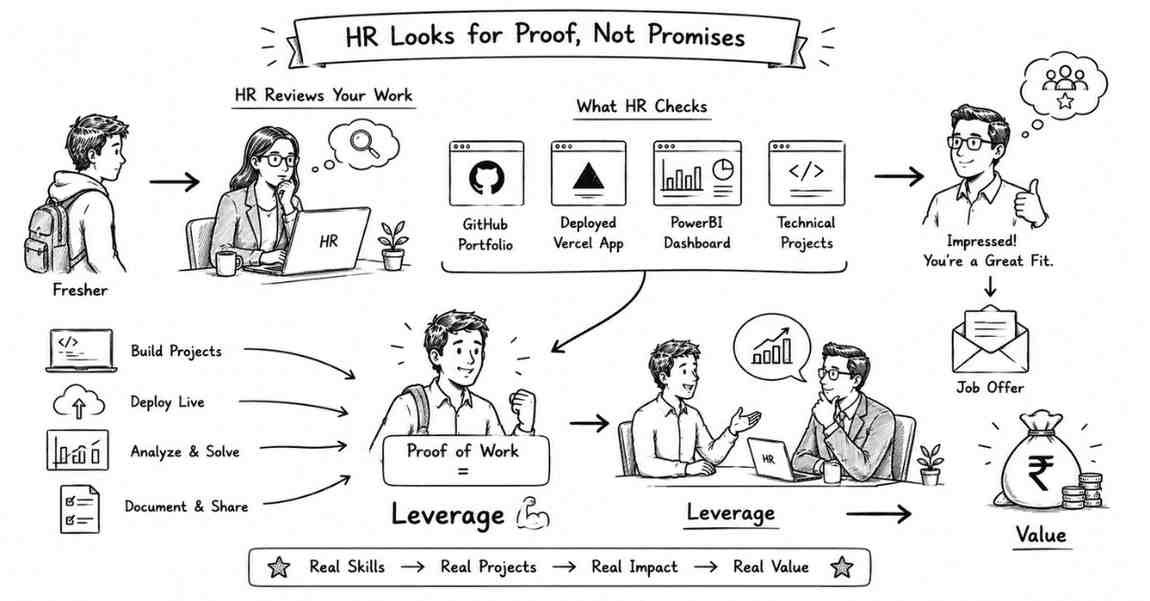
- If you only have a piece of paper (a degree) and no skills, you have zero leverage. You must accept what they give you.
- But if you followed this series, you have a live GitHub repository, a deployed Vercel application, a PowerBI dashboard, and a proven ability to write clean code. Your Proof of Work is your leverage. You are not a risk; you are a plug-and-play asset.
Companies always have a salary “band” (a range). If the budget for a Junior Developer is ₹4L to ₹6L, the HR will always offer you the bottom of the band (₹4L) first. It is their job to save the company money. It is your job to push for the top of the band.
Chapter 3: The Data Gathering Phase (Never Guess)
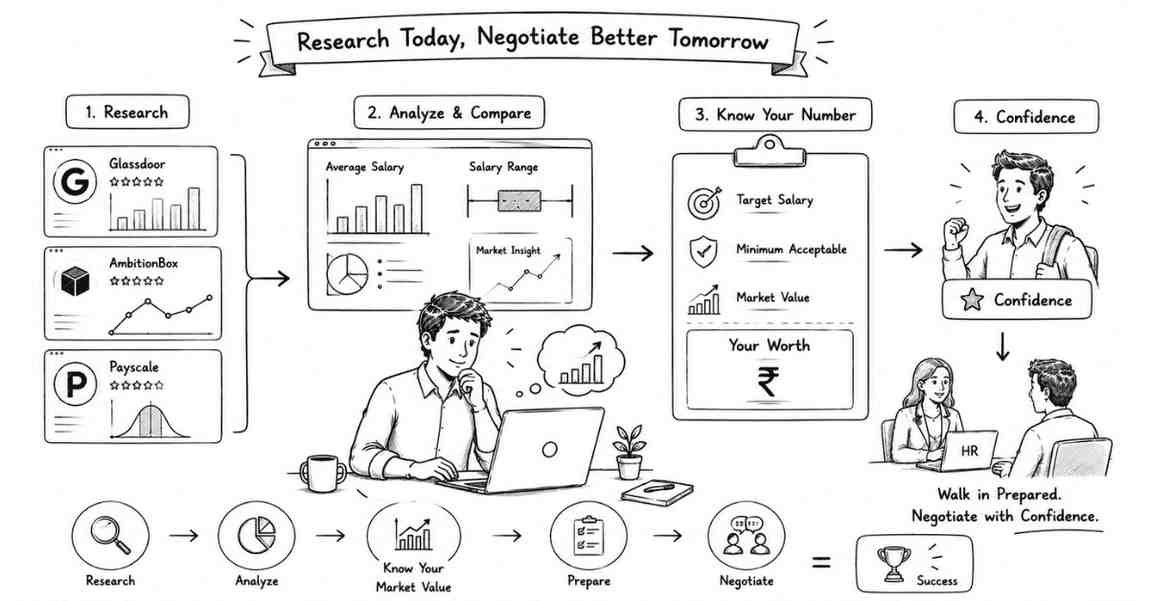
You cannot negotiate based on feelings. You cannot say, “Sir, I need 6 Lakhs because I want to buy a new bike.” You must negotiate based on Market Data. Before you even step into the final HR round, you must know exactly what you are worth.
How to find your market value:
- Glassdoor & AmbitionBox: Go to these sites and search for the exact job title at the exact company. (e.g., “Junior Data Analyst Salary at [Company Name] in Hyderabad”).
- Payscale: Look up the average salary for your specific skill set in your city.
- The Premium for Niche Skills: If you know basic HTML/CSS, your market value is low. If you know AWS Cloud Deployment, Next.js, or Advanced Machine Learning algorithms, your market value is 30% to 50% higher than the average fresher.
Write down a number. Let’s say your research shows the market average is ₹5 LPA.
- Your Minimum Acceptable Number is ₹4.5 LPA.
- Your Target Number is ₹5 LPA.
- Your Anchor Number (what you will ask for) is ₹5.5 LPA.
Always ask for slightly more than your target, so when the HR negotiates you down, you land exactly where you wanted to be.
Chapter 4: The Master Scripts (What to Actually Say)
Negotiation is a game of professional politeness. You must be firm, but highly respectful. Here are the exact scripts you need for the three most common scenarios.
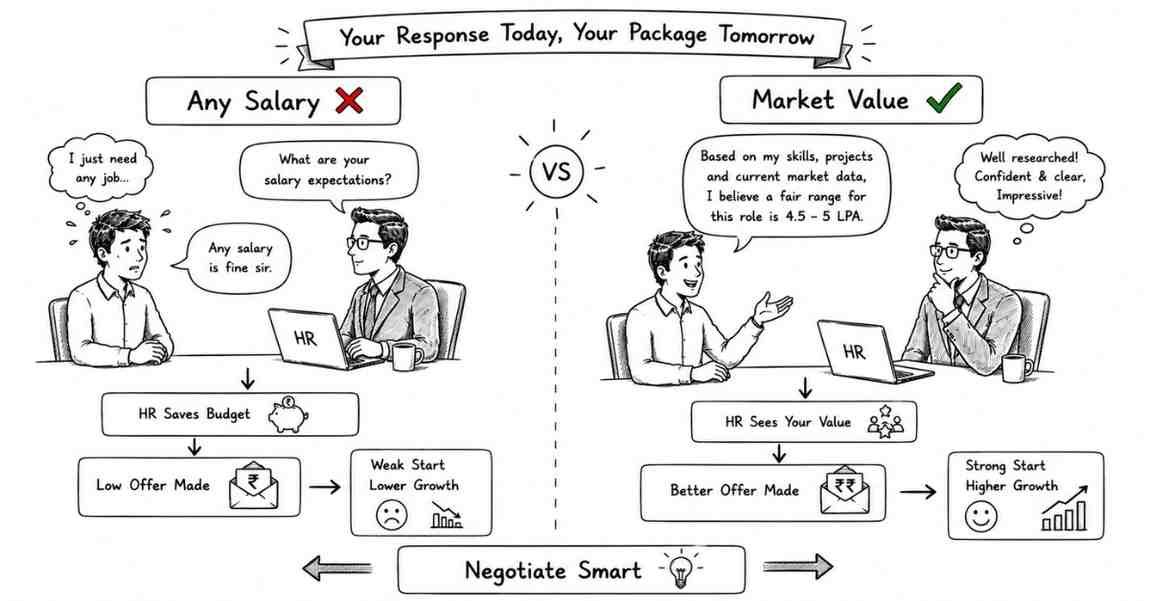
Scenario 1: When They Ask "What are your salary expectations?"
Never give a single, fixed number. Always give a range, and always justify it with data and your specific skills.
The Script:
“Based on my research using Glassdoor and industry benchmarks for this specific role in [City], the market average for a candidate with my skill set is between ₹5 Lakhs and ₹6 Lakhs. >
Because I am bringing hands-on experience in [Mention your top 2 skills, e.g., React.js and REST API integration] and already have production-level projects deployed, I am looking for a competitive offer in the range of ₹5.5 Lakhs to ₹6 Lakhs.
However, my primary focus is finding a great team where I can grow and add immediate value, so I am open to discussing this further based on the entire compensation package.”
Why this works: You showed them you did your homework. You reminded them of your specific technical value. You gave an anchor range, but you ended politely by showing flexibility.
Scenario 2: The Counter-Offer (When They Lowball You)
Let’s say you asked for ₹5.5L, but the HR replies:
“You have a great profile, but as a fresher, our maximum budget is ₹4 Lakhs.”
Do not panic. Do not immediately say yes. Use the Silence and Pivot Strategy.
Pause for 3 seconds. Let the silence hang. Then, reply with this script.
The Script:
“First of all, thank you so much for the offer. I am genuinely excited about the opportunity to join the team and work under [Manager’s Name]. >
Regarding the compensation, I was really hoping we could get closer to the ₹5 Lakh mark. While I understand the standard fresher budget, I am coming in with a highly specialized skill set in [Mention your niche skill, e.g., Cloud Architecture / Advanced SQL], which means the team won’t have to spend 3 months training me from scratch. I can start contributing to the live projects by week one.
Is there any flexibility to meet halfway at ₹4.8 Lakhs?”
Why this works: You sandwiched the negotiation between two positive statements. You reminded them that hiring you saves them training time and money. You then asked for a specific, reasonable compromise.
Scenario 3: When the Salary is "Strictly Fixed"
Sometimes, large MNCs (like TCS or Infosys) have rigid, non-negotiable fresher bands. If the HR says, “I’m sorry, our fresher package is strictly fixed at ₹3.6 LPA across the board. We cannot change the base pay.”
Do you give up? No. If you cannot negotiate the Base Pay, you negotiate the Variables.
The Script:
“I completely understand that the base salary structure is fixed for entry-level roles, and I respect the company’s policy. >
Since the base is rigid, would it be possible to explore other elements of the package? For instance, considering the live projects I am bringing to the table, could we discuss a one-time Joining Bonus? Alternatively, is there flexibility regarding a performance review and salary appraisal after 6 months instead of waiting for the standard 1-year cycle?”
Why this works: Many HRs have discretionary budgets for signing bonuses or relocation allowances. Even if they can’t change your monthly salary, getting a ₹50,000 joining bonus or a fast-tracked appraisal is a massive financial win for you.
Chapter 5: The Golden Rules of Negotiation
To ensure you don’t cross the line from “confident professional” to “arrogant applicant,” follow these three golden rules:
- Never Accept Immediately: Even if they offer you exactly what you wanted, do not say “Yes” on the spot. Say, “Thank you so much for this generous offer. I am very excited. Could you please send the official offer letter to my email so I can review the complete breakdown? I will get back to you by tomorrow morning.” This shows maturity.
- Never Mention Personal Needs: The company is not a charity. Do not say, “I have an education loan to pay,” or “Rents in Bangalore are very high.” They do not care. You must only negotiate based on the business value you provide to them.
- Be Prepared to Walk Away (Or Accept Gracefully): If you negotiate, and the HR firmly says, “This is our final offer, take it or leave it,” you have to make a choice. If you need the job, accept it gracefully. Say, “I understand. I am excited to accept the offer and prove my value on the job.” You tried, you practiced the skill of negotiation, and that is a victory in itself.
Series Conclusion: The "Job Ready 2026" Blueprint

We have reached the end of the 12-part Job Ready 2026 series.
Let’s take a moment to look back at the monster candidate you have become over these 12 episodes:
- You no longer use fancy Canva resumes; you use an ATS-beating robot parser.
- You don’t beg for jobs on Naukri; you use Profile Freshness to make HRs call you.
- You don’t rely on paper degrees; you build Proof of Work on GitHub and Vercel.
- You don’t wait in line; you Cold Email CEOs and use the Alumni Tool for referrals.
- You don’t fear interviews; you practice using the ChatGPT Mock Interviewer.
- You don’t list tools; you tell stories using the STAR Method.
- And now, you don’t settle for less; you Negotiate with Data.
You are no longer a struggling fresher. You are a highly optimized, strategically prepared, modern IT Professional.
The job market is not “dead.” The market is simply evolving. Companies have stopped hiring people who just memorized textbooks, and they have started actively hunting for people who know how to solve problems and communicate their value. You now have the exact blueprint to do exactly that.
Your Final Action Plan
Knowledge without execution is just entertainment.
👉 Action Item for Today: Bookmark this series. Save the links to these 12 blogs. Share them with your college juniors, your batchmates, and your friends who are struggling to get placed.
But most importantly, look in the mirror and ask yourself: “Do I actually have the skills to back up this optimized profile?”
A great ATS resume is useless if you don’t actually know how to code. A great cold email will fail if your portfolio links are broken. Negotiation is impossible if you don’t have real “Proof of Work” to leverage.
The ultimate foundation of this entire 12-step strategy is Real-World Skill.
If you are reading this and realizing that your technical foundation is weak, do not waste another month blindly applying for jobs. Step back, invest in yourself, and upskill.
At Frontlines Edutech, our mission is to turn raw students into deployable tech assets. Whether you want to master Full Stack Development, Cloud Computing, Data Analytics, or UI/UX Design, our curriculum is built entirely on creating the “Proof of Work” that recruiters demand in 2026. We don’t just teach you; we guide you until you have the exact projects you need to negotiate your worth confidently.
Your career is in your hands now. Go out there, hack the system, and get the job you deserve.