
Real Estate Sales Agent Career : Salary & License Guide
Table of Contents
Introduction

Becoming a real estate sales agent in India offers one of the most accessible yet potentially lucrative career paths available in 2026. Unlike professions demanding extensive formal education or years of specialized training, real estate sales welcomes motivated individuals with basic qualifications and the determination to succeed. With RERA registration as your foundation and commission-based earnings as your reward, this career path provides unlimited income potential directly tied to your effort and skill development.
Real estate agents serve as crucial intermediaries connecting property buyers with sellers, guiding clients through one of their most significant financial decisions. Your role encompasses understanding client needs, researching suitable properties, arranging viewings, negotiating favorable terms, and facilitating smooth transactions from initial inquiry through final documentation. Success requires combining market knowledge, interpersonal skills, persistence, and genuine client service orientation.
What makes this career particularly compelling is the performance-based earnings structure. While creating income variability, especially initially, it also means your earning potential has no artificial ceiling. Entry-level agents might earn ₹2-4 lakh annually while building foundations, but experienced professionals in metropolitan markets regularly earn ₹15-50 lakh, with top performers specializing in luxury or commercial properties exceeding even these figures.
This comprehensive guide walks you through everything needed to launch and build a successful real estate sales agent career in India, from mandatory RERA registration through proven strategies for finding clients, closing deals, and creating sustainable long-term success in this dynamic industry.
Understanding the Real Estate Sales Agent Role
Core Responsibilities
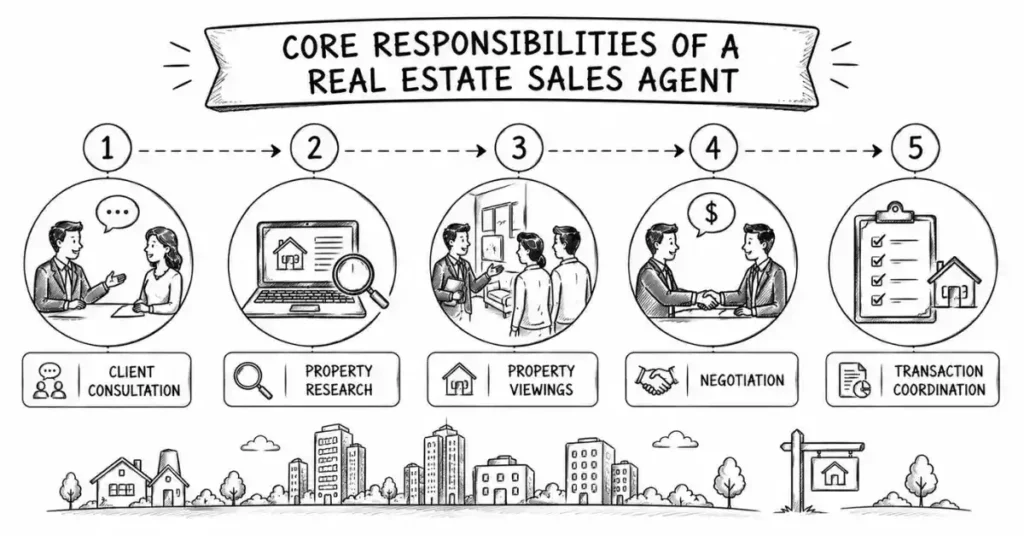
Real estate sales agents balance multiple responsibilities throughout their workdays. Your primary function is matching buyers with suitable properties or finding qualified buyers for seller clients’ properties. This seemingly straightforward task requires considerable skill, market knowledge, and relationship management.
Client consultation forms your work foundation. You meet prospective buyers to understand their budget constraints, location preferences, property type needs (apartment, independent house, plot), size requirements, amenity expectations, purchase timelines, and financing arrangements. With sellers, you understand their properties, pricing expectations, urgency levels, and flexibility on terms. These consultations demand active listening, thoughtful questioning, and realistic expectation management based on market conditions.
Property research and identification consume significant time for active agents. You search multiple listing services, your agency’s proprietary listings, developer databases, and your professional network to identify properties matching client criteria. This requires maintaining current knowledge of available inventory across your coverage area, understanding neighborhood characteristics, and recognizing good value opportunities.
Property viewings represent the most visible aspect of your work. You coordinate schedules between buyers and sellers or developers, prepare property information sheets highlighting key features, conduct professional tours emphasizing benefits while honestly addressing limitations, answer questions about properties, neighborhoods, pricing, and processes, and follow up after viewings to gauge interest and address concerns.
Negotiation and deal structuring showcase your value to clients. When buyers find interesting properties, you negotiate purchase prices, present and counter offers on behalf of clients, structure deal terms including payment schedules and contingencies, coordinate with financing institutions, and work toward agreements satisfying both parties while protecting your client’s interests.
Transaction coordination from accepted offer through closing requires meticulous attention. You coordinate document preparation and verification, liaise between buyers, sellers, banks, lawyers, and developers, ensure compliance with legal and regulatory requirements, schedule and oversee property inspections, track payment milestones, and troubleshoot issues that inevitably arise during complex transactions.
Work Environment and Schedule
Real estate sales agents enjoy considerable flexibility in work arrangements, though this flexibility comes with expectations of availability when clients need you. Most agents work independently rather than in traditional office environments, spending time meeting clients at coffee shops or their homes, showing properties across coverage areas, networking at industry events and community gatherings, and working from home offices handling administrative tasks and research.
Your schedule will be irregular and client-driven. Property viewings typically occur outside traditional business hours since most buyers work during weekdays. Evenings and weekends become prime working time when clients are available. Successful agents learn to balance client accessibility with personal boundaries to prevent burnout while maintaining responsiveness.
RERA Registration: Your Mandatory License
Why RERA Registration Is Compulsory
Operating as a real estate agent without RERA registration is illegal in India and can result in significant penalties. The Real Estate (Regulation and Development) Act, 2016 mandates registration for all agents involved in selling, purchasing, advertising, marketing, booking, or inviting individuals to purchase plots, apartments, or buildings within RERA-registered projects.
Section 9 of the RERA Act explicitly states that no real estate agent can facilitate the sale or purchase of plots, apartments, or buildings in a RERA-registered real estate project without being registered. This legal requirement protects consumers while establishing professional standards for agents.
Your RERA registration number must be quoted in all property dealings and advertisements. This transparency allows consumers to verify they’re working with legitimate, accountable agents before engaging services, building trust and credibility in your practice.
Eligibility Criteria
RERA registration eligibility is intentionally accessible to encourage broad participation while maintaining basic standards. The requirements include:
Minimum age: You must be at least 18 years old to apply for registration. This ensures basic maturity and legal capacity for business transactions.
Educational qualifications: You should have completed Class 12th or equivalent qualification. Some states may require 10th grade as minimum, so verify your specific state’s RERA website for precise requirements. These modest educational thresholds recognize that successful real estate sales depends more on interpersonal skills, market knowledge, and persistence than academic credentials.
Clean criminal record: A background free of serious offenses is essential for eligibility. This protects consumers from working with agents who may have histories of fraud or unethical conduct.
Training requirements: Existing and aspiring real estate agents must attend RERA training programs and pass the Certificate of Competency exam before applying for RERA registration to become licensed agents. This ensures all agents possess basic knowledge of real estate regulations, ethical standards, and transaction processes.
Step-by-Step Registration Process
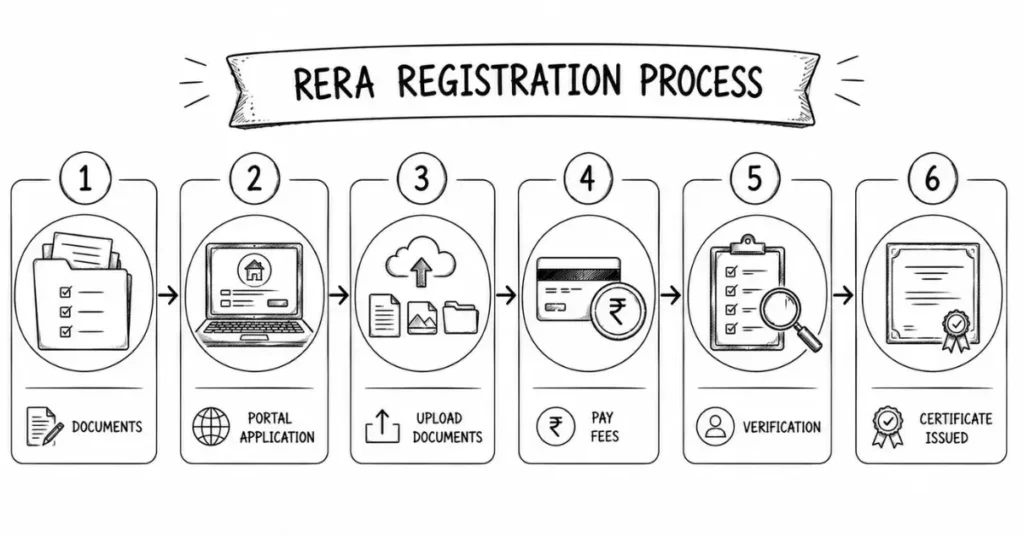
The RERA registration process is conducted entirely online through your state’s RERA portal, making it accessible from anywhere. Understanding each step helps you navigate the process efficiently.
Step 1: Document Preparation
Before starting your application, gather all required documents:
- Identity proof: Aadhaar card, Voter ID, or Passport
- PAN card
- Address proof: Electricity bill, telephone bill, or rent agreement
- Educational qualification certificates: 10th or 12th mark sheets and passing certificates
- Recent passport-sized photographs in specified format and size
- Income Tax Returns for the last three years (if available)
- Business registration documents if applying as a firm rather than individual
Ensure all documents are clear, legible, and properly formatted. Many applications face delays because submitted documents don’t meet technical specifications for file size, format (usually PDF or JPG), or quality.
Step 2: Visit State RERA Website
Log into your state’s RERA webpage (for example, Maharashtra, Delhi, Karnataka, Telangana). Each state has its own RERA portal with specific guidelines, so make sure you’re accessing the correct state authority where you plan to operate.
For Hyderabad-based agents, visit the Telangana Real Estate Regulatory Authority website. The Telangana government has made special provisions for agent registration with a step-by-step guide.
Step 3: Complete Online Application
Click on ‘Services’ on the menu tab and select ‘Real Estate Agent Registration’ from the dropdown. Download and complete the agent registration form with your personal and professional details including:
- Personal information (name, date of birth, contact details)
- Educational qualifications
- Professional background
- Business details if applicable
- Bank account information
Double-check all entries before submission, as errors or inconsistencies can delay processing significantly. Common mistakes include mismatched names across different documents, incorrect dates, transposed digits in contact numbers or identification numbers, and incomplete address information.
Step 4: Upload Required Documents
Upload all required documents in the specified formats and sizes, clearly labeled according to portal instructions. Most portals provide upload guidelines specifying maximum file sizes and acceptable formats.
Step 5: Pay Registration Fees
Registration fees vary by state but typically range from ₹5,000 to ₹25,000. Payment is processed through the online portal using net banking, credit/debit cards, or other digital payment methods. Save your payment receipt and transaction reference number for tracking purposes.
Step 6: Application Verification
After submission, your application enters the verification queue where RERA authorities review your documents. This process typically takes 4-6 months, though timelines vary by state depending on application volumes and administrative efficiency.
During verification, authorities may request additional information, clarifications, or supplementary documents. Monitor your application status regularly through the portal and respond promptly to any queries to avoid extending your overall processing time.
Step 7: Receive Registration Certificate
Once approved, you’ll receive your RERA registration certificate digitally through the portal. Download and save multiple copies of this certificate. Your registration number should be prominently displayed on your business cards, email signatures, advertisements, and all client-facing materials.
Registration Validity and Renewal
RERA registration is valid for five years in most Indian states. This five-year validity ensures agents maintain current registrations and stay updated with regulatory changes through periodic renewals.
Mark your expiration date clearly in your calendar and set reminders starting 90 days before expiration. Initiate the renewal process at least 60 days before your current license expires to prevent any gap in your legal authorization to operate.
The renewal process typically mirrors the initial application, requiring updated documents if needed, payment of renewal fees (often similar to initial registration costs), and verification by authorities. Some states offer streamlined renewal for agents with clean records and no complaints.
Operating with an expired RERA registration violates the law and can result in penalties, inability to legally close transactions, and loss of credibility with clients and partners
Understanding Real Estate Agent Compensation
Commission-Based Earnings Structure
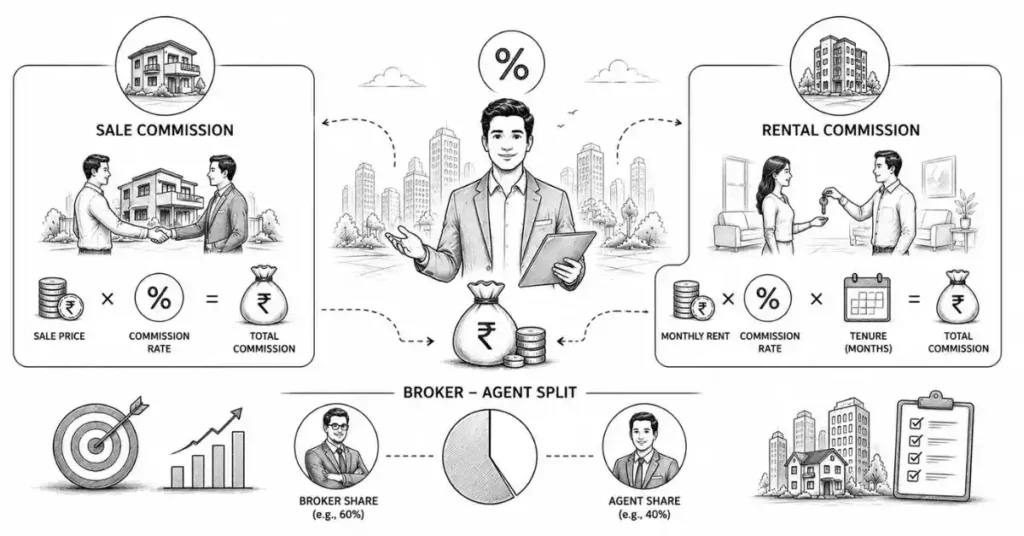
Real estate agents in India earn primarily through commissions on successfully closed transactions rather than fixed salaries. Understanding commission structures is essential for realistic income planning and career decision-making.
Sale transaction commissions: Agents usually earn 1-2% of the property’s sale price. For luxury or commercial properties, rates can be negotiable. The specific percentage depends on property type (residential vs. commercial), property value (higher-value properties sometimes negotiate lower percentage rates), local market norms, and your negotiation with clients or your brokerage.
Rental transaction commissions: Typically, agents take one month’s rent as commission for facilitating rental agreements. This provides another income stream beyond sales transactions.
Commission calculation examples: On a property selling for ₹80 lakh with a 2% commission rate, the agent earns ₹1.6 lakh from the sale. On a ₹50 lakh property at 2%, the commission is ₹1 lakh. For a ₹1 crore property at 2% commission, the total is ₹2 lakh. On higher-value properties like ₹2 crore with a 1.5% commission, the agent earns ₹3 lakh
Commission Splits with Brokers
However, agents rarely retain entire commissions. Most work under brokerages or agencies that share commissions according to negotiated splits.
Broker-agent relationship: In India, agents typically operate under brokers, and the commission earned from a sale is first paid to the broker. The broker then takes their share before passing the remaining amount to the agent. Brokers provide essential support such as marketing, office space, resources, training, brand reputation, and leads, and in return receive a portion of the commission.
Common split arrangements:
- 50-50 splits: The agency and agent each receive half the commission. This is typical for new agents receiving maximum support.
- 60-40 splits: The agent receives 60% and the agency receives 40%. This reflects growing experience and reduced support needs.
- 70-30 splits: Experienced agents with proven track records receive 70% while agencies take 30%.
- 80-20 or higher: Top producers with strong personal brands may negotiate 80% or more, with agencies retaining only 20%.
Split examples: Using a ₹1 crore property with 2% commission (₹2 lakh total), at a 50-50 split the agent receives ₹1 lakh. At a 70-30 split, the agent receives ₹1.4 lakh. These splits compensate the agency for infrastructure, training, leads, marketing support, and brand reputation they provide.
Factors Affecting Commission Rates
Property value: Higher-value properties often attract lower commission rates. An agent might charge 1.5% on a luxury villa worth ₹10 crore because even a small percentage translates into substantial commission. For lower-value properties, the rate might be 2% or more to ensure the agent earns a reasonable fee.
Market conditions: In competitive buyer’s markets, commission rates may face downward pressure. In seller’s markets with high demand, agents maintain stronger commission positions.
Agent experience and reputation: Established agents with proven track records and strong reputations command better commission rates and more favorable splits than newcomers.
Property type complexity: Commercial properties or unique properties requiring specialized knowledge may justify higher commission rates than standard residential properties.
Realistic Salary Expectations
Income by Experience Level
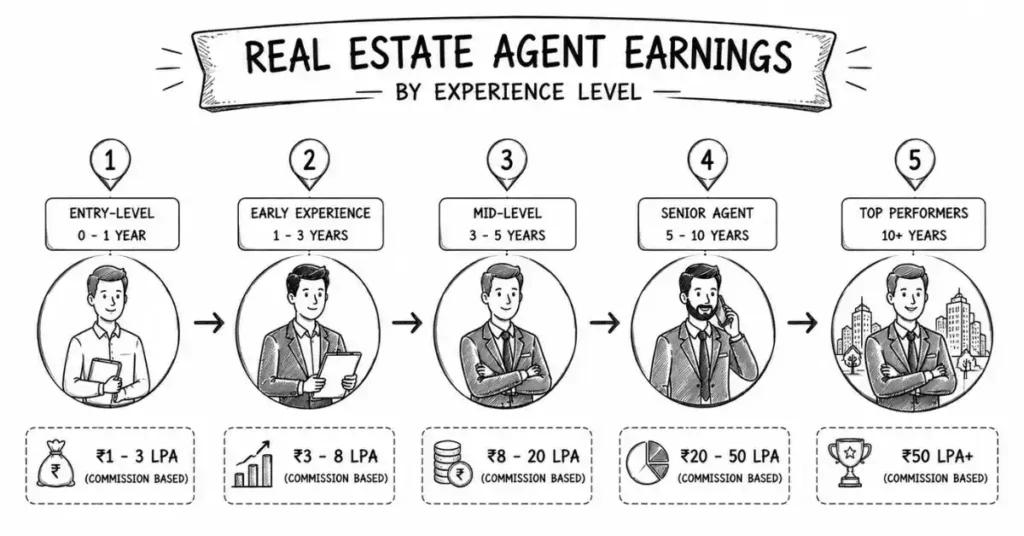
Real estate agent income varies dramatically based on performance, experience, location, and market conditions.
Entry-Level (0-2 years): New agents typically earn ₹2-4 lakh annually during their first two years. This challenging period involves building skills, establishing market knowledge, developing client networks, and learning transaction processes. Many new agents close their first deals 3-6 months after starting, experiencing significant income gaps during this learning phase. Financial preparation for this period is essential for career survival.
Mid-Career (3-5 years): Agents with 3-5 years of experience typically earn ₹5-10 lakh annually as their deal flow becomes more consistent. By this stage, you’ve developed efficient prospecting systems, built a referral network generating repeat and referred business, mastered negotiation and transaction processes, and established market credibility and reputation.
Experienced (7-10 years): Agents with 7-10 years and established reputations command ₹12-25 lakh or more annually. Experienced agents benefit from strong referral networks reducing marketing costs, efficient systems maximizing productivity, specialized market expertise in neighborhoods or property types, and strong negotiation skills closing complex deals.
Top Performers (10+ years): Elite agents with 10+ years, extensive networks, and specialization in luxury or commercial properties exceed ₹50 lakh annually. Top performers typically focus on high-value transactions, lead teams of junior agents sharing in their commissions, diversify income through property management or consulting, and maintain exceptional reputations generating consistent high-quality referrals.
Geographic Earnings Variations
Location significantly impacts earnings potential. Metropolitan markets like Mumbai, Delhi, Bengaluru, Pune, and Hyderabad offer higher property values translating to larger commission amounts, greater transaction volumes providing more opportunities, diverse property types enabling specialization, and competitive markets requiring differentiation.
Tier-2 and tier-3 cities offer lower average property values reducing commission sizes per transaction, but less competition from established agents, lower living costs preserving more earnings, and growing markets creating emerging opportunities.
Essential Skills for Sales Success

Interpersonal Excellence
Real estate sales is fundamentally a people business where relationship quality determines success. Active listening helps you truly understand client needs, concerns, and motivations. Many agents talk too much and listen too little, missing crucial information.
Clear communication enables you to explain complex processes, terms, and documents in accessible language. Clients rely on you to guide them through unfamiliar territory. Emotional intelligence allows you to read clients’ unstated concerns, manage anxieties around large financial decisions, navigate conflicts between family members with different priorities, and maintain composure during stressful negotiations.
Market Knowledge
Comprehensive market knowledge establishes credibility and enables quality advice. Clients expect agents to serve as local experts understanding neighborhood characteristics, schools, transportation, amenities, safety, development plans, and community culture. They also expect knowledge of current pricing trends, days-on-market averages, inventory levels, buyer demand patterns, and seasonal market variations.
Negotiation Abilities
Negotiation skills directly impact your success rate and earnings. Every transaction involves negotiating price, possession dates, included fixtures, repair responsibilities, payment terms, and contingencies. Preparation forms the foundation—research comparable transactions, understand your client’s priorities and walk-away points, and anticipate the other party’s motivations. Win-win orientation produces better outcomes than adversarial approaches, enabling deals to close with both sides reasonably satisfied.
Self-Management
Commission-based work without daily supervision requires exceptional self-discipline. No one will force you to prospect, follow up with leads, or attend networking events. Your income directly reflects your self-discipline and activity levels. Create consistent daily routines including dedicated prospecting time, client meeting blocks, administrative task completion, and networking activities.
Finding Your First Clients

Leverage Your Personal Network
Your personal network provides the highest probability source for initial clients and referrals. People who already know and trust you will give you opportunities to prove yourself before you’ve established a professional reputation.
Sphere of influence includes everyone you know: family, friends, former colleagues, classmates, neighbors, religious or community organization members, parents from children’s schools, and service providers you use regularly. Most people know dozens to hundreds of individuals, many of whom will buy, sell, or know someone who will during your first year.
Send personalized messages to close contacts explaining your career transition, your RERA registration and agency affiliation, and how you can help with real estate needs. Offer to answer real estate questions for anyone in your network, even if they’re not currently buying or selling. This positions you as a knowledgeable resource.
Join the Right Brokerage
New agents benefit tremendously from joining established brokerages providing training, support, leads, and systems. Evaluation criteria should include training programs for new agents, lead generation support through walk-ins or website inquiries, mentorship opportunities with experienced agents, fair commission split structures, brand reputation in your market, positive office culture, and technology platforms including CRM and marketing tools.
Interview multiple agencies before deciding. Ask current agents about their experiences, support quality, lead opportunities, and earning potential. Understand commission structures clearly, including any fees or transaction costs beyond splits.
Digital Presence
Modern real estate success requires strong digital presence. Create comprehensive LinkedIn profiles highlighting your RERA registration, agency affiliation, coverage areas, and specializations. Share market insights, property listings, neighborhood information, and real estate tips regularly. Use Facebook and Instagram for visual property marketing with professional pages separate from personal profiles
Building Long-Term Success
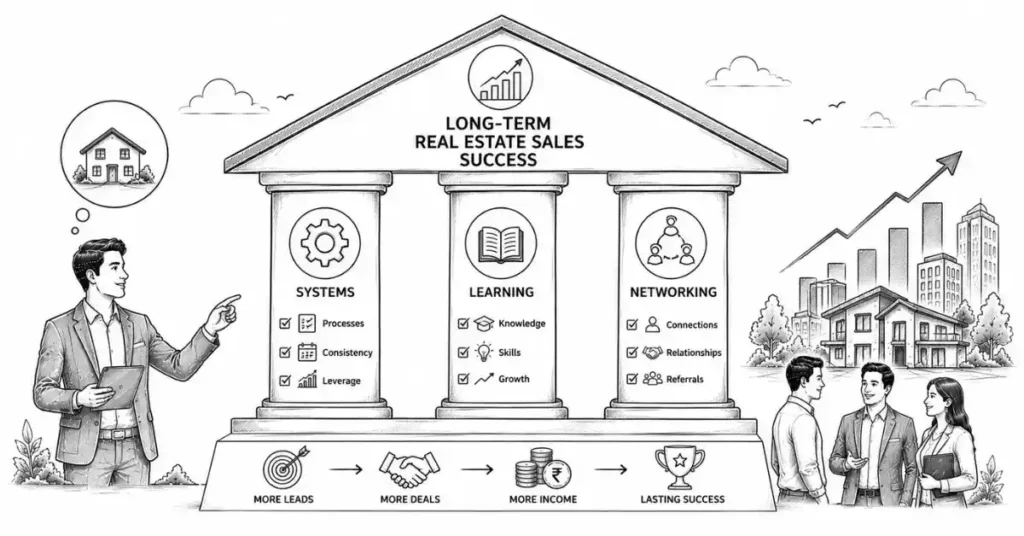
Develop Systems
Sustainable success requires systematic approaches to lead management, client communication, and transaction coordination. Use CRM systems to record every lead, schedule follow-up reminders, track interactions, and segment contacts. Create transaction checklists preventing forgotten tasks during hectic closing periods. Develop email templates for common communications.
Continuous Learning
Real estate constantly evolves with regulatory changes, market conditions, new technologies, and shifting buyer preferences. Attend workshops, webinars, and conferences regularly. Seek mentorship from experienced agents. Deepen market expertise in specific neighborhoods or property types, differentiating yourself from competitors.
Professional Networking
Join professional associations for networking, education, and credibility. Attend industry conferences and events. Build complementary relationships with mortgage brokers, lawyers, property inspectors, interior designers, and accountants serving the same clients.
Frequently Asked Questions
How long before I earn my first commission? Most new agents close their first deal within 3-6 months of receiving RERA registration and actively working. However, this varies based on prospecting intensity, local market conditions, initial network strength, and luck. Plan financially for potentially longer timelines.
Can I work part-time initially? Yes, many successful agents began part-time while maintaining other employment, gradually transitioning as real estate income grew. Part-time entry reduces financial risk and allows testing whether real estate suits you before fully committing.
What’s the biggest challenge new agents face? Financial stress from income inconsistency during the first 1-2 years leads many promising agents to quit prematurely. Address this through adequate savings before starting, part-time transitioning, or joining brokerages offering salary components for new agents.
Conclusion

Real estate sales agent careers offer accessible entry, unlimited earning potential, flexible work arrangements, and the satisfaction of guiding clients through significant life decisions. Success requires combining mandatory RERA registration with continuous skill development, systematic client relationship building, self-discipline in commission-based work, and persistence through inevitable challenges.
Your journey begins with RERA registration and continues through deliberate daily efforts building market knowledge, client relationships, and professional reputation. The agents who thrive approach their careers as long-term businesses requiring patience, investment, and consistent effort rather than quick-money schemes.
Take your first concrete action today—visit your state RERA website, contact agencies for interviews, or reach out to your network—and begin building your real estate sales career.