
Real Estate Investment Analyst Career : Salary Guide
Table of Contents
Introduction

Real estate investment analysts occupy a sophisticated analytical position at the intersection of finance and property markets, evaluating investment opportunities for institutional investors, private equity firms, REITs (Real Estate Investment Trusts), family offices, and high-net-worth individuals. Unlike traditional real estate agents who facilitate transactions or property managers who oversee operations, investment analysts focus on financial modeling, market analysis, due diligence, risk assessment, and return projections that guide decisions involving crores or billions of rupees in capital deployment.
The career offers strong compensation reflecting the analytical sophistication and high-stakes nature of the work. Real estate investment analysts in India earn salaries varying significantly by experience level: entry-level professionals earn ₹5-8 lakh per annum, mid-level analysts command ₹10-18 lakh, and senior-level positions offer ₹20-30 lakh or more. According to Indeed data, the average salary is ₹8.53 lakh per year, while PayScale reports ₹4.5 lakh for general real estate analysts, with the range typically falling between ₹8.15 lakh to ₹23.72 lakh depending on specialization and employer.
India’s growing sophistication in real estate investment creates exceptional opportunities for qualified analysts. The REIT market continues expanding, institutional capital flows into Indian property markets are increasing, private equity real estate funds are deploying significant capital, commercial real estate transactions are becoming more complex, and data-driven investment decision-making is becoming standard rather than exceptional. Organizations recognize that quality financial analysis directly impacts investment returns, making skilled analysts invaluable team members.
Real estate investment analysis particularly appeals to individuals with strong quantitative abilities who enjoy working with financial models, spreadsheets, and data rather than people-focused roles. If you’re analytical, detail-oriented, comfortable with numbers and financial concepts, and interested in real estate without wanting to work directly in sales or operations, investment analysis might be your ideal career path.
This comprehensive guide explores everything needed to build a successful real estate investment analyst career in India, from understanding core responsibilities and essential skills through educational requirements, the CFA credential pathway, realistic salary expectations, key financial concepts and modeling techniques, and proven strategies for breaking into and advancing within this competitive, intellectually demanding profession.
Understanding the Real Estate Investment Analyst Role

Core Responsibilities
Real estate investment analysts perform comprehensive financial and market analysis supporting investment decisions across acquisition, hold, and disposition phases.
Financial modeling and analysis forms the foundation of investment analysis work. You build detailed financial models projecting cash flows over investment holding periods, typically 5-10 years. You analyze purchase costs, financing terms and conditions, rental income projections from leases and market assumptions, operating expenses including property taxes, insurance, maintenance, utilities, and management fees, capital expenditures for improvements and major repairs, and debt service if leverage is employed.
You calculate key investment metrics including Net Operating Income (NOI) representing property income before financing and taxes, Capitalization Rate (Cap Rate) indicating yield based on purchase price, Internal Rate of Return (IRR) measuring annualized return including time value of money, Net Present Value (NPV) representing present value of future cash flows minus initial investment, Cash-on-Cash Return comparing cash flow to equity invested, and Return on Investment (ROI) measuring total profitability.
These financial models typically run in Excel with complex formulas, scenarios, and sensitivity analyses showing how changes in key assumptions (rental rates, vacancy rates, exit cap rates, interest rates) impact returns. Your models must be accurate, transparent, and flexible enough to quickly test different scenarios as deal parameters evolve.
Market research and competitive analysis provides context for financial projections. You study supply and demand dynamics in target markets understanding absorption rates, vacancy trends, new construction pipelines, and tenant requirements. You analyze rental rate trends and lease comparables benchmarking projected rents against current market evidence. You research demographic and economic indicators including population growth, employment trends, income levels, and business formation affecting property demand.
You evaluate competitive properties understanding their occupancy, rental rates, amenities, age, condition, and market positioning. You assess submarket characteristics including transportation access, nearby amenities, development restrictions, and growth prospects. This market intelligence validates or challenges financial model assumptions, ensuring projections reflect realistic expectations rather than wishful thinking.
Investment due diligence verifies assumptions and identifies risks before capital commitment. You review legal documents including purchase agreements, existing leases, title reports, survey documents, and environmental assessments. You analyze property financial statements verifying historical income and expense patterns, identifying unusual items, and assessing management quality.
You coordinate property inspections evaluating physical condition, deferred maintenance, required capital improvements, and functional obsolescence. You assess tenant creditworthiness and lease rollover risk understanding when leases expire, renewal probabilities, and potential downtime. You identify regulatory and zoning considerations affecting property use, expansion possibilities, or future restrictions. Thorough due diligence protects investors from unforeseen issues that could destroy projected returns.
Investment memoranda and presentation preparation communicates recommendations to decision-makers. You prepare comprehensive investment memoranda documenting property description and location, market analysis and positioning, financial projections and key metrics, risk assessment and mitigation strategies, comparable transactions and valuation support, and investment recommendation with clear rationale.
You create presentations for investment committees distilling complex analysis into clear, compelling narratives supporting investment decisions. These presentations must balance comprehensive information with accessibility, enabling senior executives to make informed decisions quickly. Your analytical quality and communication clarity directly influence whether investments receive approval and capital deployment.
Portfolio monitoring and reporting continues after acquisition. You track actual performance against projections identifying variances and their causes. You prepare quarterly or annual reports for investors showing financial performance, market conditions, key operational metrics, and forward outlook. You assess exit timing and strategies recommending when to hold, reposition, or sell assets based on market conditions and investment objectives.
Work Environment and Career Context
Real estate investment analysts typically work in office environments at institutional investors (pension funds, insurance companies, sovereign wealth funds), private equity real estate funds investing in property acquisitions and developments, REITs managing portfolios of income-producing properties, family offices managing ultra-high-net-worth real estate portfolios, investment banks providing real estate advisory services, or consulting firms offering real estate investment advisory services.
Your work is highly analytical, spending significant time in Excel building and refining financial models, researching markets using databases and reports, analyzing comparable transactions, coordinating with brokers, attorneys, and other advisors, and preparing presentations and memoranda. The role involves minimal client-facing work compared to sales or brokerage positions, suiting individuals who prefer analytical problem-solving over relationship management.
Work hours can be demanding, particularly during active deal processes or when investment committee meetings approach. Expect 50-60 hour weeks during busy periods, with more reasonable 40-45 hour weeks during slower times. The intellectual challenge and high-stakes nature create pressure, but most analysts find the work engaging and rewarding given the strategic importance of their analysis.
Essential Skills for Investment Analysis Success

Financial and Quantitative Abilities
Strong financial and analytical capabilities form the absolute foundation for investment analyst careers.
Financial statement analysis requires understanding income statements, balance sheets, and cash flow statements for properties and real estate operating companies. You must interpret NOI, EBITDA, funds from operations (FFO) for REITs, and other specialized real estate financial metrics. You analyze operating leverage, expense ratios, and profitability trends identifying performance patterns and red flags.
Valuation methodologies include comparable sales analysis valuing properties based on recent transactions of similar assets, income capitalization approach using cap rates to value income-producing properties, discounted cash flow analysis projecting future cash flows and discounting to present value, replacement cost approach estimating land value plus construction costs, and REIT valuation using specialized metrics like FFO, AFFO (adjusted FFO), and NAV (net asset value).
Excel modeling proficiency is non-negotiable for investment analysts. You must master complex formulas and functions including financial functions (NPV, IRR, XIRR, PMT), logical functions (IF, AND, OR) for scenarios and sensitivities, lookup functions (VLOOKUP, INDEX, MATCH) for data management, and array formulas for advanced calculations. You structure models with clear assumptions sections, transparent calculation flows, built-in error checks, scenario analysis capabilities, and sensitivity tables showing impact of variable changes.
Professional models follow best practices including separating inputs, calculations, and outputs, using consistent formatting and color coding, documenting assumptions and methodologies, building flexibility for easy scenario testing, and maintaining audit trails showing calculation logic. Your modeling quality directly impacts your credibility and value to employers.
Statistical and quantitative analysis helps interpret market data, identify trends and correlations, assess risk and volatility, and make probabilistic forecasts rather than single-point estimates. Understanding regression analysis, standard deviation, correlation coefficients, and Monte Carlo simulation enhances your analytical sophistication.
Real Estate Knowledge
While financial skills are paramount, deep real estate understanding differentiates excellent analysts from merely adequate ones.
Property type expertise requires understanding office building characteristics, lease structures, tenant requirements, and value drivers including location, building class, parking ratios, and amenities. Retail property knowledge covers tenant mix strategies, percentage rent structures, anchor tenant importance, foot traffic patterns, and omnichannel retail impacts. Industrial property understanding includes clear height importance, loading dock specifications, power requirements, last-mile logistics trends, and e-commerce impacts.
Multifamily residential knowledge covers unit mix optimization, rent control regulations, property management intensity, and demographic drivers. Hospitality property analysis requires understanding revenue per available room (RevPAR), operating leverage, brand flags versus independent operation, and cyclicality. Each property type has unique characteristics, metrics, and value drivers analysts must understand.
Lease structure comprehension enables accurate income projections. You must understand gross leases where landlords pay operating expenses, net leases where tenants pay portions of operating costs (single, double, or triple net), percentage rent structures common in retail, free rent periods and tenant improvement allowances reducing effective rents, renewal options and rent escalations affecting long-term income, and early termination clauses creating income risk.
Market dynamics and cycles help contextualize current conditions and forecast future trends. Understand how supply and demand drive rental rates and values, how construction cycles create periodic oversupply, how economic cycles impact property performance, how interest rate changes affect cap rates and values, and how regulatory changes influence markets.
Analytical and Critical Thinking
Investment analysis requires rigorous, objective thinking that questions assumptions and identifies risks.
Scenario analysis tests investment performance under various conditions: base case reflecting most likely assumptions, upside case showing optimistic outcomes, downside case modeling adverse scenarios, and stress testing for extreme conditions like severe recession, major tenant losses, or interest rate spikes. Understanding how sensitive returns are to key assumptions identifies risk factors requiring attention and mitigation.
Risk assessment systematically identifies market risk from economic downturns or oversupply, property-specific risk from physical defects or functional obsolescence, tenant risk from credit weakness or industry challenges, financial risk from excessive leverage or variable-rate debt, regulatory risk from zoning changes or environmental issues, and liquidity risk from limited ability to exit investments quickly.
Critical evaluation means challenging assumptions rather than accepting them uncritically, seeking disconfirming evidence for attractive deals, understanding what could go wrong not just what could go right, and maintaining objectivity even when deals appear compelling. The best analysts protect investors by identifying problems before capital commitment, not after losses occur.
Communication and Presentation Skills
Analytical brilliance matters little if you can’t communicate findings effectively.
Written communication produces clear investment memoranda, concise executive summaries highlighting key points, well-organized reports with logical flow, and precise language avoiding ambiguity. Your writing must be professional, error-free, and accessible to audiences with varying real estate and financial expertise.
Verbal presentation enables you to present investment recommendations confidently, explain complex financial analysis clearly, answer questions from senior executives thoughtfully, and defend assumptions and conclusions persuasively. Investment committee presentations are high-pressure situations where clarity, confidence, and credibility determine whether recommendations receive approval.
Data visualization helps communicate insights through clear charts showing performance trends, comparative bar graphs highlighting relative values, scenario comparison tables, geographic heat maps showing market performance, and sensitivity tornado charts showing key risk factors. Well-designed visuals make complex analysis accessible and actionable.
Educational Background and Certifications
Relevant Degrees
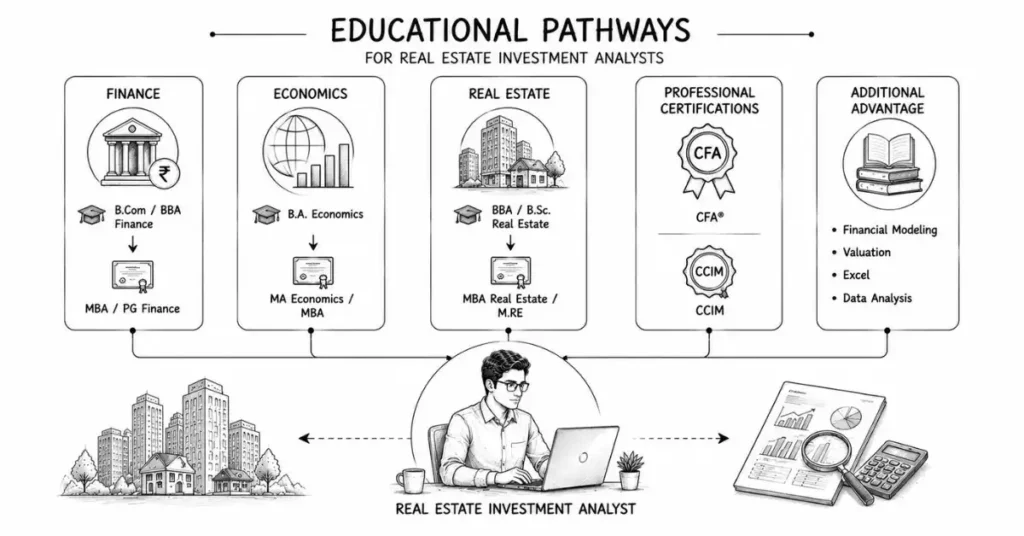
While real estate investment analysis doesn’t mandate specific degrees, certain educational backgrounds provide strong foundations.
Finance and accounting degrees including bachelor’s or master’s in finance, accounting, or commerce provide financial statement analysis skills, valuation methodologies, corporate finance principles, and quantitative foundations directly applicable to investment analysis.
Economics degrees offer understanding of market dynamics, supply and demand analysis, statistical and econometric methods, and macroeconomic factors affecting real estate markets.
Real estate-specific programs through specialized real estate finance degrees or MBAs with real estate concentrations provide targeted industry knowledge combining finance principles with property-specific considerations.
Engineering degrees particularly civil or industrial engineering can transition into real estate investment analysis, leveraging quantitative abilities and potentially transitioning from construction or development perspectives into investment roles.
However, successful investment analyst careers are built more on demonstrated financial modeling skills, analytical abilities, real estate knowledge, and work ethic than specific undergraduate majors. Many successful analysts come from diverse backgrounds, succeeding through graduate education, professional certifications, and continuous learning.
The CFA Charter: Valuable Credential
The Chartered Financial Analyst (CFA) designation, while not real estate-specific, is highly valued in investment analyst roles demonstrating rigorous financial analysis competency and professional commitment.
CFA curriculum coverage includes ethical and professional standards, quantitative methods and statistics, economics covering micro and macro principles, financial reporting and analysis essential for property financial statement evaluation, corporate finance principles applicable to real estate companies and REITs, equity investments including REIT analysis and valuation, fixed income relevant for understanding debt financing, derivatives used in real estate hedging strategies, alternative investments including real estate investment vehicles, and portfolio management and wealth planning.
The real estate investment property module specifically covers cost and fair value models for investment property financial reporting under IFRS standards, directly applicable to analyst work.
CFA requirements include bachelor’s degree or equivalent (final-year undergraduate students also eligible), passing three progressively difficult exams (Level I, II, and III), typically requiring 900+ hours of total study, and four years of qualified professional work experience in investment decision-making to receive the charter after passing all exams.
CFA career impact significantly enhances credibility with institutional investors and sophisticated firms, demonstrates commitment to finance professionalism, provides comprehensive financial knowledge applicable across asset classes, creates global professional network opportunities, and increases earning potential through enhanced skills and credentials. While CFA study is demanding (each level typically requires 300+ hours), the investment pays long-term dividends throughout investment careers.
Other Relevant Certifications
CCIM (Certified Commercial Investment Member) focuses specifically on commercial real estate investment analysis, financial analysis, and market analysis, providing targeted real estate investment knowledge complementing general finance credentials.
MBA with real estate focus provides broader business education with specialized real estate coursework, valuable for those aspiring to senior leadership or entrepreneurial real estate investment roles.
Real Estate Investment Analyst Salary and Career Progression

Compensation by Experience Level
Entry-Level Analysts (0-3 years): Junior analysts supporting senior team members earn ₹5-8 lakh per annum. This includes fresh graduates or those with 1-2 years in related fields transitioning into real estate investment analysis. PayScale reports lower figures around ₹4.5 lakh for general real estate analysts, likely reflecting more junior or non-investment focused positions.
Mid-Level Analysts (3-7 years): Analysts managing their own deal analysis and leading due diligence earn ₹10-18 lakh annually. According to Indeed, the average is ₹8.53 lakh, though salary ranges vary widely from ₹8.15 lakh to ₹23.72 lakh depending on employer type and specialization.
Senior Analysts/Associates (7-12 years): Senior professionals leading investment recommendations and mentoring junior analysts earn ₹20-30 lakh per annum. These roles involve greater autonomy, larger transaction responsibility, and strategic involvement beyond pure analysis.
Vice President/Director (12+ years): Senior leadership overseeing investment teams and strategy can earn ₹30-60 lakh or more, though these roles transition from pure analysis toward portfolio management, team leadership, and strategic decision-making.
Employer Type Impact
Compensation varies significantly by employer:
Institutional investors (pension funds, insurance companies, sovereign wealth funds) offer stable salaries with good benefits but typically lower cash compensation than private equity.
Private equity real estate funds provide competitive base salaries plus performance bonuses tied to fund returns, potentially creating substantial upside for successful investments.
REITs offer moderate base compensation with potential for equity participation as companies are publicly traded, balancing stability with upside potential.
Real estate consulting firms provide exposure to diverse clients and learning opportunities, though typically lower compensation than investment-side roles.
Family offices vary widely but can offer excellent compensation with more direct access to principals and strategic decision-making.
Location and Company Size
Metropolitan markets like Mumbai, Bangalore, Delhi-NCR, and Pune offer higher absolute salaries but also higher living costs. Large institutional firms and established private equity funds typically provide better compensation than smaller shops, though smaller firms sometimes offer equity participation or faster advancement offsetting lower base salaries.
Building Your Investment Analyst Career
Entry Pathways
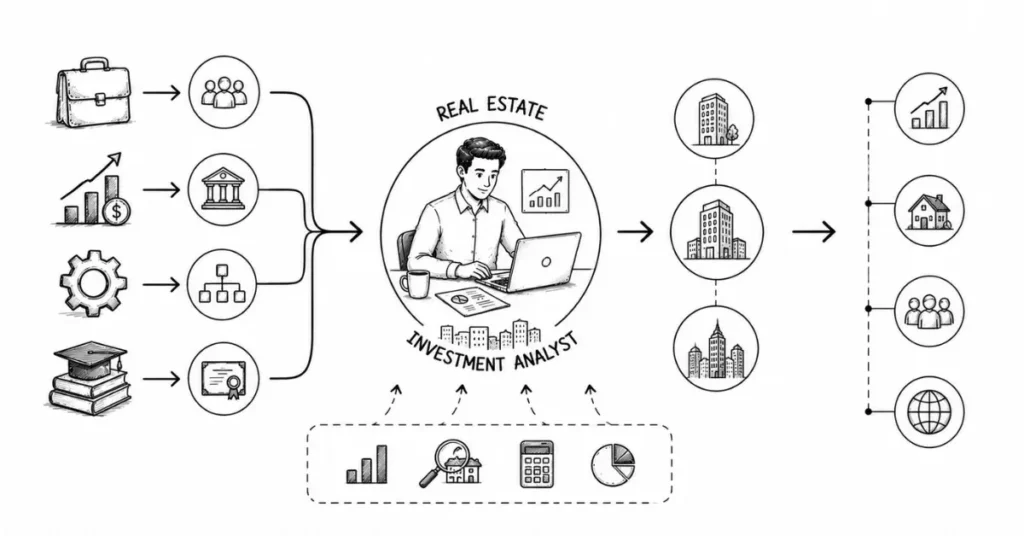
Target analyst programs: Many large institutional investors and private equity firms recruit directly from top business schools through formal analyst programs providing structured training, mentorship, and clear advancement paths.
Related finance roles transition: Starting in investment banking, equity research, or corporate finance builds financial modeling and analytical skills transferable to real estate investment analysis. After 2-3 years gaining core finance competency, transition laterally into real estate-focused roles.
Real estate operations background: Some analysts start in property management, leasing, or development operations gaining practical real estate knowledge, then transition into investment analysis roles combining operational understanding with developed financial skills.
Graduate programs: MBA or master’s in real estate/finance programs provide credential credibility plus recruiting access to institutional investors and funds actively hiring from business schools.
Skill Development Strategy
Master Excel financial modeling through online courses, practice models, and continuous refinement. Build template libraries for different property types demonstrating your capabilities to prospective employers.
Pursue CFA starting with Level I during undergraduate or early career, demonstrating commitment to finance professionalism and building comprehensive analytical foundations.
Study real estate markets systematically tracking transactions, trends, and market reports developing deep knowledge of specific property types or geographies creating specialization value.
Build practical experience through internships at real estate firms, case competitions focusing on real estate investment analysis, or personal investment analysis projects even on hypothetical deals practicing skills.
Career Advancement Strategies

Develop deal sourcing capabilities moving beyond pure analysis toward identifying attractive opportunities through market knowledge and industry relationships.
Build specialized expertise in specific property types (industrial, hospitality, data centers), investment strategies (value-add, opportunistic, core), or geographic markets creating differentiated knowledge.
Cultivate strategic thinking understanding not just financial analysis but business strategy, competitive positioning, and value creation beyond financial engineering.
Consider entrepreneurship after gaining expertise, as some analysts launch their own investment firms or advisory practices leveraging developed skills and industry networks.
Frequently Asked Questions
Is CFA necessary for real estate investment analysis? Not mandatory, but highly valuable. CFA demonstrates financial competency, provides comprehensive training, enhances credibility, and improves both hiring prospects and long-term earning potential. Many successful analysts don’t hold CFA, but it provides significant advantages.
Can I transition from property management to investment analysis? Yes, though challenging. You’ll need to develop financial modeling skills, potentially pursue CFA or relevant graduate education, demonstrate analytical abilities through projects or coursework, and likely accept lateral or backward career movement initially while transitioning.
What’s the work-life balance like? Moderate to demanding. Expect 50-60 hour weeks during active deals or before investment committee meetings, with more reasonable 40-45 hours during slower periods. Generally better than investment banking but more demanding than many corporate finance roles.
Is real estate investment analysis recession-proof? No career is recession-proof, but investment analysis skills remain valuable across cycles. Downturns reduce deal flow but create opportunistic investment opportunities requiring analytical support. Strong analysts weather downturns better than sales-focused roles.
How important is networking? Moderately important. Unlike sales roles where networking drives success, analyst roles prioritize analytical skills and work quality. However, industry connections help identify opportunities, source deals, and advance careers, particularly at senior levels.
Should I specialize in one property type? Eventually yes. Starting as a generalist builds broad foundations, but 3-5 years in, consider specializing in office, industrial, retail, multifamily, or specialized property types developing deep expertise commanding premium compensation.
Conclusion

Real estate investment analyst careers offer intellectual challenge, strong compensation, strategic importance, and satisfaction from guiding major capital deployment decisions through rigorous financial analysis. The profession rewards quantitative abilities, financial modeling skills, real estate knowledge, critical thinking, and effective communication.
Your journey begins with relevant education providing financial and analytical foundations, continues through entry-level analyst roles building modeling skills and market knowledge, and advances through demonstrated analytical excellence, continuous learning through CFA or other credentials, and strategic specialization creating differentiated expertise.
The analysts who build lasting success combine technical financial mastery with practical real estate understanding, rigorous analytical thinking with clear communication, and objective critical evaluation with collaborative teamwork supporting investment success.
Take your first step today—strengthen your Excel modeling skills, investigate CFA registration, apply for analyst positions at investment firms, or pursue graduate education in finance or real estate positioning yourself for this analytically rigorous, financially rewarding career in India’s sophisticated real estate investment ecosystem.