
Real Estate Career Salaries India : Salary Comparison
Table of Contents
Introduction

Choosing a real estate career path involves not just aligning with your skills and interests, but also understanding the financial rewards and earning trajectories each specialization offers. Real estate presents one of the widest salary ranges of any profession in India—from entry-level agents earning ₹2-3 lakh annually to top performers and senior managers exceeding ₹40-50 lakh per year. This dramatic variance reflects the diversity of roles, the impact of experience and performance, and the fundamental differences between commission-based and salary-based positions.
Understanding these compensation structures enables informed career decisions aligned with your financial needs, risk tolerance, and long-term goals. Commission-based sales roles offer unlimited upside but income volatility, particularly initially. Salary-based management, facility, and analytical positions provide stability and predictable progression but typically lower peak earning potential. Hybrid roles combining base salaries with performance incentives balance security with upside opportunity.
As of 2026, Indian real estate professionals earn an average of ₹22.9 lakh annually, with the majority earning between ₹16 lakh and ₹50 lakh depending on role, experience, and performance. Real estate managers average ₹19.9 lakh, mostly ranging from ₹16 lakh to ₹38.6 lakh. Facilities managers earn an average of ₹17.8 lakh, with 70% earning between ₹13 lakh and ₹49.4 lakh. Real estate sales professionals average ₹13.4 lakh, with significant variation from ₹5.7 lakh to ₹41.8 lakh based on performance.
This comprehensive salary comparison guide examines compensation across all major real estate career paths including sales agents and brokers, property managers, facility managers, appraisers and valuers, investment analysts, marketing specialists, and project managers. For each role, we explore entry-level through senior compensation, factors affecting earnings, income stability versus upside potential, geographic variations, and realistic career earnings trajectories helping you make informed decisions about which real estate specialization aligns with your financial objectives and personal circumstances.
Real Estate Sales Agent and Broker Compensation
Earnings Overview
Real estate sales agents experience the widest salary variance of any real estate profession, reflecting the pure performance-based nature of commission compensation.
Average and median earnings: Real estate agents earn an average base salary of ₹4.25 lakh annually according to PayScale data, though this represents only base salary without commissions, bonuses, and profit sharing that constitute the majority of agent income. When including all compensation sources, real estate sales professionals average ₹13.4 lakh annually, with the majority earning between ₹5.7 lakh and ₹41.8 lakh.
Real estate agents and property managers collectively earn between ₹28,199 and ₹1,84,812 per month (₹3.4 lakh to ₹22.2 lakh annually) depending on experience and performance. At career start, monthly earnings typically range from ₹28,199 to ₹89,554 (₹3.4-10.7 lakh annually). After 5 years of service, this increases to ₹43,260 to ₹1,52,613 monthly (₹5.2-18.3 lakh annually) for a 48-hour working week.
Experience-based progression:
- Entry-level (less than 1 year): ₹2.58 lakh average total compensation
- Early career (1-4 years): ₹3.8 lakh average
- Mid-career (5-9 years): ₹4.5-5 lakh base, significantly higher with commissions
- Experienced (10-19 years): ₹6-10 lakh base plus substantial commission income
- Top performers: ₹15-43 lakh total compensation
Monthly income ranges: Real estate agents typically earn between ₹23,750 to ₹60,000 monthly (₹2.85-7.2 lakh annually) depending on their position and frequency of closed deals. Lower-end agents just starting with fewer deals earn ₹23,750-30,000 monthly. Mid-range agents with consistent client flow earn ₹35,000-45,000 monthly. High-end agents closing large, high-value deals earn ₹50,000-60,000+ monthly.
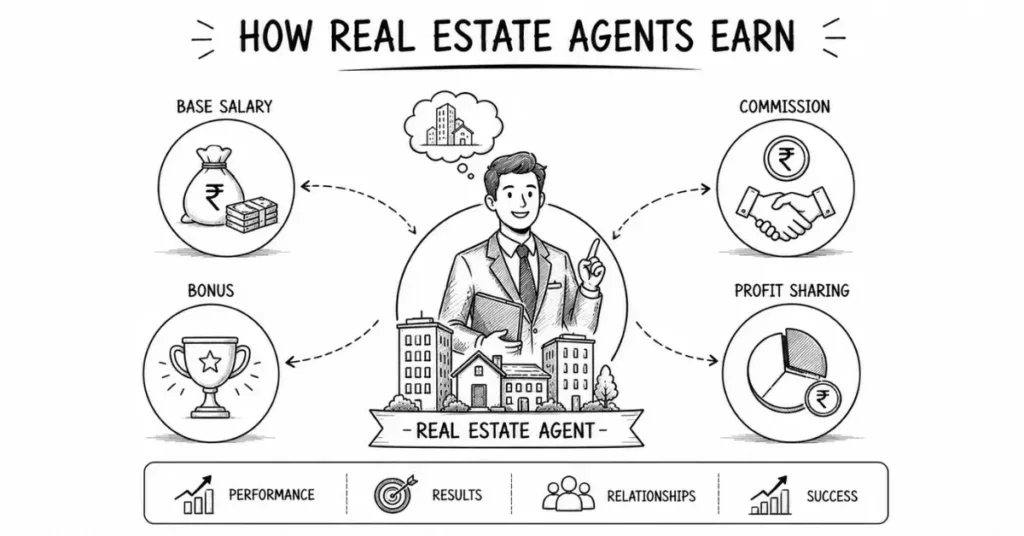
Compensation Components
Real estate agent income comprises multiple elements:
Base salary: ₹1.41 lakh to ₹10 lakh annually for employed agents, though many work purely on commission
Commission: ₹98,000 to ₹9.83 lakh annually, representing the primary income source for most agents. Commission percentages typically range 1-2% of property values, split with brokerages at ratios from 50-50 for new agents to 70-30 or higher for experienced producers.
Bonus: ₹10,000 to ₹1.96 lakh annually for meeting volume targets or closing high-value deals
Profit sharing: ₹33,000 to ₹20 lakh annually for agents with equity stakes or profit participation arrangements
Annual earnings including bonuses: ₹8.88 lakh average, with bonuses ranging up to ₹1.33 lakh. By 2031, salary potential for real estate agents is estimated to rise by 30%.
Residential vs. Commercial Specialization
Residential real estate income: Residential agents benefit from steady income through first-time home buyers, rental sourcing deals adding additional transactions, and more stable demand as people constantly relocate for work or living. However, individual transaction values are lower, limiting per-deal commission amounts.
Commercial real estate income: Commercial properties have much higher values generating larger earned commissions. Office buildings, retail spaces, and logistics hubs come with higher price tags. Even a single commercial deal can provide multiple lakhs in commission. However, sales cycles are longer and deal flow may be less consistent. The rewards are higher but require patience and sophisticated client relationships.
Income Stability and Risk
Real estate sales offers high upside potential with no artificial income ceiling, performance-based rewards directly tied to effort and skill, and opportunities for exceptional earners to reach ₹40-50 lakh+ annually.
However, it presents high income volatility particularly in early career years, with significant variance month-to-month and year-to-year, dependency on market conditions and economic cycles, and zero income during months without closed transactions. This structure suits individuals with financial cushions, tolerance for uncertainty, confidence in sales abilities, and entrepreneurial mindset.
Property Management Compensation
Earnings Overview
Property managers enjoy salary-based compensation offering greater stability than commission-only sales roles.
Average and range: Real estate managers earn an average of ₹19.9 lakh annually, with 70% earning between ₹16 lakh and ₹38.6 lakh. The top 10% earn more than ₹27.5 lakh per year, and the highest reported salary reaches ₹40 lakh.
Property managers starting their careers earn between ₹28,199 and ₹89,554 monthly (₹3.4-10.7 lakh annually). After 5 years, this increases to ₹43,260 to ₹1,52,613 monthly (₹5.2-18.3 lakh annually).
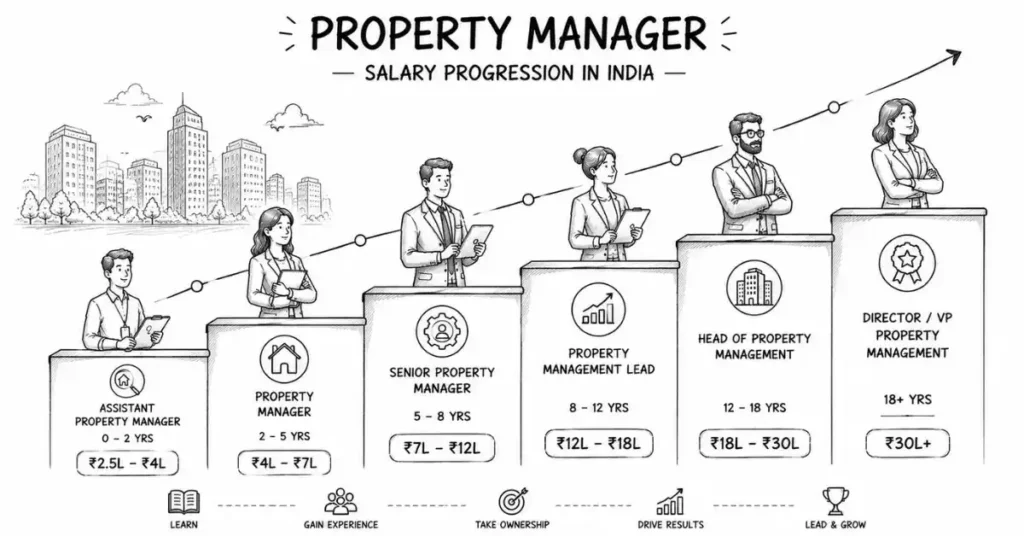
Experience-based progression:
- Entry-level (0-2 years): ₹3-4 lakh annually
- Early career (2-5 years): ₹4-6 lakh annually
- Mid-career (5-10 years): ₹6-10 lakh annually
- Experienced (10-15 years): ₹10-15 lakh annually
- Senior level (15-20 years): ₹15-20 lakh annually
- Executive positions: ₹20-40 lakh annually
Highest Paying Property Management Roles
The top 5 highest-paying property management positions:
- General Manager: ₹26 lakh per year
- Assistant General Manager: ₹23 lakh per year
- Manager Real Estate: ₹23 lakh per year
- Real Estate Manager: ₹22 lakh per year
- Deputy General Manager: ₹20 lakh per year
Gender Comparison
Male property managers average ₹20 lakh annually compared to female property managers averaging ₹18 lakh. This 10% gap likely reflects differences in experience levels, position types, or portfolio sizes rather than pure discrimination, though gender equity remains an industry concern.
Income Stability and Benefits
Property management offers predictable monthly salaries eliminating income volatility, standard benefits including health insurance and paid leave, clear career progression with defined advancement pathways, and lower stress regarding personal financial sustainability.
However, it presents lower peak earning potential than top-performing sales agents, limited ability to dramatically increase income through exceptional performance, slower income growth tied to promotions rather than immediate performance, and salary ceilings in ₹30-40 lakh range for most positions.
Facility Management Compensation
Earnings Overview
Facility managers command strong compensation reflecting their technical expertise and operational complexity.
Average and range: Facilities managers earn an average of ₹17.8 lakh annually, with 70% earning between ₹13 lakh and ₹49.4 lakh. This wide range reflects variations in portfolio size, organizational type, industry sector, and credential status (CFM-certified professionals earn significantly more).
Combined facilities and real estate managers average ₹22.5 lakh based on limited data, ranging from ₹21.1 lakh to ₹26.9 lakh for professionals with 10-15 years of experience.
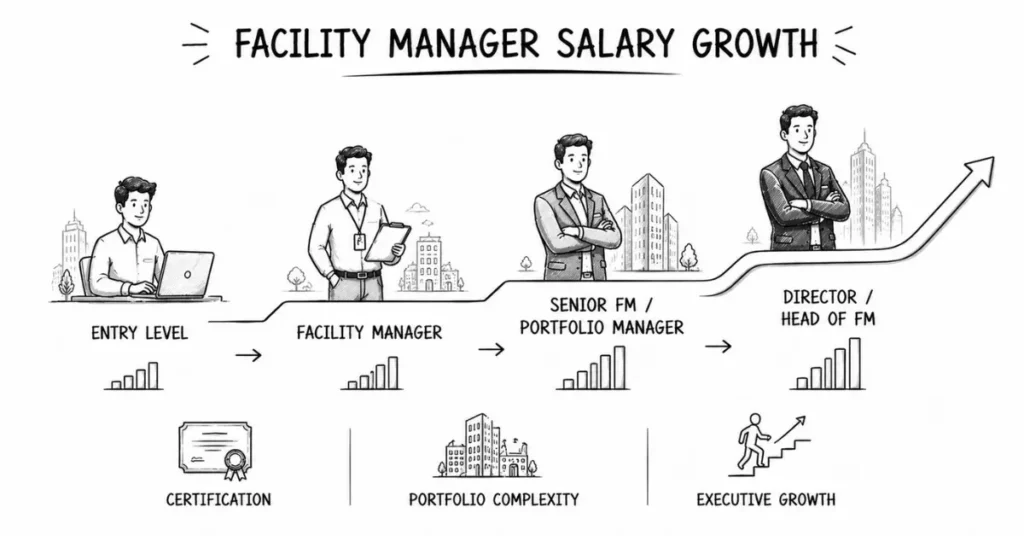
Experience-based progression:
- Entry-level (0-1 year): ₹3.6 lakh
- Early career (1-4 years): ₹3.9 lakh
- Mid-career (5-9 years): ₹5.7 lakh
- Experienced (10-15 years): ₹13-22 lakh
- Senior level (15-20 years): ₹20-30 lakh
- Executive positions: ₹30-49 lakh
Factors Affecting Facility Manager Compensation
Portfolio complexity: Managing sophisticated facilities like data centers, hospitals, or manufacturing plants commands premium compensation compared to standard office buildings.
Industry sector: Technology companies, healthcare institutions, and manufacturing firms typically offer higher facility management compensation than retail or basic office environments.
Certifications: CFM (Certified Facility Manager) holders earn approximately 25% more than non-certified peers, representing ₹4-6 lakh additional annual compensation for mid-career professionals.
Geographic location: Metropolitan markets like Mumbai, Bangalore, Delhi-NCR, and Pune offer ₹2-5 lakh higher salaries than tier-2 cities, though cost-of-living differences partially offset this advantage.
Gender Comparison
Male facilities managers average ₹18 lakh compared to female facilities managers averaging ₹17 lakh. This smaller 6% gap compared to property management suggests greater gender equity in technical facility roles
Stability and Growth
Facility management balances solid base compensation providing financial stability, strong demand driven by corporate expansion and infrastructure growth, technical specialization creating competitive advantages and job security, and clear advancement paths through certification and experience.
The field offers moderate peak earnings of ₹30-49 lakh, higher than property management but lower than top sales performers, steady progression rewarding continuous skill development and certification, and growing importance as organizations recognize facility management’s strategic value.
Comparative Analysis: Sales vs. Management Roles

Income Trajectory Comparison
Year 1-2:
- Sales agents: ₹2-4 lakh (highly variable)
- Property managers: ₹3-4 lakh (stable)
- Facility managers: ₹3.6-3.9 lakh (stable)
Year 3-5:
- Sales agents: ₹5-10 lakh (performance-dependent)
- Property managers: ₹4-6 lakh (steady progression)
- Facility managers: ₹4-6 lakh (steady progression)
Year 5-10:
- Sales agents: ₹10-25 lakh (wide variance)
- Property managers: ₹6-10 lakh (predictable growth)
- Facility managers: ₹8-15 lakh (moderate growth)
Year 10-15:
- Sales agents: ₹15-43 lakh (top performers)
- Property managers: ₹10-20 lakh (senior positions)
- Facility managers: ₹13-25 lakh (experienced professionals)
Year 15+:
- Sales agents: ₹20-50+ lakh (elite performers, brokerage owners)
- Property managers: ₹15-40 lakh (directors, VPs)
- Facility managers: ₹20-49 lakh (senior managers, directors)
Risk-Reward Profiles
Sales Agents:
- Highest upside potential: Top 1% earn ₹41.8 lakh+
- Highest income volatility: Month-to-month variance
- Performance dependency: 100% tied to closed deals
- Financial risk: Requires savings cushion for lean periods
- Best for: Risk-tolerant, confident sellers, entrepreneurial personalities
Property Managers:
- Moderate total compensation: Top 1% earn ₹38.6 lakh
- High income stability: Predictable monthly salaries
- Limited performance upside: Bonuses typically 10-20% of base
- Low financial risk: Stable employment reduces uncertainty
- Best for: Risk-averse, operations-focused, work-life balance priorities
Facility Managers:
- Moderate-high compensation: Top tier reaches ₹49.4 lakh
- High income stability: Regular salaries with annual increases
- Certification premium: CFM adds 25% to earnings
- Low-moderate financial risk: Corporate employment provides stability
- Best for: Technically-inclined, operations experts, certification-focused professionals
Other Real Estate Career Salaries
Real Estate Investment Analysts
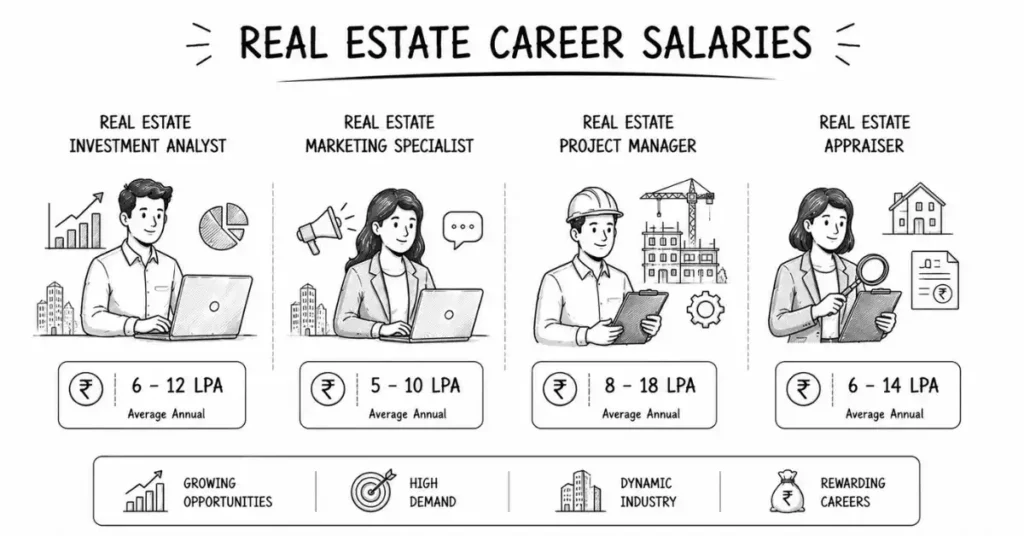
Average compensation: ₹8.53 lakh annually with ranges from ₹8.15 lakh to ₹23.72 lakh depending on experience and employer type.
Progression:
- Entry-level (0-3 years): ₹5-8 lakh
- Mid-level (3-7 years): ₹10-18 lakh
- Senior (7-12 years): ₹20-30 lakh
- VP/Director (12+ years): ₹30-60 lakh
Investment analysis offers strong compensation growth with clear advancement, stable employment at institutional firms or funds, intellectual challenge appealing to analytical personalities, and lower peak earnings than sales but higher stability.
Real Estate Marketing Specialists
Average compensation: ₹20.5 lakh annually, ranging from ₹15 lakh to ₹50 lakh based on experience and specialized skills.
Progression:
- Entry-level (0-2 years): ₹2.5-4 lakh
- Mid-level (3-5 years): ₹6-10 lakh
- Senior (6-10 years): ₹12-26 lakh
- Expert (10+ years): ₹30-50 lakh
Marketing specialists with specialized skills (performance marketing, SEO, AI platforms) earn premiums of ₹8-20 lakh over generalists. The field offers creative fulfillment, digital skill development, growing demand, and moderate-high earning potential.
Real Estate Project Managers
Average compensation: ₹9.5 lakh monthly (approximately ₹79,000) with ranges from ₹8-15 lakh annually for construction and real estate project managers.
Progression:
- Entry-level (0-2 years): ₹3.2 lakh
- Early career (2-5 years): ₹4.5 lakh
- Mid-career (5-10 years): ₹5.95-9.5 lakh
- Experienced (10-15 years): ₹7.3-12 lakh
- Senior (15-20 years): ₹7.8-16 lakh+
Project management offers tangible impact seeing developments complete, moderate-strong compensation rewarding experience and PMP certification, high responsibility managing complex projects and large budgets, and clear advancement through increasing project complexity and leadership roles.
Real Estate Appraisers/Valuers
Average compensation: ₹4.5 lakh for general real estate analysts, with registered valuers earning ₹5-8 lakh mid-career and ₹15-30 lakh+ at senior levels.
Progression:
- Entry-level (0-3 years): ₹3-5 lakh
- Mid-career (3-7 years): ₹5-10 lakh
- Senior (7-15 years): ₹10-20 lakh
- Expert (15+ years): ₹20-40 lakh (commercial specialists)
Appraisal offers analytical work suited for detail-oriented professionals, independent practice options after building experience, specialized expertise creating competitive advantages, and moderate-strong earnings particularly in commercial property specialization.
Geographic Salary Variations
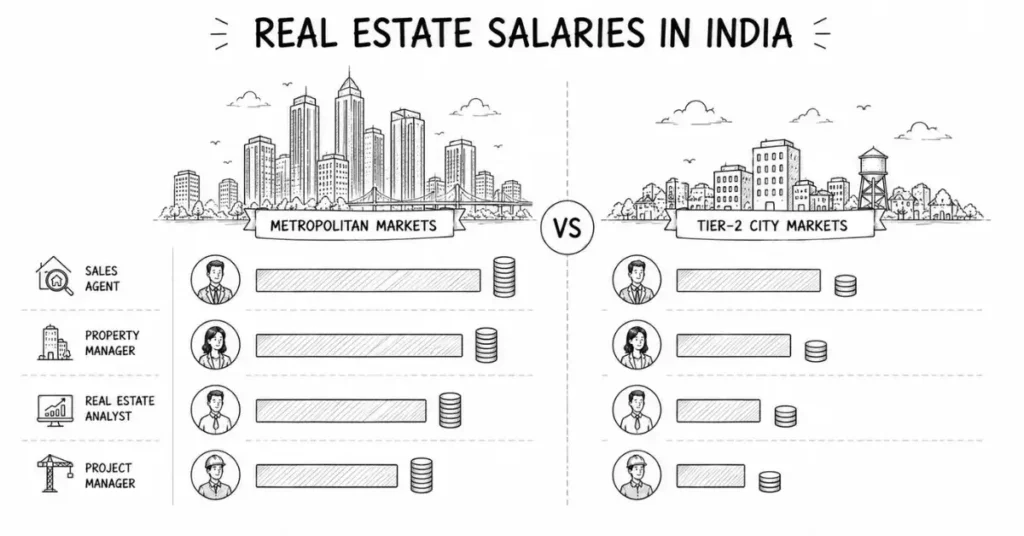
Metropolitan Markets
Mumbai, Bangalore, Delhi-NCR, Pune, Hyderabad offer 20-40% higher absolute salaries than national averages but also 25-50% higher living costs. Net purchasing power after expenses may be similar to tier-2 cities despite higher gross salaries.
Advantages: Larger transaction volumes, higher property values, more sophisticated clients, better professional infrastructure, greater advancement opportunities, and stronger RERA enforcement.
Disadvantages: Higher competition, greater living expenses, longer commutes, more stressful environments, and higher business operating costs.
Tier-2 City Markets
Ahmedabad, Jaipur, Lucknow, Coimbatore, Indore, Nagpur offer 15-30% lower absolute salaries but also 30-50% lower living costs, potentially providing better quality of life despite lower nominal earnings.
Advantages: Lower competition, better cost-of-living ratios, potentially faster advancement in smaller markets, stronger community connections, and growing real estate markets creating opportunities.
Disadvantages: Smaller transaction volumes, lower property values affecting commission potential, fewer sophisticated investment opportunities, less developed professional infrastructure, and potentially weaker regulatory enforcement.
Factors Affecting Earnings Across All Roles
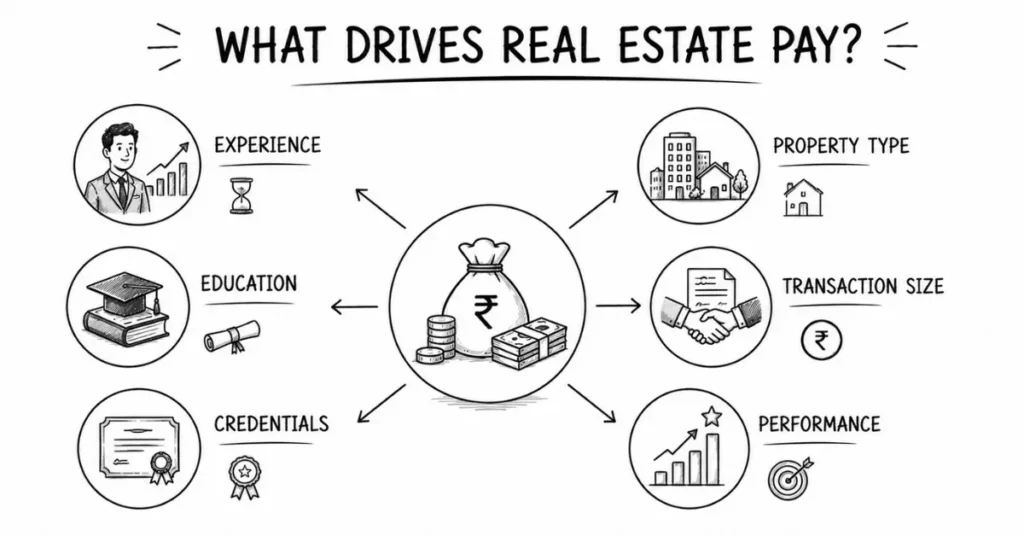
Experience and Track Record
Experience consistently drives compensation across all real estate specializations. Property managers see 2-3x salary growth from entry to 10 years. Sales agents see 5-10x income growth with experience and established client bases. Facility managers double or triple earnings over 10-15 years. Investment analysts see 3-5x compensation growth advancing from analyst to VP levels.
Education and Credentials
Bachelor’s degrees increase property management earnings by 69% versus high school education and earn 23% less than master’s degree holders. Professional certifications including CPM, CFM, PMP, CCIM, and CFA create 20-30% salary premiums over non-certified peers. Specialized training in PropTech, AI marketing, financial modeling, or technical building systems commands additional premiums.
Property Type and Transaction Size
Commercial properties generate 2-5x higher commissions per transaction than residential despite longer sales cycles. Luxury residential offers premium commissions compared to moderate-priced housing. Complex facilities (data centers, hospitals, manufacturing) command higher facility management compensation than standard offices. Large portfolios enable property managers to earn more than single-property positions.
Performance and Results
Sales agents demonstrate the clearest performance-compensation link, with top performers earning 10-15x entry-level agents. Project managers completing large, complex developments on time and under budget advance faster and earn more. Marketing specialists demonstrating ROI through lead generation and conversion command premium compensation. Investment analysts identifying successful deals receive bonuses and faster advancement.
Making Your Career Choice

If You Prioritize Maximum Earning Potential
Choose real estate sales/brokerage with specialization in commercial properties, luxury residential, or high-value transactions. Accept income volatility and uncertainty in exchange for unlimited upside. Top performers consistently earn ₹30-50 lakh+ annually.
If You Prioritize Income Stability
Choose property management or facility management offering predictable salaries, steady progression, and lower income risk. Accept lower peak earnings (₹30-40 lakh range) in exchange for financial predictability and employment stability.
If You Prioritize Analytical Work
Choose investment analysis or appraisal leveraging quantitative abilities and systematic thinking. Enjoy moderate-strong compensation (₹20-40 lakh at senior levels) with intellectual challenge and professional respect.
If You Prioritize Creative Expression
Choose marketing specialist roles combining creativity with digital skills. Enjoy moderate-high compensation (₹20-50 lakh range) with creative fulfillment and growing demand.
If You Prioritize Tangible Impact
Choose project management seeing developments transform from concepts to completed buildings. Enjoy moderate-strong compensation (₹15-30 lakh range) with visible contributions and professional satisfaction.
Conclusion

Real estate career salaries in India span an enormous range from ₹2-3 lakh for entry-level positions to ₹40-50 lakh+ for top performers and senior executives. Understanding these compensation structures, risk-reward profiles, and progression trajectories enables informed career decisions aligned with your financial objectives, risk tolerance, and personal priorities.
Sales roles offer highest upside but greatest uncertainty. Management roles provide stability but lower peaks. Analytical positions balance moderate-strong compensation with intellectual challenge. Specialized roles command premiums rewarding expertise and credentials.
Your optimal path depends on your unique combination of skills, personality, financial situation, and career goals. Many successful real estate professionals transition between roles throughout their careers—starting in sales to build market knowledge, moving into management for stability during family-building years, or pivoting to specialized roles leveraging developed expertise.
The consistent truth across all real estate specializations: continuous learning, professional certification, performance excellence, and long-term commitment dramatically increase earning potential regardless of which path you choose.