
Module 6: Practical Applications & Scenarios

Table of Contents

Real-World Case Studies and Communication Solutions
Introduction
Understanding communication theory is one thing. Applying it to real, messy workplace situations is another. This subtopic brings everything you’ve learned into actual scenarios you’ll likely encounter. You’ll see how the principles from previous modules work (or fail) in real situations, and learn practical solutions that actually work.
Case Study 1: The Misaligned Project Expectation
The Scenario
Sarah is a project manager who inherited a project from a colleague. The client expects certain deliverables by the deadline. Sarah’s team is working on something different because they interpreted the brief differently. The client is about to realize the misalignment, and the deadline is two weeks away.
What Went Wrong
- Insufficient clarity during project kickoff
- Assumptions instead of documented requirements
- No verification that team understood the same thing as the client
Poor Communication Approach
Sarah waits until the client asks for a status update. When they realize the misalignment, the client is furious. Sarah tries to explain that she inherited the confusion, which sounds like making excuses. The client loses trust. The project timeline slips by a month while the team rebuilds the work.
Better Communication Approach
Sarah discovers the misalignment during her first week. She immediately:
- Acknowledges the issue: “I’ve identified a discrepancy between what we’re building and what you’re expecting. That’s on us for not verifying the brief clearly. I want to fix this.”
- Shows she owns it: No excuses about inheriting the project. She takes responsibility.
- Proposes solutions: “Here’s what I recommend: We have three options. Option 1: Redirect to what you’re expecting (timeline impact: 4 days, cost impact: $X). Option 2: Deliver current version and adjust in phase 2 (timeline: on track, cost: moderate). Option 3: Extend timeline and deliver perfect alignment (timeline: +2 weeks, cost: minimal). Here’s my recommendation and why.”
- Gives them choice: She’s not telling them what to do. She’s presenting options with clear implications.
Outcome
Client appreciates the transparency and proactive approach. They choose Option 1 (slight delay is better than wrong deliverables). The project is salvaged, and client trust in Sarah increases.
Communication Lessons
- Verify assumptions early
- Address issues immediately rather than hoping they resolve
- Own mistakes rather than making excuses
- Provide solutions, not just problems
- Give clients choices with clear tradeoffs
Case Study 2: The Cross-Cultural Communication Conflict
The Scenario
An Indian project coordinator and a German team lead are working together. The German lead gives direct feedback about work quality: “This analysis isn’t rigorous enough. We need to redo it.” The Indian coordinator interprets this as harsh criticism of their competence and becomes defensive and withdrawn.
What Went Wrong
- Different communication styles misinterpreted
- No discussion of cultural communication preferences
- Feedback without softening for cultural context
Poor Communication Approach
The Indian coordinator stops contributing ideas in meetings. When asked directly, they say “Everything is fine.” The German lead thinks they’re not engaged or capable. Quality suffers. Tension builds.
Better Communication Approach
From the German lead’s perspective:
After noticing the coordinator seems withdrawn, the German lead takes initiative:
“I want to make sure we’re working well together. I’ve noticed you seem less engaged, and I’m wondering if something I said bothered you. I want to understand.”
This opens dialogue without accusation.
From the Indian coordinator’s perspective:
When receiving feedback, they could say: “I appreciate the feedback. Can you help me understand specifically what wasn’t rigorous? I want to make sure I understand your expectations so I can improve.”
This asks for clarity while showing commitment to growth.
The Conversation:
German lead: “I want to give you feedback about the analysis. The methodology needs more rigor.”
Indian coordinator: “I hear that. Can you show me what you mean? I want to understand your standards so I can meet them.”
German lead (realizing impact): “I didn’t mean it as a personal criticism. In my culture, we give direct feedback as a sign of respect—we think you’re capable of handling it. But I realize that might not translate well. Let me be more specific about what needs improvement and how I can help.”
Indian coordinator: “Thank you for clarifying. In my background, direct criticism in front of others feels harsh. I respond better to private feedback. Can we discuss this one-on-one?”
Outcome
Both people understand the cultural difference. They adjust their communication. Feedback becomes more effective because it’s culturally appropriate. Relationship strengthens.
Communication Lessons
- Don’t assume your communication style is universal
- When someone withdraws, address it directly with curiosity, not judgment
- Explain the reasoning behind your communication style
- Ask for preferences rather than assuming
- Adapt your style without abandoning your authenticity
Case Study 3: The Team Member Who Keeps Missing Deadlines
The Scenario
Dev keeps missing project deadlines. His manager, Priya, is frustrated. She’s started assigning him less important work because she doesn’t trust he’ll deliver. Dev is demoralized and his performance is actually declining. Nothing has been explicitly discussed.
What Went Wrong
- Assumptions instead of direct conversation
- No inquiry into the real reason for missed deadlines
- Consequences applied without communication
Poor Communication Approach
Priya continues assigning less critical work without discussing why. Dev assumes he’s in trouble but doesn’t know what to do about it. He stops trying as hard. The situation deteriorates.
Better Communication Approach
Priya schedules a one-on-one: “Dev, I’ve noticed you’ve missed the last three deadlines. Before I assume anything, I want to understand what’s going on. Walk me through what’s happening.”
Possible reasons Dev reveals:
- He didn’t understand the requirements clearly
- He’s overwhelmed with too much work
- He’s struggling with a technical aspect and felt embarrassed to ask
- He has personal challenges affecting his focus
- The deadlines aren’t realistic given his workload
The Conversation:
Dev: “Honestly, I’m not sure what you want from me. The requirements were unclear, so I wasn’t sure if I was building the right thing. I didn’t want to bother you with questions.”
Priya: “That’s helpful to know. I should have been clearer about requirements, and you should always feel comfortable asking questions. Here’s what I’ll do differently: more detailed briefs and check-ins at midpoint. Here’s what I need from you: let me know immediately if requirements are unclear or if you’re stuck.”
Outcome
Dev’s deadline performance improves. He feels trusted again. Priya learns that lack of clarity, not lack of effort, was the problem. Relationship is repaired.
Communication Lessons
- Ask before assuming
- Address issues directly and privately
- Look for root causes, not just surface problems
- Take responsibility for your part (unclear requirements, inadequate support)
- Focus on solutions, not blame
- Regular check-ins prevent surprises
Case Study 4: The Difficult Feedback Conversation
The Scenario
Maria needs to give feedback to a team member about their presentation skills. The team member is talented but gets very nervous presenting and rushes through their words. Their latest presentation had key information that got lost because of delivery issues.
What Went Wrong
This one hasn’t gone wrong yet—it’s about preventing it from going wrong.
Poor Communication Approach
Maria avoids giving the feedback because she doesn’t want to hurt the team member’s feelings. She hopes they’ll improve on their own. They don’t, and the client is getting concerned about communication competency.
Better Communication Approach
Maria schedules a one-on-one: “I want to give you some feedback about your presentation. Can we talk about it?”
Maria: “Your content was excellent. Here’s what I noticed about delivery: you were speaking quickly, which made key points hard to follow. I don’t think it’s a lack of knowledge—I think it’s presentation technique. With a small adjustment, you’d be really effective.”
Team member: “I do get nervous presenting. I know I rush.”
Maria: “That makes sense. Nervousness makes people speed up. Here’s what I’d suggest: we could get you some presentation coaching, or we could practice with smaller groups first to build confidence. What would help you most?”
Team member: “I think coaching would help.”
Maria: “Great. I’ll set that up. And I want you to know: I’m giving you this feedback because I think you have real talent. I wouldn’t bother if I didn’t believe you could improve.”
Outcome
The team member receives the feedback without feeling attacked. They’re motivated to improve. Maria sets them up for success. Their next presentation is significantly better.
Communication Lessons
- Don’t avoid difficult feedback—delayed feedback is worse
- Separate the person from the behavior
- Be specific about what needs improvement
- Offer solutions, not just criticism
- Frame feedback as support, not judgment
- Follow up to ensure improvement
Case Study 5: The Manager Who Doesn’t Listen
The Scenario
A manager runs meetings where people present ideas, but the manager immediately dismisses most of them or doesn’t seem to truly consider them. Team members stop sharing ideas. The team becomes quiet and passive. The manager wonders why nobody has good ideas anymore.
What Went Wrong
- Manager doesn’t realize impact of dismissive communication
- Team interprets dismissal as “your ideas don’t matter”
- Psychological safety eroded
Turning Point
A brave team member gives the manager feedback: “I notice when we share ideas, they get dismissed pretty quickly. I’ve stopped sharing because I don’t feel heard.”
The manager gets defensive at first but then reflects: “Is that how I come across? That’s not my intention. I think we need to do better.”
Better Communication Approach Going Forward
Manager commits to:
- Listening fully before responding: “Tell me more about that idea…”
- Finding something valuable in every idea: “I like how you’re thinking about customer needs. Here’s where I see a challenge…”
- Asking questions instead of dismissing: “Help me understand how you’d implement this…”
- Giving credit when ideas contribute: “That suggestion you made last week—we used it and it worked well.”
- Making space for ideas: “Before we jump to solutions, let’s brainstorm. All ideas welcome.”
Outcome
Team members start sharing ideas again. The manager realizes some of the ideas actually are good—they just needed to be fully developed. Team engagement improves. Innovation increases.
Communication Lessons
- Dismissive communication kills psychological safety
- Listening is a choice—choose it even with ideas you disagree with
- Questions open dialogue better than statements
- Recognition of contributions encourages more contributions
- Your communication style directly impacts team engagement
Key Takeaways From These Case Studies
- Communication problems are usually about assumptions, not capability. Most people want to do good work. Poor communication creates barriers to good work.
- Direct, early communication prevents escalation. The sooner you address issues, the easier they are to resolve.
- Understanding the other person’s perspective is crucial. What seems obvious to you might be confusing to them.
- Ownership beats excuses. People respect those who take responsibility.
- Curiosity beats judgment. Asking why before concluding leads to better understanding.
- Culture and context matter. Same communication lands differently depending on background and situation.
- People respond to being heard. When people feel genuinely listened to, they’re more receptive to feedback and direction.
How to Use These Cases
Reflection Exercise:
For each case study, ask yourself:
- Have I been in a similar situation?
- What would I have done differently?
- Which communication principles from previous modules applied here?
- How will I handle this type of situation in the future?
Discussion Exercise (if in a group):
- Discuss what you noticed about communication in each case
- Debate whether the “better” approach was truly better
- Share your own similar experiences
- Problem-solve how to handle these situations in your specific context
Conclusion
Real workplace communication is messy. People have emotions, misunderstandings happen, and perfect clarity is rare. But these cases show that problems are usually fixable through direct, honest, curious communication. The professionals who excel are those who address issues early, take responsibility, listen genuinely, and focus on solutions rather than blame.
When you encounter situations like these in your career, remember these cases. Remember that there’s usually a communication solution before there’s a performance problem.

Communication Templates and Frameworks
Introduction
Communication templates and frameworks aren’t about being robotic or formulaic. They’re about giving you structure when you’re stressed, emotional, or facing a situation you’re unsure how to handle. The best communicators have internalized these frameworks so they apply them naturally, without sounding scripted.
This subtopic provides templates you can adapt to your situation and communication style. Use them as guides, not scripts.
Framework 1: The Difficult Conversation Structure
Use this when you need to discuss something challenging with someone.
Step 1: Set the stage (1-2 minutes)
“I want to talk about something that’s been on my mind. This is important to me, and I want to handle it respectfully. Do you have 15 minutes?”
Step 2: State the situation (2-3 minutes)
Use facts, not interpretations: “In the last three meetings, when I’ve suggested X, it was interrupted before I finished.”
Step 3: Explain the impact (1-2 minutes)
“When this happens, I feel like my input isn’t valued, and it affects my motivation to contribute ideas.”
Step 4: Ask for their perspective (3-5 minutes)
“Help me understand your perspective. What’s going on from your side?”
Step 5: Find common ground (2-3 minutes)
“I think we both want to feel respected and heard. We both want good ideas to surface. Is that right?”
Step 6: Collaborate on solutions (3-5 minutes)
“Here’s what would help me: [specific ask]. What would help you?”
Step 7: Confirm understanding (1-2 minutes)
“So we’ve agreed that [X will change]. Does that capture it?”
Framework 2: The Feedback Delivery Template
Use this to give feedback that improves rather than damages.
Situation + Observation + Impact + Growth Path:
“When you [specific situation], I noticed [specific observation]. The impact was [concrete result]. Here’s what I know about you: [positive quality]. With [specific adjustment], I think you could be even more effective. What do you think?”
Real Example:
“In the client meeting yesterday, when they asked about timeline and you said ‘We’ll figure it out,’ I noticed they didn’t ask follow-up questions. The impact was they seemed uncertain about our commitment. Here’s what I know: you’re great at thinking on your feet. With a more specific answer like ‘We’ll have clarity by Friday,’ I think you’d inspire more confidence. What would make that easier for you?”
Framework 3: The Bad News Delivery Template
Use when you need to communicate something negative.
Lead with clarity + Provide context + Acknowledge impact + Next steps:
“I have news that’s not what we hoped for. [Direct statement of news]. Here’s the context: [why this happened]. I know this affects [what it affects]. Here’s what we’ll do: [concrete action plan].”
Real Example:
“The client decided not to move forward with the project. Their budget was cut unexpectedly in their fiscal review. I know this affects our team’s workload and our Q4 targets. Here’s what we’re doing: we’re redirecting resources to three other opportunities I’ve identified, and I’m working on a new prospect pipeline to make up the revenue. I’ll update you weekly.”
Framework 4: The Status Update Email Template
Use for regular progress communication.
Subject Line: [Project Name] – Status Update [Date]
What we accomplished this week:
- Item 1
- Item 2
- Item 3
What we’re working on next week:
- Item 1
- Item 2
Blockers/risks:
- Item 1: [mitigation plan]
On track for [end date]? Yes/No. If no: [adjusted timeline and reason]
Questions/input needed from you:
- Item 1
Contact info: [Your name, email, phone]
Framework 5: The Apology/Accountability Template
Use when you’ve made a mistake.
Acknowledge + Take responsibility + Explain impact + Commit to fix + Follow up:
“I made a mistake. [Clear statement of what you did wrong]. I take full responsibility—there’s no excuse. I understand this affected [what it affected]. Here’s what I’ve done to fix it: [concrete actions]. Here’s how I’ll prevent it in the future: [specific change]. I’ll follow up with you on [date] to confirm it’s resolved.”
Real Example:
“I missed the deadline on the report. I underestimated how long the analysis would take and didn’t ask for help when I fell behind. I understand you were counting on it for the board presentation. I’ve completed it now and will send it this afternoon. Going forward, I’m building in buffer time and asking for help when I’m at 75% capacity, not 95%. I’ll check in with you Friday to make sure this works for your timeline.”
Framework 6: The Asking for Help Template
Use when you’re stuck and need assistance.
Situation + What you’ve tried + Specific ask + Appreciation:
“I’m stuck on [specific issue]. I’ve tried [what you’ve tried]. Here’s where I’m blocked: [specific blockers]. Would you be willing to [specific ask]? I’m happy to [what you can offer in return]. Thanks for considering.”
Real Example:
“I’m stuck on how to approach the data visualization for the dashboard. I’ve tried three different chart types and they’re all overcrowding the screen. The problem is we have 12 metrics to display in a small space. Would you be willing to spend 20 minutes brainstorming design approaches? I can handle implementation once we have a direction. I’m happy to tackle your data cleaning task in exchange. Thanks!”
Framework 7: The Delegation Template
Use when assigning work to ensure clarity.
Purpose + Specific deliverables + Timeline + Success criteria + Resources + Check-in:
“I’d like you to take on [project/task]. Here’s why it matters: [purpose]. I need: [specific deliverables]. Timeline: [when]. Success looks like: [specific criteria]. Here’s what I’ll provide: [resources, training, support]. Let’s check in [when] to make sure you’re on track. Questions?”
Real Example:
“I’d like you to lead the customer research interviews for the new product. We need user insights to inform our feature decisions. I need: interview transcripts and a summary of key themes. Timeline: I need them by March 15. Success looks like 10+ interviews across our target user segments with clear themes emerging. I’ll provide you with the interview guide template, budget for incentives, and an intro to our customers. Let’s check in after your first 3 interviews to make sure the approach is working. Questions?”
Framework 8: The Disagree Respectfully Template
Use when you have a different perspective in a meeting.
Agree on goal + Share perspective + Ask questions + Find compromise:
“I agree that we need to [shared goal]. I see it differently because [your perspective]. Can you help me understand [specific question]? What if we considered [alternative]?”
Real Example:
“I agree we need to reduce costs. I’m concerned that cutting the customer support budget will hurt retention. I know we’re seeing pressure from competitors. What would happen if we reduced support hours rather than headcount? That might give us savings while maintaining relationships.”
Framework 9: The Recognition/Appreciation Template
Use to appreciate others’ contributions.
Specific action + Impact + Appreciation:
“I want to recognize [person’s name] for [specific action]. Because of this, [specific positive impact happened]. This matters because [why it matters]. Thank you.”
Real Example:
“I want to recognize Maria for volunteering to mentor the new interns this quarter. Because of this, they’re up to speed on our processes much faster than usual, and the team feels supported. This matters because good mentorship creates a strong culture. Thank you.”
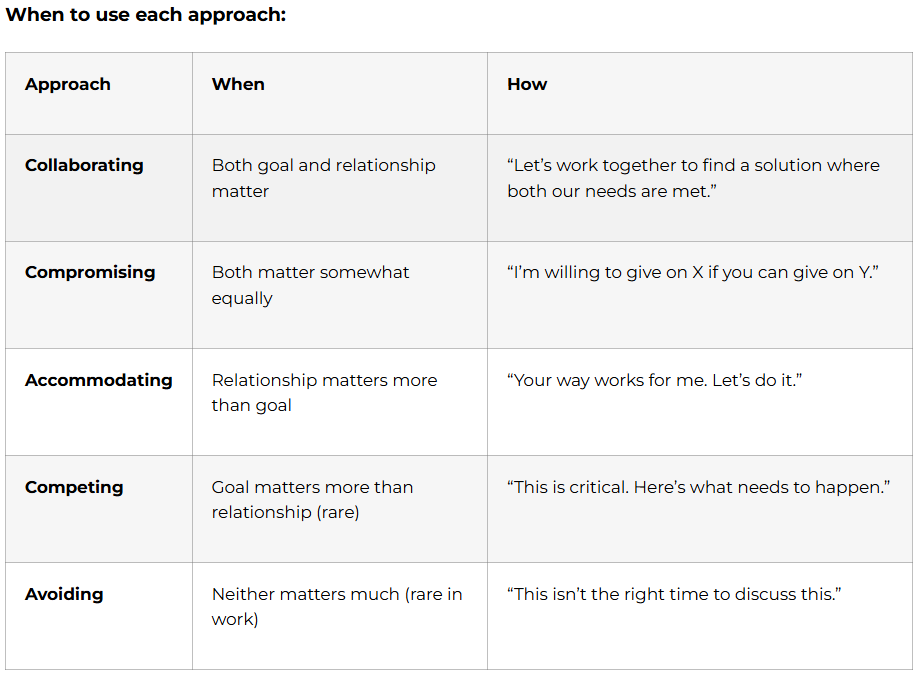
Framework 10: The Conflict Resolution Framework
(Adapted from Thomas-Kilmann model)
How to Adapt These Templates to Your Style
These templates work best when you make them your own.
If you’re naturally formal: Keep the structure but add professional language.
If you’re naturally casual: Keep the structure but use conversational language.
If you’re direct: Use these frameworks but get to the point faster.
If you’re indirect: Use these frameworks but add more softening language.
The structure stays the same. The words change to match you.
When NOT to Use Templates
Templates aren’t good for:
- Highly emotional situations where you need real, unscripted conversation
- Creative brainstorming where structure kills ideas
- Casual friend-like conversations where structure seems cold
- Crisis situations requiring immediate action
Use templates as guides, not scripts. Once you internalize the structure, you’ll apply it naturally without sounding robotic.
Practical Exercise: Create Your Own Templates
This week:
- Identify one communication situation you face regularly: [feedback, status updates, difficult conversations, etc.]
- Write a template that works for your communication style using the frameworks above
- Practice using it in a low-stakes situation (with a peer, not your boss)
- Refine based on how it felt
- Use it in a real situation
By practicing with templates, you internalize the structure until it becomes automatic. Then you communicate clearly under pressure without sounding scripted.
Conclusion
Communication templates aren’t crutches for poor communicators. They’re training wheels for developing skills that eventually become automatic. Professional athletes train with specific drills. Musicians practice scales. Communicators practice frameworks.
Use these templates to build muscle memory around effective communication. Over time, you won’t need to think about the structure—it will come naturally. That’s when you know you’ve truly developed the skill.

Self-Assessment and Continuous Improvement Guide
Introduction
Most professionals don’t systematically assess their communication skills. They operate on autopilot, repeating patterns that may or may not be serving them well. Some receive feedback after damage is done. Others never get honest feedback at all.
The professionals who advance fastest take a different approach. They regularly assess their communication effectiveness, identify specific areas for improvement, and systematically work to enhance their skills. This subtopic provides tools for that assessment and improvement process.
Part 1: Communication Self-Assessment Tools
The Honest Mirror Assessment
Before using external tools, ask yourself these questions honestly:
Listening Skills
- Do people seem engaged when talking to me?
- Do I understand what people are really saying, or just the surface words?
- Do I interrupt or prepare my response while others are speaking?
- When someone disagrees with me, do I listen to understand or listen to argue?
Clarity
- When I explain something, do people need to ask follow-up questions?
- Are my emails clear on first read, or do they require clarification?
- Can I explain complex topics in simple terms?
- Do people understand what I’m asking of them?
Emotional Intelligence
- Can I sense when someone is uncomfortable or upset?
- Do I adjust my communication when someone seems defensive?
- Do I take feedback without getting emotional?
- Can I manage difficult emotions during conversations?
Professionalism
- Would I be comfortable with my emails/messages being forwarded to my manager?
- Do I maintain composure under stress?
- Do people perceive me as reliable and trustworthy?
- Do I follow through on what I say I’ll do?
Authenticity
- Do I communicate differently in different settings (performing vs. genuine)?
- Do people feel they know the real me, or just a professional version?
- Am I defensive about feedback, or do I hear it genuinely?
- Can people trust what I say?
The 360-Degree Feedback Approach
Get feedback from multiple perspectives. Ask people from different levels:
From your manager: “How is my communication affecting my performance? What should I work on?”
From peers: “How do I come across in meetings? Is there anything about how I communicate that frustrates you?”
From your team (if applicable): “Do you feel heard by me? Is my communication clear?”
From clients/stakeholders: “How is our communication working? Anything you’d like to see improve?”
You may get uncomfortable feedback. That’s the point. Your perception of your communication is often quite different from how others experience it.
The Video Review Exercise
Record yourself in a low-stakes situation (practice presentation, mock meeting, or team call). Watch it.
Ask yourself:
- How do I look? Confident or anxious?
- How do I sound? Rushed or measured?
- Do I make eye contact?
- What habits do I notice? (Filler words, gestures, posture)
- What surprised me?
Most people are shocked by how they come across on video. This is invaluable feedback.
Part 2: Identifying Your Communication Strengths and Weaknesses
Strengths Assessment
Identify what you’re already good at. This is important because you’ll build on these strengths.
Common strengths might include:
- Strong in one-on-one conversations
- Great at public speaking
- Excel at written communication
- Good listener
- Clear thinker who explains things well
- Builds rapport easily
- Handles conflict well
Once you identify your strengths, ask: “How can I leverage these more? How do these strengths help my career?”
Weaknesses Assessment
Be honest about areas for improvement. Pick 2-3 real gaps, not things that don’t matter.
Common weaknesses might include:
- Struggle with public speaking
- Emails are often unclear or too long
- Interrupt people frequently
- Get defensive when receiving feedback
- Have difficulty with difficult conversations
- Don’t listen well when stressed
- Come across as arrogant or cold
- Ramble and lose people’s attention
Once you identify weaknesses, prioritize. Which one, if improved, would have the biggest impact on your career?
Part 3: Creating Your Communication Improvement Plan
Step 1: Pick ONE Thing to Work On
Not five things. One. You’ll succeed faster if you focus.
Choose based on:
- Impact: How much will this affect your career and relationships?
- Readiness: Are you emotionally ready to work on this?
- Feasibility: Can you realistically improve this in 90 days?
Step 2: Define Current State and Desired State
Current state: “I interrupt people frequently and don’t realize I’m doing it.”
Desired state: “I let people finish before I respond. I pause for 2 seconds after they finish before I speak.”
Be specific. Vague goals don’t get achieved.
Step 3: Identify Root Cause
Why do you interrupt? Because you’re:
- Excited and eager to contribute?
- Anxious and trying to fill silence?
- Genuinely not aware you’re doing it?
- Stressed and mentally rushing?
Understanding the root cause helps you address it at the source.
Step 4: Create Specific Actions
Action 1: Record yourself in meetings (if appropriate) and listen back for interruptions. What triggers them?
Action 2: Set a personal rule: “After someone finishes, I pause and count to 2 before speaking.”
Action 3: Ask one trusted colleague for feedback weekly. “Did I interrupt today?”
Action 4: Practice in low-stakes conversations first (peers, not your boss).
Action 5: Track progress weekly. On a 1-10 scale, how am I doing with this?
Step 5: Create a 90-Day Timeline
Week 1-2: Awareness. Notice when you interrupt.
Week 3-4: Implementation. Start consciously pausing.
Week 5-8: Refinement. Adjust approach based on what’s working.
Week 9-12: Integration. The new habit becomes more automatic.
Step 6: Measure Progress
Track something concrete:
- Number of meetings where you don’t interrupt
- Feedback from your accountability partner
- Your own sense of how it’s going
- Reactions from others (are people more engaged?)
Part 4: Accountability and Support Structures
Finding an Accountability Partner
Pick someone who:
- Will give you honest feedback
- Is supportive but not enabling
- You see regularly
- Respects confidentiality
- Is working on communication improvements too (mutual accountability)
Meeting frequency: Weekly or biweekly check-ins work best.
What to discuss:
- What went well this week?
- What was challenging?
- What will you do differently next week?
Creating a Personal Board of Advisors
You don’t need one accountability partner. You might have:
- Someone for technical feedback (does this make sense?)
- Someone for emotional support (I’m struggling with this)
- Someone who models what you’re trying to develop
- Someone you trust to be honest even when it’s uncomfortable
Part 5: Ongoing Learning and Development
Beyond Your Current Role
Communication skills aren’t something you develop once. They evolve as your role evolves.
If you’re a junior professional: Focus on clarity, asking good questions, showing respect.
If you’re a manager: Focus on listening, giving feedback, creating psychological safety.
If you’re a leader: Focus on vision communication, authenticity, inspiring others.
If you’re in sales/client roles: Focus on understanding clients, building trust, handling objections.
Your improvement plan changes as your role changes.
Continuous Learning Strategies
Read widely:
- Books on communication (Crucial Conversations, Nonviolent Communication, etc.)
- Articles on your specific challenges
- Case studies of communicators you admire
Learn from others:
- Notice how skilled communicators handle situations
- Ask them questions about their approach
- Try their techniques in your own style
Take courses:
- Communication workshops
- Presentation skills training
- Emotional intelligence development
- Conflict resolution training
Practice consistently:
- Every conversation is a chance to practice
- Seek opportunities to present, facilitate meetings, lead
- Volunteer for projects that stretch your communication
Part 6: The Continuous Improvement Cycle
This isn’t linear. It’s a cycle you repeat throughout your career.
Quarter 1: Assess
- How am I communicating?
- What feedback am I getting?
- What’s my biggest opportunity?
Quarter 2: Improve
- Focus on one area
- Take action
- Track progress
Quarter 3: Apply
- Use new skills in increasingly challenging situations
- Solidify new habits
- Measure real-world impact
Quarter 4: Reflect
- Did I achieve my goal?
- What stayed with me?
- What do I want to work on next?
Then repeat.
Part 7: Tracking Your Progress Over Time
Communication Improvement Journal
Keep a simple record:
Date | What I worked on | What happened | What I learned | Next step
Example:
“Nov 15 | Not interrupting | Caught myself 4 times and paused | People seemed more open to my ideas | Continue practicing in meetings”
This journal becomes a record of your growth. You’ll be surprised by how much you improve over time.
Annual Communication Audit
Once a year, ask yourself:
- How has my communication improved?
- What feedback am I getting now vs. last year?
- What new challenges am I facing?
- What should I focus on this year?
Part 8: Common Mistakes in Self-Assessment and Improvement
Mistake 1: Picking too many things to work on
You’ll get overwhelmed and improve nothing. Pick one.
Mistake 2: Expecting immediate change
Habits take weeks to months to develop. Be patient.
Mistake 3: Assuming your self-assessment is accurate
You’re likely both harder and easier on yourself than reality. Get external feedback.
Mistake 4: Not celebrating progress
When you do improve, acknowledge it. This reinforces the new behavior.
Mistake 5: Abandoning the effort when it gets uncomfortable
Growing always involves discomfort. That’s actually the signal you’re changing something real.
Your 90-Day Communication Improvement Starter Plan
This Week:
- Complete the honest mirror assessment
- Get feedback from one person (manager, peer, or trusted colleague)
- Watch yourself on video
- Identify your #1 communication strength and weakness
Week 2:
- Choose ONE area to improve
- Define current state and desired state specifically
- Find an accountability partner
- Create specific actions for this area
Weeks 3-12:
- Execute your plan
- Check in with accountability partner weekly
- Adjust approach based on what’s working
- Track progress
- Celebrate small wins
Week 13:
- Assess results
- Get feedback from people around you
- Decide on next improvement area
- Repeat the cycle
Conclusion
Professional communication is a skill, not a talent. Like any skill, it improves through honest assessment, focused practice, and consistent effort. The professionals who stand out aren’t naturally gifted communicators—they’re people who committed to getting better and followed through.
Your communication affects everything in your career: relationships you build, trust you earn, opportunities you get, and impact you have. It’s worth investing time to improve. Start this week with your self-assessment. Then commit to one improvement. Watch what changes when you take communication seriously.