
Omnichannel Retail Management & Customer Experience
Table of Contents
Introduction: The Blurring Lines Between Online and Offline
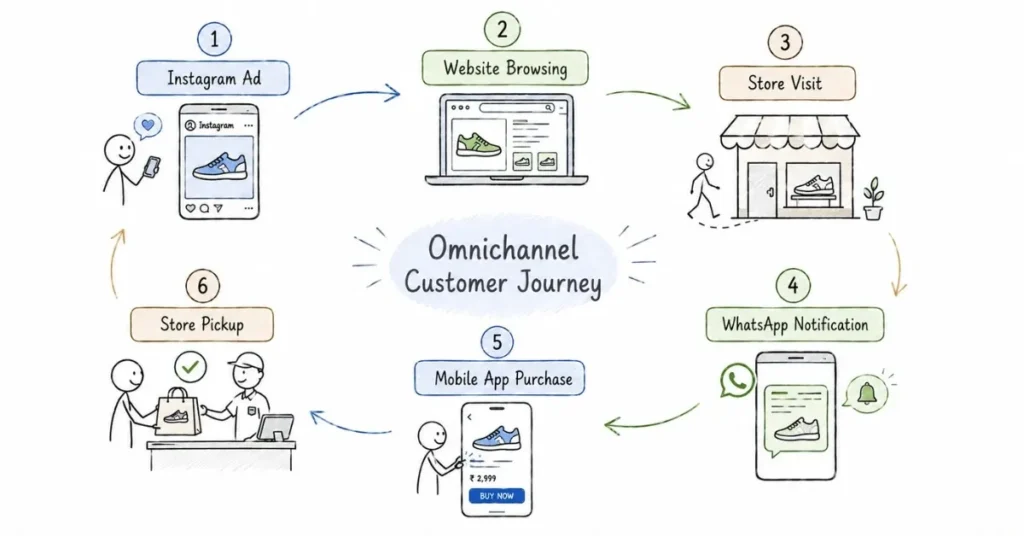
Let me tell you about Priya’s shopping journey last week:
Monday morning: She saw an Instagram ad for a dress on her phone during her commute.
Monday lunch: She checked the product on the brand’s website on her office laptop, read reviews.
Tuesday evening: She visited the brand’s physical store in her mall, tried the dress, but didn’t buy (wanted to think about it).
Wednesday: She got a WhatsApp message: “Hi Priya, we noticed you tried the blue dress yesterday. It’s now on 20% sale!”
Thursday: She opened the brand’s app on her phone, added the dress to cart.
Friday morning: She completed purchase on the app, chose “Pick up from store” option to avoid delivery waiting.
Friday evening: She picked up the dress from the same store she visited on Tuesday.
This is omnichannel retail. One customer, one journey, six touchpoints across four channels (Instagram, website, physical store, app). Everything connected seamlessly.
Welcome to the future of retail in India where online and offline don’t compete, they complement. And managing this complexity is one of the most exciting, challenging, and well-paying career paths in e-commerce today.
What is Omnichannel Retail? (Simple Explanation)
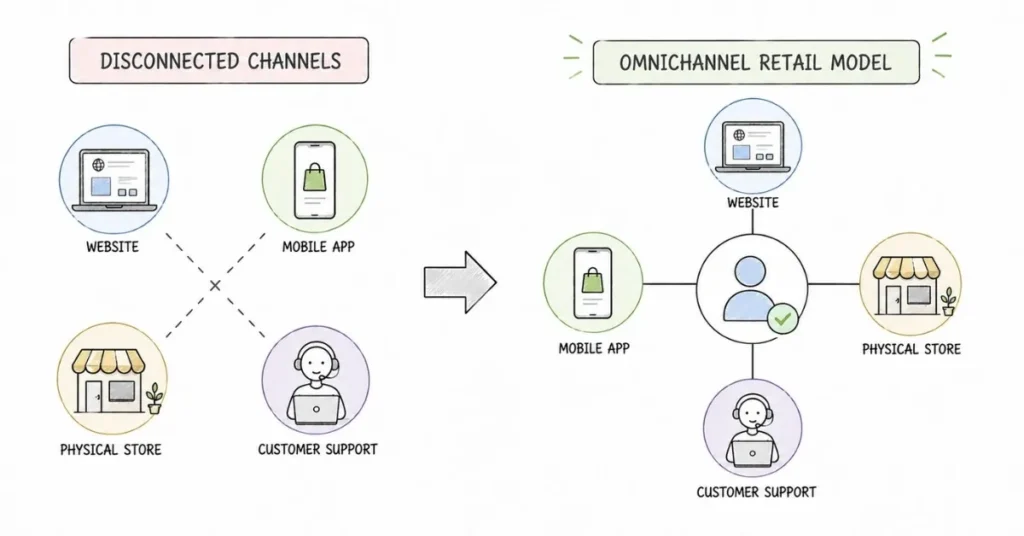
Multichannel retail (Old way):
You have a website. You have a store. They operate independently. Customer buys online or in store, two separate worlds.
Omnichannel retail (New way):
All channels connected. Customer can:
- Browse online, buy in store
- Buy online, pick up in store (BOPIS)
- Buy online, return in store
- Check store inventory on website
- Get consistent pricing and experience everywhere
Why Indian retailers are moving to omnichannel:
- Customers demand it: Shoppers want flexibility. They’ve experienced Amazon’s convenience and expect similar from everyone.
- Better data: When online and offline are connected, you understand complete customer journey, not fragments.
- Higher sales: Research shows omnichannel customers spend 30-40% more than single-channel customers.
- Survival: Pure offline retailers struggled during COVID. Pure online players have high customer acquisition costs. Omnichannel combines best of both.
Examples in India:
- Reliance Retail: Online shopping on JioMart, pickup from Reliance Fresh/Smart stores
- Westside: Browse website, try in store, order online if size not available
- Nykaa: Strong online presence + physical Nykaa Luxe stores
- Tanishq: Check jewelry online, visit store for purchase (high-value items need physical trust)
Career Roles in Omnichannel Retail
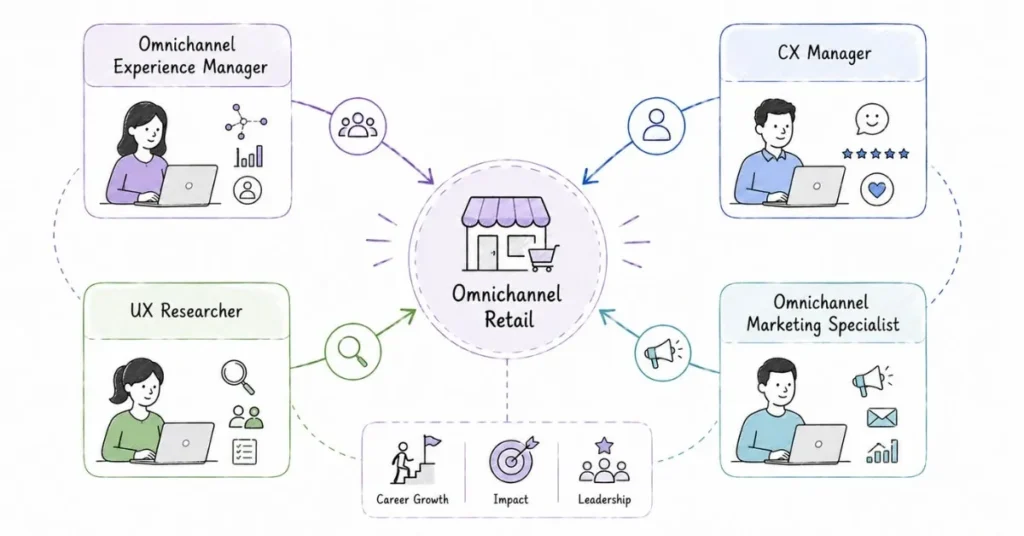
Unlike traditional e-commerce roles (marketing, development, etc.), omnichannel roles are relatively new. This means:
- Fewer qualified people (less competition)
- Higher salaries (scarce skills command premium)
- Opportunity to define the role (best practices still emerging)
Let’s break down the key roles:
Omnichannel Experience Manager: The Integration Specialist
What you actually do:
You’re the person ensuring all channels work together harmoniously. Not just technically integrated, but creating cohesive customer experience.
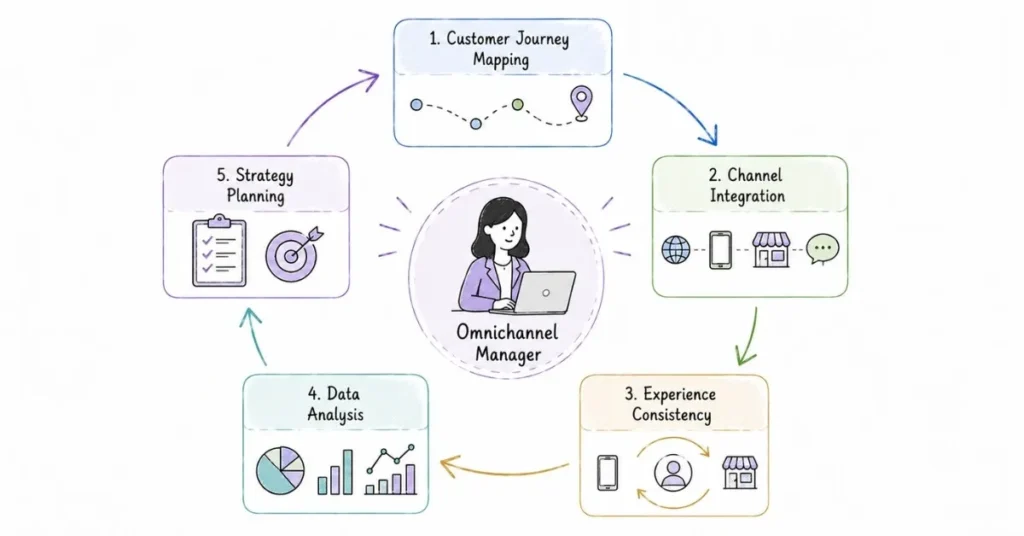
Key responsibilities:
Customer journey mapping:
Understanding every touchpoint across channels:
- How do customers discover you? (Social media, Google, word of mouth, seeing physical store)
- How do they research? (Website, reviews, YouTube, asking friends)
- How do they buy? (Online, in-store, app)
- Post-purchase? (Delivery, returns, customer service, repeat purchase)
You map all of this, identify friction points, and fix them.
Channel integration strategy:
- Should we allow returns in store for online purchases? (Sounds simple, but involves inventory tracking, staff training, system integration)
- What products to display in physical stores vs. online catalog? (Store space is limited, online is unlimited)
- How to ensure inventory accuracy across channels? (Real-time sync between warehouse, store stock, and online display)
Experience consistency:
- Pricing should be same online and offline (or transparent about why it’s different)
- Promotions should be honored across channels
- Customer service quality should be consistent
Data analysis:
- Which channels drive most conversions?
- Where are customers dropping off?
- What’s the ROI of each channel?
A typical week for Anjali, Omnichannel Experience Manager at a fashion retailer in Mumbai:
Monday:
- Review weekend performance across all channels
- Store sales: ₹45 lakhs, Online: ₹28 lakhs, BOPIS orders: ₹8 lakhs
- Notice: BOPIS (Buy Online Pick in Store) growing 15% weekly should we expand this?
Tuesday:
- Meeting with IT team: Discussing real-time inventory sync issues
- Customers seeing “In Stock” online but item not available when they visit store
- This causes frustration and lost sales
Wednesday:
- Mystery shopping at own stores
- Testing customer experience: Is store staff aware of online promotions?
- Can they help customers who have questions about online orders?
Thursday:
- Analyzing customer journey data
- Discovery: 40% of high-value purchases start with online research but complete in-store
- Recommendation: Train store staff to handle “I saw this online” customers better
Friday:
- Planning holiday season omnichannel strategy
- Diwali approaching: How to manage inventory between stores and online?
- Should popular items be reserved for online or kept in stores?
Skills you need:
Strategic thinking:
- Understanding business objectives
- Balancing competing priorities (online team wants more inventory, stores want more inventory you decide allocation)
Data literacy:
- Analyzing customer behavior across channels
- Using tools like Google Analytics, retail analytics platforms
- Making data-driven decisions
Project management:
- Coordinating between multiple teams (online, stores, IT, marketing, operations)
- Managing timelines and execution
Technology understanding:
- You don’t code, but you must understand POS systems, inventory management systems, CRM, analytics platforms
- Understanding what’s technically possible vs. impossible
Customer empathy:
- Genuinely understanding customer needs and pain points
- Thinking like a customer, not just an operations person
Communication:
- Presenting to senior management
- Collaborating with diverse teams
- Explaining complex integration concepts simply
Salary expectations:
This is a mid-to-senior level role:
- 3-5 years experience: ₹10-18 LPA
- 6-9 years experience: ₹18-30 LPA
- 10+ years (Director level): ₹30-50 LPA
How to break into this field:
Path 1: From e-commerce operations:
- Start in e-commerce operations/management
- Volunteer for omnichannel projects
- Build understanding of both online and offline retail
- Transition to dedicated omnichannel role
Path 2: From retail store management:
- Start in physical retail management
- Learn digital/online retail
- Position yourself at the intersection
- Transition to omnichannel role
Path 3: From consulting:
- Work with retail consulting firms
- Gain exposure to multiple retailers’ omnichannel challenges
- Move to in-house omnichannel role
Most common: People with 3-5 years in either e-commerce or retail operations transition into omnichannel roles.
Customer Experience (CX) Manager: The Happiness Engineer
What you actually do:
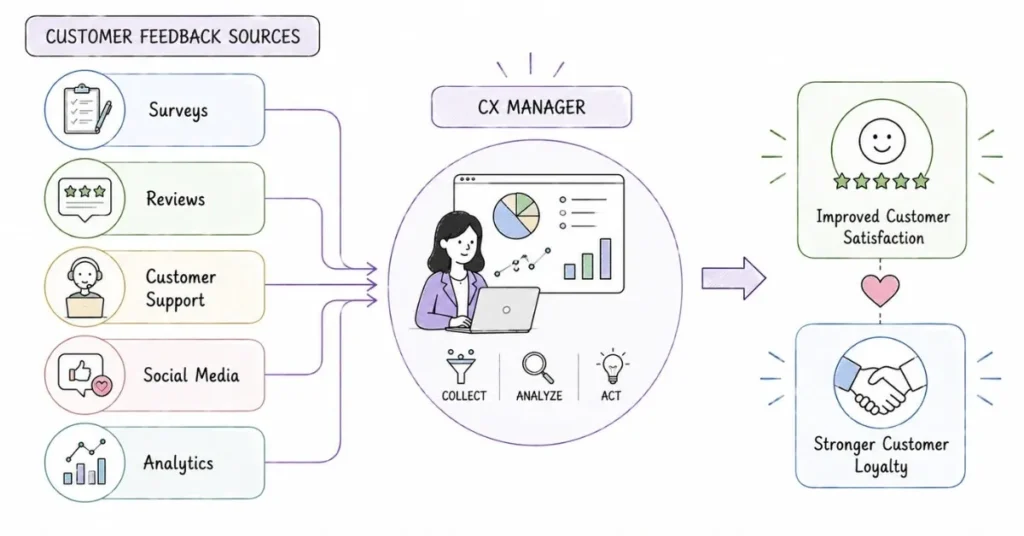
You own the end-to-end customer experience. Your north star metric: Customer satisfaction and loyalty.
Key responsibilities:
Voice of Customer (VoC) programs:
- Collecting customer feedback across all touchpoints
- Surveys, reviews, social media listening, customer service calls
- Analyzing patterns: What are customers happy about? What frustrates them?
Customer journey optimization:
- Identifying pain points in customer journey
- Working with relevant teams to fix them
- Example: Customers complain checkout is confusing → Work with UX team to simplify
Customer service strategy:
- Email, chat, phone, WhatsApp, social media managing all support channels
- Training support teams
- Creating self-service resources (FAQs, knowledge base)
Retention programs:
- Loyalty programs design and execution
- Win-back campaigns for inactive customers
- Turning satisfied customers into brand advocates
Metrics tracking:
- NPS (Net Promoter Score): Would customers recommend you?
- CSAT (Customer Satisfaction Score): How satisfied are customers?
- Retention rate: What % of customers come back?
- Resolution time: How fast are issues resolved?
A typical day for Karthik, CX Manager at an electronics e-commerce company in Bangalore:
9:00 AM: Check dashboard
- Yesterday’s NPS: 62 (industry average is 50, we’re doing well)
- Customer complaints: 45 (up from usual 30 investigate)
- Average resolution time: 4 hours (target is 6 hours great)
10:00 AM: Deep dive into yesterday’s complaint spike
- 20 out of 45 complaints about delayed deliveries in Hyderabad
- Check with operations: Logistics partner issue
- Proactive action: Send apology email with ₹100 voucher to all affected customers
12:00 PM: Weekly call with customer service team
- Discuss recurring issues
- Team facing multiple queries about product compatibility
- Solution: Create detailed compatibility guide on website, reduce future queries
2:00 PM: Review customer feedback on new feature (recently launched “product comparison” tool)
- 78% positive feedback
- Some confusion about how to use it
- Create tutorial video and email to customers
4:00 PM: Work on loyalty program redesign
- Current program: Points for every purchase
- Planning: Add experiential rewards (early access to sales, exclusive products)
- Research shows millennials prefer experiences over just discounts
5:30 PM: Prepare monthly CX report for leadership
Skills you need:
Customer empathy:
- Genuinely caring about customer experience (not just metrics)
- Ability to see from customer perspective
Data analysis:
- Analyzing feedback at scale
- Identifying patterns in thousands of reviews/complaints
- Quantifying impact of CX improvements
Communication:
- Writing clear policies, FAQs, help content
- Training teams
- Presenting to leadership
Problem-solving:
- Creative solutions to customer pain points
- Balancing customer demands with business constraints
Tools proficiency:
- CRM systems (Zoho, Salesforce, Freshdesk)
- Survey tools (SurveyMonkey, Typeform)
- Analytics platforms
- Social listening tools (Hootsuite, Sprinklr)
Salary expectations:
- Entry level – CX Executive (1-3 years): ₹4-8 LPA
- Mid level – CX Manager (4-6 years): ₹9-16 LPA
- Senior – Head of CX (7+ years): ₹18-32 LPA
How to break into CX:
Entry point 1: Customer service/support:
- Start as customer support executive
- Understand customer issues deeply
- Move into CX strategy roles
Entry point 2: Operations:
- Start in e-commerce operations
- Focus on customer-facing processes
- Transition to CX
Entry point 3: Marketing:
- Start in marketing, focus on customer engagement
- Move toward CX specialization
Key differentiator: Genuinely caring about customers. The best CX managers are those who are naturally customer-obsessed, not just doing it as a job.
UX Researcher: The Customer Psychology Expert
What you actually do:
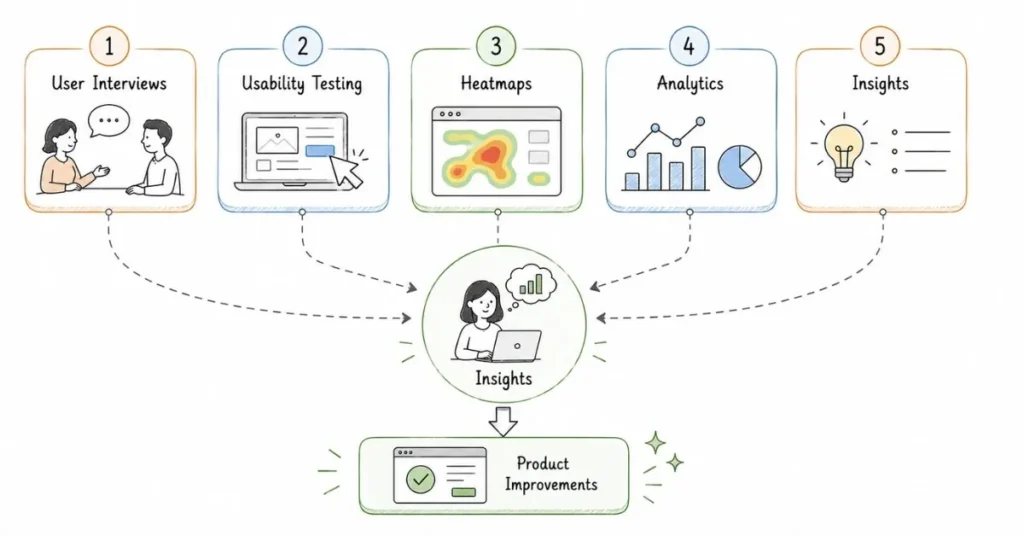
You study how customers interact with your website, app, and stores. Your research informs design and product decisions.
Key responsibilities:
User research:
- Conducting user interviews (talking to 20-30 customers monthly)
- Usability testing (watching users navigate your website, noting where they struggle)
- Surveys and questionnaires
- Field studies (observing shopping behavior in stores)
Data analysis:
- Analyzing user session recordings (tools like Hotjar show how users navigate)
- Heatmaps (where do users click most? what do they ignore?)
- Funnel analysis (where do users drop off in checkout?)
Persona development:
Creating user personas fictional characters representing customer segments:
Persona example – “Rahul, the Value Seeker”:
- Age 28, Tier 2 city, ₹40,000 monthly income
- Shops online for best deals
- Price-sensitive, compares across websites
- Prefers COD, skeptical of online payments
- Influenced by reviews heavily
Your research creates 4-5 such personas. Design and marketing teams use these to make decisions.
Insight reporting:
- “60% of users abandon cart at payment step our payment page is confusing”
- “Tier 2 city users search in Hindi but our search doesn’t understand Hindi”
- “Users can’t find size guide, leading to wrong size orders and returns”
These insights directly drive product improvements.
A typical week for Sneha, UX Researcher at a D2C home décor brand in Delhi:
Monday:
- Planning research for new feature (AR Augmented Reality users can see how furniture looks in their room)
- Define research questions: Will users understand how to use AR? Does it increase purchase confidence?
Tuesday-Wednesday:
- Conducting usability tests
- 15 participants come in (mix of age groups, tech comfort levels)
- They use the AR feature, we observe and take notes
- Common finding: Older users (45+) struggle to understand they need to point camera at their room
Thursday:
- Analyzing data from user tests
- Creating report with findings
- Recommendations: Add tutorial video, make instructions simpler
Friday:
- Present findings to product and design team
- Collaborative discussion on implementing improvements
Skills you need:
Research methods:
- Qualitative research (interviews, observations)
- Quantitative research (surveys, analytics)
- A/B testing
- Usability testing protocols
Psychology understanding:
- Understanding human behavior and decision-making
- Cognitive biases
- User motivations
Tools proficiency:
- Analytics: Google Analytics, Mixpanel
- Heatmaps: Hotjar, Crazy Egg
- User testing: UserTesting.com, Maze
- Survey tools: SurveyMonkey, Typeform
- Design tools: Figma (to understand designs)
Communication:
- Presenting research findings clearly
- Creating compelling reports
- Storytelling with data
Salary expectations:
- Entry level – UX Research Intern/Associate (0-2 years): ₹4-7 LPA
- Mid level – UX Researcher (3-5 years): ₹8-16 LPA
- Senior – Lead UX Researcher (6+ years): ₹18-30 LPA
How to break into UX research:
Educational background:
- Psychology, HCI (Human-Computer Interaction), Design, Sociology backgrounds fit well
- But not mandatory many come from diverse backgrounds
Portfolio:
- Conduct independent research projects (even on existing apps/websites)
- Document process and findings
- Show critical thinking
Certifications:
- Nielsen Norman Group UX certifications
- Google UX Design Certificate
- Interaction Design Foundation courses
Starting point:
- UX research internships (many companies offer)
- Freelance UX research for startups
- Join as UX designer and specialize in research
Omnichannel Marketing Specialist: The Cross-Channel Storyteller
What you actually do:
You create marketing campaigns that work across all channels cohesively. A customer sees your Facebook ad, then your billboard, then receives an email all telling consistent story.
Key responsibilities:
Cross-channel campaign planning:
Planning campaigns that leverage multiple channels:
- Social media creates awareness
- Store displays reinforce the message
- Email drives conversions
- App push notifications remind lapsed users
Attribution modeling:
Understanding which channel gets credit for sales:
- Customer saw Instagram ad, clicked, didn’t buy
- Next day, searched Google, clicked website, added to cart
- Got cart abandonment email, clicked, still didn’t buy
- Saw retargeting ad on Facebook, finally bought
Which channel gets credit? You figure this out.
Budget optimization:
Allocating marketing budget across channels based on ROI.
Personalization strategy:
Different customers see different messages:
- First-time visitor: “Welcome! 10% off your first order”
- Cart abandoner: “Complete your purchase”
- Loyal customer: “Thanks for being VIP, here’s exclusive preview of new collection”
Skills you need:
Combination of digital marketing skills (covered in Subtopic 3) plus:
- Understanding offline marketing
- Store merchandising knowledge
- Cross-channel analytics
- Marketing automation tools (HubSpot, CleverTap)
Salary expectations:
- ₹7-14 LPA (mid-level)
- ₹15-28 LPA (senior)
How to break in:
Start as digital marketer, take on cross-channel projects, specialize in omnichannel.
Technology Powering Omnichannel: What You Should Know
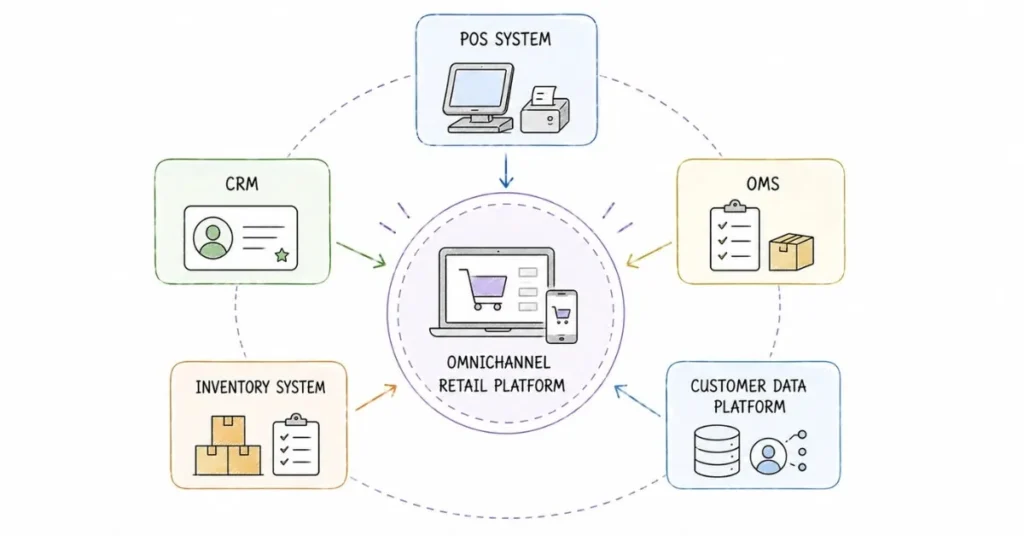
You don’t need to code these systems, but understanding them is crucial for omnichannel roles:
POS (Point of Sale) Systems:
The system in physical stores where staff bill products. Modern POS systems are connected to online inventory, customer data, etc.
Popular in India: Pine Labs, Mswipe, Ezetap
OMS (Order Management System):
Central system managing all orders (online, in-store, app).
Examples: Unicommerce, Vinculum, Browntape
CRM (Customer Relationship Management):
Stores all customer data purchases, preferences, interactions.
Examples: Zoho CRM, Salesforce, HubSpot
Inventory Management Systems:
Tracks inventory across warehouses, stores, in-transit.
Examples: Zoho Inventory, TradeGecko, Cin7
CDP (Customer Data Platform):
Unifies customer data from all sources for 360-degree view.
Examples: Segment, mParticle, CleverTap
Understanding these systems: Take free demos, watch YouTube tutorials, understand capabilities. In interviews, demonstrating this knowledge sets you apart.
Indian Market Specific Omnichannel Challenges
Challenge 1: Diverse customer base
A customer in Mumbai wants app-based convenience. A customer in Patna might prefer store shopping with online browsing. One strategy doesn’t fit all.
Challenge 2: Infrastructure limitations
Real-time inventory sync requires good internet at store level. Many tier 2/3 stores have connectivity issues.
Challenge 3: Staff training
Store staff comfortable with traditional retail need training for omnichannel (helping customers with online orders, using POS systems, etc.)
Challenge 4: Cultural preferences
High-value purchases (jewelry, electronics) often need physical touchpoint even if customer researched online. Omnichannel strategy must account for this.
Challenge 5: Logistics complexity
BOPIS (buy online pick in store) sounds simple until you consider India’s geography. Customer in Jaipur orders online, wants to pick from Udaipur store while visiting inventory needs to be moved. Complex!
Success Stories
Rohit's journey to Omnichannel Manager:
- Started as E-commerce Executive at ₹4 LPA
- Company launched physical stores, Rohit volunteered to help with online-offline integration
- Within 2 years, became Omnichannel Specialist at ₹8.5 LPA
- Year 5: Omnichannel Manager at ₹16 LPA
- His edge: Being at intersection of online and offline during transition
Neha's CX career:
- Started in customer service at ₹3 LPA
- Obsessed with solving customer problems, went beyond her role
- Created documentation of common issues, proactive solutions
- Noticed by management, promoted to CX Executive at ₹5.5 LPA
- Year 4: CX Manager at ₹11 LPA
- Her secret: Genuinely caring about customers, not just metrics
Is Omnichannel Career Right for You?
You’ll love this if:
- You enjoy complexity and connecting dots
- You like working across teams and departments
- You’re comfortable with ambiguity (best practices still evolving)
- You enjoy both strategy and execution
- You like bridging online and offline worlds
You might struggle if:
- You prefer deep specialization in one area
- You dislike coordinating with multiple stakeholders
- You want clear, established career paths
- You prefer independent work over collaboration
Your Entry Strategy
Option 1: Internal transition
If you’re in e-commerce or retail currently, volunteer for omnichannel projects. Be the bridge person. Build expertise. Transition internally.
Option 2: Consulting to in-house
Join retail consulting firm, work on omnichannel projects for various clients, then move to in-house role.
Option 3: Start in one channel, add the other
E-commerce background? Learn about physical retail. Retail background? Learn about digital. Become T-shaped (deep in one, broad understanding of other).
Final Thoughts
Omnichannel retail is where Indian retail is headed. Companies like Reliance are investing billions. Tata Digital (Tata Neu) is building massive omnichannel presence. Every major retailer is following.
This creates massive opportunity for professionals who understand this space. The roles are well-paying, intellectually stimulating, and future-proof.
The best part? It’s still early. You can enter now and grow with the industry.
Your omnichannel career journey starts with understanding that the future of retail isn’t online vs. offline. It’s online + offline, seamlessly integrated, customer-centric.
Welcome to the future of retail careers.