
MUSIC & AUDIO PRODUCTION CAREERS
Table of Contents
Introduction
Close your eyes and listen. The thumping bass that makes your heart race in a club. The crystal-clear dialogue in your favorite film. The perfectly balanced mix on a hit song. The immersive soundscape of a video game. Behind every sound you hear across media and entertainment stands an audio professional who captured, shaped, mixed, or mastered it to create the experience you’re enjoying.
Music and audio production careers encompass the technical and creative work of recording, producing, mixing, and mastering music, plus sound design for film, television, games, and live events. These careers blend artistic sensibility with technical expertise, requiring both trained ears and skilled hands operating sophisticated equipment and software. From traditional recording studios to home production setups, from film sound stages to concert venues, audio professionals shape how the world sounds.
India’s music and audio industry is thriving across multiple dimensions. The music industry alone—including recorded music, live performances, and music streaming—continues growing. Film and OTT content production drives demand for sound engineers and composers. Live entertainment from concerts to weddings employs audio professionals. The podcasting boom creates opportunities for audio producers and editors.
Music producers in India earn an average of ₹4.42-4.76 lakhs annually, with entry-level producers earning ₹2.87-7.5 lakhs and experienced professionals commanding ₹7.65-20+ lakhs. Sound engineers earn an average starting salary of ₹4.5 lakhs annually, with sound mixing engineers earning ₹4-5 lakhs initially and ₹6-8 lakhs with 6-7 years experience. Music composers earn an average of ₹2.9 lakhs annually, ranging from ₹0.2-9.5 lakhs, with top film music directors earning ₹9.88+ lakhs annually. Sound technicians average ₹5.58 lakhs per year.
This comprehensive guide explores music and audio production careers including music producer and composer roles, recording engineer and mixing positions, mastering engineer specialization, live sound engineering, post-production audio for film and TV, and the skills, equipment, education, and strategies needed to build sustainable careers in this technically demanding but sonically rewarding field.
Understanding the Audio Production Landscape
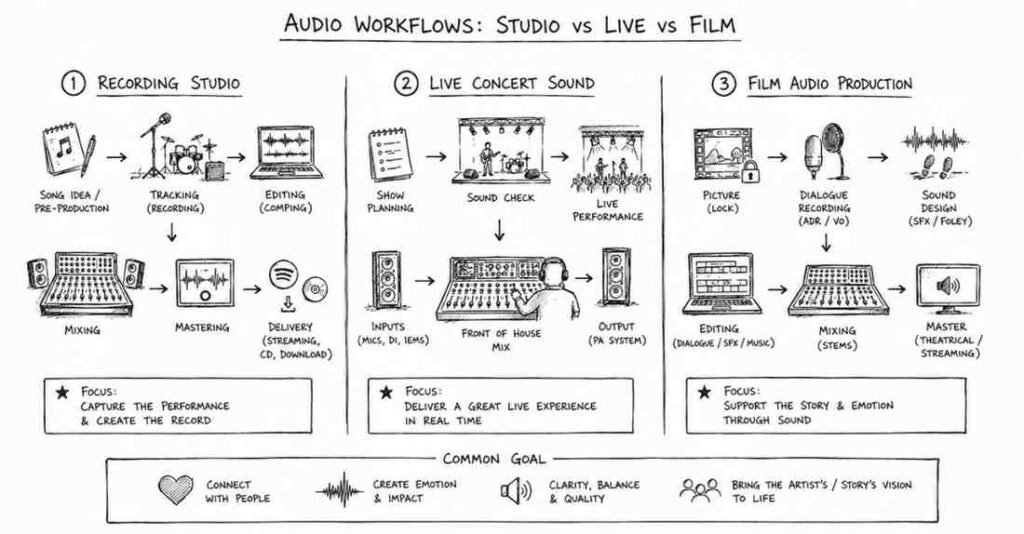
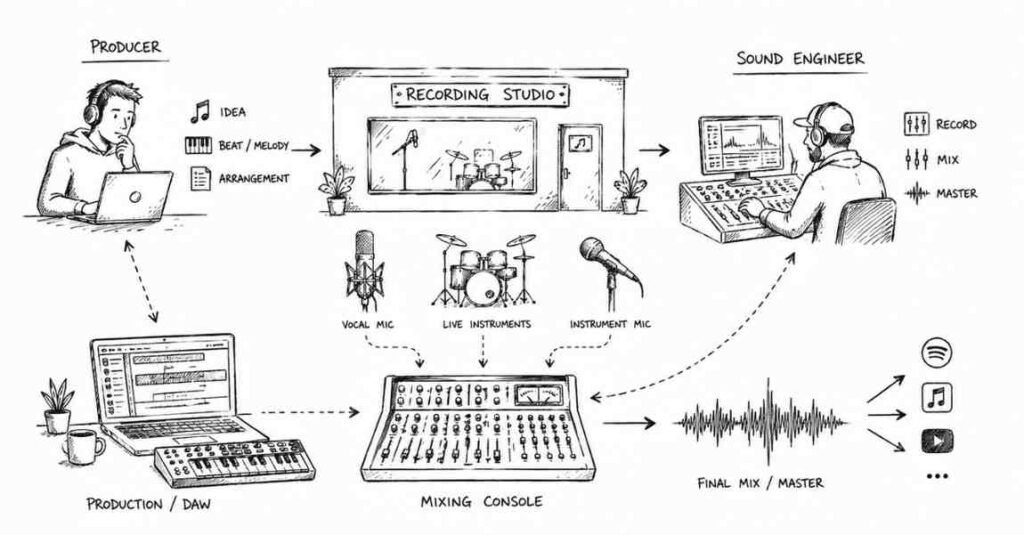
The Audio Production Ecosystem
Audio production spans diverse contexts, each with specialized requirements and opportunities.
Music recording and production creates recorded music for commercial release, streaming platforms, or artist portfolios. This involves capturing performances, programming virtual instruments, arranging compositions, mixing tracks, and mastering final mixes. Work happens in professional recording studios, project studios, or increasingly in home studios as technology democratizes music production.
Film and television sound encompasses dialogue recording during production, sound design creating audio elements, Foley artistry recording everyday sounds, music composition and scoring, and final mixing combining all elements. Film sound professionals work on location during shoots and in post-production facilities during editing and mixing.
Live sound engineering manages audio for concerts, festivals, theater productions, corporate events, houses of worship, or any live performance. Live sound engineers set up PA systems, mix performances in real-time, and troubleshoot issues immediately without the luxury of post-production fixes.
Game audio creates music, sound effects, voice acting, and interactive audio for video games. Game audio presents unique challenges—assets must trigger dynamically based on player actions, maintain quality across various platforms, and loop seamlessly.
Broadcast audio handles sound for radio and television broadcasts, podcasts, streaming shows, or online content. Broadcast engineers ensure consistent audio quality meeting technical broadcast standards.
Audio post-production for advertising, corporate video, e-learning, or multimedia projects provides steady work for audio professionals outside entertainment’s glamorous but competitive sectors.
Career Paths and Specializations
Audio careers typically involve specializing in specific aspects while maintaining broad foundational knowledge.
Music production focuses on creating recorded music—working with artists, crafting arrangements, selecting sounds, and overseeing recording processes resulting in finished tracks.
Recording engineering emphasizes the technical craft of capturing audio—microphone selection and placement, signal flow management, tracking sessions, and creating clean, usable recordings.
Mixing engineering transforms multitrack recordings into stereo or surround mixes—balancing levels, applying processing, creating depth and space, and achieving sonic cohesion.
Mastering engineering provides final polish to mixed audio—optimizing overall tone, matching levels across album tracks, preparing files for distribution, and ensuring playback translation across systems.
Sound design creates sonic elements for storytelling—from futuristic sci-fi sounds to realistic everyday ambiences, from creature vocalizations to weapon effects.
Live sound engineering manages real-time audio for performances—system setup, mixing, monitoring, and immediate problem-solving.
Many successful audio professionals work across multiple specializations, but developing deep expertise in one area often provides career foundation and differentiation.
Music Production Careers
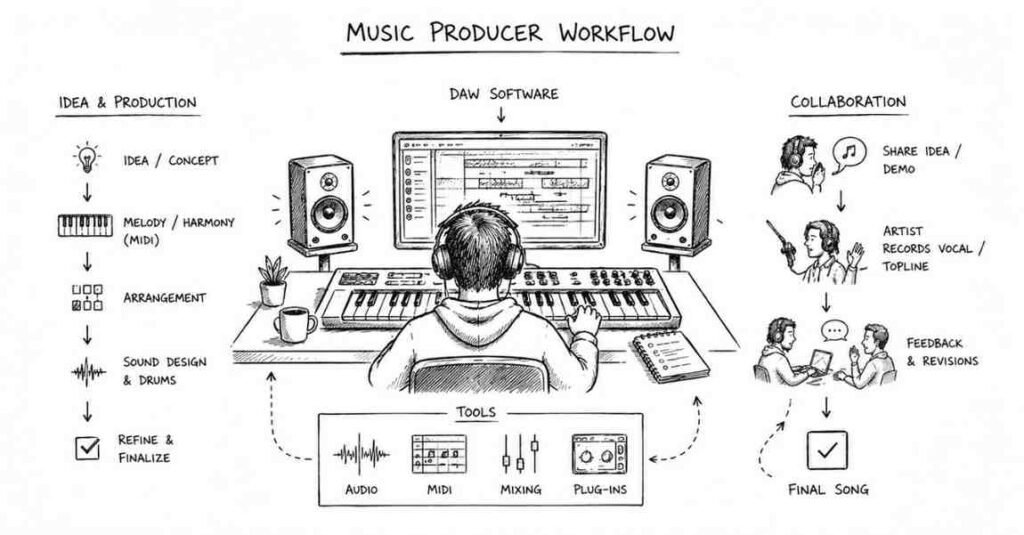
Music Producer: The Sonic Architect
Music producers oversee music creation from concept to finished master, blending creative direction with technical execution.
What music producers do: They collaborate with artists developing songs and arrangements, select sounds including instruments, synthesizers, or samples, program beats and electronic elements, record or coordinate recording sessions capturing performances, arrange compositions determining structure and instrumentation, direct performances guiding artists toward desired emotions or execution, mix tracks or work with mixing engineers balancing all elements, and oversee projects ensuring creative vision and technical quality.
The producer’s role varies dramatically by genre and context. Electronic music producers might create entire tracks solo using software. Pop producers might work with large teams of writers, musicians, and engineers. Film score producers coordinate orchestras and recording logistics. The common thread is responsibility for final sonic result.
Skills required: Musical knowledge, including theory, harmony, rhythm, and arrangement. Technical proficiency with digital audio workstations (DAWs) like Pro Tools, Logic Pro, Ableton Live, or FL Studio. Sound design abilities crafting or selecting appropriate sounds. Critical listening discerning what works sonically and musically. Communication skills articulating vision to artists and collaborators. Project management coordinating sessions, budgets, and timelines. Creativity generating musical ideas and solving sonic challenges.
Career progression: Many producers start making their own music, producing for friends, or assisting established producers learning techniques and workflows. Building a portfolio of produced tracks demonstrates capability. Networking within music scenes connects you with artists needing production. As reputation grows, you command higher fees and attract better projects. Successful producers sometimes establish production companies or labels.
Compensation: Music producers earn highly variable income depending on projects, reputation, and deal structures. Average salaries range from ₹4.42-4.76 lakhs annually. Entry-level producers earn ₹2.87 lakhs to as high as ₹7.5 lakhs for those with less than one year experience. Mid-career producers (4-9 years) average ₹4.56 lakhs. Senior producers (10-20 years) earn ₹7.65 lakhs on average. The highest-paid producers exceed ₹20 lakhs annually. Many producers work on points (percentage of royalties) rather than or in addition to flat fees, meaning successful songs generate ongoing income.
Composer and Songwriter: Creating Original Music
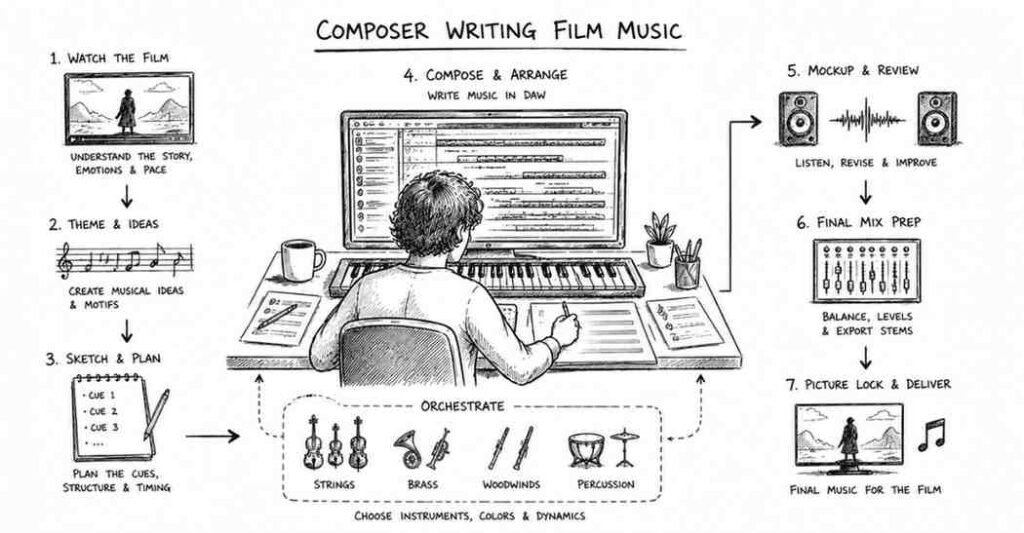
Composers write original music for films, television, games, advertising, or their own artistic projects, translating emotions and narratives into sound.
What composers do: They analyze scripts or briefs understanding emotional and narrative needs, compose themes and motifs representing characters or ideas, orchestrate music determining instrumentation and arrangement, produce demos or full productions of compositions, coordinate with directors or creative teams refining music to vision, conduct recording sessions if using live musicians, and deliver final music integrated into productions.
Film composers face unique challenges—music must support storytelling without overwhelming it, sync precisely with picture, and evoke specific emotions at exact moments. Game composers must create music that loops seamlessly and adapts to player actions. Advertising composers must distill brand identity into brief sonic signatures.
Skills required: Music theory and composition understanding harmony, melody, and form. Proficiency with notation software (Sibelius, Finale) and/or DAWs for production. Understanding orchestration and arrangement. Ability to work to picture timing music precisely. Communication skills translating verbal creative direction into musical responses. Versatility writing across styles and moods. Technical skills producing high-quality recordings or mock-ups.
Career paths: Some composers start through music school studying composition formally. Others emerge from playing in bands, producing electronic music, or assisting established composers. Building portfolios requires creating original music—scoring student films, writing library music, creating sample tracks, or producing personal projects. Networking with filmmakers, game developers, or agencies opens doors to paid work.
Compensation: Music composers earn an average of ₹2.9 lakhs annually in India, with salaries ranging from ₹0.2-9.5 lakhs. Music directors and conductors average ₹3.2 lakhs. Top film music directors, particularly in Bollywood, earn significantly more—averaging ₹9.88 lakhs annually and potentially earning up to ₹50 lakhs for major projects. Composers often negotiate project fees plus potentially backend royalties depending on contract structures. Established composers with strong portfolios command ₹1-5+ lakhs per film score.
Recording and Mixing Engineering
Recording Engineer: Capturing Sound
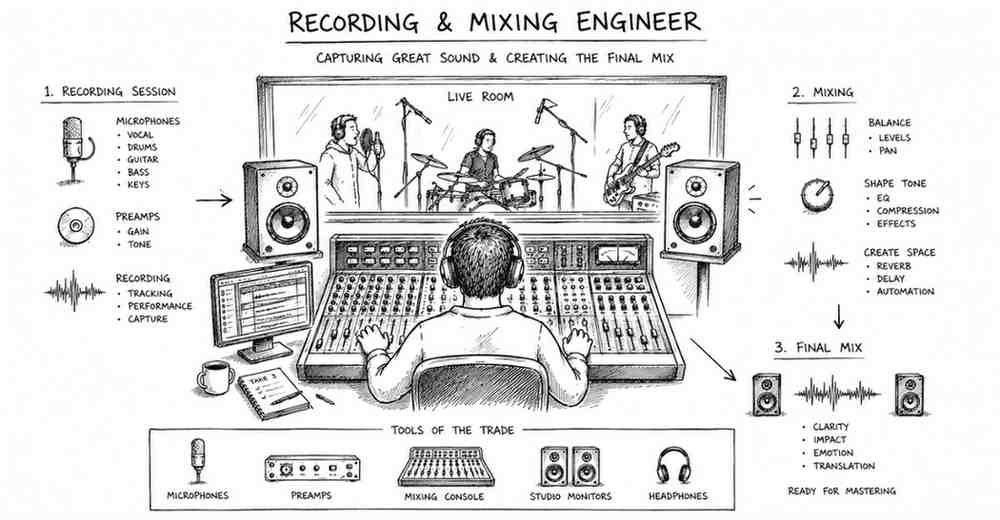
Recording engineers handle the technical aspects of capturing audio during recording sessions, ensuring clean, usable recordings that serve the production.
What recording engineers do: They select and position microphones appropriate for sources and desired sounds, set up signal chains routing audio through preamps, processors, and into recording systems, monitor recordings ensuring clean capture without distortion or technical issues, document sessions maintaining proper file organization and notes, troubleshoot technical problems when equipment malfunctions or issues arise, and coordinate with producers and musicians facilitating smooth sessions.
Recording engineering is both technical craft and subtle art. The same guitar amp sounds completely different with different microphones positioned slightly differently. Understanding these variables and making appropriate choices shapes recorded sound.
Technical knowledge: Understanding microphones—dynamic, condenser, ribbon—and their polar patterns, frequency responses, and applications. Signal flow from source through preamps, converters, and recording systems. Gain staging preventing distortion while capturing adequate levels. Acoustics and room treatment managing reflections and resonances. Digital audio concepts including sample rates, bit depth, and file formats.
Work environments: Recording engineers work in professional recording studios serving major labels and established artists, project studios catering to independent artists and local scenes, home studios operated by artists or producers, mobile recording rigs capturing live performances or on-location sessions, or as freelancers moving between various facilities.
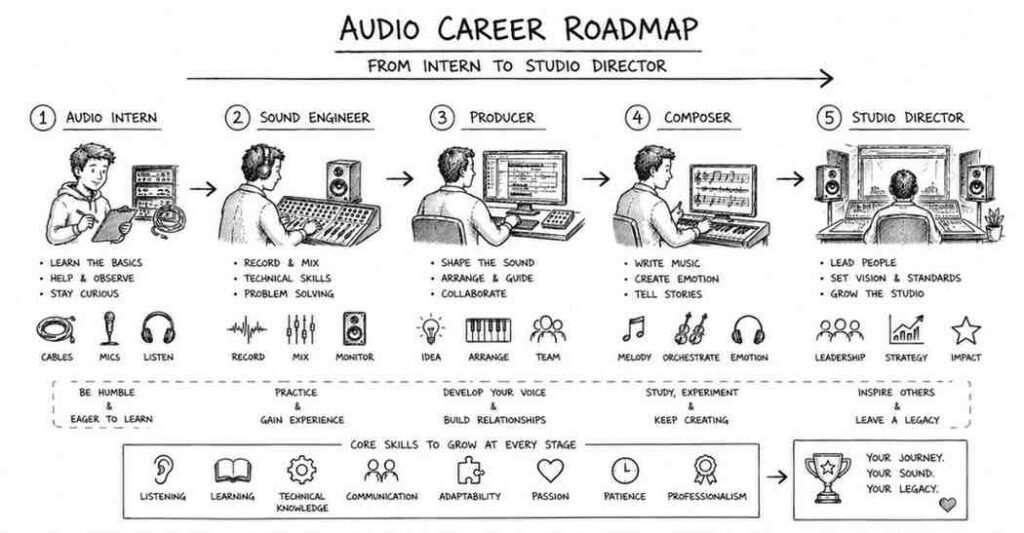
Career progression: Many recording engineers start as runner or studio assistants—setting up sessions, maintaining equipment, making coffee, and observing sessions learning through osmosis. Promotion to assistant engineer involves operating recording software, placing microphones under supervision, and handling technical tasks. After 2-4 years, assistant engineers might engineer full sessions. Senior engineers handle major projects and sometimes train others.
Salary expectations: Sound engineers earn an average starting salary of ₹4.5 lakhs annually. This progresses with experience—sound technicians average ₹5.58 lakhs per year. Recording engineers fall within general sound engineering salary ranges, with experienced engineers at established studios earning ₹6-10 lakhs annually. Top engineers at premier facilities or working with major artists earn ₹12-18+ lakhs.
Mixing Engineer: Sculpting the Sonic Landscape
Mixing engineers take multitrack recordings and blend them into cohesive, emotionally impactful stereo or surround mixes.
What mixing engineers do: They balance levels ensuring all elements sit appropriately in the mix, apply equalization shaping frequency content of each element, use compression controlling dynamics and adding punch or sustain, add effects like reverb and delay creating space and depth, create stereo or surround placement positioning elements in the soundfield, automate changes creating movement and emphasis, and deliver mixes meeting technical specifications and creative vision.
Great mixing transforms good recordings into exceptional listening experiences. Mixing engineers solve problems—making vocals clear despite dense instrumentation, creating power without harshness, achieving loudness without fatigue, and making mixes translate across playback systems from earbuds to stadium speakers.
Skills required: Critical listening discerning frequency content, dynamics, spatial information, and musical balance. Deep knowledge of mixing tools—EQs, compressors, reverbs, delays. Understanding psychoacoustics how humans perceive sound. Musical sensibility knowing what serves songs versus what impresses technically. Technical precision working cleanly and efficiently. Communication understanding and implementing client feedback.
Learning mixing: Mixing improves through hours of practice analyzing professional mixes, trying to recreate them, mixing multiple projects accumulating experience, and receiving critical feedback from mentors or communities. Formal training through audio schools provides structured learning, but self-teaching through practice and study remains viable.
Compensation: Mixing engineers earn within sound engineering salary ranges—₹4-8 lakhs annually at mid-level, ₹8-15 lakhs for experienced professionals. Top mixing engineers, particularly those with credits on hit records, can command ₹1-3+ lakhs per song mixed or ₹25-50+ lakhs annually. Many mixing engineers charge per song (₹10,000-1+ lakh depending on reputation and complexity) or per day (₹15,000-50,000).
Mastering Engineer: The Final Polish
Mastering engineers provide final processing to mixed audio, optimizing overall tone, dynamics, and loudness while ensuring consistency and translation.
What mastering engineers do: They analyze mixes identifying technical or tonal issues, apply overall EQ shaping final frequency balance, use compression and limiting controlling dynamics and achieving appropriate loudness, sequence tracks for albums determining spacing and flow, create multiple format deliverables preparing files for streaming, CD, vinyl, or other formats, and quality control ensuring technical compliance and sonic excellence.
Mastering is subtle work—small adjustments with significant cumulative impact. Mastering engineers act as final quality check and sonic polish between artists/mixing engineers and listeners.
Technical requirements: Mastering requires exceptional monitoring—highly accurate speakers and acoustically treated rooms revealing subtle details. Specialized mastering software and hardware provide precision processing. Trained ears from years of critical listening enable proper judgments.
Career path: Most mastering engineers have extensive mixing or recording experience before specializing in mastering. The specialization requires investment in dedicated mastering environment and deep refinement of critical listening skills. Some mastering engineers work at dedicated mastering facilities, while others operate independent mastering studios.
Compensation: Mastering engineers typically charge per song (₹3,000-25,000 depending on reputation and market) or per album. Successful mastering engineers with strong clientele earn ₹8-20+ lakhs annually. Top mastering engineers serving major labels or premium independent markets can exceed ₹25+ lakhs.
Live Sound Engineering
Live Sound Engineer/FOH Engineer: Real-Time Audio
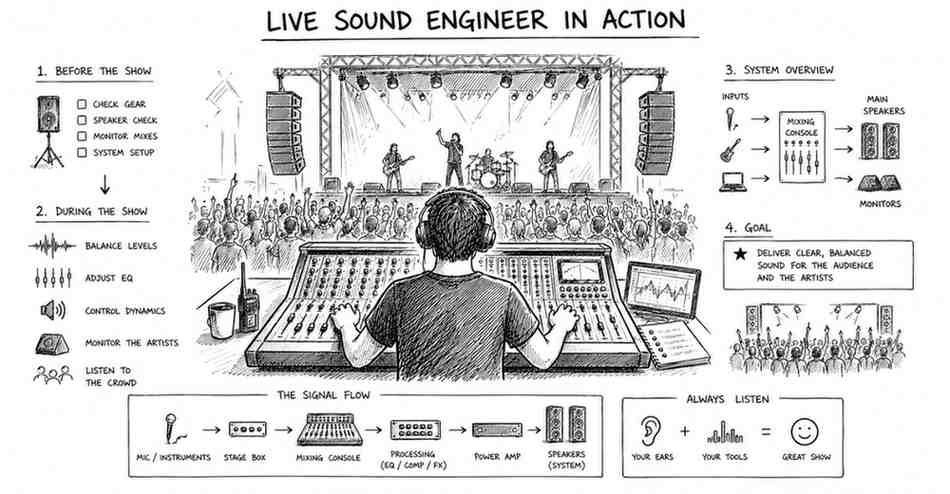
Live sound engineers manage audio for performances, mixing sounds in real-time for audiences without the safety net of post-production fixes.
What live sound engineers do: They set up PA (public address) systems including speakers, amplifiers, and mixing consoles, position stage monitors for performers to hear themselves, soundcheck all inputs testing microphones, instruments, and playback, mix performances in real-time balancing all sources for audience listening, troubleshoot issues immediately when equipment fails or feedback occurs, and strike/pack systems after events.
Live sound differs fundamentally from studio work. Studio engineers can fix mistakes through editing or additional takes. Live engineers must solve problems instantly while performances happen. The pressure is immense but the immediate gratification of a great-sounding show is uniquely satisfying.
Skills required: Technical knowledge of PA systems, microphones, signal routing, and acoustic principles. Quick problem-solving diagnosing and fixing issues under pressure. Physical stamina for long hours loading equipment and working shows. Listening skills in challenging environments distinguishing issues amid stage volume and crowd noise. Calm demeanor under pressure maintaining professionalism during crises.
Types of live sound work: Concert touring with bands handling audio nightly across venues. Festival engineering managing multiple artists on festival stages. Corporate events providing audio for conferences, product launches, or company events. Houses of worship managing audio for religious services. Theater sound designing and operating audio for theatrical productions. Wedding and social events providing music and speech reinforcement.
Career progression: Many live sound engineers start as stagehands or audio assistants loading gear and running cables learning systems and protocols. Progression leads to system technician setting up and maintaining equipment, monitor engineer managing stage monitoring, and front-of-house (FOH) engineer mixing for audiences. Top touring engineers travel globally with major artists.
Compensation: Live sound work often pays day rates varying by event type and engineer experience. Entry-level audio assistants earn ₹1,000-3,000 per day. Mid-level engineers earn ₹5,000-15,000 daily. Experienced touring engineers or those working major events can earn ₹20,000-50,000+ per day. Annual earnings depend on how much you work—full-time live engineers earn ₹4-15 lakhs annually, with top touring engineers potentially exceeding ₹20+ lakhs.
Post-Production Audio for Film & TV
Sound Designer: Crafting Sonic Worlds
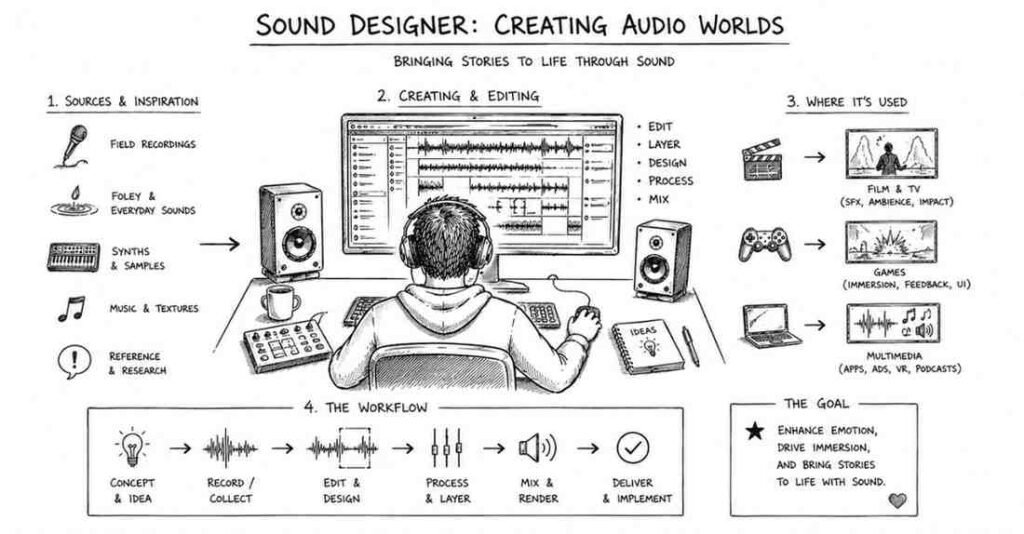
Sound designers create audio elements for films, television, games, or multimedia—from realistic everyday sounds to fantastical creatures or futuristic technology.
What sound designers do: They analyze scripts or scenes identifying sound needs, record source material capturing real-world sounds, manipulate recordings processing sounds to achieve desired characteristics, synthesize sounds creating impossible or otherworldly elements, layer and mix designed sounds creating complex sonic textures, and deliver sound effect libraries integrated into productions.
Sound design combines technical skill with creative imagination. Designing alien creature vocalizations, futuristic weapon sounds, or simply making footsteps feel perfect for a character requires both sonic understanding and storytelling sensibility.
Skills required: Recording abilities capturing clean source material in various environments. Audio editing proficiency in software like Pro Tools, Reaper, or specialized tools. Processing knowledge using EQ, compression, reverb, and specialized effects. Creativity imagining novel sonic approaches. Attention to detail ensuring sounds sync precisely with picture. Understanding narrative knowing what sounds serve story versus merely impress technically.
Compensation: Sound designers earn an average of ₹4.1 lakhs annually. Film and television sound designers with experience earn ₹6-12 lakhs annually. Game audio designers earn ₹5-10 lakhs. Freelance sound designers charge project rates or daily rates depending on work structure.
Foley Artist: Recreating Everyday Sounds
Foley artists record everyday sound effects synchronized to picture—footsteps, clothing rustles, prop handling—replacing production audio that’s often unusable or creating sounds that weren’t captured originally.
What Foley artists do: They watch scenes analyzing sound needs, perform actions synchronized to picture creating matching sounds, record performances capturing clean Foley, and deliver Foley tracks integrated into sound mixes.
Foley is specialized, physical work. Walking convincingly as different characters in different footwear on various surfaces requires attention to detail and physical coordination. Props rooms at Foley stages contain diverse materials simulating various sounds.
Career path: Foley remains relatively niche in India with limited dedicated Foley facilities compared to Hollywood. Many Indian films either skip detailed Foley or outsource to international facilities. However, growing OTT production and rising production values create increasing opportunities.
Re-Recording Mixer/Dubbing Mixer: Final Sound Mix
Re-recording mixers or dubbing mixers create final sound mixes for films and television, combining dialogue, music, and sound effects into cohesive soundtracks.
Responsibilities: They balance dialogue, music, and effects achieving clarity and impact, create surround or immersive mixes utilizing multiple speakers, match audio across scenes ensuring consistency, ensure technical compliance meeting broadcast or theatrical standards, and work with directors and sound supervisors incorporating creative feedback.
Re-recording mixing is the culmination of film sound work, requiring both technical mastery and artistic sensibility about what serves story.
Compensation: Re-recording mixers at major facilities earn ₹8-18 lakhs annually. Freelance mixers charge day or project rates depending on scope. Top mixers working on major films earn ₹20-40+ lakhs annually.
Essential Skills and Tools
Core Technical Skills
Understanding signal flow: Tracing audio from source through preamps, processors, converters, and recording/playback systems prevents mistakes and enables troubleshooting.
Acoustic knowledge: Understanding how sound behaves in spaces—reflection, absorption, diffusion, resonance—informs recording, mixing, and live sound decisions.
Critical listening: Trained ears distinguishing frequency content, stereo imaging, dynamics, distortion, phase issues, and other sonic characteristics develop through years of focused listening.
Software proficiency: Digital Audio Workstations form the center of modern audio work. Pro Tools dominates professional studios. Logic Pro is popular among music producers particularly in electronic genres. Ableton Live excels at electronic music production and live performance. FL Studio has strong user base particularly in hip-hop and EDM. Reaper offers affordable, capable alternative.
Plugin knowledge: Virtual processors—EQs, compressors, reverbs, delays, saturation, modulation effects—require understanding to use musically and technically.
Musical Knowledge
Music theory: Understanding harmony, melody, rhythm, and form helps producers arrange effectively and engineers make musically appropriate mixing decisions.
Instrumentation: Knowing how instruments sound, their ranges, playing techniques, and typical mic choices informs both recording and mixing.
Genre conventions: Different genres have sonic expectations—hip-hop’s heavy bass, metal’s distorted guitars, classical’s dynamic range. Understanding these conventions helps you serve music appropriately.
Soft Skills
Communication: Translating technical concepts to non-technical clients, understanding vague creative direction, giving constructive feedback, and managing interpersonal dynamics matter enormously.
Project management: Meeting deadlines, managing budgets, coordinating collaborators, and maintaining organization separate successful professionals from talented amateurs.
Patience and persistence: Audio work involves tedious tasks, perfectionist iterations, and problem-solving frustrations. Perseverance and maintaining quality standards despite pressures define professional work.
Education and Training
Formal Audio Education
Dedicated audio schools: Institutions like Abbey Road Institute (Mumbai), SAE Institute (multiple Indian cities), Sound and Music Academy, and others offer diploma or degree programs in audio engineering, music production, or sound design. These provide structured curricula, access to professional equipment, hands-on experience, and industry connections through alumni networks.
Programs typically cover recording techniques, mixing, acoustics, audio theory, music production, live sound, and post-production. Durations range from 6-month certificates to 2-year diplomas to 3-year degrees.
Mass communication or media programs: Some universities offer sound engineering or audio production specializations within broader media or film studies degrees.
Music conservatories: Formal music education provides strong foundational knowledge supporting production or composition careers, though technical audio training might require supplemental learning.
Self-Taught Pathways
Many successful audio professionals are largely self-taught, learning through online resources, experimentation, mentorship, and experience.
Online learning: Platforms like Pensado’s Place, MixWithTheMasters, YouTube tutorials, Udemy courses, and manufacturer tutorials teach techniques from beginner to advanced levels. Some online programs offer structured curricula comparable to formal education.
Books and publications: Classic texts like “Mixing Audio” by Roey Izhaki, “The Mixing Engineer’s Handbook” by Bobby Owsinski, or “Modern Recording Techniques” provide comprehensive technical and creative knowledge.
Practice and experimentation: Hands-on work with software and equipment builds skills impossible to learn theoretically. Recording yourself and friends, remixing existing tracks, or producing original music creates learning opportunities.
Mentorship and assisting: Working under experienced professionals—even unpaid initially—provides invaluable practical education impossible to replicate in classrooms.
Getting Your First Work
Internships and assistantships: Recording studios, live sound companies, post-production facilities, or established producers often need assistants. Even unpaid positions provide learning and connections worth short-term financial sacrifice if affordable.
Work with emerging artists: Offer affordable or free services to musicians, filmmakers, or content creators building their careers. Growing together creates loyalty and shared success while building your portfolio.
Online platforms: Sites like Fiverr, Upwork, SoundBetter, or AirGigs connect audio professionals with clients globally. Starting rates are low but provide income, experience, and portfolio pieces.
Local music and film scenes: Every city has musicians recording demos, bands needing live engineers, or filmmakers creating short films. Engage with local creative communities offering your services.
Create personal projects: Produce your own music, score imaginary films, design sounds for game concepts, or create sample packs. Personal projects demonstrate initiative and build portfolios when client work is scarce.
Networking and Community
Online communities: Forums like Gearslutz (now Gearspace), subreddits like r/audioengineering or r/WeAreTheMusicMakers, Facebook groups, or Discord servers connect you with peers sharing knowledge and sometimes opportunities.
Local networking: Attend recording studios’ open houses, live music events, film screenings, or audio equipment demos. Meet people working in audio locally building relationships potentially leading to collaboration or work.
Professional organizations: Groups like Audio Engineering Society (AES) offer conferences, workshops, and networking connecting students and professionals.
Challenges and Realities
Highly Competitive Field
Many people pursue audio careers driven by passion for music and sound. Standing out requires combination of skill, persistence, professionalism, and sometimes fortunate timing.
Irregular Income
Freelance audio work—which many pursue—means inconsistent income. Some months are flush with projects; others are lean. Financial planning and emergency funds are crucial.
Long Hours and Irregular Schedules
Recording sessions run late into nights. Live sound work happens evenings and weekends. Post-production deadlines require extended hours. Work-life balance can be challenging particularly early career.
Hearing Health
Exposure to loud sound—in studios, at live shows, through headphones—risks hearing damage. Using hearing protection appropriately, monitoring at reasonable levels, and regular hearing checkups protect your most valuable asset.
Technology Changes
Software updates, new plugins, evolving standards, and emerging techniques require continuous learning throughout your career. Staying current prevents obsolescence.
Rewards of Audio Careers
Working with Music and Sound
If you love music and sound, few careers offer such direct daily engagement. Your passion becomes your profession.
Creative and Technical Blend
Audio work satisfies both creative and technical minds—artistic expression through sonic craft and technical problem-solving through equipment and software.
Diverse Opportunities
Audio skills apply across music, film, television, games, live events, advertising, podcasting, and more. Versatility provides career flexibility and variety.
Seeing Impact
Hearing your work on released music, films, games, or at live events provides tangible satisfaction. Credits and discographies document career accomplishments.
Potential for Good Income
While competitive and irregular early career, established audio professionals with strong reputations earn comfortable to lucrative livings doing work they’re passionate about.
Conclusion
Music and audio production careers offer technically demanding, creatively rewarding paths for those with trained ears, technical aptitude, and patience for meticulous craft. Whether as music producers earning ₹4-20+ lakhs annually, recording and mixing engineers earning ₹4-15+ lakhs, composers earning ₹2.9-50 lakhs for major film projects, or sound engineers starting at ₹4.5+ lakhs progressing to ₹6-8+ lakhs with experience, opportunities exist across music recording, film post-production, live sound, and emerging formats like podcasting and gaming.
Success requires combining musical knowledge with technical audio skills, building strong portfolios demonstrating capabilities, gaining experience through assisting or early projects, networking within music and film communities, and continuously learning as technology and techniques evolve. Start wherever you are with whatever equipment you have—even basic setups enable learning fundamentals. Study professionally produced audio analytically. Practice consistently on any available material. Create personal projects demonstrating your abilities.
The Indian music and entertainment industry needs skilled audio professionals who understand both creative artistry and technical craft. Whether you dream of producing hit records, engineering at prestigious studios, mixing for major films, or touring globally with artists, audio careers offer fulfilling paths for those willing to develop critical listening skills, master complex technical systems, and maintain dedication through the competitive early years. Your journey begins with a single recording, mix, or composition—start creating today.