
Logistics vs Supply Chain Management : Career Guide
Table of Contents
Introduction: The Confusion That Costs Careers
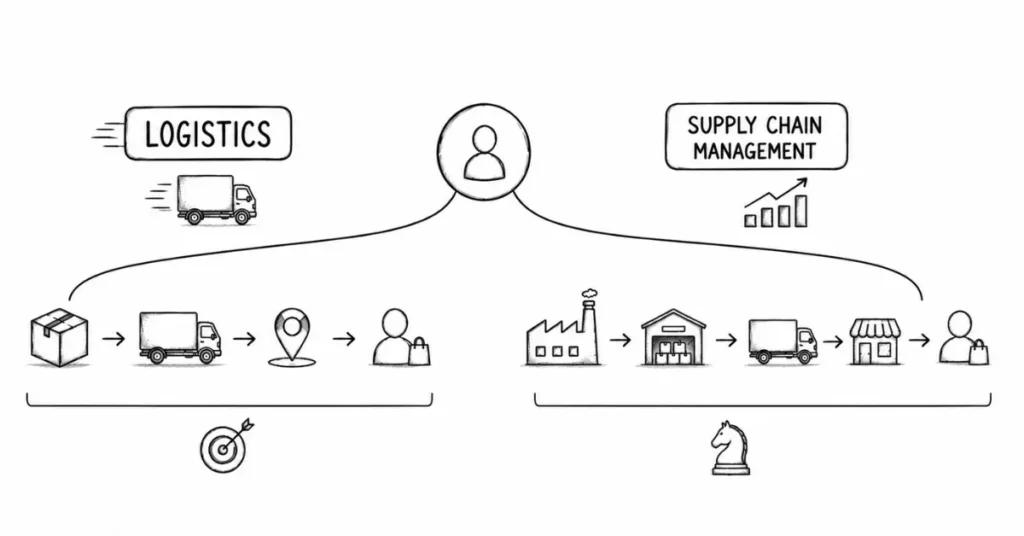
“I’m interested in logistics.” “I want to work in supply chain management.”
I hear these statements constantly from students and job seekers—often used interchangeably, as if they mean the same thing. But here’s the problem: logistics and supply chain management are NOT the same, and confusing them can lead you down the wrong career path.
I’ve seen talented professionals pigeonhole themselves by saying “I only want logistics roles” without realizing they’re excluding 70% of supply chain opportunities. I’ve also seen people accept “supply chain” positions thinking they’ll manage strategy, only to find themselves coordinating truck deliveries—frustrated because expectations didn’t match reality.
Understanding the distinction isn’t just academic semantics—it’s critical for making informed career decisions. Should you specialize in logistics or pursue broader supply chain management? Which pays better? Which offers more growth? Which fits your skills and interests?
This guide clarifies once and for all: what logistics is, what supply chain management encompasses, how they relate, and most importantly—which career path might be right for you.
PART 1: DEFINING THE TERMS
What is Logistics?
Simple Definition:
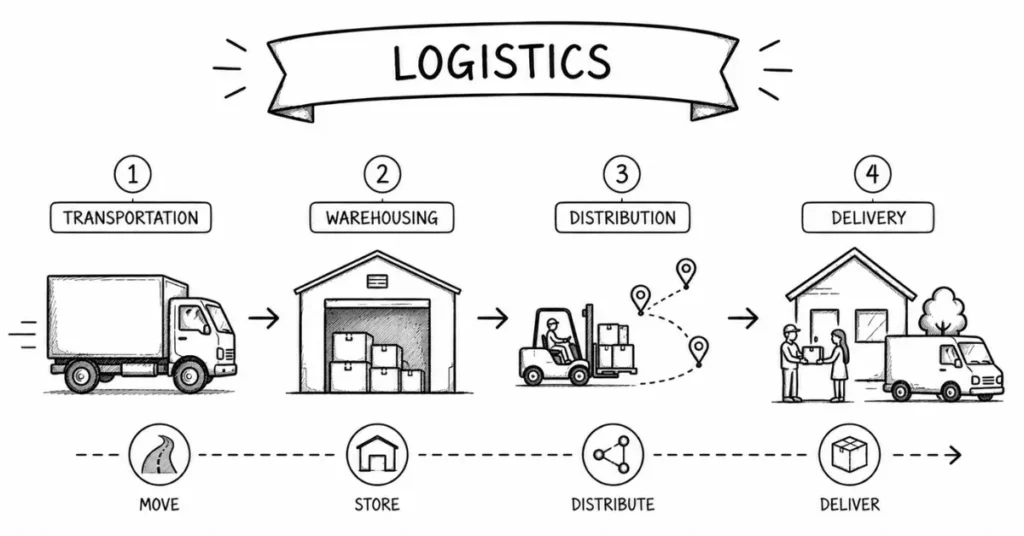
Logistics is the movement and storage of goods, materials, and information from point of origin to point of consumption.
Core Focus:
Physical execution—getting the right products to the right place, at the right time, in the right quantity, at the lowest cost.
Key Activities in Logistics:
- Transportation Management: Selecting carriers, routing shipments, tracking deliveries
- Warehousing: Storing inventory, managing facilities, order fulfillment
- Inventory Management: Tracking stock levels, managing storage locations
- Order Fulfillment: Picking, packing, shipping customer orders
- Distribution: Managing movement through distribution networks
- Freight Management: Negotiating rates, managing carriers, freight payment
Think of Logistics As:
The execution arm of supply chain. It’s operational, tactical, and focused on physical movement.
Real-World Example:
A logistics manager at an e-commerce company coordinates moving 50,000 packages daily from warehouses to customers across India—routing deliveries, managing courier partners, tracking shipments, resolving delays, optimizing delivery costs.
What is Supply Chain Management?
Simple Definition:
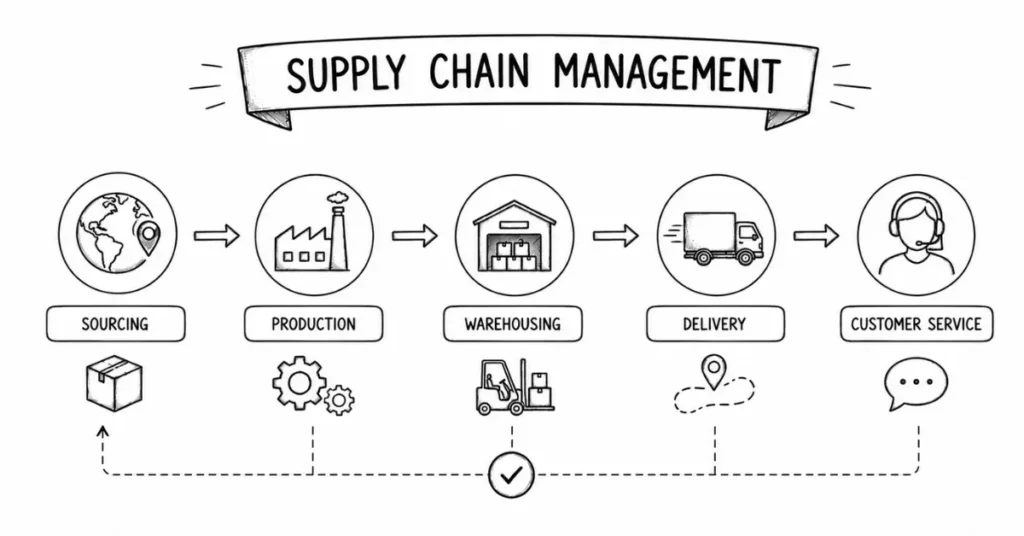
Supply chain management is the end-to-end coordination of all activities involved in sourcing, procurement, conversion, and logistics—from raw materials to final customers, including planning, execution, and optimization.
Core Focus:
Strategic integration—orchestrating flows of materials, information, and finances across the entire value chain to create customer value efficiently.
Key Activities in Supply Chain Management:
- Strategic Planning: Network design, make vs. buy decisions, location strategies
- Demand Planning: Forecasting customer demand, sales & operations planning
- Supply Planning: Production scheduling, material requirements planning
- Procurement & Sourcing: Selecting suppliers, negotiating contracts, category management
- Manufacturing Coordination: Production planning, capacity management
- Logistics Execution: (Includes all logistics activities)
- Inventory Optimization: Balancing service levels and working capital
- Performance Management: KPIs, analytics, continuous improvement
- Risk Management: Supply disruption planning, business continuity
Think of Supply Chain Management As:
The complete orchestration from suppliers’ suppliers to customers’ customers. It’s strategic, integrated, and focused on overall system optimization.
Real-World Example:
A supply chain manager at a consumer goods company owns the entire flow: forecasting demand for 50 products, planning production across 3 plants, sourcing raw materials from 100+ suppliers, managing inventory across 5 warehouses, coordinating distribution to 10,000 retail outlets, and optimizing the entire system for cost and service.
The Relationship: Logistics is PART of Supply Chain
Visual Understanding:
text
SUPPLY CHAIN MANAGEMENT (The Whole)
├── Strategic Planning
├── Demand Planning
├── Procurement & Sourcing
├── Manufacturing/Operations
├── LOGISTICS (A Critical Part)
│ ├── Transportation
│ ├── Warehousing
│ ├── Distribution
│ └── Order Fulfillment
├── Inventory Management
└── Performance Analytics
Key Insight:
Every logistics professional works in supply chain, but not every supply chain professional focuses primarily on logistics. Logistics is a subset of the broader supply chain management discipline.
Analogy:
Think of it like marketing and advertising. Advertising is part of marketing, but marketing encompasses much more—research, strategy, pricing, product development, advertising, promotions, etc. Similarly, logistics is part of supply chain, but supply chain encompasses planning, sourcing, production, logistics, and optimization.
PART 2: KEY DIFFERENCES
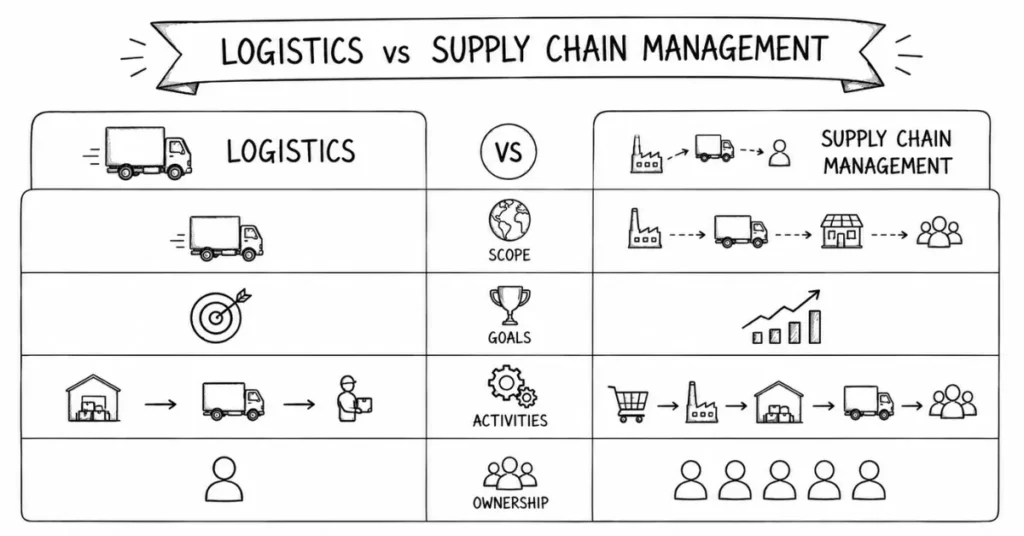
1. Scope Difference
Logistics:
- Narrow focus: Movement and storage
- Tactical execution: Day-to-day operations
- Timeline: Short-term (daily/weekly planning)
- Boundaries: Warehouse to customer, supplier to warehouse
Supply Chain Management:
- Broad scope: End-to-end value chain
- Strategic coordination: Long-term planning and optimization
- Timeline: Medium to long-term (monthly S&OP, annual strategies)
- Boundaries: Supplier’s supplier to customer’s customer
2. Role & Responsibility Difference
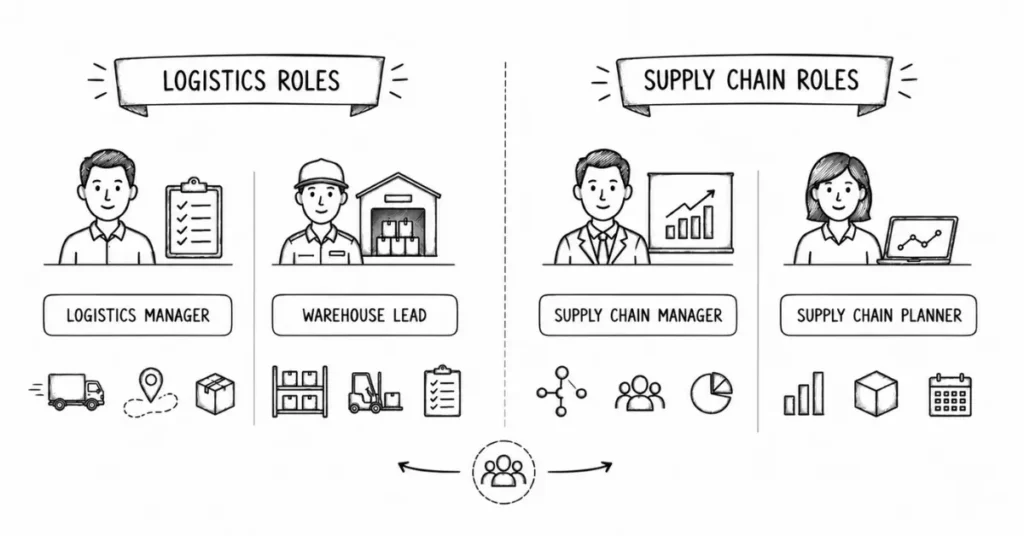
Logistics Roles Focus On:
- Executing shipments and deliveries
- Managing warehouse operations
- Coordinating with transporters and carriers
- Tracking and resolving delivery issues
- Optimizing routes and freight costs
- Ensuring on-time delivery
- Managing 3PL relationships
Supply Chain Management Roles Focus On:
- Forecasting demand and planning supply
- Strategic sourcing and supplier management
- Inventory optimization across network
- Production planning and scheduling
- Cross-functional coordination (sales, finance, operations)
- Network design and facility location
- Risk management and contingency planning
- Performance analytics and improvement
3. Skills Difference
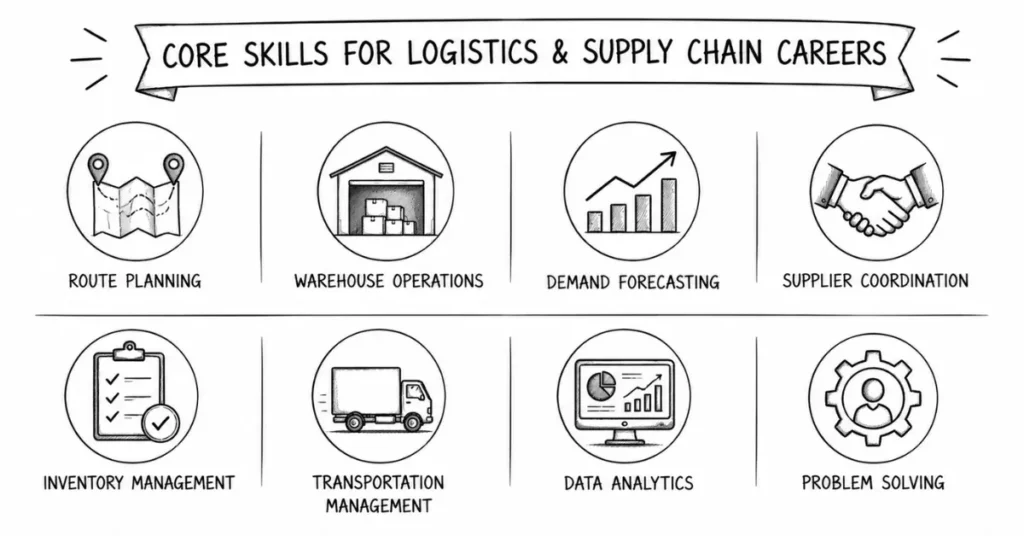
Critical Logistics Skills:
- Transportation modes and routing
- Warehouse management systems (WMS)
- Transportation management systems (TMS)
- Freight negotiation and carrier management
- Operational problem-solving (resolving delays, damages)
- Geographic and routing knowledge
- Relationship management with logistics service providers
Critical Supply Chain Management Skills:
- Demand forecasting and statistical analysis
- Strategic thinking and systems thinking
- Procurement and negotiation
- Financial acumen (understanding P&L, working capital)
- ERP systems (SAP, Oracle)
- Cross-functional collaboration
- Advanced planning tools (SAP IBP, Kinaxis, Blue Yonder)
- Business strategy and commercial awareness
Overlap:
Both require: Data analysis, problem-solving, communication, Excel, project management, stakeholder management.
4. Career Trajectory Difference
Typical Logistics Career Path:
text
Logistics Coordinator (₹3-4L)
↓
Logistics Executive (₹4-6L)
↓
Logistics Manager (₹8-12L)
↓
Senior Logistics Manager (₹13-18L)
↓
Head of Logistics/Distribution (₹20-30L)
Ceiling: Logistics leaders typically cap at Head of Logistics or VP Logistics in large organizations (₹25-35 lakhs). To reach CSCO level, you usually need broader supply chain experience beyond pure logistics.
Typical Supply Chain Management Career Path:
text
Supply Chain Analyst (₹4-7L)
↓
Supply Chain Planner/Manager (₹9-15L)
↓
Senior Supply Chain Manager (₹15-22L)
↓
Supply Chain Director (₹22-35L)
↓
VP Supply Chain / CSCO (₹35-70L+)
Ceiling: Broader path to C-suite. Supply chain management encompasses logistics, so senior SCM roles include logistics oversight plus strategy, planning, procurement.
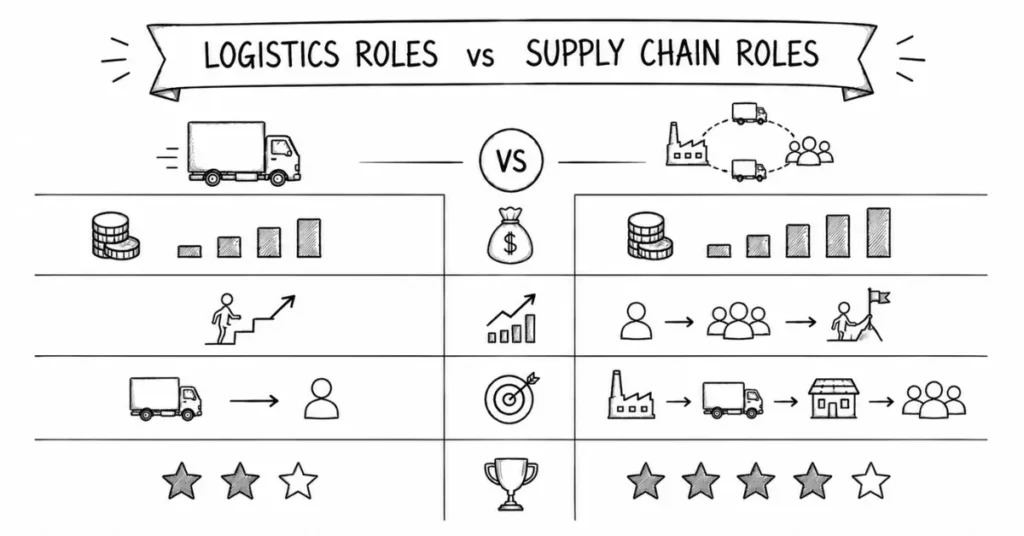
5. Compensation Difference
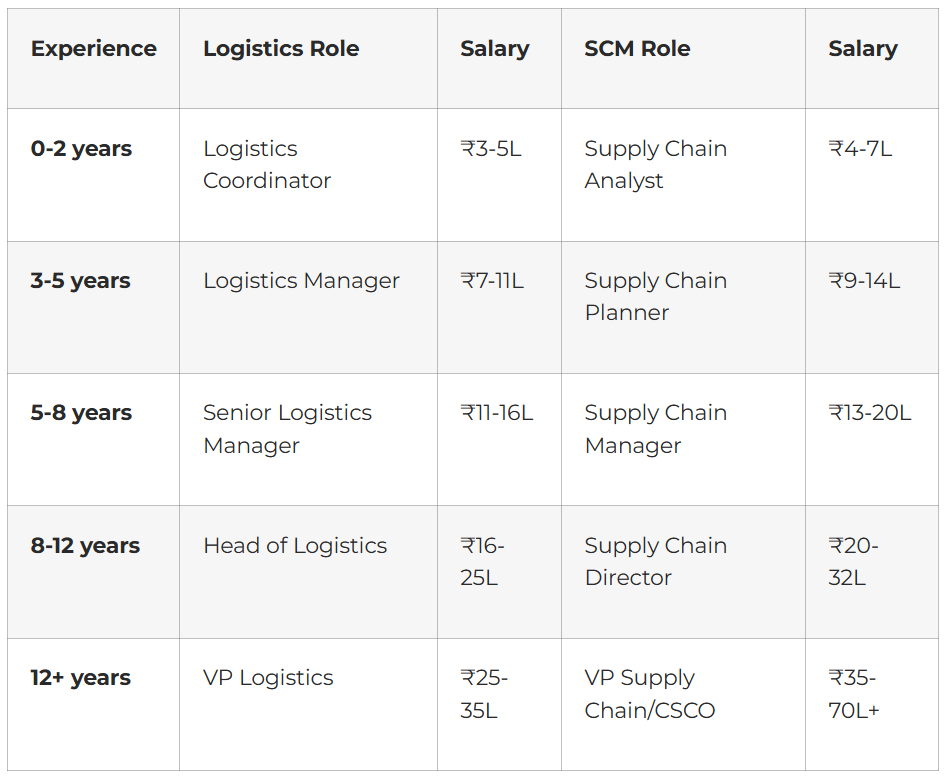
Logistics Roles:
- Entry-level: ₹3-5 lakhs (Logistics Coordinator)
- Mid-level: ₹8-14 lakhs (Logistics Manager)
- Senior-level: ₹15-25 lakhs (Head of Logistics)
- Executive: ₹25-35 lakhs (VP Logistics, large companies only)
Supply Chain Management Roles:
- Entry-level: ₹4-7 lakhs (Supply Chain Analyst)
- Mid-level: ₹10-18 lakhs (Supply Chain Manager)
- Senior-level: ₹20-35 lakhs (Supply Chain Director)
- Executive: ₹35-70+ lakhs (VP Supply Chain / CSCO)
Key Observation:
Supply chain management roles generally pay 10-20% more at equivalent experience levels due to broader scope and strategic nature. However, top logistics specialists in critical roles (e.g., Head of Distribution for major e-commerce company) can earn very competitively.
PART 3: CAREER PATH COMPARISON
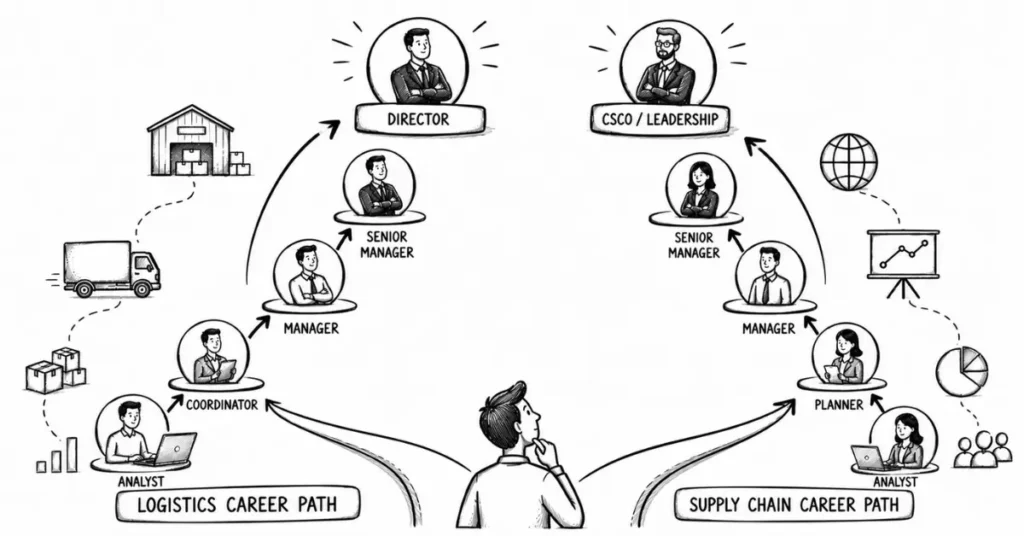
Logistics-Focused Career
Best For:
- Operational thinkers who enjoy tactical execution
- Those who prefer tangible, physical operations over abstract planning
- People comfortable with fast-paced, dynamic environments
- Professionals who like solving immediate, concrete problems
- Those who enjoy working with external partners (carriers, warehouse operators)
Career Advantages:
✅ Clear, measurable outcomes (on-time delivery, cost per shipment)
✅ Hands-on, visible impact
✅ Strong demand (every company needs logistics)
✅ Transferable skills across industries
✅ Less dependent on advanced degrees
✅ Can start with less formal education
Career Limitations:
❌ Narrower scope limits senior advancement
❌ Often seen as cost center (not strategic)
❌ May require shift work or unconventional hours
❌ Physical demands in warehouse/operations roles
❌ Lower compensation ceiling than broad SCM
❌ Can become commoditized (outsourced to 3PLs)
Typical Employers:
- 3PL companies (Delhivery, Blue Dart, DHL)
- E-commerce (Amazon, Flipkart)
- Manufacturing companies (logistics department)
- Retail chains (distribution operations)
- Logistics consulting firms
Supply Chain Management Career
Best For:
- Strategic thinkers who enjoy planning and optimization
- Analytical minds comfortable with data and forecasting
- Those interested in cross-functional coordination
- People who appreciate complexity and systems thinking
- Professionals targeting senior leadership (Director, VP, CSCO)
Career Advantages:
✅ Broader scope and strategic influence
✅ Higher compensation potential
✅ Path to C-suite (CSCO roles)
✅ Diverse career options (planning, procurement, analytics, strategy)
✅ Valued as profit enabler (not just cost center)
✅ Intellectually stimulating variety
Career Limitations:
❌ More competitive (requires strong education/credentials)
❌ Longer path to hands-on impact
❌ Requires stronger analytical and technical skills
❌ More desk-based, less operational visibility
❌ Success harder to measure (longer-term impacts)
❌ Steeper learning curve initially
Typical Employers:
- FMCG companies (HUL, ITC, P&G)
- Pharmaceutical companies
- Manufacturing firms
- Consulting firms (McKinsey, BCG supply chain practices)
- Technology companies
- Any large enterprise with strategic supply chain function
PART 4: HYBRID ROLES & OVERLAPPING POSITIONS
Roles That Blend Both
Many positions integrate logistics execution with broader supply chain responsibilities:
Supply Chain Manager (Operations Focus):
- Owns end-to-end flow but heavily weighted toward logistics execution
- Typical in mid-sized companies where roles are less specialized
- Salary: ₹10-16 lakhs
Demand & Supply Planning Manager:
- Plans what to produce/buy AND coordinates logistics to deliver
- Strategic planning + execution
- Salary: ₹12-18 lakhs
Operations Manager:
- Manages manufacturing operations + inbound/outbound logistics
- Broad scope touching multiple supply chain functions
- Salary: ₹10-15 lakhs
E-commerce Fulfillment Manager:
- Strategic fulfillment network planning + daily logistics execution
- Blends both strategic and operational
- Salary: ₹12-18 lakhs
PART 5: WHICH PATH IS RIGHT FOR YOU?
Choose Logistics-Focused Career If:
✅ You prefer action over analysis (doing vs. planning)
✅ You like tangible results you can see daily
✅ You’re comfortable with fast-paced, high-pressure environments
✅ You enjoy physical operations (warehouses, transportation)
✅ You want to start working quickly without advanced degrees
✅ You prefer external-facing roles (dealing with vendors, carriers)
✅ You’re geographically flexible (logistics hubs may be in specific locations)
Career Entry Points:
- Logistics Coordinator roles at 3PL, e-commerce, manufacturing
- Warehouse operations positions
- Transportation coordinator roles
- No MBA required initially (though helpful later)
Choose Supply Chain Management Career If:
✅ You enjoy strategic thinking and planning
✅ You’re analytically strong (comfortable with data, forecasting, modeling)
✅ You prefer cross-functional collaboration over single-function depth
✅ You want path to senior leadership (Director, VP, CSCO)
✅ You’re willing to invest in education (MBA, certifications)
✅ You appreciate systems thinking and complexity
✅ You prefer office/desk-based work over operational environments
Career Entry Points:
- Supply Chain Analyst at FMCG, pharma, manufacturing
- Demand Planning roles
- Procurement trainee programs
- Supply Chain MBA programs at companies like HUL, ITC, P&G
The Hybrid Approach (Recommended for Many)
Smart Career Strategy:
Many successful supply chain leaders follow this pattern:
Years 0-3: Start in logistics execution
- Learn operations ground-up
- Understand how things actually move
- Build operational credibility
- Develop problem-solving skills in real-time
Years 3-7: Transition to broader supply chain roles
- Move into planning, procurement, or integrated supply chain
- Pursue MBA or APICS certifications
- Leverage operational expertise with strategic skills
- Expand scope beyond pure logistics
Years 7+: Senior supply chain leadership
- Your logistics foundation makes you credible
- Your strategic skills enable leadership
- You understand both planning and execution
- You’re positioned for Director/VP roles
Why This Works:
You understand operations deeply (credibility) while developing strategic capabilities (advancement). Many CSCOs have logistics backgrounds—they know where the rubber meets the road.
PART 6: SALARY COMPARISON ACROSS EXPERIENCE
PART 7: EDUCATIONAL REQUIREMENTS COMPARISON
For Logistics Careers:
Minimum Education:
- Bachelor’s degree (any field, though engineering/commerce preferred)
- Many successful logistics professionals without specialized supply chain education
Helpful Education:
- Diploma in Logistics & Supply Chain
- MBA with Operations specialization (accelerates to management)
- APICS CLTD (Certified in Logistics, Transportation and Distribution)
Reality: Practical experience often valued more than advanced degrees in pure logistics roles. Many warehouse managers and logistics heads worked their way up from coordinator roles.
For Supply Chain Management Careers:
Minimum Education:
- Bachelor’s degree (engineering, commerce, or management)
- Increasingly, companies prefer MBA for management trainee programs
Strongly Recommended:
- MBA from reputable B-school (especially for FMCG, pharma, consulting)
- APICS CSCP certification (mid-career differentiation)
- Supply chain specialization in engineering or business programs
Reality: Supply chain management roles are more competitive and typically require stronger educational credentials, especially for premier companies (HUL, P&G, ITC).
PART 8: TRANSITIONING BETWEEN PATHS
From Logistics to Broader Supply Chain
Common Transition (Possible and Recommended):
Many professionals start in logistics and expand:
How to Transition:
- Pursue education: MBA or APICS CSCP while working in logistics
- Volunteer for projects: Demand planning, procurement initiatives at current company
- Develop analytical skills: Advanced Excel, SQL, planning tools
- Internal transfer: Request move to planning or integrated supply chain role
- Strategic job change: Position logistics experience + new education for broader role
Timeline: 3-5 years in logistics, then transition with additional education.
Example: Logistics manager → Completes executive MBA → Moves to Supply Chain Manager role covering planning, procurement, and logistics.
From Supply Chain to Logistics Specialization
Less Common but Possible:
Some supply chain professionals specialize in logistics later:
Why People Do This:
- Found passion for operational execution
- Opportunity to lead large logistics operations
- Role at e-commerce/3PL companies requiring logistics depth
Transition Strategy:
- Take roles with heavy logistics component
- Develop deep expertise in transportation/warehousing
- Pursue logistics-specific certifications (CLTD)
PART 9: FUTURE OUTLOOK
Logistics Evolution
Technology Impact:
- Automation (robotics in warehouses, autonomous vehicles coming)
- AI-powered route optimization
- Real-time tracking and visibility platforms
- Drone deliveries (experimental but growing)
Job Impact:
- Tactical coordinator roles may decrease (automation)
- Strategic logistics roles (network design, optimization) will grow
- Technology skills increasingly important
- Focus shifting to exception management and optimization
Verdict: Logistics careers remain strong but evolving. Professionals must upskill in technology and analytics to stay relevant.
Supply Chain Management Evolution
Technology Impact:
- AI-driven demand forecasting
- Digital twins and simulation
- Real-time supply chain control towers
- Blockchain for transparency
- Sustainability and ESG integration
Job Impact:
- Growing demand for supply chain strategists
- Analytics and data science integration
- Risk management and resilience planning
- Sustainability specialists emerging
- Strategic roles growing faster than operational roles
Verdict: Excellent growth outlook. Supply chain management increasingly strategic and valued at executive levels.
Final Decision Framework: Your Next Steps
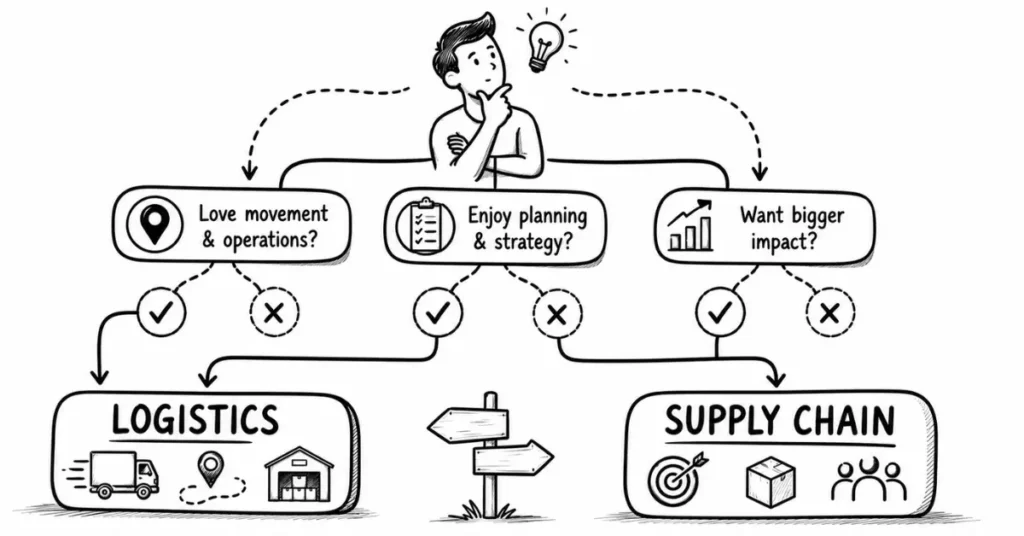
Ask Yourself:
Do I prefer action or analysis?
- Action → Logistics
- Analysis → Supply Chain Management
Where do I want to be in 10 years?
- Leading operations → Logistics specialist
- Strategic leadership/C-suite → Supply Chain Management
What’s my educational background and willingness to invest?
- Limited education/budget → Start logistics, expand later
- MBA/strong education → Direct supply chain management path
What energizes me?
- Solving today’s tangible problems → Logistics
- Planning for tomorrow’s optimization → Supply Chain Management
What lifestyle do I want?
- Hands-on, potentially irregular hours → Logistics
- Office-based, more predictable → Supply Chain Management
Conclusion: Both Paths Lead to Success
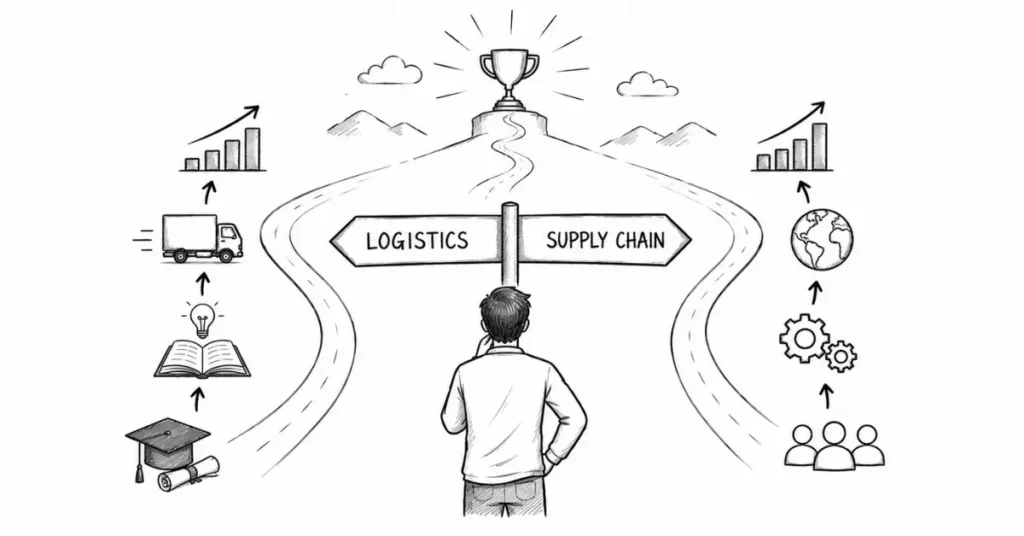
The “logistics vs supply chain management” question isn’t about which is better—both offer legitimate, rewarding careers. It’s about which fits YOU better.
The Truth:
- Logistics specialists are essential and well-compensated
- Supply chain managers have broader scope and higher ceilings
- Many successful careers blend both
- You’re not locked in—transitions are possible
My Recommendation:
If uncertain, start with logistics exposure (operational credibility), develop analytical and strategic skills, then expand scope as career progresses. This hybrid path offers flexibility and positions you well for senior leadership.
Whether you become a logistics expert orchestrating physical flows or a supply chain strategist optimizing end-to-end value chains, you’re building a valuable, future-proof career.
Choose your path deliberately. Commit fully. Deliver results. Success follows.