
ISRO Career Guide
Table of Contents
Introduction:
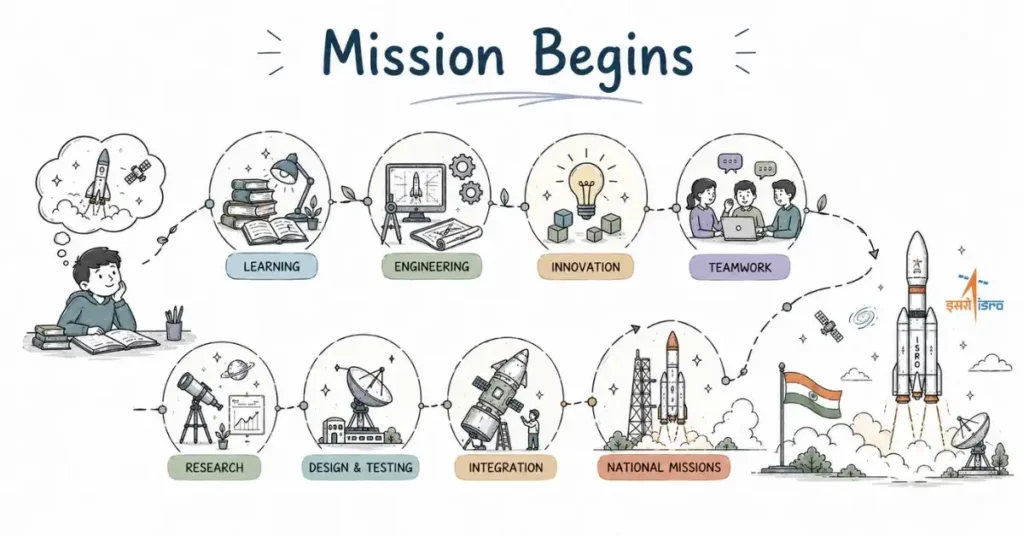
Every engineering student in India has thought about it at least once. Working on Chandrayaan. Seeing a rocket you helped build lift off from Sriharikota. Having ISRO on your resume.
The dream is common. The path, surprisingly, is not as mysterious as most students think. ISRO does not recruit through secret channels or favour only IIT graduates. It has a transparent, merit-based recruitment process that any engineering graduate from any recognised Indian university can attempt.
What it does require is clarity about the process, the preparation, and what life inside ISRO actually looks like. This guide gives you all three.
What ISRO Actually Does And Why It Matters for Your Career Choice
Before you decide whether ISRO is the right fit, understand what kind of organisation it is.
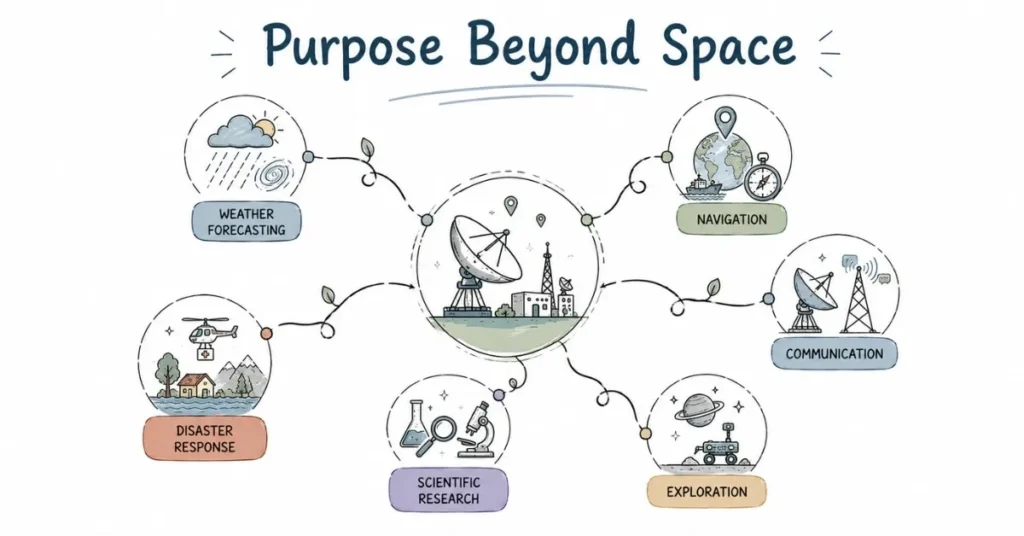
ISRO is India’s national space agency, under the Department of Space, Government of India. It designs, builds, launches, and operates satellites and launch vehicles. It also develops space applications weather forecasting, disaster management, navigation, remote sensing that directly serve the country.
Unlike a corporate employer, ISRO’s work is mission-driven in the most literal sense. Every project has a defined national purpose. Chandrayaan-3 mapped the Moon’s south pole. Aditya-L1 studies the Sun. NavIC provides navigation to India’s fishing community, armed forces, and increasingly its smartphones. Gaganyaan will send Indian astronauts to space.
If working on projects at that scale, with that kind of national significance, appeals to you ISRO is genuinely different from any corporate or startup job. If fast promotions, high cash salaries, and rapid role changes matter more a private company will serve you better. Both are valid choices.
ISRO's Major Centres Where You Could Work
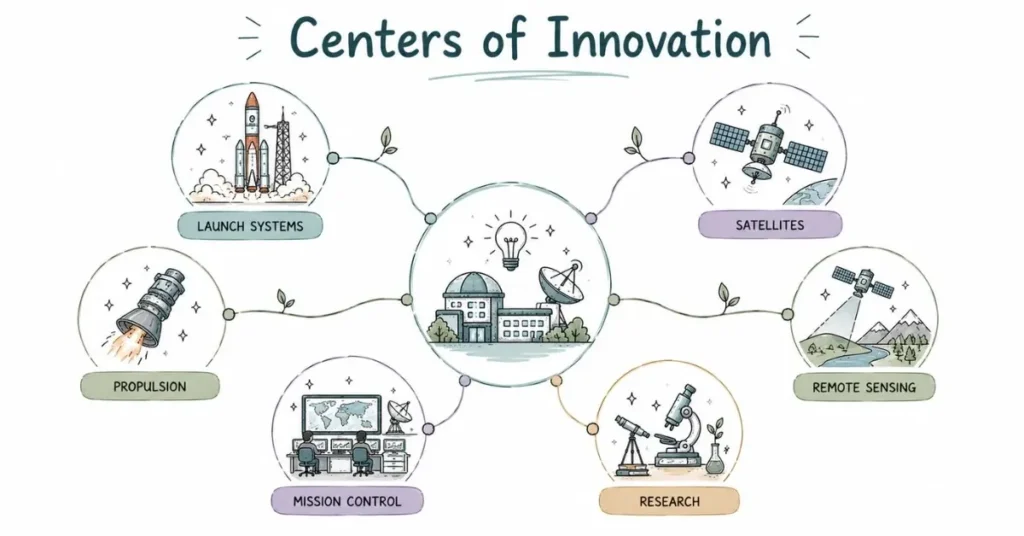
ISRO is not one office. It is a network of specialised centres across India, each focused on a different aspect of space activity. Your posting depends on your branch and the vacancy.
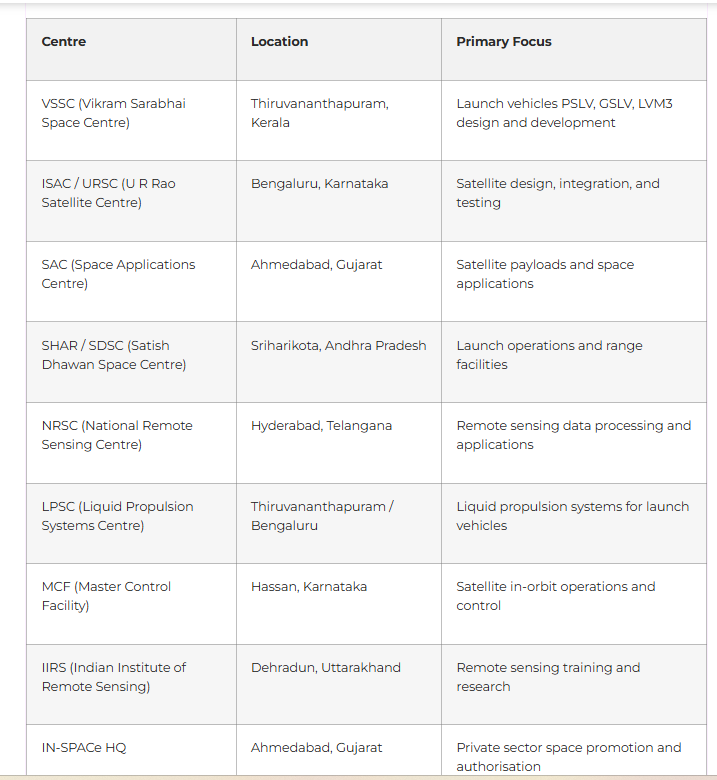
Each centre has its own culture, work pace, and specialisation. VSSC is arguably the most intense launch vehicle development has tight deadlines and high stakes. SAC has a strong research culture. NRSC in Hyderabad is particularly accessible for engineers interested in data and earth observation applications.
The Entry Route ISRO ICRB Recruitment Process

The primary way to join ISRO as an engineer is through ICRB ISRO Centralised Recruitment Board. Here is exactly how it works:
Step 1 : Notification
ISRO releases recruitment notifications on its official website (isro.gov.in). There is no fixed annual schedule notifications come out when vacancies exist. The most common entry-level role is Scientist/Engineer SC (the SC stands for the pay level, not a category indicator). Sign up for job alerts and check the website regularly.
Step 2: Eligibility Check
Most Scientist/Engineer SC vacancies require:
- B.E./B.Tech in a relevant engineering branch (Mechanical, Electronics, Computer Science, Electrical, Civil, Chemical, and Aerospace are all regularly recruited)
- Minimum 65% aggregate marks (or equivalent CGPA) in your degree
- Age below 35 years (with relaxation for SC/ST/OBC/PwD candidates as per government norms)
- Indian citizenship
No GATE score required. No specific college preference stated.
Step 3 : Written Examination
The ICRB written exam has two papers:
- Paper 1 (Technical): 80 questions specific to your engineering branch. Covers core undergraduate syllabus. Difficulty is roughly at the level of GATE but with a broader topic spread and less mathematical depth.
- Paper 2 (General): 20 questions covering general aptitude, reasoning, and general awareness including space and current affairs.
Total marks: 100. Duration: Typically 2 hours. Negative marking applies 1/3 mark deducted per wrong answer.
Step 4 : Interview
Candidates shortlisted from the written exam (typically top 3–5 times the number of vacancies) are called for a personal interview. The interview panel tests:
- Technical depth in your engineering specialisation
- Awareness of ISRO’s ongoing and recent missions
- Problem-solving approach and clarity of thought
- Communication skills and motivation
The interview carries significant weight it is not just a formality. Candidates who score moderately in the written exam but perform exceptionally in the interview do get selected.
Step 5 : Medical Examination
Selected candidates undergo a standard medical fitness examination before joining.
Step 6 : Joining and Posting
ISRO posts selected candidates to centres based on project requirements and vacancies. You can indicate a preference but cannot guarantee a specific centre. Joining formalities typically happen 3–6 months after final selection.

ISRO Salary What You Actually Take Home
This is the most searched question about ISRO careers, so here are the real numbers:
Scientist/Engineer SC (Entry Level)
- Basic Pay: ₹56,100/month (Level 10 of the 7th Pay Commission)
- HRA (House Rent Allowance): 8–24% of basic pay depending on posting city
- DA (Dearness Allowance): Currently around 50% of basic pay
- Other allowances: Transport, medical, special ISRO allowances
Total in-hand salary (approximate): ₹75,000–₹95,000/month depending on posting city
Annual CTC equivalent: ₹9–11 LPA when all allowances are counted
Senior levels:
- Scientist/Engineer SD: ₹67,700/month basic
- Scientist/Engineer SE: ₹78,800/month basic
- Scientist/Engineer SF: ₹1,23,100/month basic
- Outstanding Scientist: ₹1,44,200/month basic
- Distinguished Scientist: ₹1,77,500/month basic (the level at which ISRO chiefs typically operate)
Beyond cash salary, ISRO offers:
- Government housing (or HRA) at the centre location significantly reduces cost of living
- Medical facilities ISRO has its own hospitals and medical schemes for employees and families
- ISRO Employees Welfare Scheme covers education, housing loans, insurance
- Job security permanent government employment
- Pension NPS (National Pension System) for central government employees
- Subsidised canteen, transport, and recreational facilities at major centres
The real financial advantage of ISRO is not the monthly salary figure it is the combination of allowances, subsidised housing, medical coverage, and lifetime job security that makes the total package genuinely competitive, especially at senior levels.
What Work Life at ISRO Actually Looks Like
Students often imagine ISRO as a place of constant rocket launches and Moon missions. The reality is both more ordinary and more interesting than that.
On most days, an ISRO engineer’s work looks like this: design reviews, technical documentation, simulation runs, component testing, coordination meetings with other subsystem teams, and paperwork. A lot of paperwork. ISRO is a government organisation with the documentation culture that comes with it.
But embedded in that routine are genuinely extraordinary moments. Being part of the team that tracked Chandrayaan-3 during its final descent. Watching a PSLV carry a payload you spent three years designing. Receiving telemetry from a satellite 1.5 million kilometres away at the L1 point.
ISRO engineers also describe a strong sense of ownership. Because teams are leaner than in large corporations, individual engineers often carry responsibility for entire subsystems rather than narrow tasks. A young engineer at ISRO may own the thermal design of a satellite panel in a way that would take 10 years to achieve at Boeing.
Work-life balance is generally good at ISRO by Indian engineering standards 8-hour workdays, no weekend culture, generous leave policies. During launch campaigns, hours extend significantly. But those periods are time-bound and come with the energy of being part of something historic.

How to Prepare for ISRO ICRB : A Practical Strategy
For the Written Examination:
Start with your engineering fundamentals. The ICRB technical paper tests exactly what your B.Tech syllabus covered but at depth. Areas that consistently appear across branches:
For Mechanical / Aerospace:
Fluid mechanics, thermodynamics, strength of materials, manufacturing processes, heat transfer, machine design, engineering mathematics
For ECE:
Signals and systems, communication theory, electromagnetics, analog and digital circuits, control systems, microprocessors
For Computer Science:
Data structures and algorithms, operating systems, computer networks, database management, software engineering, programming
Study approach:
- Solve previous year ICRB papers they are the most reliable indicator of question style and difficulty
- Solve GATE previous year papers for your branch the depth is similar
- Use standard textbooks: for mechanical, R.K. Bansal and P.K. Nag are reliable; for ECE, Sedra/Smith and Haykin; for CS, CLRS for algorithms
- Set aside the last 30 minutes of each study session for space awareness read about ISRO’s current missions, recent launches, and upcoming programs on isro.gov.in
For the Interview:
- Know your final year project completely panel members probe it deeply
- Be able to explain at least two recent ISRO missions clearly (what the satellite does, what orbit it is in, what payload it carries)
- Have one or two examples of engineering problem-solving from your college experience ready
- Be honest about what you know and do not know ISRO interviewers respect intellectual honesty
Every influencer marketing professional encounters these obstacles. Here’s how to navigate them:
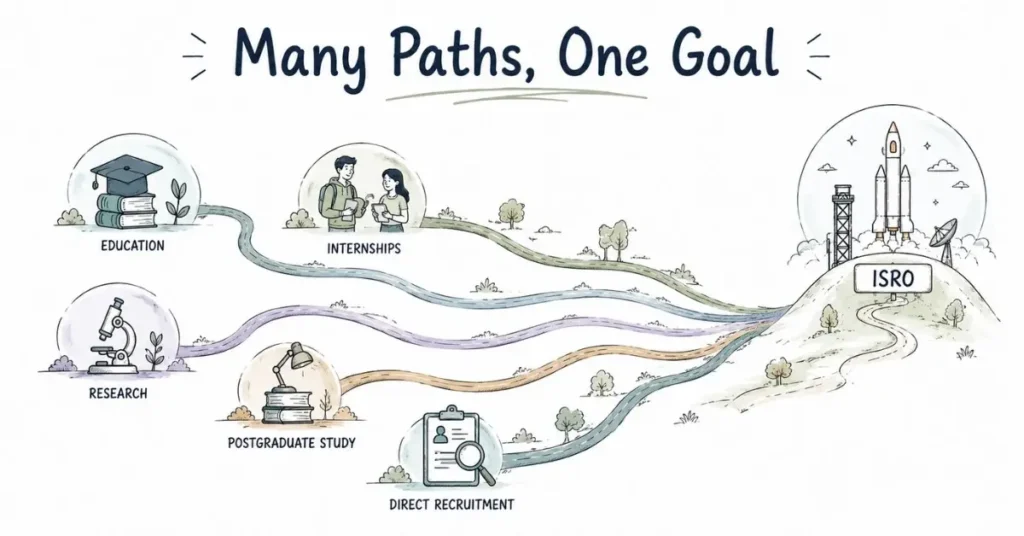
Alternative Paths Into ISRO
ICRB Scientist/Engineer SC is not the only way in. Several alternative routes exist:
IIST Direct Absorption
IIST B.Tech graduates are directly absorbed into ISRO on completing their degree no ICRB exam required. This is the most reliable single path into ISRO for anyone who can qualify through JEE Advanced.
ISRO Research Fellowships (RESPOND Program)
ISRO funds M.Tech and Ph.D. research at Indian universities through its RESPOND (Research Sponsorship) program. Students working on ISRO-sponsored research projects at IITs, NITs, and other universities can get stipends and sometimes direct consideration for ISRO positions.
ISRO Internships
Not a direct hiring pipeline, but ISRO internships at various centres are often the first step that leads to a job offer. Interns who perform well and express interest in joining are sometimes considered when vacancies arise.
Junior Research Fellow (JRF) and Research Associate positions
ISRO’s individual centres sometimes advertise JRF and RA positions for postgraduate and Ph.D. candidates these are project-based roles that can lead to permanent positions.
NSIL and IN-SPACe
NSIL (ISRO’s commercial arm) and IN-SPACe (the regulatory body) both recruit separately from ISRO proper. Their recruitment processes are less publicised but are open to engineers and non-engineers alike. Watch their official websites and NSIL’s careers page.

FAQs : ISRO Career Guide
Q: Can students from private engineering colleges get into ISRO?
Absolutely. ISRO recruits on merit through its written exam and interview. The exam does not ask for your college name. Candidates from regional private colleges who score well in the written test and perform strongly in the interview are selected regularly.
Q: How many vacancies does ISRO release each year?
This varies significantly. In some years, ISRO releases 100+ Scientist/Engineer SC vacancies in a single notification. In other years, notifications are smaller or more targeted. There is no fixed annual quota. Check isro.gov.in regularly or subscribe to job alert services.
Q: Is there a bond or service commitment after joining ISRO?
ISRO does not typically impose a bond for Scientist/Engineer SC hires. However, IIST graduates who are directly absorbed into ISRO are required to serve for a minimum period (currently 5 years) in exchange for the heavily subsidised IIST education.
Q: Can women work at all ISRO centres?
Yes. ISRO has women scientists, engineers, and project directors across all its centres. Several landmark missions including Chandrayaan and Mangalyaan had significant contributions from women engineers and scientists. ISRO provides standard government employee facilities including maternity leave and family accommodation.
Q: What happens after Scientist/Engineer SC what is the career progression?
The progression within ISRO goes: SC → SD → SE → SF → SG → Distinguished Scientist → Outstanding Scientist. Each level brings higher pay and greater responsibility. Promotions are based on a combination of time in grade, performance appraisals, and departmental requirements. Senior scientists at the SF and above levels often lead entire satellite or launch vehicle programs.