
Higher Studies - M.Tech vs MS Abroad vs MBA
Table of Contents
Higher Studies Guide: M.Tech vs MS Abroad vs MBA for Electrical Engineers
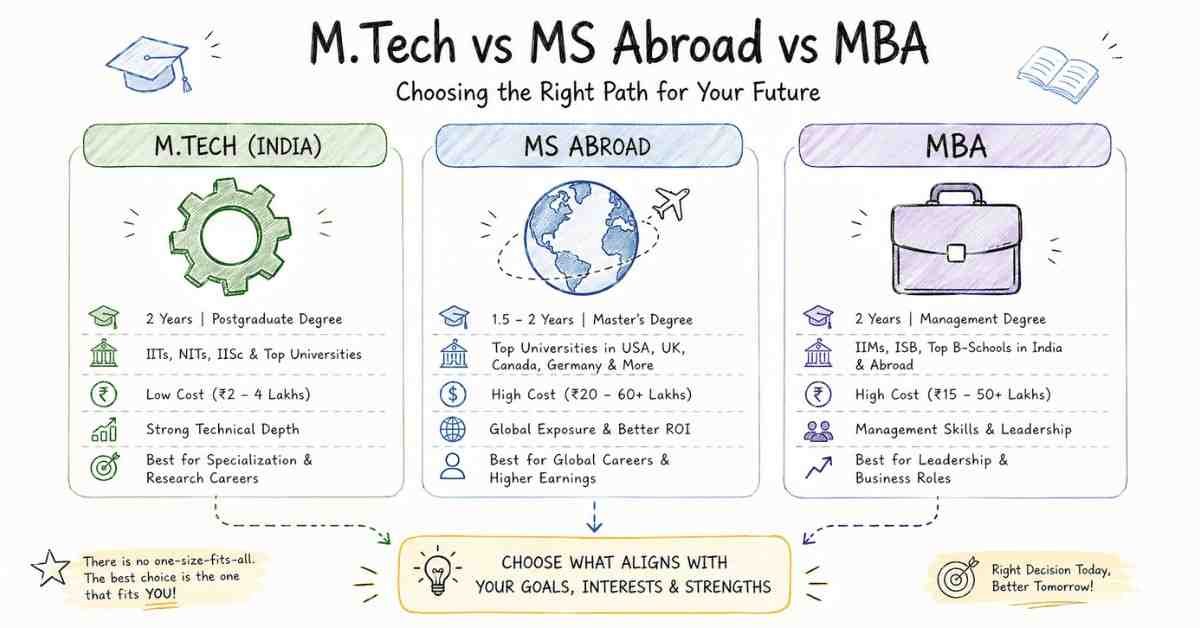
You’ve completed your B.Tech in Electrical Engineering, perhaps worked for 1-2 years, and now face a critical decision: Should you pursue higher studies? If yes, M.Tech in India, MS abroad, or MBA? Each path leads to different destinations deeper technical specialization, international career opportunities, or management roles. Choosing wrongly costs years and lakhs of rupees.
Many students make this decision based on incomplete information: “My friend did MS and got good job abroad, so I should too” or “My parents want me to do M.Tech” or “MBA seems easier than technical studies.” These aren’t good reasons. Your higher studies decision should align with your career goals, financial situation, interests, and realistic assessment of what each path offers.
This comprehensive guide compares all three options across multiple dimensions: admission processes, costs, duration, career outcomes, ROI, when each makes sense, and how to decide what’s right for you. Whether you’re a final-year student planning ahead or a working professional reconsidering your path, this guide provides the clarity you need to make an informed choice.
M.Tech vs MS Abroad vs MBA
Understanding Your Options
M.Tech (Master of Technology) in India
What It Is: 2-year postgraduate technical degree in specialized area of electrical engineering
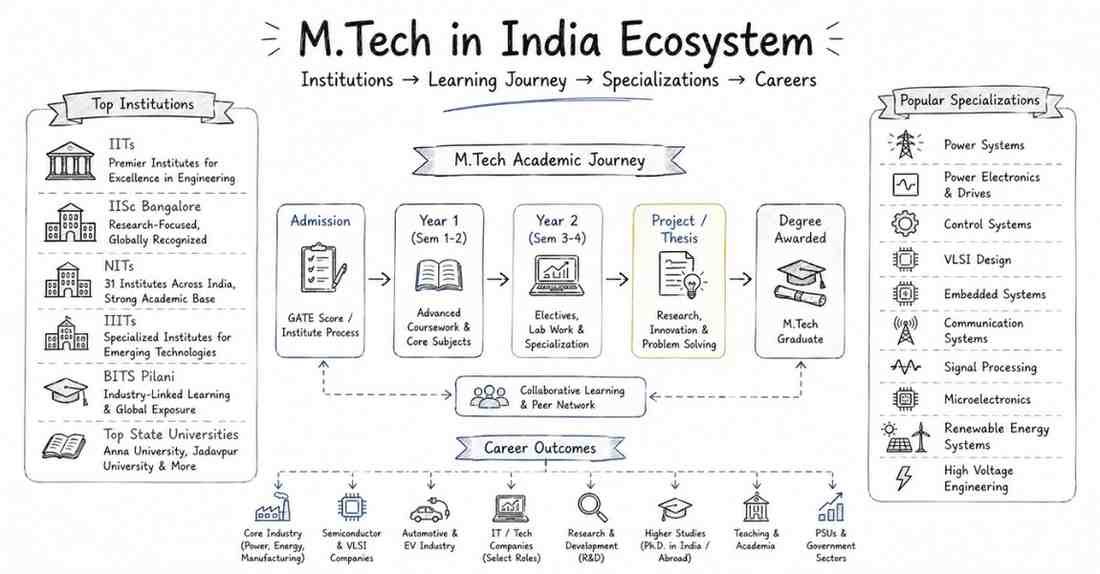
Specializations Available:
- Power Systems
- Power Electronics and Drives
- Control Systems
- VLSI Design
- Embedded Systems
- Communication Systems
- Signal Processing
- Microelectronics
- Renewable Energy Systems
- High Voltage Engineering
Top Institutions:
- IITs (7 old IITs most prestigious, newer IITs also good)
- IISc Bangalore (research-focused, highly regarded)
- NITs (31 NITs, top ones like NIT Trichy, Warangal, Surathkal excellent)
- IIITs (IIIT Hyderabad for VLSI, embedded systems)
- BITS Pilani
- Top state universities (Anna University, Jadavpur, etc.)
MS (Master of Science) Abroad
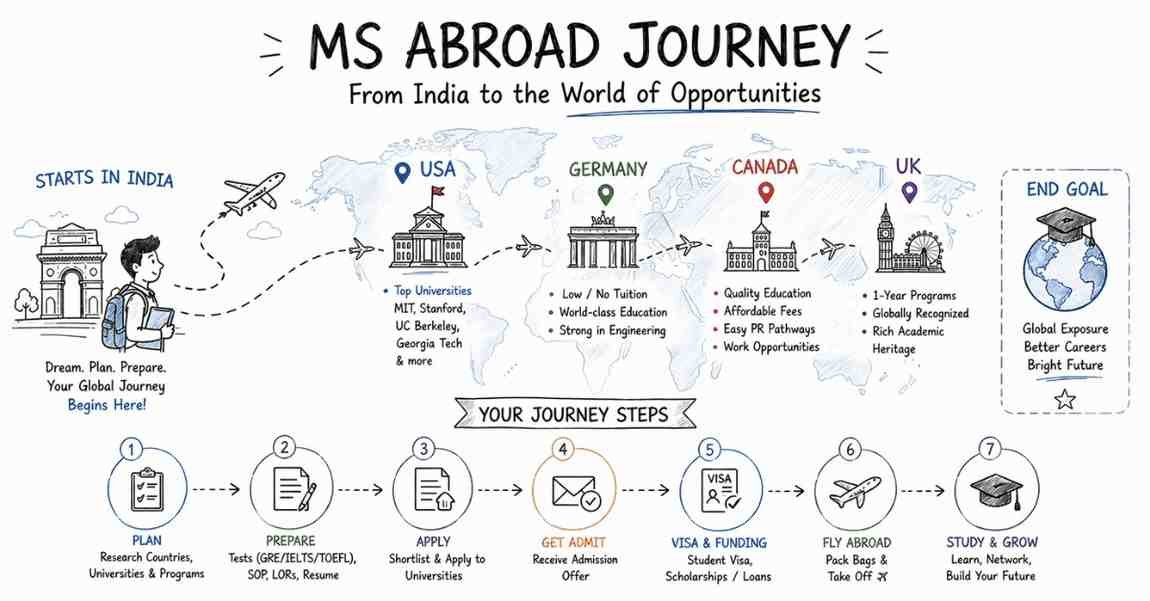
What It Is: 1.5-2 year postgraduate degree in engineering from foreign university
Popular Destinations:
- USA: Most popular, expensive, best ROI historically
- Germany: Low/no tuition, but living costs; strong engineering
- Canada: Moderate costs, easier immigration pathways
- UK: 1-year programs, expensive, work visa challenges
- Australia: Expensive, easier immigration
- European countries: Varies by country, generally affordable
- Specializations: Similar to M.Tech but more research-oriented typically
MBA (Master of Business Administration
What It Is: 2-year management degree (1-year for some international programs)
Top Options in India:
- IIMs (20+ IIMs, top 6-7 most prestigious)
- ISB Hyderabad (1-year program, high fees)
- FMS Delhi, XLRI, MDI, SP Jain, etc.
MBA Abroad: Top schools in USA (Harvard, Stanford, Wharton), Europe (INSEAD, LBS), etc.—extremely expensive (₹50 lakh – 1 crore+)
M.Tech in India: Deep Dive
Admission Process
GATE Score (Primary Route):
- Appear for GATE (Electrical Engineering paper)
- Score determines which IITs/NITs you’re eligible for
- Top IITs: Typically 600+ score; Top NITs: 500+ score
- Each institute conducts separate admission process based on GATE
CCMT (Centralized Counseling for M.Tech): For NITs, some CFTIs counseling based on GATE score
Institute-Specific Exams: Some institutes (IISc, some IITs) conduct additional written tests/interviews
Direct Admission: Some private universities, lower-tier colleges offer direct admission (not recommended unless financial constraints)
Timeline:
- GATE: February exam
- Results: March
- Admissions: April-July
- Session starts: July-August
Program Structure
Duration: 2 years (4 semesters)
Coursework:
- First year: Advanced coursework in specialization
- Second year: Project/thesis work
- Electives allowing customization
- Research-oriented (especially at IITs, IISc)
Teaching Assistantship: Many IITs/NITs offer TA positions—teaches undergrads, earns stipend (₹12,500-15,000/month)
Research Opportunities: Thesis work, possible publications, lab work
Costs
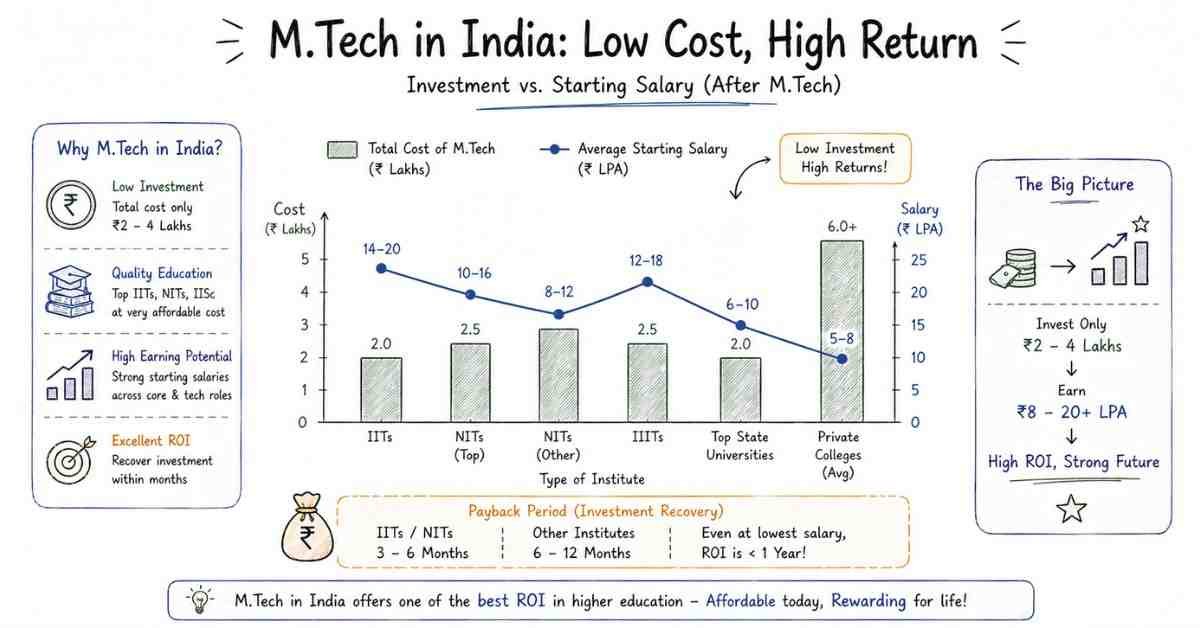
IITs/NITs/IISc:
- Tuition: ₹10,000-50,000 per semester (very subsidized)
- Hostel + Mess: ₹30,000-60,000 per year
- Books and materials: ₹20,000-40,000 total
- Total 2 years: ₹2-4 lakhs approximately
Private Colleges (if considering):
- ₹4-10 lakhs total (varies widely)
Opportunity Cost: 2 years of foregone salary (₹8-16 lakhs if you would have worked)
Total Cost (Including Opportunity Cost): ₹10-20 lakhs
Career Outcomes
Typical Placements from Top IITs/NITs:
- Core companies: ₹8-18 LPA
- Analytics/Software (if branch change): ₹12-25 LPA
- Top tech companies (Google, Microsoft): ₹30-50 LPA (rare in core electrical)
- Research positions: ₹6-12 LPA
- PSUs: Standard pay scales
Research/Academia Path:
- Gateway to Ph.D. programs (India or abroad)
- Faculty positions at engineering colleges (₹8-15 LPA starting)
Industry Specialization:
- Deeper expertise commands premium
- Power systems M.Tech → utility companies, consultancies
- VLSI M.Tech → semiconductor companies (₹10-20 LPA fresher)
- Power electronics → automotive, renewable energy
Reality Check: M.Tech from even top IITs doesn’t guarantee dramatically higher salary than good B.Tech placement
When M.Tech Makes Sense
✅ You’re passionate about specific technical area and want deep specialization
✅ Aiming for research career or Ph.D. eventually
✅ Want to teach at engineering colleges (M.Tech mandatory for most positions)
✅ Didn’t get good B.Tech placement and want second chance at better companies
✅ Specific role requires M.Tech (some R&D positions prefer postgraduates)
✅ Got admission to top IIT/IISc in your interest area (prestige + learning)
✅ Budget-constrained (M.Tech cheapest higher studies option)
When M.Tech Doesn't Make Sense
❌ You have great B.Tech job with good learning (opportunity cost high)
❌ Doing M.Tech just for degree without clear purpose
❌ Planning to switch to non-core (MBA or direct work experience better)
❌ Expecting dramatic salary increase (ROI questionable unless top IIT + good specialization)
❌ Pursuing from lower-tier college (value addition minimal)
MS Abroad: Deep Dive
Admission Process
Requirements:
- GRE: 310-320+ for good universities (Quant: 165+, Verbal: 155+, AWA: 3.5+)
- TOEFL/IELTS: English proficiency (TOEFL 100+, IELTS 7+)
- GPA: 3.0+/4.0 (approximately 7.5+/10 CGPA); higher for top universities
- LORs: 2-3 Letters of Recommendation from professors/employers
- SOP: Statement of Purpose explaining why MS, why this university
- Resume: Academic and professional experience
- Research Experience: Helps significantly (publications, projects)
Timeline:
- GRE/TOEFL: 6-8 months before application
- Applications: September-December for Fall intake (August start)
- Results: February-April
- Visa process: May-July
Application Strategy:
- Apply to 8-10 universities (mix of ambitious, realistic, safe)
- Research advisor compatibility (for research programs)
- Application fees: $75-100 per university (₹6,000-8,000)
Costs
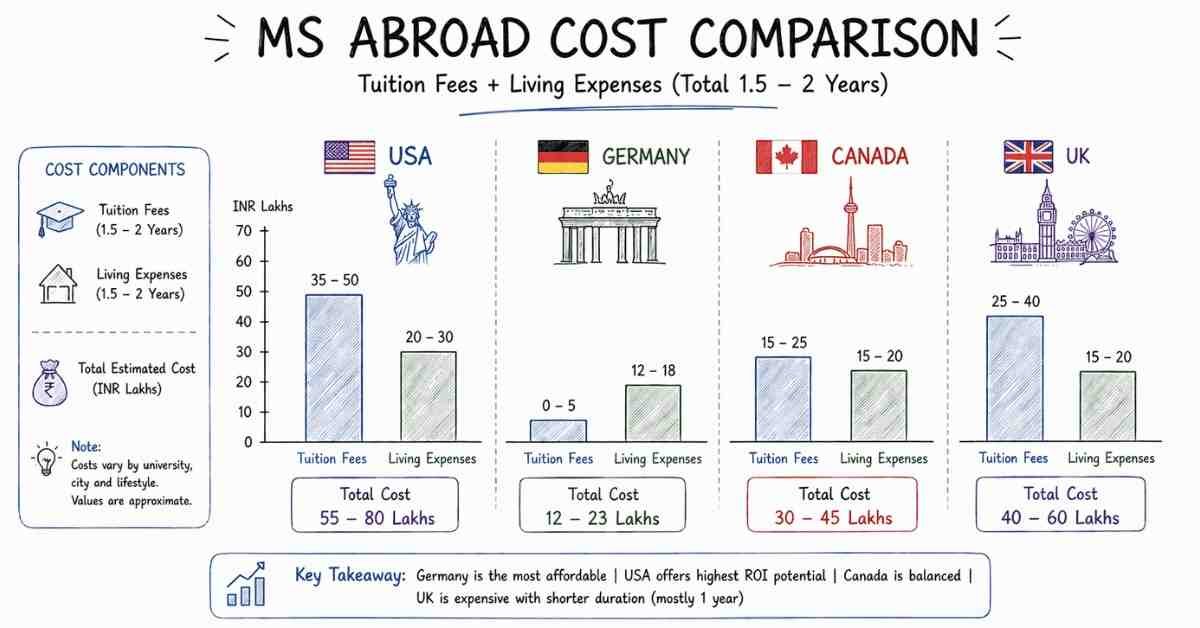
USA (Most Expensive):
- Tuition: $25,000-55,000 per year (₹20-45 lakhs/year)
- Living expenses: $12,000-20,000 per year (₹10-16 lakhs/year)
- Total 2 years: ₹60 lakhs – 1.2 crores
- Assistantships/Scholarships: Can reduce significantly (RA/TA covers tuition + stipend)
- Loan: Most students take education loans (₹40-80 lakhs typical)
Germany (Affordable):
- Tuition: Free/Nominal (€300-500 per semester)
- Living expenses: €800-1,000 per month (₹6-8 lakhs/year)
- Total 2 years: ₹12-20 lakhs
- Challenges: Learning German helps; competitive admissions
Canada:
- Tuition: CAD 20,000-35,000 per year (₹12-22 lakhs/year)
- Living: CAD 12,000-15,000 per year (₹7-9 lakhs/year)
- Total 2 years: ₹40-65 lakhs
UK (Shorter Duration):
- Tuition: £20,000-35,000 per year (₹20-35 lakhs/year)
- Living: £12,000-15,000 per year (₹12-15 lakhs/year)
- Total 1 year: ₹32-50 lakhs (1-year programs common)
Loan Considerations: Education loans available (₹40-80 lakhs), collateral often required; repayment begins after course or after grace period
Career Outcomes
US Salaries (First Job After MS):
- Electrical Engineering roles: $70,000-95,000 (₹58-78 lakhs/year)
- Software/Tech roles: $90,000-130,000 (₹75-1.08 cr/year)
- Top companies: $120,000-180,000 (₹1-1.5 cr/year)
Return to India:
- MS from good US university: ₹12-25 LPA starting (premium over B.Tech)
- Smaller premium than historically; market recognizes Indian talent now
Long-term Benefits:
- International exposure and network
- Access to cutting-edge research and facilities
- Immigration pathway (especially Canada, Germany)
- Global career opportunities
ROI Analysis:
- If staying abroad: Loan paid off in 2-4 years typically; excellent long-term ROI
- If returning to India: Marginal ROI financially; value is experience and network
- If immigration denied (US H1B lottery failure): Returns to India with significant debt
When MS Abroad Makes Sense
✅ Want to work/settle abroad long-term (biggest reason)
✅ Interested in cutting-edge research not available in India
✅ Can afford or willing to take loan with repayment plan
✅ Strong profile (good GPA, GRE, research) for admissions and assistantships
✅ Specific specialization offered better abroad (niche areas)
✅ Want international exposure and global network
When MS Abroad Doesn't Make Sense
❌ Primary goal is higher salary in India (not worth 60 lakhs+ investment)
❌ No clear reason beyond “everyone is going”
❌ Weak profile (low GPA, poor GRE)—admission to lower-tier universities not worth cost
❌ Family financial stress from large loans
❌ Committed to India long-term and not valuing international experience itself
❌ Uncertainty about immigration causes high anxiety (US H1B lottery stress real)
MBA: Deep Dive
Admission Process
Entrance Exams:
- CAT (Common Admission Test): For IIMs and most top B-schools
- XAT: For XLRI, other schools
- GMAT: For ISB, international MBAs
- Cutoffs: 95+ percentile for top IIMs; 90+ for good B-schools
Selection Process:
- Written exam score
- Group Discussion + Personal Interview
- Academic record (10th, 12th, B.Tech)
- Work experience (bonus for 2-4 years, required for ISB)
Preparation: 6-12 months intense preparation needed for competitive scores
Costs
Top IIMs (A, B, C, L, K, I):
- Fees: ₹23-28 lakhs for 2 years
- Living: ₹2-3 lakhs per year
- Total: ₹28-35 lakhs
Other IIMs (newer IIMs):
- Fees: ₹15-20 lakhs
ISB Hyderabad/Mohali:
- Fees: ₹36-40 lakhs for 1 year
- Intense program, older cohort (average 5+ years experience)
Other Top B-schools (FMS, XLRI, MDI, etc.):
- Fees: ₹10-25 lakhs
MBA Abroad (Top Schools):
- USA: $100,000-140,000 (₹80 lakhs – 1.15 crores) for 2 years
- Astronomical cost; only if aiming for global management consulting, investment banking
Career Outcomes
Placements from Top IIMs:
- Consulting: ₹25-35 LPA domestic; ₹50-70 LPA international
- Finance/Investment Banking: ₹20-40 LPA
- Product Management: ₹20-35 LPA
- Sales/Marketing: ₹18-30 LPA
- Operations/Supply Chain: ₹15-25 LPA
- General Management: ₹18-28 LPA
Average Packages:
- IIM A/B/C: ₹28-33 LPA
- Other old IIMs: ₹20-26 LPA
- Newer IIMs: ₹15-20 LPA
- Top non-IIM B-schools: ₹18-25 LPA
Long-term Career:
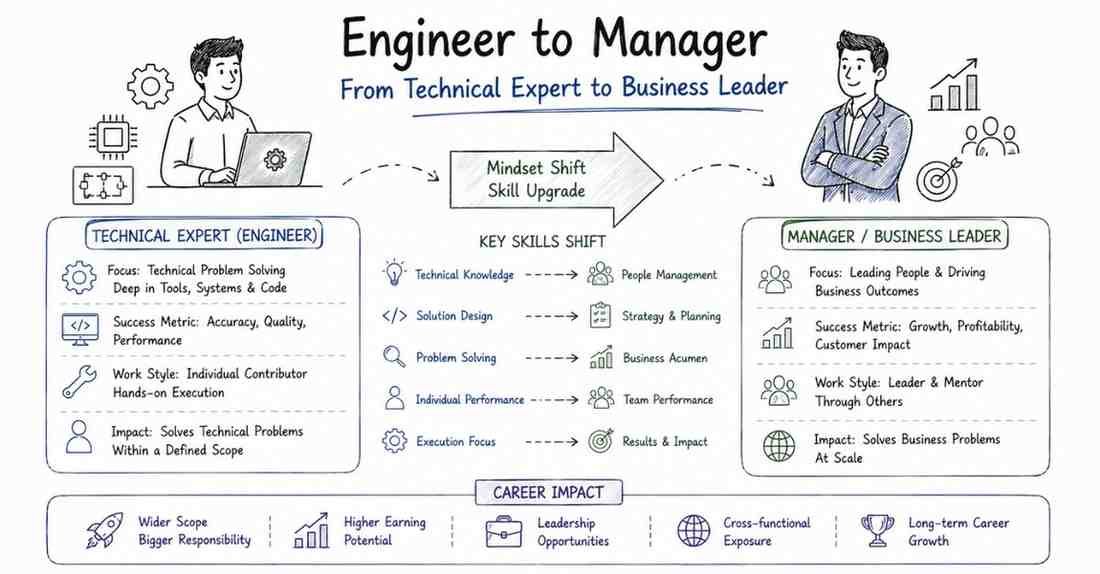
- Leadership and management roles
- Faster progression to senior management
- Entrepreneurship (many MBAs start ventures)
- Career switch opportunities (engineering to consulting, finance, product)
Electrical Engineering + MBA Advantage:
- Technical + business skillset valued
- Product management in tech companies
- Management roles in power, manufacturing, automotive sectors
- Energy sector consulting
When MBA Makes Sense
✅ Want to transition from technical to management/business roles
✅ Interested in consulting, finance, product management, marketing
✅ Entrepreneurial aspirations (network and business skills valuable)
✅ 2-5 years work experience (maturity helps in MBA; required for ISB)
✅ Strong aptitude for business (enjoy strategic thinking over pure technical)
✅ Aiming for senior leadership eventually (MBA fast-tracks to management)
When MBA Doesn't Make Sense
❌ Love technical work and want to stay in core engineering (MBA pulls you away)
❌ Doing MBA as escape from engineering without interest in management
❌ Expecting guaranteed high salary (placements have variance; loans substantial)
❌ Immediately after B.Tech with no work experience (hard to extract full value; ISB won’t admit)
❌ From lower-tier B-school (ROI questionable; only top B-schools justify cost)
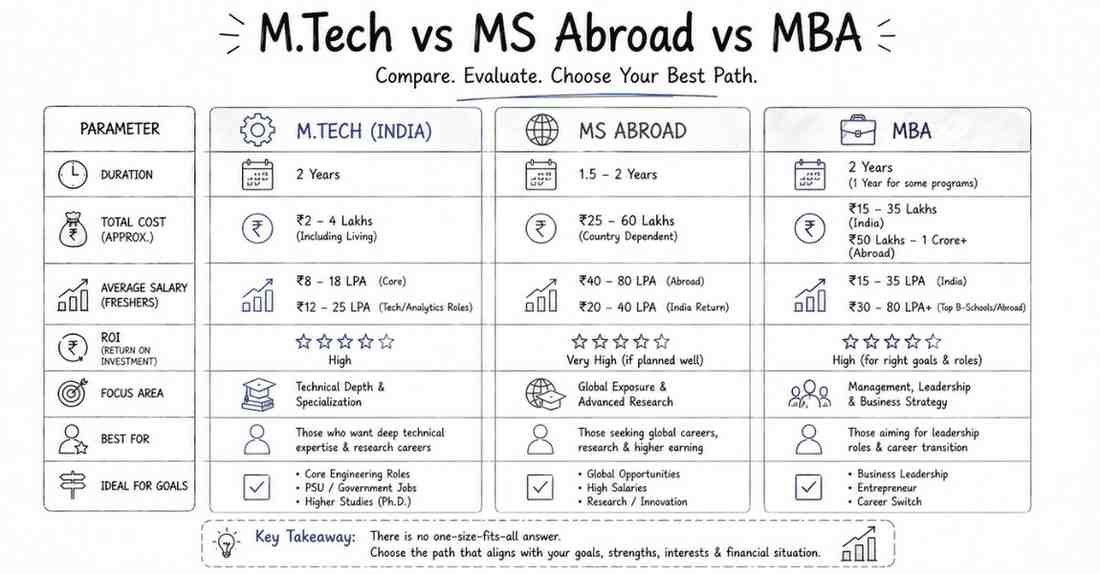
Comparative Analysis
Duration
- M.Tech: 2 years
- MS Abroad: 1.5-2 years (UK: 1 year)
- MBA: 2 years (ISB: 1 year)
Cost (Total Investment)
- M.Tech (IIT/NIT): ₹2-4 lakhs + ₹8-16 lakhs opportunity cost = ₹10-20 lakhs
- MS USA: ₹60 lakhs – 1.2 crores
- MS Germany: ₹12-20 lakhs
- MS Canada: ₹40-65 lakhs
- MBA (Top IIM): ₹28-35 lakhs
- MBA (ISB): ₹40 lakhs
Post-Completion Salary (First Job)
- M.Tech (IIT): ₹8-18 LPA (India)
- MS (USA, staying there): $70,000-95,000 (₹58-78 lakhs)
- MS (Return to India): ₹12-25 LPA
- MBA (Top IIM): ₹20-35 LPA (India)
ROI Timeline
- M.Tech: 1-2 years (low investment)
- MS (Staying abroad): 2-4 years
- MS (Return to India): 5-8 years (questionable)
- MBA (Top IIM): 2-4 years
Career Direction
- M.Tech: Deepening technical expertise; research/teaching pathway
- MS Abroad: Technical depth + international career; potential immigration
- MBA: Management and business; leadership track
Difficulty (Admission + Program)
- M.Tech: GATE preparation moderate; coursework manageable
- MS Abroad: GRE preparation moderate; application process complex; coursework rigorous
- MBA: CAT highly competitive; program intense but different skillset
The Decision Framework
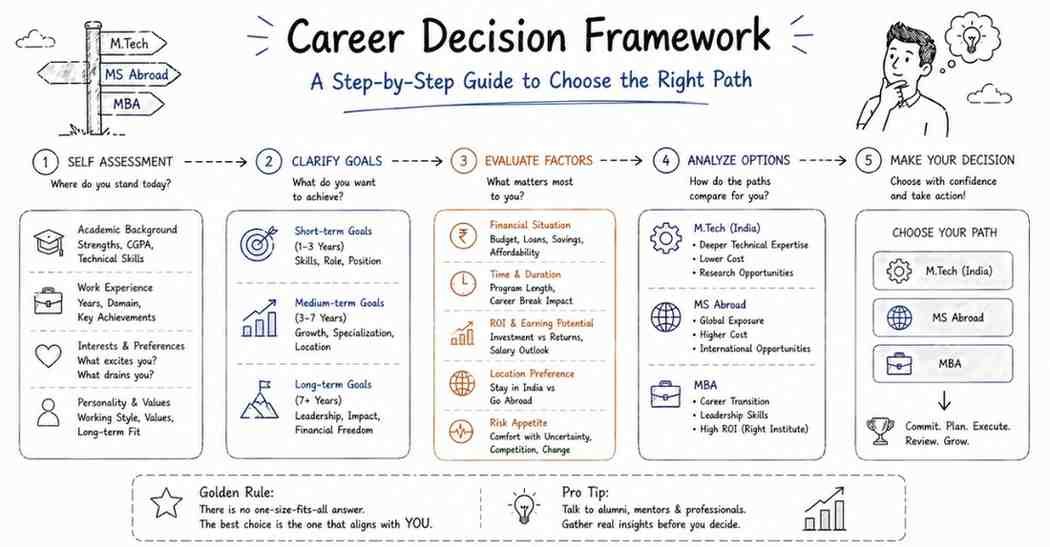
Step 1: Define Your Career Goal
Ask Yourself:
- In 10 years, what role do I want?
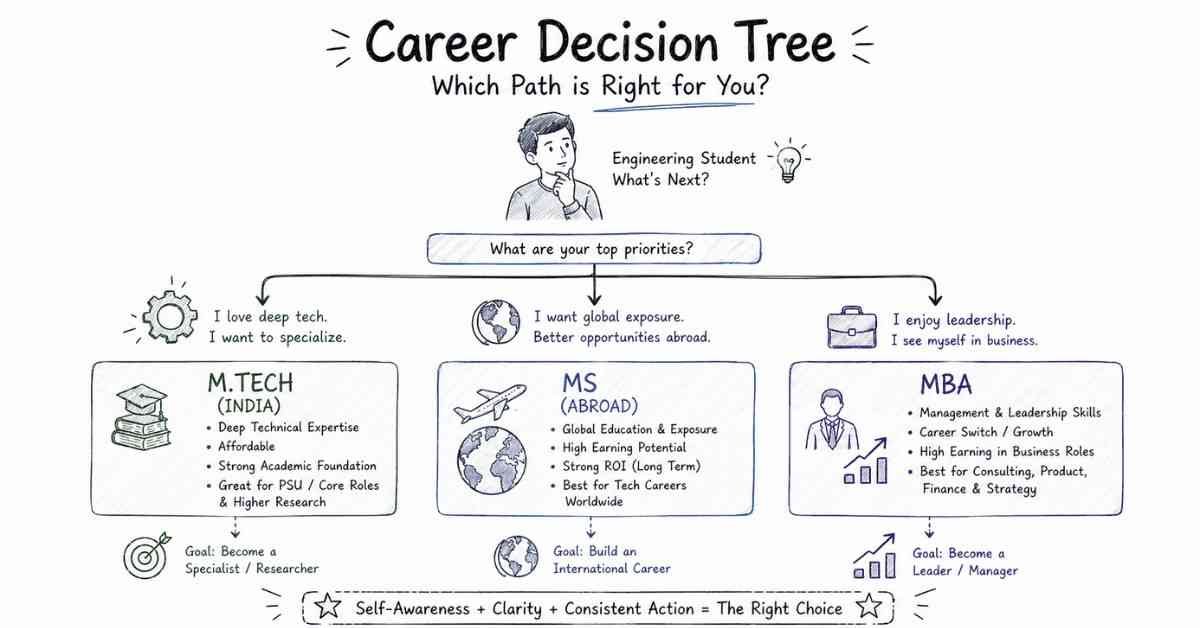
- Technical expert / researcher? → M.Tech or MS
- Engineering manager / business leader? → MBA
- Working abroad? → MS Abroad
- Academia? → M.Tech → Ph.D
Step 2: Assess Financial Situation
Budget Constraints:
- Limited budget? → M.Tech (affordable)
- Can afford/willing to take loan? → MS or MBA
- Family support vs education loan?
Loan Repayment Confidence:
- Confident about settling abroad? → MS USA loan manageable
- ncertain about visa? → Risky
- Returning to India? → Calculate if Indian salary can repay loan comfortably
Step 3: Evaluate Your Profile
Academic Performance:
- Strong CGPA (8+), good technical record → M.Tech (IIT) or MS abroad feasible
- Average CGPA (6.5-7.5) → Focus on good preparation for entrance exams
- Low CGPA → Work experience + strong profile can help MBA
Interests:
- Love technical depth → M.Tech/MS
- Interested in business, strategy → MBA
- Both? → Technical role first, MBA after few years (common path)
Step 4: Consider Timing
Right After B.Tech:
- M.Tech: Good timing
- MS Abroad: Acceptable, though work experience helps admissions slightly
- MBA: Not recommended (except few programs); 2-4 years work experience adds much more value
After 2-4 Years Work:
- M.Tech: Less common but okay if truly passionate
- MS Abroad: Good timing
- MBA: Optimal timing
After 5+ Years Work:
- M.Tech: Rare; high opportunity cost
- MS Abroad: Acceptable if career goal-aligned
- MBA: Still valuable; ISB targets this demographic
Step 5: Risk Tolerance
Risk-Averse:
- M.Tech safest (low cost, known environment)
- MBA (India) moderate risk (high cost but Indian job market familiar)
Risk-Taking:
- MS Abroad high risk-high reward (visa uncertainty, loan, but international upside)
Common Scenarios and Recommendations
Scenario 1: Good B.Tech Job (₹8-10 LPA), Interested in Technical Depth
Recommendation:
- Work for 2-3 years gaining experience
- Evaluate if job provides growth
- If plateauing, consider MS abroad (especially Germany for affordable option or USA if can afford)
- M.Tech only if genuinely research-oriented
Scenario 2: Average B.Tech Placement (₹4-6 LPA), Want Better Opportunities
Recommendation:
- If technical inclination: M.Tech from top IIT/NIT (second chance at good placements)
- If business inclination: Work 2 years, then prepare for CAT → MBA
- MS abroad if family can support financially
Scenario 3: Didn't Get Placed, Need Reset
Recommendation:
- M.Tech from good institute (IIT/top NIT) provides reset opportunity
- Prepare well for GATE
- Alternative: Work on skills, off-campus apply, gain experience, then reconsider higher studies
Scenario 4: Want to Settle Abroad Long-term
Recommendation:
- MS abroad most direct path
- Germany/Canada if want easier immigration pathways
- USA if okay with H1B uncertainty and can afford
- Start with 2 years work experience for better admissions and savings
Scenario 5: Want Management Career Eventually
Recommendation:
- Work 3-5 years in engineering role (builds foundation)
- MBA from top B-school (IIM A/B/C or equivalent)
- Technical + management combination powerful
- Or: Work in technical, move to management organically without MBA (possible, but MBA accelerates)
Scenario 6: Passionate About Research/Academia
Recommendation:
- M.Tech from IISc/top IIT (research-focused thesis)
- Then Ph.D. (in India or abroad)
- Academic career or research scientist roles
- Long path but fulfilling if genuinely passionate
Scenario 7: Budget Very Constrained
Recommendation:
- M.Tech only realistic option (₹2-4 lakhs manageable)
- MS in Germany (low tuition, but living costs still ₹12-15 lakhs total)
- Assistantships/Scholarships for MS abroad (research extensively)
- Work first, save, then pursue higher studies
Myths vs Reality
Myth 1: "MS abroad always better than M.Tech"
Reality: Depends on goals. For pure technical depth, top IITs comparable. MS abroad valuable primarily for international career pathway and exposure.
Myth 2: "MBA is easier than technical masters"
Reality: Different, not easier. MBA intense in different way case studies, group work, presentations, soft skills development.
Myth 3: "Higher studies guarantee high salary"
Reality: Amplifies profile but doesn’t guarantee. M.Tech placement salaries often similar to good B.Tech placements. MBA/MS abroad have better average outcomes but individual variance high.
Myth 4: "Everyone should do MS abroad"
Reality: Only if goals align want to work abroad, can afford, willing to handle visa uncertainty. Not universal solution.
Myth 5: "MBA means you lose technical skills"
Reality: Shifts focus to management but doesn’t erase technical foundation. Electrical engineering + MBA valuable combination for leadership roles.
Myth 6: "M.Tech from lower-tier college same as IIT"
Reality: No. Placements, learning, peer quality vastly different. M.Tech worthwhile primarily from top institutes.
Making Your Decision
Timeline for Decision
Final Year B.Tech:
- August-October: Research options, talk to seniors
- November-January: Prepare for relevant exams (GATE/GRE/CAT)
- February-April: Exams and applications
- May-July: Results and final decision
Working Professional:
- 6-12 months before target start date: Begin preparation
- Research options thoroughly
- Financial planning (savings, loans)
- Discuss with family and mentors
Information Sources
Talk to People:
- Seniors who pursued each path (get realistic picture)
- Professors (especially for research-oriented paths)
- Working professionals in target careers
- Alumni networks
Online Research:
- University websites (curriculum, faculty, placements)
- Forums (GradCafe, PagalGuy, Reddit) for honest reviews
- LinkedIn connections
- Attend education fairs (for MS abroad)
Trial Preparation:
- Start preparing for relevant exam (GATE/GRE/CAT)
- Your interest level during preparation tells you something
- Struggling to stay motivated? Maybe not the right path
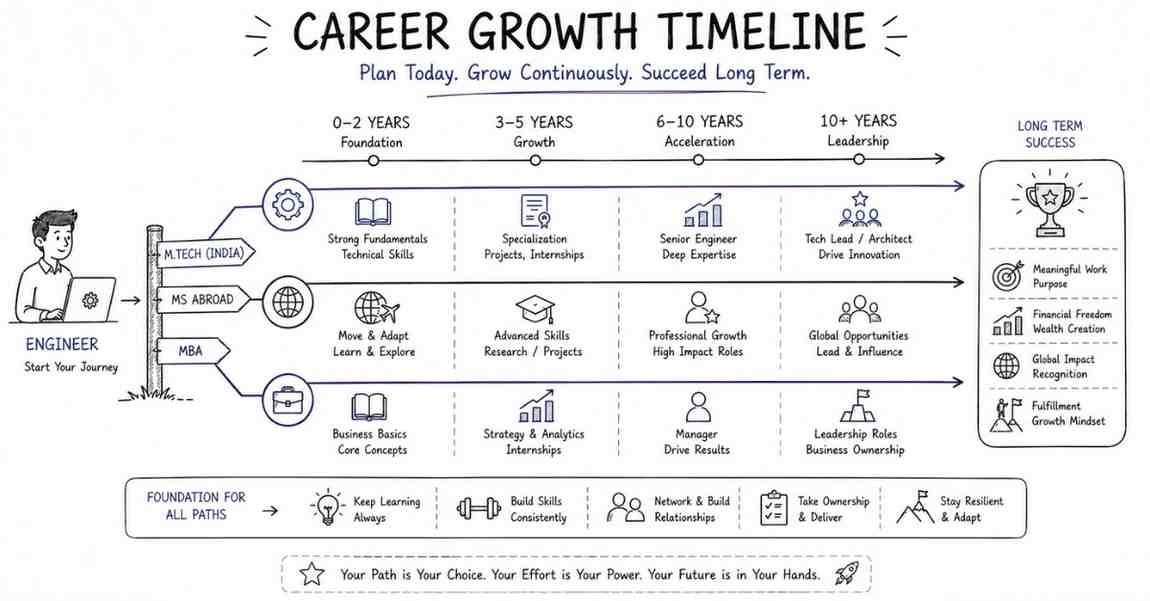
Final Thoughts: No Universal Answer
The “best” choice is deeply personal. Your classmate’s MS abroad success doesn’t mean it’s right for you. Your friend’s MBA satisfaction doesn’t make it your path. Your senior’s M.Tech regret doesn’t mean you’d regret it.
Consider:
- Your genuine interests (technical depth vs business management)
- Financial reality (family situation, loan burden comfort)
- Career aspirations (where you want to be in 10 years)
- Risk tolerance (high-risk-high-reward vs stable path)
- Life goals (settle abroad vs stay in India, work-life balance)
Remember:
- Higher studies isn’t mandatory many successful engineers built careers without postgraduation
- But if pursued strategically, adds significant value
- Timing matters right degree at wrong time less valuable than right degree at right time
- ROI isn’t just financial learning, network, personal growth matter
Most Importantly: Whatever you choose, commit fully. Half-hearted M.Tech, unmotivated MS, or disinterested MBA wastes time and money. Choose deliberately, prepare thoroughly, execute with full commitment.
Your higher studies decision is one of the most important career choices you’ll make. Take time, gather information, reflect deeply, and choose wisely.
Your future self will thank you for the thoughtful decision you make today.