
Freelance Graphic Designer Guide: Clients, Rates & Growth
Table of Contents
Introduction: Why Freelancing Is a Powerful Path for Indian Designers
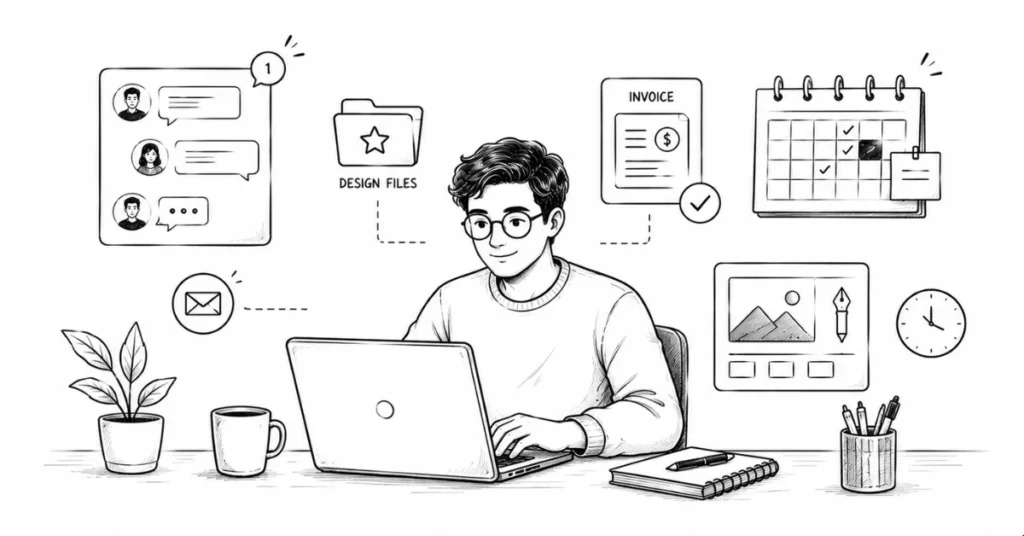
Freelance graphic design lets you work with clients across India and abroad, choose your projects, set your own schedule, and scale your income beyond a fixed salary. For many Indian designers, it starts as a side hustle and gradually becomes a full-time independent career.
But freelancing is not just “doing designs from home.” It’s a business. You’re the designer, sales team, accounts department, project manager, and customer support—at least in the beginning. This guide will show you how to treat freelancing like a real business from day one: how to launch, find clients, set rates, manage work, and grow sustainably.
Step 1: Decide Your Freelance Positioning (Who You Are for Whom)
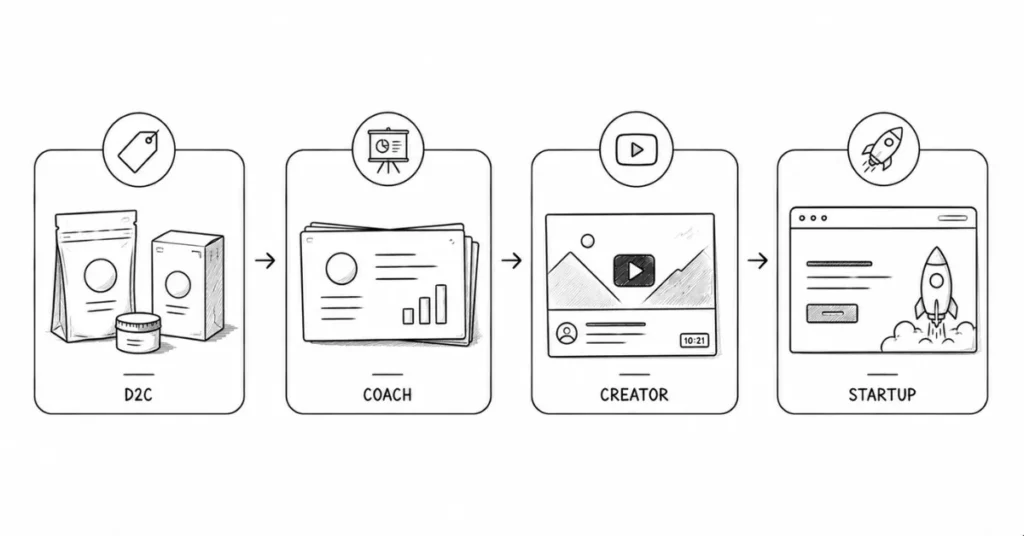
Instead of saying “I do all types of design,” get clearer:
- What kind of work do you enjoy most?
- Who do you want to serve?
- How can you make their life or business better?
Possible Positioning Examples
- “I design brand identities and social media creatives for Indian D2C and small businesses.”
- “I help coaches and trainers with slide decks, sales pages, and webinar graphics.”
- “I create YouTube thumbnails, intros, and shorts graphics for content creators.”
- “I design landing pages and performance ad creatives for startups and digital agencies.”
You’re not permanently locked in, but even an initial direction makes your marketing and portfolio more focused and attractive.
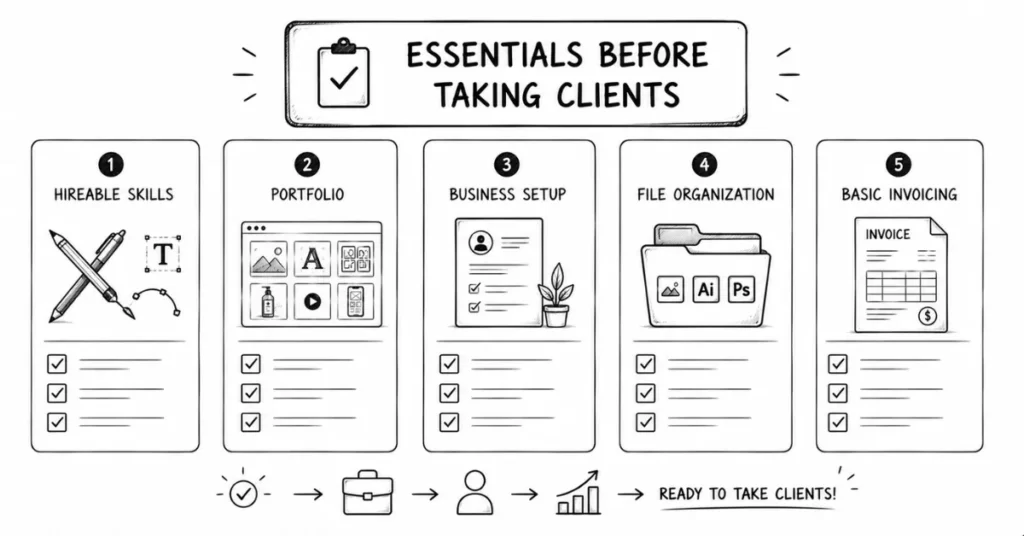
Step 2: Essential Foundations Before You Take Clients
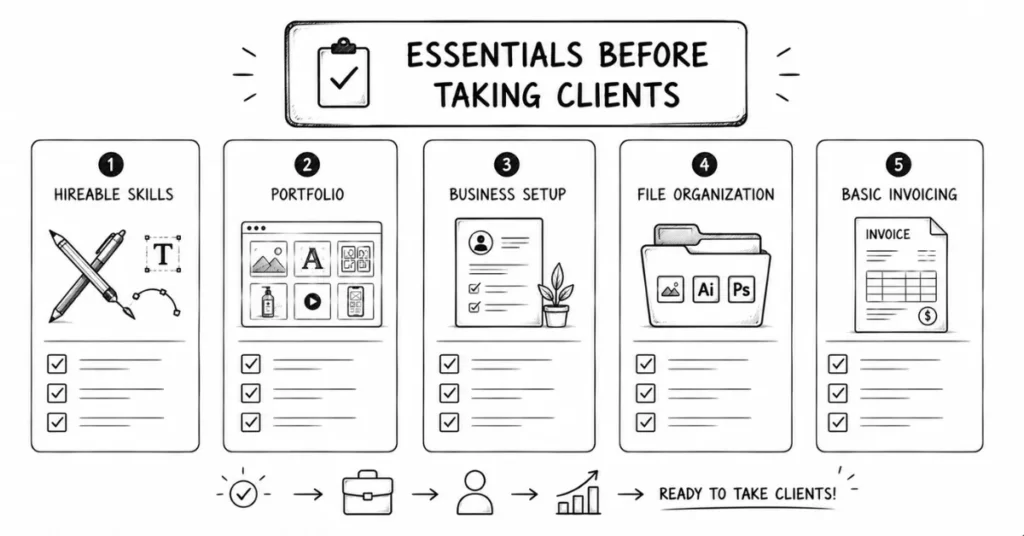
1. Skills at a Hireable Level
You don’t need to be a “top 1% designer,” but you should be able to:
- Handle typical client needs (logos, social posts, basic web/landing layouts, etc.).
- Work confidently in at least one core tool (Photoshop/Illustrator/Figma/Canva, depending on niche).
- Deliver clean, usable files (proper export sizes, formats, and organization).
If you still feel shaky on fundamentals, do 1–2 months of intense practice and small personal projects before charging money.
2. A Simple but Solid Portfolio
At a minimum:
- 6–10 strong pieces relevant to the work you want (e.g., logos + brand identities if branding, social media packs if SMM, UI screens if web/app).
- Mix of real and self-initiated projects is okay, as long as quality is high.
- Hosted on:
- Behance or a simple website (WordPress/Elementor/Webflow), and
- A Google Drive or Notion “portfolio deck” can work for quick sharing.
- Behance or a simple website (WordPress/Elementor/Webflow), and
3. Basic Business Setup
You can start very lean:
- Use your personal bank account initially, but keep clear records.
- Create a dedicated UPI ID or separate account to track business income/expenses.
- Decide on your invoice format (Google Docs, Excel, Zoho Invoice, Razorpay, etc.).
- Learn basics of GST applicability (if/when you cross threshold or want to register) by talking to a CA when you’re closer to that stage.
You don’t need to overcomplicate legal/financial setup on day one, but you should be conscious that this is a business and track money from the start.
Step 3: What Services Will You Offer?
Start with a clear, limited menu so it’s easy for clients to understand and choose.
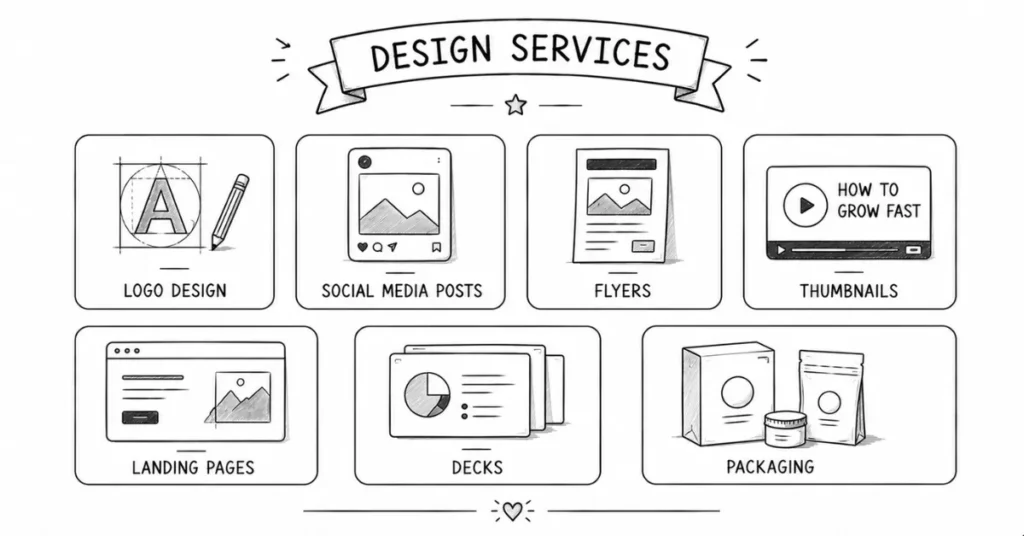
Common Freelance Graphic Design Services in India
- Logo design and basic brand identity.
- Social media post design (packs or monthly retainers).
- Brochures, flyers, posters, banners.
- YouTube thumbnail and video graphics.
- Landing page and website design (Figma/WordPress/Elementor).
- Pitch decks and presentation design.
- Packaging design (for D2C and retail brands).
You can always add/remove services later. Initially, choose 3–5 core offers and get really good at delivering them.
Step 4: How to Price Your Freelance Work (India-Focused)
Pricing feels scary for most beginners, but you can approach it logically.
1. Pricing Models
- Per Project: Fixed amount for a defined scope (best for logos, brand packs, landing pages).
- Hourly: You charge for actual time spent (common in international work, but many Indian clients resist hourly).
- Monthly Retainer: Fixed amount per month for ongoing work (great for social media, YouTube creators, agencies).
- Packages: Bundles (e.g., “Logo + business card + social media kit” at bundled price).
2. Example Beginner-Friendly Ranges (Indian Market)
These are starting ranges for someone who is decent but early in their freelance journey. You’ll adjust upwards as your portfolio and demand grow.
- Logo design (simple, small business): ₹5,000 – ₹15,000
- Brand identity starter pack: ₹15,000 – ₹40,000
- Social media post (one-off): ₹500 – ₹1,500 per post
- Social media monthly (12–20 posts): ₹8,000 – ₹30,000 per month
- YouTube thumbnail: ₹500 – ₹1,200 each (higher for big channels)
- Poster/flyer: ₹2,000 – ₹7,000
- Landing page design (no dev): ₹8,000 – ₹30,000
- Full one-page WordPress site (template-based): ₹15,000 – ₹40,000 (basic)
- Presentation (10–20 slides): ₹7,000 – ₹25,000 depending on complexity
As you gain experience and get busier, you might double or triple these numbers, especially if you niche down and demonstrate strong results.
3. Deciding Your Initial Rate
Consider:
- Your current skill level and speed.
- Your monthly income target (e.g., ₹50k/month).
- How many hours you can realistically work weekly.
- The type of clients you’re targeting (local SMB vs funded startup vs overseas).
Start at a level where:
- You don’t feel resentment doing the work, and
- You’re still competitive for your experience.
Then, after every 3–5 successful clients, revise your rates slightly upward.
Step 5: Getting Your First 5–10 Clients
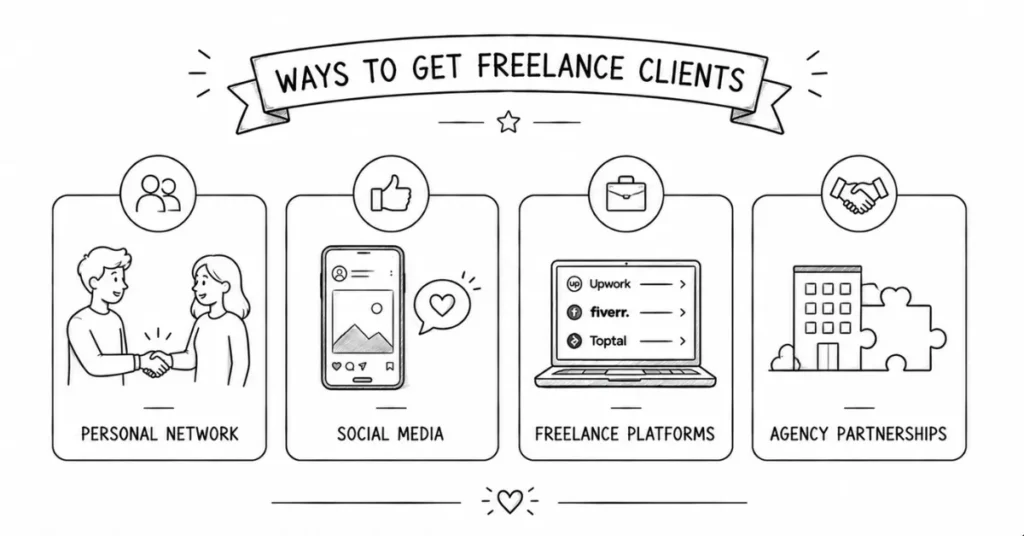
Channel 1: Your Immediate Network
- Tell friends, family, ex-colleagues, and college batchmates you’re taking on design work.
- Offer a “first 3 clients” discount in return for:
- Detailed testimonial,
- Permission to use the work in your portfolio, and
- Referrals if they’re happy.
- Detailed testimonial,
- Approach:
- Local businesses (coaching centers, boutiques, cafés, gyms).
- Freelance trainers, coaches, CA/CS, real estate brokers.
- Local businesses (coaching centers, boutiques, cafés, gyms).
Make outreach specific and helpful, not “Do you need design?” but “I noticed your Instagram/website/logo could be clearer; would you like me to suggest a refreshed version?”
Channel 2: Social Media
- Use LinkedIn for professional positioning:
- Showcase before/after examples.
- Break down projects in mini case studies.
- Post consistently (2–3 times per week).
- Showcase before/after examples.
- Use Instagram for visual proof:
- Carousels showing process and results.
- Reels showing quick transformations.
- Use niche and local hashtags.
- Carousels showing process and results.
Channel 3: Freelance Platforms
- Fiverr, Upwork, Freelancer, and similar:
- Create 2–3 focused gigs (e.g., “Minimalist Logo Design,” “Social Media Posts for Coaches”).
- Price slightly lower initially to get traction and reviews, then increase.
- Make your thumbnails and descriptions very clear and benefit-driven.
- Create 2–3 focused gigs (e.g., “Minimalist Logo Design,” “Social Media Posts for Coaches”).
Channel 4: Partnering with Agencies & Creators
- Reach out to:
- Small digital agencies,
- Social media managers,
- Video editors and YouTube managers,
- Copywriters or content strategists.
- Small digital agencies,
Offer to be their white-label design partner, where they handle the client, and you handle design. This can generate stable recurring work.
Step 6: Must-Have Freelance Systems (So You Don’t Burn Out)
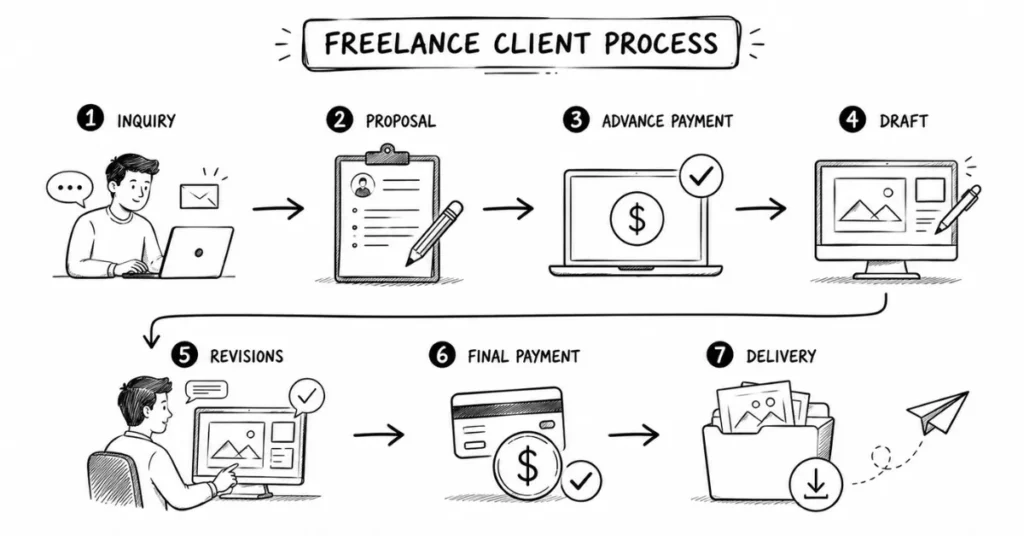
1. Basic Client Process
Create a simple, repeatable workflow:
- Inquiry / Lead.
- Short discovery call or questionnaire.
- Proposal + quote.
- 50% advance invoice.
- Kick-off + brief confirmation.
- First draft.
- 1–2 revision rounds.
- Final approval.
- Final payment.
- Delivery of files + request testimonial.
Document this once and follow it for every new client.
2. Contracts and Scope
Even a basic one-page agreement can save you headaches. Include:
- Project description & deliverables.
- Number of revisions included (e.g., two rounds).
- Timelines and milestones.
- Payment terms (e.g., 50% advance, 50% before final files).
- What counts as “out of scope” and how it’s billed.
- Cancellation and refund policy.
You can adapt simple templates and adjust language for Indian clients (simple, clear English).
3. Time and Task Management
Use any system you are comfortable with:
- Notion, Trello, Asana, or even Google Sheets.
- Maintain:
- Project list (status: lead / active / waiting / completed).
- Deadlines and milestones.
- Content/assets needed from client.
- Invoice and payment tracker.
- Project list (status: lead / active / waiting / completed).
Treat yourself like a small agency with a simple dashboard.
Step 7: Dealing with Common Freelance Problems
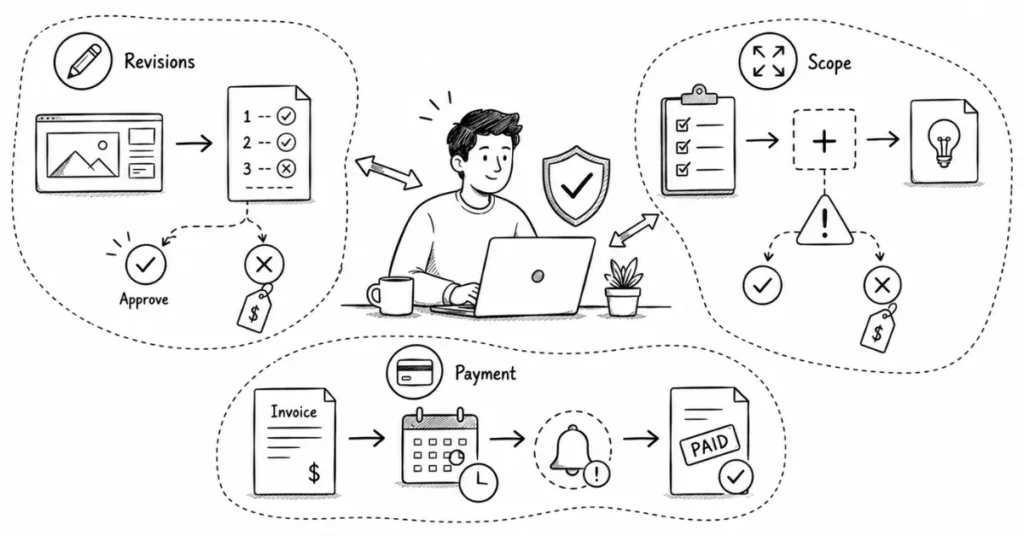
1. Clients Asking for Endless Changes
Prevention:
- Clearly specify revision rounds in your proposal and contract.
- Show moodboards and initial directions early to avoid late surprises.
Handling:
- After included revisions, say:
- “Happy to continue refining; beyond two rounds I charge ₹X per additional round/change.”
- “Happy to continue refining; beyond two rounds I charge ₹X per additional round/change.”
- Offer structured options instead of unlimited tweaks.
2. Late or Non-Payment
Prevention:
- Always take an advance (30–50%) before starting.
- Don’t deliver final high-res or source files before full payment.
- For larger projects, create milestones with partial payments.
Handling:
- Follow up politely but firmly.
- Mention that you cannot continue additional work without settling due payments.
- For chronic issues, stop working with that client; protect your time and energy.
3. Scope Creep (“Can you quickly also do this?”)
Prevention:
- Clearly define deliverables in your scope (number of designs, sizes, versions).
- Include a “small add-ons are billable beyond scope” line in your T&Cs.
Handling:
- Acknowledge the request positively, then:
- “Sure, that would be an additional ₹X or we can bundle it with Y for a package of ₹Z.”
- “Sure, that would be an additional ₹X or we can bundle it with Y for a package of ₹Z.”
- Learn to say no without being rude.
Step 8: When and How to Raise Your Rates
Increase your rates when:
- You consistently deliver good results and clients are happy.
- You are near full capacity and turning away work.
- Your skills and portfolio have clearly improved.
You don’t have to announce it publicly. Simply:
- Quote higher for new leads.
- For existing clients, give notice in advance:
- “From next month/next quarter, my rates for this package will be ₹X due to increased scope/quality/demand.”
- “From next month/next quarter, my rates for this package will be ₹X due to increased scope/quality/demand.”
Raise your prices gradually but consistently rather than staying stuck at “beginner rates” for years.
Step 9: Growing Beyond Solo – Scaling Your Freelance Business
Once you’re stable (e.g., consistent ₹60k–₹1 lakh+ per month):
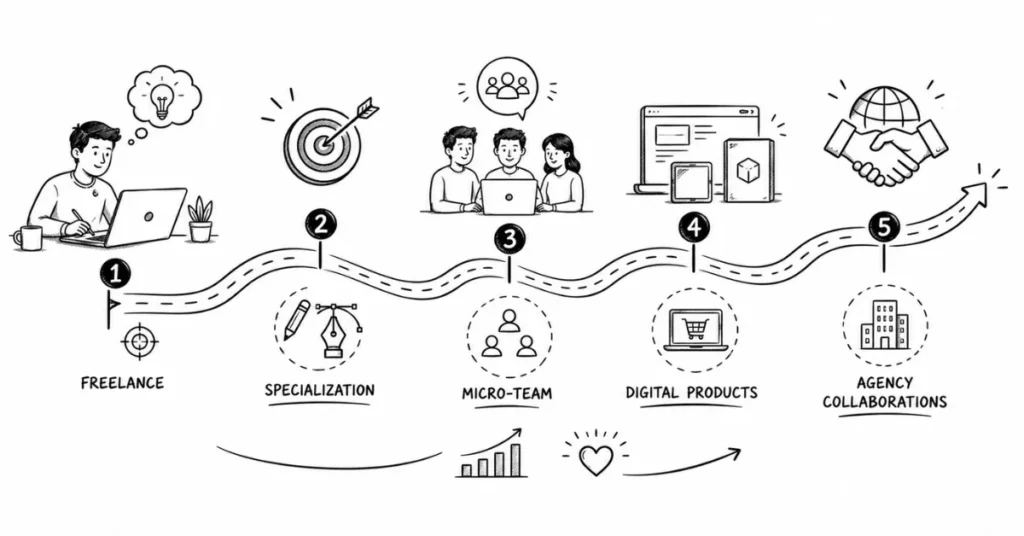
Options to Scale
- Specialize and Charge More
- Become known for one thing (e.g., “the go-to brand designer for D2C beauty brands”).
- Focus on fewer clients at higher value.
- Become known for one thing (e.g., “the go-to brand designer for D2C beauty brands”).
- Build a Micro-Team
- Hire part-time or project-based:
- Junior designers,
- Video editors,
- Virtual assistants for admin.
- Junior designers,
- You become more of a creative director and project manager.
- Hire part-time or project-based:
- Create Digital Products
- Templates (Canva, pitch decks, social media packs).
- Notion/Excel tools for small businesses.
- Mini-courses or workshops.
- Templates (Canva, pitch decks, social media packs).
- Collaborate with Agencies
- Be a retainer partner for multiple agencies.
- More predictable monthly income.
- Be a retainer partner for multiple agencies.
Step 10: Mindset and Lifestyle as a Freelance Designer
Freelancing offers freedom, but also demands self-discipline.
- Pros:
- Control over schedule and projects.
- No commute, location independence.
- Direct link between effort and income.
- Ability to pivot, experiment, and grow your own brand.
- Control over schedule and projects.
- Cons:
- Income can fluctuate.
- You handle rejection and dry spells.
- You must manage your own health, boundaries, and motivation.
- Income can fluctuate.
Treat yourself like a professional business owner:
- Set working hours and off hours.
- Take breaks and off-days.
- Invest in learning and better tools.
- Build an emergency fund (at least 3–6 months of expenses).
30-Day Launch Plan for Your Freelance Design Business
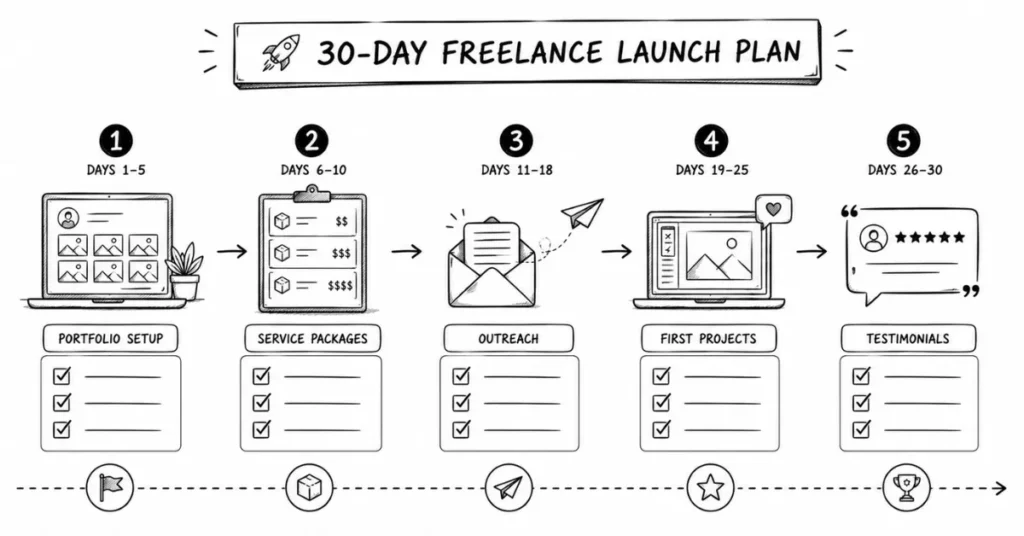
Week 1
- Finalize 8–10 strong portfolio pieces.
- Create 2–3 clear service packages with prices.
- Set up simple portfolio presence (Behance + one-page site or Notion).
Week 2
- Reach out to 30–50 people in your network with a clear message and offer.
- Publish your “I’m now taking freelance design projects” post on LinkedIn & Instagram.
- Join 3–5 relevant WhatsApp/Telegram/Facebook communities where your clients hang out.
Week 3
- Aim to close 1–3 small projects (even if at slightly lower rates).
- Deliver incredible quality and communication.
- Collect testimonials and permission to showcase work.
Week 4
- Package your best 1–2 new projects into case studies.
- Refine your pricing based on effort vs payment.
- Plan next month’s outreach and content (how you’ll keep getting leads).
Final Thoughts
Freelance graphic design in India is not a fantasy or just a side gig it can be a serious, sustainable career and business if you approach it with structure and professionalism.
You don’t have to figure everything out at once. Start with:
- One clear offer.
- One simple portfolio.
- One week of focused outreach.
Then learn from each client, each project, each mistake, and keep improving your systems, skills, and positioning.