
Supply Chain Certifications: APICS, CSCP, CPIM Guide
Table of Contents
Introduction: Do Certifications Actually Matter?
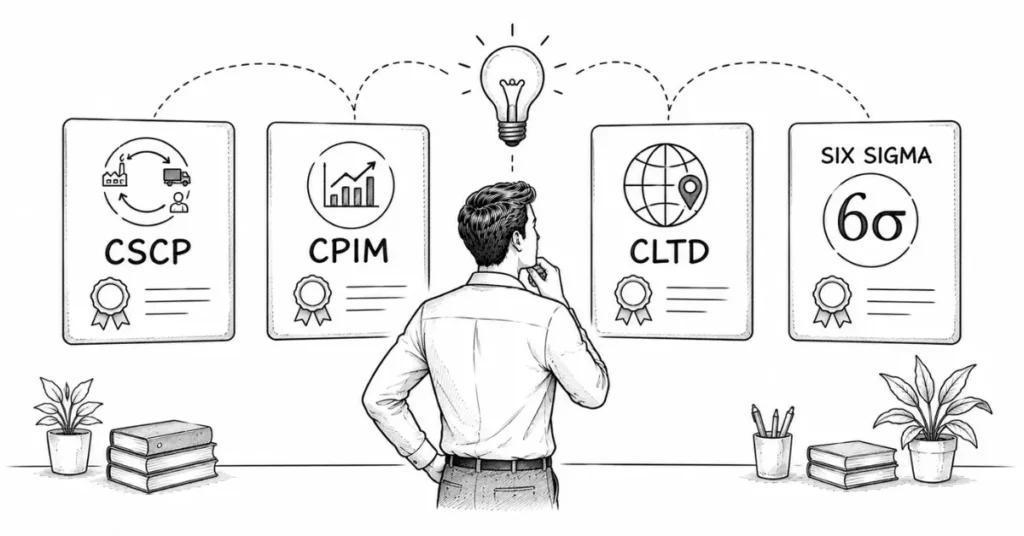
You’re scrolling through LinkedIn, and you see it again another supply chain professional with “CSCP” or “CPIM” after their name. Job descriptions mention “APICS certification preferred.” Recruiters ask about certifications during screening calls. You start wondering: Are these certifications actually worth the investment of time and money, or are they just expensive pieces of paper?
Here’s the honest truth: Supply chain certifications won’t magically transform your career overnight, but they can accelerate growth, increase earning potential by 15-20%, and open doors to opportunities that might otherwise remain closed. The key is understanding which certifications make sense for your career stage, specialization, and goals and which are wastes of money.
In this guide, I’ll break down the major supply chain certifications available to Indian professionals, their costs, benefits, and most importantly whether they’re worth your hard-earned money and precious time.
The Reality of Certifications in India
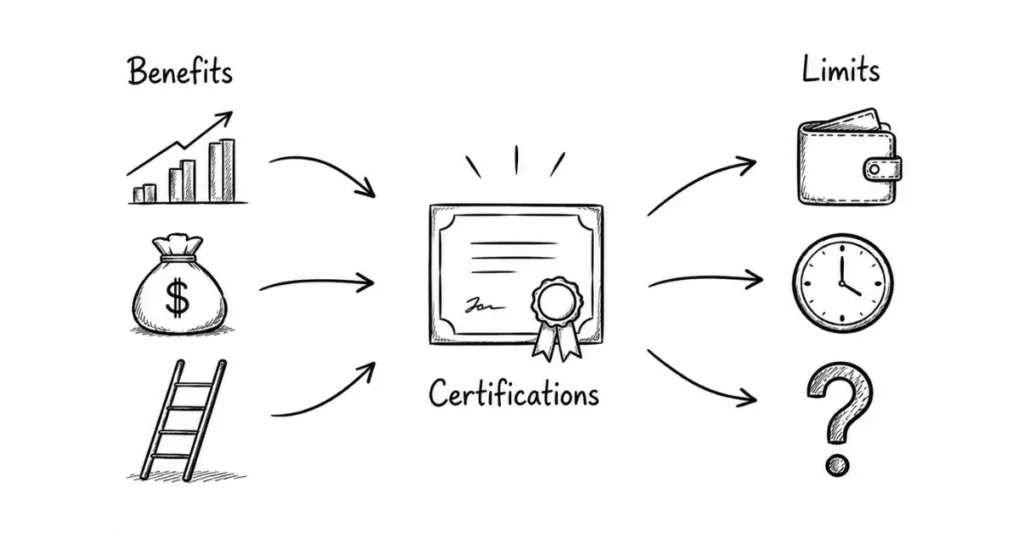
Before diving into specific certifications, let’s set realistic expectations:
The Good:
- Certifications signal commitment to professional development
- They provide structured learning covering knowledge gaps
- Global certifications (APICS) carry weight with multinational companies
- They can differentiate you in competitive job markets
- Some companies explicitly prefer or require certifications
- They provide networking opportunities through alumni groups
The Challenging:
- Certifications are expensive (₹1-2 lakhs for major ones)
- Recognition in India is still developing compared to US/Europe
- They won’t compensate for lack of practical experience
- Some employers care more about demonstrated skills than certificates
- Maintaining certifications requires ongoing fees and renewal
The Bottom Line:
Certifications work best as complements to strong performance, not substitutes for it. They’re most valuable when you’re already good at your job and seeking that extra edge for promotion or job change.
Major Supply Chain Certifications: Deep Dive
1. APICS CSCP (Certified Supply Chain Professional)
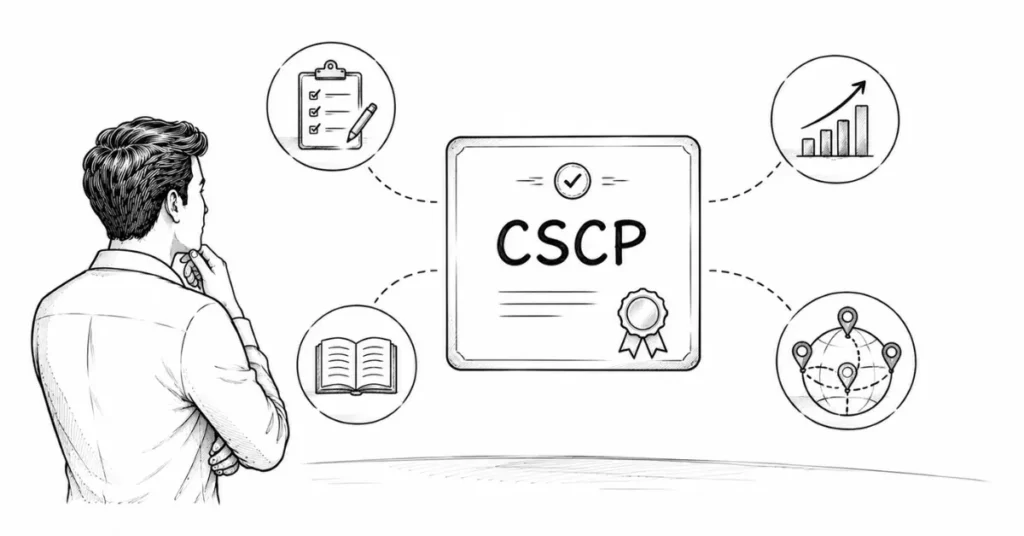
What It Is:
The most comprehensive and globally recognized supply chain certification, offered by ASCM (Association for Supply Chain Management, formerly APICS). It covers end-to-end supply chain management.
Who Should Consider It:
- Supply chain professionals with 3+ years experience
- Those targeting mid to senior-level roles
- Professionals working with multinational companies
- Anyone seeking global recognition and career mobility
Content Covered:
The CSCP curriculum covers eight key areas:
- Supply Chain Strategy & Design: Aligning supply chain with business strategy, network design, make vs. buy decisions
- Plan: Demand management, forecasting, S&OP, master scheduling
- Source: Procurement strategies, supplier relationship management, contracting
- Make: Production planning, quality management, lean manufacturing
- Deliver: Logistics, warehousing, transportation, order fulfillment
- Return: Reverse logistics, returns management
- Enable: Technology, risk management, sustainability, finance
- Improve: Continuous improvement, change management, performance measurement
Learning Format:
- Self-study with official learning system (recommended 150+ study hours)
- Optional instructor-led courses (additional cost)
- Practice exams and study materials included
Exam Details:
- 150 multiple-choice questions
- 3.5 hours duration
- Computer-based test at Pearson VUE centers (available in major Indian cities)
- Passing score: 300/350 (approximately 70%)
- Can retake if you fail (additional fee)
Investment Required:
Option 1 – ASCM Membership + Certification:
- ASCM Membership: ~$135 USD (₹11,000)
- Learning System: ~$1,095 USD (₹91,000)
- Exam Fee: Included in learning system
- Total: ~₹1.02 lakhs
Option 2 – Without Membership:
- Learning System (non-member): ~$1,395 USD (₹1.16 lakhs)
- Exam Fee: Included
- Total: ~₹1.16 lakhs
Ongoing Costs:
- Recertification every 5 years: $495 (₹41,000) or earn maintenance points through continuing education
- Annual membership if you choose to maintain it
Preparation Time:
- With supply chain experience: 3-4 months studying 8-10 hours/week
- Limited experience: 5-6 months with more intensive study
- Background: Most candidates have 3-7 years of supply chain experience
Pass Rate:
Not officially published, but estimated around 60-70% globally. Higher for well-prepared candidates from supply chain backgrounds.
Real Value Assessment:
When CSCP is Worth It:
✅ You work for or target MNCs that value global certifications
✅ You’re transitioning into supply chain from another field and need credibility
✅ You’re seeking supply chain roles internationally (Middle East, Southeast Asia, US)
✅ Your company sponsors certification costs
✅ You’re preparing for senior management roles
✅ You have knowledge gaps in certain supply chain areas the program can fill
When It’s Questionable:
❌ You’re just starting your career (0-2 years)—practical experience matters more
❌ You work for small/medium Indian companies unlikely to recognize it
❌ You can’t afford ₹1+ lakh without financial strain
❌ You already have deep expertise and strong career trajectory
❌ You’re targeting roles focused on one narrow specialization
ROI Reality Check:
A comprehensive analysis suggests CSCP can increase salary by 15-20% when changing jobs, but this applies primarily to roles with multinational exposure. For purely domestic roles in smaller companies, the impact may be minimal.
Success Story:
A supply chain manager with 5 years experience working for an Indian manufacturing company earned CSCP, then successfully transitioned to a regional role with a US-based company at 35% higher compensation. The certification was specifically mentioned as a factor in the hiring decision.
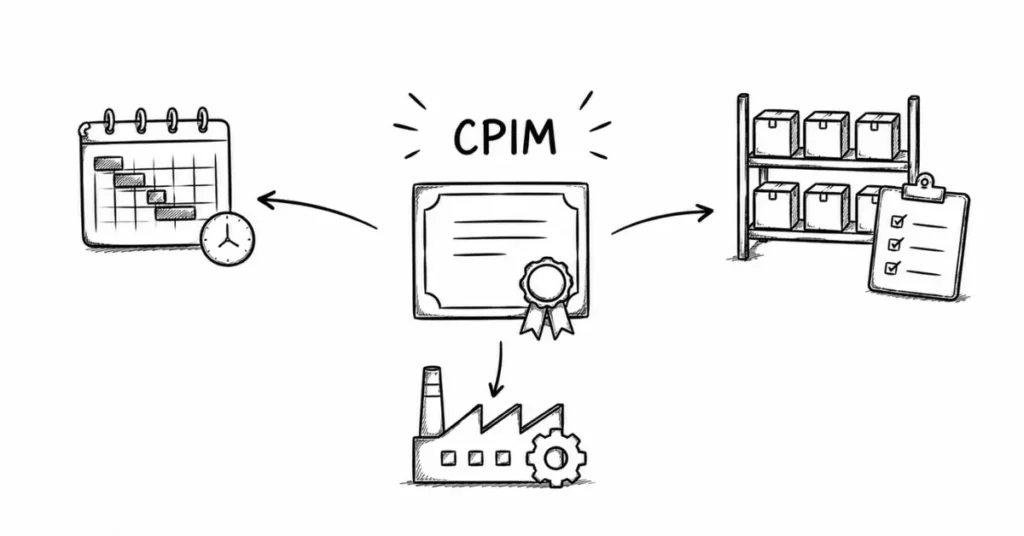
2. APICS CPIM (Certified in Production and Inventory Management)
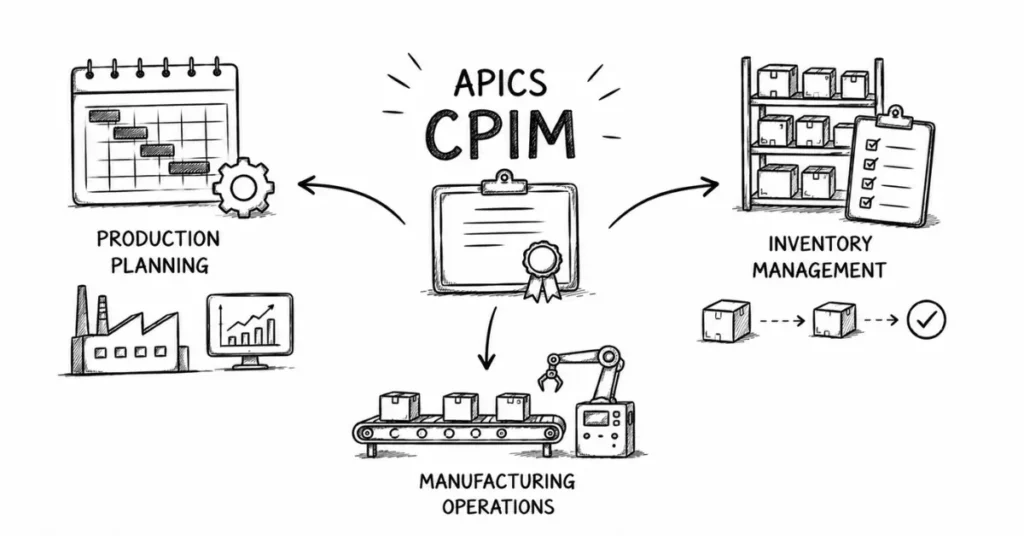
What It Is:
APICS certification focused specifically on production planning, inventory management, and manufacturing operations.
Who Should Consider It:
- Professionals in manufacturing environments
- Production planners and inventory managers
- Those in materials management roles
- Supply chain professionals wanting deep operational expertise
Content Covered:
CPIM consists of two parts:
Part 1 – Basics of Supply Chain Management:
- Supply chain strategy and sustainability
- Demand management and forecasting
- Inventory management fundamentals
- Material requirements planning (MRP)
- Capacity management
- Production planning methods
Part 2 – Master Planning of Resources:
- Strategic planning and S&OP
- Demand management advanced concepts
- Master scheduling
- Material and capacity requirements planning
- Execution and control
- Continuous improvement
Exam Details:
- Two separate exams (can be taken at different times)
- Part 1: 100 questions, 2 hours
- Part 2: 150 questions, 3.5 hours
- Computer-based at Pearson VUE centers
- Must pass Part 1 before taking Part 2
Investment Required:
- Similar to CSCP: ₹1-1.3 lakhs total
- Can spread cost by purchasing parts separately
- Exam Part 1: ~$525, Exam Part 2: ~$745 (plus learning materials)
Preparation Time:
- Part 1: 2-3 months
- Part 2: 3-4 months
- Total: 5-7 months if taking sequentially
CPIM vs CSCP: Which to Choose?
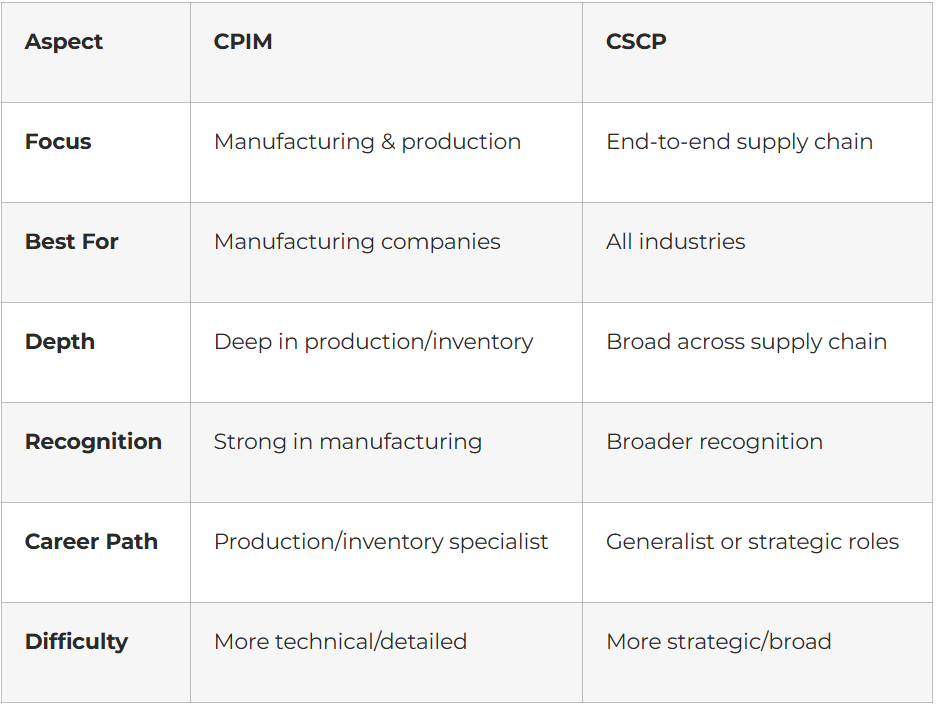
My Recommendation:
- Manufacturing environment + specializing in production/inventory → CPIM
- Broader supply chain role across industries → CSCP
- Senior roles or consulting → CSCP (broader scope more valued)
- Already have CPIM? → Add CSCP later for comprehensive credentials
3. APICS CLTD (Certified in Logistics, Transportation and Distribution)
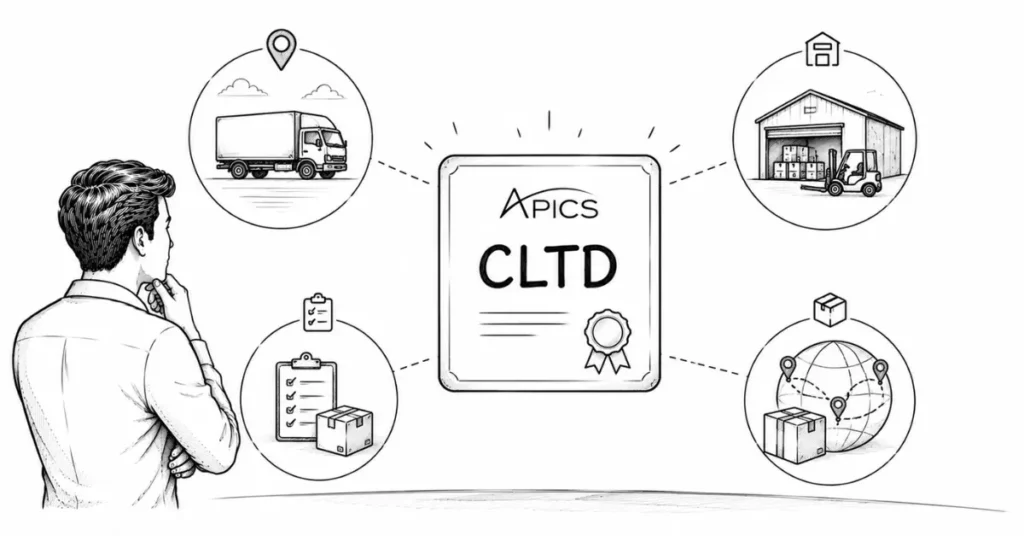
What It Is:
Specialized certification focusing on logistics, warehousing, and transportation management.
Who Should Consider It:
- Logistics managers and coordinators
- Transportation planners
- Warehouse managers
- Distribution center professionals
- 3PL company professionals
Content Covered:
- Logistics and supply chain overview
- Logistics network design
- Transportation modes and management
- Warehousing and distribution
- Global logistics
- Reverse logistics and returns management
- Performance management
Investment:
- Similar to CSCP: ₹1-1.2 lakhs
- Single exam (150 questions, 3.5 hours)
Value Assessment:
CLTD is the newest and least recognized of the three major APICS certifications. Unless you’re specifically in logistics with a company that values it, CSCP provides better ROI as it includes logistics plus broader topics.
When CLTD Makes Sense:
- You work for 3PL/logistics service providers
- Your role is purely logistics-focused
- Your company sponsors it and wants logistics expertise
- You already have CPIM and want additional specialization
4. Six Sigma Certifications (Green Belt & Black Belt)
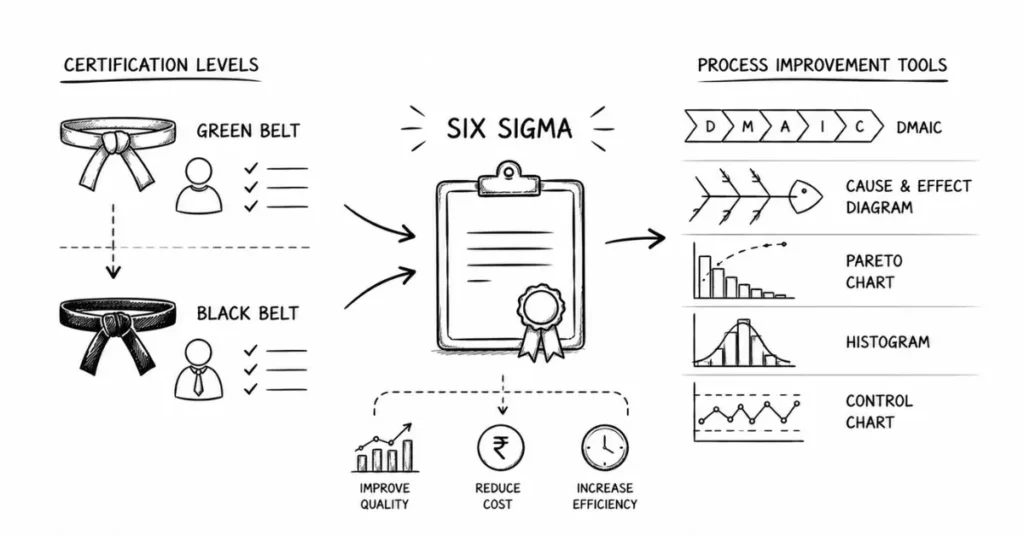
What It Is:
Quality management and process improvement methodology certification focused on reducing defects and variability.
Certification Levels:
- Yellow Belt: Basic awareness (1-2 days training)
- Green Belt: Lead smaller improvement projects
- Black Belt: Lead major improvement initiatives
- Master Black Belt: Train and coach others (very senior)
Who Should Consider It:
- Operations managers seeking to drive efficiency
- Quality professionals in any industry
- Supply chain professionals in manufacturing
- Anyone involved in continuous improvement initiatives
Content Covered:
- DMAIC methodology (Define, Measure, Analyze, Improve, Control)
- Statistical process control
- Root cause analysis
- Data collection and analysis
- Process mapping
- Project management for improvement initiatives
Investment:
Green Belt:
- Training: ₹15,000-40,000 depending on provider
- Exam (if pursuing ASQ or IASSC certification): ₹15,000-25,000
- Total: ₹30,000-65,000
- Duration: 2-4 weeks training + project work
Black Belt:
- Training: ₹50,000-1,50,000 depending on provider and format
- Exam: ₹20,000-30,000
- Total: ₹70,000-1,80,000
- Duration: 3-6 months training + major project completion
Certification Bodies:
- ASQ (American Society for Quality): Most globally recognized
- IASSC (International Association for Six Sigma Certification): Growing recognition
- Corporate certifications: Some companies (GE, Motorola) offer their own, valued mainly internally
Value Assessment:
Strong Value If:
✅ You work in manufacturing or operations-heavy environments
✅ Your company has Six Sigma culture (many Indian MNCs do)
✅ You want to transition into quality or operational excellence roles
✅ You need practical tools for process improvement
✅ Your company sponsors certification costs
Limited Value If:
❌ You work in pure logistics or procurement without process focus
❌ Your industry/company doesn’t use Six Sigma methodologies
❌ You’re early career without opportunities to lead projects
ROI Note:
Six Sigma certifications typically cost less than APICS certifications and often provide more immediate practical value. The methodologies you learn can be applied immediately, unlike APICS which is more knowledge-based.
Career Impact:
Many operations managers and directors have Six Sigma Black Belt certifications. In quality-focused industries (automotive, pharma, manufacturing), it’s almost expected at senior levels.
5. PMP (Project Management Professional)
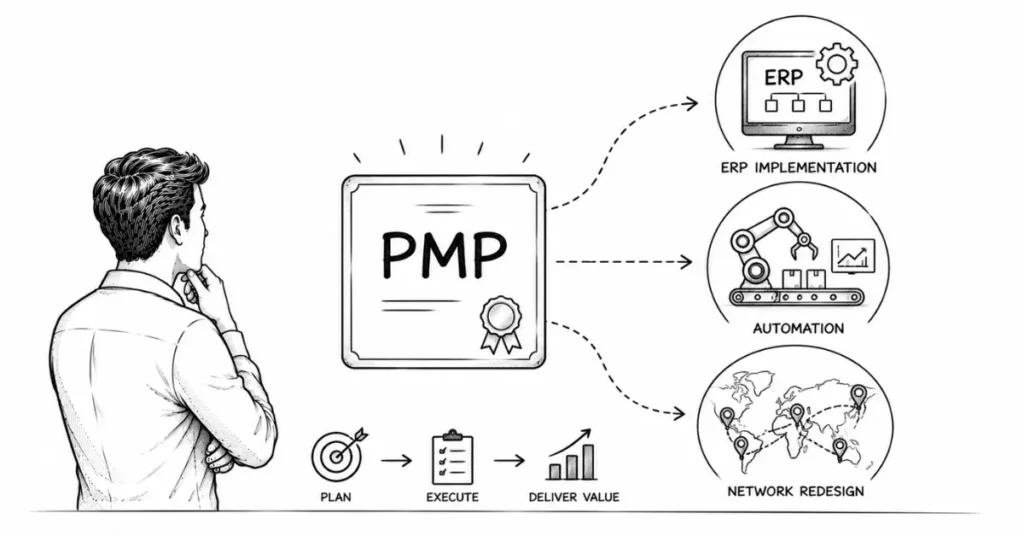
What It Is:
Global standard for project management certification by PMI (Project Management Institute).
Relevance to Supply Chain:
Not supply chain-specific, but valuable because supply chain roles increasingly involve major projects:
- ERP implementations
- Warehouse automation projects
- Supply chain network redesign
- Digital transformation initiatives
- Process improvement programs
Who Should Consider It:
- Supply chain professionals managing large projects
- Those transitioning into program management roles
- Senior managers overseeing initiatives
- Consultants leading client projects
Investment:
- PMI membership: ~$129/year (₹10,500)
- Exam fee (member): $405 (₹33,500)
- Training course: ₹15,000-50,000 (optional but recommended)
- Total: ₹35,000-75,000
Preparation:
- Requires documenting 35 hours of project management education
- Requires 4,500 hours (3 years) of project management experience OR 7,500 hours (5 years) with bachelor’s degree
- Exam: 180 questions, 230 minutes
- Pass rate: ~60-70% for well-prepared candidates
Value for Supply Chain Professionals:
PMP provides strong value if you frequently manage projects. The structured methodology helps execute complex initiatives successfully. However, it’s supplementary to supply chain expertise, not core.
6. CPSM (Certified Professional in Supply Management)
What It Is:
Procurement-specific certification by ISM (Institute for Supply Management).
Who Should Consider It:
- Procurement and sourcing professionals
- Buyer and purchasing managers
- Supplier relationship managers
Content Covered:
- Sourcing and procurement processes
- Negotiation strategies
- Contract management
- Supplier relationship management
- Category management
- Risk assessment
Investment:
- ISM membership: $225/year (₹18,500)
- Three separate exams: $395 each (₹33,000 x 3)
- Total: ~₹1.2 lakhs
- Can take exams separately over time
Value Assessment:
CPSM is highly specialized for procurement professionals. If procurement is your career path, it’s valuable. For broader supply chain roles, CSCP provides better coverage. Recognition is primarily in US; growing but still limited in India.
7. Industry-Specific Certifications
Some industries have specialized certifications:
Pharmaceutical:
- WHO-GMP (Good Manufacturing Practices): Essential for pharma supply chain
- GDP (Good Distribution Practices): For pharmaceutical distribution
Food Industry:
- FSSAI certification courses: Indian food safety regulations
- HACCP: Hazard Analysis Critical Control Points
Dangerous Goods:
- IATA DGR: Shipping dangerous goods by air
- IMO DG: Shipping hazardous materials by sea
Value: If you’re in these specialized industries, relevant certifications are often essential for compliance and career progression.
Certifications by Career Stage: What to Pursue When
Entry-Level (0-3 years):
- Priority: Focus on building practical skills over certifications
- Consider: Six Sigma Yellow Belt or Green Belt (affordable, practical)
- Avoid: APICS certifications (too early, better to wait)
Mid-Level (3-7 years):
- Priority: APICS CSCP or CPIM (depending on specialization)
- Consider: Six Sigma Green Belt or Black Belt
- Optional: PMP if managing major projects
Senior Level (7+ years):
- Priority: Complete any missing major certifications (CSCP if not done)
- Consider: Executive education programs from IIMs or international B-schools
- Optional: Specialized certifications in your focus area
Executive Level (15+ years):
- Priority: Executive leadership programs over certifications
- Optional: Maintain existing certifications for credibility
- Focus: Published thought leadership over additional credentials
The Cost-Benefit Analysis: Are They Worth It?
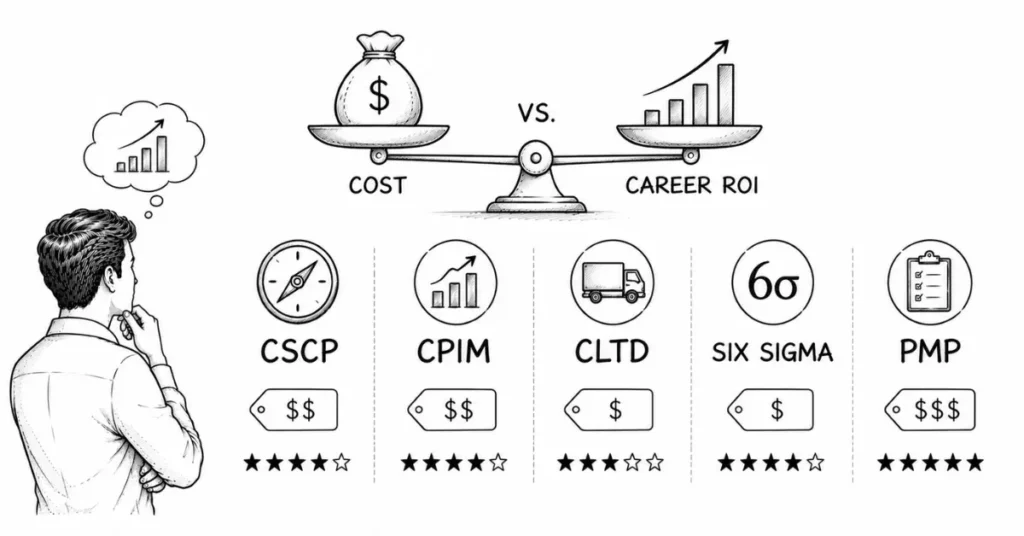
Let’s do honest math on whether certifications make financial sense:
APICS CSCP Investment:
- Cost: ₹1.1 lakhs
- Time: 150 hours study (4 months × 8 hours/week)
- Opportunity cost: ₹1.1 lakh + forgone earnings/leisure time
Potential Returns:
- Salary increase on job change: 15-20% if certification helps land better role
- If current salary is ₹10 lakhs, increase of ₹1.5-2 lakhs annually
- Break-even: Within first year if salary increases
- Long-term: Cumulative benefit over career can be ₹10-20 lakhs+
But This Assumes:
✅ You’re already employable and performing well
✅ You target companies that value certifications
✅ You leverage certification during job changes
✅ You’re not certifying instead of gaining practical experience
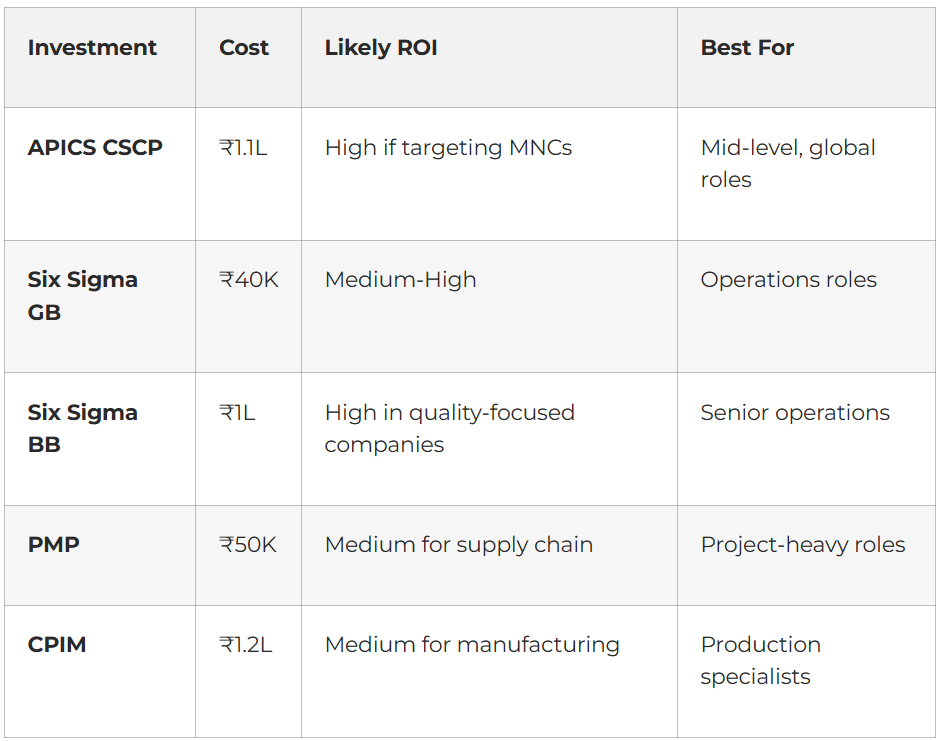
ROI Comparison:
Alternatives to Expensive Certifications
If certifications are unaffordable, consider these alternatives:
Online Courses with Certificates:
- Coursera: Supply chain specializations from top universities (₹3,000-8,000)
- edX: MicroMasters in supply chain (₹20,000-40,000)
- LinkedIn Learning: Specific skill courses (₹2,000-3,000/month)
- NPTEL: Free courses from IITs with optional paid certification (₹1,000)
Value: These won’t replace APICS recognition, but they build genuine knowledge at fraction of cost.
Employer-Sponsored Certifications:
Many companies sponsor certifications as part of professional development. Always ask if your employer will cover costs before paying yourself.
University Diplomas/Certificates:
- IIMs: Executive programs in operations and supply chain (₹1-3 lakhs)
- ISB: Executive education programs
- University certificates: Often carry more weight in India than international certifications
Free Knowledge Building:
- YouTube: Free supply chain courses and concepts
- Industry blogs and podcasts: Current trends and insights
- LinkedIn Learning: One month free trial
- Library books: APICS CSCP study guides available in libraries
How to Maximize Certification Value
If you decide to pursue certifications, maximize ROI:
Choose Strategically:
Don’t collect certifications randomly. Choose based on your career goals, industry, and target roles.
Time It Right:
Pursue certifications when preparing for job changes—that’s when they have maximum leverage in negotiations.
Leverage It Actively:
- Add to LinkedIn profile immediately
- Update resume highlighting certification
- Mention in job interviews and networking
- Join alumni groups and network
- Write posts/articles about your learning journey
Combine with Job Search:
Start job search soon after certification while knowledge is fresh and motivation is high.
Company Sponsorship:
Always explore whether employer will sponsor before self-funding. Many companies have professional development budgets.
Tax Deductions:
Professional certifications are often tax-deductible as professional development expenses. Consult with CA.
The Honest Verdict: Should You Get Certified?
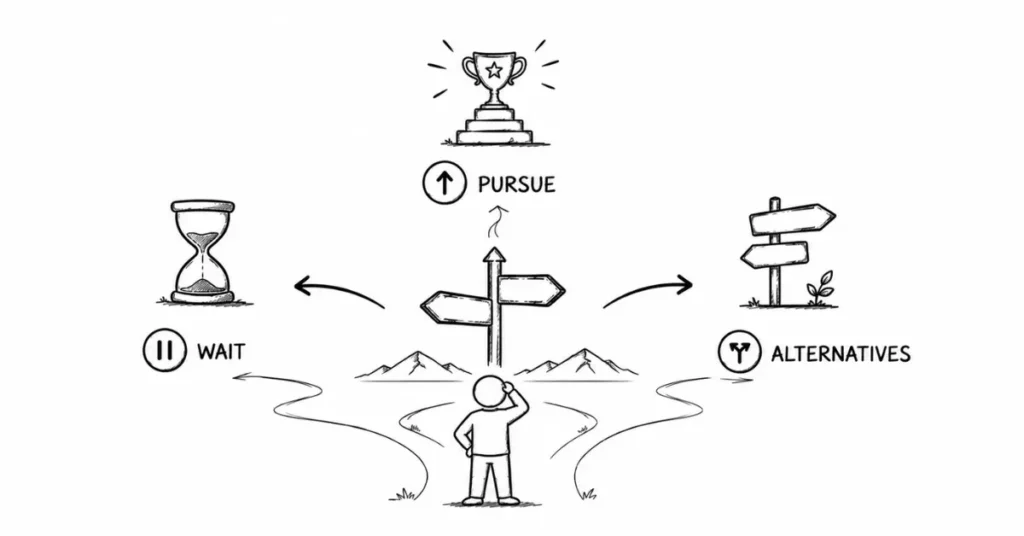
After examining costs, benefits, and Indian market reality, here’s my honest recommendation framework:
Definitely Pursue Certifications If:
- ✅ You work for or target MNCs/large companies
- ✅ You’re seeking career change and need credibility
- ✅ Your company sponsors costs
- ✅ You have 3+ years experience and solid foundation
- ✅ You’re preparing for senior management roles
- ✅ You can comfortably afford the investment
Probably Better to Wait If:
- ⏸️ You’re early career (0-2 years) without solid foundation
- ⏸️ You work for small domestic companies unlikely to recognize certifications
- ⏸️ Financial strain would result from ₹1+ lakh investment
- ⏸️ You lack practical supply chain experience
- ⏸️ Your performance in current role needs improvement
Better Alternatives If:
- 🔄 You can’t afford major certifications → Online courses and skill building
- 🔄 You’re very early career → Focus on practical experience first
- 🔄 You need immediate skill development → Shorter, practical courses
- 🔄 You’re in specialized industries → Industry-specific certifications may be better
The Bottom Line:
Certifications are valuable career accelerators for the right people at the right time, but they’re not magic bullets. Strong performance, practical skills, and demonstrated results matter more than letters after your name. Certifications work best as supplements to excellence, not substitutes for it.
If you’re already good at your job and seeking that competitive edge for the next level, APICS CSCP or relevant certifications can absolutely be worth the investment. But if you’re hoping certifications will fix performance issues or compensate for lack of experience, save your money and focus on fundamentals first.
Choose wisely, invest strategically, and remember—your skills, results, and reputation matter far more than any certification ever will.