
Educational Research Careers: PhD to Policy Pathway
Table of Contents
Part 1: Understanding Educational Research as a Career
Introduction
While most teachers focus on classroom instruction, a different breed of educators shapes learning at a systemic level—educational researchers. If you’ve ever wondered why certain teaching methods work better, how curriculum should be designed, or what policies would improve education quality, educational research is your calling.
Educational research is more than academic curiosity. It directly influences policy decisions affecting millions of students. When NCERT revises the national curriculum, educational researchers provide the evidence. When governments redesign teacher training, research data guides policy. When EdTech companies scale new learning models, research validates effectiveness.
Unlike traditional teaching with fixed salaries, educational researchers enjoy competitive compensation (₹8-50 lakhs depending on role), flexibility, intellectual stimulation, and the satisfaction of shaping education at scale. For PhD holders and academically inclined educators, this career offers stability, prestige, and genuine impact.
What is Educational Research?
Educational research is the systematic investigation of educational phenomena to understand how learning works and how education systems can be improved. It bridges theory and practice, combining scientific rigor with practical classroom insights.
Types of Educational Research:
- Quantitative Research
- Large-scale surveys and statistical analysis
- Example: “How does teacher training methodology affect student outcomes in rural schools?”
- Tools: Statistics software (SPSS, R), large datasets
- Qualitative Research
- In-depth interviews, case studies, observations
- Example: “What are students’ lived experiences with hybrid learning?”
- Tools: Interview transcription, coding software, observation protocols
- Mixed Methods
- Combines quantitative and qualitative approaches
- Example: “Measure test scores (quantitative) and understand why through student interviews (qualitative)”
- Action Research
- Teachers conduct research within their own classrooms
- Example: A math teacher testing if peer teaching improves conceptual understanding
- Impact: Directly improves teaching practice
- Policy Research
- Analyzes education policies and their effectiveness
- Example: “Does mid-day meal scheme improve attendance and learning outcomes?”
- Impact: Informs government decision-making
- Comparative Research
- Compares education systems across regions or countries
- Example: “How does India’s exam-focused approach compare with Finland’s competency-based approach?”
Key Career Roles in Educational Research
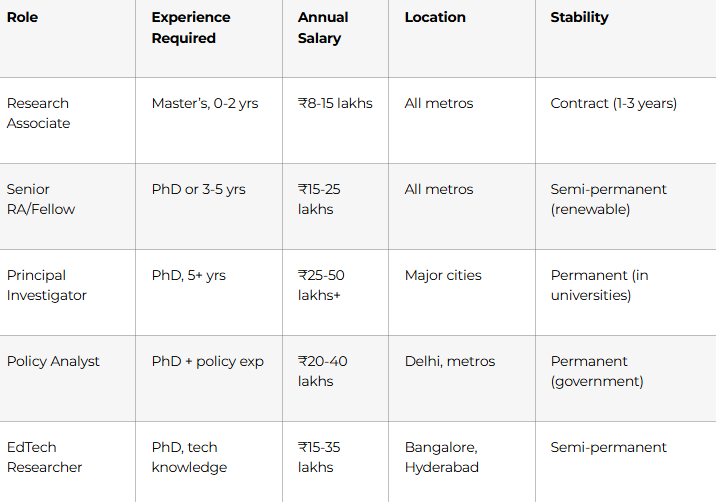
- Research Associate (Entry Level)
- Salary: ₹8-15 lakhs annually
- Experience required: Master’s degree, 0-2 years experience
- Responsibilities: Data collection, literature reviews, assisting senior researchers
- Employer types: Universities, NCERT, research institutes, EdTech companies
- Research Fellow/Senior Research Associate
- Salary: ₹15-25 lakhs annually
- Experience required: PhD or 3-5 years as Research Associate
- Responsibilities: Design studies, conduct independent research, publish papers
- Employer types: NCERT, UGC-funded universities, ICSSR
- Principal Investigator (PI)
- Salary: ₹25-50 lakhs+ annually
- Experience required: PhD + 5+ years research experience, publication record
- Responsibilities: Lead research projects, secure grants, mentor junior researchers
- Employer types: Universities, prestigious research institutes
- Policy Research Analyst
- Salary: ₹20-40 lakhs annually
- Experience required: PhD + policy research experience
- Responsibilities: Analyze education policies, provide evidence-based recommendations
- Employer types: Government think tanks, MHRD, state education departments
- Educational Technology Researcher
- Salary: ₹15-35 lakhs annually
- Experience required: Master’s/PhD + EdTech knowledge
- Responsibilities: Research learning effectiveness of new technologies
- Employer types: EdTech companies (BYJU’S, Unacademy), universities
Why Choose Educational Research?
- Intellectual Challenge
Unlike repetitive classroom teaching, research constantly presents new puzzles to solve. You design studies, analyze complex data, and generate new knowledge. - Research Leave & Flexibility
Many universities offer sabbaticals (extended research leave) every 7 years. This allows you to pursue deep, long-term projects without being tied to daily schedules. - Publishing & Prestige
Publish your findings in national and international journals. Build a personal brand as an expert. Get invited to speak at conferences. These credentials stay with you throughout your career. - Policy Influence
Your research directly shapes national education policy. A paper you publish today influences curriculum decisions affecting 10 million students next year. - Better Work-Life Balance
Unlike classroom teaching with fixed timings, research work offers flexibility. You can work from home, set your schedule (within project deadlines), and have summers relatively free. - Higher Earning Potential
Research roles pay 20-40% more than equivalent teaching positions. A professor in teaching earns ₹15-20 lakhs; a researcher earns ₹25-40 lakhs. - Job Security
Research positions in government institutions (NCERT, UGC) are permanent. Once you secure a position, you’re essentially guaranteed employment.
Real Income Breakdown
Additional Benefits:
- Publication allowance: ₹5,000-₹50,000 per published paper
- Conference travel funds: ₹2-5 lakhs annually
- Research grants: Can secure ₹5-50+ lakhs for major projects
- PhD fee reimbursement: For those pursuing concurrent doctorates
Part 2: Pathway to Educational Research Career
Prerequisites & Educational Qualifications
Minimum Requirement:
- Bachelor’s degree in any field + Master’s in Education/Psychology/Sociology
- OR PhD in Education or related discipline
Preferred Combination for Better Prospects:
Option A (Academic Path):
- Bachelor’s → Master’s in Education → PhD → Research position
Option B (Teaching + Research Path):
- Bachelor’s → B.Ed → 2-3 years teaching → Master’s in Education → Research position
Option C (Fast-Track Path):
- Bachelor’s → Integrated Master’s + PhD (5-year program) → Research position
Why Option B is often best:
You gain classroom experience (invaluable for education research) while building income. Then transition to research with credibility.
Building Research Skills Before Getting a Job
Most hiring managers look for evidence you can conduct research, not just that you have degrees.
Skills to Develop (During Master’s or Self-Study):
- Research Methods
- Qualitative methods (interviews, focus groups, case studies)
- Quantitative methods (surveys, statistical analysis)
- Mixed methods approaches
- Action research frameworks
How to learn: Enroll in online courses (Coursera, edX offer free audit), read research methodology textbooks, conduct mini-research projects
- Statistical Analysis
- Software: SPSS, R, Python, Excel
- Concepts: Descriptive statistics, t-tests, ANOVA, regression, factor analysis
How to learn: YouTube tutorials, online courses (Udemy has ₹500 courses), practice on datasets
- Literature Review & Data Management
- Tools: Zotero, Mendeley (manage research papers)
- Ability to synthesize large amounts of information
- Identify research gaps
How to learn: Practice by reviewing papers in your subject, write mini-literature reviews
- Writing & Presentation
- Academic writing style (formal, evidence-based)
- Publishing in journals (APA format)
- Conference presentations
How to learn: Write for academic journals, present at seminars, get feedback from mentors
- Technology Skills (Increasingly Important)
- Learning management systems analysis
- Educational data mining
- AI/ML applications in education
- Coding basics (Python, R)
How to learn: Specialized courses in EdTech research, online bootcamps
The PhD Decision: Do You Need One?
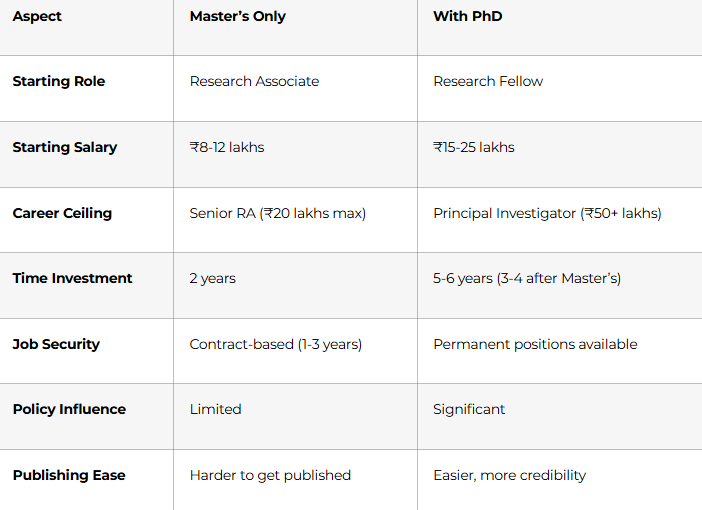
Short answer: You can get research positions with a Master’s degree, but PhD opens significantly more doors.
Master’s vs PhD Comparison:
Recommendation:
- If you want research work quickly (1-2 years): Master’s + Research Associate role
- If you want long-term career in research: Master’s → 2-3 years work → PhD → Senior positions
PhD in Education: The Investment
Duration: 3-4 years post-Master’s (full-time)
Cost:
- IIT/Central Universities: ₹0-20,000 annually (subsidized)
- Private universities: ₹2-5 lakhs annually
- Funding available: Many universities provide fellowship covering tuition + living stipend (₹10,000-₹20,000/month)
What PhD Should You Choose?
Option 1: PhD in Education
- Best for: General education career path
- Focus: Curriculum, pedagogy, teacher education, learning outcomes
Option 2: PhD in Educational Technology
- Best for: EdTech industry interest
- Focus: Technology integration, online learning effectiveness, digital pedagogy
Option 3: PhD in Educational Psychology
- Best for: Understanding student learning and behavior
- Focus: Learning theories, motivation, cognitive development
Option 4: PhD in Comparative/International Education
- Best for: Policy and global perspective
- Focus: Education systems across countries, policy analysis
Option 5: PhD in Educational Leadership/Management
- Best for: Administrative and policy roles
- Focus: School management, educational leadership, institutional policy
My recommendation for your context: PhD in Educational Technology or EdTech Research (high demand in India currently, aligns with Frontlines Edutech expertise)
Finding Research Positions: Where to Look
Top Employers of Educational Researchers in India:
Government Institutions (Most Stable):

EdTech Companies (Growing Sector):
- BYJU’S, Unacademy, Vedantu, Khan Academy India
- Roles: Learning Scientist, Educational Researcher, Research Analyst
- Salary: ₹15-35 lakhs
- Location: Primarily Bangalore, Hyderabad, Mumbai
Think Tanks & Research Organizations:
- Azim Premji Foundation (Education research focus)
- Centre for Policy Research (Education team)
- Observer Research Foundation
- Salary: ₹15-40 lakhs
International Organizations:
- UNESCO (Delhi office), World Bank, UNICEF
- Often hire Indian researchers
- Salary: ₹20-50 lakhs+ (with international allowances)
Part 3: Landing Your First Research Position & Scaling
Application Strategy
Step 1: Build Your Research Portfolio
Before applying, demonstrate research capability:
During Master’s:
- Conduct original research for your thesis
- Publish thesis findings (1-2 papers)
- Present at conferences or seminars
- Build a portfolio of research writing samples
After Master’s (If Working):
- Conduct small-scale action research in your school
- Publish findings in education journals or blogs
- Document improvement projects with data
- Create case studies of successful initiatives
Portfolio Checklist:
- 2-3 research papers (published or pre-print)
- Master’s thesis summary (5 pages)
- Research project samples showing methodology
- Recommendation letters from mentors
- LinkedIn profile highlighting research interests
Step 2: Targeted Applications
Don’t apply everywhere. Target strategically.
Tier 1 (Ideal for Fresh Research Career):
- NCERT Research Associate position
- University Research Fellowship programs
- Azim Premji Foundation Research roles
- State SCERT research positions
Application materials:
- CV (2 pages maximum)
- Research interests statement (500 words: what problems you want to solve)
- 2-3 research paper samples
- Recommendation letters (2-3)
- Application form (specific to organization)
Tier 2 (If Tier 1 doesn’t work):
- EdTech company research roles
- Private research consulting firms
- University research assistant positions (step to higher roles)
Tier 3 (Backup options):
- Part-time research consultancy
- Start your own research projects on contract basis
- Join as adjunct researcher while teaching
Pro Tip: Research positions are rarely advertised on job portals. Most are filled through:
- Direct networking with professors
- Recommendations from mentors
- Internal promotions
- Reaching out directly to research heads at organizations
Networking for Research Opportunities
Build relationships with:
University Professors: Email: “I’m interested in education research, specifically [your topic]. Would you have time for a 15-minute conversation about research opportunities in your field?”
NCERT/SCERT Researchers: Attend their seminars, ask intelligent questions, connect afterwards.
Think Tank Researchers: Follow on LinkedIn, engage with their posts, attend their webinars.
Conference Connections: Attend education research conferences (ISTES, ICAE), network, exchange contact details.
Mentorship: Identify senior researchers in your field, ask to learn from them (even unpaid initially). This often leads to paid opportunities.
Advanced Techniques for Standing Out
Research Fellow to Principal Investigator: Career Progression
Year 0-2: Research Associate
- Salary: ₹8-15 lakhs
- Responsibilities: Data collection, literature review, assist with publications
- Goal: Learn research process, publish 2-3 papers, build credentials
Year 2-5: Senior RA/Research Fellow
- Salary: ₹15-25 lakhs
- Responsibilities: Design studies independently, lead small projects, mentor junior researchers
- Goal: Publish 5-8 papers, secure small research grant (₹5-10 lakhs)
- Promotion trigger: Submit PhD (if not done), demonstrate independent research capability
Year 5-8: Principal Investigator/Senior Researcher
- Salary: ₹25-40 lakhs
- Responsibilities: Lead major research projects, secure large grants (₹20-50+ lakhs), mentor teams, influence policy
- Goal: Publish 2-3 papers yearly, lead 2-3 concurrent projects
Year 8+: Professor/Research Director
- Salary: ₹40-60 lakhs+ (with research allowances)
- Responsibilities: Set research agenda for institution, policy advisory role
- Goal: Shape education policy, develop research teams
Income Growth Example:

Monetizing Research Beyond Salary
Research Grants
- Apply to government bodies (MHRD, DST) for research funding
- Typical grant: ₹10-50 lakhs
- Timeline: 1-2 years per project
- You get overhead percentage (10-15%) as additional income
- Target: Manage 2-3 grants simultaneously = ₹3-5 lakhs extra
Consulting Projects
- EdTech companies pay ₹5-20 lakhs for research projects
- Government departments pay for policy research
- International organizations pay ₹20-50+ lakhs for studies
- Target: 1-2 consulting projects yearly
Paid Speaking & Workshops
- Universities pay ₹10,000-₹50,000 per guest lecture
- Training companies pay ₹50,000-₹2,00,000 for workshops on research
- Target: 4-6 paid speaking engagements yearly
Publishing & Royalties
- Write research-based books
- Publishers pay advances (₹2-10 lakhs) + royalties
- Example: Research book on AI in education gets ₹5 lakh advance
Combined Income Scenario (Year 8+):
- Base salary: ₹40 lakhs
- Grant overhead: ₹3 lakhs
- Consulting projects: ₹5 lakhs
- Speaking/workshops: ₹3 lakhs
- Book royalties: ₹2 lakhs
- Total: ₹53 lakhs annually
Publishing: The Currency of Research
In academia, publications are your resume. Journal papers establish you as expert and open doors.
Types of Publications:
Research Papers (Most Important)
- Published in peer-reviewed journals
- Establishes credibility
- Required for career advancement
- Typical timeline: 6-12 months from submission to publication
- Impact: ₹5,000-₹50,000 per published paper (some universities give publication incentive)
Where to publish:
High-Impact Journals:
- British Journal of Educational Psychology
- Journal of Educational Research
- Educational Research Review
- (These are international; higher prestige, longer wait times)
Indian Journals:
- Indian Journal of Educational Research
- Asia Pacific Education Review
- Indian Educational Review
- (Faster publication, good for building record)
Online Open-Access:
- Medium.com (free, reaches large audience)
- ResearchGate, Academia.edu (academic community)
- Your own blog/website
Pro Tip: For quick publication early in career, publish in Indian journals. Build track record. Then submit to high-impact international journals as you advance.
Tips for Getting Published:
- Start with your Master’s thesis (convert to 2-3 papers)
- Co-author with established researchers (higher publication probability)
- Submit to specialized journals in your niche (easier to get accepted)
- Attend conferences, get feedback on draft papers, improve before submission
- Join research networks/communities for feedback
Research Specializations Worth Pursuing
High-Demand Research Areas:
- EdTech & AI in Education
- Why: Fastest growing, well-funded, industry demand
- Salary premium: 20-30% higher
- Career opportunities: Both academia and industry
- Learning Outcomes & Assessment
- Why: Policy focus, government priority
- Salary: ₹25-40 lakhs
- Opportunities: NCERT, state boards, international orgs
- Teacher Education & Professional Development
- Why: Chronic problem in Indian education
- Salary: ₹20-35 lakhs
- Opportunities: Government, universities, NGOs
- Inclusive Education & Special Needs
- Why: Policy mandate, growing sector
- Salary: ₹18-32 lakhs
- Opportunities: Government, NGOs, international orgs
- STEM Education
- Why: Industry and government focus
- Salary: ₹22-38 lakhs
- Opportunities: Universities, EdTech, think tanks
- Educational Equity & Social Justice
- Why: International funding available, policy relevance
- Salary: ₹20-40 lakhs
- Opportunities: Think tanks, international orgs, universities
My recommendation for your context: EdTech & AI in Education (leverages your Frontlines experience, highest demand, premium salaries)
Part 4: Practical Steps to Start Your Research Career
Timeline: From Today to Research Position
If You’re Currently a Teacher:
Month 1-2: Foundation Building
- Decide on research niche (1 specific focus area)
- Take online research methods course (Coursera: “Research Methods” – free audit)
- Start reading 10 papers in your chosen field
- List 5 research questions you’re curious about
Month 3-6: Skill Development
- Learn SPSS or R (YouTube tutorials, 20-30 hours)
- Read 20+ papers in your field, write literature review (5,000 words)
- Design a small research project (can be action research in your school)
Month 6-12: First Research Project
- Conduct action research project in your classroom/school
- Collect data systematically
- Analyze and write findings
- Submit to education journal or present at conference
Month 12-18: Master’s Program
- If not done, pursue Master’s in Education or related field
- Focus on research methodology courses
- Complete thesis with original research
Month 18-24: Job Hunting
- Build portfolio with 2-3 published papers
- Network with research organizations
- Apply strategically to research positions
- Secure Research Associate position
Year 3+: Career Development
- Pursue PhD (part-time or full-time)
- Build publication record
- Climb to Senior Fellow → PI roles
Immediate Action Items (This Month)
Week 1:
- Identify 3 education research problems you’re passionate about
- Follow 5 education researchers on Twitter/LinkedIn
- Join ResearchGate and create profile
Week 2:
- Enroll in free research methods course
- Read 5 research papers in your chosen area
- Watch 3 YouTube videos on research methodology
Week 3:
- Connect with 3 researchers in your field (LinkedIn message)
- Attend 1 online education research seminar
- Write brief research proposal (500 words)
Week 4:
- Create list of 10 target organizations (NCERT, universities, EdTech companies)
- Research their research teams and publications
- Identify contact person for research roles
- Draft introduction email expressing research interest
Resources & Support
Free Online Courses:
- Coursera: Research Methods (free audit)
- edX: Statistics for Education
- YouTube: Research methodology channels
Essential Tools:
- Zotero/Mendeley (Paper management – free)
- SPSS Student Version (₹5,000 for 12 months)
- Grammarly (₹3,000 yearly for academic writing)
Communities:
- ResearchGate.net (Connect with researchers)
- Academia.edu (Share research)
- LinkedIn Research Communities (Network)
Journals to Follow:
- Educational Research Review
- Journal of Educational Research
- British Educational Research Journal
Complete Journey Summary
Educational Research Career Path:
text
Teacher/Master’s Graduate
↓ (2-3 months prep)
Research Associate (₹8-15L)
↓ (2-3 years + PhD)
Senior Research Fellow (₹15-25L)
↓ (3-5 years)
Principal Investigator (₹25-50L)
↓ (5+ years)
Research Director/Professor (₹50L+)
Key Differentiators for Success:
✅ Genuine curiosity about education problems (not just salary)
✅ Persistence with publication process (rejections are common)
✅ Networking with established researchers
✅ Specialization in high-demand research areas
✅ PhD (if you want senior positions and stability)
Final Thoughts
Educational research isn’t just a career—it’s a calling to shape education’s future through evidence. You get to answer questions that matter, influence policy affecting millions, and build a legacy beyond one classroom.
The path requires patience (PhD takes 3-4 years, publication takes 6-12 months). But the rewards—intellectual stimulation, policy influence, stable employment, and ₹50+ lakh potential—make it worthwhile.
If you’re a teacher with analytical mind, published research interests, and desire to influence education at scale, educational research is your ideal career next step.