
Commercial Real Estate Broker Career : Salary Guide
Table of Contents
Introduction
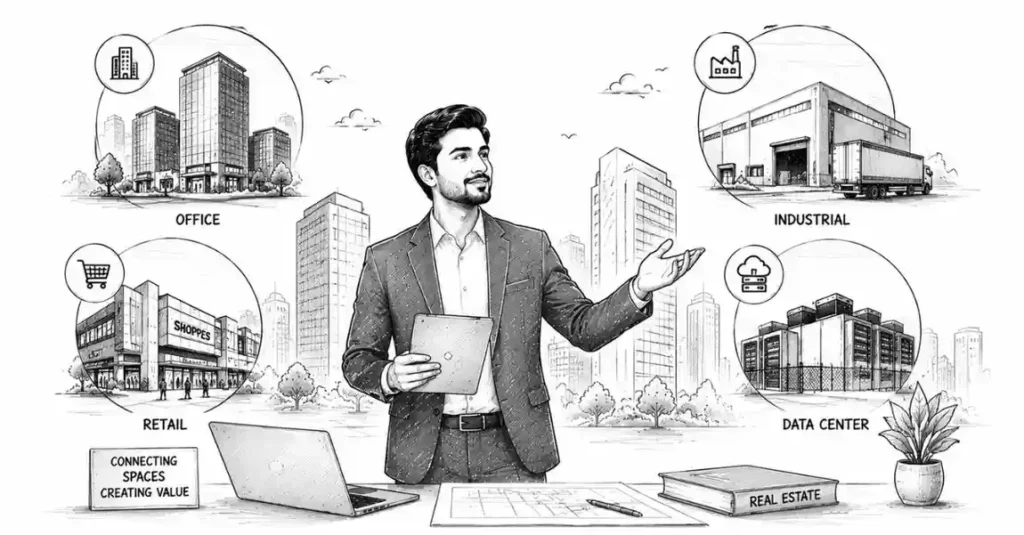
Commercial real estate represents one of the most lucrative and professionally rewarding specializations within India’s property sector. Unlike residential real estate that focuses on homes and apartments, commercial real estate encompasses properties used for business purposes including office buildings, retail spaces, industrial warehouses, hotels, healthcare facilities, data centers, and mixed-use developments. Commercial real estate professionals typically enjoy significantly higher earning potential than their residential counterparts due to larger transaction values, complex deal structures, and sophisticated client requirements.
The numbers tell a compelling story. Real estate professionals in India earn an average of ₹22.9 lakh annually, with the top 10% earning more than ₹40.9 lakh and the highest performers reaching ₹50 lakh per year. Corporate real estate specialists command even higher compensation, averaging ₹30.8 lakh annually, with ranges from ₹21.9 lakh to ₹61.3 lakh based on experience and expertise. The top 10% of corporate real estate professionals earn more than ₹50 lakh annually, and the top 1% exceed ₹61.3 lakh.
India’s commercial real estate sector is experiencing exceptional growth that creates abundant career opportunities. Global Capability Centres (GCCs) drive 35-40% of office space demand with projections of 50-55 million square feet of leasing between 2025-2027. Data centers present explosive growth with capacity expected to reach 1,800 MW by 2026 and over 4,500 MW by 2030, requiring USD 20-25 billion in investments. These massive projects create consistent demand for commercial brokers, leasing professionals, investment advisors, and transaction specialists.
This comprehensive guide explores everything you need to build a successful commercial real estate career in India, from understanding the fundamental differences from residential real estate through mandatory licensing requirements, the prestigious CCIM designation, specialized knowledge areas, realistic earnings expectations, and proven strategies for establishing yourself in this high-stakes, high-reward profession.
Understanding Commercial Real Estate
What Distinguishes Commercial from Residential
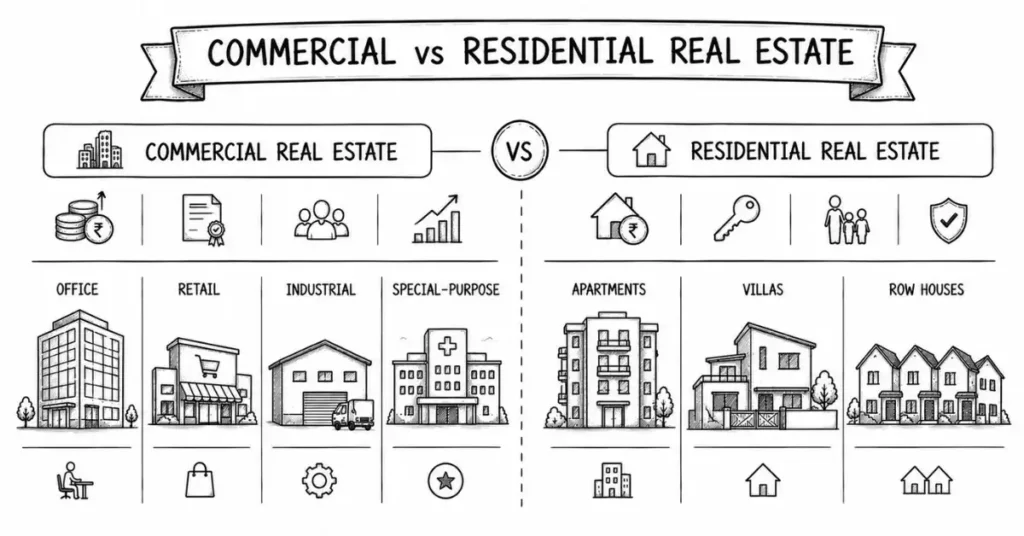
Commercial real estate differs fundamentally from residential in multiple dimensions that shape career requirements and opportunities.
Property types and purposes: Commercial properties serve business functions rather than personal living. Office buildings house corporate operations, professional services, coworking spaces, and business centers. Retail properties include shopping malls, standalone stores, restaurant spaces, and entertainment venues. Industrial properties encompass warehouses, manufacturing facilities, distribution centers, logistics hubs, and cold storage facilities. Special-purpose properties include hotels, hospitals, educational institutions, data centers, and entertainment complexes.
Transaction scale and complexity: Commercial deals typically involve much larger values—often crores to hundreds of crores compared to residential transactions of lakhs to a few crores. This scale creates higher earning potential but also demands greater expertise. Deal structures are more sophisticated, involving complex lease agreements, tenant improvement allowances, percentage rent arrangements, triple-net leases, and intricate financing structures.
Client sophistication: Commercial clients are typically businesses, investors, REITs, or high-net-worth individuals making analytical financial decisions rather than emotional ones. They evaluate properties based on return on investment, capitalization rates, cash flow projections, location analytics, and strategic business alignment. This requires brokers to demonstrate financial acumen, market expertise, and strategic advisory capabilities beyond what residential transactions demand.
Lease terms and relationships: Commercial leases typically span 3-9 years compared to residential leases of 11 months to 1 year in India. These longer commitments create revenue stability but also higher stakes for both landlords and tenants. The landlord-tenant relationship is more businesslike and contractual, with sophisticated service level agreements, maintenance responsibilities, and performance metrics.
Market analysis requirements: Commercial real estate requires understanding business considerations like foot traffic patterns for retail, workforce availability for offices, transportation logistics for industrial, zoning regulations and permitted uses, infrastructure requirements (power, water, telecom, internet), environmental considerations and regulations, and economic indicators affecting business demand.
Core Commercial Property Types
Office real estate encompasses corporate headquarters, business parks, coworking spaces, professional services buildings, and shared office centers. Office brokers need to understand workforce demographics, transportation connectivity, amenity expectations, technology infrastructure requirements, and flex space trends. Tenant requirements vary dramatically from startups seeking flexible terms to multinational corporations requiring long-term stability and substantial space.
Retail real estate includes shopping malls, high street retail, neighborhood shopping centers, standalone stores, food and beverage spaces, and entertainment venues. Retail specialists must understand consumer demographics, foot traffic analysis, anchor tenant dynamics, parking requirements, visibility and signage considerations, and omnichannel retail trends affecting physical space demand.
Industrial real estate covers warehouses, distribution centers, manufacturing facilities, logistics hubs, cold storage, and flex industrial space. Industrial agents possess deep expertise in loading dock capacities, clear ceiling heights (crucial for racking systems), power requirements for operations, transportation network access (highways, ports, rail), zoning laws for industrial use, and supply chain logistics. These technical considerations are critical for industrial clients but less relevant for other property types.
Data centers represent one of the fastest-growing commercial segments in India, requiring specialized knowledge of power infrastructure (often measured in megawatts), cooling and HVAC systems, network connectivity and fiber access, security and redundancy requirements, and regulatory compliance for data sovereignty. This technical niche offers exceptional opportunities through 2030 as India’s digital infrastructure expands.
Licensing and Educational Requirements
RERA Registration for Commercial Brokers
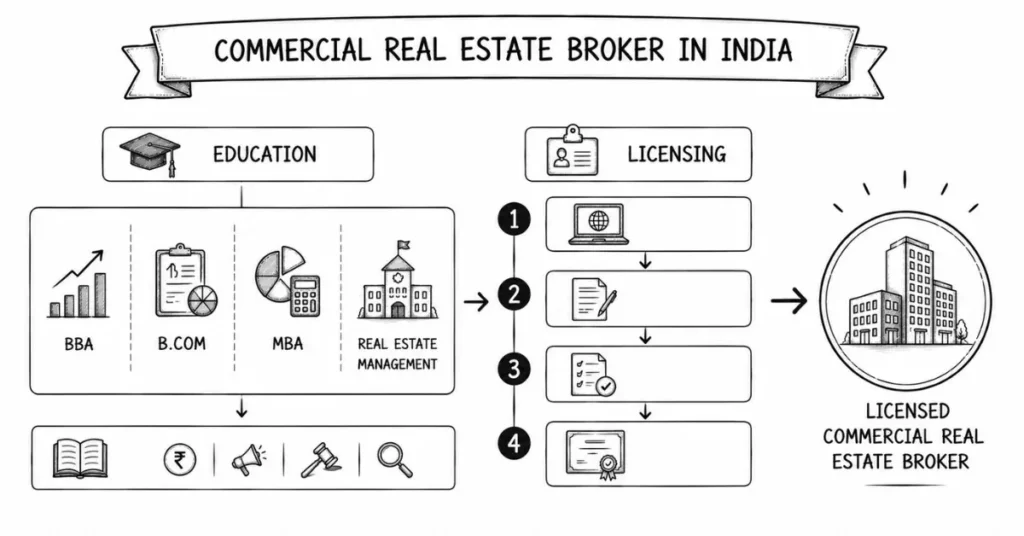
In India, to work as a commercial real estate broker or agent, you typically need to obtain RERA registration. You accomplish this by applying through your state RERA authority, taking a short course (one or two days), and paying a small fee to take the exam.
Although you may not plan to do any transactions directly, having the license makes you more legitimate and allows you more flexibility in your career. The RERA registration process for commercial agents mirrors that for residential agents, requiring minimum age of 18 years, educational qualifications of 10th or 12th grade completion, RERA training program completion, passing the Certificate of Competency exam, online application through your state RERA portal, and payment of registration fees (₹5,000-₹25,000 depending on state).
RERA registration is valid for five years, requiring periodic renewal. Your registration number must be displayed in all property dealings and advertisements, establishing professional credibility and legal authorization to practice.
Educational Backgrounds
While RERA provides legal authorization, commercial real estate rewards certain educational backgrounds that provide analytical foundations and business acumen. Business and finance degrees including BBA, MBA, BCom, or degrees in finance, economics, or accounting provide financial modeling skills, understanding of business operations, analytical thinking capabilities, and professional communication abilities highly valued in commercial transactions.
Real estate-specific education through specialized real estate management programs, property management degrees, or commercial real estate certificates offers focused industry knowledge. Engineering and architecture degrees particularly benefit those pursuing industrial or special-purpose property specializations, providing technical understanding of building systems, construction processes, and space planning.
However, successful commercial careers are ultimately built more on market knowledge, relationship skills, analytical abilities, and transaction experience than on specific degrees. Many top commercial brokers come from diverse educational backgrounds, succeeding through dedication to continuous learning and professional development.
The CCIM Designation: Gold Standard Credential
Understanding CCIM
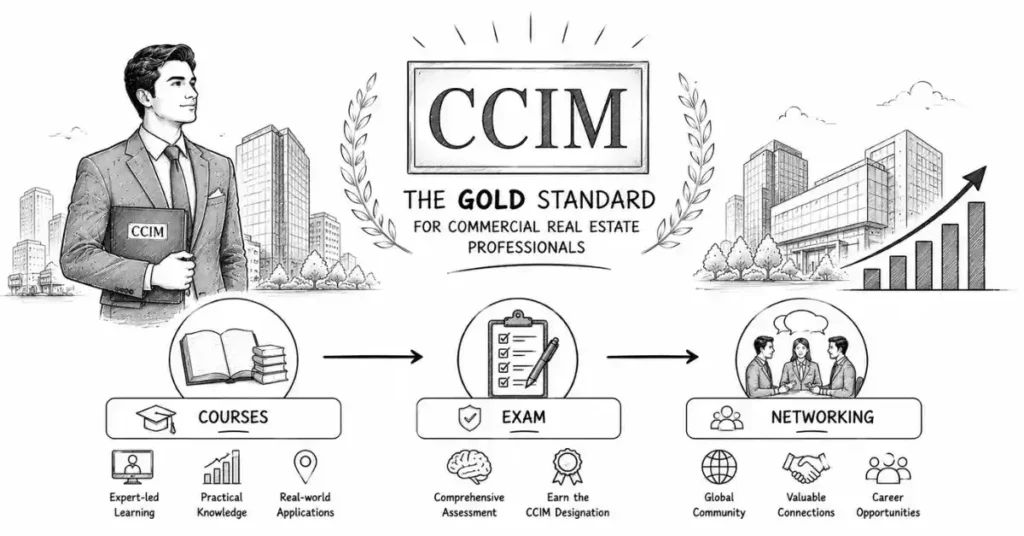
CCIM stands for Certified Commercial Investment Member, a prestigious credential awarded by the CCIM Institute to distinguished professionals in the commercial and investment real estate industry. This designation signifies advanced expertise across key domains including financial and market analysis, investment strategy, user-decision modeling, negotiation, and ethical business practices.
The CCIM Institute has been the leader in educating and equipping professionals in commercial real estate for over 50 years. As most commercial real estate investors instantly recognize the CCIM designation, it is important for any broker looking to expand their business into the commercial industry to familiarize themselves with the term.
CCIM designees are recognized as leading experts in commercial real estate, forming an elite network of professionals including brokers, leasing professionals, investment counselors, asset managers, appraisers, corporate real estate executives, property managers, developers, institutional investors, commercial lenders, attorneys, and bankers. To further enhance your credentials in commercial real estate, consider soliciting certifications such as RERA Certification (especially in India), Certified Commercial Investment Member (CCIM), and SIOR (Society of Industrial and Office Realtors).
CCIM Requirements and Process
To earn the CCIM designation, professionals must complete several rigorous requirements:
Experience requirement: You must have two years of experience in commercial real estate. This ensures candidates possess practical foundations before pursuing advanced designation.
Portfolio of qualifying experience: You must provide a portfolio ensuring your fulfillment of volume experience, demonstrating a minimum level of transaction volume or activity. This documents that you’re actively practicing commercial real estate, not merely studying it theoretically.
Core coursework: Complete four rigorous core courses covering financial analysis, market analysis, user-decision analysis, and investment analysis, plus ethics and negotiation modules. These courses provide comprehensive education in the analytical frameworks, valuation methodologies, and strategic thinking essential for commercial investment real estate.
Comprehensive examination: Pass a comprehensive final exam, often preceded by a Course Concepts Review, testing your mastery of all course content and ability to apply knowledge to complex scenarios.
Professional membership: Maintain membership in good standing with both the CCIM Institute and the National Association of REALTORS®.
The CCIM designation process typically requires 1-2 years to complete depending on your pace through coursework, examination preparation, and experience documentation. The investment includes course fees (typically $2,000-$4,000 USD or approximately ₹1.6-3.2 lakh), examination fees, Institute membership, and time commitment for study and preparation.
CCIM Benefits and Career Impact
The CCIM credential delivers substantial career benefits that justify the investment. Professional credibility: The designation instantly signals expertise to clients, investors, and industry peers, opening doors that might otherwise remain closed to non-designated professionals. Enhanced analytical skills: The rigorous coursework genuinely improves your ability to perform financial modeling, market analysis, investment evaluation, and strategic advisory, making you more valuable to sophisticated clients.
Network access: CCIM membership connects you with over 13,000 designees globally, creating referral opportunities, partnership possibilities, mentorship relationships, and deal flow access. Higher earning potential: While specific salary premiums vary, CCIM designees typically command higher commissions, fees, and compensation than non-designated peers due to their demonstrated expertise and credibility with high-value clients.
Career advancement: The designation positions you for senior brokerage roles, investment advisory positions, asset management opportunities, and corporate real estate leadership that require advanced commercial real estate expertise.
Essential Skills for Commercial Real Estate Success
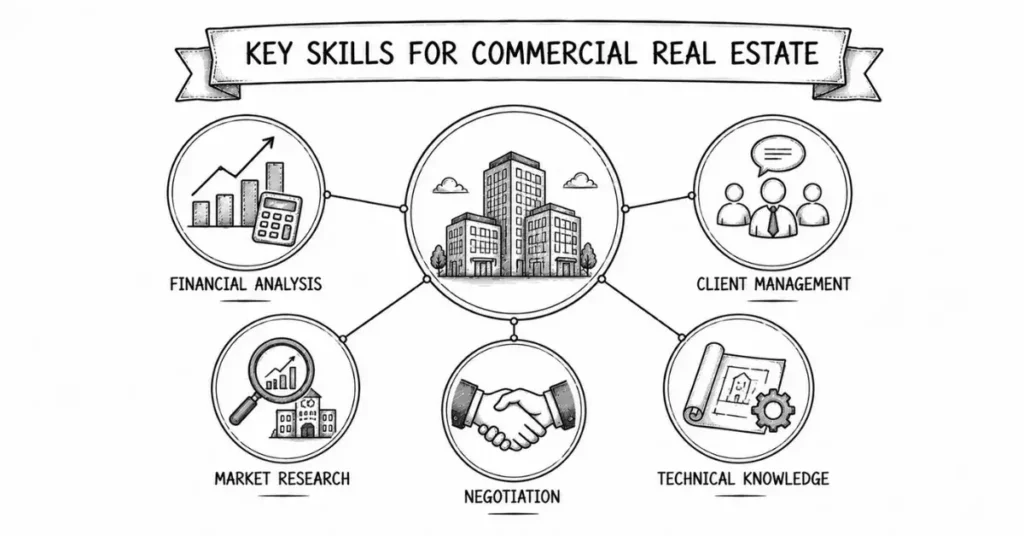
Financial Analysis and Modeling
Commercial real estate demands strong financial acumen that goes beyond residential transaction understanding. Capitalization rate (cap rate) analysis helps you evaluate property values by dividing net operating income by purchase price, understanding how cap rates vary by property type, location, quality, and market conditions, and advising clients on appropriate cap rate expectations for different risk profiles.
Cash flow analysis requires projecting rental income over lease terms, estimating operating expenses accurately, calculating net operating income (NOI), projecting cash flow after debt service, and performing sensitivity analysis showing how assumptions impact returns. Return metrics including Internal Rate of Return (IRR), Net Present Value (NPV), cash-on-cash return, and equity multiple help clients evaluate investment opportunities comparatively.
Lease versus buy analysis helps corporate clients decide whether to lease or purchase facilities by comparing financial outcomes over relevant time horizons. Proficiency in these financial concepts requires Excel modeling skills, understanding of discounting and time value of money, awareness of financing structures and terms, and ability to explain complex financial concepts clearly to clients.
Market Research and Analysis
Commercial brokers must be market experts, continuously tracking supply and demand dynamics, absorption rates and vacancy trends, rental rate movements and concessions, new construction and development pipelines, economic indicators affecting commercial demand, demographic and workforce trends, and competitive property positioning.
Technology platforms: Expertise with platforms like CoStar, LoopNet, REIS, or similar commercial real estate data services provides market intelligence, comparable transactions, available properties, and analytical tools essential for professional practice. These specialized databases are industry standards that serious commercial brokers must master.
Negotiation and Deal Structuring
Commercial transactions involve sophisticated negotiations covering not just price but lease terms and duration, tenant improvement allowances, rent escalation clauses, expense pass-throughs and operating cost sharing, renewal options and expansion rights, early termination provisions, and exclusivity or use restrictions.
Complex contract expertise: Ability to prepare, review, and understand complex commercial lease agreements, purchase agreements, and related legal documents is essential. While attorneys handle final legal review, brokers must understand deal structures sufficiently to negotiate effectively and advise clients competently.
Client Relationship Management
Commercial real estate is fundamentally relationship-driven, with deals often taking months or years from initial contact to closing. Relationship cultivation: You must cultivate and maintain relationships with property owners, investors, and potential tenants to understand their commercial real estate needs. This requires patience, consistent communication, genuine value provision beyond immediate transactions, and long-term relationship perspective.
CRM proficiency: Competency with customer relationship management systems (e.g., Salesforce, HubSpot) for lead tracking and client management helps you organize complex, long-term relationships and ensure consistent follow-up.
Specialized Technical Knowledge
Each commercial property type demands specific expertise. Industrial specialists must understand zoning and land use regulations specific to industrial uses, environmental considerations including Phase I/II environmental assessments, loading dock specifications and turning radii for trucks, clear ceiling heights and floor load capacities, power requirements (voltage, amperage), HVAC considerations for different uses, and logistics and supply chain factors.
Office specialists need to understand space planning and efficiency ratios, parking ratios and transportation access, building classification (Class A, B, C), technology infrastructure and connectivity, amenity expectations by tenant type, and sustainable building certifications (LEED, IGBC).
Retail specialists require knowledge of trade area analysis and demographics, traffic counts and visibility, parking and accessibility, tenant mix and synergies, anchor tenant requirements, and omnichannel retail trends.
Commercial Real Estate Career Path

Entry Strategies
Join established commercial brokerage firms providing training, market knowledge transfer, client access, transaction mentorship, and professional infrastructure. Major firms like CBRE, JLL, Colliers, Cushman & Wakefield, Knight Frank, and Anarock offer structured analyst and associate programs for ambitious professionals.
Specialize from the start: Rather than positioning yourself as a generalist, consider specializing early in office, retail, industrial, or specific geographic markets. Specialization accelerates your expertise development and market positioning.
Research analyst pathway: Some professionals enter commercial real estate through research analyst positions providing market intelligence, financial modeling support, and analytical services. This builds strong foundations before transitioning into client-facing roles.
Career Progression
Analyst/Associate (0-3 years): Entry-level roles earning ₹6-12 lakh annually, supporting senior brokers with market research, financial modeling, property tours, and client communications. This foundation-building phase develops market knowledge and professional skills.
Broker/Agent (3-7 years): Independent brokers managing their own client relationships and transactions, earning ₹15-30 lakh through commissions on closed deals. Success depends on building client base, closing capabilities, and market reputation.
Senior Broker/Team Leader (7-15 years): Experienced professionals with established client relationships and transaction track records, earning ₹30-50 lakh annually through personal production and potentially team overrides. CCIM designation typically achieved during this career stage.
Principal/Managing Director (15+ years): Senior leaders overseeing practice areas or offices, earning ₹50 lakh to ₹1 crore+ through combinations of personal production, team overrides, equity stakes, and leadership compensation.
Specialization Paths
Investment sales: Focus on representing buyers and sellers in property acquisition and disposition transactions, requiring strong financial analysis skills, investor relationships, market knowledge, and deal negotiation abilities.
Tenant representation: Specialize in representing corporate tenants seeking office, retail, or industrial space, requiring understanding of business operations, space planning, lease negotiation, and market intelligence.
Landlord representation/leasing: Represent property owners in leasing space to tenants, requiring property marketing, tenant qualification, lease negotiation, and property positioning expertise.
Corporate services: Work in-house for corporations managing their real estate portfolios, earning salaries averaging ₹30.8 lakh with ranges from ₹21.9 lakh to ₹61.3 lakh, providing strategic real estate advice, transaction execution, portfolio optimization, and cost management.
Income and Earnings Potential
Compensation Structures
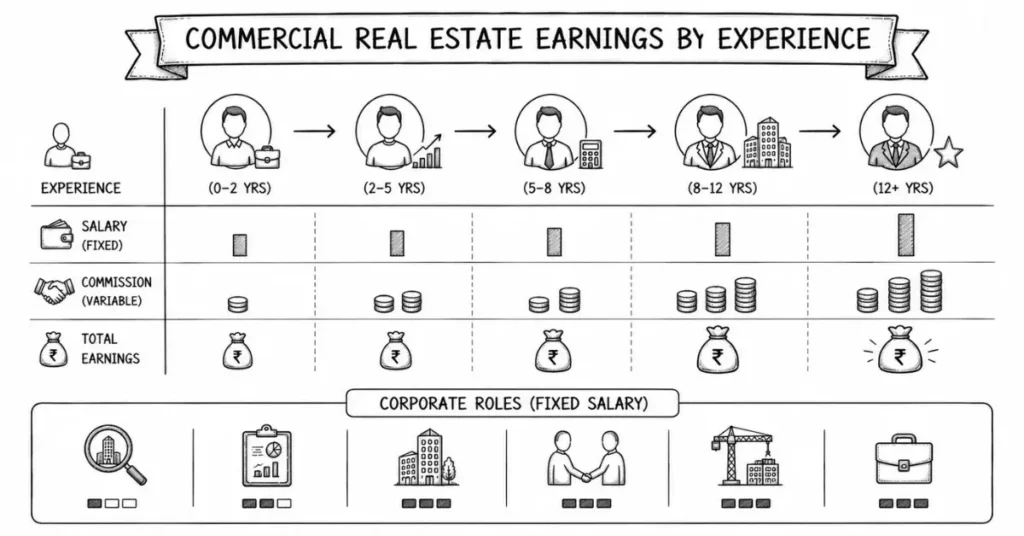
Commercial brokers typically earn through commission-based structures ranging from 2-6% of transaction value depending on property type, deal complexity, and market norms. On a ₹10 crore office lease transaction at 3% commission, the total commission is ₹30 lakh. This may be split between tenant and landlord brokers, with individual agents sharing portions with their firms.
Salary plus commission: Some firms offer base salaries (₹8-15 lakh) plus commission on transactions, providing income stability especially for newer brokers while maintaining performance incentives.
Salary-based corporate roles: Corporate real estate positions offer salaries averaging ₹30.8 lakh with less income variability than pure commission structures.
Earnings by Experience
Entry-level (0-3 years): ₹6-12 lakh annually through base salaries or modest commission earnings while building market knowledge and client relationships.
Mid-career (3-7 years): ₹15-30 lakh annually as you close independent transactions and establish market presence.
Experienced (7-15 years): ₹30-50 lakh annually through consistent deal flow, repeat clients, and possibly team production.
Senior/Top performers (15+ years): ₹50 lakh to ₹1 crore+ annually through high-value transactions, team leadership, and established reputations. The top 1% of corporate real estate professionals exceed ₹61.3 lakh annually.
Launching Your Commercial Real Estate Career
Step-by-Step Action Plan
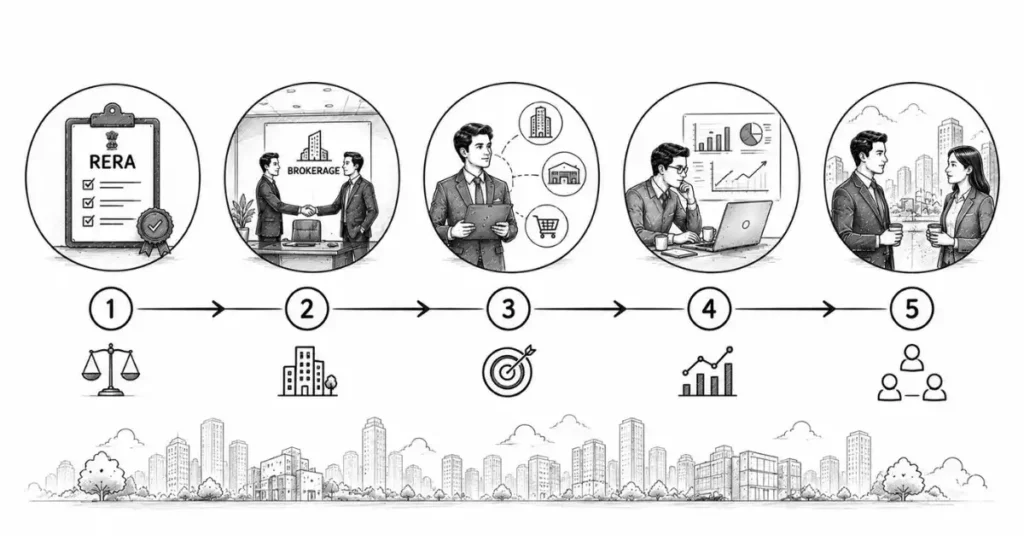
Step 1: Obtain RERA registration through your state authority, completing required training and examination. This provides legal authorization and professional credibility.
Step 2: Join a commercial brokerage firm or specialized commercial practice providing training, mentorship, market access, and transaction opportunities. Research firms carefully, evaluating their market position, training quality, compensation structures, and growth opportunities.
Step 3: Choose your specialization based on market opportunities, personal interests, educational background, and firm strengths. Commit to becoming an expert in your chosen segment rather than remaining a generalist.
Step 4: Develop financial and analytical skills through courses, certifications, and practical application. Master Excel financial modeling, understand commercial real estate metrics, and learn market analysis tools like CoStar.
Step 5: Build market knowledge systematically by tracking market reports, touring properties regularly, attending industry events, connecting with market participants, and studying comparable transactions.
Step 6: Pursue CCIM designation after gaining 2+ years of experience to differentiate yourself and demonstrate expertise.
Step 7: Build your professional network through industry associations (CCIM Institute, SIOR, RICS India), client relationships, broker peer groups, and complementary professionals (attorneys, architects, lenders).
Frequently Asked Questions
Is commercial real estate more difficult than residential? Commercial requires greater financial sophistication, longer sales cycles, more complex negotiations, and higher client expectations. However, it offers higher earnings potential, more sophisticated work, and often more interesting transactions for analytically-minded professionals.
Do I need the CCIM designation to succeed? No, it’s not mandatory. However, CCIM significantly enhances credibility, skills, network access, and earning potential, making it highly valuable for serious commercial real estate careers.
Can I transition from residential to commercial real estate? Yes, many successful commercial brokers started in residential. The transition requires building commercial market knowledge, developing financial analysis skills, understanding different client needs, and possibly accepting income reduction initially while establishing commercial credibility.
How long before earning substantial income? Commercial real estate typically requires 2-4 years before earning consistent substantial income, longer than residential due to longer transaction cycles. Initial years focus on market learning, relationship building, and closing first transactions.
What’s the work-life balance like? Commercial generally offers better work-life balance than residential since business clients operate during business hours. However, deal intensity periods can still require extended hours and weekend work.
Conclusion

Commercial real estate careers offer exceptional earning potential, sophisticated professional work, intellectual challenge, and the satisfaction of advising businesses and investors on significant financial decisions. The specialization rewards analytical thinking, financial acumen, market expertise, relationship building, and strategic advisory capabilities.
Your journey begins with RERA registration establishing legal authorization, continues through joining established commercial firms providing training and market access, and advances through continuous learning, specialization, relationship building, and potentially CCIM designation. The commercial brokers who build lasting success combine technical expertise with genuine client service, ethical practice, long-term relationship perspective, and commitment to remaining market experts.
Take your first step today—obtain RERA registration, research commercial brokerage firms in your market, connect with practicing commercial brokers for informational interviews, or begin building the financial analysis skills essential for commercial success. Your commercial real estate career awaits.