
CCNA vs CCNP vs Nokia NRS : Which Cert Should You Get?
Table of Contents
CCNA vs. CCNP vs. Nokia NRS
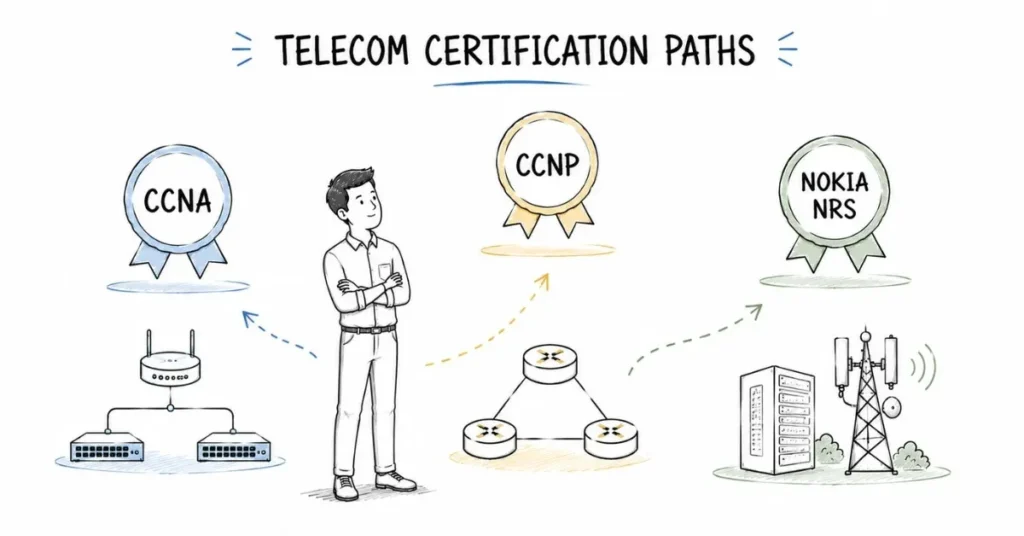
This is one of the most common questions in Indian telecom forums, WhatsApp groups, and LinkedIn comments. Students and working professionals debate it constantly and most of the advice they get is either oversimplified (“just do CCNA first”) or so generic it applies to no one specifically.
This post gives you a proper answer. It breaks down each certification on what actually matters cost, time, difficulty, which roles it unlocks, and what salary movement you can realistically expect. Then it tells you, based on your specific situation, which one to go for first.
Quick Overview: What Each Certification Is
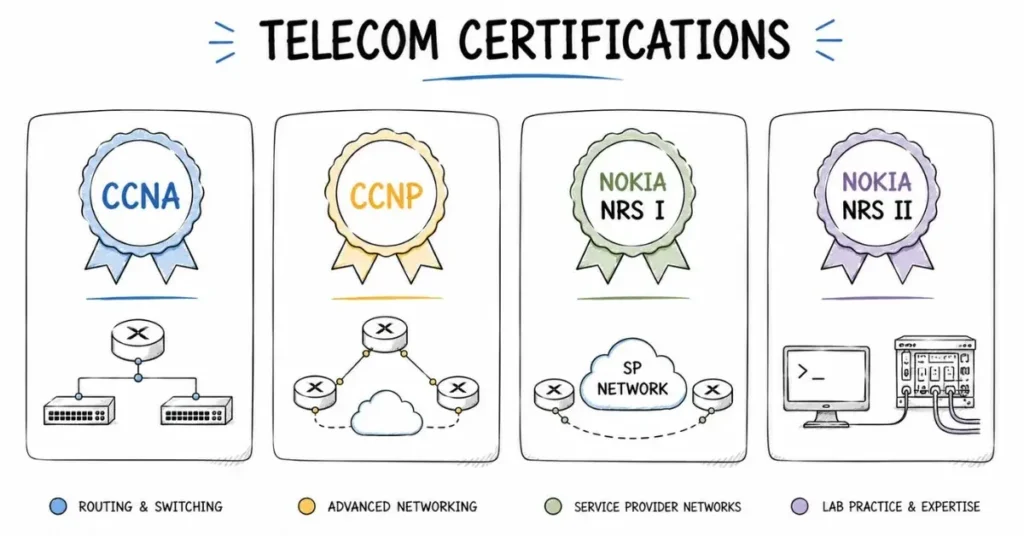
Before comparing, understand what each one is at a foundational level.
CCNA (Cisco Certified Network Associate) Cisco’s entry-level networking certification. One exam (200-301), covers networking fundamentals across routing, switching, security basics, wireless, and automation. Vendor-specific to Cisco, but the concepts it teaches (IP addressing, routing protocols, network troubleshooting) are universally applicable.
CCNP (Cisco Certified Network Professional) Cisco’s professional-level certification. Requires two exams: one core exam and one concentration exam. Concentrations relevant to telecom include Service Provider (SP), Enterprise, and Security. Significantly more advanced than CCNA — it demands deep technical mastery, not just foundational understanding.
Nokia NRS I (Network Routing Specialist I) Nokia’s entry-level routing certification. Covers IP and Ethernet fundamentals, routing protocols (OSPF, IS-IS), MPLS tunnelling, and VPN services — all on Nokia’s SR OS platform. Designed as the entry point for Nokia’s Service Routing Certification (SRC) program.
Nokia NRS II (Network Routing Specialist II) Nokia’s professional-level routing certification. Three written exams plus a 3.5-hour practical lab exam. Covers advanced IP/MPLS, MPLS services, and Nokia-specific architecture in depth. The lab component makes it genuinely rigorous — comparable in effort to CCIE, according to practitioners who hold both.
Head-to-Head Comparison
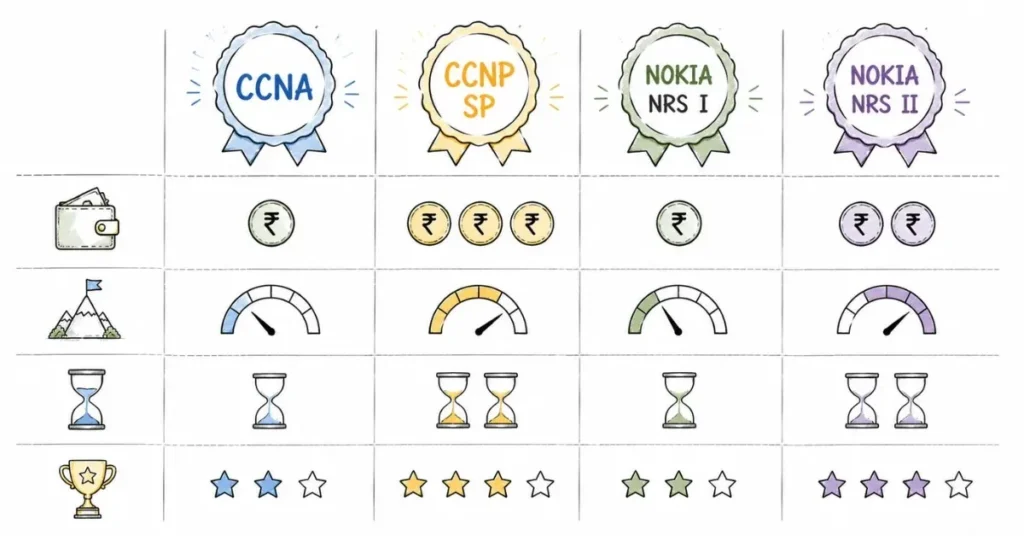
Factor | CCNA | CCNP SP | Nokia NRS I | Nokia NRS II |
Level | Entry | Professional | Entry | Professional |
Number of Exams | 1 | 2 (Core + Concentration) | 1 | 3 written + 1 lab |
Exam Cost | ~₹25,200 ($300) | ~₹58,800 ($700 total) | ~₹10,500 ($125) | ~₹60,000+ ($700+ written + €650 lab) |
Study Time | 3–5 months | 4–6 months | 2–3 months | 12–18 months |
Difficulty | Moderate | High | Low–Moderate | High |
Prerequisite | None | None (CCNA recommended) | None | NRS I recommended |
Vendor | Cisco | Cisco | Nokia | Nokia |
India Recognition | Very high — 78% of network job postings | High — senior/specialist roles | Moderate — Nokia-centric environments | High — Nokia-specific senior roles |
Salary at Entry Level | ₹3L–₹6L | ₹6L–₹12L | ₹3L–₹5L | ₹8L–₹15L |
Practice Tool | Cisco Packet Tracer (free) | GNS3 / CML | Nokia MySRLab (paid) | Nokia MySRLab (paid) |
The Honest Difficulty Comparison
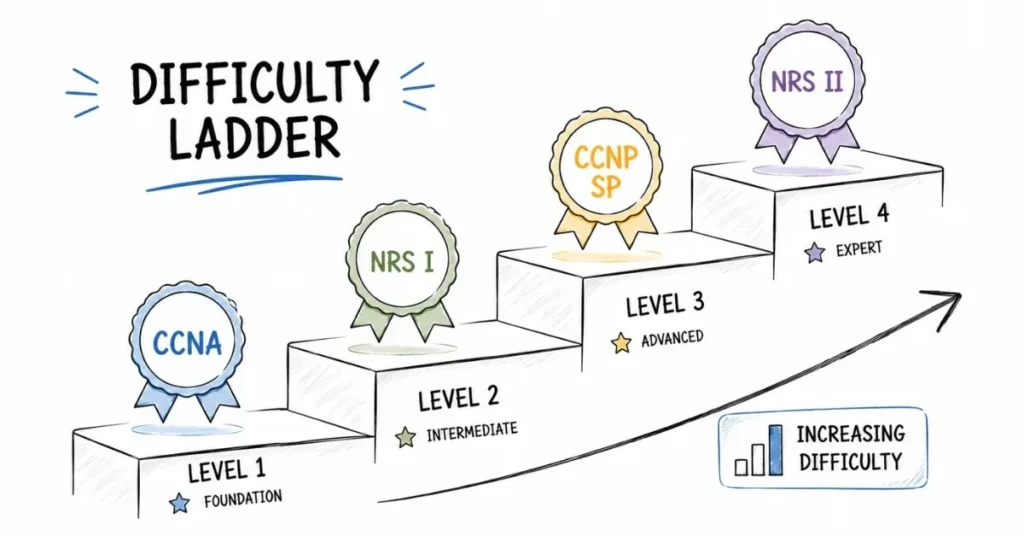
This matters because many students either underestimate CCNA or overestimate NRS I.
CCNA: Moderate difficulty. The content spans multiple networking domains — routing, switching, wireless, security, and automation. None of it is extremely deep, but the breadth means you need to be genuinely comfortable across all areas. The exam has scenario-based questions and drag-and-drop simulations, not just multiple choice. Most candidates who put in consistent effort (1–1.5 hours per day for 3–4 months) pass on the first attempt.
Nokia NRS I: Low to moderate difficulty — noticeably easier than CCNA in practice. One experienced professional who holds both described NRS I as closer to CCENT (Cisco’s old entry-level exam, which was a subset of CCNA) than to CCNA itself. The Nokia-specific command syntax is different from Cisco — that takes adjustment if you are coming from a Cisco background — but the conceptual depth is lower than CCNA.
CCNP Service Provider: A significant jump from CCNA. The core exam (SPCOR) tests deep service provider networking — OSPF, IS-IS, BGP, MPLS, Segment Routing, IPv6, and network automation. The concentration exam goes deeper into a specific area. Candidates typically need 4–6 months of dedicated study after gaining some practical experience.
Nokia NRS II: The most demanding of the four, largely because of the lab exam. The 3.5-hour practical exam requires you to configure Nokia routing equipment in real time, under time pressure, without reference material. This is not a certification you pass by studying hard for a few months — it requires genuine operational experience on Nokia equipment. Most candidates hold NRS II after several years of working in Nokia environments.
Salary Impact in India — The Real Numbers
Here is what verified salary data and real-world accounts say about the financial impact of each certification in India:
CCNA:
Freshers with CCNA typically enter at ₹3–7 lakh, compared to ₹2–3.5 lakh without it. Working professionals with 1–2 years of experience who add CCNA often jump from ₹3–5 lakh to ₹7–12 lakh when switching to network-focused roles at IT services companies like TCS, Infosys, Wipro, and HCL.
CCNP Service Provider:
Professionals with 4–6 years of experience and CCNA who upgrade to CCNP SP typically see a jump from ₹10–14 lakh to ₹20–30 lakh when moving to product companies or MNCs. This is one of the highest-ROI certification moves in Indian telecom for mid-career professionals.
Nokia NRS I:
By itself, NRS I does not move salaries dramatically in India — its recognition is narrower than CCNA. However, it is a strong add-on certification for candidates already in Nokia environments, or those who plan to follow the Nokia SRC track through to NRS II.
Nokia NRS II:
At the senior level where NRS II matters, salary ranges are ₹18–35 lakh for specialists in Nokia IP routing. The certification rarely moves entry-level salaries on its own — its value is unlocked when it sits on top of years of Nokia operational experience.
The Cisco vs. Nokia Ecosystem Question
One of the most important factors in choosing between Cisco and Nokia certifications is simply: which equipment does the company you want to work for actually use?
In India’s telecom market:
- Jio — uses Samsung and Ericsson for 5G RAN; uses a mix of vendors for core and IP networking
- Airtel — uses Nokia and Ericsson for 5G RAN; Nokia IP routing equipment for transport
- Vodafone Idea (Vi) — uses Nokia and Ericsson; Nokia IP backbone
- BSNL — Cisco-heavy IP network alongside Nokia deployments
- IT services companies (TCS, Tech Mahindra, Wipro) — manage multiple operators’ networks; both Cisco and Nokia environments exist
- ISPs and enterprise networks — predominantly Cisco
The practical implication: CCNA is the safer starting bet if you do not yet know which company you want to join, because it applies more broadly. Nokia certifications are the stronger bet if you are specifically targeting Airtel, Vi, or Nokia’s own professional services team.
Which Should You Get First? A Decision Framework
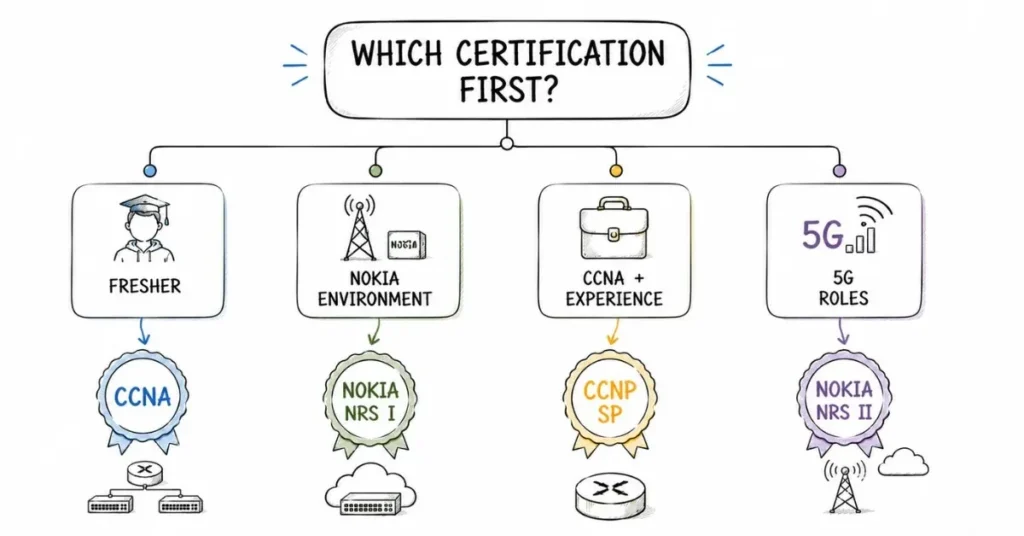
Rather than one generic answer, here is a decision based on your specific situation:
You are a fresher with no job yet:
→ Start with CCNA.
CCNA has the broadest recognition across Indian telecom. It is the standard screening filter for the largest number of network and telecom roles. Whether you end up at a Cisco shop, Nokia shop, or a managed services company running both, CCNA gives you a foundation that applies. Nokia NRS I is a reasonable second certification after CCNA if your role turns out to be Nokia-heavy.
You are already working in a Nokia environment:
→ Start with Nokia NRS I, then work toward NRS II.
If you are configuring Nokia SR OS routers daily, CCNA teaches you Cisco concepts that are not directly relevant to your work. Nokia NRS I validates the skills you are already building. NRS II is then your medium-term target — the lab component is demanding, but if you are working with Nokia equipment regularly, the preparation happens naturally through your work.
You have CCNA and 2–3 years of experience:
→ Go for CCNP Service Provider.
This is the biggest salary-impact move for mid-career telecom professionals in India. The jump from CCNA to CCNP SP moves you from ₹10–14 lakh roles to ₹20–30 lakh roles when you switch to a product company or MNC. It opens architect and senior engineer roles that CCNA simply cannot reach. The 4–6 months of additional study is worth it.
You work with both Cisco and Nokia equipment (common in managed services):
→ CCNA first, then Nokia NRS I as a parallel track.
In managed services companies like Tech Mahindra or Ericsson’s delivery centres, both equipment types appear in client environments. Having both CCNA and NRS I makes you more versatile and signals to employers that you can handle multi-vendor environments.
You want to fast-track into 5G-specific roles:
→ CCNA + Nokia 5G Associate or Nokia 5G RAN Professional.
CCNA gives you the networking foundation. The Nokia 5G certification gives you the 5G domain knowledge. Together, they make you a much stronger candidate for 5G deployment and integration roles than someone with only one or the other.
Can You Skip CCNA and Go Directly to CCNP?
Technically, yes. Cisco removed the formal prerequisite for CCNP in 2020 — you can attempt CCNP without holding CCNA.
Practically, it is a bad idea for most candidates.
CCNP assumes you already understand what CCNA teaches. If you have not mastered subnetting, OSPF fundamentals, switching concepts, and basic troubleshooting methodology, you will struggle significantly with CCNP content. The candidates who successfully skip CCNA typically have 2–3 years of hands-on networking experience already — they know the concepts, they just never sat the entry-level exam.
If you have that experience, skipping CCNA and going directly to CCNP is a legitimate time-saving move. If you are a fresher or have limited networking exposure, start with CCNA.
Study Resources Comparison — What You Actually Need
One of the practical differences between Cisco and Nokia certification paths is the quality and accessibility of study material.
For CCNA:
The study ecosystem is extensive. Jeremy’s IT Lab on YouTube is one of the most complete free CCNA courses available — covering every exam topic with clear explanations and Packet Tracer labs. Boson ExSim practice exams (approximately ₹4,000) are the gold standard for exam simulation. Cisco NetAcad’s free courses cover the theory. You can fully prepare for CCNA spending ₹5,000–₹7,000 total (exam fee aside).
For Nokia NRS I:
The study ecosystem is smaller but well-structured. Nokia publishes an official self-study guide. IPCisco.com offers structured NRS I lessons aligned to the exam blueprint. Nokia’s MySRLab lets you practice on virtual Nokia SR OS equipment — this is important because Nokia’s command syntax is meaningfully different from Cisco’s, and you need hands-on time with it. MySRLab access costs money but is genuinely necessary for proper preparation.
For CCNP SP:
Preparation is more expensive. Official Cisco Press books are the standard. INE (ine.com) and CBT Nuggets offer video courses at ₹15,000–₹30,000 per year. You need lab access — Cisco’s Modeling Labs (CML) or a cloud-based lab environment. Total preparation cost (materials + labs, exam fee excluded) typically runs ₹20,000–₹40,000.
For Nokia NRS II:
Nokia’s official training materials and MySRLab are the primary resources. Given the lab exam component, there is no shortcut — you need extensive hands-on time on Nokia equipment. Most candidates preparing for NRS II are already working in Nokia environments, which gives them daily practice through their jobs.
The Bottom Line
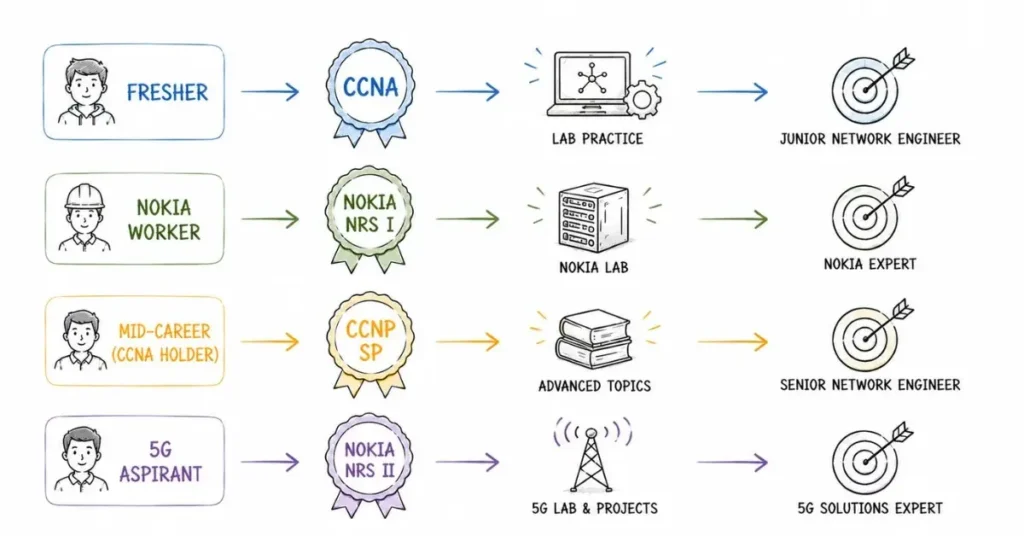
Stop overthinking this decision. Here is the clean answer for the majority of Indian telecom candidates:
If you have zero experience and no job yet: CCNA. Start this week.
If you have a job in a Nokia environment: NRS I now, NRS II in 18–24 months.
If you have 3–5 years and CCNA: CCNP SP. This is your biggest salary lever right now.
If you are targeting 5G deployment roles: CCNA + Nokia 5G Associate. Both, in that order, within 8–10 months.
The worst outcome is spending six months researching which certification to do while doing neither. The telecom job market rewards people who act, not people who plan indefinitely.
Pick the one that fits your situation from the framework above and start today.